>>> TradeGate Pre-Market Indications

DAX:
  • RWE (RWE TH) +1%
  • Allianz (ALV TH) -0.2%
    • Pimco Ranks as 2022’s Biggest Loser in $6.5 Trillion ETF Arena
MDAX:
  • TAG Immobilien (TEG TH) +1.9%
SDAX:
  • Grenke (GLJ TH) +3.1%
    • Grenke 4Q Factoring New Business Vol EU212.7M Vs. EU191.8M Y/y
  • PNE AG (PNE3 TH) +1.4%
  • Ceconomy (CEC TH) +1.3%

>>> Europe : Brokers Upgrades & Downgrades - 4th of January 2023

>>> Up
* ABN AMRO GDRs Raised to Outperform at Exane; PT 17 euros
* Celanese Raised to Outperform at RBC; PT $125
* Equinor Raised to Buy at SpareBank; PT 390 kroner
* Indivior PT Raised to 2,655 pence from 2,305 pence at Jefferies
* Lufthansa Raised to Reduce at AlphaValue/Baader
* McDonald's Raised to Buy at President Capital Management

>>> Down
* Boston Beer Cut to Underperform at Jefferies; PT $275
* Capricorn Energy Cut to Hold at Jefferies
* CVS Group Cut to Hold at Jefferies; PT 2,060 pence
* Elisa Cut to Sell at Handelsbanken
* Goldman Sachs Cut to Peerperform at Wolfe
* Heineken Raised to Equal-Weight at Barclays; PT 90 euros
* KBC Group Cut to Underperform at Exane; PT 65 euros
* Kimberly-Clark Cut to Hold at Jefferies; PT $139
* Lions Gate Cut to Market Perform at Barrington Research
* Morgan Stanley Cut to Underperform at Wolfe; PT $92
* National Beverage Cut to Underperform at Jefferies; PT $38
* SNP Schneider-Neureither Cut to Hold at Berenberg
* UPM-Kymmene Cut to Hold at Jefferies; PT 39 euros
* Volvo Cut to Neutral at Oddo BHF; PT 200 kronor

>>> Initiation
* Air Products Rated New Hold at Baptista Research; PT $325
* PayPal Rated New Outperform at CICC; PT $94.35
* Royal Unibrew Rated New Overweight at Barclays; PT 600 kroner
* Telia Rated New Sell at Citi; PT 23 kronor
* Zoetis Rated New Buy at Baptista Research; PT $196.40
* Weibo ADRs Rated New Outperform at CICC; PT $25

>>> Call
* Apple Cut to Neutral at Exane on Concerns Over Growth Outlook
* Futures Positioning Reflecting Bearish Tilt, Citi’s Montagu Says
* MS Defensive in Business/Education Services, Raises TransUnion
* Telia Rated New Sell at Citi as ‘Sobering Reset’ Approaches
* Pulp Supply Seen Ahead of Demand by Jefferies, Cuts UPM-Kymmene

>>> What to look at today - 4th of January 2023

Hong Kong shares led gains across Asian equity markets Wednesday and US and European stock futures rose in a sign of growing risk appetite. The dollar retreated against major currencies and the yen strengthened. The Hang Seng index traded more than 2% higher to levels not seen since July, helped by a jump of as much as 8% for Alibaba Group Holding Ltd. shares following news that Ant Group Co., in which the e-commerce giant holds a stake, won approval to raise $1.5 billion for its consumer unit. Gains in Hong Kong’s benchmark index accelerated after news Chinese officials were considering further support for property developers. Shares in mainland China edged higher and equity benchmarks in Australia and South Korea rose. European equity futures gained alongside contracts for the S&P 500 after the US index fell in Tuesday trade. Japanese equities ran against the grain to fall about 1%. The offshore yuan rose to the highest level since July and the dollar fell against all G-10 currencies, led by the Australian dollar, in a further signal of investor support for the Chinese economy. The yen inched higher following efforts by the Bank of Japan to depress yields on government debt.  Recession concerns lingered, with former New York Federal Reserve President William Dudley saying that an imminent slowdown won’t be severe while investors continue to mull the impact the central bank’s tightening will have on the economy. They’ll be paying attention to the jobs report this week, as softening in the labor market remains the Fed’s focus. The focus on China followed fledgling signs Covid infections may have peaked in some of its biggest cities. Anecdotal evidence showed the country remained in the grip of the pandemic with crematoriums overwhelmed in large cities such as Shanghai. US After Hours SGH +7% higher on earnings; VERA -60.7% falls on trial data

Nikkei -1,45% Hang Seng +2,50% CSI +0,02% Shanghai +0,10% Shenzen -0,06%

Eur$ 1,0568 CNH 6,8932 CNY 6,8889 JPY 130,95 GBP 1,1986 CHF 0,9337 RUB 73,0500 TRY 18,7318 WTI$ 76,71 Gold 1845 BTC 18,865 ETH 1,249

S&P +0,12% Nasdaq +0,27% EuroStoxx +0,21% FTSE +0,23% Dax +0,24% SMI

Macro :
- Pound’s Outlook Dims as BOE Takes Dovish Crown From BOJ
- Hedge Fund Debuts in Biggest Launch Led by a Woman

Keep an eye on :
- ATVI US : FTC Says No Settlement Talks Underway on Microsoft-Activision
- AIR FP : Boeing Is Seen Topping 737 Delivery Goal After December Surge
- BAKKA NO : Bakkafrost 4Q Total Harvest 24,400 Tons
- BT/A LN : BT to Take Stake in Drone Superhighway Pioneer Altitude Angel
- ALCAR FP : Carmat: First Implementation of Aeson Artificial Heart in Study
- DIC GY : DIC Asset Achieves 2022 Target for Notarized Disposals
- EXPN LN : Credit-Reporting Firms Face More US Scrutiny as Complaints Jump
- GLJ GY : Grenke 4Q Factoring New Business Vol EU212.7M Vs. EU191.8M Y/y
- ICAD FP : Icade Refinances €200M Debt, Gets €525M Credit Line
- MRN FP : Mersen Gets Contract for EV Battery Part That May be Worth €200M
- NOVOB DC : Novo Nordisk Says Obesity Drug Shortage Is Resolved
- PSH NA : Pershing Square Holdings Dec. Net Performance -4.2%
- SLIGR NA : Sligro FY Sales Beats Estimates
- STMN SW : Straumann Names Adecco’s Weder as Interim CFO
- TRI FP : Trigano 1Q Revenue EU782.3M Vs. EU786.8M Y/y
- UCG IM : UniCredit Mulls €20m Offer for Italy’s Fintech Credimi: MF
- VPK NA : Vopak, Hydrogenious LOHC Technologies to Start Hydrogen JV

FT : Bonds will rebound but investors need more diversification

Bonds will rebound but investors need more diversification
Alternatives, such as infrastructure funds, have potential

The year 2022 was challenging for investors, both in the UK and internationally. Markets gyrated on news of Russia’s invasion of Ukraine, Chinese domestic policy, and Britain’s brief experiment with Trussonomics.

The dominant narrative driving markets throughout the year was central banks’ efforts to tame runaway inflation. The stagflationary environment of slowing growth and high inflation for much of the year hurt both equities and bonds. But it was bonds that suffered most, a result of the sharp rise in interest rates.

As things stand, UK government bonds — gilts — have returned one of their worst-ever years. And this is even after a recovery from the lows following Kwasi Kwarteng’s “mini” Budget.


However, we expect bonds to have a much better year in 2023. Inflation in the UK, as well as the US and Europe, looks set to fall considerably next year. Major central banks, including the Bank of England and, most importantly, the US Federal Reserve, will slow the breakneck pace of interest rate rises and will at some point stop hiking altogether.

This should allow bonds to perform much better than last year. What is more, high quality bonds should offer some protection to investors’ portfolios if equities come under pressure again next year.

The traditional 60/40 portfolio (where three-fifths of a portfolio is invested in equities with the rest into bonds) has been extremely successful in recent decades because equities and bonds have acted as diversifiers for each other through the economic cycle.

This relationship broke down in 2022. But the peak of inflation and soon interest rates means that bonds should once again provide diversification for riskier assets.

For equities, though, the outlook is not so rosy. The economic situation in the UK is extremely precarious. The UK and Europe are already in recession and we expect the US will soon follow suit. British consumers are already feeling the pinch of higher energy bills and this will only get worse, even with the announced government intervention. And with mortgage rates surging, the housing market, a key driver of sentiment in the UK, is likely to come under pressure this year.

UK equities have the benefit of being extremely cheap. However, the multitude of economic problems that the UK faces make us hesitant to recommend them though they may still outperform other regions due to cheaper valuations. On a broader level, even with more clarity on the direction of inflation and interest rates, we think a cautious approach to investing is prudent for now.

Investors should consider a lower than usual equity weighting and a higher than usual government bond weighting in their portfolios for the time being.

That said, we have a positive view of China. Strict Covid rules are being relaxed there, which should boost growth by the latter half of 2023. In addition, over the medium term, we think that US/China decoupling is here to stay. However, the extreme views surfacing as a result of Russia’s invasion of Ukraine are likely to be assessed more practically given China’s critical role in the global financial and economic system.

Goodbye, 60/40?
The resurgence of bonds could prove short lived, however. Although inflation will come down from its recent highs next year, we believe that the average level of inflation and interest rates is likely to be higher in future than in the previous decade.

Savers might welcome a 4 to 5 per cent interest rate on their cash accounts after years of virtually no interest payments at all. But the reality is that higher inflation and an end to the ever-declining interest rates of the past 40 years will lower the real returns of fixed-income assets such as cash and bonds.

The 60/40 portfolio has been a mainstay of investing for decades. While we believe it still has its place, the higher inflation world we are entering means investors should consider making alternative assets, such as real estate, infrastructure, and private equity and credit, a more significant part of their holdings given their different sensitivity to inflation.

For example, infrastructure projects often have guaranteed inflation-linked revenue streams.

Many institutional investors have already taken steps to enhance their portfolios by allocating funds to alternative assets, seeking to benefit from the uncorrelated and sometimes superior returns they can provide. Our analysis of some of the world’s largest pension funds found that some hold as much as a third of their assets in illiquid alternatives.

Many have also chosen to limit their government bond allocations to the minimum acceptable regulatory level, given the weak long-term real returns they are expected to provide.

For retail investors, access to private markets is harder. However, there are many alternative investment trusts listed on public exchange in which to park capital, including real estate and infrastructure, as well as some more niche areas such as shipping and music royalties.

Given the large range of options and the benefits alternative assets can provide, it is perhaps now appropriate to consider if a 50/30/20 of equity/fixed income/alternatives mix might be superior to a traditional 60/40 portfolio for some investors, especially those with long investment horizons.

We expect government bonds to play an important role in portfolios in 2023, both in terms of return and protection. But in the higher average inflation world which lies ahead, investors will be rewarded for thinking outside the box.

Salman Ahmed is global head of macro and strategic asset allocation at Fidelity International

(ZH) Michael Burry: "US Is In Recession, Fed Will Cut And Will Cause Another Inf

Michael Burry: "US Is In Recession, Fed Will Cut And Will Cause Another Inflation Spike"

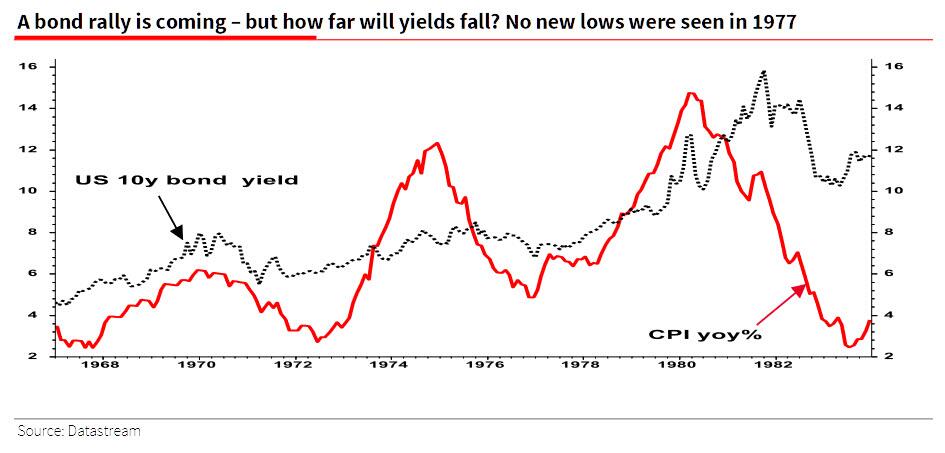
In the waning days of 2022, one of the most bearish (and accurate, at least as far as last year was concerned) strategists, SocGen's resident permabear Albert Edwards, laid out what he thinks will be the big surprise of 2023, which will be "a return to deflation fears as headline CPI inflation drops close to, or likely below zero. Investors are already anticipating recession and have an unusually strong preference for bonds."
Edwards' also expects that while the current recession and collapse in commodity prices will also cause headline inflation to collapse, core inflation will abate too but remain sticky around 3% due to residual wage-price inflation (justifying the inevitable change in the Fed's target).
Which, to Edwards, sets us up for the worst possible scenario: a second wave of inflation, just like we saw in the 1970s under the Burns Fed, to wit: "any decline will be purely a cyclical phenomenon rather than a full-blown return to the Ice Age theme" and as a result, "investors have not yet discounted a second secular wave of inflation as we eventually exit this unfolding recession – ie the Great Melt."
While Edwards is hardly alone in calling for a recession and a deflationary reversal of current soaring prices, following by an even more brutal inflationary wave as Powell reveals he was not Volcker by Burns all along, overnight another bearish icon repeated the exact same sequence of events.
Tweeting late on Monday, Scion Capital's Michael Burry, aka "the Big Short" said that while inflation has peaked, it is likely to pick up again in response to the coming stimulus which will be unleashed to offset the painful 2023 recession.
“The US in recession by any definition,” Burry tweeted on Sunday, echoing Albert Edwards verbatim, adding that "Fed will cut and government will stimulate. And we will have another inflation spike.”
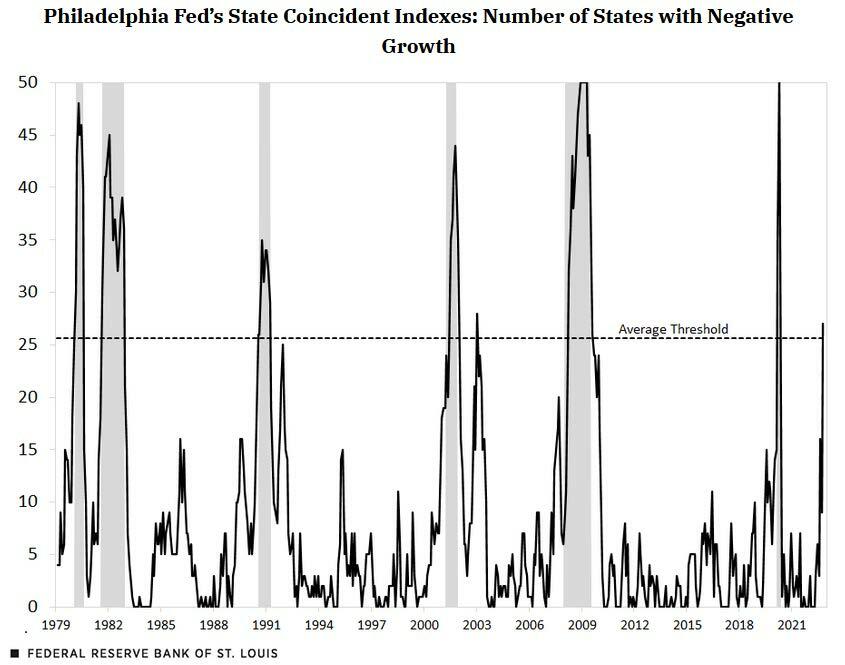
Burry is certainly right about the US being in a recession, especially now that more than half of US states have negative growth, a threshold that has always led to recessions in the past...
... the last, missing piece is the BLS admitting the US labor market is in freefall and now that even the Philadelphia Fed has opened up the pandora's box over rigged jobs data, it is only a matter of weeks if not days before the Dept of Labor admits it made a "mistake."
Where Burry is wrong is in expecting a government, or fiscal, stimmy. With Congress now divided at least until 2024, one can kiss any major, multi-trillion injection goodbye until after the next presidential election (absent a war with China of course). Which means the only stimulus for the next 24 months will have to come from the Fed, i.e., monetary, and thus will stimulate risk assets far more than the economy.
This was Burry's latest warning since September, when the S&P tumbled to its 52-week lows, and when the Big Short predicted more pain for the stock market, saying “we have not hit bottom yet.” However, the weeks following the September dump saw stocks briefly soar into a bull market amid a powerful short squeeze expect a Fed pivot; it remains to be seen if stocks will take out
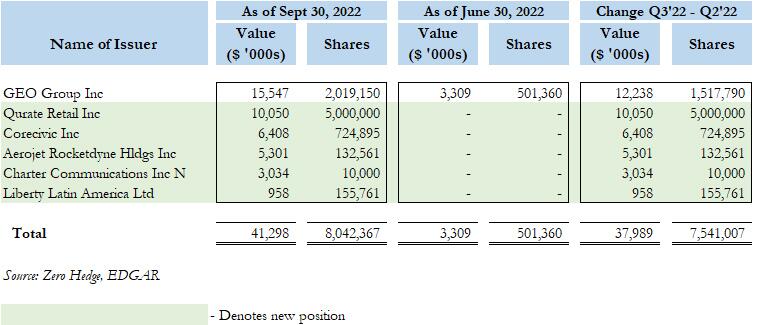
In the second quarter, Burry put his money where his mouth is, as his firm dumped all of its equity exposure besides one company. One quarter later, Burry was back in the market, adding to his GEO Group stake and opening new positions in 5 companies as we discussed at the time.

FT : Chip designer Arm targets car market for growth

Chip designer Arm targets car market for growth
SoftBank-owned company battles Intel and MIPS in auto sector as it prepares for blockbuster listing

Chip designer Arm has more than doubled revenue at its automotive business since 2020 as the UK-headquartered company seeks new avenues for growth ahead of a hotly anticipated public listing this year.

Dennis Laudick, vice-president of automotive go-to-market at Arm, said the pace of the segment’s growth — to power everything from electrification to advanced driver assistance systems (ADAS) and in-vehicle “infotainment” — had been faster than its other divisions such as smartphones and data centres.

That is because modern cars require a greater amount of chips, which are also more expensive than ever before. It is one of the few parts of the chip sector that is expected to suffer from severe shortages throughout this year because of strong demand.

“A high-end car is approaching one of the most complex pieces of software you can have in the world at the moment,” Laudick told the Financial Times. “It’s basically a data centre on wheels.”

Arm’s total revenues grew 35 per cent in 2022 to £2.7bn. The SoftBank-owned company does not disclose specific figures, but said revenue from its automotive business increased fivefold over the past four years.

Its concerted push into supplying an industry rapidly turning to electric vehicles and driverless capabilities will be crucial to the plans drawn up by SoftBank’s billionaire chief Masayoshi Son for Arm’s return to the public markets this year through a blockbuster New York listing.

Investors will be sizing up whether Arm, which has profited hugely from providing the chip designs found in most of the world’s smartphones, can continue to achieve growth.

It faces stiff competition from rivals like Intel, MIPS and Synopsys, which are also battling to build the most efficient and powerful intellectual property for chipmakers in an industry that is evolving quickly.


“The semi industry has been doing well in giant spurts of growth and now all of the chip companies are chasing the next high,” said Jay Goldberg, an analyst at D2D Advisory. “The automotive market is crucially important, and no one has won that yet.”

SoftBank’s Son announced in November that his exclusive focus from now on would be the chip designer. “I’ll be thinking about the business opportunity for Arm — the source of my energy, the source of my happiness, the source of my excitement,” he said.

SoftBank, which has owned Arm since 2016, has retrenched to a more defensive strategy after recording $10bn of losses in the past quarter.

Arm had now captured around 85 per cent of the global market for in-vehicle “infotainment”, and 55 per cent in ADAS, Laudick said. All of the top 15 automotive chipmakers, including Nvidia, STMicroelectronics and Renesas, use designs licensed by Arm.

However, the company faces much stiffer competition on chips for functions like sensors and body control.

While Arm has made significant inroads developing IP for chips used in data centres in recent years, it is the automotive market — which already contain dozens of concealed computers that have an insatiable appetite for increasingly advanced chips — that Arm is focusing its attention on most acutely.

Some high-end vehicles contain more than 100mn lines of code, with fully autonomous vehicles expected to reach half a billion by the end of the decade — compared with a Boeing 747 aircraft that contains about 14mn.

The average value of semiconductors per car is forecast to rise from $700 in 2020 to $1,138 by 2028, according to S&P Global Mobility.

“Even traditional automotive applications need a quantity of silicon much higher than in the past,” said Marco Monti, president of automotive at European chipmaker STMicroelectronics, speaking at the company’s capital markets day last year.

Monti said that automotive chip demand was accelerating rapidly, even as demand for cars themselves remained flat, adding that full electrification would add around $1,000 in the value of semiconductors to each vehicle and could require up to five times more chips.


As cars have progressed from being predominantly large boxes of hardware to complex agglomerations of software, powering everything from steering to entertainment, Arm has rapidly increased its investment in software engineering.

In 2016, the company invested around 75 per cent of its engineering resources in hardware, with 25 per cent on software. Today, it says the split is 50:50.

Arm is increasingly giving automotive chipmakers such as STMicroelectronics and Nvidia the ability to play around with different types of designs before they buy a licence, as a way to familiarise them with its products and capture customers in a competitive market.

This strategic manoeuvring is central to the company’s ability to attract and retain customers across its business, given that some of its most nimble competitors — including companies offering a rival open source alternative to Arm called Risc-V — allow engineers to tinker with their IP.

Not all chipmakers have been won over. Mobileye, an autonomous driving company that was spun out of Intel in October and has 70 per cent of the market for cameras used in driver-assist technology, uses IP developed by MIPS, based on Risc-V, for some of its most advanced chips.

“We like to buy a [computer processing unit] that has multiple vendors,” said Amnon Shashua, Mobileye’s founder, referring to the attraction of the open source architecture underpinning MIPS’s designs. Mobileye builds the rest of its chips — for things like infotainment and displays — in-house.

Shashua added that if Mobileye had been entirely reliant on Arm, and the chip designer had been successfully sold to rival chipmaker Nvidia for $66bn last year, it “would have been a disaster”.

The most advanced autonomous cars are only expected to come to market at the end of the decade. In the intervening years, chip designers including Arm, Intel and MIPS will be busily crafting designs for the next fleet of vehicles that will transform how millions travel.

“They’re fighting the fight now,” says Goldberg, but “no one is going to win for a few years.”
>>> US After Hours Summary: SGH +7% higher on earnings; VERA -60.7% falls on tri

After Hours Summary: SGH +7% higher on earnings; VERA -60.7% falls on trial data

After Hours Gainers:

Companies trading higher in after hours in reaction to earnings/guidance: NGL +9.6% (increases its FY23 adjusted EBITDA guidance; also names new CFO), SGH +7%

Companies trading higher in after hours in reaction to news: QIPT +8.1% (acquires Great Elm Healthcare), VIR +3.6% (Critical Phase 2 readouts anticipated in 2023), GERN +3.3% (to discuss top-line results from the IMerge Phase 3 clinical trial of imetelstat), GBX +1.7% (acquires GBX Leasing, its railcar leasing JV), CSWC +1.5% (releases overview of its capital markets activity for DecQ), TERN +1.4% (Suvretta Capital discloses 7.0% stake), ALG +1% (increases dividend), SWBI +0.9% (gun stocks on radar as criminal background checks rise to highest level in nine months), RGR +0.6% (gun stocks on radar as criminal background checks rise to highest level in nine months), PPL +0.3% (to provide update on progress being made as the new PPL), BHIL +0.2% (to sell the assets and equity related to its Fresh business), NEXA +0.2% (production at Atacocha mine temporarily suspended), TALO +0.1% (successfully discovers commercial quantities of oil & gas)

After Hours Losers:

Companies trading lower in after hours in reaction to earnings/guidance: None

Companies trading lower in after hours in reaction to news: VERA -60.7% (topline results of Phase 2b ORIGIN trial of Atacicept), PHAT -25.8% (FDA notifies co no action will be taken on its NDA for vonoprazan; co no longer expects product launches for H. pylori or erosive esophagitis in 1Q23), ADCT -10.6% (names new CMO), AXL -2.2% (names new CFO), KIM -0.9% (files mixed securities shelf offering), WTRG -0.8% (to sell its West Virginia natural gas utility assets), OZK -0.5% (increases dividend), RIVN -0.1% (reports Q4 production and deliveries)

>>> US Close Dow -0,03% S&P -0,40% Nasdaq -0,76% Russell -0,60%

Closing Stock Market Summary

It's a new year, but the stock market is dealing with the same issues that plagued investors in 2022. The day started on an upbeat note with the main indices logging decent gains thanks to some bargain hunting activity before those gains quickly evaporated on renewed selling interest. The S&P 500 touched 3,878 at this morning's high before briefly dipping below 3,800 around midday. 

Market participants digested a slew of sub-50.0 (the dividing line between expansion and contraction) manufacturing PMI readings for December out of Asia and Europe over the weekend. These reports added fuel to existing concerns about the Fed and other central banks risking a major policy mistake by continuing to raise rates without a full appreciation for the lag effect of prior rate hikes.

The key recognition for stock market participants is that a weaker economic backdrop might cause further downward revisions to earnings estimates, equating to valuation concerns.

Strikingly, the advance-decline line still skewed more positive. Advancers led decliners by a 3-to-2 margin at the NYSE and an 11-to-10 margin at the Nasdaq. Buyers were a reluctant bunch nonetheless, unnerved perhaps by how quickly today's early gains evaporated and the poor showing from some mega-cap issues following a dismal 2022 performance.

Sizable losses in a handful of widely-held and heavily-weighted stocks kept the indices under pressure. Tesla (TSLA 108.10, -15.08, -12.2%), which disappointed with Q4 deliveries, Microsoft (MSFT 239.58, -0.24, -0.1%), NVIDIA (NVDA 143.15, -2.99, -2.1%), and Apple (AAPL 125.07, -4.86, -3.7%), which reportedly told suppliers to build fewer components for several devices in Q1 due to weakening demand, were among the more notable standouts in that respect. 

Not all the mega-cap stocks sold off today. Gains in Meta Platforms (META 124.75, +4.40, +3.7%) and Alphabet (GOOG 89.70, +0.97, +1.1%) helped propel the S&P 500 communication services sector (+1.4%) to first place on the leaderboard. Also, Amazon.com (AMZN 85.82, +1.82, +2.2%) helped temper the losses in the consumer discretionary sector (-0.6%) that were driven by Tesla.

Meanwhile, the energy sector (-3.6%) was the worst performer by a wide margin as energy complex futures continued to lose ground. WTI crude oil futures fell 3.9% to $76.97/bbl and natural gas futures fell 10.4% to $3.68/mmbtu.

Treasury yields moved lower today, but that didn't help fuel any buying interest in the equity market. Investors were cognizant that falling Treasury yields are an offshoot of concerns about weakening growth that raises the specter of downward revisions to earnings estimates. The 2-yr note yield fell five basis points today to 4.37% and the 10-yr note yield fell ten basis points to 3.78%.

  • Dow Jones Industrial Average: flat YTD
  • S&P Midcap 400: -0.5% YTD
  • S&P 500: -0.4% YTD
  • Russell 2000: -0.6% YTD
  • Nasdaq Composite: -0.8% YTD

Reviewing today's economic data:

  • Total construction spending increased 0.2% month-over-month in November (consensus -0.4%) following an upwardly revised 0.2% decline (from -0.3%) in October. Total private construction increased 0.3% month-over-month while total public construction spending decreased 0.1%. On a year-over-year basis, total construction spending was up 8.5%.
    • The key takeaway from the report is that new single family construction continued to decline, clipped by higher interest rates that are making construction projects more expensive to finance at a time when broader economic activity is slowing due in part to the higher interest rates.
  • The final IHS Markit Manufacturing PMI reading for December was unchanged from the prior reading of 46.2.

Looking ahead to Wednesday, market participants will receive the following economic data:

  • 7:00 a.m. ET: MBA Mortgage Applications Index for the week ending 12/31
  • 10:00 a.m. ET: December ISM Manufacturing Index (consensus 48.5%; prior 49.0%) 
  • 10:00 a.m. ET: November JOLTS Job Openings (prior 10.334 million)
  • 2:00 p.m. ET: FOMC Minutes for the December 13-14