WWD : What to Watch: Clienteling Is the New Black for Europe’s Luxury Giants

What to Watch: Clienteling Is the New Black for Europe’s Luxury Giants
Existing, wealthy clients are seen as a buffer amid a darkening economic picture.

With dark economic clouds gathering, Europe’s luxury brands would be wise to lean further into clienteling, an arsenal of tactics that were sharpened during the pandemic and have been lifting a vibrant sector even higher.

Most were applied to high-spending clients, who will be key to minimizing volatility in the near term.

“We are about to go through a tough six to nine months in terms of demand and the parts that will hurt most are the entry-level price points that are essentially driven by lower-means, first-time purchasers who, given the current uncertainties, will likely postpone purchases,” said Erwan Rambourg, global head of consumer and retail research at HSBC in New York.

As macro headwinds weigh, it will be tougher for Europe’s marquee luxury brands to bring in first-time purchasers, he argued.
Rambourg is bullish long-term on the luxury sector based on a phenomenal reserve of first-time purchasers that can be recruited. However, he allows that a consumer’s first branded watch or designer handbag “is generally coming at the expense of other areas of spending and will take a hit as aspirational consumers postpone purchases right now.”
“The short term should be driven more by existing, wealthier cohorts,” he stressed.
Luckily, many European brands are becoming extremely adept at extracting a large proportion of sales from small numbers of active, affluent consumers.
According to Delphine Vitry, founding partner of Paris-based luxury consultancy MAD, it comes down to conversion rates, which range from 10 to 30 percent for walk-ins at luxury boutiques, depending on traffic levels, but reach 60 to 70 percent for clients who shop by appointment.
While declining to specify the brands, she said “best-in-class” jewelers garner 40 percent of revenues from sales by appointment, and best-in-class fashion brands as much as 30 percent.
The Art Déco salon at Cartier’s Rue de la Paix flagship in Paris.
FABRICE FOUILLET/COURTESY OF CARTIER

“The more you will do on appointment, the more you will sell,” she explained in an interview. “It’s not only about business, it’s about creating a bond, a relationship with the customer.…When you book an appointment, you’re definitely much more engaged.”
VIP clients have become such an important revenue stream that marquee brands like Chanel, Dior and Louis Vuitton have all created expansive spaces for these high-spenders at SKP in Beijing, one of the most productive luxury department stores in China.
Innovative and immersive store concepts — such as Dior’s multifaceted Avenue Montaigne flagship in Paris, and Gentle Monster’s otherworldly mechanized merchandising wizardry — plus grandiose pop-ups and activations are also part of the modern client experience.
Couture brands like Christian Dior have an edge in clienteling because when they were founded, all commerce was done by appointment.
“The way to take care of your client by appointment is to optimize, anticipate and prepare the moment when you’re going to receive the person,” Vitry said, noting that this comprises thousands of small details, from serving Champagne to wearing white gloves during the selling ceremony of jewelry or precious leather goods. “Cherishing the customer and his or her lifetime value is definitely what all luxury brands are trying to do, with more or less success.”

Last month, MAD released a white paper about what it takes to construct a well-managed luxury experience that allows the client to “concentrate on the dream that they have come to experience.” One of the key challenges for brands is to define an “experiential signature” that reinforces key memories across every channel.
The VIP salon at Montblanc’s Paris flagship on the Avenue des Champs-Élysées .
DAVIDE LEGGIO
For example, a brand may seek to make their clients feel glamorous, powerful, fashionable or edgy.
According to MAD’s tabulations, two out of three luxury clients are capable of turning their backs on a brand after encountering a poorly executed omnichannel experience, while brands with advanced omnichannel approaches can expect their multichannel clients to have a lifetime client value up to three times higher than that of single-channel clients.
Vitry said the most advanced brands employ a one-stock model and create omnichannel client journeys; empower sales associates with sophisticated clienteling apps, and motivate them with new renumeration models.
Step number one for brands to excel at clienteling is having the right company culture. Vitry noted that “technology has never been a driver for luxury” and that “creation has been at the center of luxury historically, not clients.”
Yet successful clienteling requires investments in new processes, talents, training, IT solutions and more in order to “master all touch points and interactions,” Vitry stressed.
“There’s no ambiguity — increase the conversion rate, reach VIP targets, increase the customer lifetime value, and invest massively to equip your company with top management, omnichannel devices, etc.,” she said.
She noted that most luxury brands focus on key performance indicators linked to the product, not the customer, which she characterized as a “huge shift” in mindset.
While queues in front of luxury stores might be seen as a signal of brand vitality by some, especially in cities with high tourist flows, Vitry noted they’re a concern for many brands, as queues can contain VIPs who might not have anticipated a line, or customers seeking after-sale service, for example.

“We are working with all the brands to manage these queues, to avoid these queues,” she said.
Indeed, Vitry said brands neglect or inconvenience new clients at their peril, since some could blossom into VIPs in the future. Jewelry houses should take great care with engagement-ring buyers, for example, since that’s often the first time people push the door on a luxury retailer.
“It’s a skill to identify the potential of a customer, not a science,” she said.
The coronavirus pandemic, which shuttered luxury stores in most international markets for long periods and halted waves of Chinese tourists, compelled brands to pay loads more attention to European clients in its main capitals.
According to Rambourg, “This has been instrumental in growth and carries the silver lining of luxury not being just a play on a specific market of wealth but one on global, very diversified, clienteles.
“Ironically being separated by COVID[-19] has made us become closer to end-consumer needs,” he added, citing selling over Zoom, at people’s homes, privatizing stores or other spaces as only a few of the new tactics that emerged.
“Hermès and Louis Vuitton have been really best in class in my view,” Rambourg said, also calling out Moncler’s top-notch CRM system known as “Monclient,” which has “proven to be an incredibly powerful tool.”
Vitry warned that staffing luxury boutiques looms as a future challenge, describing a “war” for the most gifted sales associates, and difficulties luring new employees who got a taste of home working and might balk at the 24/7 demands of enriching VIP client experiences.
Rambourg said he’s “still convinced that once we get past the current turmoil, luxury will be predominantly driven, as often, by recruitment rather than repeat consumers once more.”
“Just don’t forget who feeds you in good times and keep access to the entry level,” he said, advising that brands should not increase prices too much “as you risk alienating the local consumer.”
Beyond clienteling, the luxury analyst predicts that Europe’s big luxury players will continue to diversify into categories like hospitality, furniture and fine jewelry; address new markets in Africa and also smaller cities in the U.S.; focus on in-person events to create “emotional memories,” and strategize how to best capitalize on the eventual return of Chinese tourists.
(ZH) Three Paths For 2023

Three Paths For 2023

As we anticipate what 2023 might have in store for investors, we must first consider what the Fed may or may not do. We think there are three potential paths the Fed might follow in 2023. The three paths determine the level of overnight interest rates and, more importantly, liquidity for the financial markets. Liquidity has a heavy influence on stock returns.
Let’s examine the three paths and consider what they might mean for stock prices.

The Road Map for 2023
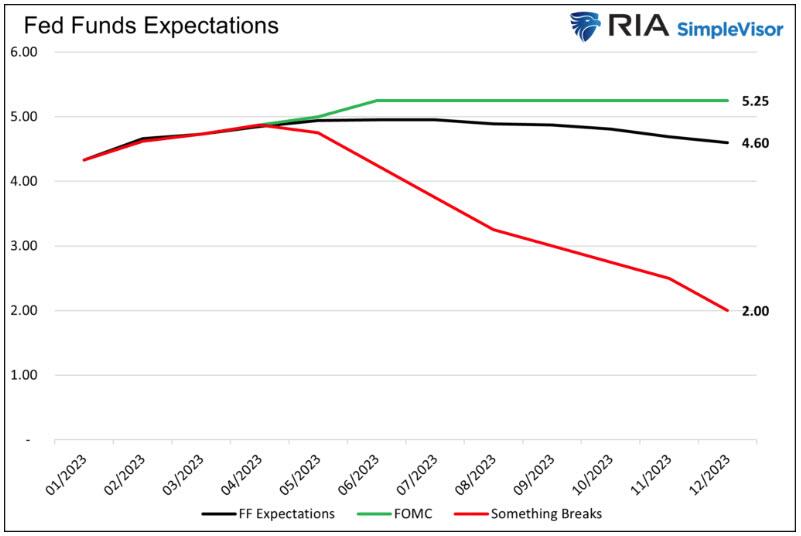
The graph below compares the three most probable paths for Fed Funds in 2023. The green line tracks the Federal Reserve’s guidance for the Fed Funds rate. The black line charts investor projections as implied by Fed Funds futures. Lastly, the “something breaks” alternative in red is based on prior easing cycles.

Scenario 1 The Fed’s Expectations
To provide investors transparency into Fed members’ economic and policy outlooks, the Fed publishes a summary of each voting member’s economic and Fed Funds expectations for the next few years. The latest quarterly guidance on the Fed Funds rate, as shown below, is from December 14, 2022 (LINK).
The dots represent where each member expects the Fed Funds rate to be in the future.
The range of Fed Funds expectations for 2023 is between 4.875% and 5.625%. Most FOMC members expect Fed Funds to end the year somewhere between 5.125% to 5.375%. Based on comments from Jerome Powell, the Fed seems to think Fed Funds will increase in 25bps increments to 5.25%.
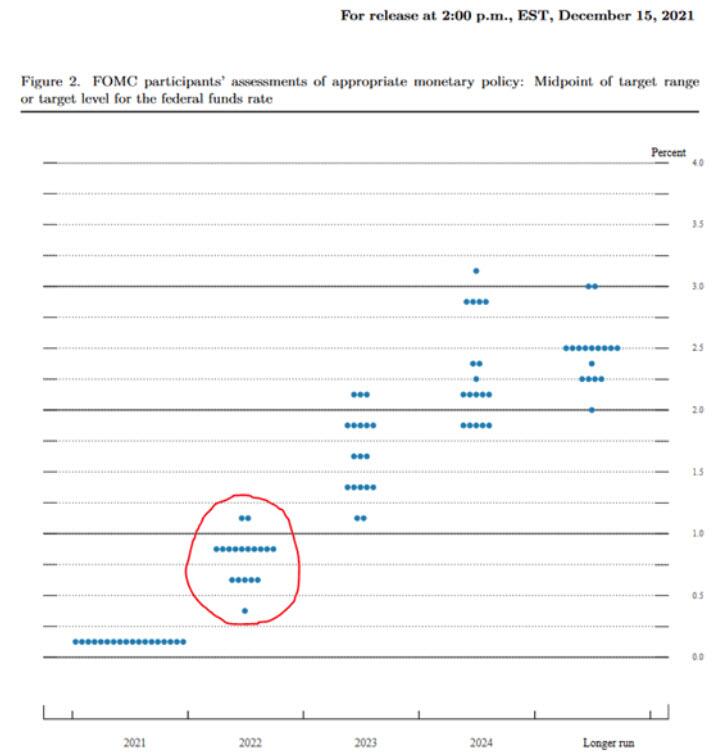
While investors place a lot of weight on the Fed projections, it’s worth reminding you they do not have a crystal ball. For evidence, we only need to look back a year ago to its 2022 projections from December 2021.
Their misguided transitory inflation forecast grossly underestimated inflation’s lasting power and how much they would have to raise rates. The point of sharing the graph is not to belittle the Fed but to highlight its poor ability to predict the future.

Scenario 2 Implied Market Expectations
Fed Funds futures are monthly contracts traded on the CME. Each contract price denotes what the collective market implies the daily Fed Funds rate will average each month. For example, when writing the article, the June 2023 contract traded at 95.05. 100 less 95.05 produces an implied rate of 4.95%. We can arrive at an implied path for Fed Funds by stringing the monthly implied rates together.
The market thinks the Fed will raise rates to just shy of 5% in May and hold them there through July. After that, the market implies increasing odds of a Fed pivot. By December, the market believes the Fed will have cut interest rates by about 40bps.
Like the Fed, the Fed Funds market can also be a poor predictor of Fed Funds.
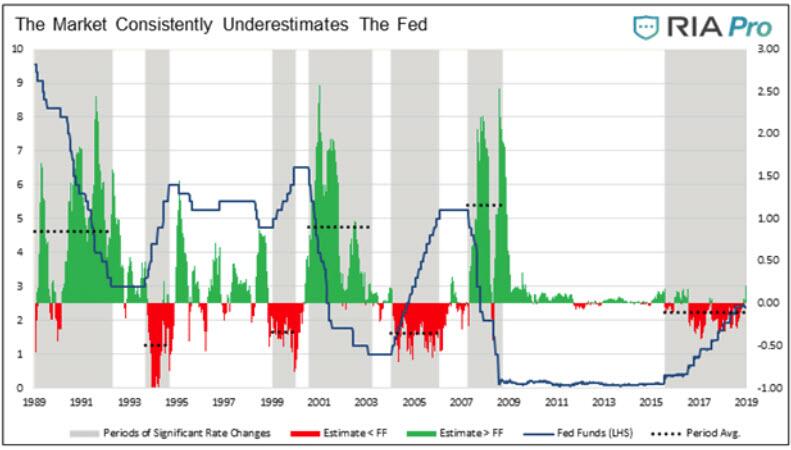
In late 2019 we wrote an article studying how well the Fed Funds futures market predicts Fed rate hikes and cuts. Per Investors are Grossly Underestimating the Fed:
As shown in the graphs, the market underestimated the Fed’s intent to raise and lower rates every time it changed monetary policy meaningfully. The dotted lines highlight that the market has underestimated rate cuts by 1% on average, but at times during the last three rate-cutting cycles, market expectations were short by over 2%.
During the last three recessions, excluding the brief downturn in 2020, the Fed Funds market misjudged how far Fed Funds would fall by roughly 2.5%. Implied Fed Funds of 4.6% today may be 2% by December if the market similarly underestimates the Fed and the economic and financial environment.

Scenario 3 Something Breaks
The first two alternatives assume the Fed will tread lightly, be it raising rates a little more or a slight pivot in 2023. The third path is the outlier “something breaks” forecast.
There is a significant lag between when the Fed raises rates and when the effect is fully felt. Economists believe the lag can take between nine months and, at times, over a year. In March 2022, the Fed raised rates by 25bps from zero percent. Since then, they have increased rates by an additional 4%. If the lag is a year, the first interest rate hike will not be fully absorbed into the economy until March 2023.
The third path, in which the Fed aggressively lowers rates, would be a response to a significantly weakening economy, inflation falling much more rapidly than expected, or financial instability. It could also be a combination of any or all three factors.
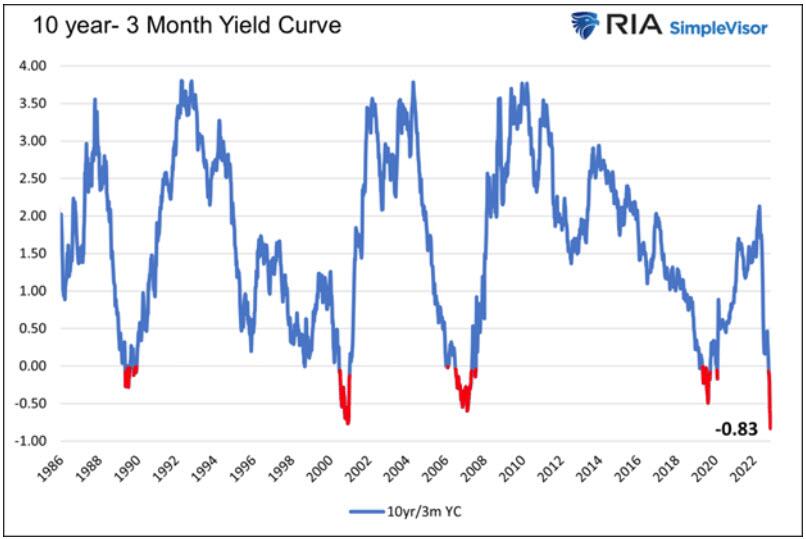
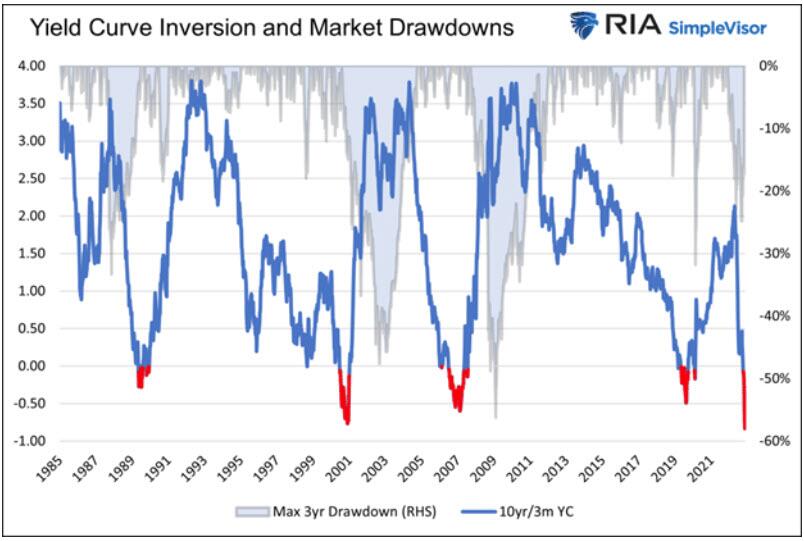
In The Foghorn is Blowing, we discuss how an inverted Treasury yield curve that un-inverts has been a great predictor of recessions, stock market drawdowns, and corporate earnings declines. The re-steepening of the yield curve is almost always the result of the Fed lowering interest rates.
The yield curve is currently inverted to a level not seen in over 40 years. It will un-invert; the only question is when and how quickly. As we wrote:
The financial foghorn is blowing. Historical odds greatly favor a recession, stock market drawdown, and a much lower Fed Funds rate.
If it un-inverts as violently as it has in the past, the 2% Fed Funds for the year-end scenario may prove too high!

Asset Performance in The Three Paths
Stock investors expect the second path with a slight pivot during the summer. Currently, corporate earnings are expected to grow by 8% in 2023. Such implies economic growth. Therefore, it also intones the Fed will not over-tighten and cause a recession. This goldilocks scenario may provide investors with a positive return.
The first alternative, the FOMC’s expected path, may entail more pain for stock investors as it implies rates will rise higher than market expectations with no pivot in sight.
The third “something breaks” scenario is the potential nightmare scenario. While investors will receive the pivot they have been desperately seeking, they will not like it. Historically, rapidly declining economic activity and financial instability do not bode well for stocks, even if the Fed adopts a more accommodative policy stance.
The graph below shows that the yield curve steepens well before the market bottoms. Likely, the steepening will result from the Fed quickly slashing interest rates in response to “something breaking.”

Don’t Forget About QT
Another Fed policy facet to consider is QT. The Fed is removing liquidity at a sizeable clip. Like interest rates, QT has a lag effect. In time, economic and financial market liquidity diminishes with QT.
Leveraged investors must often reduce exposure as liquidity becomes harder to obtain and more expensive. Usually, the deleveraging process starts slowly with fringe assets and overly leveraged investors feeling pain. However, deleveraging can spread quickly to the well-followed broader markets. The U.K. pension fund bailouts and failing crypto exchanges like FTX are likely signs of liquidity exiting the system.
Even if the Fed stops raising rates or marginally lowers them, QT will present headwinds for stock prices.

Summary
The unprecedented influx of liquidity that drove asset prices higher in 2020 and 2021 is quickly leaving the market. The lag effect of higher interest rates and fading liquidity will likely play a prominent role in determining stock prices in 2023.
Based on the Fed’s determination to quash inflation via higher interest rates and QT, we think the “something breaks” scenario is the likely path ahead.
World renown investor Stanley Druckenmiller seems to agree with us per a recent quote- “I would be stunned if we didn’t have a recession in 2023.”
Given the dynamic nature of economic and financial market activity and the difficulty of predicting the economic future, the Fed’s projections and the other two paths we discuss should be monitored closely throughout the year.
Expect the unexpected in 2023 and keep the Fed’s path top of mind.

(ZH) A Big Short-Squeeze Is Taking Place In Europe

A Big Short-Squeeze Is Taking Place In Europe

By Michael Msika, Bloomberg Markets Live reporter and commentator
It might be very early days, but it seems investors don’t want to start the year being heavily short on European stocks, especially not when it comes to the worst laggards of 2022.
The biggest losing stocks of last year are looking to put their awful performance behind them, starting 2023 in the best way possible. A basket of the 20 biggest stragglers of 2022 is up about 6% this week, more than three times the performance of the Stoxx 600.
“We are seeing strong evidence of the January effect,” says Cowen head of EMEA trading Carl Dooley, noting that the last time European stocks had a similarly poor year — in 2018 — underperformers “rallied hard” in the first month of the next year. This time round, he pointed to Faurecia, HelloFresh, SBB, Kion, Just Eat Takeaway, Zalando, GN Store Nord, Aroundtown and AMS as among those off the list of unloved 2022 names enjoying the brightest start.

There’s another common theme linking some of these stocks: a high quantity of shares out on loan, an indication of short-selling interest. Take Swedish real estate company SBB for example, with almost 23% of the free float available to borrow, according to S&P Global data. It’s up 10% this year, extending a rally since Dec. 20 to about 25%. Elsewhere, Zalando, Ocado, Aroundtown and HelloFresh all have more than 9% of their free float out on loan.
A similar picture of losers turning winners is evident in European sectors. Autos, real estate and retail are among the pace-setting industry groups, after they all severely underperformed in 2022. Banks look like the exception in the top six performing groups so far. Real estate was the second most-shorted sector after food retail by mid-December, according to S&P Global data.
“I think investors should be on really high alert for a short squeeze before we see another leg lower in equities,” says Vanda Research global macro strategist Viraj Patel. “Part of the reason for that is that we’ve got bond markets trading on recession fears, while equity markets are in this pessimistic, bearish sentiment state.”
Patel sees a possibility of a “Goldilocks state environment,” where inflation moves lower and economic activity holds up somewhat. “Could that be the template for the next couple of months? That’s certainly not priced in at the moment,” he said in a Bloomberg Television interview.
The short-covering trend shows up in the futures market too. For example, net futures positioning from asset managers and leveraged funds turned positive on the S&P 500 at the end of December, rising from a multi-year low. Meanwhile, European futures positioning has been relatively stable over the past two weeks, with investors marginally net long Euro Stoxx, while positioning in the FTSE 100 and DAX is moderatey net short and rising, according to Citigroup strategists.
“Investors have returned to their trading desks with some confidence about this new year,” says Pierre Veyret, technical analyst at ActivTrades. “It is, however, still hard to say if the current price action is being driven by real directional motivations from portfolio managers or if it is just a liquidity bull trap, covering some of last year’s short positions.”
Veyret cautions that a combination of high volatility and lower market liquidity is often treated as a dangerous indicator for stock traders.

TechCrunch : Pee is the magic number, as Withings puts a urine analysis lab in y

Pee is the magic number, as Withings puts a urine analysis lab in your toilet


Withings, best known for its smart scales, watches, and other health-focused consumer tech, released a new gadget at CES in Las Vegas today. Making a splash in an underserved market, U-Scan aims to help customers track what’s going on in their urine, without having to worry about catching their wastewater in a cup or messing about with test strips. The device syncs to the company’s ever-expanding Health Mate app and promises to give actionable insights.

The U-scan is designed to be installed in the toilet bowl, which gives users hands-free access to urine analysis. While routine in medical settings, Urine is a rarely-tapped opportunity for at-home health monitoring. That may change quite a bit over the next few years if Withings has its way. The company points out that urine has more than 3,000 metabolites, giving an immediate snapshot of the body’s balance and health.

“The ability of U-Scan to perform daily urine analysis from home will allow Withings to take its mission to help consumers fully utilize urine data to an entirely new level,” said Mathieu Letombe, Withings CEO at a press conference. “It’s one of the most exciting and complex products we have ever announced. We begin this journey with U-Scan Cycle Sync and Nutri Balance and look forward to announcing more cartridges on an ongoing basis as well as medical applications of the technology.”

The rechargeable U-Scan reader knows the difference between flush water and urine and ensures it collects only the samples it needs. When in use, urine flows efficiently to a collection inlet, activating a pump when a thermal sensor detects the presence of urine. The sample is guided through a microfluidic circuit and injected into a test pod. Here, the reaction is read by an optical sensor and reported back to the app. Every subsequent flush of the toilet cleans the system, resetting it for the next sample collection.

In Europe, the U-Scan Nutri Balance app shows an analysis of specific gravity, pH, vitamin C and ketone levels. The combination of these measurements helps people monitor their metabolic intake to optimize their daily hydration and nutrients. The ‘actionable’ part of that is that the system can recommend workouts, offer dietary suggestions, and recipes, all to help health-conscious users achieve their goals. The company points out that US functionality of Nutri Balance may vary, depending on what the FDA has to say about the matter.

The product will make its debut in Europe with dwo different health cartridges aimed at consumers. Medically focused cartridges will follow in the not-too-distant future. The price tag is €499.95, and includes one U-Scan reader and a cartridge providing 3 months of testing. The first two cartridges that are becoming available are Cycle Sync, which will help people who have monthly cycles track them, and a Nutri Balance cartridge, which will gives a detailed metabolic guide for nutrition and hydration. The company isn’t sure when the device will be made available in the US, as its launch will be depending on FDA clearance.

Incredibly, U-Scan can tell the difference between various users (and therefore assigning the results to the correct person using the device), through it’s amazingly named Stream ID feature. Low-energy radar sensors embedded within the reader measure multiple variables to identify an individual’s “urine stream signature”, by detecting the movement and distance of the stream. Stream ID information can be affirmed in the app.

In addition to the consumer-focused product, Withings Health Solutions, the company’s business-to-business division serving the healthcare provider market, is making the technology available to partners for research purposes.

The company told TechCrunch it is planning to make the cartridges available on a subscription basis, or on an individual basis.

WSJ : Jeep-Maker Stellantis to Build Flying Taxis With Archer Aviation

Jeep-Maker Stellantis to Build Flying Taxis With Archer Aviation
The global auto maker plans to help Archer build its first electric aircraft at a factory in Georgia

Stellantis STLA +3.50% NV, the global auto-making company that owns Jeep, Ram and other well-known car brands, is getting into the aircraft-manufacturing business, striking a deal with Archer Aviation Inc. to help it build an electric flying taxi.

The two companies said Wednesday that Stellantis would help Archer, a publicly traded air-mobility company established in 2018, to manufacture its first production aircraft at a factory the aviation company plans to build in Georgia.

The Netherlands-based auto maker also plans to provide up to $150 million in equity capital to Archer and aims to be the firm’s exclusive contract manufacturer for the forthcoming aircraft, which can take off and land vertically like a helicopter.

The move is an unusual one for the auto industry, which has largely stuck with ventures that involve ground transportation and vehicles with wheels, rather than propellers.

Stellantis Chief Executive Carlos Tavares said its decision aligns with the auto maker’s broader strategy of providing other transit services to customers, outside its traditional business of selling them individual cars and trucks.

In recent years, Stellantis has also invested in a car-sharing rental firm, similar to Zipcar, and, like other car companies, is trying to diversify its business model, particularly in urban areas where many people don’t own a car.

Archer, a San Jose, Calif.-based firm that specializes in small, electric-powered aircraft, was among a number of flying-taxi startups that have pursued stock-market listings over the past two years through special-purpose acquisition companies, or SPACs. Archer has said its goal is to deploy 6,000 aircraft by 2030.

The aviation firm’s first model, the Midnight, is designed to carry up to five passengers, including the pilot, and take short-distance trips of about 20 miles with a 10-minute charging time in between, Archer has said.

United Airlines Holdings Inc. has backed Archer, agreeing last fall to pay a $10 million deposit on a 100-aircraft order.

Electric-flying-taxi companies have been developing and testing vehicles, but need to secure approval from regulators before they or customers that purchase the aircraft launch commercial service. In the U.S., the Federal Aviation Administration has been examining aircraft, working on pilot requirements and looking into how to integrate planned vehicles into the airspace.

Archer expects to gain certification by the end of 2024 and start commercial operations afterward, the company’s CEO has said.

Archer’s stock has struggled since going public in September 2021, with shares down roughly 80% through Tuesday’s close.

Stellantis aims to provide Archer with the personnel, manufacturing expertise and capital to spool up production at the factory in Georgia, which is scheduled to open in 2024. The two companies said the partnership would help Archer meet its plans to commercialize its aircraft and avoid spending hundreds of millions of dollars during its manufacturing ramp-up phase.

The auto maker, which became a strategic partner for Archer in 2020, said it plans to buy more shares in the firm on the open market, after first investing in the aviation firm in 2021.

Stellantis is cutting back in other areas, as it tries to restructure its business to invest in costly new technologies, such as electric vehicles.

In December, the auto maker said it would indefinitely stop operations at a 1,350-employee assembly plant in Illinois, citing the need to generate savings to fund its transition to EVs.

Stellantis, which was formed through the merger of France’s PSA Group and Fiat Chrysler Automobiles NV in January 2021, said it intends to spend $35 billion in the coming years on new battery-powered models and manufacturing capabilities.

The car company said it aims to have EVs represent half of its sales in North America by 2030. At the same time, Stellantis has scaled back manufacturing ambitions in China, having faced stiff domestic competition and complications with a local partner that built and distributed Jeep SUVs in the country.

Nikkei : Nissan limits use of joint IP in Renault's new venture with Geely

Nissan limits use of joint IP in Renault's new venture with Geely
Deal is step forward in rethink of Japanese, French automakers' ties

TOKYO -- Nissan Motor and Renault have agreed to restrict the use of the intellectual property they developed together, including one patent for hybrid vehicles, in a new company established by Renault, Nikkei has learned.

The agreement marks a major step forward for the Japanese and French automakers, which have been reviewing their capital tie-up. The treatment of jointly held IP is one of the focal points of the talks.

The new company, announced by Renault in November and tentatively named Horse, will produce hybrid vehicle drivetrains and engines, with Chinese automaker Geely taking a 50% stake in the new company. Nissan will not have an ownership interest in the venture.

Unlike Nissan and Renault, which focus on different markets -- the former in the U.S., China and Japan, while the latter concentrates on Europe -- the new company plans to supply products to about 130 countries, including the U.S. and China.

According to sources, Renault had told Nissan that it wanted to use patents and other IP jointly acquired with Nissan in the new venture.

However, Nissan said it would not allow the use of joint IP for products to be offered in the U.S. and China to forestall competition with the new company and prevent technology leaks. In Europe, the Middle East and other regions, Nissan will also seek consent if products using joint IP are supplied to automakers other than Nissan.

A Nissan official told Nikkei that Renault has agreed to the restrictions on joint IP. Renault declined to respond, saying, "We do not comment on intellectual property."

Nissan and Renault have jointly developed patents for internal combustion engine cars and hybrid vehicles since the start of their alliance in 1999. According to Renault's annual reports, the two companies have developed about 1,770 joint patents in the five years through 2021.

In principle, a joint patent can be used freely by both companies without paying royalties, but in this instance the two companies will not allow the use of the patents, even for a fee.

Nissan and Renault have been negotiating over their joint IP as "one package" in a review of their capital relationship. Nissan has requested that Renault give up a 28% stake in the Japanese carmaker, cutting its current 43% stake to 15%, which is equal to Nissan's holding of Renault shares.

FT : Chinese battery makers strengthen grip on global supply

Chinese battery makers strengthen grip on global supply
Electric vehicle boom in Asia’s biggest economy helps CATL and BYD reach worldwide market share of 50%

Chinese battery manufacturers have extended their dominance over global supply, with the top two producers reaching a combined market share of 50 per cent, and leaving South Korean and Japanese rivals lagging behind.

CATL, supplier to carmakers including Tesla and Volkswagen, more than doubled battery sales to 165.7 gigawatt hours in the 11 months to the end of November, according to data from Korea’s SNE Research — enough for roughly 3.3mn average-sized electric vehicles.

That extends the company’s lead as the world’s biggest producer and takes its market share to 37.1 per cent, up from 32.2 per cent in 2021.

The SNE report also showed “frightening” growth at China’s second-largest cell producer and EV manufacturer BYD, whose battery sales almost tripled to 60GWh over the same period to give it a 13.6 per cent market share.

The tightening grip of China’s battery manufacturers comes on the back of breakneck growth in the country’s domestic EV market despite challenges to the economy from the property sector slowdown and zero-Covid policies in force until last month.

The China Passenger Car Association expects the country’s electric car sales growth to slow to 30 per cent this year as subsidies are withdrawn, after doubling to 6.4mn-6.5mn vehicles in 2022.

Many analysts have predicted that CATL and BYD’s market share will drop as competition intensifies both domestically and overseas, but the moment is yet to arrive.

Korea’s LG Energy Solution and Japan’s Panasonic recorded growth of less than 10 per cent in the first 11 months of 2022, the SNE data show, with BYD displacing LG as the world’s number two producer.

Kevin Shang, an energy storage analyst at consultancy Wood Mackenzie, said CATL’s strengths in technology development, supply chain control, economies of scale and relationships with carmakers had given it the upper hand.

“Innovation is a key weapon in the market,” he said. “In the short term, CATL will hold its dominating position with more effort but faces competition from South Korean companies and US clean energy policy in the longer run.”

The SNE figures represent the battery capacity installed in electric cars that have been sold, meaning the ranking is influenced by model launches among carmakers with which they have supply relationships.

A further factor for the Chinese groups’ growth has been the shortages and high prices of raw materials such as nickel and lithium that have encouraged adoption of cheaper Chinese batteries by European car companies such as Volkswagen and Volvo, SNE said.

CATL has ridden out some of the pressures that battery manufacturers are facing from soaring raw material prices, with net profit almost trebling in the second and third quarters following an unexpected drop in the first.

Even so, its share price has sunk 30 per cent over the course of the year as part of a broader rout among Chinese tech stocks, taking its market capitalisation to about $140bn.

The deepening of CATL’s dominance in the industry comes as it pursues international expansion across Europe and North America.

The company last month started producing cells from its German battery facility, its first outside China, which will be followed by a huge 100GWh plant in Hungary.

>>> Stoxx 600 Pre-Market Indications

  • Prosus (1TY TH) +2.1%
    • Prosus’s Net Proceeds From Tencent Share Sales $7.23b to Date
  • Vodafone (VODI TH) +1.4%
  • Legrand (LRC TH) +1.2%
    • Legrand Raised to Outperform at Bernstein
  • Schneider Electric (SND TH) +1.1%
    • Schneider Electric Raised to Outperform at Bernstein
  • Nel (D7G TH) +1%
  • Iberdrola (IBE1 TH) +0.9%
    • Ditching Russian Gas Could Boost EU Utilities’ Green-Power Shift
  • SocGen (SGE TH) -0.8%
  • Shell (R6C0 TH) -1.3%
  • Equinor (DNQ TH) -1.5%
  • Rolls-Royce (RRU TH) -1.9%
    • Rolls-Royce Cut to Sell at Panmure Gordon; PT 53 pence