China's tech supply chain reels as infections soar, demand sours
Silver lining: Dealing with COVID wave now 'could pave way for recovery'
TAIPEI/ HONG KONG -- China's tech supply chain is heading into the new year facing the twin challenges of slumping demand and staffing chaos caused by Beijing's abrupt U-turn on COVID controls.
In a sign of the gloomy outlook for consumer electronics, Apple has notified several suppliers to build fewer components for AirPods, the Apple Watch and MacBooks for the first quarter, citing weakening demand, according to Nikkei Asia's supply chain checks with several component suppliers.
"Apple has alerted us to lower orders for almost all product lines actually since the quarter ending December, partly because the demand is not that strong," a manager at an Apple supplier told Nikkei Asia. "The supply chain in China is still trying to cope with the latest abrupt policy turns, which brought a shortage of laborers because of the sharp COVID surges."
That policy change came in early December when China started to dismantle the world's most stringent COVID regime, which included mass testing and quarantines, to kick-start the flagging economy.
Tech manufacturers initially welcomed the turnaround after years of fighting to maintain operations under the strict COVID measures. But now they face the challenge of embracing a new normal of rising infections and looser controls.
"It's very chaotic," an executive at an electronic component maker that supplies Samsung, Apple and several Chinese smartphone makers told Nikkei Asia. "The new wave of COVID surges spread super fast, and most companies found it already makes no sense to quarantine their employees."
An employee at smartphone maker Honor described how workers now are largely resigned to catching the virus.
"The typical greeting now is: 'Have you already tested positive?'" they said. "It has become so natural now. If it's inevitable, most of us would rather get it earlier than later. Otherwise, it might disrupt our work next [this] year."
Local governments have helped spur the change. Provinces including Zhejiang, Chongqing and Anhui have announced that workers, including medical staff, who are asymptomatic or have only mild symptoms can go back to work with "due protection."
An official from Jiangsu province who previously oversaw manufacturers' COVID prevention measures told Nikkei Asia that the local government is no longer intervening in factories' epidemic control measures and almost all factories are asking workers with mild symptoms to come back to work.
Some worry that the abrupt exit from zero-COVID will have knock-on effects for China's economy.
"The rapid surge of infections in big cities might be only the beginning of a massive wave of COVID infections," Ting Lu, Nomura's chief China economist, warned in a recent note. "We expect major activity indices to remain weak or even to drop further in December."
Alicia Garcia Herrero, chief economist for Asia Pacific at Natixis, predicted a "noticeable" impact on manufacturing from the opening up. "However, it might not last too long if most major cities manage to peak by the end of Chinese New Year," she added. "In a nutshell, I believe a lack of external demand will be an even more important factor for China's manufacturing sector in 2023."
But others, like the Honor employee, are taking a more optimistic view: It is better to get over the worst of the infections now, while demand is slow anyway.
"More than half of our team has tested positive, and of course, we face disruptions in output," the manager of a print circuit board supplier in Jiangsu province that serves Apple and Intel told Nikkei. "But demand happened to be quite lackluster, so we just asked staff to take some leave."
Ding Yi, the owner of Wuxi Huansheng Precision Alloy Materials, described a similar situation. Production at his facility was interrupted in mid-December after most workers were infected, he said, but has gradually resumed by the end of the month.
"There is no big impact on the overall order fulfillment because orders decrease near the end of the year. That occurs all the time, so I am not that worried," he said.
For now, tech manufacturers are reluctant to cut back on staffing despite the gloomy demand outlook, for fear of repeating the headaches they experienced this year.
Foxconn's complex in Zhengzhou, the world's biggest iPhone-making site, suffered a labor shortage following a COVID outbreak in late October. Now it is offering bonuses of up to 14,000 yuan ($2,013) and asking employees to refer more recruits.
Other manufacturers in the tech supply chain, including Jabil in Chengdu, Pagatron in Shanghai and LY iTech in Shenzhen, also raised wages and bonuses for workers earlier this month after a large number of workers quit amid COVID outbreaks or left early for the Chinese New Year holiday, which starts on Jan. 20.
There is also optimism that the new year will bring change for the better.
"Most of us hope the surge of COVID waves will peak around February, and could gradually return to normal starting in March," a manager with SMIC, China's top chipmaker, told Nikkei Asia. "We experienced a very dark time back at the start of December, when almost half of our team and suppliers suddenly got COVID and there was maybe less than 50% of people still coming into the plant ... but now people are gradually getting used to the infection, and things are gradually improving."
Jonah Cheng, chief investment officer of private equity firm J&J Investment, is likewise optimistic.
"The electronics supply chain is still at the stage of digesting excessive inventories rather than starting to churn out massive components, but the bottom of the downturn will hopefully come in the first quarter of 2023," Cheng said.
"It's actually a good sign that China is heading to reopen its doors," he added. "There must be a lot of disruption in the short term, but in the coming quarters, [the reopening] could be good to stimulate the economy and could pave ways for a recovery."
Favouring trains over planes may be smart for legacy airlines
KLM chief’s comments might signal strategy to free up new avenues for her carrier’s future growth
Suggesting customers should not buy your products is a strange marketing strategy.
But Marjan Rintel, chief executive of KLM, is unlikely to lose her job over comments made in the Financial Times last month that passengers should forgo polluting flights in favour of the train on certain journeys. In fact, she is taking little business risk at all. She may even have hit on a smart strategy to free up new avenues for her carrier’s future growth.
There is little debate over which is the cleanest mode of transport. Trains are at least 12 times more energy efficient per passenger than air travel, according to the International Energy Agency. Even accounting for all the infrastructure involved in European rail travel — laying tracks, lighting stations and so on — it remains by far the more environmentally friendly option, according to numerous studies.
But switching all intra-EU air passengers to rail is unrealistic. Take the Berlin to Munich route — just over an hour by air and close to five hours on a high-speed train. A study by Oxera found that based on current schedules and capacity, only 26 per cent of air passengers on that route could be accommodated on trains. And then there is the question of the extra time that travelling on Europe’s rail network would require for many journeys. Roughly half of all air journeys within the EU would take eight hours or more by train.
Europe may have a very good rail network connecting many major cities, but if trains are to compete with planes, only high speed rail will deliver the journey times that make this a realistic alternative for the shorter routes. Yet the European Court of Auditors in 2018 described Europe’s HSR network as “an ineffective patchwork of poorly connected national lines”.
These and other obstacles, such as the scarcity of low-cost train operators, a complex ticketing system and the absence of point-to-point baggage handling services are all deterrents to passengers seeking to integrate train travel into international journeys.
In fact, according to consultants Roland Berger, even if these obstacles were overcome and all air journeys of less than 1,000km were transferred to rail (adding some four hours to the trip), the carbon savings for aviation would be less than 5 per cent.
So Rintel’s suggestion appears to be relatively benign for KLM’s business model.
Yet if legacy airlines such as KLM are clever about integrating rail into their offering, and if they can bring their expertise in ticketing, customer loyalty programmes, fare management and ancillary services to the rail sector, they may open up other opportunities.
For example, while many short-haul routes are important to legacy airlines to feed passengers on to their more lucrative long-haul flights, they are not profitable for many flag carriers on their own. “They are just a means to an end,” says one airline executive.
The competition on these routes, largely with low-cost carriers, “is much more intense and legacy carriers have of course a higher cost base”, says Rico Luman, transport analyst at ING. “Indeed, shortages — including on limited airport take-off and landing slots — still matter.”
So if airlines have a stake in getting passengers to their hubs by another route, with seamless ticketing and check-in services to smooth the journey, they can then use the slots that have been freed up for more lucrative services. Seven of the top 10 revenue-generating routes in the world are long-haul international flights, according to OAG. For KLM, it is particularly urgent to make better use of their slots, given that the Dutch government has ordered the number of flights from its Schiphol hub to be cut by more than 10 per cent to 440,000 a year to reduce emissions.
But KLM is not the only airline to be exploring closer relationships with train operators. Lufthansa, Austrian Airlines and others have been doing the same. Deutsche Bahn has even become the first non-airline member of the Star Alliance of airline operators, which jointly market flights and connections across their networks.
“Airlines could get people to book rail tickets through them and perhaps take a commission. It could be a nice way to make a bit of money,” says Robert Thomson of Roland Berger. But it could also be a useful tool against low-cost competition on crucial feeder routes — assuming the airlines and rail operators can get the service right.
8 Documentaries to Stream in January 2023
A roundup of new documentaries coming to streaming platforms, including "Pamela, a Love Story" and "The 1619 Project."
Streaming platforms are kicking off 2023 with new documentaries set to launch in January. The titles explore different themes, from illegal financial activity to crimes in higher education and American history.
“The 1619 Project,” premiering on Hulu, will take a closer look at the achievements of Black people, as well as reveal facts about the legacy of slavery. Meanwhile, “Death in the Dorms” will tell the stories of six women who were murdered while pursuing an education at colleges across the U.S.
Netflix will show the life story of Pamela Anderson, told by the star herself, in the upcoming “Pamela, a Love Story.”
Related Galleries


For a guide to some new standout documentaries available to stream in January, read on for more.
“Madoff: The Monster of Wall Street”
Stream on Netflix on Jan. 4

A still from “Madoff: The Monster of Wall Street.”
COURTESY OF NETFLIX
The four-part docuseries centers around Bernie Madoff’s infamous $64 billion global Ponzi scheme, which financially displaced many individual investors. The project will uncover the former Wall Street leader’s career trajectory and showcase how fellow co-conspirators and the financial system were willing to overlook unusual behavior. It will have looks at the whistleblowers, employees, investigators and victims surrounding the scheme, including never-before-seen video depositions of Madoff himself.
“Death in the Dorms”
Stream on Hulu on Jan. 5
“Death in the Dorms” tells the stories of six young women from six different colleges who were murdered.
“The Hatchet Wielding Hitchhiker”
Stream on Netflix Jan. 10

A poster of “The Hatchet Wielding Hitchhiker.”
COURTESY OF NETFLIX
The documentary tells the tale of Caleb “Kai” McGillvary, a nomad hiker who first became famous after saving a woman from a violent attack. His news interview about the incident, in which McGillvary used a hatchet to repeatedly hit the alleged attacker, earned him widespread fame for his bravery. But his story took a turn in 2013, when he was convicted of killing a lawyer who he alleged sexually abused him.
“How I Caught My Killer”
Stream on Hulu Jan. 12
The newest true-crime docuseries that shines a light on unique homicide cases, including in-depth interviews, archival evidence and reenactments. It will highlight victims who left clues that ultimately led to helping solve heinous crimes. Additionally, the series is set to address the disproportionate amount of people who lose their lives to homicide each year.
“Break Point”
Stream on Netflix Jan. 13
The docuseries takes a closer look over a year of the new class of tennis players competing across the globe in the ATP and WTA tours. With the dream of becoming the top tennis player, the series will showcase the triumphs and pitfalls, from career-threatening injuries to victories.
“Super League: The War for Football”
Stream on Apple TV+ Jan. 13
The four-part series follows what happens when plans for a breakaway soccer league come up and the leaders have the choice to either defer or upend tradition. It will offer an exclusive look at access to league presidents, club owners and the architects behind the European Super League.
“The 1619 Project”
Streaming on Hulu Jan. 26
An expansion of “The 1619 Project” by Pulitzer Prize-winning journalist Nikole-Hannah Jones, the six-part docuseries will place the consequences of slavery and the contributions of Black people at the forefront of American history. The episodes are adapted from essays from The New York Times number-one bestselling book of the same name: “The 1619 Project: A New Origin Story.” Executive producers for the limited series include Oprah Winfrey, Kathleen Lingo and Shoshana Guy.
“Pamela, a Love Story”
Steam on Netflix Jan. 31

A still of Pamela Anderson in “Pamela, a Love Story.”
COURTESY OF NETFLIX
The project will showcase Pamela Anderson in a new, all-encompassing light, including her small-town upbringing, her acting career and her role of being a mother. Sometimes called “the blonde bombshell,” “Pamela, a Love Story” will allow Anderson to tell her story on her own terms.
"Doom Cycle Of Default, Fraud, And Contagion" Could Give Way To Crypto Spring
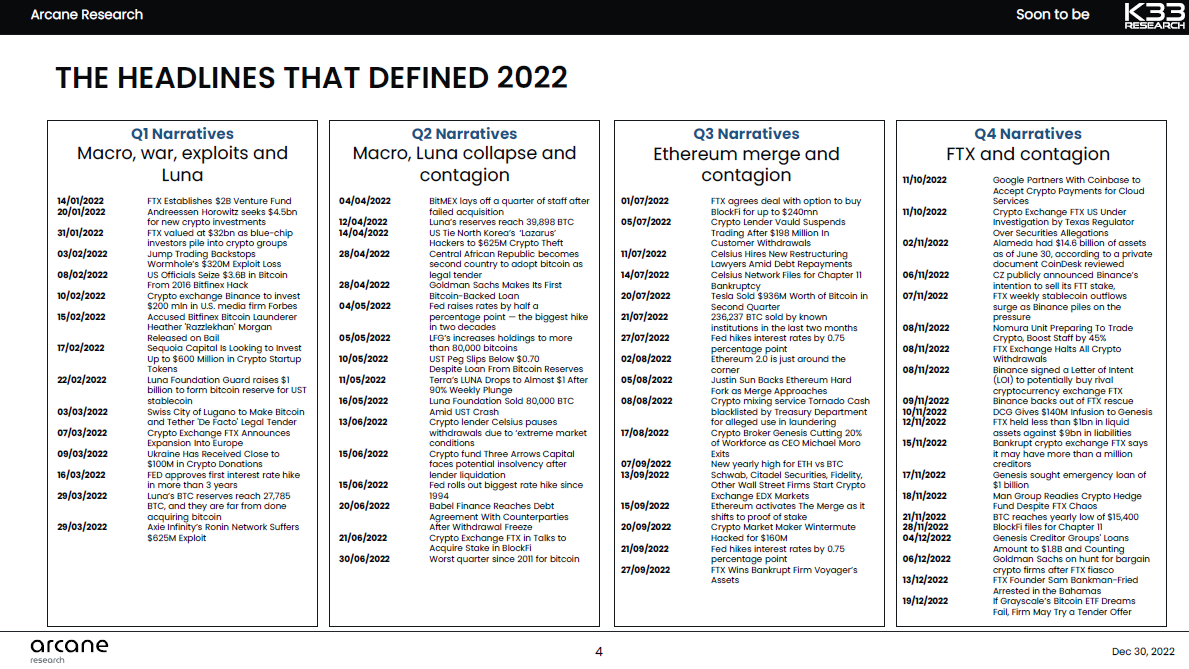
Crypto endured a major hangover year in 2022 after a 2020-21 boom during the central banks' Covid liquidity party. The emerging blockchain space was battered by central banks removing the punch bowl, harsh macroeconomic environment, bankruptcies, exchange blowups, stablecoin implosions, and even criminal charges against top crypto executives.
"Consistent interest rate hikes and quantitative tightening in 2022 granted us a devastating hangover. Fortune did not favor the brave, and we entered a consistent doom cycle of default, fraud, and contagion. A financial crisis with seemingly no end that still ravages our industry. In 2022, the naked swimmers were exposed and bad apples got eliminated. This is promising through long-term lenses, while ever so painful in the short term," Vetle Lunde, research analyst at Arcane, wrote.
Lunde wrote if 2022 had one key lesson for the crypto industry, it would be the following: "your funds in someone else's custody is someone else's liability, and their intentions could be harmful. While there are good arguments for storing funds at exchanges, traders should strive to avoid concentrating risks on one venue."
Arcane's analyst put together the top headlines that defined the crypto industry in 2022 -- much of the headlines were doom and gloom.
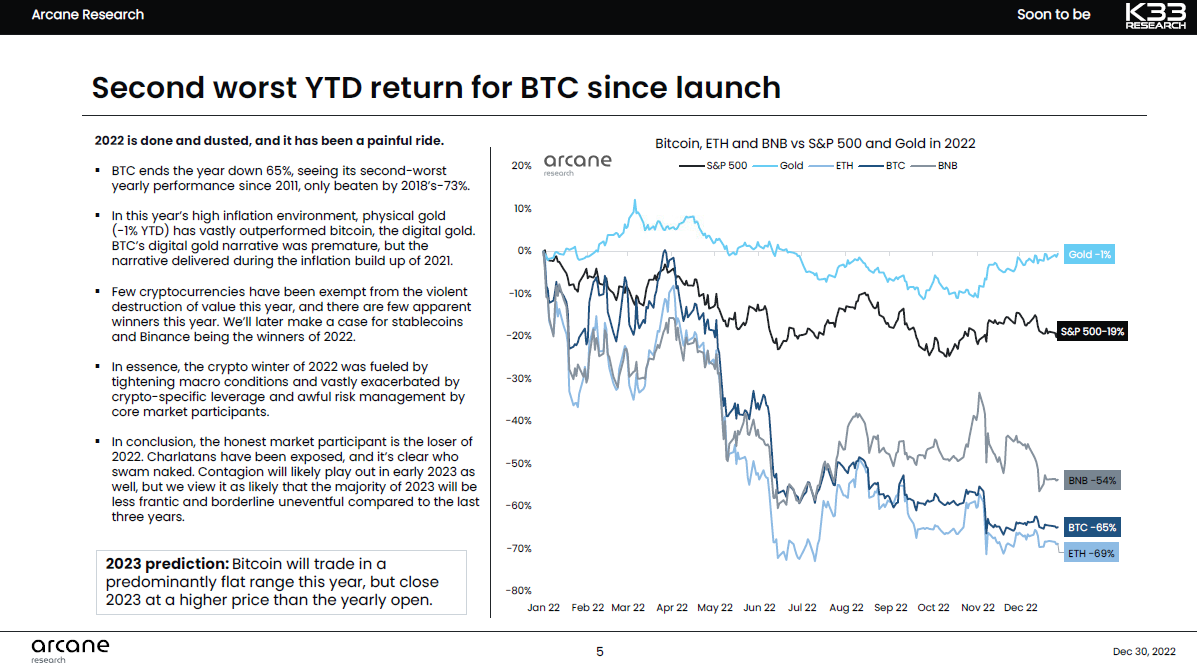
Lunde pointed out Bitcoin recorded the second worst year-to-date returns in existence. He called the down move in crypto "a painful ride."
Lunde continued with an outlook for 2023, expecting a calmer market due to declining volatility.
We expect the market to calm down in 2023, with declining volumes and falling volatility. Overall, we expect interest and headlines related to crypto to be fewer and the market to be less hectic in general. This will be a year to accumulate and build exposure. It will be a year for the patient, and we do not anticipate prices nearing former all-time highs in 2023. We believe BTC and ETH will increase their relative strength in the market and that altcoin returns will be subdued for most of the year.
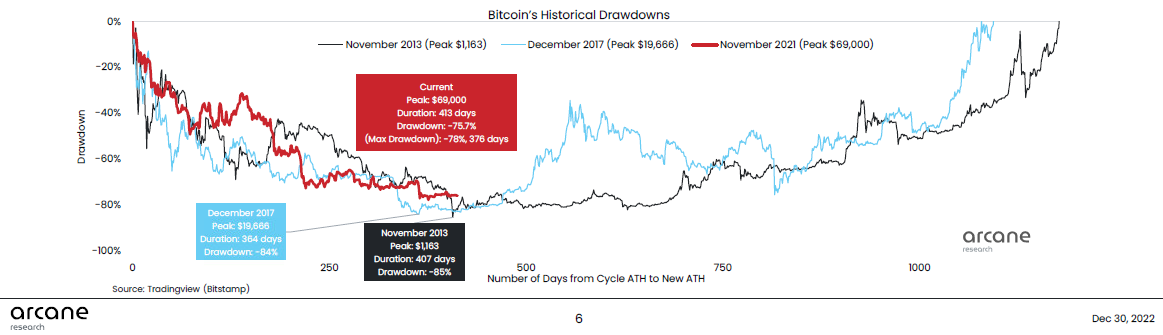
And he revealed further the current drawdown in Bitcoin appears to follow similar bear market patterns in previous cycles.
The 2018 bear market saw a 364-day long duration from peak to through, while the 2014-15 bear market lasted for 407 days. For now, BTC has bottomed 376 days after peaking, right in between the duration of earlier cycle peak to through periods. If a new bottom is reached in 2023, this will be the longest-lasting BTC drawdown ever.
And one silver lining the analyst said about the FTX debacle is that it might increase "more rapid progress with regulations, and we view both positive signals related to U.S. spot BTC ETF launches and more coherent classifications of tokens as a plausible outcome by the end of the year, with exchange tokens being particularly exposed for potential security classifications."
Here is Lunde's core 2023 forecast for crypto:
While the tightening macro landscape and BTC's correlated relationship to macro complicate analogies to previous bear markets, we firmly believe that this is an excellent area to build gradual BTC exposure. However, we expect low activity to be the key trend throughout most of 2023, with diminishing trading volumes and volatility in a significantly more boring market than the previous three years. As we advance into the next year, patience and long-term positioning will be key.
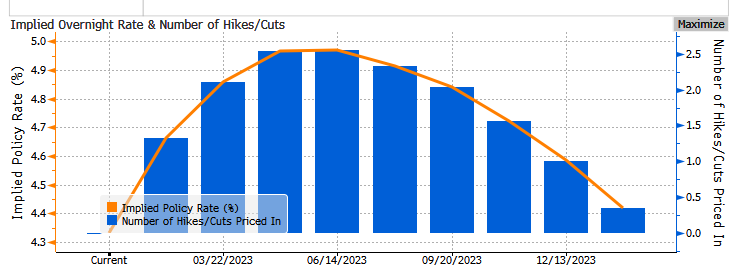
Much of the crypto down cycle has come since the Federal Reserve embarked on its most aggressive tightening scheme in decades.
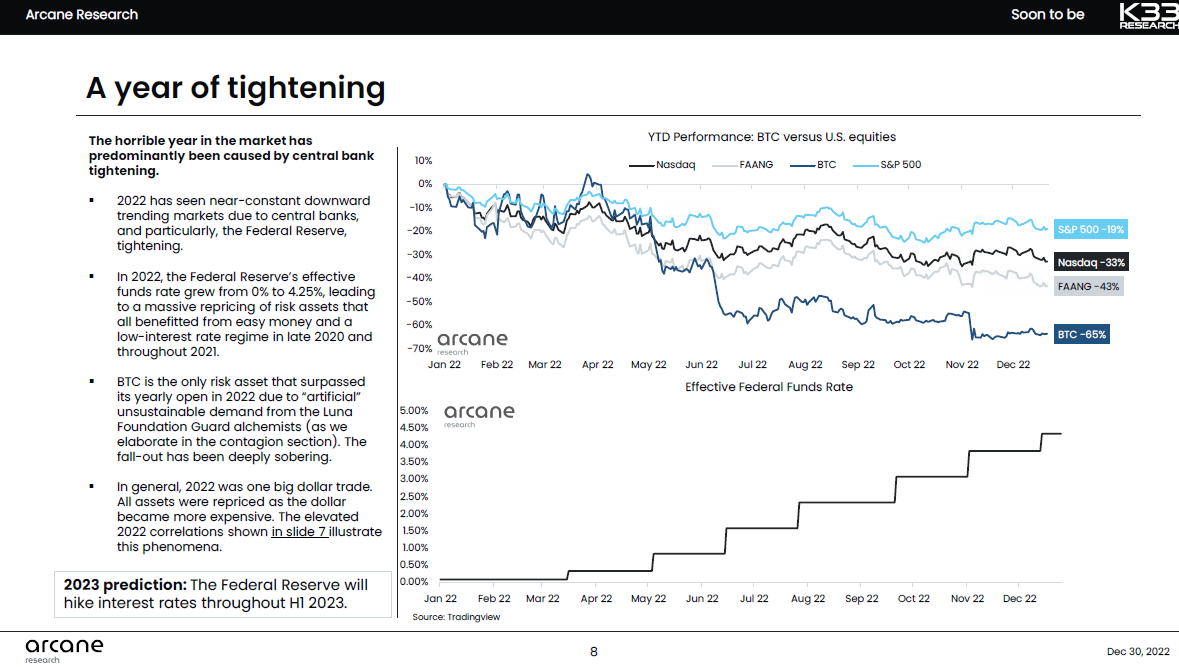
And rate traders are already pricing in the possibility the Fed might have to begin cutting late in the second half of 2023.
He also noted Bitcoin liquidity is drying up as the coins are being pulled off the markets.
This has direct implications for BTC liquidity and, in particular, experienced BTC scarcity. With fewer BTC available to trade, the impact of the net buyer or net seller will be more significant, and we believe the market is slowly headed towards a scenario where the net buyer will once again make a difference.
The backward-looking review and forward outlook might suggest crypto winter has peaked, while others, such as David Marcus, CEO and founder of Lightspark, recently warned crypto will need until at least 2024 to "recover from the abuse of unscrupulous players."
Hong Kong home sales drop to lowest level since 2008 financial crisis
Housing market recovery is not expected until middle of this year despite border reopening with mainland China
Hong Kong home sales have fallen 40 per cent year-on-year to their lowest level since the 2008 global financial crisis, data from the local land registry and projections from real estate agencies have shown.
The slump in one of the world’s priciest real estate markets is expected to only bottom out by mid-2023 and home prices could fall by up to another 10 per cent this year, analysts said.
Last year “was the worst year since 2008 for Hong Kong residential”, said Praveen Choudhary, an equity analyst at Morgan Stanley specialising in the city’s real estate and conglomerates.
Home sales closed by the property development arm of Hong Kong’s richest man Li Ka-shing halved from 2021 as the city struggled to revive its economy after years of harsh Covid-19 restrictions. New home transactions at CK Asset Holdings, Li’s real estate unit, fell from 900 in 2021 to about 450 in 2022 as the territory battled its first significant Covid outbreak, which peaked in March.
The total transactional value for its sales doubled to about HK$26bn (US$3.3bn) due to the sale of luxury flats. But sales at 21 Borrett Road, a prime project in the heart of the city, came under scrutiny after 152 units were sold for a total HK$21bn, with the average square foot price roughly a quarter lower than the average of other units sold previously.
“The total transactional value this year is better than expected,” William Kwok, CK Asset’s chief manager of sales, told the Financial Times. “A bulk deal is just the same as selling the units one at a time when it comes to sales volume from the company’s perspective.”
Under Beijing’s zero-Covid policy, Hong Kong only recently reopened its borders with the rest of the world and is expected to resume quarantine-free travel to mainland China from mid-January.
New home sales agreements plummeted to 10,068 between January and November 2022, from 16,136 over the same period of 2021, according to the local land registry, while transactional value halved from HK$214bn to HK$107bn.
Annual home sales agreements in 2022 are projected to be lower than that of 2008 at 11,046 units based on preliminary December data, according to real estate agents from local-based Midland Realty and Centaline Property Agency.
Stewart Leung, vice-chair of Hong Kong-based real estate conglomerate Wheelock Properties, said developers would “probably have to wait until mid-2023 to see the light at the end of the tunnel”. Wheelock sold nearly 600 new homes in 2022 at a total value of about HK$9.5bn, compared with 2,100 units and HK$33.1bn the previous year.
Real estate services groups JLL and Knight Frank expect home prices to fall by up to 10 per cent overall in 2023, while JPMorgan expects an 8 per cent dip in 2023.
Downward pressure on home prices has also been aggravated by an exodus of residents following the introduction of new security laws in the city and tough Covid curbs.
But Paul Chan, Hong Kong’s financial secretary, said in his weekly blog note on Sunday that he was optimistic about the outlook, with the city’s reopening of its border with mainland China boosting sentiment in the property market, despite the US rate-hiking cycle still casting a shadow over the sector.
Some property developers “will be keen to launch more residential projects in 2023 with further discounts” to recover last year’s lagging sales, according to Eddie Kwok of property group CBRE Hong Kong.
Poor real estate market performances have hit the government’s land sales revenue, with an estimated HK$35bn generated in 2022 — a 68 per cent year-on-year drop — according to Martin Wong of Knight Frank.
A plot in Kowloon that could accommodate 1,750 units was last month awarded to CK Asset with a bid of HK$8.7bn, setting a much lower than expected average price per square foot of gross floor area at HK$6,138, the lowest since 2014.
Hollywood talent agencies seek new deals tied to Netflix advertising model
United Talent Agency chief Jeremy Zimmer says ad-supported service ‘changes the game’ for creators
The creative talent behind shows on Netflix’s new ad-supported service should earn more money if their series are popular with viewers, the chief of one of Hollywood’s top talent agencies has argued, a move that would represent a major shift in the streaming pioneer’s model.
In November, Netflix introduced a new subscription service in which viewers have access to a more limited selection of titles for a lower price in exchange for watching ads.
In an interview with the Financial Times, Jeremy Zimmer, head of the United Talent Agency, said this new strategy “changes the game” in terms of how the streamer should compensate creative talent.
“A show that does really well will get more advertisers and more revenue will flow to Netflix,” he added. “Therefore, our clients who created that show should be compensated for that additional revenue.”
Netflix, which launched its ad-supported service to offset slowing subscriber growth, has long resisted profit-sharing arrangements. Instead of offering traditional “back end” payments that allow talent to earn more from a successful show, Netflix buys out all rights upfront.
But Zimmer says Netflix’s launch of an ad-supported service has altered that formula.
“They’ve changed all the rules [by saying] it’s no longer an ad-free environment,” he said. “There’s a different revenue stream coming in that they had said wasn’t going to be there.”
Netflix is likely to resist attempts by UTA or its rivals, including Creative Artists Agency and Endeavor, to seek new sources of revenue tied to performance. However, talent agencies are trying to use the streamers’ advertising push — Disney Plus also launched an ad tier this month — as an opportunity to persuade them that aligning artists’ financial interests with the performance of programmes is good for both parties.
The nature of the advertising business means that there will be more transparency on how shows perform than Netflix has allowed in the past. With the launch of the ad service, Netflix will now allow detailed data to be collected by Nielsen ratings — allowing talent to access more information about how well their programmes perform on the platform. In theory, this could give artists leverage to bargain for more money when they produce a hit.
However, analysts say they do not expect meaningful profits from Netflix’s advertising business any time soon. “They’re off to a slow start” with the advertising service, said Tim Nollen, an analyst at Macquarie Capital. “It looks like 2025 before we see any real benefit from it.”
Netflix is missing its advertising viewership guarantees by as much as 20 per cent, according to a report this month in Digiday, which suggested the streaming service was returning cash to advertisers as a result.
Nollen noted that the ad service was still new, but he said he was surprised by a lack of promotion of the advertising tier. “Netflix is in a bit of a quandary,” he added. “They don’t want to dilute themselves” by incentivising full-price subscribers to switch to the lower-cost advertising tier.
Zimmer said there had not been serious discussions with Netflix about profit-sharing arrangements because it is “all relatively new”. But he said when clients launch new programmes on Netflix, “they will want to build in opportunities to get compensated for shows that are successful and are deemed successful by advertisers and audiences”.
The streaming industry itself is facing serious headwinds, including slower subscription growth and investor impatience with the billions of dollars that the traditional Hollywood groups have lost trying to build up their services. A potential strike by the Writers Guild of America when its contract ends in May could also deal a blow to studios.
Morgan Stanley analysts wrote this month that if the streaming services launched by traditional studios were unable to deliver “meaningful” profits in the next two years, some would need to “give up and/or consolidate”.
Some could choose to emulate Sony’s “arms dealer” strategy of selling content to streamers or even traditional TV networks, the analysts added.
Zimmer said Netflix and other streamers would do well to sell their shows to rivals.
“All the streamers are now realising, ‘Wow, we could use additional revenue’,” he added. “Maybe those shows don’t need to just sit on our servers alone.”
Syndicating their content to broadcasters would allow the streamers to generate extra revenue — and open another profit opportunity to the creative talent, Zimmer said. “The revenue they get from that would be a way to share proceeds from the creators.”
Brussels plans energy market overhaul to curb cost of renewables
Industry representatives warn that proposed reforms could stifle investment in wind and solar power
Brussels plans to overhaul the bloc’s electricity market to prioritise cheaper renewable power, the EU’s energy commissioner has said, despite industry warnings that the reforms could stifle investment in wind and solar farms.
Kadri Simson said the European Commission was under “very strong political pressure” to redesign the market to cut bills for consumers as the EU battles its most challenging energy crisis for decades.
“We are working under extraordinary circumstances and delivering [the reforms] faster than the commission usually does,” she said in an interview.
Simson said the commission was looking at how to bring the “benefits of a larger share of renewables” to consumers. “We will also need gas-fired power plants, but we don’t want to create a system where they will be in operation 24-7,” she added.
In a draft document outlining possible reforms, seen by the Financial Times, the commission suggests making renewable power more reflective of its “true production costs”, given that once the infrastructure is built, the energy source for a wind farm or solar array is essentially free.
It also proposes extending a windfall tax on renewable power companies, the proceeds of which are passed to consumers and which is due to expire in 2023.
Proposals to improve the bloc’s electricity market come after months of pressure from several member states, notably France and Spain, which have urged the commission to end a system under which the most expensive fuel in the bloc — currently gas — sets the price for all power generated.
The model, known as the “merit order”, prioritises renewable and nuclear power to meet electricity demand first, followed by gas and coal. Prices are set by the final generator called on to meet demand, meaning renewable power prices are often pegged to the cost of fossil fuels.
This has promoted investment in renewables, which have benefited from the higher cost of gas, but has meant consumers paying steep prices for renewable power despite its lower production costs.
EU politicians have argued that last year’s record increases in European gas prices and a rising number of clean energy projects have undermined the system.
The bloc faces continuing difficulties in 2023. The International Energy Agency has warned the reduction in pipeline gas from Russia risks leaving the EU with a shortfall of 30bn cubic metres of the fuel — around 7 per cent of its 2021 consumption — over the year.
Renewables accounted for about two-fifths of European electricity production in 2020, with 36 per cent coming from fossil fuels and 25 per cent from nuclear, according to European Commission data.
France, the EU’s largest producer of nuclear power, and Spain, which generates almost half its energy from renewables, have been the most vocal advocates of decoupling gas and renewable prices.
Industry executives said Brussels’ proposals would undermine long-term contracts such as power purchase agreements (PPAs). These are based on average pricing over the contract term and ensure developers receive a return on their investment.
“Talking about reworking the electricity market to sweat out any imagined margins is the wrong thinking at a very critical moment,” said Ulrik Stridbæk, head of regulatory affairs at Ørsted, the Danish energy company.
Nick Keramidas, regulatory affairs director at Greek metallurgy company Mytilineos, said: “These PPAs can be worth hundreds of millions of euros because they can last 10 or 15 years. [When making investments] you need to make sure the market fundamentals will . . . not change.”
Christian Zinglersen, head of the EU’s energy regulator ACER, said long-term changes must provide “the right investment signals for all the new build necessary to carry our very accelerated and ambitious energy transition”.
Brussels has said it will launch a consultation on the possible reforms, and publish a full proposal by the end of March.
The windfall tax was among several emergency measures taken by the EU last year to ease the energy crisis. The EU asked member states to cut gas consumption by about 15 per cent and has approved a temporary windfall tax on oil and gas companies.
A cap on the price of wholesale gas, to prevent it rising again to August’s record high of €300 per megawatt hour, was signed off by ministers in December.
Norway, which replaced Russia as the biggest exporter of gas to the EU after Moscow’s full-scale invasion of Ukraine in February, has criticised the bloc for potentially worsening the supply problem.
“Price caps don’t solve the fundamental issue that there’s a lack of energy in the European market. Putting in a price ceiling, there is a risk that it might make the underlying situation worse,” said Amund Vik, state secretary in the ministry of petroleum and energy.
Simson defended the cap, saying Brussels would not have proposed it “unless we were convinced we had to do something so European consumers can avoid these [high prices]”.
She also denied that a corruption scandal involving allegations of bribery between Qatar and European parliament lawmakers would hit the bloc’s energy contracts with the Gulf state. Qatar was focusing on a regasification terminal due to come online in Germany in 2025, which the case should not affect, she said.
Simson acknowledged it was “not a good idea” to undertake major energy legislation in the midst of a crisis. But, she said, “This is something that will define our electricity networks for decades. And . . . we cannot treat it as emergency measure.”
Business trends, risks and people to watch in 2023
What to look for this year in the corporate world in sectors from energy to private capital and technology
This time last year, companies were wondering if there was an end in sight to the Covid-19 pandemic. Then in February, Russia launched a full-scale invasion of Ukraine, creating major ructions in markets from oil and gas to food and unsettling investors around the world.
Some industries have been particularly affected by the economic reordering: this is what to look for in the coming year in the corporate world in sectors from energy to private capital and technology.
Energy
Trend to watch
2023 could represent a new era in energy: the beginning of a partitioned global oil market. For the past three decades, energy, particularly oil, has generally flowed freely around the world to the highest bidder. European and US sanctions on Russian exports have turned that market on its head, in effect dividing the world once again between east and west.
Russian energy exports that used to flow to Europe will now head towards India and China. US exports will flow to Europe and shipments from the Middle East may plug gaps in both directions. How this new system performs, whether the sanctions regimes work and who steps in to trade Russian energy will drive prices in the next 12 months and potentially for years to come.
Biggest risk
Authorities in the US and Europe are gradually moving towards increased regulation of climate targets and emissions reporting. The US Securities and Exchange Commission in March proposed measures that would make companies disclose data about carbon emissions in their annual reports. Under the recently passed Inflation Reduction Act, “excess” methane emissions in the US will be penalised from 2024. In Europe, Shell’s appeal against a landmark ruling on its emissions reduction targets is ongoing.
This year is likely to see more litigation and more pressure for increased regulation, with direct consequences for how energy companies plan, operate and report.
Person to watch
Wael Sawan takes the helm at Shell, Europe’s biggest energy company this month, replacing Ben van Beurden who spent nine years as chief executive.
Sawan, a Shell lifer, inherits a company making record profits but still facing big questions about its future. Officially, he has been appointed to implement the energy transition strategy developed by van Beurden. But even a slight change in approach or tone would have significant implications for the sector, given Shell’s size and influence.
Principally Sawan must decide whether to direct more of the company’s huge hydrocarbon-driven profits into low-carbon energy, or whether the current crisis justifies maintaining oil and gas production levels for longer.
What would be the biggest surprise?
Will any of the biggest western oil and gas majors significantly increased their existing climate pledges? Much more aggressive cuts in fossil fuel production and consumption are required for the world to stand any chance of keeping warming below 2C. However last year’s energy crisis revived fears about energy security, presenting an opportunity for industry groups to argue in favour of continued investment in oil and gas during the transition.
Tom Wilson in London
Technology
Trend to watch
Artificial intelligence has taken a leap into the mainstream with “generative” systems that write, or create images that look like they came from a human. With capital flooding into the sector, the race is on to turn these systems into the foundation for a new mass-market computing platform.
ChatGPT, the conversational system launched by OpenAI in late 2022, demonstrated how this new form of AI could transform the way people work with computers. The coming year is likely to bring developments on many fronts, as the capabilities of generative systems extend into areas such as producing video and audio, and as tech companies compete to apply the technology to everyday work, communication and entertainment.
Person to watch
Elon Musk: Who else? For the third year in a row, Musk gets the Financial Times’s pick as the techie to watch in 2023 — though this time, it may be for all the wrong reasons. Even if he makes good on a promise to step aside as the chief executive of Twitter, his personal ownership and near-constant presence guarantee that his antics at the social media company will keep him in the headlines.
Of greater importance to the tech world, however: will Musk get back to what he does best, helping to turn electric vehicles and space rockets into important new industries? His giant Starship rocket could soon get its first orbital test launch, potentially ushering in an era of much lower-cost space flight. And after a 63 per cent slide in its stock price from the peak, Tesla shareholders will be hoping Musk has his sights in 2023 set squarely on consolidating his lead in the fast-growing EV market.
Biggest risk
A severe change in the financial climate in 2022 has already hit tech hard, letting the air out of the bubble in growth stocks. This would be compounded if an economic downturn follows in 2023, turning a sharp valuation adjustment into a broad-based rout in the industry.
Many tech companies have already been struggling to deal with the aftermath of the boom, cutting workers and paring back investments. An economic crunch that also hit demand for their products and services would force many companies to cut much deeper and threaten to turn the post-Covid hangover into an outright tech depression.
What would be the biggest surprise?
If one of the big tech companies decides to voluntarily spin off a significant part of its business, without waiting to have its hand forced by regulators.
The sheer scale of the biggest tech giants has made them increasingly difficult to manage. And with regulators breathing down their necks, there is a risk that senior managers will become distracted and overly cautious. What better answer than to unpick parts of their operations and attempt a return to their entrepreneurial roots?
Richard Waters in San Francisco
Private Capital
Trend to watch
Private equity giants such as Blackstone, CVC and KKR are considered “patient capital”. Their funds can last a dozen years or longer, affording them the luxury to wait out shifts in markets caused by unexpected events such as the war in Ukraine.
Time is now becoming their enemy. Soaring interest rates have nearly doubled interest costs for many leveraged portfolio companies. It transfers value to lenders and creates a headache as debt maturities near.
Frozen capital markets, meanwhile, have made it hard to sell businesses and return capital, creating illiquidity problems for investors and cutting cheque sizes for new funds. The clock is ticking on valuations, too. Buyout groups are slow to mark down their portfolios when markets fall. Year-end audits, however, may finally force them to acknowledge writedowns from tumbling public market values.
Biggest regulatory risk
Jonathan Kanter, the head of the Department of Justice’s antitrust unit, is leading a sweeping reform of enforcement that gives much more focus to private equity.
Kanter is worried about the size and influence of the industry, telling the FT “we’re seeing a once-in-many generation(s) shift in how markets function” and a “once-in-century inflection point in terms of reach of corporate power”.
Already, his tougher enforcement approach has caused dealmakers to rethink mergers and forced a number of executives to resign from overlapping corporate board seats. It is an opening salvo.
Person to watch
Orlando Bravo, the billionaire co-founder of Thoma Bravo, has stood out for his ability to raise capital and quickly invest it. In about two years, his firm has raised more than $55bn and agreed to take more than a dozen public software companies private.
Bravo remained aggressive last year, agreeing to leveraged buyouts for seven listed companies since Russia’s full-scale invasion of Ukraine. He will now have to show he did not overpay, as rising interest rates hit technology valuations and ballooning financing costs eat into cash flows.
Pension and sovereign wealth investors will be watching closely.
In recent deals, Thoma Bravo has used as much as $8bn in equity to clinch takeovers, relying on unconventionally large direct investments from deep-pocketed investors. Whether these deals can earn sufficient returns remains to be seen.
What would be the biggest surprise?
A classic playbook in private equity is to increase the size and geographic reach of investments with acquisitions, creating economies of scale. The same strategy may apply to buyout groups themselves as they merge with larger asset managers such as BlackRock.
Larry Fink has resisted large deals in alternative assets but tumbling market multiples may present the opportunity to hunt for big game. The rise of the retail market and slowing industry growth has only bolstered the value of BlackRock’s distribution capability for potential sellers.
Antoine Gara in New York
Commercial property
Trend to watch
No-one involved in commercial property anticipates an easy ride in 2023. A downturn has already begun and is expected to worsen. The question being asked by analysts and investors is: how far will the market fall before it reaches a new equilibrium?
Owners of offices, shops and warehouses around the world were still figuring out what impact the pandemic has had on their tenants when they were hit by rising interest rates last year.
The market is recalibrating as the long era of cheap money, which has drawn so many new investors to the sector since the financial crisis, comes to a juddering halt.
Higher borrowing costs, inflation and the threat of recession will push some landlords to the brink in 2023, and the expectation is that forced sales will begin in earnest within the first half of the year, as property owners have to refinance loans at far higher rates or sell assets to meet redemption requests from their own investors.
Person to watch
Sandeep Mathrani took over as WeWork boss in 2020 with a simple promise: he would drag the shared office company to profitability.
Once the poster child for fast-growth start-ups, WeWork became a story of corporate hubris as its $47bn valuation tumbled and a public listing floundered in 2019.
Mathrani has avoided the spotlight his predecessor Adam Neumann relished and slashed costs, but WeWork remains lossmaking. Mathrani’s ability to turn a profit in 2023 will give some indication of how other debt-laden companies will fare in the fast-changing world of work.
Biggest risk
In 2022, the phrases “stranded assets” and “zombie offices” drifted into the lexicon of property agents and investors. Both describe the slew of older workplaces that will fall short of new environmental legislation that is being phased in.
This year that new regulation will continue to eat away at the value of offices. Landlords will need to invest in their buildings to meet new rules and keep attracting tenants. But against a grim economic backdrop, their ability to do so will be severely tested.
What would be the biggest surprise?
A return to the “old normal” for office landlords. Throughout the pandemic, even as workplaces were completely emptied, property owners maintained that the good times would return and staff would flood back given the chance. That idea now looks fanciful. Occupancy rates are half pre-pandemic levels in the UK and remain far down in the US too: hybrid working looks like it is here to stay.
George Hammond in London
Cryptocurrencies
Trend to watch
After a major market crash in the summer — defined by job cuts, insolvencies and the collapsing price of tokens such as bitcoin and ether — the industry was rocked again in November by the bankruptcy of crypto exchange FTX.
Its collapse has undermined one of the industry’s sacred tenets: that decentralisation is its fundamental feature and strength. Recent data also suggests concentration and centralisation. Data provider CryptoCompare found that Binance, the world’s largest exchange, has a more than 60 per cent share of spot and derivative crypto markets.
The crypto industry lost an array of once-prominent businesses last year and the question of decentralisation is likely to arise again in 2023.
Person to watch
The downfall of Sam Bankman-Fried means the troubled crypto space needs a new advocate.
Cathie Wood’s Ark Investment Management has lost almost $50bn in assets from its exchange traded funds since its 2021 peak, but the outspoken bitcoin evangelist may become an industry flagbearer in 2023.
Unshaken by the collapse of Bankman-Fried’s FTX in November, Wood has predicted bitcoin will be valued at $1mn by 2030.
However bitcoin has endured a horrible 12 months, losing more than 60 per cent of its value since January 2022. If the industry’s flagship token recovers this year, Wood’s unwavering faith in “disruptive innovation” will not be far behind.
Biggest risk
In the aftermath of FTX’s collapse, crypto exchanges are under scrutiny from consumers and regulators asking whether they are financially stable.
Some exchanges have since committed to issuing proofs of reserves. Binance has said it holds more than $60bn in assets, enough to meet customer withdrawals.
Yet, the company’s disclosures do not include its liabilities, making it difficult to ascertain its financial health. In a market now plagued by consumer anxiety, the stability of businesses such as Binance remains a big worry for regulators and consumers.
What would be the biggest surprise?
Before he became SEC chair, Gary Gensler won a certain amount of popularity among crypto enthusiasts for teaching a course on blockchain technology at the Massachusetts Institute of Technology.
Since then, his tough regulatory stance on crypto has lost him support among many industry advocates. It would be a huge surprise if they learnt to love him again.