WSJ : Are Vaccines Fueling New Covid Variants?

Are Vaccines Fueling New Covid Variants?
The virus appears to be evolving in ways that evade immunity.

Public-health experts are sounding the alarm about a new Omicron variant dubbed XBB that is rapidly spreading across the Northeast U.S. Somestudies suggest it is as different from the original Covid strain from Wuhan as the 2003 SARS virus. Should Americans be worried?

It isn’t clear that XBB is any more lethal than other variants, but its mutations enable it to evade antibodies from prior infection and vaccines as well as existing monoclonal antibody treatments. Growing evidence also suggests that repeated vaccinations may make people more susceptible to XBB and could be fueling the virus’s rapid evolution.

Prior to Omicron’s emergence in November 2021, there were only four variants of concern: Alpha, Beta, Delta and Gamma. Only Alpha and Delta caused surges of infections globally. But Omicron has begotten numerous descendents, many of which have popped up in different regions of the world curiously bearing some of the same mutations.

“Such rapid and simultaneous emergence of multiple variants with enormous growth advantages is unprecedented,” a Dec. 19 study in the journal Nature notes. Under selective evolutionary pressures, the virus appears to have developed mutations that enable it to transmit more easily and escape antibodies elicited by vaccines and prior infection.

The same study posits that immune imprinting may be contributing to the viral evolution. Vaccines do a good job of training the immune system to remember and knock out the original Wuhan variant. But when new and markedly different strains come along, the immune system responds less effectively.

Bivalent vaccines that target the Wuhan and BA.5 variants (or breakthrough infections with the latter) prompt the immune system to produce antibodies that target viral regions the two strains have in common. In Darwinian terms, mutations that allow the virus to evade common antibodies win out—they make it “fitter.”

XBB has evolved to elude antibodies induced by the vaccines and breakthrough infections. Hence, the Nature study suggests, “current herd immunity and BA.5 vaccine boosters may not efficiently prevent the infection of Omicron convergent variants.”

A New England Journal of Medicine study published last month provides more evidence of the vulnerability caused by immune imprinting. Neutralizing antibodies of people who had received the bivalent were 26 times as high against the original Wuhan variant as they were against XBB and four times as high as they were against Omicron and the BA.5 variant.

Similarly, a study this month in the journal Cell found that antibody levels of people who had received four shots were 145 times as high against the original Wuhan strain as the XBB variant. A bivalent booster only slightly increased antibodies against XBB. Experts nevertheless claim that boosters improve protection against XBB. That’s disinformation, to use their favored term.

A Cleveland Clinic study that tracked its healthcare workers found that bivalent vaccines reduced the risk of getting infected by 30% while the BA.5 variant was spreading. But, as the study explained, the reason might be that workers who were more cautious—i.e., more likely to wear N95 masks and avoid large gatherings—may have also been more likely to get boosted.

Notably, workers who had received more doses were at higher risk of getting sick. Those who received three more doses were 3.4 times as likely to get infected as the unvaccinated, while those who received two were only 2.6 times as likely.

“This is not the only study to find a possible association with more prior vaccine doses and higher risk of COVID-19,” the authors noted. “We still have a lot to learn about protection from COVID-19 vaccination, and in addition to a vaccine’s effectiveness it is important to examine whether multiple vaccine doses given over time may not be having the beneficial effect that is generally assumed.”

Two years ago, vaccines were helpful in reducing severe illness, particularly among the elderly and those with health risks like diabetes and obesity. But experts refuse to concede that boosters have yielded diminishing benefits and may even have made individuals and the population as a whole more vulnerable to new variants like XBB.

It might not be a coincidence that XBB surged this fall in Singapore, which has among the highest vaccination and booster rates in the world. Over the past several weeks a XBB strain has become predominant in New York, New Jersey, Connecticut and Massachusetts, making up about three-quarters of virus samples that have been genetically sequenced. The variant has been slower to take off in other regions, making up only 6% of the Midwest and about 20% in the South. The Northeast is also the most vaccinated and boosted region in the country.

Hospitalizations in the Northeast have risen too, but primarily among those over 70. One reason may be that the T-Cell response—the cavalry riding behind the front-line antibodies—is weaker in older people. The virus can’t evade T-Cells elicited by vaccines and infections as easily as it can antibodies. Because of T-Cells, younger people are still well-protected against new variants.

Another reason may be that monoclonal antibodies are ineffective against XBB, and many older people who catch Covid can’t take the antiviral Paxlovid because they have medical conditions such as severe kidney disease or take drugs that interfere with it.

The Biden administration’s monomaniacal focus on vaccines over new treatments has left the highest-risk Americans more vulnerable to new variants. Why doesn’t that seem to worry the experts?

FT : US nuclear enjoys revival as public and private funding pours in

US nuclear enjoys revival as public and private funding pours in
Atomic energy industry hails 2022 as ‘inflection point’ after decades spent out of favour

The US nuclear industry has hailed 2022 as an “inflection point”, with surging private investment and unprecedented government support breathing new life into a sector that fell from favour in recent decades.

New federal legislation enacted in the past 18 months will pump about $40bn into the sector over the coming decade, according to industry estimates, while roughly $5bn in private funds has flowed into companies designing new types of reactor in the past year alone.

“It’s a really great investor environment — both publicly and privately,” said Ryan Norman, analyst at energy think-tank Third Way. “There’s federal recognition that nuclear energy technologies have a key role to play in the US energy future,” he said. “No matter how you cut it, we’re talking about billions of dollars being poured into these advanced reactor companies.”

The influx of funding comes as nuclear power, long dogged by safety concerns and investor skittishness over costs, has re-emerged as a central element in the fight against climate change.

Nuclear can provide a baseload of carbon-free power at scale 24 hours a day, regardless of weather, making it much more reliable than intermittent renewable sources such as wind and solar.

“What we’re going through now isn’t so much a renaissance as it is an enlightenment,” said Craig Piercy, head of the American Nuclear Society. “Leaders in industry and in government are really getting down to the hard math of ‘how do we get on the path toward deep decarbonisation?’”

The US has the world’s biggest nuclear fleet, with 93 reactors that provide about 20 per cent of the nation’s power — and half of its carbon-free power.

In recent years high-efficiency turbines, cheap natural gas and renewable generation supported by subsidies have driven down wholesale power costs. Nuclear, where costs are largely fixed, has found it difficult to compete. Thirteen reactors have been closed since 2013, prompting warnings that without intervention half the existing fleet would be out of action by the end of the decade.

But a concerted push by the federal government to support the sector has stemmed the decline. The Bipartisan Infrastructure Law passed in late 2021 set aside $6bn to prop up ailing reactors through a civil nuclear credit programme. California’s Diablo Canyon plant in November became the initiative’s first beneficiary, staving off shutdown with a $1.1bn award.

The passage of the Inflation Reduction Act in August offered more federal handouts to struggling reactors, introducing a production tax credit of up to $15 per megawatt hour to prop up plants.

“What we’ve witnessed in the last 12 to 18 months is a generational investment,” said Piercy, who estimates the two pieces of legislation combined could provide as much as $40bn in support. That would be the most since the industry’s infancy in the 1950s and 1960s, when the Department of Defense invested heavily in naval reactors that were later spun out into commercial power-generation technology.

“I think this year will be remembered as a positive inflection point for nuclear,” he added.

Private funds are also flowing rapidly into the sector as companies look to develop new types of reactor that are nimbler, smaller, cheaper and safer than traditional large-scale nuclear. The Nuclear Energy Institute estimates that more than $5bn in private investment has been pumped into advanced nuclear companies globally over the past 12 months alone.

Capping the year off, US government scientists achieved a breakthrough in the development of nuclear fusion technology, seen by many as the holy grail of energy generation, by achieving a net energy gain for the first time.

Unlike the fission process used in modern reactors, which splits atoms to create power, fusion melds them together and could in theory provide limitless power without creating long-lived radioactive waste.

Despite the breakthrough, adoption of fusion and the infrastructure to support it remains years off. But support for the technology has taken off in the past two years, according to Chris Kelsall, chief executive of UK-based fusion developer Tokamak Energy.

“It’s been a palpable inflection in the level of awareness, interest and engagement with the investment community — and also a noticeable enlargement in the breadth, depth and diversity of counterparties that are interested in participating in the fusion journey,” he said. “There’s a bright future for nuclear technology, both fission and fusion.”

(ZH) Swiss National Referendum Will Limit Population To 10 Million Through Stric

Swiss National Referendum Will Limit Population To 10 Million Through Strict Immigration Control, To Save Environment

The most popular party in Switzerland, the Swiss People’s Part (SVP), known for its agrarian roots and opposition to mass immigration, is set to pursue a referendum calling for the renegotiation of international treaties, or even their complete abandonment, if the Swiss population hits 10 million.
As John Cody reports at Remix News, the proposed referendum comes at a time when Europe increasingly faces environmental catastrophe, a housing crisis, and huge strains on public resources due to soaring immigration levels. Many European nations are among the most densely populated nations in the world and life in them is only expected to become more crowded in the near future unless dramatic action is taken. Switzerland is no exception.
“Our country is cracking in every corner. We are going through the debacles of recent years. If we don’t intervene, we will be overtaken by events,” said Marcel Dettling, the SVP’s campaign manager.
Dettling warns that economic migration remains high, especially from groups known for their difficulty integrating into Switzerland, a fact highlighted by Switzerland’s alarming prison population data.
“Today, there is very strong economic migration,” says Dettling.
“Whoever has set foot in Switzerland will never leave the country. Migrants from Africa have welfare rates of 34 percent.”
Dettling’s party is meeting on Jan. 6 and 7 in Thurgau, near the shores of Lake Constance, and the main topic of discussion is expected to be immigration, with the new referendum featuring the working title “initiative for sustainability.”
Explosive population growth
The text for the referendum has also already been completed and would stipulate that Switzerland’s population should not exceed 10 million until 2050. After 2050, this limit could be slightly increased but only due to organic, surplus births.
SVP National Councilor Thomas Matter says he must sound a “red alert” over Switzerland’s rising population, adding that “this is the last moment when we can still change something for Switzerland.”
“The migration figures are hair-raising,” he said.
“In 2022, Switzerland will have 200,000 more inhabitants, the population of the canton of Basel-City.”
There is also the threat that a conflict between Serbia and Kosovo would only ramp up the refugee numbers Switzerland is facing.
The country is already rapidly approaching 9 million residents. In 2022, 145,958 people arrived, raising the population to 8.89 million. It. is now only a matter of time until the population hits 9 million.
Over the past 20 years, Switzerland’s population has increased by 21 percent.
“If Switzerland grows so strongly again over the next 20 years, everything will collapse,” said Matter, who serves as a national councilor.
According to him, the country’s financial reserves for education, health and transport are exhausted.
“It is urgent to leave the model of quantitative growth for qualitative growth.”
Details of the referendum text
Just like the country’s debt brake, the referendum would serve as a brake on immigration. The text stipulates that if certain population limits are reached, the government must take certain steps to inhibit population growth. For example, if Switzerland’s population reaches 9.5 million, the Swiss Federal Council will have to take steps with new laws to counteract this growth.
However, if the country reaches 10 million, the government must respond with “rigorous measures,” including the Federal Council abandoning international agreements, such as the UN migration pacts or EU treaties relating to free movement.
It is important to note that Switzerland has featured a number of referendums on the topic of immigration in the past, including the famous 2014 referendum “against mass immigration,” which won with 50.3 percent of the vote. The SVP-backed referendum was designed to place strict quotas on immigration, but despite winning the vote, the referendum was more or less made toothless by the Swiss parliament.
Switzerland was threatened by the EU over any attempt to restrict free movement, with the EU warning Switzerland that any abandonment of free movement would have meant that all EU agreements became null and void, which would have presented severe economic consequences for the country.
The SVP harshly criticized the final agreement, which failed to implement immigration quotas but instead offered moderate improvements regarding job market conditions for the Swiss. The SVP called it “a betrayal of voters’ wishes” and unconstitutional, while the EU commission celebrated the “hugely watered-down version of the initiative.
The SVP, this time around, will include language in the referendum that outright calls for Switzerland to ignore these international agreements, but Swiss business interests and the country’s left-liberal bloc are likely to put up a serious fight should the referendum win.
SPV argues that immigration does not equal endless growth
The current Western model promotes the idea of endless GDP growth through mass immigration. More immigrants equal more consumers, more housing construction springing up across the countryside, and more Third World peoples adopting a First World lifestyle.
Left-liberal and Green parties across the Western world have simultaneously called for Europeans to have fewer children to save the environment, while promoting mass immigration from Middle Eastern, African, and Asian countries, with these newcomers known for their notoriously high birth rates. At the same time, countries like Switzerland, Germany, and the United Kingdom are breaking population records due to immigration, leading to a severe strain on the environment and social welfare models within these European nations — a development that has been rejected by only a handful of nations such as Denmark and Hungary.
The right, if it wants to survive, may have to tie environmental causes and climate change, which the youth of Europe overwhelmingly believe is occurring, to soaring population growth through immigration. The Swiss referendum may be a nod to a growing reality. Any referendum that calls for immigration restriction is likely to fail given the growing pro-migration youth vote, but if it can be tied to green causes, such a referendum may have a chance.
Futhermore, the SVP argues that this endless population growth model is not only unsustainable, but actually will not result in the desired outcome of endless economic growth.
SVP National Councilor Manuel Strupler states that purely “quantitative” immigration does not guarantee higher per capita growth. Furthermore, this type of immigration “dilutes” the values ​​of Switzerland.
“At some point, someone will have to pay the costs of our current policy. We have a duty to the next generation to preserve the values ​​that have made Switzerland successful”
Thomas Matter argues that population growth has actually reached the point of harming economic growth and will help push the country into recession. He says that while the population will increase by 2.5 percent in 2022, per capita income will only rise by 2 percent:
“They want us to believe that immigration rhymes with growth. But in reality, we are heading towards a recession,” he said.
He notes that France and Germany have closed their borders to illegal immigration from Switzerland, with Switzerland increasingly seen as a transit country. He warns that “a disaster is brewing.”

WSJ : Shift to EVs Triggers Biggest Auto-Factory Building Boom in Decades

Shift to EVs Triggers Biggest Auto-Factory Building Boom in Decades
Car industry has earmarked billions for EV projects—much of it directed to the South

The U.S. auto industry is entering one of its biggest factory-building booms in years, a surge of spending largely driven by the shift to electric vehicles and new federal subsidies aimed at boosting U.S. battery manufacturing.

Through November, about $33 billion in new auto-factory investment has been pledged in the U.S., including money for the construction of new assembly plants and battery-making facilities, according to the Center for Automotive Research, a nonprofit organization based in Michigan.

The 11-month total adds to the $37 billion in new auto-factory spending committed in 2021, when a number of new projects were revealed in states such as Tennessee, Kentucky and Michigan. The annual figure is up from $9 billion in 2017 and a more than eightfold increase from two decades ago, the center found.

About two-thirds of the new auto investment revealed over the past two years is going to sites in the U.S. South, the data shows, tilting activity farther away from the Great Lakes region, the auto industry’s stronghold for a century.

The race by auto makers to populate their lineups with electric vehicles is the biggest factor behind the factory-spending spree. The federal climate package passed in 2022 is likely to further accelerate U.S. investment, earmarking tens of billions of dollars to subsidize EV and battery factory projects, as well as facilities for processing battery materials such as lithium and graphite.

Some foreign-owned car companies are targeting the U.S. for expansions, an offset to weakness in other global markets. Meanwhile, freshly capitalized EV startups, including Rivian Automotive Inc., are building out their manufacturing capabilities.

Rivian, which began building vehicles in Illinois in 2021, has committed to a second factory in Georgia to open in 2026. Hyundai Motor Co. has revealed plans for a $5.5 billion factory complex in the state, as well.

The capital outlays amount to a collective bet by the car industry that buyers will embrace battery-powered models in numbers large enough to support these investments. The global auto industry plans to spend a collective $526 billion on electric vehicles through 2026, according to consulting firm AlixPartners.

“You have to invest now, or you’re going to be left behind in the transition,” said John Lawler, chief financial officer for Ford Motor Co.

The wager is made riskier by signs of a possible economic downturn that could weigh on consumers’ willingness to splurge. Still, company leaders say they are confident the manufacturing investments will fuel their futures long beyond a potential recession. State officials see it as a once-in-a-generation chance to bolster local economies and secure jobs.

Southern states such as Georgia, Tennessee and Kentucky have emerged as some of the biggest winners in the battle to land new auto-factory projects.

Pat Wilson, commissioner for Georgia’s economic development department, said this isn’t by coincidence. Georgia had spent years investing in technical colleges and prepping project sites to attract car companies, he said.

“I feel like we are right now riding that wave,” Mr. Wilson said.

State leaders in the South have pitched the advantages of lower energy costs and an abundance of developable land, analysts and site selectors say. Car companies are also looking for shovel-ready sites, where certain infrastructure, such as roads and utilities, is in place. This prep work helps speed up factory construction.

Energy costs are a significant factor in choosing a battery-plant site because these facilities are big energy consumers. Tennessee, for instance, had an average electricity industrial price of 6.89 cents per kilowatt-hour, compared with 8.38 cents in Michigan, according to October 2022 data from the U.S. Energy Information Administration.

“There’s no question that some of the markets in the Southeast have figured out a great secret sauce, in terms of how to court those big projects,” said Eric Stavriotis, the head of location incentives for CBRE Group, a Dallas-based real-estate company.

Within the past year, the rush to move more of the battery-making supply chain to the U.S. has also led to many new factory projects, many expected to open in the next few years.

Most EV batteries today are made in Asia. But the cost of transport, coupled with the risks of relying on overseas suppliers, has prompted more car companies to localize battery manufacturing.

The Inflation Reduction Act further hastened efforts to increase domestic output. It offers billions of dollars in manufacturer incentives for domestic battery production, and limits a federal tax credit for EV buyers to vehicles with batteries and their mineral components sourced in North America or from trade-friendly countries.

In the past year, General Motors Co. opened a new battery factory with LG Energy Solution in Ohio and is developing two more, in Tennessee and Michigan.

Panasonic Holdings Corp. said over the summer that it would build a $4 billion battery factory in De Soto, Kan. Ford, Toyota Motor Corp. and Jeep-owner Stellantis N.V. also have multibillion-dollar battery-factory projects in progress.

The investments are in contrast to other belt-tightening moves made in recent months as auto executives prepare for a possible downturn. Some car companies have laid off workers or restrained hiring. Stellantis said last month that in February it is indefinitely idling a 1,350-employee assembly factory in Illinois that makes the Jeep Cherokee.

Ford’s Mr. Lawler said despite recessionary concerns, auto companies can’t be shortsighted in their EV-related investments. Ford has multiple factory projects under way, including in Tennessee and Kentucky, and plans to invest $50 billion in EVs through 2026.

“The greater risk we see is that if you hold back, if you don’t make the investments,” he said. “We can’t put the future on pause.”

FT : Xi Jinping’s credibility ‘badly wounded’ as China’s Covid death toll mounts

Xi Jinping’s credibility ‘badly wounded’ as China’s Covid death toll mounts
Beijing’s war games with Russia and aggression against Taiwan fail to distract from public health crisis

As an unparalleled coronavirus outbreak swept through China in December, President Xi Jinping remained mostly silent on the health crisis in the world’s most populous country.

But during an annual pre-recorded New Year’s Eve address broadcast by state television on Saturday, China’s most powerful leader since Mao Zedong finally made a call for unity while defending his handling of the pandemic.

“Since the outbreak of the epidemic, we have always put people first and life first, adhered to scientific and precise prevention and control, optimised and adjusted prevention and control measures according to the time and situation, and maximised the protection of people’s lives and health,” he said.

Xi added: “After arduous efforts, we have overcome unprecedented difficulties and challenges . . . While it is still a struggle, everyone is working hard with perseverance, and the dawn is ahead. Let’s work harder, persistence means victory, and unity means victory.”

The ruling Chinese Communist party’s attempts to downplay and distract from the worsening health crisis that has followed Xi’s decision to drop almost all Covid restrictions reflect the damage wrought on his credibility at home and abroad, just as he embarks on a third term in power, experts said.

“We can see very clearly that Xi Jinping is badly wounded in the sense that his prestige and authority have suffered tremendously,” said Willy Lam, an expert in Chinese politics at the Chinese University of Hong Kong. “His claim that the Chinese system is the best in the world is now subject to serious questioning.”

Before Saturday’s speech, Xi had not directly addressed the pandemic’s impact over the past three weeks even as infections hit new records and hospitals and crematoria across the country overflowed with the sick, dying and dead.

Instead, as hundreds of millions of people came down with Covid-19, China’s military conducted naval war games with Russia, launched its third-largest air force incursion around Taiwan and flew a fighter jet within metres of a US military aircraft in the South China Sea. On Friday evening, Xi held a virtual meeting with Russian president Vladimir Putin and reaffirmed his support 10 months after Moscow’s invasion of Ukraine.

China on Friday reported just one coronavirus fatality for the day before, despite forecasts suggesting this winter’s wave would cause millions of deaths.

The party has been left with the awkward task of releasing obituaries for deceased top cadres too noteworthy to ignore. State propagandists have parroted banal party-speak, projecting bluster and offering little in the way of explanation to suffering citizens.

Lam said that for Xi, who had previously claimed victory over the pandemic, one “particularly detrimental” long-term threat is that the harm is being felt “not only by ordinary people, not only the disadvantaged classes, but even senior cadres, their parents and retired senior cadres”.

Despite heavy controls on public dissent, Chinese censors have struggled to staunch the flood of complaints on social media. Most have focused on the lack of forewarning or preparation for China’s thinly resourced healthcare system ahead of the reopening.

“If [China] opens at the end of the year, then what is the reason for so many cities being closed down for three months this year?” said one social media user. “Why choose to open up in winter when the virus is the most active and the people’s immunity system is weakest?”

John Delury, a China expert at Yonsei University in Seoul, said “at a minimum”, the party leadership faces a “narrative problem” of “how they explain to their public what the hell is going on”.

“Some serious damage is being done to public trust,” he said. “We may not see the immediate effects of that. But it’s going into the public calculus about how competent their government is.”

“This is the worst possible start to Xi’s third term,” he added. “There’s no question that this redounds back to his stature.”

The sudden pivot last month from relentless lockdowns and mass testing followed slowing growth in the world’s second-biggest economy, as well as rising public frustration with officials’ draconian enforcement of the zero-Covid strategy that culminated in rare public protests in cities across the country in late November.

Yun Sun, director of the China Program at the Stimson Center, a US think-tank, argued that the political legacy of China’s zero-Covid policy — including its establishment, longevity and easing — would undermine confidence in Xi’s decision-making.

“The question most contested is the best timing for opening and the preparation the government should have made,” she said. “The core is not whether Xi lost credibility because he changed the zero-Covid policy. Instead, it is: if changing the policy was inevitable, [why] didn’t he do a better job preparing for the consequences?”

Diana Fu, an expert on China’s domestic politics with the Brookings Institution think-tank, said Xi’s U-turn might have come too late to salvage his reputation in the eyes of critical citizens.

“On the one hand, this reversal of policy may be evidence that the Chinese political system under Xi is still adaptive and responds to the cries of its citizens. On the other hand, it also underscores the phenomenal degree of discretionary power that the top leader wields,” she said. “The lives of 1.4bn citizens hinge on what Xi and his coterie of advisers decide about when to shut down and when to open up the country.”

As the chaotic scenes unfolding in China dominated global news broadcasts, the image of competent virus management cultivated by Xi’s administration suffered a heavy blow on the international stage.

Recommended

The Big Read
The humbling of Xi Jinping

Countries including the US, Italy and Japan imposed negative Covid test requirements for air passengers from China amid a dearth of reliable official data from Beijing and rising fears of new mutations of the virus.

Elizabeth Freund Larus, an adjunct fellow at the Pacific Forum, a US foreign policy research institute, said the measures highlighted a “lack of trust” in Xi’s administration.

“US officials believe that the Chinese government has been less than forthcoming about the origins of Covid-19 and less than truthful about the number of positive Covid cases in China,” she said.

“The Chinese government allowed millions of tourists to travel domestically and abroad for lunar new year in 2020 knowing that there was a new coronavirus infecting the population. When the mortality and infection rate became evident . . . it was already out of control in the US.

“Washington is not going to make the same mistake twice.”

FT : UK defence chiefs seek funding increase to confront rising threats

UK defence chiefs seek funding increase to confront rising threats
Military has to replenish weapons stockpile and procure new equipment

In early December, Britain’s defence minister Ben Wallace and the head of the armed forces Admiral Sir Tony Radakin went to see Prime Minister Rishi Sunak at 10 Downing Street with an overarching topic on their minds: the UK military’s need for money.

The future of Britain’s military, and how much it costs, is a more urgent matter today than at any time since the end of the cold war. For one, Russian president Vladimir Putin has fuelled the threat of a wider land war in Europe.

“Clearly the war in Ukraine has refocused attention on Britain’s defence capabilities and their financial sustainability,” said Malcolm Chalmers, an expert on British defence policy at the Royal United Services Institute, a London think-tank.

At the meeting, Wallace and Radakin secured a financial stop-gap that would replenish weapon stockpiles, depleted by military aid sent to Ukraine, and guarantee at least another £2.3bn in support for Kyiv in 2023.

“Defence spending will be protected from inflation next year and [is] forecast to grow to nearly £50bn,” Wallace told parliament shortly afterwards. The current budget is about £46bn a year, the second largest in Nato after the US.


Left unanswered, however, was what would happen beyond 2023. “What you saw [at Number 10] was an agreement about the defence budget, where we got some additional funds . . . at a very difficult financial time,” Radakin said in a speech a week later.

“Inevitably the [financial] conversations will get tougher as we step into the new year,” Radakin added, noting optimistically: “But we’re having the right conversations.”

Fundamentally, defence chiefs are looking for a long-term financial commitment so the UK can confront the rising threats from Russia, China, North Korea and Iran that were identified last year in Britain’s high-level, defence strategy, the Integrated Review (IR).

But Sunak’s desire to keep a tight rein on spending is evident in the wave of public sector strikes, as ministers refuse to countenance union pay demands. He has also distanced himself from pledges made by his shortlived predecessor Liz Truss to raise defence spending from 2 to 3 per cent of gross domestic product.

“The prime minister and I both recognise the need to increase defence spending,” chancellor Jeremy Hunt said at his autumn budget on November 17. “But before we make that commitment it is necessary to revise and update the Integrated Review, written as it was before the Ukraine invasion.”

A key question the update will need to answer is whether the British military should continue to “tilt” towards the Indo-Pacific region and away from Europe, as the original IR stressed, a prospect that alarmed some allies even before Russia’s full-scale invasion of Ukraine.

With UK inflation in double digits, the stretched defence budget will also have to absorb a rise in pay, which together with pensions, accounts for about 30 per cent of annual spending, according to Chalmers.

In 2022, the armed forces got a below-inflation pay settlement of 3.75 per cent, less than teachers and most NHS workers, he said. “For next year, a lot of service personnel will argue they should get the same kind of settlement as the private sector, currently running at some 7 per cent,” he added.

Another key area is new equipment, which accounts for almost half of total defence spending. The MoD has budgeted £242bn for procurement over the next decade, but that is before the effects of high inflation and the weakness of sterling are taken into account.


The biggest single capital cost is the nuclear deterrent. Its renewal, including plans to build four new submarines to carry the missiles, will cost an estimated £31bn.

There are other big-ticket items, such as further orders for the F-35 stealth fighter jets, which cost about £90mn each and are needed for the UK’s two new aircraft carriers.

The UK ordered an initial 48 aircraft but had committed to as many as 138, with military experts estimating at least 70 are required to ensure the two aircraft carriers have a credible strike capability.

In addition, the UK has a poor record buying new weapon systems. Britain’s “procurement process is fundamentally broken”, said Francis Tusa, a military consultant and editor of the Defence Analysis newsletter. “We are demonstrably spending more and getting less . . . France, Italy, Germany and Spain do things better, quicker and cheaper,” he said.

According to Tusa, the army is the worst example of this. Despite close to £20bn spent on equipment over the past decade, there was little to show for it in terms of new kit, he said.

A prime example is the disastrous £5.5bn Ajax programme. This was meant to deliver state of the art armoured vehicles for a ground force still largely reliant on 1970s-era armoured vehicles. Instead, it is mired in delays and doubts about its future due to problems with excessive noise and vibration.

The most fundamental issue for military chiefs, however, will be the overall strategic direction set out in the IR’s planned update, which will then determine the level of long-term defence funding in next year’s spring budget.

James Heappey, a junior defence minister, said recently he wanted the updated IR to be “the world’s most boring refresh” with a focus on “all the unsexy bits” of the military, such as spare parts and stockpiles, which the war in Ukraine has shown to be lacking.

Radakin, by contrast, has a more ambitious vision that involves “thinking big”. Early examples of that ambition, Radakin believes, are in Asia-Pacific with the trilateral security pact signed with Australia and the US, called Aukus. More recently, the UK expanded its Tempest programme with Italy to develop an advanced fighter jet, to include Japan, a country that has previously relied on US-made kit.

“If the costs of defence are high . . . the value we derive is every bit as large,” Radakin said, pointing to the UK’s more than 400,000 defence-related jobs and £8bn of annual exports. “I genuinely think there are opportunities . . . We’ve got a case to sell to governments that actually [if] we get a bit more money we can do even more.”

>>> US Close Dow -0.22% S&P -0.25% Nasdaq -0.11% Russell -0.28%

Closing Stock Market Summary

The stock market had another disappointing session to close out a disappointing year. The main indices remained pinned in negative territory today amid thinner holiday trading conditions, but to be fair, pared their losses in a substantive way thanks to a rally effort in the final hour. 

The initial move lower was driven by stocks seeing a reversal of yesterday's gains with acute weakness in the mega cap space, many of which aren't so "mega" any more given the massive loss in market capitalization they have suffered this year. 

The Vanguard Mega Cap Growth ETF (MGK) fell 0.2% today, but had been down as much as 1.6%. For the year it declined 34.0%. 

Selling efforts picked up again around 1:00 p.m. ET without a news catalyst. That down leg saw the S&P 500 hit, and bounce off, the 3,800 level. With lighter volume, the market can be vulnerable to abrupt shifts in action. Those shifts can happen upward just as easily as they happen downward, and that is exactly what happened in the last hour of the session. 

Some of the same mega cap names that drove the downside moves today ended up registering a gain. Apple (AAPL 129.93, +0.32, +0.3%), Tesla (TSLA 123.18, +1.36, +1.1%), and Meta Platforms (META 120.34, +0.08, +0.1%) were among the winning standouts for the group. Notwithstanding today's positive finish for these names, they still lost 26.8%, 65.0%, and 64.2%, respectively, this year. 

Ten of the 11 S&P 500 sectors closed in the red with the real estate (-1.0%) and utilities (-1.0%) sectors showing the steepest losses. Fittingly, the S&P 500 energy sector (+0.8%) was alone in positive territory, bolstered by rising oil prices. WTI crude oil futures rose 2.0% to $80.05/bbl. The energy sector was the only S&P 500 sector to end 2022 higher (+59.0%).

Treasuries were also weaker today, keeping with how most of 2022 has gone for that market. The 2-yr note began the year at 0.73%, but settled at 4.42%, up five basis points. The 10-yr note began the year at 1.51% and closed today's session at 3.88%, up five basis points.

  • Dow Jones Industrial Average: -8.8% YTD
  • S&P Midcap 400: -14.5% YTD
  • S&P 500: -19.4% YTD
  • Russell 2000: -21.6% YTD
  • Nasdaq Composite: -33.1% YTD

Today's economic data was limited to the December Chicago PMI, which checked in at 44.9 (Briefing.com consensus 40.0) versus 37.2 in November. The report was better than expected, although a number below 50.0 still connotes a contraction in general business conditions for the manufacturing sector in the Chicago Fed region. 

Looking ahead to Tuesday, market participants will receive the following economic data:

  • 9:45 a.m. ET: IHS Markit Manufacturing PMI final for December reading (prior 46.2)
  • 10:00 a.m. ET: Construction Spending for November (prior -0.3%)

TechCrunch : Fidelity slashes the value of its Twitter stake by over half

Fidelity slashes the value of its Twitter stake by over half
Fidelity, which was among the group of outside investors that helped Elon Musk finance his $44 billion takeover of Twitter, has slashed the value of its stake in Twitter by 56%. The recalculation comes as Twitter navigates a number of challenges, most the result of chaotic management decisions — including an exodus of advertisers from the network.
Fidelity’s Blue Chip Growth Fund stake in Twitter was valued at around $8.63 million as of November, according to a monthly disclosure and Fidelity Contrafund notice first reported today by Axios. That’s down from $19.66 million as of the end of October.
Macroeconomic trends are likely to blame in part. Stripe took a 28% internal valuation cut in July, while Instacart this week reportedly suffered a 75% cut to its valuation.

But Twitter’s wishy-washy policies post-Musk clearly haven’t helped matters.
The network’s become less stable at a technical level as of late, on Wednesday suffering outages after Musk made “significant” backend server architecture changes. Twitter recently laid off employees in its public policy and engineering department, dissolving the group responsible for weighing in on content moderation and human rights-related issues such as suicide prevention. And the company’s raised the ire of regulators after banning — and then quickly reinstating — accounts belonging to prominent journalists.
Then again — as Axios business editor Dan Primack pointed out, appropriately in a tweet — Fidelity seems to rely heavily on public market performance where it concerns valuations. It’s quite possible that the firm doesn’t have any inside info on Twitter’s financial performance.
Cutbacks at Twitter abound as the company approaches $1 billion in interest payments due on $13 billion in debt, all while revenue dips. A November report from Media Matters for America estimated that half of Twitter’s top 100 advertisers, which spent almost $750 million on Twitter ads this year combined, appear to no longer be advertising on the website. Twitter’s heavily pushing its Twitter Blue plan, aiming to make it a larger profit driver. But third-party tracking data suggest it’s been slow to take off.

Some Twitter employees are bringing their own toilet paper to work after the company cut back on janitorial services, the New York Times recently reported, and Twitter has stopped paying rent for several of its offices including its San Francisco headquarters.

Musk has attempted to save around $500 million in costs unrelated to labor, according to the aforementioned Times report, over the past few weeks shutting down a data center and launching a fire sale after putting office items up for auction in a bid to recoup costs.
Separately, Musk’s team has reached out to investors for potential fresh investment for Twitter at the same price as the original $44 billion acquisition, according to The Wall Street Journal.
A poll put up by Musk asking if he should step down as head of the company closed December 19 with users voting resoundingly in favor of him leaving. Musk responded several days afterward, saying he’d resign as CEO “as soon as [he found] someone foolish enough to take the job” and after that “just run the software and servers teams.”

TechCrunch : Inside Matrix, the protocol that might finally make messaging apps

Inside Matrix, the protocol that might finally make messaging apps interoperable
After years of walled gardens, cross-pollination could be in sight

Interoperability and decentralization have been major themes in tech this year, driven in large part by mounting regulation, societal and industrial pressure and the hype trains that are crypto and web3. That rising tide is lifting other boats, such as an open standards-based communication protocol called Matrix — which is playing a part in bringing interoperability to another proprietary part of our digital lives: messaging.
The number of people on the Matrix network doubled in size this year, according to Matthew Hodgson, one of Matrix’s co-creators — a notable, if modest, boost to 80.3 million users (that number may be higher; not all Matrix deployments “phone home” stats to Matrix.org).
While the bulk of all this activity has been in enterprise communications, it looks like mainstream consumer platforms might now also be taking notice.
Some sleuthing from engineer and app researcher Jane Manchun Wong unearthed evidence that Reddit is experimenting with Matrix for its chat feature — a move more or less confirmed to TechCrunch by Reddit. A spokesperson said that it’s “looking at a number ways to improve conversations on Reddit” and was “testing a number of options,” though they stopped short of name-checking Matrix specifically.
Given the bigger swing in support of interoperability — it’s happening also in digital wallets and maps — a closer look at Matrix gives some insight into how we got here.
In the beginning

View from above hands holding mobile phones. Image Credits: Malte Mueller / Getty

Anyone who has ever sent an SMS or email won’t have considered for a second what network, service provider or messaging client their intended recipient used. The main reason is that it doesn’t really matter — T-Mobile and Verizon customers can text each other just fine, while Gmail and Outlook users have no problems emailing each other.

But that wasn’t always the case. In the earliest days of electronic mail, you could only message users on the same network. As mobile phones proliferated throughout the 1990s, people initially couldn’t message their friends if they were on a different mobile network. Europe and Asia led the charge on interoperability, and by the start of the millennium the big North American telcos also realized they could unlock a veritable goldmine if they allowed consumers to message their friends on rival networks. It was a win-win for everyone.
Fast-forward to the modern smartphone age, and while email hasn’t exactly gone the way of the dodo and SMS is still stuttering along, the preeminent communication tools of today aren’t nearly as friendly with each other. Those looking to embrace independent privacy-focused messaging apps such as Signal will hit a brick wall when they realize that literally all their pals are using WhatsApp. Or iMessage. Or Telegram. Or Viber … you get the picture.
This trend permeates the enterprise realm, too. If your work uses Slack, good luck sending a message to your buddy across town forced to use Microsoft Teams, while those in human resources shoehorned onto Meta’s Workplace can think again about DM-ing their sales’ colleagues along the corridor using Salesforce Chatter.
This is nothing new, of course, but the issue of interoperability in the online messaging sphere has come sharply into focus in 2022. Europe is pushing ahead with rules to force interoperability and portability between online platforms via the Digital Markets Act (DMA), while the U.S. has similar plans via the ACCESS Act.
Meanwhile, Elon Musk’s arrival at Twitter has driven awareness of alternatives such as Mastodon, the so-called “open source Twitter alternative” that shot past 2 million users off the back of the chaos at Twitter. Mastodon is powered by the open ActivityPub protocol and is built around the concept of the fediverse: a decentralized network of interconnected servers that allow different ActivityPub-powered services to communicate with each other. Tumblr recently revealed that it intends to support the ActivityPub protocol in the future, while Flickr CEO Don MacAskill polled his Twitter followers on whether the photo-hosting platform and community should also adopt ActivityPub.
But despite all the hullaballoo and hype around interoperability spurred by the Twitter circus in recent weeks, there was already a quiet-but-growing movement in this direction; a movement driven by enterprises and governments seeking to avoid vendor lock-in and garner greater control of their data stack.
Enter the Matrix
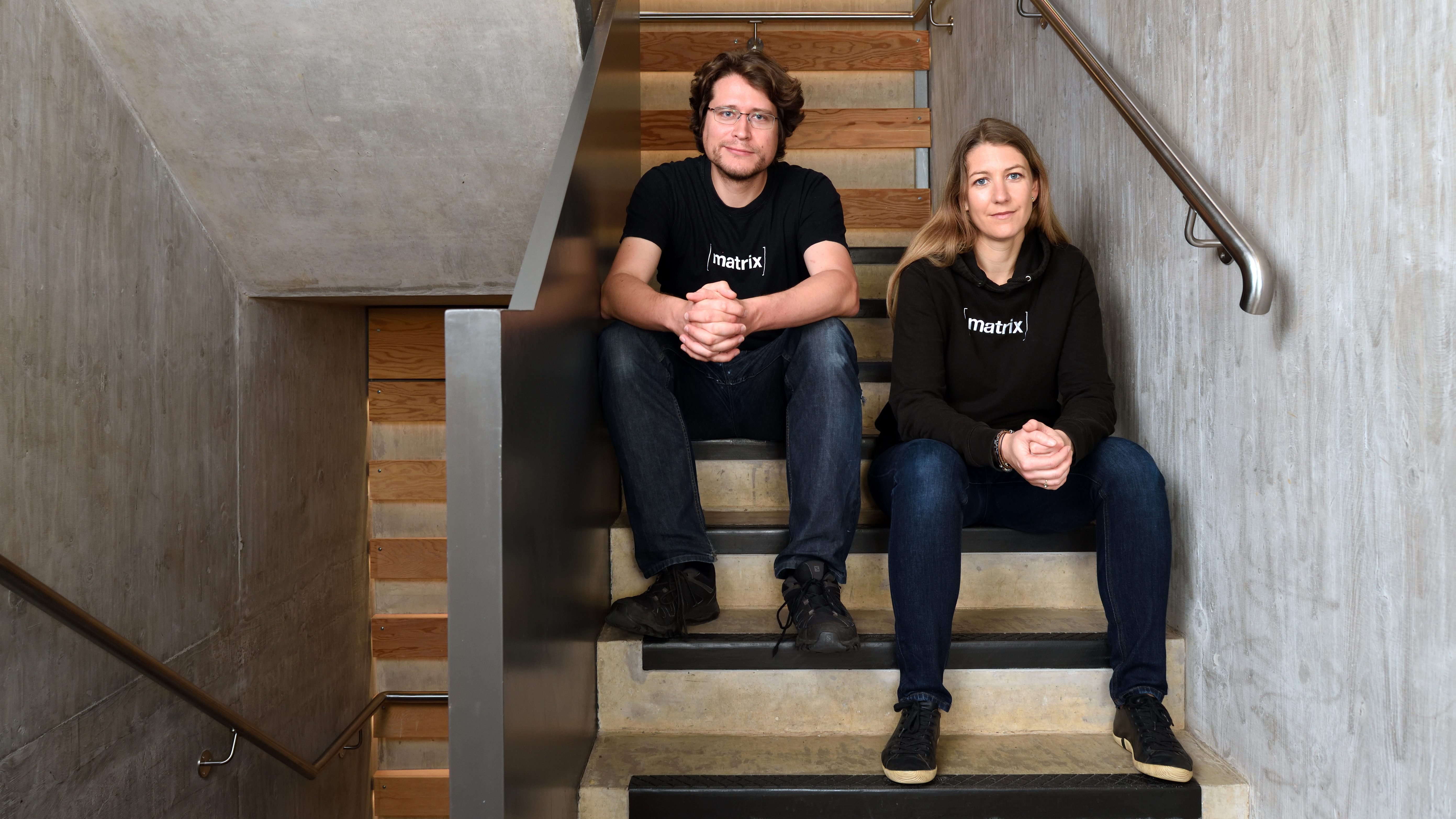
Element founders and Matrix co-creators Matthew Hodgson and Amandine Le Pape. Image Credits: Element

Matrix was developed inside software and services company Amdocs back in 2014, spearheaded by Hodgson and Amandine Le Pape who later left the company to focus entirely on growing Matrix as an independent open source project. They also sought to commercialize Matrix through a company called New Vector, which developed a Matrix hosting service and a Slack alternative app called Riot. In 2018, Hodgson and Le Pape launched the Matrix.org Foundation to serve as a legal entity and guardian for all-things Matrix, including protecting its intellectual property, managing donations and pushing the protocol forward.
The flagship commercial implementation of Matrix was rebranded as Element a little more than two years ago, and today Element — backed by Automattic, Dawn Capital, Notion, Protocol Labs and others — is used by a host of organizations looking for a federated alternative to the big-name incumbents sold by U.S. tech giants.
Element itself is open source and promises end-to-end encryption, while its customers can access the usual cross-platform features most would expect from a team collaboration product, including group messaging and voice and video chat.

Element in action. Image Credits: Element

Element can also be hosted on companies’ own infrastructure, circumventing concerns about how their data may be (mis)used on third-party servers, ensuring they remain in control of their full data stack — a deal-maker or breaker for entities that host sensitive data.
A growing array of regulations, particularly in Europe, are forcing Big Tech to pay attention to data sovereignty, with the likes of Google partnering with Deutsche Telekom’s IT services and consulting subsidiary T-Systems last year to offer German companies a “sovereign cloud” for their sensitive data.
This regulatory push, alongside growing expectations around data sovereignty, has been a boon for the Matrix protocol. Last year, the agency responsible for digitalizing Germany’s health care system revealed that it was transitioning to Matrix, ensuring that the 150,000 individual entities that constitute the health care industry such as hospitals, clinics and insurance companies, could communicate with each other regardless of what Matrix-based app they used.
This builds on existing Matrix implementations elsewhere, including inside the French government via the Tchap team collaboration platform, as well as the German armed forces Bundeswehr.
“The pendulum has been clearly swinging toward decentralization for quite a while,” Hodgson explained to TechCrunch. “We’re now seeing serious use of Matrix-based decentralized communications across or within the French, German, U.K, Swedish, Finnish and U.S governments, as well as the likes of NATO and adjacent organizations.”
Back in May, open source enterprise messaging platform Rocket.Chat revealed that it would be transitioning to the Matrix protocol. While this process is still ongoing, this represented a major coup for the Matrix movement, given that Rocket.Chat claims some 12 million users across major organizations such as Audi, Continental and Germany’s national railway company, The Deutsche Bahn.
“We believe that the value of any messaging platform grows based on its ability to connect with other platforms,” a Rocket.Chat spokesperson told TechCrunch. “We put a lot of effort into connecting Rocket.Chat with other platforms. We don’t have to worry about what client we use when emailing each other, and the same should be true when we’re messaging each other.”

Rocket.Chat. Image Credits: Rocket.Chat

What’s perhaps most interesting about all this is that it runs contrary to the path that traditional consumer and enterprise social networks, and team collaboration tools, have taken.
Slack, Facebook, Microsoft Teams, WhatsApp, Twitter and all the rest are all about harnessing the network effect, where a product’s value is intrinsically linked to the number of users on it. People, ultimately, want to be where their friends and work colleagues are, which inevitably means sticking with a social network they don’t particularly like or using multiple different apps simultaneously.
Open and interoperable protocols support a new breed of business that’s cognizant of the growing demand for something that doesn’t lock users in.
“Our goal is not to force people to use Rocket.Chat in order to communicate with each other,” Rocket.Chat’s spokesperson continued. “Rather, our goal is to enable organizations to collaborate securely and connect with other organizations and individuals across the platforms of their choosing.”
Bridging the divide
The Matrix protocol also supports non-native interoperability through a technique called “bridging,” which ushers in support for non-Matrix apps, including WhatsApp, Telegram and Signal. Element itself offers bridging as part of a consumer-focused subscription product called Element One, where users pay $5 per month to bring all their friends together into a single interface — irrespective of what app they use.

Element One subscribers can bring different messaging apps together. Image Credits: The Matrix Foundation

This is enabled through publicly available APIs created by the tech companies themselves. However, terms of use are typically restrictive with regard to how they can be used by competing apps, while they may also enforce rate limits or usage costs.
Bridging as it stands sits somewhere in a grey area from a “is this allowed?” perspective. But with the world’s regulatory eyes laser focused on Big Tech’s stranglehold on online communications, the companies perhaps don’t enforce all their T&Cs too rigorously.
The DMA came into force in Europe last month — though it won’t officially become applicable until next May — and it has specific provisions for interoperability and data portability. At that point, we’ll perhaps start to see how the Big Tech “gatekeepers” of the world plan to support the new regulations. In reality, what we’re talking about are open APIs that “formally” permit smaller third parties to integrate and communicate with their Big Tech brethren. This doesn’t necessarily mean that such APIs will be slick and easy-to-use with clear documentation though, and we can probably expect some deliberate heel-dragging and hurdles along the way.
Compliance

WhatsApp and Facebook application displayed on a iPhone. Image Credits: Justin Sullivan/Getty Images

Popular messaging apps such as WhatsApp, while offering end-to-end encryption, weren’t designed for enterprise or governmental use cases as they don’t allow organizations to easily manage any of their messaging data — yet such apps are widely used in such scenarios. Back in July, the U.K.’s Information Commissioner’s Office (ICO) called for a government review into the risks around “private correspondence channels” such as personal email accounts and WhatsApp, noting that such usage lacked “clear controls” and could lead to the loss of key information being “lost or insecurely handled.”
“I understand the value of instant communication that something like WhatsApp can bring, particularly during the pandemic where officials were forced to make quick decisions and work to meet varying demands,” U.K. information commissioner John Edwards said in a statement at the time. “However, the price of using these methods, although not against the law, must not result in a lack of transparency and inadequate data security. Public officials should be able to show their workings, for both record keeping purposes and to maintain public confidence. That is how trust in those decisions is secured and lessons are learnt for the future.”
In the business realm, meanwhile, the U.S. Securities and Exchange Commission (SEC) recently settled with 16 Wall Street firms for $1.1 billion over “widespread recordkeeping failures” related to their use of private messaging apps such as WhatsApp.
“Finance, ultimately, depends on trust,” SEC Chair Gary Gensler said at the time. “Since the 1930s, such record keeping has been vital to preserve market integrity. As technology changes, it’s even more important that registrants appropriately conduct their communications about business matters within only official channels, and they must maintain and preserve those communications.”
Maintaining an accurate paper trail, and ensuring that politicians and businesses are accountable for their actions, is the name of the game — a level of control that something like the Matrix protocol promises. However, mandating that every company over a certain size — as the DMA regulation does — has to make their software interoperable with others raises a bunch of questions around privacy, security and the broader user experience.
The encryption elephant in the room

Concept illustration of “elephant in the room.” Image Credits: Klyaksun/Getty Images

As Casey Newton has noted over at The Platformer on more than one occasion, Europe’s new interoperability regulations come with several pitfalls. Chief among them, perhaps, being the hurdles they will create for end-to-end encryption — that is, ensuring that data remains encrypted and impossible to decode while in transit.
End-to-end encryption is a huge selling point for the big technology companies of today, one that WhatsApp hollers from the rooftops. But making this work between different platforms built by different companies is not exactly easy, and many — if not most — experts on the subject say that it’s not possible to enforce a truly secure, interoperable messaging infrastructure that doesn’t compromise encryption in some way.
WhatsApp can control — and therefore promise — end-to-end encryption on its own platform. But if billions of messages are flying between WhatsApp and countless other applications run by other companies, WhatsApp can’t really know what’s happening to these messages once they leave WhatsApp.
Ultimately, no two services deploy their encryption identically, a challenge that Hodgson acknowledges. “End-to-end encrypted platforms have to speak the same language from end to end,” he said.
In a blog post published earlier this year to address encryption concerns, the Matrix Foundation suggested some workarounds, including having all the big gatekeepers switch to the same “decentralized end-to-end protocol” (i.e., Matrix, unsurprisingly) which, by the Foundation’s own admission, would be a large undertaking — but one “we shouldn’t rule out,” it said.
To illustrate this point, Hodgson pointed to Element’s 2020 acquisition of Gitter, a developer-focused community and chat platform purchased from GitLab and used by big-name companies including Google, Microsoft and Amazon. Within two months of closing the deal, Element had introduced native Matrix connectivity to Gitter.
Coordinating such a transition on a Facebook, Google or Apple scale would be an entirely different proposition, of course; one that could cause all manner of knock-on chaos. In a blog post earlier this year, cryptography and security expert Alec Muffett suggested that messaging apps and social networks adhering to the same standard protocol would lead to “no practical differentiation” between different services.
“Imagine a world where Signal and Snapchat would have to interoperate — what would that look like?” Muffett asked TechCrunch rhetorically in a Q&A for this story. “Specifically, which features from one needs to be presented on the other, and what are the differentiators surrounding those features? And how would conflict in functionality be reconciled?”
This is why the Matrix Foundation proposed other potential solutions, such as adopting a TLS certificate-style warning, where the user is alerted to the fact that their cross-service conversation is not fully protected. This is perhaps comparable to how Apple’s Messages app supports both encrypted iMessage texts and (unencrypted) SMS. But according to Muffett, it would bring unnecessary complexity to the mix.
“Apart from any other reason that I could cite, there is any amount of user interface research which explains that security-pop-up-warnings are generally not understood and not heeded,” Muffett said. “There is tons of research to back this up — popup warnings are an ‘anti-pattern.'”
The Matrix Foundation also proposed converting communication traffic between encryption languages in a “bridge,” though this would effectively mean having to break the encryption and re-encrypt the traffic safely somewhere.
“These bridges could be run client-side — for example, the Matrix iMessage bridge runs client-side on iPhone or Mac — or by using client-side open APIs to bridge between the apps locally within the phone itself,” Hodgson said. “Alternatively, they could be run server-side on hardware controlled by the user in a decentralized fashion, ensuring that the re-encryption happens in as secure an environment as possible, rather than on a vulnerable centralized server.”
There’s no escaping the fact that breaking encryption is far from ideal, irrespective of how a solution proposes to reconcile this. But perhaps more importantly, a robust solution for addressing the real encryption issues introduced by enforced interoperability doesn’t truly exist yet.
Despite that, Hodgson has said in the past that the upsides of the new EU regulations are greater than the downsides.
“On balance, we think that the benefits of mandating open APIs outweigh the risks that someone is going to run a vulnerable large-scale bridge and undermine everyone’s E2EE,” he wrote in May. “It’s better to have the option to be able to get at your data in the first place than be held hostage in a walled garden.”
Tip of the iceberg
It’s worth noting that the Matrix protocol, while chiefly known for its presence in the messaging realm today, has other potential applications too. The Matrix Foundation recently announced Third Room, a decentralized and interoperable metaverse platform built on Matrix. This runs contrary to a potential future metaverse controlled by a handful of gatekeepers such as Facebook’s parent company Meta.

For now, Element remains the flagship poster child of what a Matrix-powered world could look like. The company has secured some big-name customers already, such as Mozilla, which is using Element as a fully managed service, while Element said that it signed an $18 million four-year deal with another (unnamed) company this year. Meanwhile, it also has strategic backers, among them WordPress.com parent Automattic, which first invested $4.6 million in Element back in 2020 before returning for its $30 million Series B last year.
In many ways, the ground has never been so fertile for Matrix to flourish: it’s in the right place at the right time, as the world seeks an exit route from Big Tech’s clutches backed by at least a little regulation. Twitter, too, has played more than a bit part in highlighting the downsides of centralized control, playing into the hands of all the companies banging the interoperability drum.
“The situation at Twitter has been absolutely amazing in terms of building awareness of the perils of centralization, providing a pivotal moment in helping users discover that we are entering a golden age of decentralization,” Hodgson said. “Just as many users have discovered that Mastodon is an increasingly viable decentralized alternative to Twitter, we’ve seen a massive halo effect of users discovering Matrix as a way to reclaim their independence over real-time communications such as messaging and VoIP — our long-term user base in particular is growing at its fastest-ever rate.”

WWD : CEO Talks: New Balance Chief Joe Preston Hopes to Double Sales to $10 Bill

CEO Talks: New Balance Chief Joe Preston Hopes to Double Sales to $10 Billion
The Boston-based sports brand is targeting a younger consumer but still embracing the performance runner on which its legacy was built.

Joe Preston is a New Balance lifer.
The president and chief executive officer of the sports brand has been with the company for 27 years. Over the course of his career he has served in a variety of roles, including overseeing the Asia-Pacific and international operations and leading its global product and sports marketing initiatives.
He ascended to the top position in 2018 and since then has been working to double the company’s sales — which are expected to hit $5 billion this year — by partnering with up-and-coming athletes and cultural influencers to attract a younger consumer while never losing sight of the company’s roots in performance running.

Here, Preston, who will be honored by the American Apparel & Footwear Association at the 2023 American Image Awards Gala in April, talks about what makes New Balance unique and its growth strategies for the future.

WWD: You’ve been with New Balance for quite some time. You must have seen a lot of changes over the years.
Joe Preston: I’ve been here since 1995 when the company had sales of $150 million with most of it in the U.S. We went on a real growth spurt between 1995 and 2000/2001, in which we grew to about $1 billion in the U.S. Then our next phase of growth was international. By the time we reached late 2008/2009, we were about $2 billion. And then over the next 10 years, we reached $4 billion. Then COVID[-19] hit and all our stores closed everywhere around the globe and we came back to about $3.3 billion.
WWD: Where are you today?
J.P.: In 2021, we jumped back up to $4.3 billion and in 2022, we’ll end up over $5 billion. What’s changed has been the growth and expansion globally. Today we’re about one-third in the U.S. and about two-thirds outside of the U.S.
WWD: How much of your business is footwear versus apparel?
J.P.: We were predominantly only a footwear company for many, many years. But as we began to expand internationally and moved into markets where there were no third-party retailers, we opened New Balance stores and we needed to make sure that we developed our apparel capabilities. So today, apparel accounts for about 20 percent of our overall footprint and we think there’s huge potential there.
WWD: What hasn’t changed?
J.P.: It’s still a family-owned business. Jim and Ann Davis have been operating it since the ‘70s. Jim bought it in 1972. And that is still a core part of our culture and commitment to community.
WWD: You became CEO in 2018. How have you put your mark on the business?
J.P.: We had a strong run from 2012 to 2015. And then we were basically flatlining through ‘18. And so when I became CEO, in October of ‘18, we tried to hit a reset on how we were going to operate, the categories we were going to focus on. And we put together this mantra called: “Control our Destiny.” This was pre-COVID[-19]. And that was all about getting closer to the consumer and controlling the things we could. We’ve long been a really good wholesale partner but when you operate direct-to-consumer, it allows you to get closer to that consumer. You have a direct connection, you can understand where and how you need to pivot. So that was a key point for us. We began this whole digital transformation before COVID[-19] that served us well as we came back into 2020. Basically all of our business was online during those months when all our stores were closed. So we basically rewired the company on the front end, from a design and development standpoint, and then the back end, all the way through our supply chain. And we’re still in the midst of it. We think it’s going to continue to revolutionize how we operate.

WWD: What lessons did you learn during the pandemic?
J.P.: The biggest thing is that it really allowed us to operate more like a global brand. We began a 7:30 a.m. Tuesday morning meeting that we still have today with our functional leaders in our geographic areas all at the table online. And it really allowed us to develop our action plan. We also implemented the “Agile Methodology,” which is usually used just in technology. But we brought it into our leadership team. What we were doing is running 30-, 60- and 90-day sprints in which we would have leaders who had the authority, autonomy and accountability to develop action plans within that time period. And so it allows us to really accomplish a lot and I fundamentally believe that’s the reason why we are in the position we are today.
WWD: You used to rank third behind Nike and Adidas in performance footwear. Where do you stand now?
J.P.: It’s a little hard to delineate between what’s performance footwear and what’s not. But the goal that we set in the 2012 to 2015 time frame was to be the number-three athletic brand. That’s what drove us entering categories other than running. Around 2012, we entered into baseball and signed Dustin Pedroia [formerly of the Boston Red Sox] and a couple of other players. And today about 25 percent of Major League players wear our brand. And if you go to any of the AAU [Amateur Athletic Union organization] games around the country, you can see New Balance all over the field. So that also gave us confidence that we could move beyond what our core had been.
Los Angeles Clippers small forward Kawhi Leonard is a New Balance ambassador.
WWD: What came after that?
J.P.: We reentered basketball and signed Kawhi Leonard. And today we have a handful of NBA players that are on our roster of athletes. Then we entered global football, or soccer — first with a team deal, then with two of the arguably top five players in the world with Sadio Mane [who plays for Bayern Munich] and Raheem Sterling [who plays for Chelsea in the U.K.]. So now we have running, basketball, soccer — those are the core categories for us. But running is obviously a big one in our roster of athletes: Sydney McLaughlin for one. She’s the world record holder [in the 400-meter hurdles], and I think that’s allowed us to strengthen our performance credibility as we branch out.

WWD: You’ve got some newer running shoe brands such as Hoka and On that are making big inroads among consumers. How do you keep up with these upstarts who want to take market share from you?
J.P.: I think you have to have teams that are focused in specific areas. For example, our running team is an experienced group. And it’s not about design. It’s about development. It’s about engineering. And it’s also about how you’re servicing the running specialty retailers here in the U.S. and throughout Europe. You’ve got to really stay on each one of those categories, you’ve got to wake up every day and live it. We have teams like that on other categories too, including lifestyle — people who look specifically at what the current trends are and where they’re going. And applying those is a key part of trying to be successful.
WWD: Where have you had the most success as you branch out into other sports?
J.P.: Baseball has been a huge success for us. But with all these other categories that we’ve entered, it is two things. First, it’s the credibility from the performance standpoint, and then it’s the connectivity with the younger consumer. And that has allowed us to sell not just the performance basketball shoes or soccer boots, it has also allowed a crossover to our lifestyle product. In lifestyle, the energy is coming in part from those athletes as well as entertainment ambassadors that we have. The way our marketing and brand teams have brought those stories together along with our product teams which are creating silhouettes and color and materials that are trend-right, is delivering significant momentum for the company.
WWD: Let’s talk a little more about your lifestyle product. You’ve collaborated with a lot of different people including Todd Snyder, Kith, and Stone Island. How do you make that jump without alienating the customer who has been running marathons in your shoes forever?
J.P.: I’m not afraid of us alienating someone who’s been buying our performance running shoes for years. And so long as we’re continuing to deliver the fit, the feel and the performance of those products, we should be able to retain them. The collaborations that we have done brought great energy to the brand. We’re very selective in who we work with and how they are brought to market. And I think that’s an important element. There’s a lot of diligence and execution from our brand and commercial teams to make sure they are brought forward with authenticity. And that’s been quite successful.

WWD: Which ones have been the most successful?
J.P.: We’ve had a relationship with Ronnie [Fieg] of Kith for a long time. And our relationship with Teddy [Santis] of ALD [Aime Leon Dore], as creative director of our Made in USA line, has been excellent. With all our collaborators, we’re trying to work with companies and individuals that we think share our brand values.
WWD: You mentioned Teddy Santis. What does he bring to the table and where do you see the relationship going in the future?
J.P.: He brings out the core authentic values of our brand. I look at his design language and it’s so strong and clear. And he’s brought that to our Made in USA footwear and apparel items. He’s been a great partner.
WWD: Other brands have had problems when their celebrity ambassadors go off the rails. How do you identify who you want to work with and ensure they’re the right fit?
J.P.: We have a sports marketing team and a brand ambassador team, so they are constantly looking at who’s out there and who we think would be a great fit to team up with, whether it’s a specific product collaboration or someone we think would be good to team up with. Our mantra is to be fiercely independent. Sometimes it can be easier for athletes or brand ambassadors just to go with the biggest brands out there. But we think we offer a bespoke approach that allows them to show their personalities. I think many have seen the way we have executed our brand and marketing efforts and that builds upon itself.
WWD: Who are some of your most popular ambassadors today?
J.P.: Jack Harlow, the musician. He was a New Balance fan before we entered into an agreement with him. And he’s been great.
WWD: Anybody else on your wish list?
J.P.: There are a lot, but they wouldn’t let me back in the building if I told you. But the intersection of sport, fashion and music has a lot of energy and we think there’s an opportunity for us to continue to try to find synergies in an authentic way for our brand.
The New Balance headquarters in Boston.
WWD: Who is your customer and what’s the breakdown between men’s and women’s?
J.P.: It’s getting a little hard to answer that question these days because of unisex sizing, but we skew a little more male to female. Performance running is slightly more female to male. If you see young people wearing our brands, some of them are athletes and others just like the fit, the fashion and the trend element. We’ve always had a big tent from a brand perspective, which gives us good opportunity for growth.

WWD: How do sales break down between lifestyle and performance?
J.P.: Pure play lifestyle is definitely bigger than performance, but it really depends on the market. In the U.S., performance is a higher percentage of our overall total revenue than it is in China or Korea.
WWD: How is your business in China, considering the situation over there right now?
J.P.: We have a big presence over there and we’re growing in China, but it’s definitely been curtailed by the situation. When you’re shutting down major cities for days or weeks upon end, it certainly impacts retail in those districts.
WWD: Where do you see apparel going in the future? Do you see it becoming a bigger part of the business?
J.P.: It’s a key part of our growth over the next three to five years. And we have a new head of apparel, Julie Pike. We’re really trying to get everything in order for it to begin acceleration in 2024. And again, with d-to-c being an important part of our overall business in particular markets, growth in apparel is imperative.
WWD: How many stores do you operate and where?
J.P.: We own 475 stores and there are another 3,000 third-party stores. We own and operate stores in the U.S., throughout Western Europe, Japan, Hong Kong and the Pacific.
WWD: Is retail something you’re going to be rolling out or do you think those numbers are going to remain steady?
J.P.: We think it’s an important part of us getting closer to the consumer. But we’re still going to be a wholesaler. We still have strong relationships with some of the biggest retailers around the globe, as well as some of the smallest and most strategic retailers around the globe, specifically run specialty and lifestyle specialty stores. And we think that is also an important part of our bringing our brand to consumers.
WWD: With some of your competitors, their retail stores offer a lot of bells and whistles. Is that something that you feel necessary for your stores as well, or are they more product driven?
J.P.: You have to meet the consumer where they want to shop, how they want to shop and when they want to shop. So everyone that’s coming into one of your stores begins their journey, usually on their phone, on their way or at home. So it’s not just about the in-store experience. It’s about the whole consumer journey. We have a major focus to try and understand that journey by category, because the journey for someone coming in for a performance running product is different than for someone who’s coming in looking for the latest release. And so when they get to the store — or post-purchase — you want to make sure it’s a seamless experience.

WWD: Made in the USA has been a big focus of New Balance. You just announced you’ll be investing $65 million to expand your factory in Skowhegan, Maine. How many factories do you have?
J.P.: We have three in Maine, two in Massachusetts and one in the U.K. And we’re building a distribution center in Tennessee. We opened a second facility in Massachusetts earlier this year. Domestic manufacturing is also about community. The communities where we own and operate these factories benefit at a number of different levels, from the employment of course, but also the giving and involvement that New Balance has for decades.
WWD: Did you benefit from having all of these domestic plants when there was such an issue with supply chain around the world?
J.P.: We’ve had the factory in Lawrence, Massachusetts, since 1982. When all the other brands went overseas, Jim kept his U.S. factories. Of course, they had to shut in March of 2020 but a couple opened back up 10 days later making masks — anything we could do to help the front line at the time. COVID[-19] threw wrenches into any sort of steady-state production, including domestic manufacturing, so it had been a challenge, but it’s operating effectively right now.
WWD: Do you think corporations have a greater responsibility in strengthening American cities post-pandemic?
J.P.: It’s always been part of New Balance. We’ve had four global headquarters, all of them within a quarter mile of where the first one began, just outside of Boston in Brighton. And domestic manufacturing is another example of that. It’s always been an important part of who we are, trying to do good in communities where you live and work.
New Balance recently opened The Track, a new headquarters and research facility.
WWD: You recently opened The Track in your hometown of Boston, a massive multisport facility and sports research lab. Why did you want to invest that kind of energy into a new facility?
J.P.: It was a 10-year project that included the building of new global headquarters. Next door to that was the building of a Bruins practice facility. And then next to that a Celtics practice facility. So both those teams practice in these buildings that are right next to our global headquarters. Across the street, the track opened up this past April and that’s really a great example of community. The track season is 100 days long so the local colleges and high schools will be in there. And the other 250 days of the year, it’s occupied by other activities, whether that’s indoor soccer, basketball or other things that communities come in and participate in. Also, within there, there is a 3,500-person music venue and a 17,000-square-foot [research and development] innovation center for all sports. That’s where our future is going to be created from a product standpoint. This was Jim’s vision of building a New Age headquarters and reenvisioning the area.

WWD: Where do you see New Balance going in the next five years?
J.P.: From a growth standpoint, we laid out a refreshed long-range plan in 2019 — unbeknownst that we’d be facing COVID[-19] a year later — that we refreshed in the middle of 2020, to grow from $7 billion to $10 billion. We didn’t put a date on the $10 billion because we could grow a lot quicker if we wanted to. But it’s not just about total growth, it’s about the quality of that growth. So we have been spending the last three years really trying to strengthen our distribution, introduce new products that are higher-end. And that has helped us be successful. So from a growth standpoint, we believe we can reach $10 billion over the next few years.
WWD: Tell us a little bit more about your management style. Did you have a mentor?
J.P.: Well, I’ve worked with Jim Davis for 27 years — he’s been a great mentor. He’s a real entrepreneur and an eternal optimist. He understands how to operate as a global company and also the importance of being strong in your own community. So that’s had a big influence on me. I think there’s been a lot of carnage with COVID[-19] but the silver lining is the way our team became action-oriented. I fundamentally believe these 30-, 60-, 90-day sprints have been a key part of us trying to operate faster with agility to not just detect consumer trends, but react and respond with products and programs to address it.
WWD: Are there any other Davis family members in the company?
J.P.: Yes, Chris Davis, their son, is our chief marketing officer and he’s doing a great job. And Kassia Davis is president and CEO of PF Flyers and worked for New Balance for a number of years. She also has her own women’s brand [the sustainable fashion brand Kada] that she started from scratch that is completely separate from New Balance.
WWD: New Balance used to own PF Flyers until you sold it to Kassia. What other brands do you own?
J.P.: We also own Warrior, a lacrosse and hockey brand.
WWD: Are you exploring acquiring any other brands?
J.P.: There are always inquiries that come to us to acquire companies. But we believe the opportunity we have with the brand in front of us is significant and exciting. And that’s where we’re focused.