Global bonds rally as investors bet peak in interest rates is near
ECB and BoE join Fed in hinting they may be approaching the end of rate-rise cycle
A global bond rally gathered momentum on Thursday after the Bank of England and European Central Bank joined the Federal Reserve in hinting that they may be nearing the end of their cycle of rate rises.
Both the BoE and the ECB raised borrowing costs by half a percentage point, following Wednesday’s smaller quarter-point rise by the Fed. While all three moves were widely expected by markets, investors seized on signs that rates may be close to peaking on both sides of the Atlantic to pile into government debt.
Wall Street stocks built on the previous days gains, following an earlier rally in Europe.
“Markets wanted to rally and are getting very excited, looking past anything slightly more hawkish” said by officials at the three central banks, said Matthew Rees, head of global bond strategies at Legal & General.
The yield on the 10-year German Bund, a regional benchmark, slipped 0.19 percentage points to 2.10 per cent, while the yield on the equivalent UK and Italian government bonds fell 0.21 percentage points and 0.34 percentage points respectively, following a rally in US Treasuries in the previous session.
The BoE’s half percentage point interest rate rise was widely anticipated by investors, though the bank’s statement that any further increases would require evidence of “more persistent” inflationary pressures knocked the pound, which traded 0.8 per cent lower against the dollar at $1.227 shortly after the decision.
The ECB later raised rates by the same amount and said it intended to replicate the move at its next meeting in March, “opening the door to either a pause or a slower rate hike” after that, said Carsten Brzeski, global head of macro at ING.
The euro fell 0.9 per cent against the dollar to $1.089. In equity markets, the region-wide Stoxx Europe 600 added 1 per cent, while London’s FTSE stood 0.6 per cent higher.
The moves followed Wednesday’s gains on Wall Street, which were triggered in part by Fed chair Jay Powell’s comments at a question-and-answer session with journalists.
“Reading between the lines of [Powell’s] remarks, we see the first baby steps towards a looming pause in rate hikes following the expected March hike, and ultimately a pivot to rate cuts later this year,” said analysts at Bank of America.
Wall Street’s benchmark S&P 500 hit its highest level since August in the previous session and rose a further 0.7 per cent early on Thursday. The tech-heavy Nasdaq 100 climbed 2.2 per cent to its highest point since September. Shares in Meta surged 19 per cent on stronger than expected fourth-quarter revenue and a promise from chief executive Mark Zuckerberg that 2023 would be “the year of efficiency”.
The dollar index, which tracks the US currency against a basket of six currencies, traded 0.5 per cent higher, having slipped more than a tenth in the past three months as the pace of interest rate rises has slowed.
Powell used his press conference to acknowledge that “for the first time the disinflationary process has started” in consumer goods, which markets interpreted as dovish, though he added that disinflation had yet to set in across the core services ex-housing part of the price index. Despite a slowdown in economic growth, the labour market remained “extremely tight”, Powell said.
Unlike the Fed, however, markets expect March’s rate rise to be the central bank’s last and are pricing in the possibility of rate cuts in late 2023. “We’ll just have to see,” Powell said.
Barclays analysts said Powell’s press conference “sent mixed messages, reiterating that the committee’s work is not done, but showing reluctance to lean against easing financial conditions”.
In Asia, Hong Kong’s Hang Seng index dipped 0.5 per cent, China’s CSI 300 slipped 0.3 per cent and Japan’s Nikkei rose 0.2 per cent.
Prada, Gucci and Moncler Top the Lyst Index for Q4 in 2022
Italian fashion dominated Lyst’s quarterly ranking of the industry’s hottest brands.
MILAN – Who’s the hottest of them all? The question that constantly echoes in the Lyst offices was once again answered in Italian.
According to the latest installment of the Lyst Index report, which quarterly ranks the most sought-after brands and products, Prada, Gucci and Moncler were top of mind in Q4 of 2022, closely followed by Miu Miu and Valentino.
Prada replaced Gucci at the top of the ranking, with searches for its products increasing 37 percent between October and December and with the Prada logo slingback shoes being the fashion house’s fourth item to enter the separate list for hottest products last year.
Moving up 14 places into the third position, Moncler scored its highest ever Lyst Index ranking since the fourth quarter in 2020 – reflecting a 76 percent spike in searches during the holiday period.
Bottega Veneta and Loewe gained five and seven positions respectively. Incidentally, actress Margot Robbie deserves some credit for the Italian brand’s jump, as she created buzz – and plenty of memes – wearing a Bottega Veneta custom jersey dress to the Governors Awards in November, consequently causing searches for the item to skyrocket 143 percent in 24 hours.
Dior was the eighth most desirable brand in the index, followed by Dolce & Gabbana and Saint Laurent, both gaining three positions.
After a controversial end to the quarter, Balenciaga slipped seven positions into the 11th spot, falling out of the top 10 for the first time since the Lyst Index was launched five years ago.
Nike and Versace came 12th and 13th, while Fendi, Louis Vuitton and Diesel lost seven, six and eight positions respectively to rank between the 14th and 16th spots.
Entering the report for the first time, Ugg stepped into the 17th place, supported by a strong Gen Z following and over 1.2 billion mentions on TikTok. Searches for the brand’s Ultra Mini boots spiked 82 percent in searches over the holidays.
Burberry, Coach and Jacquemus completed the top 20.
A “Breakout Brands” category introduced last year to highlight the fastest-growing labels outside this list made a return. For the quarter, it included Alaïa, boosted by placements on celebrities as well as Jenna Ortega’s viral dance as “Wednesday Addams” that totaled 1.7 billion views on TikTok, as well as 16Arlington and Mugler, whose searches were up 56 percent and 49 percent, respectively.
As for the 10 hottest product ranking, the Saint Laurent Icare quilted bag stood on the higher step of the podium, beating the footwear competition of the Prada logo slingback shoes and Dr. Martens Leonore Chelsea boots.
The rest of the list reflected such a duality between partywear and comfy options, with the 16Arlington Solaria dress and Mach&Mach heels with a crystal double bow ranking fourth and eighth, respectively, and sandwiching Acne Studios’ mohair checked scarf and the Loewe padded bomber jacket. The latter was seen on the likes of Hailey Bieber, Kendall Jenner and Taylor Russell and generated 478.5 million views under the dedicated hashtag on TikTok.
The Bottega Veneta Sardine bag, Miu Miu’s logoed satin briefs and the Crocs x Salehe Bembury clogs were also among the most desirable products.
The hottest products in the fourth quarter of 2022, according to the Lyst Index. COURTESY OF LYST
To compile the report, Lyst analyzes the online shopping behavior of more than 200 million active users a year searching, browsing and buying fashion across brands and stores online. The formula behind the index includes searches on and off platform, product views and sales, as well as social-media metrics, such as brand and product mentions and engagement statics worldwide.
“Five years ago we wanted to make a definitive world-famous fashion chart, like the Billboard Hot 100 for music,” said Katy Lubin, vice president brand and communications at Lyst. ”What data tells us quarter after quarter is that the brands in the index drive culture… Together they shape demand, pioneer innovation and build value for entire industry. And while there’s often movement up and down, once you get to the top of the chart, it’s an exclusive club: 65 percent of the brands from the first Lyst Index are still in the top 20 today, and since it started only 16 brands have been able to enter the list. I did worry that with so little movement the report could get a little bit boring but thankfully in fashion there is always something to talk about, and so the data tells a thousand stories and right now what we’re seeing are lots of little fires.”
These included “trends moving faster and becoming more localized; communities becoming more micro and more engaged… small brands coming in hot, revival brands rising fast, climbing up the index… This is a new environment, a new customer mindset and there’s huge power in this shift away from mass global moments and towards building deep, meaningful relationships with individual customers. We are watching the communities surrounding the brands become more and more active stakeholders in their success,” Lubin said.
As numbers can tell only a part of the story, to celebrate the fifth anniversary of the index Lyst went straight to the source and asked directly some of the hottest labels how they succeed to spark, maintain or further fuel the heat.
On Tuesday evening the company and its chief executive officer Emma McFerran hosted an event gathering industry leaders and designers at the Milan campus of the Accademia Costume & Moda fashion school to address the topic. Panelists included Remo Ruffini, chairman and CEO of Moncler; Lorenzo Bertelli, Prada Group’s marketing director and head of corporate social responsibility; Jacopo Venturini, CEO of Valentino; as well as Emilio Pucci’s artistic director Camille Miceli and Palm Angels’ founder Francesco Ragazzi.
While designers deep-dived on the importance of community and culture in their work, the executives offered intel on their businesses’ secret sauce.
Ruffini was generous in listing ingredients, mentioning energy, uniqueness, patience and focus among these. “You have to be concentrated on your own products and ideas, not watching too much around… And to be really tuned with all generations – from young kids to a more mature crowd, especially in this moment when the trend has changed and we’re going to a cleaner approach [in products],” he said.
To this end, Ruffini underscored that “voices are never enough” to connect and engage with a wide array of communities, cultures and markets. Being flexible in adapting strategies and the vision to the macro changes was another key element for him.
“Of course, having great ideas and a great execution, which you have to do simultaneously, but also to dream,” said Bertelli about his own formula. “You need to have the time to dream and brainstorm by yourself, to do strategic or later thinking and get inspired. I’m not spending too much time just on fashion,” said the executive about balancing a deep-dive on a specific aspect of the business and zooming out of it – an exercise he said to come natural to him “maybe because I studied philosophy at university.”
Venturini was all about authenticity, instead. “For me it’s a little bit different because I worked for different companies. I don’t think there’s a single recipe, every firm is different from the other, its values and roots are different. The most important thing is being authentic in the brand you work in,” he noted.
As CEO of Valentino, such a process started from repositioning the company “where it deserves to be as the most legitimate Italian brand of couture.”
“Being a maison of couture doesn’t mean only to do couture shows or dresses but having couture in the blood of the company, so having couture manners, intimate relationship between premieres and customers, an obsession for details and a very small, cozy and warm environment. These are the values that should be translated into the contemporary world, in the way we behave, in the way the stores are or we welcome our customers [there],” said the executive.
Asked about maintaining the brand’s heat over time, Venturini once again addressed the roots. “Everything starts from creativity,” he said. “Now I’m a CEO but I’ve been a merchandiser for many years and I learned to have a lot of respect for creativity… For me it’s an energy generator and I feel the responsibility to maintain this energy until it hits the store. So there’s a long process but you have to be coherent in everything you do [throughout it],” Venturini said. He pointed to the brand’s Pink PP show as an example, highlighting how the concept trickled down to stores’ reconfiguration, ads, website and social media accounts to keep “the strength of the creative idea” over the span of a semester.
“It’s very difficult [to maintain the heat]. I always say that the most important thing is to change before something happens, change before it’s too late. Even if the business and reactions are good, you have to understand what’s the next step of the brand,” offered Ruffini.
“Sometimes it’s really about being brave and just go with the idea,” echoed Ragazzi, while Miceli stressed the power of repetition and urged to “insist, insist and insist in your message.”
“My job every day is making beautiful things. It’s very simple and immediate and it gives people a way of showing their personality and transmit something about joyfulness and being well with yourself. It’s all we need today,” said Miceli, underscoring that her work is made easier given the colorful fashion house she helms creatively.
“A brand today has to create value to pass to its community but also to entertain, to be able to bring energy, stimulate customers and create something they have never seen,” added Ragazzi. The designer underscored the personal need to approach his brand with mixed media, spanning from clothing and photography to Formula 1 activations, like the partnership recently inked with the Haas team. “It’s all about catering the interests of your community and clients and try to reach them in different fields… I want to connect the dots and be right where they go on holiday, listen to music and so on,” he said.
Students in the audience asked for the ultimate tip, and the advice varied.
“Make sure you have knowledge, so study and travel a lot. That helps in having great ideas, and then have more knowledge on how to execute, because I always think that a product is not just a product but also comes with how you’re going to communicate it, they are just one thing for me,” offered Bertelli.
“I think you should continue to be curious,” agreed Venturini. “And you need to be humble because times change very fast and the taste of the customer is changing…. [Along with being] passionate in what you to do, [these] are for me the three key elements, no matter if you have success or not. If you don’t have success, you will have it: you learn by your mistakes, you learn by doing. There is no other way,” he concluded.
François-Henri Pinault’s Surprise China Trip Boosts Ties With Local Government, Retailers
The whirlwind trip is taking the Kering head to Shanghai, Beijing, Chengdu and Nanjing, where he has been meeting with local government officials, important landlords, making store visits and catching up with the local team.
SHANGHAI — François-Henri Pinault, chairman and chief executive officer of Kering, is making a surprise visit to China right after Chinese New Year.
Pinault is one of the first luxury executives to visit China since the country reopened its borders in late December. Pinault’s last trip to China was three years ago, just before the coronavirus outbreak in Wuhan.
The week-long whirlwind trip is taking Pinault to Shanghai, Beijing, Chengdu and Nanjing, where he has attended meetings with local government officials and important landlords, made store visits and hosted a town hall meeting with Kering’s China team.
During his meeting with Shanghai Party Secretary Jining Chen on Wednesday, Chen said the local government welcomed Kering’s increased investment in the Shanghai market and urged Kering to facilitate more cross-cultural exchanges between France and China.
“This will eventually fufill President Xi Jinping‘s vision of Shanghai, to transform the city into an influential socialist modern city as well as improve the livelihoods of our people,” said Chen.
Pinault reassured Chen of the importance of Shanghai and the broader China market to Kering. He told Chen the company has plans to “reinforce strategic investment in Shanghai that combines the company’s sustainable enterprise innovations and digital transformation know-how.”
“We will continue to make good use of the China International Import Expo platform to release new products, technologies and services. We will contribute to Shanghai’s rise as a global consumption center,” Pinault added.
In between his meetings, Pinault has been making quick visits to Kering brands’ stores at key shopping malls, including Plaza 66 and IAPM in downtown Shanghai.
Accompanied by Jinqing Cai, Kering’s president of Greater China, Pinault has spent time chatting with store managers and employees to boost morale and has been all smiles in group photos he took with the local team.
“We were quite nervous and spent a week preparing for his visit. But he seemed satisfied and impressed by our store. He even took the time to see the store inside out a few times,” a Balenciaga sales associate at the IAPM flagship told WWD.
“He avidly shook our store manager’s hand before leaving, I heard he rarely does it,” the employee said.
Balenciaga’s chief executive officer Cédric Charbit and Saint Laurent’s chief executive officer Francesca Bellettini are accompanying Pinault on his China visit. It is believed that visits by global heads at Kering’s other brands, including Gucci, Bottega Veneta, Boucheron and Alexander McQueen, will swiftly follow.
Pinault also took a half-day trip to Nanjing, specifically to meet with Tiejun Wu, the founder and chairman of Deji Plaza, a top-performing Chinese shopping mall that raked in more than 21 billion renminbi, or $31.2 billion, in 2022.
Wu is one of the most prominent collectors of traditional Chinese art and is also believed to be a top client at Christie’s, the auction house acquired by Pinault in the mid-1990s.
Following his Shanghai trip, which also included a festive company town hall meeting that featured a traditional Chinese dance performance, Pinault’s last stop will be Beijing, where he will meet with Ji Xiao An, the chairman of SKP, widely considered the best luxury shopping mall in China.
Pinault will also meet with executives at WF Central, an up-and-coming luxury shopping mall close to the Forbidden City.
Pinault’s visit spotlights the company’s confidence in the China market post-reopening. Despite macroeconomic uncertainty and other risk factors, Barclays predicts the Chinese luxury sector will grow by 15 percent in 2023.
The Asia Pacific market, excluding Japan, currently accounts for 33 percent of annual sales for the company, according to Kering’s third quarter results.
A recent HSBC report stated, though, that a “stronger team in Mainland China…could help the brand converge towards peers’ sales growth regardless of the fact it will be in a transition period.”
Kering will report fourth quarter and full-year report on Feb. 15.
Pinault’s China trip unofficially kicks off a series of executive visits to China in the coming months.
It is understood that Bernard Arnault, chairman and CEO of LVMH Moet Hennessy Louis Vuitton, will travel to China soon.
Arnaud Carrez, marketing and communications director of Cartier, is also understood to be planning a China trip in the coming months.
Capri Holding’s John Idol and Michael Kors’ newly anointed chief executive officer Cedric Wilmotte also have plans to visit China in March, the company’s local team confirmed to WWD.
Ferrari raises outlook after record-breaking 2022
Luxury brand boosted by demand in China and US
Ferrari projected even higher sales and profits this year after delivering record results in 2022, driven by demand across the Americas and China, as it shrugged off the spectre of an economic downturn.
The supercar brand’s net profits, revenues and cash generation hit record levels last year, as luxury buyers splashed out for more models and spent ever-higher sums on personalised features.
Sales growth was driven by its entry-level Portofino M, and higher demand for its hybrid hypercar, the SF90.
In China, sales rose 73 per cent to 1,552 models, while in the Americas they rose 22 per cent 3,447 cars. Europe was still the largest market, up 8 per cent at 5,958 cars.
Bespoke additions, from interior fabrics to distinctively coloured brake callipers, are a mainstay of Ferrari’s business, adding tens of thousands of pounds to the cost of its models that already begin at £170,000.
Net profits last year rose 13 per cent to €939mn, after a 19 per cent rise in shipments and sales to 13,221 and €5.1bn. Free cash flow when finance deals were stripped out rose 18 per cent to €758mn.
The brand expects 2023 sales to be about €5.7bn, up from €5.1bn last year, with pre-tax profits between €1.45 and 1.5bn, compared with €1.23bn in 2022.
It also projects its profit margin, which last year was 24 per cent, will rise to 26 per cent.
“Despite a complex global macro-scenario, we look ahead with great confidence, encouraged by the many signs and achievements of an evolving Ferrari,” said chief executive Benedetto Vigna.
Daniel Röska, an auto analyst at Bernstein, said the company beating expectations was “groundhog day”, and that it may even be boosted by a wider global downturn.
“Recession risk in 2023 provides yet another margin of safety, as investors focus on Ferrari’s status as a safe-haven asset,” he said.
Ferrari’s buoyant outlook “suggests management has good confidence in 2023 mix and margin”, said analyst Tom Narayan at RBC.
This year will see the first sales of the Purosangue, the first high-riding Ferrari, as the brand enters the sport utility vehicle market for the first time.
Although Ferrari will not use the model to drive higher sales, unlike Porsche and Bentley, which have seen significant sales growth from SUVs, the model is expected to help Ferrari increase margins.
Some 22 per cent of its models sold last year were hybrid, with the rest running on combustion engines alone. The brand is preparing to launch its first fully electric car in 2025.
Ferrari’s revenues from selling engines to other companies fell 18 per cent to €155mn, due to lower shipments to Maserati ahead of the end of the supply contract between the two groups.
Asian shares advanced with US and Europe futures on Thursday, extending a rally on Wall Street after Federal Reserve Chair Jerome Powell said the central bank had made progress in its battle against inflation. A benchmark of Asian stocks climbed about 0.7%, with Hong Kong-listed technology companies among the top performers. The picture was more mixed in Japanese and mainland China markets, while Adani Group companies led the Indian market lower. The dollar continued its decline against both Group-of-10 and emerging-markets currencies. A gauge of the greenback’s strength was at the lowest level since April as global investors position for a potential peak in US interest rates. Positioning in US swaps markets assumes the Fed is getting closer to cutting rates as traders bet that economic conditions are likely to keep it from the additional rate increases that policymakers still anticipate. Adding to the positive tone for risk taking, in US after-hours trading, Meta Platforms Inc. surged, leading social-media stocks higher, after reporting better-than-expected sales during the holiday quarter. The Adani Group’s deepening crisis continued to rumble through markets on Thursday. Adani Enterprises Ltd. tanked as much as 10% in early Mumbai trading, after the company said it abandoned its follow-on share sale to insulate investors in the offering from potential losses. The other nine stocks in the group also fell. Bonds of the Indian billionaire Gautam Adani’s flagship firm plunged to distressed levels in US trading. Gold hovered around a nine-month high and Bitcoin hit the highest since August in the wake of Fed decision. Later Thursday, central banks in Europe will be center stage with both the European Central Bank and the Bank of England expected to raise rates by half a percentage point each. US After Hours META +18.7% shocks investors with strong earnings, online ad peers higher in sympathy; ALGN +15.6%, ELF +13.3% also higher on earnings; CHX -8.6%, MXL -7.5%, QRVO -4.4% lower on earnings.
Nikkei +0.14% Hang Seng +0.41% CSI +0.06% Shanghai +0.29% Shenzen +0.41%
Eur$ 1.1025 CNH 6.7152 CNY 6.7130 JPY 128.41 GBP 1.2396 CHF 0.9067 RUB 69.7447 TRY 18.8160 WTI$ 77.13 Gold 1,954 +0.17% BTC 23,900 +0.92% ETH 1,675 +2.42%
S&P +0.30% Nasdaq +0.91% EuroStoxx +0.62% FTSE +0.37% Dax +0.58% SMI +0.37%
Macro :
- Abby Cohen Is Cheered by Markets’ Revaluation, Wary on Leverage
- Gundlach Tells CNBC Odds of A 2023 Rate Cut A ‘Coin Flip’
- Powell Vows Fed Not Done Hiking Rates and Markets Rally Anyway
- Adani Crisis Deepens as Stock Rout Hits $104 Billion, Bonds Sink
- ECB to Hike Again With Attention on What’s Next: Decision Guide
Keep an eye on :
Keep an eye on :
- ABBN SW : ABB 4Q Operating Ebita Misses Estimates
- ABBN SW : ABB Sees Order Growth Easing in 2023 With Inflation Uncertainty
- ASMI NA : ASMI to Invest ~$100M by 2025 in Korean R&D Site (Feb. 1)
- ATVI US : Microsoft Receives EU’s List of Concerns About Activision Deal
- AIR FP : Airbus, Qatar Airways Reach Settlement in A350 Paint Dispute
- AIR FP : Airbus, Qatar Airways Reach Settlement in A350 Paint Dispute
- AI US : OpenAI Introducs ChatGPT Subscription Plan of $20/Month
- BARC LN : *BARCLAYS SAID TO WEIGH BOOSTING BONUS POT FOR FICC TRADERS
- BNP FP : SocGen, BNP Among Entities Studying Bids for Orange Bank: Echos
- BONAVA SS : Bonava FY Dividend per Share Misses Estimates
- BRG NO : Borregaard 4Q Operating Revenue Beats Estimates
- CAPMAN FH : CapMan FY EPS Misses Estimates
- CO FP : Casino Group Confirms Exploratory Talks With Teract
- CSGN SW : Credit Suisse Weighs Splitting China Team in First Boston Revamp
- DSY FP : Dassault Systemes Sees 1Q Non-IFRS Oper Margin 30.7% to 31.3%
- DBK GY : Alfa Laval 4Q Adjusted Ebita Beats Estimates
- DTE GY : Deutsche Telekom Completes Majority Stake Sale in GD Towers Unit
- DOF NO : DOF ASA Says Creditors Requests to Open Bankruptcy Proceedings
- DSV DC : DSV 4Q Revenue Meets Estimates
- DWS GY : DWS FY Net Outflows EU19.9B, Est. Outflows EU18.03B
- EDF FP : French MPs Seek To Block Post-Nationalization EDF Asset Sales
- ENI IM : ENI May Sell up to 10% Stake in Plenitude Unit: MF
- EPR NO : Europris 4Q Net Income Beats Estimates
- EVO SS : Evolution 4Q Ebitda Beats Estimates
- FYB GY : Formycon AG plans capital increase of approx. 5% of the share capital by way of an accelerated bookbuilding procedure, Formycon Offering of 910,000 Shares Prices at EU77/Share
- ITX SM : Zara Says It’s Time Its Largest Market Pays for Online Returns
- IFX GY : Infineon Sees 2Q Segment Result Margin About 25%, Est. 23.7%
- INGA NA : *ING 4Q NET INCOME EU1.09B, EST. EU975.8M
- BAER SW : Julius Baer FY Net Inflows Beats Estimates
- KESKOB FH : Kesko 4Q Adjusted Ebit Misses Estimates
- META US : Meta Platforms Soars on Revenue and Expense Outlook: Street Wrap
- MSFT US : OpenAI Introducs ChatGPT Subscription Plan of $20/Month
- NEOEN FP : Neoen Sees FY Ebitda Above EU410M, Saw EU390M to EU410M
- NESN SW : Nestlé Canada to Wind Down & Exit Frozen Meals & Pizza Business
- NDA SS : Nordea 4Q Profit Beats Estimates Boosted by Lending Income
- NTI NO : Norsk Titanium Progressing to Commercial Expansion With Airbus
- OMV AV : OMV Is Said to Explore Sale of International Oil, Gas Assets
- ORA FP : SocGen, BNP Among Entities Studying Bids for Orange Bank: Echos
- PUB FP : Publicis Sees 2023 Organic Revenue +3% to +5%, Est. +0.96%
- PUB FP : Publicis Sees 3% to 5% Sales Growth in 2023, Beating Estimates
- ROG SW : Roche FY Core EPS Misses Estimates
- SAN SM : Santander Profit Beats Estimates on Rate Boost While Costs Jump
- SRS IM : Saras Shares Offered As Part of Derivative Deal: Terms
- SRS IM : Angelo Moratti’s Fund in Derivative Deal Over 5% of Saras
- WAF GY : Siltronic 4Q Sales Meets Estimates
- SHL GY : Siemens Healthineers Earnings Slump as Test-Kits, Costs Weigh
- SLIGR NA : Sligro FY Ebitda Misses Estimates
- GLE FP : SocGen, BNP Among Entities Studying Bids for Orange Bank: Echos
- STLA IM : Stellantis to End Night Production at French Site: AFP (Feb. 1)
- UHR SW : Swatch Proposes Dividend CHF6/Bearer, CHF1.20/Registered Share
- SREN SW : Swiss Re Plans Reorganization, to Split Reinsurance in Two
- TEL NO : Telenor 4Q Ebitda Beats Estimates
- TIT IM : KKR Is Said to Ready Bid for Telecom Italia Network
- UBI FP : Guillemot Brothers Buy ~4M Ubisoft Shares Worth ~€75.4M
>>> Up
* Billerud Raised to Hold at Jefferies; PT 125 kronor
* Elior Group Raised to Buy at AlphaValue/Baader
* FedEx Raised to Buy at Citi; PT $240
* FLSmidth Raised to Hold at Handelsbanken
* Nixu Raised to Accumulate at Inderes; PT 8.20 euros
* Nixu Raised to Accumulate at Inderes; PT 8.20 euros
* UniCredit Raised to Add at AlphaValue/Baader
>>> Down
>>> Down
* Auto Trader PT Cut to 405 pence from 441 pence at Credit Suisse
* Banca Generali Cut to Equal-Weight at Barclays; PT 38.50 euros
* Epiroc Cut to Hold at DNB Markets; PT 220 kronor
* Epiroc Cut to Hold at DNB Markets; PT 220 kronor
* FinecoBank Cut to Equal-Weight at Barclays; PT 18 euros
* Getinge Cut to Hold at Pareto Securities; PT 255 kronor
* Hugo Boss Cut to Hold at Jefferies; PT 69 euros
* Husqvarna Cut to Sell at DNB Markets; PT 82 kronor
* Match Group Cut to Market Perform at Oppenheimer
* Peloton Cut to Market Perform at JMP
* Piippo Cut to Sell at Inderes; PT 2.30 euros
* Standard Chartered Cut to Neutral at Goldman; PT 885 pence
>>> Initiation
>>> Initiation
* Kemira Rated New Buy at Stifel; PT 21 euros
* LXI REIT Plc Rated New Buy at Panmure Gordon; PT 121 pence
* LXI REIT Plc Rated New Buy at Panmure Gordon; PT 121 pence
* Trifork Holding Rated New Buy at Berenberg; PT 200 kroner
>>> Call
>>> Call
* Billerud Upgraded at Jefferies, Valuation Reflects Uncertainties
* Hugo Boss Cut at Jefferies With Sales Growth Set to Decelerate
* Merck KGaA Downgraded, Negative Catalyst Watch Opened at Citi
* Neoen 4Q Power Projects Are ‘Strong Improvement’: Morgan Stanley
* StanChart Cut at Goldman as Rate Divergence Upside Played Out
* Trifork Holding New Buy at Berenberg on Long Growth Runway
Chinese Companies Dominate Among Global AI Patents
Chinese enterprises increased patent filings for artificial intelligence products rapidly in the past couple of years.
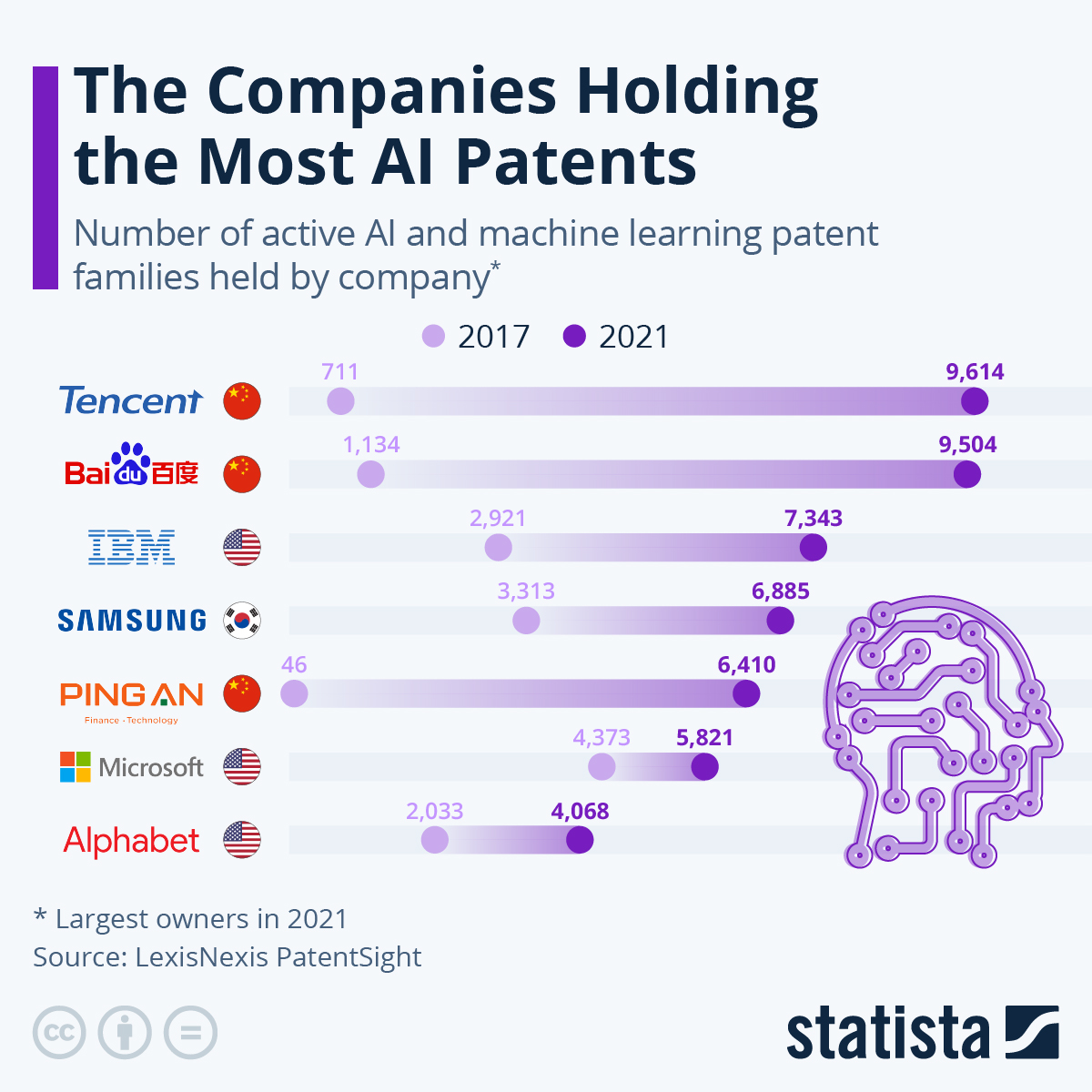
As Statista's Katharina Buchholz notes, the companies holding the most active AI and machine learning patent families are now tech giant Tencent and search engine provider Baidu, ahead of U.S. firm IBM, South Korea’s Samsung, Chinese insurance provider Ping An and former AI patent leader Microsoft.
The latter company has been seeing one of its major AI investments come to fruition recently, as conversational AI bot ChatGPT by Microsoft partner OpenAI has been making waves. Microsoft swiftly announced another round of funding for OpenAI, rumored to be to the tune of $10 billion.
You will find more infographics at Statista
As this chart based on the LexisNexis PatentSight directory shows, Tencent and Baidu became the largest patent owners in machine learning and AI in 2021, each holding more than 9,000 active patent families. A family is a set of patents covering the same technical content. IBM owed more than 7,000 families that same year, while Microsoft held just under 6,000 – rank six. Between 2012 and 2019, it was Microsoft which owned the most AI patents, according to LexisNexis.
Even bigger than the rise in filings by Tencent and Baidu was the AI patent frenzy unleashed by Chinese insurance and banking giant Ping An. The number of patent families it owns grew from fewer than 50 to more than 6,000 just in the past five years. years. Among the AI tools recently developed by the company is software for analyzing facial micro-expressions (i.e. eye blinks, involuntary twitches), which Ping An uses to assess insurance claims its policyholders send in by video.
Economists detect dovish undertones from ‘more optimistic’ Jay Powell
Fed chair insists ‘there is a long way to go’ but investors zero in on sanguine comments
When Jay Powell took to the lectern to give his first press conference of 2023, the Federal Reserve chair stuck to pretty much the same script he has been using since the US central bank started ratcheting up rates last year.
He spoke of the Fed’s unwavering commitment to rooting out high inflation and pledged to keep squeezing the economy until it is vanquished, insisting the central bank is not yet done with its campaign of interest rate rises.
“We are going to be cautious about declaring victory and sending signals that we think the game is won, because we’ve got a long way to go,” he told reporters on Wednesday after the Fed raised its benchmark rate by a quarter point. That marked a downshift from the larger increases the central bank has relied on in recent months and a return to a more conventional pace of tightening.
But even as Powell jettisoned the idea that the Fed would ease off any time soon — keeping open the possibility of another two 25-basis-point increases to come — he was decisively more upbeat not only about the economic outlook but also the central bank’s grip on inflation.
That helped fuel a rally in US government bonds and stocks, with the S&P 500 closing at its highest level since last summer.
“People came into this thinking he might have that same scolding tone as he had in December,” said Julia Coronado, a former Fed economist who now runs MacroPolicy Perspectives. “He sounded more positive and more optimistic.”
Powell’s optimism might have been subtle, but it was in evidence throughout the question and answer session. While he maintained price pressures were still unacceptably high, he repeatedly said the “disinflationary process” was under way. What is more he said he saw a “path” to bringing inflation down to the Fed’s 2 per cent target without a “really significant economic decline or a significant increase in unemployment”.
Powell also seemed more relaxed about a recent easing of financial conditions and the fact that traders in fed funds futures do not seem to believe the central bank will have to raise rates to levels implied by officials’ projections given their expectation that inflation will moderate more quickly. He even went so far as to suggest officials could consider reversing course earlier if forthcoming data suggests.
That marked a significant de-escalation in a months-long tussle with traders who have refused to back off their wagers that the Fed will not raise the benchmark rate to at least 5 per cent and hold it there throughout the year.
The increase on Wednesday took the federal funds rate to between 4.50 per cent and 4.75 per cent. Most officials have signalled the Fed must increase it to 5.1 per cent before considering cuts in 2024 at the earliest. Yet traders’ bets suggest it will start loosening monetary policy before the end of the year.
“Perhaps Powell was in no mood to fight the market because he wasn’t convinced the market’s inflation outlook is wrong,” suggested Michael Feroli, a former Fed economist now at JPMorgan.
Powell’s comments were sufficiently dovish to cause consternation among those economists who had thought the Fed would raise rates in March and again in May before taking a breather.
For instance, Aneta Markowska at Jefferies said she is now slightly less confident in her base case that the Fed will follow though with a final quarter-point increase in May. “Whether they pause in March or May, that really is just a function of how you think the data will play out,” she said.
Not all economists are so sanguine especially given concerns that progress on inflation could stall. Peter Hooper, global head of research at Deutsche Bank, said: “Folks who were inclined to look for things to be optimistic about picked those parts out and maybe didn’t put enough weight on the thrust of the overall message.”
Hooper, who worked for the Fed for almost 30 years, said the central bank was trying to communicate that it expects to raise rates “a couple more times . . . to get to a noticeably more restrictive level”.
Şebnem Kalemli-Özcan, an economist at the University of Maryland and a member of the New York Fed’s economic advisory panel, also warned booming markets and even looser financial conditions could harden the central bank’s resolve.
“If equity markets keep going through the roof, then that says there is growth in the future and everything is rosy,” she said. “People start spending more, and that is what the Fed doesn’t want.”
“They don’t want people to buy stuff and they don’t want people to borrow to buy stuff,” Kalemli-Özcan added. “They want to slow down sentiment.”