FT : Chinese developer Country Garden boosted by vote to restructure bond repaym

Chinese developer Country Garden boosted by vote to restructure bond repayment
Property shares rise after Beijing eases borrowing requirements for homebuyers

Shares in Chinese property developer Country Garden rose almost 20 per cent on Monday after creditors agreed over the weekend to restructure the repayment of a renminbi-denominated bond that was due on Saturday.

The approval from bondholders provides the cash-strapped company with more time as it rushes to meet domestic and international repayment obligations.

Country Garden, which has become the focus of international investors trying to gauge the state of China’s vast property sector, said in a statement to bondholders that it had secured 56.08 per cent approval from participating Chinese creditors in a vote.

Creditors granted an extension for a nearly Rmb4bn ($550mn) bond that had been set to mature on Saturday and allowed the developer to repay the debt in a series of instalments over the course of three years.

The news sent the developer’s Hong Kong-listed shares up as much 19.1 per cent on Monday. The stock is still down more than 60 per cent in the year to date.

Country Garden, once considered one of the Chinese developers least likely to default, has struggled to meet recent repayment obligations. It missed interest payments of $22.5mn on two $500mn international bonds about a month ago, triggering a broad sell-off in shares of property groups already under pressure from widespread defaults.

Developer stocks listed in Hong Kong rose as much as 10.5 per cent on Monday following action by Chinese authorities to lower downpayment requirements nationwide for first-time and second-time homebuyers.

The pace of mortgage rule easing to encourage homebuyers has picked up markedly in recent weeks after years of a punishing crackdown on excess leverage in the sector. Major cities including Beijing, Shanghai, Guangzhou and Shenzhen lowered minimum mortgage interest rates for first-time homebuyers last week.

Ting Lu, an analyst at Nomura, said while the recent easing marked a “significant step in stimulating the property sector”, these measures were “still not enough” to pull it out of a protracted liquidity crisis.

Dealogic data shows Chinese developers face a $38bn wall of renminbi and dollar bond payments coming due over the next four months, while Fitch Ratings warned last week that annual new home sales in China could fall by as much as 15 per cent.

The rating agency also warned that the situation at Country Garden “may exacerbate weakness in [Chinese] homebuyers’ sentiment”.

Country Garden, which alone had liabilities of about Rmb1.36tn as of the end of the first half of 2023, faces more repayment pressure this week. The grace period for the dollar bond payments it missed a month ago is set to expire on Wednesday.

FT : Chinese lenders extend billions of dollars to Russian banks after western s

Chinese lenders extend billions of dollars to Russian banks after western sanctions
Beijing has pushed renminbi as alternative global currency to dollar

Chinese lenders stepped in to extend billions of dollars to Russian banks as western institutions pulled back their operations in the country during the first year of Moscow’s invasion of Ukraine.

The moves by four of China’s biggest banks are part of Beijing’s efforts to promote the renminbi as an alternative global currency to the dollar.

China’s exposure to Russia’s banking sector quadrupled in the 14 months to the end of March this year, according to the latest official data analysed for the Financial Times by the Kyiv School of Economics. 

The lenders took the place of western banks, which came under acute pressure from regulators and politicians in their home countries to exit Russia, while international sanctions made doing business much harder.

The Industrial and Commercial Bank of China, Bank of China, China Construction Bank and Agricultural Bank of China increased their combined exposure to Russia from $2.2bn to $9.7bn in the 14 months to March, according to Russian central bank data, with ICBC and Bank of China accounting for $8.8bn of the assets between them.

During the same period, Austria’s Raiffeisen Bank — the foreign bank with the biggest exposure to Russia — increased its assets in the country by more than 40 per cent, from $20.5bn to $29.2bn.

Raiffeisen has said it is looking at ways of pulling out of the country and has reduced its assets to $25.5bn since March.

The moves by Chinese banks are part of a shift by Russia to adopt the renminbi rather than the US dollar or euro as a reserve currency.

“The loans by Chinese banks to Russian banks and credit institutions, which are for the most part a case of the yuan taking the place of dollars and euros, show the sanctions are doing their job,” said Andrii Onopriienko, deputy development director at the Kyiv School of Economics, who compiled the data. 

The rise of renminbi trading highlights Russia’s economic pivot to China as trade between the two countries hit a record $185bn in 2022.

Before last year’s invasion, more than 60 per cent of Russia’s payments for its exports were made in what the country’s authorities now refer to as “toxic currencies”, such as the dollar and euro, with renminbi accounting for less than 1 per cent.

“Toxic” currencies have since dropped to less than half of export payments, while the renminbi accounts for 16 per cent, according to data from Russia’s central bank.

Raiffeisen is one of the few western banks that has kept a significant presence in Russia, after several other foreign lenders cut ties and sold subsidiaries last year.

But reforms brought in by the Kremlin last summer have made it much harder for foreign banks to sell their Russian subsidiaries. On Friday, Russia’s deputy finance minister Alexei Moiseev reaffirmed the government’s position to obstruct foreign bank sales.

Profits at Raiffeisen’s Russian business rose 9.6 per cent to €867mn in the first six months of this year, with the Austrian lender raising pay for its Russia-based staff by €200mn.

The European Central Bank is increasing pressure on lenders it supervises, including Raiffeisen, to exit Russia.

Raiffeisen said it was trying to find ways of selling or spinning off its Russian business, while staying compliant with local and international laws and regulations.

“We are committing to further reducing business activity in Russia whilst we continue to progress such potential transactions,” the bank added.

Overall, the proportion of Russian banking assets held by foreign lenders reduced from 6.2 per cent to 4.9 per cent in the 14 months to March.

ICBC, Bank of China, China Construction Bank and Agricultural Bank of China all declined to comment.

>>> Weekend Papers Summary

Weekend Papers Summary

NEW YORK TIMES
-Why did a drug gang kill 43 students? The Mexican police and others secretly colluded with a cartel that kidnapped 43 students. Wiretaps show just how much the authorities helped the gang.
-Jimmy Buffett has died at the age of 76. With songs like “Margaritaville” and “Cheeseburger in Paradise,” he became a folk hero to fans known as Parrot Heads. He also became incredibly wealthy.
-A brutal path forward for Ukraine, village by village. As Ukraine pushes slowly forward in its counteroffensive, it’s relying heavily on the effort of hundreds of small-scale assault groups.
-Russia said it had thwarted a Ukrainian attack on a vital bridge that links Russia to occupied Crimea.
-President Biden struggles to make ‘Bidenomics’ a plus, not a minus. Wages are up, inflation has slowed and the White House has a new slogan. Still, President Biden’s poor marks on the economy are making Democrats worried.
-Biden team isn’t waiting for impeachment to go on the offensive. The White House has enlisted two dozen attorneys, legislative liaisons and others to counter Republican efforts to impeach President Biden.
-President Biden said he would meet Gov. Ron DeSantis after Hurricane Idalia. The governor’s aide said he had no such plans.
-One of Montana’s top elected officials has made banning the app a top priority, putting the state at the center of a geopolitical storm. Lobbying groups, businesses and influencers have defended TikTok on billboards and in court filings against a Montana proposal.
-Mongolia, a nation with few Catholics gives pope a welcome fit for an emperor. Although it was the first trip to Mongolia by a Roman Catholic pontiff, Pope Francis noted that the two entities have ties dating back many centuries.
-Why Charter and Disney Are Fighting, and What It Means for Viewers. Subscribers to Charter’s Spectrum service cannot watch the U.S. Open or college football games this weekend, with deeper implications for the industry.
-Europe’s boars still hold radioactivity. What surprised scientists is why. Some boars in Germany have radiation levels exceeding the limit deemed safe for humans consumption. Research suggests it’s not just because of Chernobyl.
-As the anniversary of women’s uprising nears, Iran cracks down. Sept. 16 marks one year since Mahsa Amini died in the custody of the morality police, setting off protests. The authorities are trying to quell new unrest.
-Can plastic recycling ever really work? Many plastics that carry the “chasing arrows” symbol, like soda cups and yogurt tubs, are rarely recycled. A new California law is raising the bar.

THE FINANCIAL TIMES
-New data confirming that the world’s largest economy is cooling has given the US Federal Reserve room to hold interest rates steady, economists say, even as it leaves open the possibility of resuming a historic monetary tightening campaign later in the year.
-Igor Kolomoisky, an influential Ukrainian oligarch who backed Volodymyr Zelenskyy’s presidential campaign, has been named as a suspect in a fraud and money laundering case. Zelenskyy’s administration is attempting to beef up its anti-corruption credentials to assuage concerns of western allies, which have poured billions of dollars in economic and military support into the country in the wake of Russia’s full-scale invasion.
-The impact of the Hollywood strikes on California’s economy has reached almost $5B four months after script writers took to the picket lines, a figure that is expected to grow after the latest talks between union representatives and studios ended in acrimony. The first joint strike by actors and writers in 60 years has shut down most Hollywood productions, creating a knock-on effect for caterers, dry cleaners, drivers, rental companies and other small enterprises that support the industry, said Kevin Klowden, chief global strategist at the Milken Institute, who conducted the research.
-An influx of cash from Saudi Arabia stoked a record-breaking summer transfer window for European football, with clubs in the English Premier League spending more than £2B on new players for the first time.
-Hedge funds have upped bets against Argentina’s bonds as the emergence of radical rightwing candidate Javier Milei has sparked investor fears that the country is on course to elect a leader who will struggle to govern in the throes of an economic crisis. The total value of Argentina’s bonds borrowed by investors to wager on a fall in prices has jumped by 65% since Milei, a self-described “anarcho-capitalist”, won a primary poll last month ahead of a presidential election in October.
-The Florida-based start-up, Magic Leap, was valued at $6.4B in 2018, having secured funding from investors including Alibaba, Google and Qualcomm. But poor sales of its consumer-oriented headsets led to lay-offs, a restructuring and a pivot to business customers. Its valuation fell to $2B by late 2021, when Saudi Arabia’s Public Investment Fund bought a controlling stake in the company, infusing it with more cash and taking total funding to $4B.
-Six industry groups told a Texas-based federal appeals court that the Securities and Exchange Commission overstepped last week when it adopted new rules for private fund managers. The package requires increased disclosure and puts new limits on the way the industry treats customers — mostly pension funds, endowments and other institutional investors.
-Xi Jinping’s decision to send Premier Li Qiang to the G20 Summit summit (rather than attend himself), which western officials say was conveyed to them by Chinese counterparts, has yet to be confirmed by Beijing. But the absence of China’s president will be a blow to India’s rotating presidency of the multilateral gathering and the status of the New Delhi summit. It also shakes the stature of the G20 as the pre-eminent global leadership forum, amid deep fissures between its members.
-By the time Omar Bongo Ondimba died in 2009 after 41 uninterrupted years as president of Gabon he had fathered as many as 50 children. In that crowded field it was the French-educated Ali Bongo, one of seven “official sons” and a jazz-funk musician, who emerged as his successor. Ali, now 64, was elected president a few months after his father’s death, a position he held until this week when he became the latest African head of state to be swept out of office in a coup. Thousands poured on to the streets of Libreville, the seaside capital, to celebrate the apparent demise of the Bongo dynasty.

NY POST
-Support for Florida Gov. Ron DeSantis’ campaign “collapsed” after the first Republican presidential debate, according to a new poll.The poll, published Saturday in the Wall Street Journal, showed former President Trump’s lead over his top rival at a yawning 46 points — nearly double the gap in the Journal’s last poll in April. In a survey of 600 Republican primary voters, 59% said Trump would be their first choice, followed by 13% for DeSantis. That’s down from the 24% the Florida governor previously logged, when he was seen as closing in on Trump. Former South Carolina Gov. Nikki Haley was third at 8%.
-Amazon shareholders are suing the e-commerce giant for allegedly refusing to consider Elon Musk’s SpaceX for a profitable satellite contract because of his ongoing feud with Amazon founder Jeff Bezos. Cleveland Bakers and Teamsters Pension Fund (CB&T) filed a lawsuit on Monday in the Delaware Court of Chancery on behalf of Amazon against Bezos, current CEO Andy Jassy, and other top executives at the company. The shareholders accused Amazon’s founder and executives of “consciously and intentionally breached their most basic fiduciary responsibilities” in its decision to purchase rocket launchers for its Project Kuiper satellite internet system. The lawsuit alleges that Amazon’s board awarded contracts worth $2.7B to Blue Origin, Bezos’ space company, and did not consider rival SpaceX, which is owned by Musk, as an alternative launch provider despite its track record. - Source TradeTheNews.com

>>> Barron’s Weekend Summary: Warner Bros. Discovery David Zaslav CEO has a big

Barron’s Weekend Summary: Warner Bros. Discovery David Zaslav CEO has a big salary and a big task at the parent company for CNN and Max

Cover Story:
Warner Bros. Discovery David Zaslav CEO has a big salary and a big task at the parent company for CNN and Max: turning around a media giant saddled with high debt and multiple challenges. Zaslav, or Zas, as he is known in the industry, has also become a bit of a lightning rod. Discovery was founded 38 years ago, shortly after which Tele-Communications, a company controlled by billionaire John Malone, who would become a mentor to Zaslav, bought a big stake. Zaslav, who previously worked at NBC, was named CEO of Discovery in 2006 and took the company public two years later. Zas—who “always plays offense,” according to company veteran J.B. Perrette, now WBD’s top streaming executive—deserves credit for growing Discovery revenue nearly 10 times from its initial public offering in 2008, to $33.8 billion in 2022. Zaslav achieved this early on, in part by replacing Discovery’s sleepy nature documentaries with unscripted, low-budget, lowbrow content like Shark Week, Naked and Afraid, and Dirty Jobs.

Interview:
- China debt watcher Charlene Chu, senior analyst at Autonomous Research talks to Barron’s about China’s real estate crisis. China’s property developers are under duress again, re-igniting concerns about a debt crisis. But with a faltering economy and diminished confidence among households and companies, Chu worries the ingredients are there for a broader financial crisis for the first time. The property sector, which holds 70% of Chinese households’ wealth, is ailing. Existing home prices slid 9% month over month in big cities in July, the steepest decline in a decade.

Tech Trader:
No update this week

The Trader:
-US government data on Friday showed a larger-than-expected gain of 187,000 nonfarm payrolls in August, but significant downward revisions for the previous two months totaling 110,000 fewer jobs than initially reported, putting the three-month average job growth near 150,000—below February 2020. The unemployment rate jumped to 3.8% from 3.5%, while the labor-force participation rate rose 0.2%, for its first increase since March. Even the monthly gain in average hourly earnings slowed, while average hours worked rose.
- Health-care stocks have been deeply out of favor this year. While the S&P 500 has gained 18% year to date, the 65 health-care companies in the index have lost an average of 1%. Pharmaceutical and biotech stocks, in particular, have been hit or miss. For every Eli Lilly, which has soared 50%, Zoetis, which has gained 32%, and Vertex Pharmaceuticals, which has jumped 21%, there’s a Moderna, Pfizer, or Organon, which have fallen 35%, 30%, and 20%, respectively. The divergent performances exemplify the risk that investors take by betting on drug developers. There are some with recent scientific and commercial wins—like Lily’s upcoming Alzheimer’s treatment Donanemab and its diabetes drug Mounjaro, which may soon be approved in the US as a weight-loss treatment. On the other hand, Pfizer and Moderna have yet to follow their Covid-19 vaccine successes with new blockbusters.

Features:
-Trouble spots at the IRS agency remain, and continued improvements in service hang in question now that the agency’s 2024 base funding—along with extra funding promised under the 2022 Inflation Reduction Act (IRA) for upgrades—is on lawmakers’ chopping block. Of the $80B allocated to the IRS under the IRA in August last year for improvements over 10 years, $20B was already rescinded under the Fiscal Responsibility Act in June this year. President Biden is calling for an increase in IRS appropriations for the 2024 fiscal year to $14.1B from $12.3B to account for inflation and a 2% cut made in 2022; House Republicans are aiming to cancel unspent IRA funds and slash $1.1B out of the annual budget, reducing it to $11.2B.

Europe:
Chinese manufacturers are raising the intensity of the race to dominate the electric-vehicle market. China’s BYD and Tesla are likely to come out as the winners, while European manufacturers like Volkswagen and Renault are set to lose out, according to analysts at UBS. BYD is the key company driving competition in the EV space now, with a sustainable cost advantage of around 25% over the legacy car companies, according to UBS analysts led by Patrick Hummel.
BYD’s Seal battery-electric vehicle exemplifies the threat to the rest of the industry. It recently cut the price on the model to less than $30,000. UBS estimates BYD is achieving a 16% gross margin and 5% earnings before interest and tax margin on the Seal, similar to profits made on mass-market internal combustion engine cars globally.

Emerging Markets:
-The wobbly Chinese property market is only making people more nervous and government efforts to boost consumption have been mis-targeted and insufficient, when they aren’t simply absent. “Boosting consumption may be the best solution, but the government’s plans to do so don’t seem credible,” said Adam Wolfe, emerging markets economist at Absolute Strategy Research.Chinese have reasons to save beyond the falling value of their homes, which are their core nest eggs. China’s once revered pension system’s future is becoming muddier each year. The country’s rapidly aging population soon will not be able to be supported by a dwindling number of working-age contributors to the social security system, and the pension system is already feeling the effects.

Commodities:
-Could Hurricane Idalia push gasoline prices down? Hurricanes often damage oil refineries, causing prices of fuels like gasoline to soar. Hurricane Idalia, which made landfall in Florida on Wednesday, looks like it will be an exception. In fact, there’s a chance that the net effect of the hurricane actually will be to drag fuel prices lower. Previous hurricanes—such as Hurricane Harvey in 2017 and Hurricane Ida in 2021—had major impacts on refineries, inflicting damage and causing several facilities to shut down. Harvey damaged refineries owned by Exxon Mobil, among others, causing more than 4 million barrels of refining capacity per day to go offline temporarily. Total U.S. refining capacity is about 18 million barrels. Gasoline prices rose about 20 cents per gallon in the days afterward.

Streetwise:
No update from Jack Hough this week.

The Information : Selling a Vision, and a $2 Million Hypercar, at Pebble Beach

The chassis lurking under the skin of most cars is a pretty pedestrian thing—mostly sections of stamped and welded steel perforated with mounting points for the engine, suspension and everything else required to make the machine whole.
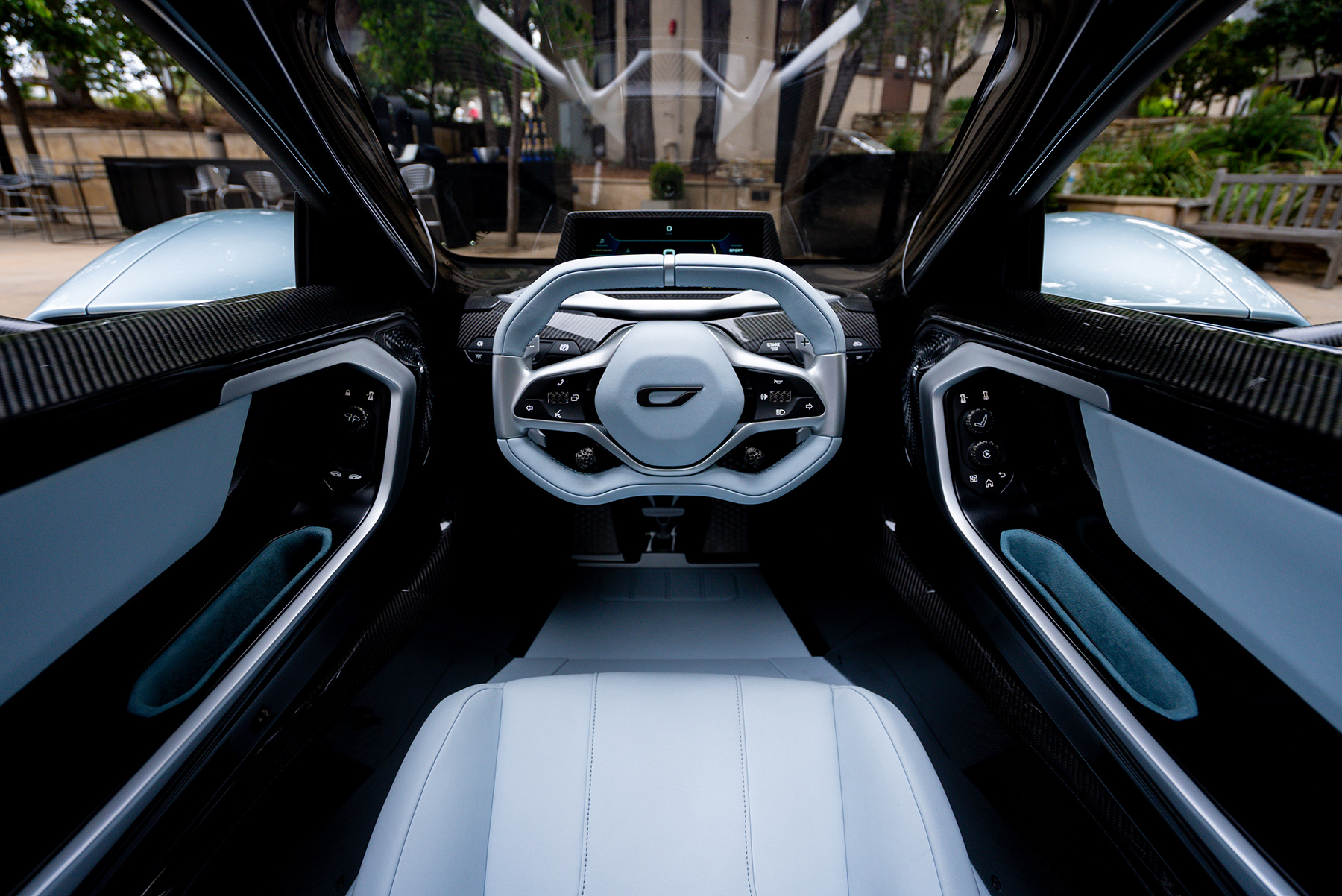
The 3D-printed chassis of the Czinger 21C, however, has an unnervingly organic look. Imagine a car not so much designed as evolved out of a puddle of primordial goo, formed around a skeleton of high-end alloys—destined to cradle two lucky souls who sit in the cockpit, like Maverick and Goose, one ahead of the other.
The Czinger (pronounced “zinger”) is the brainchild of battery and electric vehicle entrepreneur Kevin Czinger and his son, Lukas. It has a wholly novel design, thanks to its entirely different manufacturing process. A traditional automotive factory has a lot of big machines stamping out parts, with foundries and suppliers making the smaller stuff, all of it meticulously designed and coordinated for months or years ahead of mass production. Any little change of component specification or output volume requires the sorts of logistical nightmares that have driven Tesla’s Elon Musk to a state of mania.
The 3D-printed chassis of the Czinger 21C looks not so much designed as evolved out of a puddle of primordial goo.
The Czinger 21C, which is produced by the Czingers' sibling company Divergent 3D, relies on additive manufacturing—aka 3D printing—to create parts that are stronger and lighter than anything made through traditional techniques. The car also opens the door to something more broadly disruptive: call it manufacturing as a service. “If you think big picture, that means Divergent can essentially act like Amazon Web Services,” said Lukas. “We build these modular factories all over the world.…You want a part made that’s a run of 10? We’ll make 10. You want 10,000? We’ll make 10,000.”
The 28-year-old former investment banking analyst is chief operating officer at Divergent 3D and a co-founder of Czinger, the hypercar company he started in 2019 with his father. Kevin, who previously co-founded and helmed battery fabricator and EV manufacturer Coda Automotive, founded Divergent 3D back in 2013.
The 21C is the first product from Czinger, and as I witnessed at this month’s Monterey Car Week, it’s a marvel of engineering: a $2 million, 1,250 horsepower hypercar that weighs less than a Honda Civic. More than just a really fast car (top speed: 253 miles per hour), it also does double duty as a proof of concept and a marketing tool for additive manufacturing in the automotive world. Divergent and Czinger “work very, very closely together under one roof,” Lukas said. “They complement each other and they earn business for each other."

For the ultrawealthy elite who flock to Monterey Car Week every year, a car like the Czinger is but one mild indulgence among many. Buyers with garages full of such toys are often shuttled out on chartered jets arranged by their dealers, hosted for a comped week of high-end festivities and auctions that culminate in the Pebble Beach Concours d’Elegance, the world’s most prestigious car show.
While Sunday’s Concours celebrated the past (this year’s Best in Show was a 1937 Mercedes-Benz), another part of Car Week focused much more on the future. At a Friday gathering called Quail, a Motorsports Gathering, Czinger unveiled the Blackbird, a special edition of the 21C hypercar meant to honor the iconic Lockheed SR-71 Blackbird, still the fastest aircraft in the world (or at least the fastest our military is ready to tell us about). The Blackbird features 1,350 horsepower (100 more than a base 21C), and is lavished with special touches like custom wheels, a different exhaust system and an interior that evokes the SR-71 with orange highlights referencing the signature glow of its afterburners.
Kevin and Lukas Czinger, promoting the $2.8 million special-edition Blackbird during Monterey Car Week.
When it eventually goes into production—the Czingers are promising the first vehicles later this year—the entire 21C run will be just 80 cars. Czinger will produce four special Blackbirds, each priced at $2.8 million. Yes, a single car for the price of 28 Porsche 911s. Blackbird was just one of dozens of high-tech, high-performance machines making their international debuts at Quail, many of them priced well into seven figures.

Lukas spent the day fielding interviews, chatting with clients and smiling for the cameras in front of the Blackbird. Despite the glaring afternoon sun shining down, the hypercar was a dark, menacing specter on Czinger’s stage, its doors splayed to the sky like wings. Few there could hope to afford one, but buying one takes more than a bounteous bank account.

Lukas told me the company was looking not just for customers, but for “long-term ambassadors” who would offer the brand their own level of exposure, access and prestige. “Once you sell someone a $2 million–plus car, they don’t go away. They’re either your problem or, you know, your happiness. You think pretty carefully about who that first 80 are.” At Quail, those sorts of people are not in short supply. By the next day, all four of the special-edition Blackbirds had been pre-ordered.
Lukas and I spoke early the following morning, just a few hours after the last visitors left the Blackbird party celebrating the car’s unveiling. The Czingers transformed Carmel’s Sunset Center into a makeshift speakeasy, one requiring QR codes instead of secret phrases to enter. (Had any party like this happened during the real Prohibition, it wouldn’t have survived long. You could hear the bass from a block away and see the LED lights shining into the sky from even farther afield.)
The Czinger 21C Blackbird edition.
At the party, Lukas was surrounded by fans and clients, a common theme for the weekend. He lamented he’d barely had any time to himself, just a few minutes here and there to mentally reset. But, he told me, that’s often enough. “It sounds kind of trite, but I just step back and breathe in a different way. Give myself a kind of step back of perspective and recharge pretty quickly. Focus, regroup and, you know, enjoy again.”

This practice is part of Lukas’ broader meditative mindset, something he developed while studying electrical engineering at Yale University, where he also played soccer and suffered a traumatic concussion in a match. To recover, he had to take a year off from school and work. “I found myself alone a lot, not able to do a lot of the things that I had learned to love,” he said. The aftereffects of a brain trauma—light and sound sensitivity, an inability to focus—left him with little to do but meditate, which he’d do for upward of four hours a day.

While the side effects lingered for years, Lukas recovered enough to get back to work. He’d previously spent summers doing mergers and acquisitions at various investment firms before accepting a job with Centerview Partners at the company’s San Francisco offices. He loved his life, despite working upwards of 18 hours a day. He did, though, take a little time off to see his father speak at the 2015 Solid Conference in San Francisco, focusing on future advancements in hardware.

Kevin spoke about reinventing manufacturing, radically reducing the amount of materials required to build a car and ultimately reducing its environmental footprint. “It was basically a pitch,” Lukas said. “It was him really teasing interest and declaring that he would like to start something.” That something would prove the potential of Divergent's technology—and would ultimately become the Czinger company and the 21C.
The 21C is a two-seater, with the driver and passenger sitting single-file, like fighter pilots in a cockpit.

Lukas decided to leave his fledgling finance career and build Czinger with his father. Since then, Divergent and Czinger have raised over $700 million, with Stockholm-based investment group Hexagon AB contributing $100 million—“plenty of capital for the next few years,” Lukas said.

That's despite some aggressive goals. Divergent plans to have 30 factories around the globe by 2030, each able to churn out high-quality parts at volume using additive manufacturing, meaning no lengthy and expensive tooling. The company already has numerous clients in the aerospace and automotive industries, including Aston Martin and another unannounced major automaker.

For Czinger, its biggest test comes soon, when the rubber literally meets the road. The first of the 21C hypercars ships later this year. After the Pebble Beach Concours festivities, Lukas was off to let a few lucky customers get early test drives. “I get nervous every time you put customers in the car,” he said. “I hope they love it.”

They had better, because while the 21C has become a marketing tour de force for Divergent, the only thing that matters to Czinger drivers is whether it’s a great car. And for $2 million-plus, it will have to be more than great