FT : Renault chief moots €10bn valuation for EV unit to be floated next year

Renault chief moots €10bn valuation for EV unit to be floated next year
Luca de Meo hits out at unrealistic valuations for EV start-ups and calls for European investors to support region’s car sector

The boss of Renault said the company’s new electric vehicle division could fetch an initial public offering price of up to €10bn when it floats in the first half of next year, as he hit out at the unrealistic valuations placed on recently listed EV start-ups.

Luca de Meo also warned Europe’s car industry is being held back by the region’s over-cautious investors, as mainstream carmakers struggle to compete with what he considered ridiculous valuations offered by US investors to lossmaking EV start-ups.

The French carmaker is spinning out its electric vehicle and software arm as a separate unit called Ampere, with plans to hold a European IPO in the first half of 2024.

Although Renault has not confirmed its pricing ambitions for the unit, speaking to the Financial Times at the Munich auto show, de Meo said the business could be worth “eight, nine, 10 billion [euros]” when it lists.

Polestar, the EV brand part-owned by Volvo and China’s Geely, was valued at $21bn when it listed last year. Vietnam’s VinFast listed earlier this year with a value of $23bn. Yet some analysts have valued the Ampere business at only €5bn, while others have questioned the need to carve out the business at all.

“If European investors care about the future of Europe they better put money into this, instead of putting question marks all over the thing,” said de Meo.

“I don’t know what European investors are doing, but if they want to protect Europe [they should back] projects like this one, where someone has the guts to have a substantiated, holistic response to the challenge that the Chinese and Americans are giving us.”

The IPOs of Polestar and VinFast involved mergers with special purpose acquisition companies, allowing the companies to float their shares with substantially less scrutiny than traditional stock market listings. While Nasdaq-traded Polestar’s market capitalisation has fallen to just under $7bn, VinFast, which is also listed on Nasdaq, stands at about $68bn after shooting up to a high of $190bn just after its IPO last month.

“Look at the valuation of European companies,” de Meo added. Referring to BMW’s market capitalisation of €62bn, he asked: “Do you think that VinFast can be worth more than BMW? Let’s be serious.”

The Ampere deal is part of a radical overhaul by de Meo, who joined as chief executive in 2020, that included the carmaker spinning off its engine business in partnership with China’s Geely and Saudi Arabia’s Aramco.

De Meo said splitting the units was vital because making electric vehicles was a “different sport” to traditional vehicles. He added that Renault, listed in France, is only worth €11bn, roughly equal to the value of its Nissan stake and the value of its bank that finances car purchases.

“I have nothing to lose” in floating the EV unit, he added.

WSJ : Italy Seeks to Leave China’s Belt and Road Initiative—Without Angering Bei

Italy Seeks to Leave China’s Belt and Road Initiative—Without Angering Beijing
Rome’s disappointment with infrastructure accord comes as Western skepticism grows about China’s global economic ambitions

ROME—Italy is preparing to cancel its controversial membership of China’s Belt and Road infrastructure initiative, engaging in an elaborate diplomatic dance to avoid angering Beijing and triggering retaliation against Italian businesses.

Italian Foreign Minister Antonio Tajani held talks in Beijing on Sunday and Monday to facilitate as smooth an exit as possible from the initiative while laying the groundwork for alternative economic deals with China.

“We didn’t achieve great results with the Belt and Road, but that doesn’t matter,” Tajani told reporters in Beijing. “We are determined to move ahead with plans to strengthen our commercial ties.”

The Italian government of Prime Minister Giorgia Meloni has long signaled its discomfort with the Belt and Road memorandum that a previous Rome government signed with Chinese President Xi Jinping in 2019.

The memorandum marked the first time that a Group of Seven industrialized economy had signed up to Xi’s global infrastructure project, and was seen as a propaganda coup for Xi at a time when Belt and Road was facing criticism within China and in some participating countries.

Rome’s decision to sign up raised eyebrows in Washington and in European Union capitals. Meloni, then in opposition, strongly criticized the decision. The memorandum with China has had few practical consequences and hasn’t led to any major Chinese investments in Italy. Nor has it helped Italian business to boost exports to China, an area where Italy lags behind other European economies such as Germany and France.

Many Western countries view the initiative as a vehicle for boosting China’s global economic and diplomatic clout. The U.S. and EU are trying to reduce economic dependencies on China in the context of growing geopolitical tensions, heightened by Xi’s close alignment with Russian President Vladimir Putin and the latter’s invasion of Ukraine.

As the U.S. has stepped up efforts to curb Beijing’s global influence, it has put gentle pressure on Italy to pull out of Belt and Road, including when Meloni visited the White House in July. At the time, Meloni told President Biden she was still assessing her options.

Italy says it hasn’t yet made a formal decision on whether to cancel its Belt and Road membership. But Rome officials have made little secret of their desire to opt out. The memorandum will automatically renew itself in 2024 unless Italy formally withdraws by late this year.

Italian Defense Minister Guido Crosetto recently called the original decision to sign up an “improvised and atrocious” move. The question now, he told newspaper Corriere della Sera, was “how to go back on our steps without harming the relationship.”

Italy says it wants to boost business ties with China in other ways, including by shifting the focus of cooperation towards a different existing bilateral accord, called the Strategic Partnership agreement.

“The Strategic Partnership will guide our relationship. It represents an opportunity for our businesses in many sectors and it will strengthen our exports,” Tajani said after meeting with his Chinese counterpart, Wang Yi, on Monday. “We are betting on economic growth.”

Meloni has been worried that Beijing could punish Italy for announcing a withdrawal by curbing Italian exports to China, officials in Rome said.

She is expected to travel to China this fall and wants to resolve the issue by then, the officials said. To secure broad political support for withdrawal, Meloni wants Parliament to vote on it before her trip, these people said.

However, Italian officials are now becoming more confident that they can navigate their way out of the agreement without a backlash from Beijing.

China has said publicly that it wants Italy to remain a Belt and Road member, but there are also indications that Beijing has accepted Rome’s cancellation as inevitable. A recent article in the Global Times, a Communist Party mouthpiece, said Italy’s departure from the infrastructure initiative “should not be fundamentally detrimental” to bilateral relations.

“We need to use tact, elegance, diplomatic politeness so that we don’t damage the good relationship we have with China,” said a former top Italian official. “We want the same kind of relationship that France or Germany have,” he said, pointing out that Paris and Berlin have more lucrative economic relations with China despite never signing up to Belt and Road.

Since Italy signed up to the infrastructure project in 2019, its trade deficit with China has further widened. Meanwhile, attitudes in Italy and other parts of Europe have become more critical of China’s ambitions to buy local infrastructure or companies that possess technological know-how. Successive Italian governments have vetoed Chinese investments in strategically sensitive companies.

Italian officials have carefully avoided making public statements that could embarrass China. The Chinese “want conversations on this topic to happen privately. They are terrified by the prospect that we will make them lose face,” said another Italian official. “These are conversations that have to happen behind closed doors.”

FT : Iran Slows Buildup of Near-Weapons-Grade Nuclear Fuel

Iran Slows Buildup of Near-Weapons-Grade Nuclear Fuel
Move apparently aimed at easing tensions with Washington

Iran significantly slowed the pace at which it is accumulating near-weapons-grade enriched uranium in recent months, the United Nations’ atomic agency reported on Monday, a move that could ease tensions with the U.S. and help open the way to broader negotiations over its nuclear program.

According to a confidential International Atomic Energy Agency report, Iran added 7.5 kilograms—about 16.5 pounds—of 60% enriched uranium in the three months to August, far less than the 51.8 kilograms it added in the previous six months.

The more slowly Tehran accumulates highly enriched uranium, the less potential fissile material it has for nuclear weapons.

The decision to curtail its accumulation of highly enriched uranium, which can be turned into weapons-grade fissile material in a matter of days, isn’t a significant change to Tehran’s nuclear program. It already has 121.6 kilograms of 60% enriched uranium, enough for at least two nuclear weapons. Iran has also produced enough lower-grade fissile material to fuel several other weapons. The IAEA reports—it released two on Monday—also made clear that Tehran continued not to cooperate with the agency on other significant issues.

However, slowing the buildup of 60% enriched uranium moves in the direction of a key request from Washington as part of indirect talks between Iran and the U.S. aimed at de-escalating tensions between the two countries earlier this year. The Biden administration was pushing for Iran to stop adding to its 60% stockpile.

The amount of 60% enriched uranium added to Tehran’s stockpile in the quarter to August was the second lowest since Iran started gearing up its highly enriched uranium production in the spring of 2021.

Iran has hugely expanded its nuclear program over the past four years following the decision by the Trump administration to take the U.S. out of the 2015 nuclear deal, which placed strict but temporary controls on Tehran’s nuclear work in exchange for lifting a swath of international sanctions.

In April 2021, Iran started producing 60% enriched uranium, becoming the only nonnuclear country to do so.

Iran insists its nuclear program is for purely peaceful, civilian purposes. U.S. officials have said they believe it would take Iran several months to produce some kind of nuclear weapon although they say there is no evidence Tehran has resumed work on producing an actual nuclear weapon.

The Wall Street Journal reported last month that Iran had started slowing its accumulation of 60% enriched uranium and had potentially started reversing course by diluting a small amount of the material. While the pace of production of fissile material can fluctuate for a number of reasons, the decision to dilute material was a clear sign Tehran was intending to slow its buildup of the material.

The IAEA said on Monday that Iran had diluted to 20% enriched uranium 6.4 kilograms of the 60% material in July.

Its report presented a mixed picture on Iran’s other nuclear steps. It showed that Iran was largely abiding by another U.S. ask—not adding significant numbers of advanced centrifuges to its fleet of machines for enriching uranium.

However, while Iran’s overall stockpile of enriched uranium fell, there were significant increases in Iran’s buildup of 20% and 5% enriched uranium, which can fairly easily be further enriched to 60%.

The IAEA also reported that it had made no progress in winning Iran’s approval to install further cameras in Iranian nuclear-related facilities despite an Iranian promise in the spring to do this. Iran removed the cameras in June 2022, severely reducing the nuclear agency’s ability to monitor key Iranian activities, such as the number of centrifuge machines Iran is making for nuclear enrichment.

And the IAEA reported that Tehran had continued to largely stonewall its probe into undeclared nuclear material found in Iran from 2019. Both issues were being closely watched by Washington. It also reported that Iran had denied visas and refused to recognize agency inspectors, including experienced personnel, preventing them taking part in inspections in the country.

Last month, Iran released four U.S. citizens from prison into house arrest, the first step in a planned prisoner swap that Washington expects will eventually see them return home. If the U.S. detainees are set free, Iran will gain access to billions of dollars of oil revenue trapped in South Korea under U.S. sanctions. That process is likely to take some weeks.

For the Biden administration, the hope is to avoid any crisis with Tehran in the lead-up to next year’s presidential elections. Critics in Washington and elsewhere say the U.S. is preparing to reward Iran for taking U.S. citizens hostage and for a minor pause in its nuclear work while Tehran ramps up regional threats and supplies military assistance to Russia for its war against Ukraine.

U.S. and European officials told Iran that if there was de-escalation of tensions over the summer, they would be open to broader talks later this year, including on Iran’s nuclear program. Washington had also conditioned de-escalation on Iran and its proxy forces not attacking U.S. forces in the Middle East. Tehran has largely abided by that condition since a U.S. contractor was killed by an Iranian supported group in Iraq in March.

Still, relations between Washington and Tehran remain tense and it is unclear how much political space there is for broader dialogue. The situation in the Persian Gulf remains tense, with the U.S. sending F-35 jet fighters and thousands of Marines to the Gulf in response to attempted Iranian seizures of commercial vessels.

With Iran yet to release the U.S. prisoners or stop the accumulation of highly enriched uranium, some observers believe Washington appears willing to pay too high a price for a diplomatic opening.

“Slowing accumulation of 60% enriched material thus far does not impact Iran’s overall ability to make weapons-grade uranium for several atomic weapons in under three months,” said Andrea Stricker, deputy director of the Nonproliferation and Biodefense Program at the Foundation for Defense of Democracies, a think tank that opposed the nuclear deal. “Washington is ceding valuable leverage to gain more meaningful restraints on Tehran’s nuclear program.”

Some discussions between Western countries and Iran are expected to take place on the sidelines of the United Nations General Assembly meeting later this month.
FT : There is no green future for Europe without an upgraded power grid

There is no green future for Europe without an upgraded power grid
Electrifying the EU economy must be made easier, cheaper and quicker

In 2022, the EU witnessed a record surge in wind and solar power. Three million heat pumps were sold. Almost one in four new cars is now electric. This is thanks to the European Green Deal and our work to end imports of Russian fossil fuels. These trends are predicted to accelerate this year.

But Europe will only ensure its energy security and deliver on its climate ambitions if we sustain a fast pace in the rolling out of renewables and the electrification of our economy. With supply and demand booming across Europe, we now need to ensure that clean electricity can be delivered across the continent. For this to happen, our power infrastructure must be ready.

Our 11mn kilometres of grids need to grow and change to serve increasing demand. Electricity consumption is expected to increase by about 60 per cent between now and 2030.

Grids will need to integrate a large share of intermittent renewable power and adapt to a more decentralised electricity system: with millions of rooftop solar panels and electric vehicles, electrolysers producing green hydrogen, and local energy communities sharing resources, we will need flexibility, speed and digitalisation.

Today, completed renewable projects can face long waits to be connected to the grid. Securing permits for grid reinforcements can take up to 10 years.

When there is no certainty about connection timelines or costs, planned generation projects are simply abandoned. Even existing renewables plants are often penalised. Solar panels are frequently the first technology to be switched off when grids are overloaded, because they are flexible and easy to manage. This is wasteful and costly.

Across Europe, grid interconnection projects are delayed due to cost overruns, inflation and rising interest rates. But by placing a stronger focus on its transmission and distribution grids, the EU can turn a potential barrier into a powerful enabler.

The EU’s regulatory framework has reduced the length of the permitting procedure for electricity transmission priority projects to under three and a half years on average. And emergency legislation introduced last year accelerated authorisation of new renewable projects. If extended into the broader grid connections, it could help fast-track progress without cutting corners on environmental safeguards. More technical assistance and sharing of best practices could also help national administrations to move faster.

We must invest more and better. Europe needs to invest €584bn in its grids by 2030. There are avenues to explore. In July, the European Investment Bank increased financing by 50 per cent to help mobilise more than €150bn in new green investments. Furthermore, the EU taxonomy on sustainable activities can offer opportunities to increase the financial attractiveness of transmission and distribution operators.

A rapid agreement on the proposed electricity market reform would also help change the remuneration mechanisms for grids projects, boosting anticipatory investments.

We also need to make progress on cross-border interconnections where they still lag behind, despite the commission’s 15 per cent interconnection target. This would increase security of supply and bring down prices.

Finally, we must not underestimate the industrial and commercial opportunities for Europe. The world’s three largest cable manufacturers are European. A better alignment of investment in grids and in manufacturing capabilities is needed.

If we boost our industrial capacity, expand the pool of skilled labour and improve supply chains, this would have a positive effect in terms of jobs and growth. As a start, the EU Net Zero Industry Act will support cable manufacturing along with other clean technologies, for our domestic and export markets. In this way, European industry could also tap into the global surge in grid investment — 80mn km of new grids are needed worldwide by 2050.

The answer to the grid challenge does not necessarily mean “more cables and lines”. There are ways to reinforce the networks without building more physical infrastructure. The European Commission’s “digitalisation of energy action plan” points to various solutions. Flexible storage, and demand response solutions can be crucial.

Europe faces a fundamental challenge in ensuring its energy independence and deliver on its climate goals. It is time to shift our attention from targets and rules to what is needed to make things happen. This means placing the issue of grids at the heart of the debate. Upgrading the power grid will plug Europe into a sustainable future.

FT : Burning Man organisers plot ‘exodus’ of people trapped in desert mud

Burning Man organisers plot ‘exodus’ of people trapped in desert mud
Annual Nevada festival has become magnet for tech and finance execs and social media influencers

Organisers of the Burning Man festival have announced an “exodus” of thousands of attendees stranded in the Nevada desert after torrential rains transformed an event that has become a magnet for technology executives, venture capitalists and social media influencers into a “nightmare” of muck and broken toilets.

“Exodus likely to begin around noon [Pacific] today, Monday 9/4,” the organisers of the event in Black Rock City, Nevada said, days after they urged attendees to shelter in place and conserve food and water as deepening mud shut roads away from the venue.

The burning of a human effigy and temple that culminates the annual event is now planned for Monday night.

News that roads away from the event would reopen as the mud dries ends days of misery for thousands of festival-goers attending what was once the US’s signature counterculture event, but now attracts celebrities alongside older hippies and families.

Burning Man, which began in San Francisco more than three decades ago with a few dozen people witnessing the effigy’s immolation, moved to a barren stretch of the Nevada desert in 1990.

It draws tens of thousands of attendees who travel in trailers or even private aircraft to a “playa” to witness a dizzying agenda of electronic music and light shows, punctuated by a “Man Burn” and a similar razing of a “Chapel of Babel”.

Organisers say the event aims to “generate society that connects each individual to his or her creative powers”.

This year’s Burning Man aimed to celebrate the animal world and challenge the belief that “somehow, despite all evidence to the contrary, mankind is somehow not part of the animal kingdom”.

But heavy rains intervened, transforming the normally parched landscape that can accommodate air-conditioned recreational vehicles and campers into a muddy “hellscape”, as one attendee described it on TikTok, with broken toilets surrounded by six inches of muck.

Some famous attendees such as comedian Chris Rock and former US solicitor general and current Hogan Lovells partner Neal Katyal hiked for miles to flee the muck and find road transport to Reno.

“People are having to change their flights and work schedules if they can’t work remote,” Angie Peacock, 44, a holistic health coach from Missouri, told the Financial Times.

The portable toilets have started to work again, but not cleaning facilities, said Peacock, who has not showered in 10 days. Peacock and others in her camp have passed the time with playing music and participating in naked mud runs.

Music executive Bryan Freeman, 54, and his travel partner bought a $94,000 motorhome and drove from Los Angeles to Burning Man, where he celebrated his birthday in the “beautiful” playa that was lit like Times Square.

But that changed on Friday when the deluge of cold rain brought “horrific” and “miserable” conditions, he told the FT.

After portable toilets overflowed, rumours of disease surfaced on social media, causing Burning Man’s organisers to state “online rumours of transmissible illnesses in Black Rock City are unfounded and untrue”.

Freeman’s travel partner had planned to leave by private jet on Monday from the makeshift airport set up by Burning Man, but his flight was postponed to Tuesday.

But he said one of the event’s 10 principles, “radical self reliance”, meant most attendees had packed sufficient supplies — including “enough food and alcohol” to last through Monday.

“I will be back,” Freeman said. “If you ask people out here what their biggest fear was, it wouldn’t be that something bad is going to happen on the playa . . . It would be that this event goes away.”

FT : Disney/Charter: for millions, Iger vs Malone is a can’t-watch contest

Disney/Charter: for millions, Iger vs Malone is a can’t-watch contest
Sports fans in the US are losing out because of a clash over cable and internet

The hottest rivalries in sport right now include Novak Djokovic versus Carlos Alcaraz in tennis and Aaron Rodgers against Josh Allen in the National Football League. For millions of American fans those face-offs are inaccessible because of another star showdown: “Battlin’” Bob Iger taking on John “Cable Cowboy” Malone.

Disney channels including ESPN have gone dark on the screens of around 15mn Charter Communications pay-TV customers. Such “carriage” disputes occur sporadically. But this one may be existential. “Cord-cutting”, as the cancellation of cable subscriptions is called, has accelerated. Cable and satellite TV have lost their shine for the likes of Charter. These boast booming broadband businesses. 

For Disney, the Charter relationship is a cash cow that generates more than $2bn annually in high margin fees. Such returns have subsidised the billions of continuing losses in streaming.

Charter argues that Disney wants it both ways — charging high prices for traditional cable TV rights while creating a cheap streaming product. Disney claims that its content remains the centrepiece of the cable bundle.

There must be a creative solution. But the collective action conundrum is sufficiently complex to ensure no one has identified it over the tail-end of the US summer holiday period.

In 2018, Charter had 16.6mn video customers. That figure has eroded to just 14.7mn. The company still generates several billion dollars of free cash flow annually.

Charter shares are up 40 per cent in the last five years for an enterprise value of more than $150bn. Disney stock has fallen a quarter. The House of Mouse blames its partner for supposedly charging too much.

The days of plentiful profits for content makers and distributors are over.

Iger vs Malone is a clash over which conduit should dominate viewers’ lives: cable or internet. But the audience for that fight is niche. The pair need to resolve their differences and bring sports back on offer fast — for the sake of both their businesses.

FT : Vladimir Putin says he is ‘open to negotiations’ on Black Sea grain deal

Vladimir Putin says he is ‘open to negotiations’ on Black Sea grain deal
Russian president to discuss UN-brokered accord with Turkey’s Recep Tayyip Erdoğan in the city of Sochi

Russian president Vladimir Putin said Moscow was “open to negotiations” about returning to a UN-brokered Black Sea grain deal, ahead of a meeting with Turkey’s Recep Tayyip Erdoğan.

Giving a joint statement before today’s meeting in the city of Sochi, Putin said the two sides “would not bypass issues, related to the Ukrainian crisis”.

“I know you want to raise the question about the grain deal. We are open to negotiations,” Putin said.

Erdoğan said any agreement on the grain deal would be “very important” for developing countries in Africa. “The world is waiting for what will be the result from here today,” Turkey’s president said.

Putin and Erdogan’s meeting comes nearly two months after Moscow pulled out of the grain agreement, which had allowed roughly 33mn tonnes of grain to be exported from Ukraine across the Black Sea.

Erdoğan has sought to position himself as a middleman between Russia and the west. Ankara has declined to sign up to western sanctions on Russia, and the two countries have deepened their economic ties since the Ukraine war began last year. Turkey, a Nato member, played a key role in negotiating the initial grain agreement, which was negotiated in July 2022.

More than half of the food had been delivered to developing countries, including Turkey, according to the deal’s co-ordination committee. Russia’s exit from the agreement has sparked fears of a potential food crisis in parts of Africa, the Middle East and Asia.

Without safe access to Black Sea ports, Ukraine’s farmers have been forced to reroute their grain exports via land and its Danube ports. These routes carry significantly higher costs and could lead them to plant fewer crops, exacerbating fears of a food shortage down the line.

In a sign of the extent to which the situation has deteriorated in recent weeks, Russia has launched a series of attacks on Ukraine’s southern Odesa region including its Danube ports such as Izmail. Kyiv claimed overnight strikes on Monday crashed across the river on to the territory of Nato-member Romania.

The European Commission said the “general expectation is that Russia at least rejoins the Black Sea grain deal” and that it would stop “targeting especially the Ukrainian grain export”.

The strikes on Danube ports “further demonstrate how Russia is exacerbating the global food crisis with its actions which are putting at risk millions of vulnerable people around the world,” the commission added.

Ahead of the meeting with Erdoğan, Moscow had laid out a list of demands for rejoining the accord. Russia has long alleged that the original deal was unfairly implemented, claiming that western sanctions had prevented the enforcement of a parallel deal to allow Moscow’s own agricultural exports.

Western diplomats said Moscow had been particularly aggravated because it was unable to export ammonia, a key fertiliser ingredient, through Ukrainian controlled territory.

(ZH) US Stock-Bond Ratio Poised To Keep Downward Bias

US Stock-Bond Ratio Poised To Keep Downward Bias

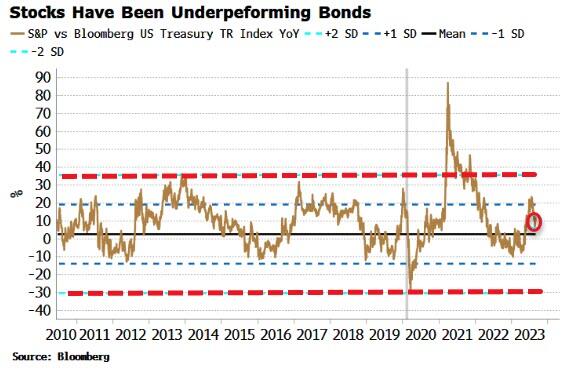
The growth in the US stock-bond ratio is poised to keep falling, but yields on nominal and inflation bonds both bouncing from very oversold levels are likely to be choppy.

It’s generally a frustrating time after big moves as markets take time to settle down, and a new clear, tradeable trend becomes apparent. We are in one of those periods now, but yields should have an overall downwards bias, enough to keep pressure on the stock-bond ratio.

I highlighted a couple of weeks ago that stocks were on the overbought side versus bonds, and we may see a reversal. Since then the annual change of the stock-bond ratio has fallen from its one standard-deviation level.
Equities have run into some resistance around the 4500 level on the S&P. Countervailing forces from rising recession risks and a Fed still drumming the “higher for longer” mantra will conspire to keep equities in a range until the logjam is broken.
Bonds, though, may have a slight edge as they bounce from very oversold levels.
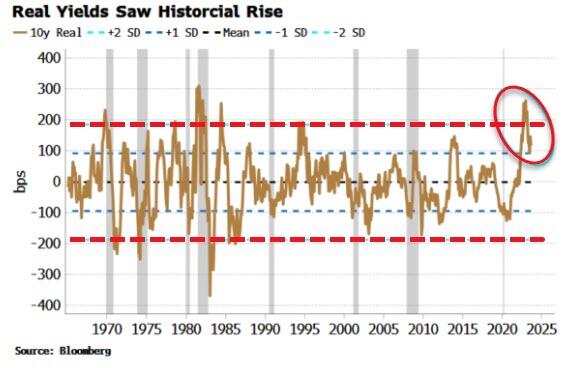
Real yields’ rise at the beginning of 2023 was close to the sharpest they had experienced in over 50 years. Their annual rate of change subsequently fell, but then has bounced again over the last few weeks.
Historically when moves have been very extreme it can lead to periods of choppiness in the breaks of the overall normalization trend. And even though real yields are less overbought, they are still stretched to the upside, meaning in the medium term they should have a downwards bias.
It’s similar for nominal yields. They are less overbought than they were, and face choppiness, but they should have an overall downwards bias in the longer term.
Moreover, as volatility settles down, +4% yields will look increasingly attractive to many buyers – leveraged and unleveraged – especially if recession risks are perceived to be rising (even though investors should not assume the usual investment rules apply in inflationary recessions)