>>> Europe : Brokers Upgrades & Downgrades - 4th of July 2023 V2(+)

>>> Up
* Adidas PT Raised to 220 euros from 180 euros at Berenberg
* Castellum Raised to Buy at DNB Markets; PT 125 kronor
* City Pub Raised to Buy at Panmure Gordon; PT 130 pence
* Games Workshop PT Raised to 12,000 pence at Peel Hunt
* Kindred GDRs Raised to Buy at ABG; PT 140 kronor
* Norva24 Group Raised to Buy at Citi; PT 35 kronor
* Saipem Raised to Buy at Redburn; PT 2.57 euros (+)
* Wacker Chemie Raised to Buy at HSBC; PT 155 euros

>>> Down
* AstraZeneca Cut to Hold at Deutsche Bank; PT 11,000 pence
* Dunelm Cut to Underperform at RBC; PT 1,000 pence
* Georg Fischer Cut to Add at Baader Helvea; PT 70 Swiss francs
* Intrum Cut to Hold at Arctic Securities; PT 89 kronor
* Persimmon Cut to Neutral at JPMorgan; PT 1,090 pence
* Tobii Cut to Hold at Handelsbanken

>>> Initiation
* Fugro Reinstated Outperform at BNPP Exane; PT 18.90 euros
* Knorr-Bremse Re-Initiated Neutral at BNPP Exane; PT 66 euros
* Verallia Resumed Buy at Deutsche Bank; PT 48 euros (+)

>>> Call
* Adidas PT Raised to Street-High at Berenberg on Brand Turnaround
* Citi Strategists Say US Futures Positioning Is Looking Stretched (+)
* Dunelm Will Find Growth Tougher, Cut to Underperform at RBC
* Goldman Strategists Say Too Early to Dismiss Risk From Rates (+)
* Monster Agrees to Buy Bang; ‘Strategic Positive’ Says Goldman
* Norva24 Group Raised to Buy at Citi on Attractive Entry Point
* Persimmon Downgraded at JPMorgan as Volume Recovery in Jeopardy
* Sainsbury 1Q ‘Very Strong’ With Positive Grocery Sales: Shore (+)
* Virbac Guidance Cut Confirms Market Slowdown, Jefferies Says (+)

(ZH) More Dedollarization: Indian Refiners' Payments To Russia, Argentina Paymen

More Dedollarization: Indian Refiners' Payments To Russia, Argentina Payment To IMF Both In Yuan

The world continues to chisel away at the dollar's reserve status.

In the first of the two most recent examples of how non-western nations plan to avoid the weaponized dollar, late last week Argentina made a loan repayment to the International Monetary Fund worth the equivalent of $2.7 billion “without using dollars” on Friday, using Chinese yuan and special-drawing rights notes instead, Reuters reported.

The operation is expected to deplete Argentina's $1.65 billion in SDRs, according to a central bank source, "with yuan making up the difference." While Reuters' take home message here is that the "use of yuan underscores how desperate the country's dollar position has become", an alternative conclusion is that when it comes to international obligations - at least as far as the IMF is concerned - the yuan is as good as the greenback, an observation that will make China quite happy.

As a result of the payment, Argentina's foreign currency reserves saw a sharp decrease to around $27.933 billion for end-June, the same source told Reuters, bringing foreign reserves to their lowest since March 2016. Still, the move gave a boost to Argentina's markets on the last day of the month, which overall in June saw the stock index tick up nearly 25% and bonds up almost 13%.
Both parties are now locked in talks to speed up disbursements from their $44 billion program and ease economic targets, as a major drought continues to hammer vital grains exports.
Argentina's economy ministry said a team will travel to Washington early next week to continue negotiations.

"IMF staff and the Argentine authorities will continue to advance their work in the coming days, with the aim of reaching agreement on the fifth review of the Fund-supported program," the fund said separately on Friday, after a "standard informal Executive Board briefing on Argentina" was held Thursday.

But wait, there's more.

Indian refiners have also begun paying for some oil imports from Russia in Chinese yuan, Reuters also reported citing "sources with direct knowledge of the matter" as Western sanctions force Moscow and its customers to find alternatives to the dollar for settling payments.

In other words, it is the weaponization of the dollar that is forcing the world to find alternative to - drumroll - the dollar, something we have been warning would happen ever since Russia was effectively blacklisted and targeted by the entire dollar-based monetary platform.

And just in case there is still some confusion about the long-term viability of the petrodollar, China has also switched to the yuan for most of its energy imports from Russia, which overtook Saudi Arabia to become China's top crude supplier in the first quarter this year.

"Some refiners are paying in other currencies like yuan if banks are not willing to settle trade in dollars," said an Indian government source.

Indian Oil Corp, the country's biggest buyer of Russian crude oil, in June became the first state refiner to pay for some Russian purchases in yuan, three sources familiar with the matter said. At least two of India's three private refiners are also paying for some Russian imports in yuan, two other sources said.

According to Reuters, it could not immediately be determined how much Russian oil Indian refiners have bought with yuan, although Indian Oil has paid in yuan for multiple cargoes.

The rise in yuan payments has given a boost to Beijing's efforts to internationalise its currency, with Chinese banks promoting its use specifically for Russian oil trade.

Since the imposition of sanctions on Moscow, Indian refiners have mostly bought Russian crude from Dubai-based traders and Russian oil companies such as Rosneft, the Litasco unit of Russian oil major Lukoil, and Gazprom Neft, according to shipping data compiled by Reuters.
Indian refiners have also settled some non-dollar payments for Russian oil in the United Arab Emirates' dirham, sources have said.

"First preference is to pay in dollars but refiners sometimes pay in other currencies such as dirham and yuan when sellers ask them," said the government source, who did not elaborate further and declined to identify any Indian companies paying in yuan for Russian oil.

Reuters previously reported in March that India had asked banks and traders to avoid using the yuan to pay for Russian imports because of long-running political differences with China. And while it was not immediately clear whether recent purchases represent a change in that view, clearly this "directive" is now being ignored as US influence in the region wanes with every passing day.

Furthermore, India's imports from Russia rose to a record in May, with Russian crude oil accounting for 40% of India's overall oil imports compared with 16.5% a year earlier, denting purchases from Iraq and Saudi Arabia.

While Western sanctions against Moscow are not recognized by India and its purchases of Russian oil may not violate them, Indian banks are wary of clearing payments for such imports:
  • In May, State Bank of India, the country's top lender and a key banker for state refiners, rejected IOC's planned payment in dollars for a cargo delivered by Rosneft, two sources said. The cargo was loaded on tanker NS Bora, handled by Dubai-based Sun Ship Management, an entity connected to Russia's largest state shipping company, Sovcomflot, which the European Union sanctioned in February and the United Kingdom in May.
  • In June, IOC used ICICI Bank (ICBK.NS), a private-sector Indian lender, to settle this trade with Rosneft by paying in yuan to Bank of China (601988.SS), two sources with direct knowledge of the matter said. One private refiner has also been using the same mechanism for payments for Russian oil, one of the sources said.

Since then, IOC has used the same method to pay with yuan for other cargoes from Rosneft, one of the sources with direct knowledge of the matter said.

"Whenever IOC will face problems it would push for payment in yuan," the person said, adding that IOC had asked Rosneft to consider supplying oil in vessels not managed by sanctioned entities.

Another state refiner, Bharat Petroleum Corp Ltd (BPCL.NS), is also exploring yuan payment for Russian oil, a separate source said.

"Many traders (sellers) are insisting for yuan payments," the source said.
That pretty much says it all.
(ZH) Life Cycle Emissions: EVs Vs Combustion Engine Vehicles

Life Cycle Emissions: EVs Vs Combustion Engine Vehicles

According to the International Energy Agency, the transportation sector is more reliant on fossil fuels than any other sector in the economy. In 2021, it accounted for 37% of all CO2 emissions from end‐use sectors.
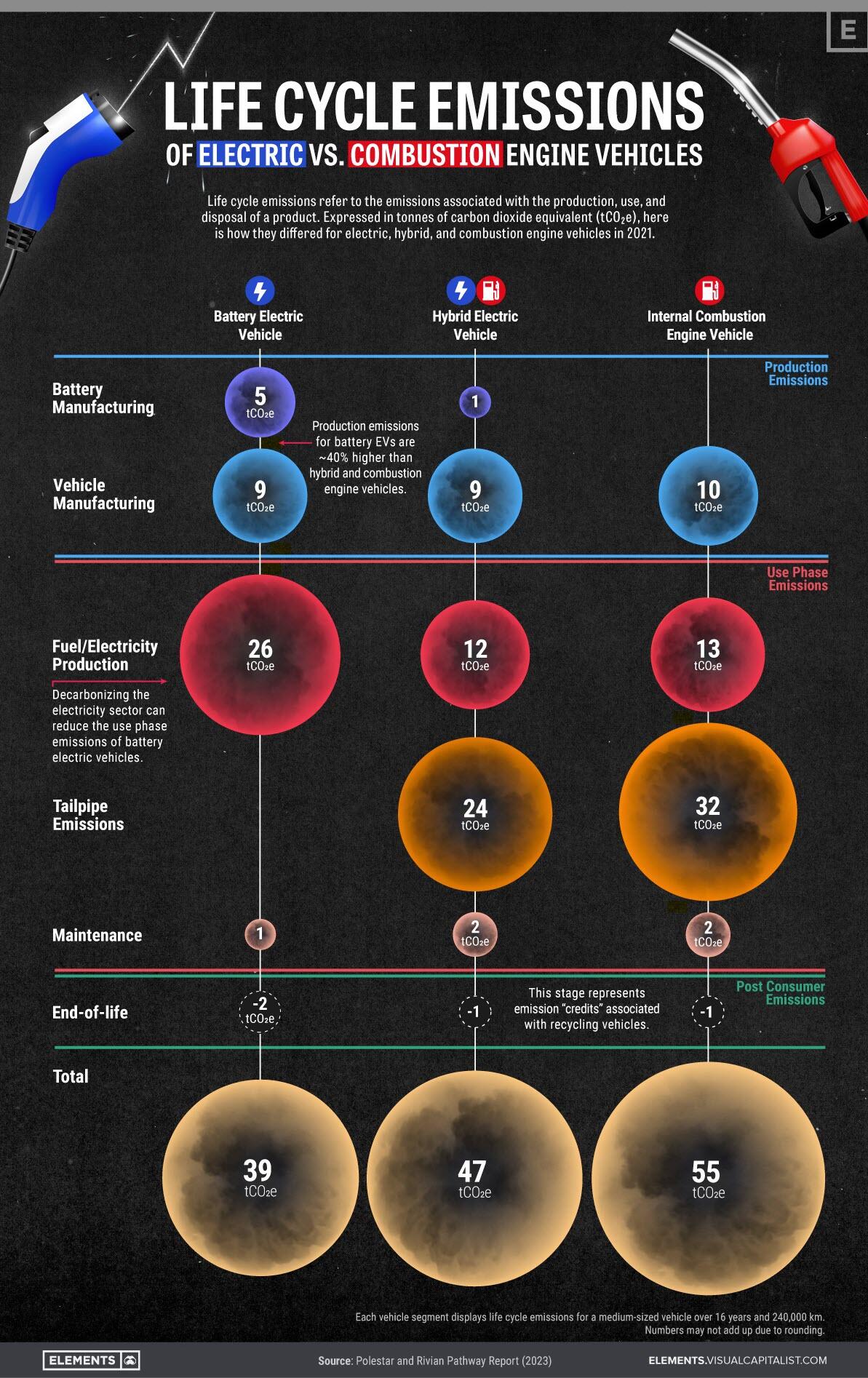
To gain insights into how different vehicle types contribute to these emissions, Visual Capitalist's Selin Oguz and Sam Parker created the inforgapohic below to visualize the life cycle emissions of battery electric, hybrid, and internal combustion engine (ICE) vehicles using Polestar and Rivian’s Pathway Report.
Production to Disposal: Emissions at Each Stage
Life cycle emissions are the total amount of greenhouse gases emitted throughout a product’s existence, including its production, use, and disposal.
To compare these emissions effectively, a standardized unit called metric tons of CO2 equivalent (tCO2e) is used, which accounts for different types of greenhouse gases and their global warming potential.
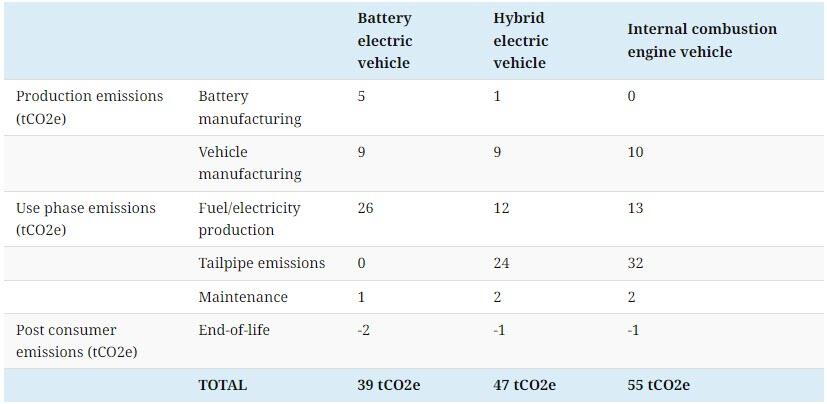
Here is an overview of the 2021 life cycle emissions of medium-sized electric, hybrid and ICE vehicles in each stage of their life cycles, using tCO2e. These numbers consider a use phase of 16 years and a distance of 240,000 km.
While it may not be surprising that battery electric vehicles (BEVs) have the lowest life cycle emissions of the three vehicle segments, we can also take some other insights from the data that may not be as obvious at first.
  1. The production emissions for BEVs are approximately 40% higher than those of hybrid and ICE vehicles. According to a McKinsey & Company study, this high emission intensity can be attributed to the extraction and refining of raw materials like lithium, cobalt, and nickel that are needed for batteries, as well as the energy-intensive manufacturing process of BEVs.
  2. Electricity production is by far the most emission-intensive stage in a BEVs life cycle. Decarbonizing the electricity sector by implementing renewable and nuclear energy sources can significantly reduce these vehicles’ use phase emissions.
  3. By recycling materials and components in their end-of-life stages, all vehicle segments can offset a portion of their earlier life cycle emissions.
Accelerating the Transition to Electric Mobility
As we move toward a carbon-neutral economy, battery electric vehicles can play an important role in reducing global CO2 emissions.
Despite their lack of tailpipe emissions, however, it’s good to note that many stages of a BEV’s life cycle are still quite emission-intensive, specifically when it comes to manufacturing and electricity production.
Advancing the sustainability of battery production and fostering the adoption of clean energy sources can, therefore, aid in lowering the emissions of BEVs even further, leading to increased environmental stewardship in the transportation sector.

>>> Stoxx 600 Pre-Market Indications

  • Wacker Chemie (WCH TH) +1.9%
    • Wacker Chemie Raised to Buy at HSBC; PT 155 euros
  • Ryanair (RY4C TH) +1.3%
    • Ryanair June Load Factor 95%
  • Umicore (NVJP TH) +1.1%
  • Rheinmetall (RHM TH) +1%
  • Boliden (BWJ TH) +0.7%
  • ASML (ASME TH) +0.6%
  • Wolters Kluwer (WOSB TH) +0.6%
  • Novo Nordisk (NOVC TH) +0.6%
    • Irish Times: Diabetes patients forced to ration insulin due to product shortage
  • Aixtron (AIXA TH) -0.6%
  • Covestro (1COV TH) -0.6%
  • K+S (SDF TH) -0.6%
  • Thyssenkrupp (TKA TH) -0.6%
    • Public Funding Will Be Test of Low-Carbon Steel’s Mettle
  • Evonik (EVK TH) -0.7%
  • HelloFresh (HFG TH) -0.8%
  • Nel (D7G TH) -0.8%

>>> TradeGate Pre-Market Indications

DAX:
  • Rheinmetall (RHM TH) +1%
    • Thornburg Intl Value Buys More Rheinmetall
  • Vonovia (VNA TH) +0.7%
  • Siemens Energy (ENR TH) +0.6%
    • Siemens Energy Investor Raised Voting Rights to 5.34% on June 29
  • Deutsche Bank (DBK TH) +0.6%
    • Deutsche Bank Upgraded to A- by Fitch, Outlook Stable
  • Bayer (BAYN TH) +0.5%
MDAX:
  • Wacker Chemie (WCH TH) +1.9%
    • Wacker Chemie Raised to Buy at HSBC; PT 155 euros
  • Evotec SE (EVT TH) +0.7%
  • K+S (SDF TH) -0.6%
  • Evonik (EVK TH) -0.7%
SDAX:
  • Deutsche PBB (PBB TH) +1.4%
  • Suedzucker (SZU TH) +1.1%
  • PNE AG (PNE3 TH) +1%
  • Aroundtown (AT1 TH) +0.9%
  • Schaeffler (SHA TH) +0.7%
  • AUTO1 (AG1 TH) -0.5%

>>> What to look at today - 4th of July 2023

The rally in global shares paused Tuesday amid lackluster trading as US futures fluctuated and Japanese equities weighed down a gauge of Asia stocks. The Australian dollar declined after the central bank kept interest rates unchanged while the yield on the nation’s three-year bond reversed an earlier gain. Australian equities rose. Japan’s Topix fell about 0.5%, while Hong Kong’s Hang Seng Index rose by around the same amount and shares in Shanghai fluctuated.  This follows an advance of just 0.1% for the S&P 500 in a shortened session Monday that ended at lunchtime. The Nasdaq 100 added 0.2% on a day that brought data showing a slowdown in manufacturing.  Major currencies were mostly steady. Treasuries weren’t trading Tuesday due to the Independence Day holiday in the US. The offshore yuan strengthened for a third day after the People’s Bank of China extended again its efforts to prop up the currency through its daily reference rate.  Economists and traders were divided on the likelihood of a rate hike or pause by the Reserve Bank of Australia.  Shares of Chinese non-ferrous metals firms climbed after the government imposed restrictions on exports of gallium and germanium, which are crucial for the semiconductor, telecommunications and electric-vehicles sectors. The ban is seen China’s escalation of the tit-for-tat technology trade conflict with the US and its allies. The new restrictions are a second, and much bigger, countermeasure in the tech war after China’s similar move on Micron Technology Inc., according to Jefferies analysts, including Edison Lee. “If this doesn’t change the US-China dynamics, more rare earth export controls should be expected,” they wrote in a note. Meanwhile, a key part of the US Treasury yield curve approached its most inverted level in decades on Monday as traders priced in further hikes from the Federal Reserve. Two-year yields exceeded the 10-year by around 111 basis points. ooling signals in the world’s biggest economy — which are set to influence the trajectory of the Fed’s monetary-tightening cycle — mean investors are tempering expectations for stocks for the remainder of the year, especially as central banks worldwide have maintained their hawkish rhetoric. The manufacturing sector painted a grim picture as US factory activity fell to its weakest level in more than three years. Production and new orders data also suggested a pullback. Oil rose as traders assessed the latest salvo from OPEC+ kingpins Saudi Arabia and Russia to prop up prices by curbing supply. Gold ticked higher


Nikkei -1.03% Hang Seng +0.12% CSI -0.06% Shanghai -0.15% Shenzen +0.09%

Eur$ 1.0901 CNH 7.2417 CNY 7.2322 JPY 144.64 GBP 1.2687 CHF 0.8970 RUB 89.2767 TRY 25.9473 WTI$ 70.18 +0.56% Gold 1,924 +0.13% BTC 31,050 -0.26% ETH 1,953 -0.29%

S&P -0.03% Nasdaq -0.11% EuroStoxx +0.04% FTSE -0.13% Dax +0.07% SMI +0.04%

Macro :
- US to Curb China Access to Cloud Services Like Amazon, WSJ Says
- Public Funding Will Be Test of Low-Carbon Steel’s Mettle

Keep an eye on :
- CNA LN : UK’s Ofgem Warns Energy Suppliers to Hold Off Big Dividends
- CSGN SW : Top Credit Suisse Banker in Qatar Set to Join Exodus (Correct)
- EFGN SW : EFG’s Collardi Says ‘Realistic’ to Hire 100 Wealth Bankers
- ELE SM : Repsol Chairman Exploring Deal for Enel’s Endesa: Confidencial
- ENEL IM : Repsol Chairman Exploring Deal for Enel’s Endesa: Confidencial
- FCC SM : FCC Aims to Launch Takeover Offer of Metrovacesa: El Economista
- FIS US : GTCR in Talks for FIS Worldpay Stake at Up to $20b Value: Rtrs
- FLOW NA : Flow Traders Prelim 2Q Normalized Net Trading Income About EU49M
- HLN LN : Advil Owner Haleon Said to Mull Sale of Nicotine Gum Business
- IDR FP : Indra Approves New Organizational Structure, Names Executives
- INF LN : Informa Placed on Positive Catalyst Watch at Citi Before Results
- MVC SM : FCC Aims to Launch Takeover Offer of Metrovacesa: El Economista
- PSH NA : Pershing Square Holdings June Net Performance +7.3%
- REP SM : Repsol Chairman Exploring Deal for Enel’s Endesa: Confidencial
- RYA ID : Ryanair June Load Factor 95%
- STLA US : Stellantis to Invest in Italy Plant as Part of Electric Overhaul
- FR FP : Valeo Still in Talks With a Couple of Clients for Price Hikes
- VIRP FP : Virbac Cuts FY Organic Revenue at Constant FX Forecast
- VOW GY : Portugal Light Vehicle Sales Rose 44% in June, Acap Says
- WP US : GTCR in Talks for FIS Worldpay Stake at Up to $20b Value: Rtrs

>>> Europe : Brokers Upgrades & Downgrades - 4th of July 2023

>>> Up
* Adidas PT Raised to 220 euros from 180 euros at Berenberg
* Castellum Raised to Buy at DNB Markets; PT 125 kronor
* City Pub Raised to Buy at Panmure Gordon; PT 130 pence
* Games Workshop PT Raised to 12,000 pence at Peel Hunt
* Kindred GDRs Raised to Buy at ABG; PT 140 kronor
* Norva24 Group Raised to Buy at Citi; PT 35 kronor
* Wacker Chemie Raised to Buy at HSBC; PT 155 euros

>>> Down
* AstraZeneca Cut to Hold at Deutsche Bank; PT 11,000 pence
* Dunelm Cut to Underperform at RBC; PT 1,000 pence
* Georg Fischer Cut to Add at Baader Helvea; PT 70 Swiss francs
* Intrum Cut to Hold at Arctic Securities; PT 89 kronor
* Persimmon Cut to Neutral at JPMorgan; PT 1,090 pence
* Tobii Cut to Hold at Handelsbanken

>>> Initiation
* Fugro Reinstated Outperform at BNPP Exane; PT 18.90 euros
* Knorr-Bremse Re-Initiated Neutral at BNPP Exane; PT 66 euros

>>> Call
* Adidas PT Raised to Street-High at Berenberg on Brand Turnaround
* Dunelm Will Find Growth Tougher, Cut to Underperform at RBC
* Monster Agrees to Buy Bang; ‘Strategic Positive’ Says Goldman
* Norva24 Group Raised to Buy at Citi on Attractive Entry Point
* Persimmon Downgraded at JPMorgan as Volume Recovery in Jeopardy