FT : Allison Kirkby, the Glaswegian telecoms turnaround expert taking over BT

Allison Kirkby, the Glaswegian telecoms turnaround expert taking over BT
First female chief executive of the UK group is heading home after nearly a decade in Scandinavia

Allison Kirkby, who has been appointed to lead BT, would have dropped an emerging career in telecoms had Manchester United’s owners not turned her down as chief financial officer of her favourite English Premier League club.

“The Glazers didn’t like me,” said the executive, a Glaswegian like the club’s former manager Sir Alex Ferguson.

After the setback Kirkby set off to Scandinavia, where she has spent most of the past decade turning around former state-owned telecoms monopolies unloved by investors and facing costly fibre optic rollouts. Now she is coming home to attempt the same with Britain’s own problem-stricken giant.

BT on Monday announced that Kirkby, one of its non-executive directors since 2019, would become its first female chief executive, replacing outgoing boss Philip Jansen by January next year at the latest.
Kirkby beat Marc Allera, the head of BT’s consumer division, who was tipped as the leading internal candidate, to the top job. But despite being drafted in from Sweden’s Telia, which she has run for the past four years, Kirkby is “very much a continuity candidate”, according to James Barford, an analyst at Enders Analysis.

Jansen, who joined BT from outside the industry in 2019, has set in motion plans to invest £12bn to push high-speed broadband out to 25mn homes by 2026. But cost-cutting is as much in focus: the group also plans to shed up to 55,000 jobs, or about 40 per cent of its workforce, by the end of the decade.

Kirkby’s job is “all about execution”, said Barford. The 56-year-old Scot is well acquainted with the sector and the need for big changes to combat its multiple challenges.

A prominent telecoms investor described her as “one of the best telecom executives in Europe . . . who’s not scared of changing things if it creates value”. He added: “She may not be well known in the UK but she’s seen as a star in the Nordics.”

Kirkby is the third female chief executive to take the helm at a European telecoms company in the past 18 months following the appointments of Christel Heydemann to run France’s Orange and Margherita Della Valle at Vodafone.
She will be one of just nine FTSE 100 female chief executives.

Over the past decade, Kirkby has run three Nordic telecoms companies and on each occasion has been unafraid to push through big changes. At Sweden’s Tele2, she masterminded the $3.3bn takeover of local cable and broadband group Com Hem in 2018. In just a year at the helm of Denmark’s TDC Group, she split the company into two separate units.

At Telia, Sweden’s former state monopoly operator, Kirkby managed to offload international assets, which had proved difficult to sell. She pushed through a sale of its international telecoms carrier business to local pension funds for almost €1bn, and sold about half of its towers business in Sweden, Norway and Finland to Brookfield and Alecta.

“She’s very affable, very astute and — most importantly for this job — she understands capital allocation very well,” said Bruce Flatt, chief executive officer of $825bn alternatives manager Brookfield, where Kirkby now sits on the board. “BT is going to need capital and she’s going to have to make some of those same decisions that she made at Telia.”

Deutsche Bank analysts said her departure from Telia was “negative” for the group’s share price, which dropped by 4.5 per cent in Stockholm on Monday.

Kirkby said on Monday that she was “fully supportive” of BT’s existing turnaround plans.
Robert Grindle, a telecoms analyst at Deutsche Bank, said Kirkby faced a bigger task at BT with the fibre optic rollout than she did at Telia. “She has to continue building fibre with ‘fury’ to fend off the threat from other big telcos and altnets,” he said.

BT has received much of the blame for the UK’s status in Europe as a laggard over its slow fibre optic rollout.
As of February, 12.4mn UK homes, or about 42 per cent, had full-fibre broadband, according to regulator Ofcom.
That compares with 89 per cent of Spanish households and 63 per cent of French homes, according to 2021 figures.

A former BT board director said Kirkby was “an extremely capable person” and the right candidate “not just to deliver the fibre optic rollout but to deal with the many operational things internally in the company that need to be strengthened”.

Ian Durant, the former chair of bakery chain Greggs, where Kirkby served as a non-executive director for six years, described her as “feisty, fun and fearless in equal measure”.

By the age of 14, Kirkby was already holding down two jobs: delivering fresh cartons of cream around her local neighbourhood in Glasgow and, as a door-to-door salesperson for the Avon cosmetics brand, colloquially known as an “Avon lady”.

In a 2020 TED Talk, Kirkby chalked up her success in business to a series of knock-backs during her youth, including being bullied at an inner-city school in Glasgow and opting not to go to university immediately after school and instead help care for her father after he was diagnosed with terminal cancer. “All of those experiences whilst tough really made me who I am today,” she recalled.

She will have to deploy those skills to face up to the other challenges that BT faces: it is being probed by Ofcom over information offered to new customers about mobile and broadband deals as well as over disruption to 999 emergency services on a single day in June. Last year, BT conceded to pay demands following an eight-day strike by 40,000 workers.

The group’s share price has fallen nearly 24 per cent to £1.21 over the past year.

Kirkby must also reconcile the positions of two big shareholders whose investments are under water: Patrick Drahi’s Altice owns almost 25 per cent of BT while Deutsche Telekom — whose chief executive earlier this year expressed dissatisfaction over the languishing share price — has 12 per cent. Despite the telecoms group being tipped as a possible takeover target, Drahi’s vehicle said in May it had no plans to bid for BT.

One investor said because of the state of the debt markets BT was “probably an unpurchaseable company” for the time being, whether by Drahi or anyone else. “So the good news is that [Kirkby will] have some time to be able to get her ship in order.”

FT : Chinese developer’s cancelled share placement fuels property sector woes

Chinese developer’s cancelled share placement fuels property sector woes
Country Garden stock falls 10% after one of country’s biggest real estate groups abruptly calls off issuance

One of China’s biggest property developers has abruptly abandoned a share placement, sending its stock down as much as 10 per cent on Tuesday and renewing concerns about the troubled real estate sector.

Country Garden, one of the country’s largest developers and a barometer of the sector’s health, decided to cancel a $300mn share placement on Monday night, two people briefed on the situation said. A successful placement would have been a rare new capital markets deal in a sector starved of investment. JPMorgan was the sole bookrunner.

“Due to inconsistency in communications with various parties, the company hasn’t managed to sign off the final agreement on a proposed [share placement] plan,” Country Garden said in a statement sent to the Financial Times on Tuesday. “The company is also not considering the deal at the current stage.”

The cancellation is a blow for an industry whose poor performance remains one of Chinese policymakers’ biggest challenges almost two years after developer Evergrande defaulted and sparked a cash crunch. Country Garden is one of the few prominent private developers to avoid default, posting a Rmb2bn ($280mn) profit in the first half of last year.

But it has lost almost half of its stock market value this year, and on Monday the group issued a profit warning for the first half of 2023, citing “impairments for property projects” amid the “downward trend of real estate sales”. The company said it would reduce expenses and “actively seek guidance and support from the government and regulatory authorities”.

In its statement on Tuesday, the developer added that it was closely looking for opportunities to expand its fundraising channels amid market uncertainties and lukewarm property sales. Country Garden said it was “actively working with intermediary agencies on fundraising plans”.

Beijing has stopped short of providing a major bailout for the property sector since the crisis erupted two years ago. It has instead encouraged “high-quality” developers to return to markets.

Ruiying He, a credit analyst at Lucror Analytics, noted that Country Garden had Rmb12.4bn of bonds maturing this year in the Chinese mainland, as well as $1bn of bonds coming due in January.

“The cancelled share sale may raise questions about investor appetite towards the company, as well as the controlling shareholder’s ability and willingness to support it,” she said.

Country Garden has come under pressure in stock markets in recent weeks amid concerns over a potential default from well-known property conglomerate Dalian Wanda, which last week averted default on a bond after completing a last-minute asset sale.

Other developers, including state-owned Greenland, have also been the subject of volatile trading amid growing doubts about the wider sector’s health.

Data released on Tuesday by China Real Estate Information showed sales from China’s top 100 developers fell 33 per cent year on year to Rmb350bn in July.

Poor economic data has added to pressure on Xi Jinping’s government to inject further stimulus.
Property investment fell 7.9 per cent year on year in the first half of 2023, while metrics from retail sales to exports have disappointed expectations.

JPMorgan declined to comment.

WWD : Prada Beauty to Launch Makeup and Skin Care

Prada Beauty to Launch Makeup and Skin Care
Lynsey Alexander and Inès Alpha are the brand’s global creative makeup artist and e-makeup artist, respectively.

PARIS — The designer beauty wars are heating up.

The newest entrant: Prada, whose vision of beauty will infuse two new product categories — makeup and skin care — starting on Aug. 1.

“What does beauty mean today? This question was at the core of our work with L’Oréal,” Miuccia Prada and Raf Simons, co-creative directors of Prada, jointly said, referring to the brand’s beauty licensee. “Abandoning all the clichés of the past, we believe that beauty today is the representation of one’s personality, freedom and self-confidence.

“The idea of ‘care’ was also crucial, as a gesture and as a need, for one’s well-being,” they continued. “The important results that research has achieved in this field has allowed us to work on real and effective products.”

Cyril Chapuy, president of L’Oréal Luxe, Prada Beauty’s licensee, deems the further beauty incursion to be an important step for the Milan-based brand.

“After the spectacular launch of Prada Paradoxe in 2022 that reinstated the brand’s leadership in feminine fragrances, the Skin and Color launch opens a new chapter that will propel the brand to new heights,” he said, describing the collection as representing “contemporary luxury beauty at its best: superior quality, ground-breaking tech innovation and no compromise on sustainability.”

After L’Oréal acquired the Prada Beauty license on Jan. 1, 2021, it swiftly rebooted the existing fragrance portfolio and launched scents such as Luna Rossa Ocean and Prada Paradoxe, which became the top women’s perfume launch last year in the U.S.

“That’s why now we feel it’s the perfect time for the brand to widen our global point of view and vision on beauty,” said Yann Andrea, international general manager of Prada Beauty.

The launch of makeup and skin care will take place first on prada-beauty.com and prada.com, on Aug. 1. Then the tight rollout will include Harrods and Selfridges in London on Aug. 18. Douglas in Munich, Frankfurt and Dusseldorf, Germany, and Rinascente in Rome will start carrying the products in October.
Prices will range from 45 euros for a lipstick to 80 euros for an eye shadow and 360 euros for a cream.

The U.S. brick-and-mortar launch is planned for January.

Prada Beauty products will be carried in very selective brick-and-mortar distribution — mainly high-end department stores, shopping malls, speciality stores and perfumeries, as well as travel-retail locations.

L’Oréal executives would not discuss sales projections, but industry sources estimate that in three years, Prada skin care and makeup might generate 25 to 30 percent of the brand’s total beauty business. That could mean about 250 million euros in annual retail sales.

“Prada Beauty is an iconic signature,” Chapuy said.
“The brand fits with L’Oréal Luxe’s very diverse and complimentary portfolio of 23 luxury beauty brands.”

L’Oréal Luxe keeps bolstering its designer makeup offer, with Prada color cosmetics coming two years after the launch Valentino makeup. Some other fashion beauty brands in the Luxe portfolio, such as Giorgio Armani and Yves Saint Laurent, are already three-axis.

Skin care — including sun care — and makeup were the largest product categories at L’Oréal, generating 40.1 percent and 20.2 percent, respectively, of overall group sales of 38.26 billion euros in 2022.

Also last year, the Luxe division was the group’s largest sales-maker, ringing up 38.3 percent of the total.

“As one of the most captivating couture brands in the world, Prada Beauty has a unique ability to resonate with the younger generation,” Chapuy continued, explaining it “has an exceptional growth potential to excel in all luxury beauty categories and soon join the very selective club of L’Oréal Luxe billionaire brands.”

For Prada, the overarching objective was to rethink beauty. “This was our approach, vision and ambition,” Andrea said.

It all began at the brand’s roots, with the Prada Beauty team working closely with the Prada designers and their creative team. “We had the privilege to get the access to 27,000 prints and fabrics just to create the perfect synergy between fashion and beauty,” Andrea said. “Our beauty philosophy was to first get the most sophisticated skin. Then, you can add a touch of color eccentricity.

“We wanted to rethink the way of developing product and of collaborating with makeup artists,” he said.

So Prada Beauty opted to tap two artists: Lynsey Alexander for real-life makeup and Inès Marzat — aka Inès Alpha — for makeup in the virtual world. They work closely together, as well as with Prada and Simons.

“Prada loves to create dialogues,” Andrea said of the brand. “This really allowed us to open new perspectives on colors, textures and finishes.”

“Three years ago, the L’Oréal team came to me with pretty much a blank canvas of an idea for a brand,” said Alexander, Prada Beauty’s global creative makeup artist. “Obviously, we have the heritage and all the incredible archive to look at from Mrs. Prada, but from a beauty perspective, the slate was clean.”

This was new for Alexander. She’d been asked to rebrand, reformulate and inject youthfulness into color cosmetics brands before — but never to start anything entirely from scratch. “It was quite a daunting task, really,” she said. “It began with me by going deep into Prada land.”

Starting three years ago during pandemic-related lockdowns, Alexander dove deep into those archives. “Everything was sent to me in terms of Saffiano leather textures, nylon swatches of fabric, archive prints,” she said. “I basically turned my house into a sort of Prada catalogue.”

Swatches and samples were everywhere. Alexander took in runway imagery, too. She reminded herself: “I’m creating a makeup line here for a really cool, amazing brand with such heritage and history, but I have to make something that is desirable. I want to make something that is beautiful.”

Alexander had a constant dialogue with herself, asking questions like: “Do I desire it? Do I want to wear it? Would I put it on the runway? Would Mrs. Prada wear it?

“Because you can go so off-piste with makeup when you have no real framework,” she continued. “There’s no limits to where you can take it.”

No compromises were made on the sustainable, cruelty-free formulas as the backs-and-forths were ongoing with Alpha, the designers and the L’Oréal labs, which would swiftly road-test products. Inclusivity was top of mind.

“Every single palette, every single lipstick color I feel super proud of because it’s been vetted through the toughest of audiences,” Alexander said.

She believes less is more makeup-wise, so eschewed eye shadow compacts with five or six colors. “It’s too many. We don’t wear makeup like that anymore,” Alexander said. “This is not the ’80s.”

Instead, six four-color palettes were created.

“We’ve gone for hyper extremes,” said Alexander, referring to the strongest hyper matte color to the most metallic foil. “We’ve used the most incredible hybrid formula, and it basically feels like a wet cream, but it has the performance and the payoff of a powder. There’s absolutely no fall-out. Mrs. Prada hates glitter, which is music to my ears. So everything metallic and shiny has a grown-up, luxe quality.

“The concept was three neutral harmonies with one striking unexpected twist — sort of disruption of color,” Alexander added. “That’s what gives it the Prada edge.”

The makeup colors were inspired by Prada prints, including remarkable pairings of colors, such as aubergine and orange, to an elegant effect. “I wanted to take that philosophy and fit it into the makeup,” Alexander said. “It had to be really considered and thought out.”

She has also been appointed the official makeup artist for Prada fashion and will create the look for its womenswear show in Milan, for the first time on Sept. 21.

The makeup was created to be performant for real women. The first lipsticks developed were red, pink and beige, then secondary colors and off-key hues were added. “We were all in agreement that we should just be doing matte lipsticks,” said Alexander, referring to the texture favored by the house since its first show in 1988. “Basically, we did the same as we did with the eye shadows — soft matte lipsticks and hyper-matte lipsticks.”

There are 13 of each. The hyper matte’s outer packaging has a gold-colored band around the middle, while the soft matte’s is silver-hued. “For the packaging, our idea was to reconcile high sophistication and essentiality,” Andrea said.

The lipsticks use three pure pigments, rather than the up to 12 traditionally, for a strong, long-lasting payoff in one stroke. The weightless products are also infused with caring ingredients.

A transparent matte lip balm comes in the Prada signature green and can be used as a primer.

“Prada is obsessed with tech and beauty — this idea of tech being a big involvement in where we’re going, what we’re looking toward,” Alexander said. “Part of my journey was working with a digital makeup artist.”

That was Alpha, the global creative e-makeup artist, with whom Alexander collaborated. They would start with the same brief, decipher it then chat over Zoom to compare what they’d created.

“It was really inspiring,” Alexander said.

Prada foundations
An orange that Alpha made digitally might spring to life in the real world or vice versa, whereby a physical prototype could be translated digitally into the 3D virtual world.

“It was a real dialogue of everyone being the master of their field, but then pushing it into unknown territory and basically ending up with something completely unique that we definitely didn’t plan on starting at that point,” Alexander said. “Inès works with pixels, and I work with pigments.”

For the e-makeup artist, focusing on physical color cosmetics was a newfangled manner of creation, too. Alpha called the position at Prada Beauty her “dream job,” bridging two worlds. She views the virtual color cosmetics as continuing and augmenting the physical makeup.

“It was also a dream to work with Prada, which is a brand that I’ve been fascinated with since I was a child,” she said. “When we started collaborating, they asked me: ‘How can you work on the pixels so our labs can get inspiration from what you do to create textures or colors?’

So Alpha, who also mined the brand’s archives, proposed they work with various digital avatars on which she’d recreate physical makeup looks. “That’s super complicated,” she said, adding: “I had never worked that intricately on colors before.”

Alpha explained it’s impossible to recreate with the same intensity with pigments the colors appearing on a screen. “The goal for my work was to go beyond those constraints,” she said. “The AR looks that I created as face filters — everyone will be able to try them on,” continued Alpha, explaining those are like AR try-ons supplemented with a third layer of 3D makeup.

The conversations between Alpha and Alexander spilled over to foundation, which has soft-filter technology and comes in 33 colors developed with the help of artificial intelligence. “It was a human-and-tech approach when it comes to the shade creation,” said Andrea, calling the range inclusive.

“The product itself is very flexible. One shade can stretch over to a couple of skin tones,” Alexander said.

Foundation formulas include IRL(In-Real-Life)-micro-filter technology to optimize light diffusion.

“It basically creates this IRL filter on the face,” she said.

Rather than be about hiding or concealing imperfections, it’s meant to reveal skin perfection. “The name is Prada Reveal — it’s not about masking. Over time, it improves your skin’s quality. Everything’s about care and comfort,” Alexander said.

“We wanted to create a very strong connection between skin care and foundation,” Andrea added.

Prada had launched skin care once before, in September 2000. Under another licensee, the brand dove into beauty with unidose products. Tinted lip balms came next, but the range was discontinued.

The new skin care line, which includes Prada Augmented Skin The Cream, The Serum and The Cleanser & Makeup Remove, is not about correcting faults, as traditional treatments are, but takes a more positive approach.

“It’s about adaptation, which is the new performance,” Andrea said.

Prada skin care uses Adapto.gn Smart Technology, comprised of rare breeds of 15 plants dating back more than 400 million years.

“They have the power to increase or body’s resistance to any form of aggressions,” said Andrea, adding the tech helps skin adapt to its environment in real time.

In the L’Oréal Retail Lab, located in the Paris suburb of Clichy, Andrea walked through an in-store Prada Beauty prototype.

It came in the brand’s legendary green and displayed fragrance, skin care and foundation, and lip and eye makeup. The Prada triangle hung from the ceiling and padded walls connoted its Re-Nylon textures.

“It was our ambition to develop a global beauty brand and this house of Prada Beauty,” Andrea said.

That dream is swiftly becoming reality.

>>> US After Hours Summary: ANET +12%, WWD +9.7%, AESI +6.2%, TREX +5.6% trendin

After Hours Summary: ANET +12%, WWD +9.7%, AESI +6.2%, TREX +5.6% trending higher on earnings; ZI -17.1%, HLIT -14.1%, AAN -9.6%, RMBS -7.9%, DV -7.4% (also acquiring Scibids), MPWR -7.1% tracking lower following earnings

After Hours Gainers:

Companies trading higher in after hours in reaction to earnings/guidance: ANET +12%, WWD +9.7%, AESI +6.2%, TREX +5.6%, BHE +4.5%, CWK +4%, SBAC +3.2%, VRNS +2.6%, TWO +2.2%, DRQ +2% (also acquired Great North Wellhead), MSA +2%, GDEN +2%, THC +1.7%, RSG +1.6%, VNOM +1.4%, VNOM +1.4%, CAR +1%, KRC +0.5%, TFII +0.1%, NTB +0.1%

Companies trading higher in after hours in reaction to news: EBS +9.4% (awarded 10-yr $704 mln max BARDA contract), RWAY +3.3% (CEO taking temporary leave of absence), FLR +1.5% (selected for I-35 NEX project in TX), PLTR +0.6% (selected by Defense Information Systems Agency for spectrum band support), SYNA +0.5% (adds new products to agreement with Broadcom), LMT +0.5% (awarded multiple U.S. Army contract modifications), INCY +0.4% (supply agreement with Replimune), LAC +0.4% (shareholders vote in favor of separation), CRD.A +0.1% (to restart repurchase program; increases dividend)

After Hours Losers:

Companies trading lower in after hours in reaction to earnings/guidance: ZI -17.1%, HLIT -14.1%, AAN -9.6%, RMBS -7.9%, DV -7.4% (also acquiring Scibids), MPWR -7.1%, CRK -6.7%, KFRC -6.5%, VTS -6%, RYI -5.9%, AMKR -5.5%, AMRC -5.1%, SANM -4.7%, LEG -4.5%, HOLX -3.7%, CRC -3.6%, YUMC -3.5%, WDC -2.3%, BMRN -2.2%, LSCC -2.1%, PGRE -1.9%, ES -1.6%, BCC -1.4%, FANG -1.2%, PCH -1%, RIG -0.9%, AVB -0.3%, RRX -0.1%, OGS -0.1%, ELME -0.1%

Companies trading lower in after hours in reaction to news: TARS -4.8% (stock offering), ESRT -0.7% (files mixed shelf), QS -0.7% (appoints new President), LNN -0.2% (acquires FieldWise)

Reuters : Even with alpha strikeout, Steve Cohen scores

Even with alpha strikeout, Steve Cohen scores

NEW YORK, July 31 (Reuters Breakingviews) - Hedge fund mastermind Steve Cohen is best known for his savvy trades, but it doesn’t take an investing whizz to make money in baseball. His New York Mets are one of the worst teams in the league despite a record-setting $364 million payroll. In sports, however, beta is alpha.

Cohen bought full ownership of the club in 2020 for $2.4 billion and spent lavishly on the roster. With a losing record about two-thirds of the way through the 2023 season, the Mets over the weekend dealt ageing star pitcher Max Scherzer, a sign they’re thinking about next year. Even so, the Mets are already worth $500 million more than Cohen paid, according to Forbes, a nice uplift for substandard performance. Point72 generated a 10% return last year, based on the FT’s reporting. At SAC Capital Advisors, Cohen routinely outpaced Wall Street with average annual earnings of 30% before the firm pleaded guilty to insider trading charges in 2013.

Losers are often winners in sports, financially speaking. Dan Snyder just sold his woeful Washington Commanders for $6 billion; Snyder paid $800 million for the team and its stadium in 1999. Similarly, a group led by former basketball superstar Michael Jordan recently offloaded the pitiful Charlotte Hornets for $3 billion after buying the franchise in 2010 for just $275 million. The only insight required in sports is that the futures market for billionaires will keep growing.

FT : Basel III: Endgame

Basel III: Endgame
The most ambitious regulatory crossover event in banking history

Pour one out for the weekends and Augusts ruined by the new bank-capital rules proposed by a trio of US regulators.

Wall Streeters and other analysts/lobbyists are piecing together the consequences of the thousand-plus-page proposal that constitutes the finale of the global regulatory response to the 2008-09 financial crisis.

Among the takeaways from the proposed rules, according to sellside notes:

  • There could be an approximately 24-per-cent increase in risk-weighted assets for the largest banks (with more than $750bn in assets), and 11 per cent for banks with more than $100bn. This affects basic calculations of capital requirements, because regulators measure bank capital as a proportion of risk-weighted assets.

  • The standardisation of “operational RWAs” — in the past the biggest banks had the option of calculating operational risk with internal models. This takes away that option in favour of more standard metrics.

  • Regulators also want to include cross-jurisdictional derivatives claims in their calculations of capital requirements at global systemically important banks, or G-SIBs.

  • Banks with more than $100bn in assets will need to include accumulated other comprehensive income, or AOCI, in regulatory capital calculations, though only starting in 2028. This means some banks with unrealised losses in their available-for-sale bond portfolios will now need to hold capital against losses.

Most bankers expected tougher capital requirements. The Basel standards are a global effort, at least in theory, and the US’s proposals lag behind EU’s Basel Endgame rules. And past comments from Federal Reserve Vice Chair Michael Barr highlighted the Fed’s commitment to shoring up capital requirements. In any event, the US isn’t uniquely preoccupied with bank capital; CreditSights says this fits with American regulators’ usual approach to regulation, which is to “gold plate” rules first adopted internationally.

Even so, the timeline is a bit quicker than Goldman Sachs’ bank-equity analysts expected, and the capital requirements a bit stricter. They wrote that “the phase-in period looks to be more onerous than we had anticipated, with banks required to reach 80-per-cent compliance with B3E RWA changes by [July 1 2025].”

The bank’s analysts found that the new proposal could translate into a capital deficit of 20bp, or $15bn, if implemented right away. (NB: this does not include GS.)


The analysts also point out a different rule proposal for changing the extra capital-buffer requirements imposed on G-SIBs. Along with the inclusion of derivatives in the G-SIBanks’ cross-jurisdictional capital requirement calculations, “they are also adding in a broader range of non-bank financials in the intra-financial system calculations, such as PE firms, asset managers and exchange traded funds,” writes GS.

This could be interesting for banks’ prime brokerage businesses, which have been notably steady as of late. The analysts estimate that the capital “buffers” required would increase 20bp at Bank of America and State Street, and 10bp at JPMorgan and Wells Fargo. (Again, they do not include their own prime-brokerage-standout bank in this analysis.)

Still, the inclusion of operational RWAs is likely the biggest change, and possibly the largest burden, on US banks from the Basel III Endgame rules, CreditSights analysts say.


The proposed rules say these RWAs will be based on data meant to measure the volume and complexity of a particular bank’s business. These will be based on lease/interest/dividend-producing activities; services such as fee/commission income; and financial and/or trading activities.

CreditSights highlights that American Express could see an outsized impact on capital requirements, because of its reliance on fees for income:

Among the bigger banks, Morgan Stanley is expected to see the largest relative increase in capital requirements from these changes, according to CreditSights and GS. But CreditSights analysts argue that other changes to the systemic-risk calculations (which are compared to risk-weighted assets) could lead Morgan Stanley to drop a G-SIB size category, simply because their RWA base will be larger.

On the bright side for US banks, they are ahead of the game in holding capital against their credit risk. In fact, CreditSights found that risk-weighted asset measurements for credit should actually decline.

Goldman Sachs’ credit strategists, for their part, say that the agency mortgage-backed securities market could incrementally benefit from the treatment of MBS under the new rules:

The notice of proposed rulemaking (NPR) leaves agency MBS generally untouched from a risk weighting perspective. As a result, we expect this to be a marginal positive for the GNMA MBS basis, as banks may seek out more capital-efficient instruments over time. This is especially the case since the Ginnie/Fannie swap is cheap relative to history (Exhibit 1 and 2). We note that this view is longer-term and will take time to realise given the tenor of implementation.

Another question raised by all of this is what the banks will do in response. It isn’t clear how that will work just yet. As GS’s equity analysts point out, this doesn’t necessarily mean that the biggest banks will need to sell equity or issue debt to raise capital:

We take no view on the magnitude of banks’ RWA mitigation: Banks have historically been able to reduce RWA increases from regulatory capital rule changes as they adapt to new standards, and we expect this to occur with the Basel III Endgame, although it is difficult to estimate the amount of RWA mitigation without knowing which businesses will be most impacted.

Plus ça change, plus c’est la même chose.

Business Of Fashion : Adidas Signs £900 Million Shirt Deal With Manchester Unite

Adidas Signs £900 Million Shirt Deal With Manchester United

Adidas AG agreed to extend its shirt-sponsorship deal with English football club Manchester United in one of the biggest tie-ups in Premier League history.

The German sportswear maker signed a further 10-year contract that will keep its famous stripes and logo on the players’ shirts until 2035. The deal is worth at least £900 million ($1.2 billion).

The renewal of the sponsorship deal comes as Manchester United navigates a lengthy sale process. The Glazer family has owned the historic club since 2005 but is running a process to find a buyer or investors. UK-based billionaire Jim Ratcliffe and Sheikh Jassim Bin Hamad J.J. Al Thani, a member of Qatar’s royal family, have tabled bids valuing the club at more than $5 billion.

The team’s fortunes on the pitch improved last season. However, it has struggled to be as successful as it was under former manager Alex Ferguson, who retired in 2013 — the last time the club won the Premier League.

Adidas’s existing deal, which began in the 2015/2016 season, was worth at least £750 million. The shoemaker is seeking new avenues of growth to bolster sales after terminating its partnership with Ye, the rapper and designer formerly known as Kanye West.

>>> US Close Dow +0,28% S&P +0,15% Nasdaq +0,21% Russell +1,09%

Closing Stock Market Summary

The stock market spent most of the session trading flattish at the index level. The major indices eked out slim gains, though, on this last session of the month due to a nice move higher in the last 10 minutes of trading. The Russell 2000 paced index gains by a decent margin, rising 1.1%.

Many stocks participated in the late afternoon climb. The market-cap weighted S&P 500 rose 0.2%; the Invesco S&P 500 Equal Weight ETF (RSP) rose 0.3%; and the Vanguard Mega Cap Growth ETF (MGK) rose 0.1%. 

In the early going, the major indices largely traded in narrow ranges near their flat lines as participants looked ahead to a busy week of earnings. The calendar this week will feature quarterly results from the likes of Apple (AAPL 196.45, +0.62, +0.3%), Amazon (AMZN 133.68, +1.47, +1.1%), Merck (MRK 106.65, +0.31, +0.3%), and Qualcomm (QCOM 132.17, +2.69, +2.1%).

There's also some market-moving economic data, including the July ISM Manufacturing Index on Tuesday, the July ISM Non-Manufacturing Index on Thursday, and the July Employment Report on Friday.

Even when the major indices were flattish, market breadth still reflected a positive bias. Advancers led decliners by a 5-to-2 margin at the NYSE and a 5-to-3 margin at the Nasdaq. 

Small cap stocks were standout performers, leading to a 1.1% gain in the Russell 2000.

The energy sector (+2.0%) rose to the top of the leaderboard by a decent margin, boosted by a gain in Chevron (CVX 163.66, +4.79, +3.0%) after it was upgraded to Buy from Neutral at Goldman Sachs.

The health care sector (-1.1%), meanwhile, was the worst performer. Johnson & Johnson (JNJ 167.33, -6.95, -4.0%) was a drag on the sector after a U.S. judge ruled against resolving talc claims in bankruptcy, according to Reuters. Agilent (A 121.77, -4.28, -3.4%) was another notable loser after being downgraded to In-line from Outperform at Evercore ISI.

  • Nasdaq Composite: +37.1% YTD
  • S&P 500: +19.5% YTD
  • Russell 2000: +13.7% YTD
  • S&P Midcap 400: +12.3% YTD
  • Dow Jones Industrial Average: +7.3% YTD

Reviewing today's economic data:

  • Chicago PMI rose to 42.8 in July ( consensus 43.0) from 41.5 in June

Economic data on Tuesday will include:

  • 9:45 ET: Final July S&P Global U.S. Manufacturing PMI (prior 46.3)
  • 10:00 ET: June Construction Spending ( consensus 0.6%; prior 0.9%), July ISM Manufacturing Index (consensus 46.8%; prior 46.0%), and June job openings (prior 9.824 mln)

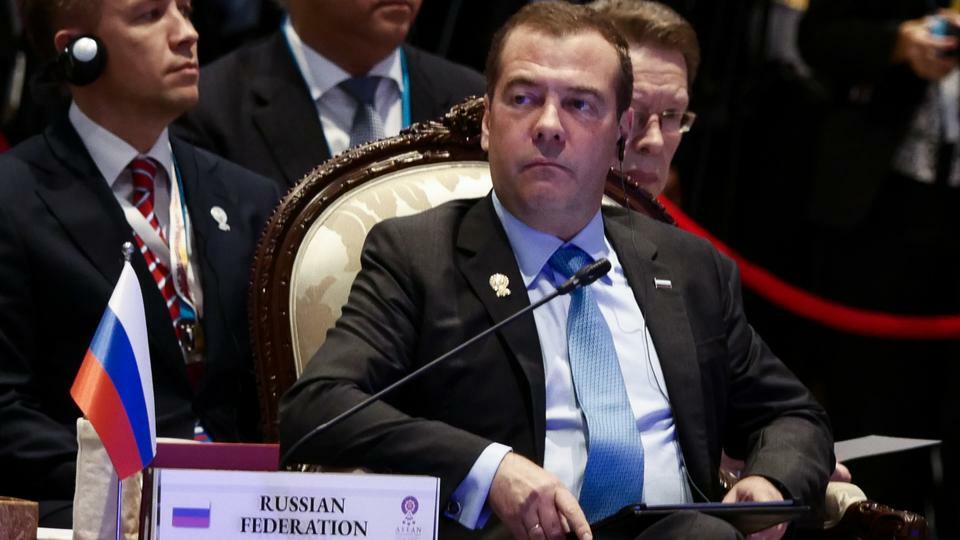
>>> Medvedev Says Russia Could Use Nuclear Weapon If Ukraine Offensive Wins

Medvedev Says Russia Could Use Nuclear Weapon If Ukraine Offensive Wins
Senior Russian national security official Dmitry Medvedev has issued a dire nuclear warning and threat aimed at Ukraine and its Western backers (though certainly not for the first time).
He said in a Sunday Telegram post that Russia could be forced to mount nuclear attack if Ukraine's counteroffensive succeeds. In effect it is to say that if Ukraine "wins", nukes would be deployed. This would happen in the scenario of "part of our land being taken away," he said.
"Just imagine that the offensive… in tandem with NATO, succeeded and ended up with part of our land being taken away. Then we would have to use nuclear weapons by virtue of the stipulations of the Russian Presidential Decree," the former president and now deputy chairman of Russia’s Security Council asserted, which is being widely cited in Western press reports.
"There simply wouldn’t be any other solution,” he added. "Our enemies should pray to our fighters that they do not allow the world to go up in nuclear flames.”
It remains a little ambiguous over whether Medvedev was primarily referencing Russian territory proper within its national borders "being taken away", or if this was a reference to the four regions of eastern/southern Ukraine, as well as Crimea, which have been declared absorbed into the Russian Federation as of last year.
Putin and top Russian officials had previously asserted that Donetsk, Luhansk, Kherson, and Zaporizhzhia would now be defended as de facto Russian territory under the law. Medvedev appears to be reasserting that even if this territory comes under 'existential threat' of being taken by Kiev and NATO, the 'nuclear option' would be firmly 'on the table'.
But Medvedev has throughout the conflict been prone to delivering hawkish, even apocalyptic-sounding warnings and statements. For example last January he said "The loss of a nuclear power in a conventional war can provoke the outbreak of a nuclear war."
He added in the Telegram statement, "Nuclear powers do not lose major conflicts on which their fate depends." Such threats are perhaps why Washington has remained hesitant on supplying Ukraine forces with longer-range missiles, also at a moment President Zelensky is actively vowing to 'return' the war to Russia.
Here's what Zelensky threatened on Sunday, as we previewed:
On Sunday, the day following a major drone attack on Moscow's financial district, Ukrainian President Volodymyr Zelensky has announced that he is ready to "return" war to Russia's own territory, emphasizing that this is "inevitable".
"Today is the 522nd day of the so-called 'Special Military Operation', which the Russian leadership thought would last a couple of weeks," he said in a new video message. "Gradually, the war is returning to the territory of Russia - to its symbolic centers and military bases, and this is an inevitable, natural and absolutely fair process."
He described these increasing attacks Russian territory as an "inevitable, natural and absolutely fair process" of the war between the two nations.
Russia could also be seeking to reassert it's 'red lines' in the face of these increasingly brazen attacks. Inside Ukraine there have been reports that intelligence and military command centers are being hit with Russian missiles at greater regularity.
When F-16s are introduced to Ukraine (possibly by year's end or next), this will represent a whole new alarming level of escalation. Moscow has underscored that the American-NATO fighters are capable of delivering a tactical nuke.