>>> Hedge Funds Dump Record Amounts Of Chinese Stocks In Longest Selling Stretch

Hedge Funds Dump Record Amounts Of Chinese Stocks In Longest Selling Stretch On Record

Not too long ago, investors - especially "smart", fast money - loved plunking money in China, especially during painful drawdowns.

Not this time: according to Bloomberg, global investors have sold China’s blue-chip stocks during the longest stretch of outflows on record, signaling that even the nation’s "blue chip" leaders are falling out of favor as the neverending rout deepens.

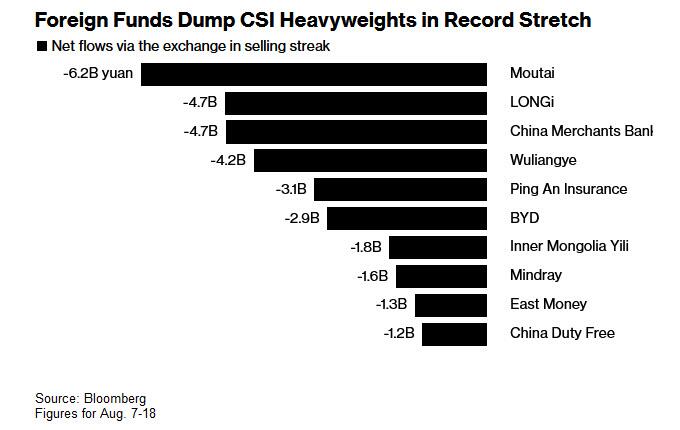
According to the latest flow data on individual stocks available on Bloomberg, foreign investors sold 6.2 billion yuan ($851 million) of liquor giant Kweichow Moutai during Aug. 7-18, making China’s largest liquor maker the most heavily sold stock via trading links with Hong Kong. It was followed by 4.7 billion yuan of selling each for leading renewables stock LONGi Green Energy Technology Co. and major lender China Merchants Bank.

The 10 most-sold stock by foreigners in the latest rout were among the 50 largest ones on the CSI 300. Major distiller Wuliangye Yibin, Ping An Insurance Group of China, and EV maker BYD saw selling of at least 2.9 billion yuan each through Aug. 18.
In total, overseas funds offloaded the equivalent of $10.7 billion in Chinese shares in a thirteen-day run of withdrawals through Wednesday - the longest since Bloomberg began tracking the data in 2016 - as they fled the mainland market. The departures comes as a prolonged housing slump raises the risk of broader financial contagion, making the nation’s equity benchmark among the worst global performers this month with a nearly 8% loss.

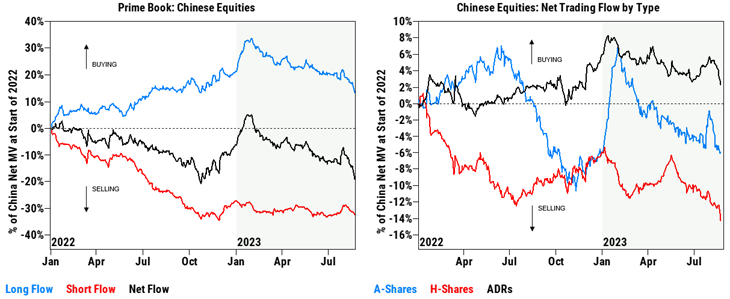
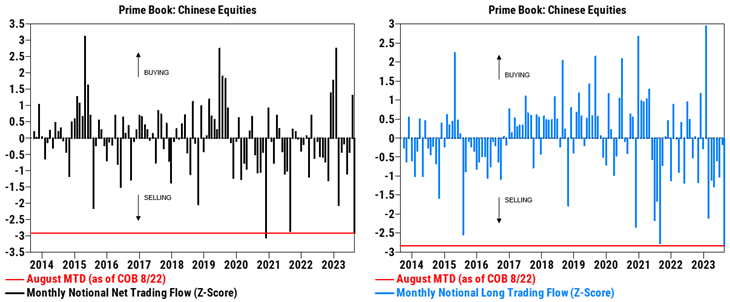
Goldman's Prime Brokerage group made a similar observation, finding that hedge funds net sold Chinese stocks for 3 straight sessions and in 12 of the 16 days MTD. In cumulative notional terms as seen on the Prime book, this month's net selling in Chinese equities - onshore and offshore combined - is approaching record levels vs. monthly net flows of the past decade.

Importantly, long liquidations accounted for more than 70% of the notional net selling MTD. This month's notional long selling already exceeds the levels seen in Aug '21 and Jul '15 and is on track to be the largest over the past decade.
Including the August MTD activity, hedge funds have now reversed all of the cumulative notional net buying in Chinese stocks from Nov '22 to Jan '23 (aka "the reopening trade"). Since the start of February, ~56% of the cumulative notional net selling has ben driven by A-shares with the remainder roughly split between H-shares and ADRs.
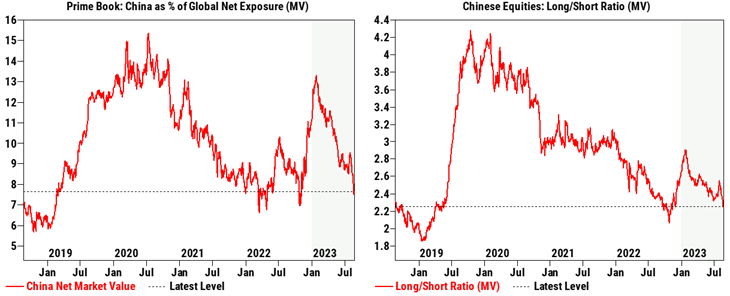
Chinese equities collectively now make up ~7.6% of global net market value on the Prime book, vs. 9.5% at the start of August and 11.2% at the start of 2023, the lowest level since early November and in the 14th percentile vs. the past five years. Aggregate long/short ratio in Chinese equities now stands at ~2.2 (vs. ~2.7 at the start of 2023), also at the lowest level since November and in the 14th percentile vs. the past five years.

The CSI 300 Index is now trading at its lowest since November as optimism of another stimulus following the July Politburo meeting quickly evaporated, even as China's social mood is turning uglier by the day amid record youth unemployment which is rising by one percent every two months. Foreigners had moved into the market en masse back then, only to leave again now in droves as economic data continue to disappoint and stimulus fails to impress.

A separate Bloomberg analysis showed that emerging market funds have also turned more bearish on Chinese stocks, deepening their average underweight position to almost 100 basis points as of the second quarter from 24 basis points three months earlier. They were overweight by 40 basis points as of end-2022.

The selling streak is showing little sign of cooling, and on Wednesday overseas funds shed another 10.5 billion yuan. A top-performing Chinese macro hedge fund blamed global capital for sinking the country’s stocks, calling them a “bunch of aimless flies” that stir up market volatility. The silver lining is that foreign funds own less than 4% of total A-shares outstanding, according to a report this month from China International Capital Corp. Of course, by the time they are gone, the financial assets of the Chinese population will be worth a fraction of what it is now.

WSJ : China’s Crisis of Confidence in Six Charts

China’s Crisis of Confidence in Six Charts
Chinese households are losing faith in the nation’s future and could drag down the entire economy
What ails China?

There are plenty of answers, from demographics to geopolitics to trade. But the key problem might boil down to household finances and, just as important, everyday citizens’ deeply shaken confidence that their lives will keep improving following China’s Covid-19 emergency.

Why look at households specifically? China has a serious debt and productivity problem, especially in the state-owned and local-government sectors, but that has been true for years. Exports are falling, but China has weathered trade downturns before. Moreover, private manufacturing and infrastructure investment are actually holding up relatively well.

What is really new and notable about the current slowdown is a combination of exceptionally weak consumer prices, consumption, services-sector investment and property investment. All of that points firmly at households.

Reduced willingness to spend and take risks by families also undermines other parts of the economy in pernicious and self-reinforcing ways: consumption directly, and investment indirectly because household borrowing, mainly through mortgages, has long helped keep cash-strapped property developers and local governments above water.

The shift to thrift
Chinese household debt, primarily mortgage debt, has risen so rapidly over the past decade that, as a percentage of disposable income, it is now approaching pre-2009 U.S. levels according to some analysts.
But there is a critical difference with the precrisis U.S.—China isn’t facing a tidal wave of mortgage delinquencies. Instead, households are paying down mortgage debt rapidly and retrenching financially in general.

This rise in risk aversion has many causes, but several of Beijing’s key policies during the pandemic probably contributed—especially the three-year spell of “zero-Covid” policies that damaged the services-sector jobs engine and the crackdown on property-developer leverage that forced developers to delay the delivery of “presold” houses to families.

Getting stiffed
The key thing to understand is that Chinese households are actually giant lenders to a linchpin of the economy: property developers. About 90% of homes sold in China in 2021 were “presold,” meaning developers sold families rights to yet-to-be-built apartments.
In essence, Chinese households took out interest-paying mortgages—and then passed on that cash, interest-free, to property developers in return for apartments that didn’t yet exist. Property developers in turn fill local-government coffers by purchasing land for development.

To fully appreciate what a bad deal this was, consider that mortgage loans in China also tend to be “recourse.” That means if home buyers walk away, banks can still go after their other assets.

When big, financially stressed developers such as Evergrande began defaulting on these obligations to households in 2021, buyers responded by abandoning the market and paying down debt. Individual residential mortgage debt outstanding actually fell outright by 200 billion yuan, or about $28 billion, in the first half of 2023.

Hard times in the job market
To make matters worse, the housing crisis came as the economy’s key job engine—the services sector—was already under threat from Beijing’s “zero-Covid” policies and a regulatory crackdown on the internet platform economy, which, according to some estimates, accounts for about a quarter of urban jobs.
The services sector, which until 2020 had accounted for all the net job growth in China since 2012 and absorbs most highly educated graduates, shed a net 12 million jobs between 2020 and 2022, according to official figures. Strong exports helped paper over the cracks for a while, but as China was finally reopening in early 2023, the pandemic-era export boom was reversing.

As a result, China entered the second quarter of 2023 with deeply wounded service and construction sectors, and a manufacturing engine threatening to stall out. The job market has struggled to find its footing, and a record coterie of new college graduates—many of whom fled the 2021 and 2022 job market for higher education—has pushed youth unemployment over 20%.

Crisis of confidence
The battered job and property markets have translated into pervasive pessimism: Households are saving at much higher levels than before the pandemic and expressing deep skepticism about further increasing consumption or buying a home.
A long-running survey of urban bank depositors by the central bank found that about 58% of respondents indicated a preference for boosting savings deposits in the second quarter, slightly down from December 2022’s 62% but up close to 15 percentage points since mid-2019. Only 24.5% were inclined to boost consumption.

Actual growth in savings deposits remains high, too: above 15% on a three-month annualized basis, according to the research consulting firm Gavekal Dragonomics. That compares with a pre-Covid average pace of about 10%.

Breaking the downward spiral
China’s economy is still growing, and incomes—for those with jobs—are rising. But as long as China remains stuck in a negative feedback loop of failing developers, falling home prices and skittish households, it might be difficult to arrest the economy’s slide.

That risks pessimistic expectations becoming firmly entrenched, in turn prompting even higher saving and an economy with less momentum. It could also trigger larger problems in the financial system as developers and local governments—and their bankers—struggle to fill the hole in the financing ecosystem left by retrenching households.

To break the feedback loop, the central government probably needs to flex its own balance sheet with big fiscal transfers to households, or indirectly bail out property developers—and reverse course on some of the aggressive regulatory measures that have alienated foreign investors and some domestic entrepreneurs.

But it remains unclear if Beijing will take such steps. For one, Beijing might be wary of big direct spending because its effective liabilities—in the form of local government debt—are substantial. Having invested so much political capital painting housing speculation, tech moguls and dependence on foreigners as social maladies in recent years, an explicit reversal now could amount to a significant political risk: in essence, an admission that more of the central leadership’s signature policies have failed.

FT : Italy is flying in the wrong direction with price cap plans

Italy is flying in the wrong direction with price cap plans
But airlines’ failure to understand their disgruntled customers is making the policy a vote winner

Just mention the words Italy and price cap and the blood pressure at Ryanair’s head office shoots off the scale. 

That happened last week when I tried to talk to the airline’s chief executive Eddie Wilson about Italy’s recent proposal to cap fares from mainland Italy to Sicily and Sardinia at 200 per cent above the annual average, and to limit the use of “profiling algorithms” to set prices.

“They think we have algorithms that mean I can tell which people have iPhones and we charge them more. Rubbish,” he said, in one of his calmer moments. Airfares “are built on demand. If flights aren’t moving we lower fares.” The implication was that, obviously, the reverse must be true if demand exceeds supply.

Airfares have risen substantially in the post-Covid era, up 30 per cent this summer in Europe versus last year. Airlines complain of a scarcity of aircraft and labour, as well as higher fuel costs, even as they report bumper profits thanks to increased fares. But the industry’s net margins this year are still only forecast to hit 1.2 per cent.

So if Italy’s prime minister Giorgia Meloni thinks a cap on prices is the way to lower the fares of trips to the summer hotspots of Sicily and Sardinia, she is mistaken — and not just because such a move could contravene EU law. 

Any price cap will almost certainly lead to higher fares across the year. Why would any airline offer rock-bottom prices out of season — when locals may be the main passengers — if they only drag down the average and, by extension, their ability to price according to demand in peak season? Yes, they want to fill the aircraft in the winter months. But the frequency of flights can be scaled back and extra aircraft used on other routes to drive those prices higher.

Italy’s move to limit profiling algorithms also presumes that the aviation industry is more technologically sophisticated than it really is. “Most airlines run on systems that were designed in the stone age of technology,” says Anand Krishnan, chief executive of IBS Software, a leading supplier to airlines.

Essentially, carriers divide a flight into “buckets” of seats with different fares, based on expected demand and what the competition is doing. When one bucket sells out, customers are directed to the next one. 

But as many airlines sell a large proportion of their tickets through global distribution systems, they usually don’t know who a passenger is, what their spending power might be, and what might push them to buy. As a result, they are often left with empty seats. “Your biggest opportunity to maximise revenue is to sell all the seats and then sell things beyond the seat,” says Krishnan. “The right call might have been to make that sale at $150 instead of $200.”

Very few airlines are remotely close to having the intelligence required to personalise pricing for those not in their loyalty programmes. 

Nor is artificial intelligence the answer. “Even if [the airlines] could dynamically create a price point for you, their revenue management, accounting and invoicing systems cannot cope with anything close to the complexity required,” Krishnan adds. 

Instead, airlines have resorted to unbundling the fare into its constituent parts — the seats, luggage, boarding priority, etc — asking passengers to pay for what suits their needs. They are also trying to sell a host of extra services, from cars to insurance to holidays, forcing travellers to wade through page after page of marketing.

“It’s a dilemma because you have to maximise revenues in a competitive arena,” says Andrea Giuricin, transport economist. “But it means you are making it more difficult for the customer.” 

That strategy has driven suspicion that airlines are charging more and delivering less. According to a recent survey by the UK consumer right group, Which?, bankers are more trusted than airlines. In the US, a Gallup poll last year found that for the first time in a decade, more passengers had a negative view of the industry than positive. 

Meloni’s government may be cynically tapping into this general discontent to win a few headlines with measures that ministers know are impossible to implement. But the initiative would not feel like a vote winner if airlines understood their passengers in the first place — and were able to deliver a better service.

FT : On China’s property mess and its banks’ ‘impossible trinity’

On China’s property mess and its banks’ ‘impossible trinity’
Goldman Sachs says Chinese developers need to liquidate $2tn of property inventory

Plenty of pixels have been devoted to China’s property problems — especially as the grace periods on Country Garden bonds slip away.

Now Goldman Sachs has a handy Q&A out with a summary of its main analysis on the country’s property-sector collapse, where the bank tries to unpack the potential implications for its financial system and markets. So we thought we would cover some of the main points.

First, China’s property sector has a lot of debt! (And not only in “that’s a big number” terms, that’s relative to GDP as well.) From the bank:

USD 8.4tn (Rmb 58tn) of property sector debts. The increase in China property sector debts mirror the growth in the China property sector over the past 15 years. We estimate that back in 2008, mortgage borrowing and developer indebtedness were relatively low at 9.3% and 7.3% of GDP respectively, totalling 16.6% of GDP (Exhibit 4). The following decade saw very sharp increases, with total real estate debt peaking at 54.5% of GDP at the end of 2020, of which mortgage debt/GDP reached 34.0% and developer borrowing rose to 20.5% of GDP. This was part of a broader “debt boom” that ranks as among the largest in world history — with China’s overall debt-to-GDP ratio nearly doubling from 2008 to 2023 . . . Following the imposition of the “Three Red Lines” and other tightening measures from late 2020, leverage has declined. We estimate that total borrowing fell to 48% of GDP at the end of 2022, with the total amount of property sector debts outstanding at Rmb 58tn (USD 8.4tn), of which Rmb 39tn (USD 5.4tn) were in mortgage loans and Rmb 19tn (USD 2.6tn) from developer borrowings.


While the mortgage figures might look scary, China’s home buyers generally contribute large downpayments on their homes, and their loans are full recourse. The biggest bite will come from debt-servicing costs, Goldman Sachs argues, as that burden grew to 22 per cent of household disposable income in the first half of last year. The analysts expect the worst mortgage-related stress to hit smaller cities.

The real pain will probably surface in loans to developers. China’s property sector saw some deleveraging after the government imposed credit controls in 2020. But, uh, that trend has been “uneven”, the bank says:

On the one hand, bank loans to developers have continued to increase — as policymakers have encouraged banks to provide credit for project completions, and made it easier to roll over loans — rising further to Rmb 12.7tn at the end of 2022. On the other hand, non-bank financing (ie onshore and offshore bonds plus shadow banking) has dropped significantly on tighter market conditions and shadow bank regulation. As a result, bank loans have become an even larger part of developer borrowing (76% at the end of 2022)

Imagine a grimacing emoji here.

About 75 per cent of Chinese property developers’ debt is held by banks, the bank found, with 16 per cent held by trust companies and 6 per cent by insurers. This means “any broad restructuring efforts towards developer debts would have implications across both Chinese banks and trust companies. The latter has been evident in recent days with reports that three Chinese firms failed to receive payment from maturing trust products linked to Zhongzhi Enterprise Group,” the strategists write.

So what does this mean for banks? Probably nothing good!

GS estimates an average 10-per-cent loss rate to conclude that there could be Rmb 1.9tn of “systemwide property credit losses”. Of that, 61 per cent could be “absorbed by the banks . . . the concentration potential losses within banks indicates why a comprehensive restructuring of China property debts could require recapitalisation for certain segments of the China banking sector.”

As long as defaults don’t spill over into mortgages, the banking system in China has “significant capacity” to handle losses on loans to property developers, the bank says. But the strategists see more weakness in smaller banks, and say “a comprehensive restructuring of the property sector may need to be accompanied by restructuring or recapitalisation” of that group.

Even the bigger banks will face issues from the property meltdown:

Banks do face margin pressure, however. We see risk of an ‘impossible trinity’ for banks — that they cannot maintain the desired balance of provisions, capital and dividends at the same time owing to squeezed earnings. We assume local governments’ default risk will be limited as long as debt rollover is permitted and net balances continue to increase, and assess the potential multiyear margin loss of banks on the back of local government debt rollover due to lowering rates. We also stress-test that a ~60 bps rate cut per year on local government debt would trigger non-covered banks to face recapitalisation risk. With developers and local governments finding it difficult to secure financing, further policy changes are needed to boost confidence and address the issue of mortgage demand, plus liquidity risk of small banks and shadow banking.

So how does the problem get solved? Construction has slowed, which is a step in the right direction. Now it’s become an excess-inventory problem. We’ve added one line of emphasis in the passage below:

Over USD 2tn in inventory liquidation needed to handle the stock problem. With the construction of new housing declining, policymakers are likely to shift their attention from dealing with the “flow” credit issues towards the “stock” problem — namely, the excess inventory currently sitting on developers’ balance sheets, including raw land and undeveloped projects. Of developers’ estimated Rmb 107tn in total assets at the end of 2022, by far the largest component is inventories at 60%. This is followed by other assets at 16%, account receivables at 14% and cash at 9% . . . Therefore, the ability of property developers to generate sufficient cash to repay liabilities hinges on realising value from their high levels of inventories. To put this into context, our China property team’s estimate of 2023E primary market property sales is Rmb 13.2tn, meaning that developers’ inventory equates to around 4.8 yrs in terms of current sales. Our China property team has estimated the liquidation value for the inventory sitting on stressed developers’ balance sheets is between Rmb 15tn (USD 2.2tn) in their base case scenario, and Rmb 20tn (to USD 2.9tn) in their bull case. For stressed developers to engage in comprehensive restructurings of their balance sheets, we believe large-scale asset liquidations will be needed. This will require liquidating projects from mostly privately owned developers, many of which are located in lower tier cities.

So we’ve discussed what this means for banks and developers. What about the broader Chinese economy? GS estimates that the property meltdown could take a 1.5-percentage-point bite out of GDP this year. But that will be the worst it gets, argues GS, which estimates property-related economic headwinds will start to recede, albeit slowly, next year.

What about the takeaways for markets? The strategists argue that Chinese stocks are close to a trough from this property panic; credit is still looking ugly and distressed bonds probably won’t prove to be bargains; and interest rates and government-bond yields should continue to decline until the economic picture brightens.

Their view on the renminbi is interesting:

Currency: Still Renminbi downside, but mostly on a trade-weighted basis. The Renminbi has been under renewed pressure on the back of softer-than-expected activity data and the persistent weakness in the property sector, which led the authorities to ease further with a policy rate cut last week. Given this backdrop of weak growth and subdued inflation, easier financial conditions via both lower rates and a weaker currency are likely part of the solution. Still, the PBoC has stepped up its efforts to slow the pace of currency depreciation, with the countercyclical factor (CCF) rising further in recent days and offshore CNH funding costs rising. With onshore rates likely to go at least slightly lower, the widening interest rate differential is likely to remain an important and persistent headwind for the Renminbi. However, given the PBoC’s preference and ample tools at their disposal (such as stronger CCF fixings, potentially cutting FX deposit reserve requirement ratio, and/or adding FX forward sales reserve requirement), we expect the pace of depreciation to moderate in line with the recent slower trend. We see the USD/CNY cross at 7.30, 7.20, 7.00 in 3-, 6- and 12-months, respectively. We view the risks to our near-term forecasts as skewed to the upside and think the Renminbi remains an attractive funding candidate for carry trades given the declining rates and managed volatility (we have an open trade recommendation to be long BRL and COP funded out of CNY).

And they argue that iron ore has farther to fall:

Commodities: Iron ore’s property leverage means more downside. Despite iron ore being the most obvious commodity proxy for China’s continued contraction in early cycle property activity — with close to 25% of global seaborne demand tied to that sector — the market has remained relatively tight so far this year. Benchmark iron ore prices have displayed resilience close to $100/t, a level which hardly prices any supply-side margin pressure. This discordance with fundamental intuition has been rooted in a tighter than expected iron ore market so far this year, in turn reflecting a combination of surging China steel exports and domestic steel scrap tightness. However, in our view this micro tightness is not sustainable in an environment of global steel demand deterioration, which is now weighing on China’s export flows and broader mill margins. It also appears from media reports that Beijing is set to enforce policy cuts across the steel sector between now and year-end, in-line with the policy target of limiting domestic steel output to a flat full year profile. Set against materially stronger seaborne supply in H2 versus H1 (10% higher), our Commodities research team anticipate an inflection towards a 56Mt surplus in H2 and continue to hold our 3M $80/t target and $90/t average for the rest of this year. As the expected surpluses over the remainder of this year and 2024/25 enable a progressive rebuild in inventories from current low levels, that should support an average iron ore price level trading deeper into the cost curve.

GS also argues that unlike Japan, “China avoided large FX and equity overvaluation, has more headroom for urbanisation and income convergence than Japan did in the 1990s, and has moved more quickly on deleveraging.”

So while China is definitely giving off Japan-in-the-1990s vibes, there may be a few differences that could help limit the carnage (relatively speaking).
>>> US After Hours : NVDA +8,2%, GES +15.3%, SPLK +11.5%, ADSK +6.2%, SNOW +3.5%

After Hours Summary: NVDA +8.2% sharply higher on another huge beat-and-raise, many semi names up in sympathy; GES +15.3%, SPLK +11.5%, ADSK +6.2%, SNOW +3.5% also higher on earnings

After Hours Gainers:

Companies trading higher in after hours in reaction to earnings/guidance: GES +15.3%, SPLK +11.5%, NVDA +8.2% (also approves additional $25 bln for share repurchases), ADSK +6.2%, SNOW +3.5%

Companies trading higher in after hours in reaction to news: SMCI +8.4% (in sympathy with strong NVDA earnings), EHAB +8.1% (EHAB satisfies TMA conditions with EHC to initiate strategic review; will consider sale, merger), MRVL +3.7% (in sympathy with strong NVDA earnings), NVTS +3.4% (to reveal new high-performance power platform at SEMICON Taiwan 2023), AMD +3.4% (in sympathy with strong NVDA earnings), AVGO +3% (in sympathy with strong NVDA earnings), MU +2.5% (in sympathy with strong NVDA earnings), TSM +2.5% (in sympathy with strong NVDA earnings), FN +2.4% (in sympathy with strong NVDA earnings), CVS +1.2% (launches Cordavis which will work with manufacturers to develop biosimilar products), NXPI +0.9% (in sympathy with strong NVDA earnings), RKLB +0.8% (accelerates next recovery mission), NUE +0.6% (files mixed shelf securities offering), DNA +0.3% (stock offering by selling shareholders), EXEL +0.3% (names new CMO), TSE +0.2% (approves restructuring plan), FTI +0.1% (awarded significant contract by TotalEnergies)

After Hours Losers:

Companies trading lower in after hours in reaction to earnings/guidance: VNET -5.2%, NTAP -1.6%, ZUO -0.8%, OOMA -0.4%

Companies trading lower in after hours in reaction to news: HRTX -2.9% (stock offering by selling shareholders), EHC -1.9% (EHAB satisfies TMA conditions with EHC to initiate strategic review; will consider sale, merger), INTC -0.4% (in sympathy with strong NVDA earnings)

The information : NFT Startup Casualties Pile Up

NFT Startup Casualties Pile Up

he past week has been filled with NFT drama, with OpenSea changing its policy for collecting royalty fees and drawing the ire of investors and NFT creators alike. But first, let’s take a look at the latest in a string of NFT startups that are calling it quits.

Recur, a startup that helps other businesses create and manage NFT collections, said on Friday that it’s shutting down on November 16. Backed by metaverse investment firm Digital, billionaire hedge fund manager Steve Cohen’s family office and musicians Jason Derulo and David Choi, Recur announced it raised a $50 million Series A round at a $333 million valuation in September 2021. Cohen was also a member of Recur’s board.

Recur co-founder Zach Bruch said in a post that “unforeseen challenges and shifts in the business landscape have made it increasingly difficult for us to continue providing the level of service and dedication that we have always strived to maintain.”

But the writing has been on the wall for a while. Interest in NFTs has waned dramatically since the middle of last year, evidenced by slumping NFT prices and trading volumes. Big companies have also pulled back from issuing NFTs, with Sega and Disney abandoning their web3 plans and Meta winding down its NFT efforts earlier this year.

Tessera, a startup that let users collectively own NFTs, shuttered in late June. Tessera CEO Andy Chorlian said on Twitter that the company “spent a long time” analyzing the NFT market and its financial position and decided shutting down was the best option. The startup had raised $20 million in July 2022 from Paradigm and other investors.

And earlier this month, Nifty’s, a company that helped brands like Warner Bros. launch NFT collections before pivoting to work with creators, announced it was shutting down. The startup had raised a $10 million seed round in July 2021 from investors including Samsung Next, Palm NFT Studio and Coinbase Ventures. Nifty’s said on Twitter that “the investment opportunities we were working on didn’t pan out, and we now find ourselves at the end of our runway.”

Other startups that help companies issue NFTs are likely suffering too. Notably, MoonPay has been trying to do more business with helping other companies build and manage NFT collections, as I reported in May, after revenue from its main crypto payments business declined.

OpenSea’s Royalty Reversal
In other NFT news, OpenSea changed up its royalty fee enforcement policy last week, a move that highlights fierce competition among NFT marketplaces.

As a quick recap, royalty fees (which OpenSea calls “creator fees”) are used to compensate the original creators of an NFT. The idea is that NFT creators can make money each time their NFTs are sold on secondary markets, in addition to the money they get from selling new NFT collections.

It was customary for NFT marketplaces to enforce collection of royalty fees until X2Y2 announced in August 2022 that it would make them optional. After that, some NFT marketplaces like Magic Eden followed suit. But OpenSea doubled down on them, announcing in November that it would enforce the fees through a new blockchain tool.

OpenSea reversed course last week, saying it would phase out mandatory royalty fees by February 2024. The move drew criticism from billionaire Mark Cuban, an OpenSea investor, as well as Yuga Labs, the company behind the popular Bored Ape Yacht Club NFT collection. Yuga CEO Daniel Alegre said on Twitter that the company will stop listing some of its NFTs on OpenSea.

OpenSea’s short-lived royalty policy is the latest example of the race to the bottom on NFT fees—as soon as one marketplace cuts fees, it’s difficult for a competitor to keep them in place. A similar dynamic has played out with the transaction fees that NFT marketplaces collect on each trade, which are separate from the royalties that go to NFT creators. OpenSea was forced to temporarily cut its transaction fees earlier this year after zero-fee marketplace Blur started grabbing market share.

But the backlash also shines a spotlight on what’s at stake for big NFT creators like Yuga Labs, which was valued at $4 billion when it raised a $450 million seed round led by Andreessen Horowitz’s crypto fund in early 2022. A Galaxy Digital report last year showed that Yuga Labs has reaped $148 million from royalties on its NFT collections.

Overheard
“Sniped a code off twitter today and joined @friendtech. Like the concept and looking forward to what the team can build with this,” NBA player Grayson Allen tweeted on Sunday.

Friend.tech, a blockchain-based social media platform, is the latest web3 craze and Allen is one of its most high profile users to date. The startup, which is backed by the crypto-focused venture firm Paradigm, launched in August and quickly gained traction. Built on Coinbase’s new blockchain Base, Friend.tech has a unique approach: users can sell tokens to other users in exchange for access to a private chat group. It’s still too early to tell if this is a flash in the pan, like the brief craze for “move to earn” startup StepN, or if it has legs.

The Information : SpaceX Working with Cloudflare to Speed Up Starlink Service

SpaceX Working with Cloudflare to Speed Up Starlink Service

pace Exploration Technologies, Elon Musk’s rocket company, is working with Cloudflare to boost the performance of SpaceX’s satellite internet service Starlink, according to a person with direct knowledge of the project.

The two companies are working on a way to increase Starlink’s terrestrial network of mini data centers around the globe—known as points of presence. That, in turn, could help it deliver faster network speeds to its customers, the person said. Such improvements could help overcome one obstacle to Starlink’s long term growth, as future bandwidth-hungry applications become commonplace.

Starlink is SpaceX’s most ambitious new effort after its rocket launch business. But the service, which had 1.5 million subscribers as of May, is still relatively small and, at least in areas with larger populations, faces tough competition from terrestrial internet services.

THE TAKEAWAY
  • SpaceX and Cloudflare are working on an effort that could boost the performance of the Starlink satellite internet service.

More specifics of the arrangement between SpaceX and Cloudflare, including its financial terms, couldn’t be learned. SpaceX didn’t respond to a request for comment. A Cloudflare spokesperson had no comment.

Cloudflare, a company that offers network security and content delivery services, has data centers in 300 cities in more than 100 countries, according to its website. That network helps it offer services that speed up internet connections and improve website performance for its customers.

While known for its 4,000 or so satellites circling the globe in low earth orbit, Starlink also relies on earth-bound infrastructure. It uses antenna farms known as ground stations to wire into fiber cables that carry data around the globe. Those fiber connections link to the mini-data centers, which enable Starlink to service larger population centers and increase the speed of service for users.

But the service has historically struggled to provide the same speed of service to dense urban areas where there are more people competing for bandwidth. That makes Starlink unattractive in those areas, particularly as people in major cities typically have lots of choices for high-speed internet services, often at lower cost than what Starlink charges.

Last June, SpaceX CEO Elon Musk said in a tweet that Starlink was working to address some issues with latency—delays in network transmissions—which can affect applications like online videogames. In response, Cloudflare CEO Matthew Prince said that he would be interested in working with Musk to improve Starlink speeds by putting antennas on the roofs of Cloudflare’s data centers. It couldn’t be learned whether that is part of the arrangement between the two companies.

Starlink is known for its ability to provide internet to regions that lack broadband infrastructure, such as rural America and war-torn Ukraine. The service’s satellites communicate with terminals at people’s homes, businesses and in some cases recreational vehicles and boats.

Seizing on SpaceX’s rocket launch business and its aspirations to go to Mars, Cloudflare previously looked into whether it could work with Starlink to create an “inter-planetary cloud” with mini data centers on the moon and Mars, one of the people said. It's unclear whether those discussions have moved forward.

While partnerships are rare at SpaceX, it’s not the first time Musk’s company has tapped into another tech company’s infrastructure. In 2021, Starlink partnered with Google Cloud to install ground stations at Google’s data centers.