In late September, a stakeholder in Humane received a humbled message from the startup. The Information
had just broken the news that OpenAI CEO Sam Altman had been secretly meeting with renowned former Apple designer Jony Ive. The duo was dreaming up the “iPhone of artificial intelligence,” according to later reports, and had been speaking with SoftBank CEO Masayoshi Son about funding their plans.
Unfortunately for Humane, the idea sounded uncannily similar to the product it had been stealthily working on for years: a wearable assistant built in part on
OpenAI technology. Even more embarrassing, Altman is a significant shareholder in Humane, according to filings the company has submitted to the Federal Communications Commission. The previously unreported message to stakeholders, which The Information viewed, explained that Humane was not involved in the Altman-Ive project in any way.
Altman later said his plans with Ive were in a “very nascent stage,” but the news of his straying attention couldn’t have come at a worse time for Humane. The five-year-old company had been planning to unveil the full details of its blockbuster first product, the Ai Pin, to coincide with the solar eclipse on October 14. Instead, the company quietly pushed the launch date to November 9.
To those closely watching the firm, Humane appears well positioned to secure a foothold in the budding market for AI devices. It has raised over $240 million from Microsoft, Tiger Global Management and Marc Benioff's Time Ventures. It was founded by two well-regarded former
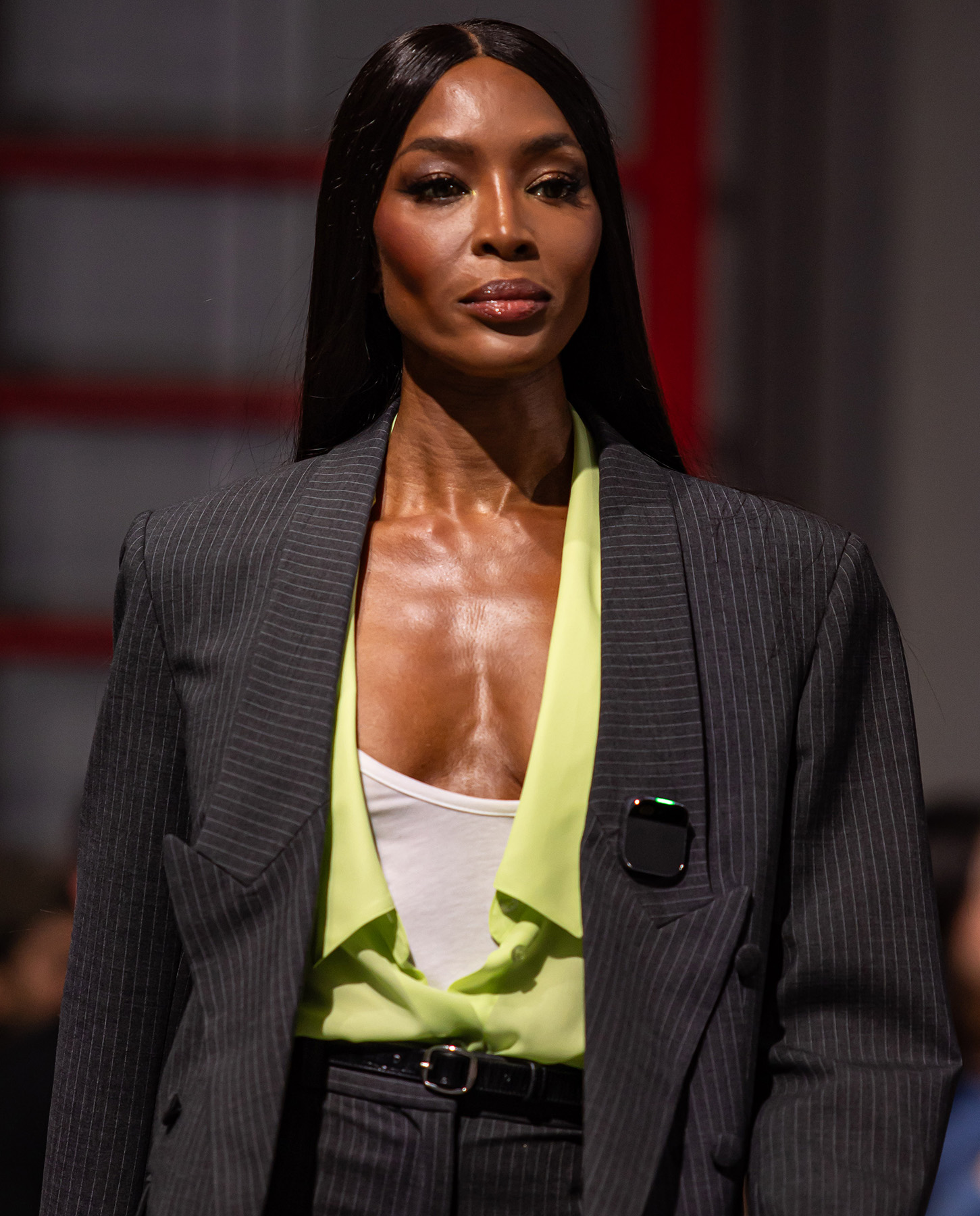
Apple executives, Imran Chaudhri and Bethany Bongiorno, who assembled an all-star team of several dozen former Apple designers, engineers and executives. And it has already mustered a buzzy marketing campaign that’s taken the Ai Pin to the TED Talks stage and the runways of Paris Fashion Week, where it adorned the lapel of supermodel Naomi Campbell.
The co-founders’ ambitious vision for a future of “ambient computing” aims to free humankind from our addiction to screens, allowing us to become more fully engaged with the physical world around us. If widely adopted, Humane’s technology could also disrupt the advertising-driven attention economy that has come to define the big tech ecosystem.
But as expectations for Humane and its Ai Pin mount, some close to the company have expressed nagging doubts about Humane’s debut product and its overall business strategy. In conversations with former employees, current investors and industry observers, questions arose about the company’s approach to user privacy and the form factor of the Ai Pin itself. In particular, some worry that the device’s front-facing camera will alienate segments of the public who fear being recorded against their will.
While several former company insiders praised married co-founders Chaudhri and Bongiorno for the consistency of their vision across the years, others suggested the pair’s commitment to their original idea for the product may have fostered blind spots around its viability. The Ai Pin is not a neglible purchase; it is expected to cost as much as $1000 and require a monthly data subscription, according to sources familiar with the company’s plans. (A company spokesperson declined to confirm specifics about the device's pricing or features, stating that “Humane will be sharing full product details when the device is unveiled on Nov 9.”)
Altman and Ive are not the only potential competitors nipping at its heels. On October 3, Rewind, an AI company focusing on personalized memory aids, abruptly announced the pre-order for its first device, the $59 microphone-equipped Rewind Pendant.
On October 17, Meta’s Smart Glasses hit the market, enabled with Meta’s AI voice assistant. Even an unfunded prototype for an AI assistant necklace called Tab, created by a 20-year-old founder, was enough to
whip up excitement last month on X. And with the looming threat of slow-moving behemoths like Apple, Google and Amazon on the horizon, Humane’s head start in the AI device market will only take it so far.
All of these companies are betting that the next frontier in consumer AI lies in personalized agents—always-on chatbots like ChatGPT attuned to your wants and needs. Now the race is on to find the right form factor to integrate the technology seamlessly into people’s lives.
But the biggest challenges the companies will face are likely more existential than hardware related. Ultimately, they’ll have to answer the fundamental question: Is society ready for devices that know us as well as we know ourselves?
Humane was founded in 2018 by the husband-and-wife team of Chaudhri and Bongiorno, who met while working on the iPad at Apple. Chaudhri, a designer and inventor whose name appears on hundreds of patents, has developed some of the mobile features and interfaces that today feel like second nature, from the iPhone’s widget-filled dashboard to the swipe-to-unlock gesture. Bongiorno, a former director of software engineering at Apple, was often the person overseeing the rollout of such features.
Despite—or perhaps because of—their role in bringing iPhones, iPads and iPods into our everyday lives, the Humane leadership team has made it their mission to end the tyranny of screens and bring back face-to-face connection.
The alternative they’ll present at next month’s Ai Pin launch is a small, screenless device about the size of a saltine cracker, equipped with a camera, a microphone and speaker, a variety of sensors, and a laser projector. The device is meant to secure magnetically to a user’s clothing, allowing its camera, with a 180-degree field of view, to take in the world around the wearer.
A Qualcomm Snapdragon chip, typically found in larger devices, will deliver smartphone-level speed, connectivity, camera capabilities and security. According to FCC filings
first noticed by journalist Janko Roettgers, the company will operate as a mobile virtual network operator, allowing the device to operate completely independent of a smartphone or computer.
The Ai Pin’s outputs seek to be elegantly minimalist. It can respond out loud to inquiries, as well as indicate notifications and different modes using haptics, vibrations and light patterns. But what really sets the hardware apart from wearable predecessors like the Apple Watch, Oura Ring or Fitbit is its software’s ability to converse with the user.
Building on OpenAI’s GPT-4, Humane has developed a proprietary LLM designed to incorporate maximal context into user requests. With a simple finger tap, users can activate an AI-powered voice assistant that the company believes will act as a personalized, hyperintelligent agent, answering any question imaginable.
In May, the company trademarked the phrase “Catch me up,” which prompts the assistant to deliver a digest of updates gathered from emails, text messages and calendar invites. The assistant can also draw on data collected about the user, along with environmental cues, to handle elaborate queries such as, “Does this lunch work with my diet?” or “Would this make a good gift for my niece?”
This is the aspect of Humane’s pitch that wowed many investors. “When we first looked at it in October last year, hardware was one thing, but we thought the multimodal input system that produced accurate answers with simple commands was its core strength,” said Samuel Kim, who led SK Network’s venture investment in the company. “This was before OpenAI and other AI players launched multimodal AI,” he added, referring to the ability to process multiple forms of data, such as images, speech and text, simultaneously.
“Many AI skills, features, what used to be discrete ‘apps,’ meld into a voice that handles it all, and few people will really want those walls restored,” said Michael Stewart, and investor at Microsoft venture fund M12. Microsoft particpated in Humane’s Series C round earlier this year.
Several people familiar with the company's roll-out strategy warned against getting too fixated on the inaugural product’s November 9 launch. They suggested that Humane is hoping to create a total paradigm shift in consumer computing. Partnerships with Volvo and LG suggest future potential to lean into the Internet of things, integrating Humane technology into home appliances and in-car systems.
“The vision is much larger than one device,” said one former employee. “It’s an entire platform.”
Humane’s founders have been outspoken in their desire to end our addiction to the smartphone. The devices they once helped build at Apple have since been linked to a worldwide loneliness epidemic, populationwide declines in physical and mental health, and shortened attention spans. Yet as any of the 310 million smartphone users in the U.S. can tell you, the conveniences they afford make it almost impossible to break the habit.
The trouble is, once that smartphone comes out of your pocket, the apps on there are incentivized to keep your eyeballs glued to them—in part so that you can view more ads. This is why, according to Dave Vondle, director of experimentation and publishing at global design company Ideo, “The thing that people want to get away from is deeper than just screens. The screen has become a symbol for divided attention.” By escaping the “attention economy,” devices “could be designed in ways that are better for everybody’s mental health.”
Of course, what those ads buy users is free or cheap access to entertainment and connectivity. But that might be changing, said Jenna Fizel, Ideo’s senior director of emerging technology: “There seems to be, culturally, this desire to pay for our electronics and our virtual experiences differently than we currently are.”
Because they have no screens on which to display ads, devices like Humane’s won’t have as much incentive to get users hooked on all-day usage. That raises questions, however, about whether the company will be able to drive revenue through hardware and subscription sales alone.
One former employee confirmed that Humane wanted to distance itself from the surveillance advertising model. “There’s a lot of good around it,” the person said, alluding to a business model that’s not ad supported or dependent on users staying “heads-down inside of a phone.” However, they added, “I question, personally, how much people actually want that. Because people want their TikTok, you know.”
Despite a concerted effort to distance itself from the originator of the smartphone, Apple, that corporation has loomed large in Humane’s company psyche.
In April, Chaudhri teased Humane’s Ai Pin
in a TED Talk titled “The Disappearing Computer.” While onstage, he pulled up a photo of a toddler strapped into a mixed-reality headset and noise-canceling headphones. With a pained look, he said, “The future is not on your face.” The goggles on the child looked strikingly similar to the Vision Pro that Apple would announce two months later—a project Chaudhri likely would have been aware of, given that its development began in 2015.
“The strangest thing for me was how anti-Apple people were,” said one former Humane employee. “When the Vision Pro was unveiled, almost everyone on Slack was bashing it”— including ex-Apple employees who’d worked on the product, the person said.
The circumstances of Chaudhri’s departure from Apple might explain some of this. According to Tripp Mickle’s book “After Steve,” Chaudhri wrote an email to his design colleagues a month before he planned to officially resign from his role as director of design in 2017. In his note, he suggested that his river of inspiration had run dry. The note allegedly triggered insecurities among the remaining team members, who feared it implied that Apple itself was running low on inspiration. Ive and Apple’s design vice president, Alan Dye, fired Chaudhri on the spot, according to Mickle, before he was able to collect the Apple shares that were coming due as part of his compensation package. (Neither Ive, Dye, nor Chaudhri responded to a request for comment.)
Ive and Dye’s concerns may have been valid. Former Humane employees said many of the people who joined the startup from Apple were eager to return to a founder-led company. The passion that used to drive these employees’ work at Apple had died along with its founder, Steve Jobs, in 2011, according to former Humane workers.
Chaudhri and Bongiorno recruited some of Apple’s veteran talent to fill top roles at the new company, including Ken Kocienda, head of project engineering; Rubén Caballero, technical adviser; and Patrick Gates, chief technology officer. Those three alone had spent a combined 43 years at Apple. At one time or another, Humane has hired over 90 former Apple employees, an astonishing number for a company that as of March employed about 200 people in total.
In 2019, the partners at Kindred Ventures—who had just led Humane’s seed round—introduced the team at Humane to Sam Altman. OpenAI had released GPT-2 to developers earlier that year, and Altman was eager to visualize ways in which future consumer devices and operating systems could integrate LLMs.
Altman has praised the 2013 film “Her,” in which a lonely man played by Joaquin Phoenix falls in love with an AI operating system named Samantha, which he carries around in his breast pocket in the form of a small folding device. “The things ‘Her’ got right—like the whole interaction models of how people use AI—that was incredibly prophetic,” he told a crowd at the Dreamforce conference in September.
Altman co-led Humane’s Series A in 2020 with his friend and frequent co-investor Lachy Groom, tweeting that the company was building “the first genuinely new computing platform I've seen since OpenAI!” According to FCC filings, Altman has accumulated 14.93% equity in the company, making him its largest shareholder. Board directors include Groom, Valia Ventures’ Khaled Jalanbo and Kindred Ventures’ Steve Jang. Altman has demonstrated his ongoing support for the startup, participating in three investment rounds, including the Series C in March.
Investors said they were drawn to Humane’s very early vision of a hardware endpoint for generative AI tools—the kind of sci-fi hardware that tech’s major players are only now beginning to introduce to the public. Stewart recalled previewing Humane’s product in the fall of 2021 and finding its capabilities astonishing. “The team had working mockups of the device that still had some latency and word-error flaws,” he said. But the demo “clearly introduced—for the first time to my eyes and ears—an interactive and useful combination of computer vision and object classification with language synthesis using an earlier version of GPT.” He continued: “I felt it was the first time seeing a plausible use case of personal generative AI.”
By all appearances, Altman and Humane were fully aligned in their mission to create the definitive AI hardware. But then, along came Jony Ive. According to one source, when the news broke last month of Altman’s meetings with the designer, a riff on the “distracted boyfriend” meme circulated the Humane office, labeling Altman as the distracted boyfriend and Ive as the woman walking by. The neglected girlfriend was Humane.
As early as Altman’s talks with Ive may be, they constitute a significant threat to Humane and other device makers’ plans. SoftBank CEO Masayoshi Son, who has promised to make his business “the investment company for the AI revolution,” has reportedly promised $1 billion in funding for the project. (SoftBank Ventures also participated in Humane’s $100 million Series B.)
And Humane isn’t the only startup feeling blindsided. Altman also participated as an angel investor in two seed rounds for Dan Siroker’s company, Rewind, in 2020 and 2022. “I pitched him on this idea...that now everyone’s talking about, but I’ve been talking about for a while, for wearable hardware,” said Siroker. “Within three days he wired $1 million of his own money to do that. Very rarely do investors do that, and with such conviction so quickly.”
However, until this reporter informed him of Altman’s involvement with Humane, Siroker had no idea his star investor was also Humane’s. “Oh, interesting. I missed that,” he said when told of Altman’s investment in a rival. Then he joked, “Well, then I’ll be more careful with what I tell him!”
Humane’s desire to create a shift in personal computing has extended not only to the product they are building but also to the company’s work culture. Chaudhri and Bongiorno, said one former employee, “are absolutely delightful people. They treat everyone with kindness, respect and as their equal, which is rare given their position.” Several former employees also commented on the refreshing work-life balance at Humane compared with tech giants like Apple.
Humane did, however, borrow one significant element of Apple’s culture: its outward-facing secrecy. Until April’s TED Talk, the company had operated in near-blackout stealth. Even employees recruited for the company didn’t know what kind of product they’d be working on until their first day on the job. But once employees signed their rigorous nondisclosure agreements, Humane’s co-founders “tried to make Humane an open culture, which is a high contrast from Apple’s high internal secrecy culture,” according to a former employee.
While Humane is a “design-led organization,” another former employee noted, it is also “different from Apple in that engineering and design aren’t divided arbitrarily.” Pockets of employees had come from other companies like Fitbit, Nest, and Google, but Apple’s influence was undeniably dominant. The ex-Apple contingent, according to several former employees, borrowed processes from their former employer, creating a divide between those who’d worked at Apple and those who hadn’t.
“Moving as fast as they are, sometimes it’s good to have a bunch of people from the same place so at least they know how to execute together. But definitely it’s not without its friction,” said one former employee.
As much as former employees admired the founders’ unshakable nature, some felt there was a fine line between constancy and tunnel vision. At its worst, according to one former employee, the lack of “diversity of opinion and work style” made it difficult to dissent. “Cult followers tend to not question,” said another ex-employee. “I questioned [things], which was not a popular thing to do and was probably seen as me not believing in the product.”
One of the biggest topics debated internally was the question of privacy. Humane’s current
privacy policy defines its data usage permissions quite liberally. The policy states that “third-party partners” may “collect information about your online activities”; that the company will share data “as may be required by applicable laws and regulations or requested by any judicial process or governmental agency”; and that it will collect data “to provide you with content and offers tailored to your interests.”
Though the company has remained tight-lipped about product details in the lead-up to its November launch, it insisted that it will avoid privacy problems by being clear and transparent with users about what kind of information it is asking for and why. “The first point of discussion with any feature was how to gain and keep user trust, to keep them informed,” said a former employee. A spokesperson for Humane echoed these sentiments: “Privacy is at the core of Humane's values. Since day zero we have aimed to build a product that is more transparent about its behaviors than the devices people use today.”
Much of this focus apparently came from CTO Gates, who led development of iCloud, FaceTime and iMessage while at Apple, and who was deeply impacted by the experience of processing subpoena requests at the tech giant.
Unlike systems like Alexa that are always passively listening for their “wake word,” the Ai Pin only activates with a press of the finger. To alleviate concerns about the intrusive nature of a front-facing camera, the device also includes a privacy indicator called the Trust Light.
“The Trust Light indicates when its input, optical or audio sensors are active, ensuring full transparency and data security,” said the company spokesperson. “The Ai Pin privacy chip also protects it from being exploited, which means if it’s ever physically tampered with, it will shut down and require service from Humane to restore operation.”
The company has yet to offer a detailed description of the Ai Pin’s encryption standards, but finding trustworthy solutions to privacy and data-gathering questions could be what makes or breaks the company.
Tech history is littered with the remains of wearable devices that failed to catch on, from the infamous Google Glass to Jawbone’s Bluetooth earpiece to Narrative Clip’s life-logging camera. Hardware presents a notorious challenge for new startups, thanks to its capital-intensive research and development process, the difficulty of manufacturing at scale and the risks associated with trying to shift consumer behavior.
Competition in the space also promises to be fierce—Humane is just one of several companies taking a stab at the AI wearable concept. While Meta has enabled its Smart Glasses with a Meta AI voice assistant, the company seems to be focusing its marketing more on the product’s livestreaming and content-sharing capabilities. Like the Ai Pin, Meta’s product will display a pulsing light while recording. To ease privacy concerns, the company promises that “recordings and text transcripts are processed to respond to your request but not stored.” The product retails at $299.
The AI-powered Rewind Pendant, though a far cheaper product at $59, is perhaps a more apt comparison. The Pendant also runs on GPT-4 and will rely on an “always listening” model. The device will, however, require verbal permission at the beginning of every conversation with a new person. (The system uses voice recognition to give ongoing permission to frequent speakers.) Given those permissions, the Pendant’s goal is to record and transcribe everything its wearer says or hears, allowing them to easily organize and search their previous conversations.
Founder and CEO Siroker, who has struggled with hearing loss, said the always-listening device aims “to do for memory what a hearing aid did for my hearing, what glasses do commonly for vision.” Unlike his competitors, he is fiercely opposed to including a camera in the product. The Rewind’s privacy solution is to store the data gathered locally on the device rather than uploading that information to the cloud. The company has also made a bold promise on its website to “never sell your data or do advertising.”
While Humane has not publicly revealed the exact pricing on its Ai Pin, the company seems to have chosen to market it as a luxury product. Naomi Campbell was selected to be the first person spotted publicly with an Ai Pin, at Paris Fashion Week. According to the presentation at Coperni’s spring-summer 2024 fashion show, the device will come in a variety of casings, including matte black, white and silver, and black and gold. With the monthly subscription and the premium price tag, it’s unlikely the Ai Pin will target the mass market right off the bat.
The public caught a first glimpse of the Ai Pin on model Naomi Campbell's lapel at Paris Fashion Week in September. Photo by Victor Lochon/Getty Images.
Of course, the trade-off for butler-level personalization is substantial data collection and sharing with third parties. “There’s certain value-adds that you cannot do without an external network or connecting to the cloud,” explained one former Humane employee, referring to the kinds of personalized recommendation services the Ai Pin can provide. “The key is convincing people of the value of that, so that they can make the choice to opt in.”
Humane is currently valued at $850 million, and it has no plans to fundraise again soon, according to a source familiar with the company’s financial situation. But some former employees questioned whether Humane will be able to buy itself enough time to bring its full vision to life.
A series of patents filed between 2018 and 2023 offer glimpses of what might lie in Humane’s future. While the first model is only capable of projecting simple laser displays, such as app icons and buttons, upon a user’s hand, the company’s patents leave space for a projector capable of displaying photos and videos. Another patent, filed by Chaudhri and Bongiorno, is devoted entirely to tracking fertility using body temperature and user input data.
Other patents theorize that the device could track a user’s biometric data (such as heart rate, body temperature and perspiration levels) to “estimate an emotional state of the user” and guess how significant the scene they’re witnessing is to them. Using this information, the device could decide independently when to activate its camera and microphone. One patent imagines that the Ai Pin will leave a parent free to engage in their child’s birthday party, knowing that their device will capture key memories at the right moments all on its own.
Several former employees raised concerns about whether a first-mover startup like Humane can fend off tech giants like Apple, Google and Amazon—who may have been caught off guard by the generative AI revolution but are now playing catch-up with a full arsenal of resources.
“Humane’s saving grace is that Siri is garbage,” said one former employee. “But will it be garbage forever? In my opinion, an Apple Watch with an AI-powered Siri would bring down Humane’s value proposition significantly.”
This month, the Apple Watch 9 rolled out a new feature that allows users to interact with the device using hand gestures, not unlike Humane’s functionality. Analysts also recently reported that Apple could begin rolling out generative AI features as part of its iOS 18 operating system in 2024.
Amazon, too, is charging full-speed ahead on AI development, as CEO Andy Jassey
recently made clear to The Information. The company has
promised to integrate generative AI into Alexa via a custom-built LLM by early next year, for a more personalized and conversational experience.
With the big incumbents closing in, anticipation for the Humane’s November 9 launch event has included its share of nerves. “It is of course difficult to iterate hardware at the speed of how AI is unfolding now, so the actual product intro is a moment of high risk,” acknowledged M12 investor Stewart.
Yet even former employees who expressed frustrations about Humane’s strategy largely seemed to be rooting for the scrappy startup. Especially given Chaudhri and Bongiorno’s expertise in designing and managing major hardware features, Humane’s fans are counting on the visionary co-founders having a road map that can withstand a few detours.
As one former employee put it, “They’re not betting the farm on one thing.”