Cigna Calls Off Humana Pursuit, Plans Big Stock Buyback
Health-insurance providers couldn’t agree on financial terms for deal that would have created $140 billion giant
Cigna CI 0.33%increase; green up pointing triangle abandoned its pursuit of a tie-up with Humana HUM 0.27%increase; green up pointing triangle that would have created a roughly $140 billion giant in the health-insurance industry.
The companies couldn’t come to agreement on price and other financial terms, according to people familiar with the matter. In the near term, Cigna is turning its focus toward smaller, so-called bolt-on, acquisitions.
The Wall Street Journal reported late last month that Cigna and Humana were discussing a combination whose structure was unclear. It turns out that Cigna would have been acquiring Humana in a cash-and-stock transaction with a large stock component, the people said.
But shareholders reacted coolly, with Cigna stock dropping nearly 10% since the talks surfaced as questions swirled about the wisdom of using of the company’s stock as currency, among other things.
Instead, Bloomfield, Conn.-based Cigna plans an additional $10 billion of stock buybacks, bringing its total planned repurchases to $11.3 billion.
Cigna continues to believe in the merits of a combination with Humana. A new company would have been focused on improving access to care and lowering costs for consumers, the people said.
Cigna also believes a deal would have been achievable from a regulatory perspective, despite the current administration’s tough stance on mergers and acquisitions.
Cigna intends to use the majority of its discretionary cash flow for share buybacks next year, including repurchasing at least $5 billion of common stock between now and the end of the first half of 2024.
A merger of the managed-care providers would have been huge. Even after the share declines, Cigna had a market value of roughly $76 billion as of Friday, and Humana’s stood at about $59 billion.
Cigna, which focuses largely on commercial insurance—the type provided by employers and bought by individuals, continues to explore the sale of its Medicare Advantage business, which could fetch several billion dollars in a divestment.
Selling its Medicare business, while halting its pursuit of Humana, could leave Cigna shut out of an important and growing part of the insurance business that is favored by investors. Cigna had long lagged behind the top contenders in the business in terms of size and scale.
Cigna’s $54 billion acquisition of Express Scripts Holding in 2018 made it one of the biggest players in pharmacy benefits, and it has been building up its Evernorth health-services unit, which includes an array of non-insurance businesses.
Humana, the No. 2 Medicare insurer, remains in the midst of its own succession handoff. Humana said in October that Jim Rechtin—previously chief executive of Envision Healthcare—would take over as president and chief operating officer, effective Jan. 8. Rechtin is then to take over as chief executive officer from Bruce Broussard in the back half of 2024.
Venezuela’s threat to annex part of Guyana
Washington should reimpose full sanctions on President Maduro’s authoritarian government
It is the sort of extravagant territorial claim that makes authoritarian leaders salivate. A demand to annex two-thirds of a much smaller neighbour’s territory, supposedly to right a historical injustice. Access to a rich offshore oilfield adds extra appeal, along with the lure of gold and diamonds onshore.
Venezuela’s revolutionary socialist President Nicolás Maduro could not resist the temptation. After leading a propaganda campaign featuring stirring reggaeton songs and tours of schools to instil patriotic values, Maduro held a referendum last week to ask if voters wanted to incorporate the sparsely populated and largely jungle-covered Essequibo region of Guyana into Venezuela.
Official media trumpeted the result as an overwhelming endorsement, despite witness reports of thin turnout. Maduro ordered state oil and gas companies to grant drilling rights in environmentally sensitive Essequibo, redrew Venezuela’s official map and established a new military zone covering the disputed area, which is larger than Greece.
Maduro’s mischief-making has broader geopolitical implications. Venezuela is an authoritarian regime backed by Russia, China and Iran. Moscow has equipped its military, although troops are said to be in a poor state of readiness. Guyana, by contrast, is a democratic state aligned with the west. Thanks to the discovery of oil, it was the world’s fastest-growing economy last year.
Backed by the US and the UK, Guyana has denounced Venezuelan aggression and vowed to resist the territorial claim, which it says violates an 1899 international tribunal ruling. ExxonMobil, operator of the big oilfield off the coast of Essequibo, hopes all parties will respect the decision of the International Court of Justice, which is considering the Venezuelan claim. Caracas has already rejected the court’s jurisdiction.
Maduro’s sudden reactivation of a long-dormant claim owes much to domestic politics. After cratering the economy, cracking down on dissent and triggering the flight of more than a fifth of the population, the president is highly unpopular. He will face a feisty and popular opposition candidate next year if, as widely expected, he runs for re-election. What better than a foreign adventure to distract voters from near-worthless salaries and triple-digit inflation?
The Venezuelan leader might wish to consider how a similar move by another authoritarian South American military-backed regime ended in the 1980s. The Argentine junta’s decision to invade the Falkland Islands triggered war with Britain and a humiliating defeat, which toppled the generals and paved the way for a return to democracy — surely not the outcome Caracas has in mind.
Maduro’s aggression towards a small neighbour raises serious questions about the Biden administration’s decision in October to grant Venezuela wide-ranging relief from economic sanctions for six months, in return for promises to move towards free and fair elections and to release hostages.
Few observers believed Maduro ever had any such intention. But by pocketing US concessions, which were offered up front, then launching a fresh crackdown on the opposition, Maduro has ridden roughshod over the understanding, even before his move on Essequibo.
The Biden administration should respond by swiftly reimposing all the economic sanctions it lifted on Venezuela, sending Maduro a clear message that his behaviour is unacceptable and signalling future sanctions relief can only come after clear moves towards free and fair elections at home and respect for its neighbour’s territorial integrity. To do any less would be to betray Venezuela’s long-suffering opposition and an important democratic ally.
The Week’s 10 Biggest Funding Rounds: X-Energy And Seismic Therapeutics Lead Surprisingly Big Week
Usually, as December wears on, startups announce fewer and fewer big rounds. However, that was not the case this week, as five companies announced rounds of $100 million or more. Pretty good for what is normally a quiet time of year.
1. X-energy, $235M, energy: The top round this week may have slipped under most people’s radar. Rockville, Maryland-based X-energy, a developer of advanced small modular nuclear reactors and fuel technology for clean energy, completed its Series C financing that totaled $235 million. This week the company announced it had added an additional $80 million from Ares Management Corp. and Kam Ghaffarian to hit that big total.
2. X.AI, $135M, artificial intelligence: You may have heard Elon Musk has an artificial intelligence startup to compete with OpenAI. Well, this week it was reported by various sources the company, X.AI (of course), is attempting to raise $1 billion, per a securities filing earlier this week. So far, the Austin, Texas-based company has raised $135 million. Musk was a co-founder in OpenAI, so AI is not new to him. X.AI was announced in July — funded by Musk himself — and released an early version of its ChatGPT competitor, Grok, last month.
3. Seismic Therapeutic, $121M, biotech: Cambridge, Massachusetts-based Seismic Therapeutic led the way for biotechs this week — although it is far from the only biotech on this list. The machine-learning immunology company closed a $121 million Series B led by new investor Bessemer Venture Partners. The new cash will be used to further push the trials of two therapies for different types of autoimmune diseases. Last year Seismic raised a $101 million series A round. Founded in 2020, the company has now raised $222 million, per Crunchbase data.
4. Vast Data, $118M, data: AI data platform startup Vast Data raised a $118 million Series E led by Fidelity Management and Research Co., jumping the company’s valuation to $9.1 billion. The new valuation is a significant spike from its previous valuation of $3.7 billion set in 2021. Vast’s data storage platform is optimized for AI workloads across datacenters and clouds, allowing customers to manage both structured and unstructured data to generate insights. The New York-based company already has seen significant growth. At the end of its fiscal year third quarter, Vast Data had surpassed $1 billion in cumulative software bookings — a 3.3x year-to-year growth rate. It also maintained positive cash flow for the last 12 quarters. This is not the first headline-grabbing move for Fidelity Management and Research this week. Earlier in the week it led a $642 million minority investment in AI cloud infrastructure company CoreWeave — which saw its valuation hit $7 billion. The new valuation — as reported by Bloomberg — is a significant jump from late May, when the company extended its Series B at a $2 billion valuation. Founded in 2016, Vast has raised $381 million, per Crunchbase.
5. Odyssey Therapeutics, $101M, biotech: Just about 13 months ago, Boston-based Odyssey Therapeutics led this list when it locked up a $168 million Series B led by General Catalyst. It’s back this week after it closed a $101 million Series C led by Ascenta Capital. Odyssey is developing precision immunomodulators and oncology medicines to treat serious human diseases, and has a portfolio of immunology and oncology therapeutics. Founded in 2021, Odyssey has raised nearly $487 million, according to the company.
6. Gecko Robotics, $100M, robotics: Gecko Robotics became the latest startup in defense tech to make waves with a big raise in recent weeks. The company, which creates robots to assess the safety and condition of critical infrastructure, raised an additional $100 million in a Series C extension led by some big names — the US Innovative Technology Fund and Founders Fund. The Pittsburgh-based robotics startup announced a $73 million Series C in March 2022. The new round comes a month after the startup landed a contract with the U.S. Navy to use its robots to assess damage as it builds submarines. Founded in 2013, the company has raised $222 million to date, per Crunchbase data. The round is the latest big round to go to a defense tech startup as VCs start to seemingly warm to the industry. However, just last week rocket propulsion startup Ursa Major said it has added another $38 million to its previously reported $100 million Series D — bringing its total Series D and D-1 funding to $138 million. In October, defense and aerospace startup Shield AI raised a massive $200 million Series F at a $2.7 billion valuation.
7. (tied) Artbio, $90M, biotech: Cambridge, Massachusetts- and Switzerland-based clinical-stage radiopharmaceutical company Artbio closed a $90 million Series A co-led by Third Rock Ventures and an undisclosed health care fund. Founded in 2021, the company has raised $113 million, per Crunchbase.
7. (tied) Cortex, $90M, health care: Menlo Park, California-based Cortex, a medical technology company treating atrial fibrillation, launched and raised $90 million in funding led by KKR and Hellman & Friedman.
9. Pontera, $60M, fintech: New York-based Pontera, the fintech company enabling 401(k) participants to receive wealth management services, secured $60 million in a funding led by Iconiq Growth. Founded in 2021, Pontera says it has raised $160 million.
10. (tied) AssemblyAI, $50M, artificial intelligence: San Francisco-based AssemblyAI, which builds speech Al models, raised a $50 million Series C led by Accel. Founded in 2017, AssemblyAI has now raised $115 million, per the company.
10. (tied) MaintainX, $50M, asset management: San Francisco-based MaintainX, a provider of a maintenance and frontline work execution platform, raised $50 million in funding led by Bain Capital Ventures. Founded in 2018, MaintainX has raised $104 million, per the company.
Big global deals
The biggest raise of the week came from South America.
- Brazil-based Emergent Cold Latin America, a refrigerated warehousing and logistics provider, raised a $500 million venture round.
How Hamas Used Sexual Violence on October 7th
Physicians for Human Rights Israel issued a report collecting evidence of sexual and gender-based violence. One of its authors lays out their findings.
Earlier this week, the Israeli government presented evidence at the United Nations about rape and mutilation committed by Hamas militants during the attack on October 7th, in which more than twelve hundred people were killed. “I was called down on October 7 to collect bodies and remains from the terror attack,” Simcha Greinman, a volunteer medical worker, said. “I saw in front of my eyes a woman. She was naked. She had nails and different objects in her female organs. Her body was brutalized in a way that we cannot identify her, from her head to her toes.” An Israeli police superintendent shared testimonies from eyewitnesses, including one who saw girls with broken pelvises from “repetitive rapes.”
While some accounts of the horrific violence have now been corroborated by reporting from the BBC and other news agencies, one of the first comprehensive examinations of the sexual and gender-based violence on October 7th was conducted by a nonprofit called Physicians for Human Rights Israel, whose mission is to combat medical discrimination and improve access to health care in Gaza, the West Bank, and Israel. In a position paper, published last month, the organization called for an investigation into “widespread” sexual violence. “Based on the currently available information and the accounts indicating that sexual and gender-based violence occurred across several locations,” the report states, “an inquiry must be conducted to examine whether their scope and manifestations amount to crimes against humanity under international humanitarian law.” (The Israeli government has criticized the United Nations, saying its women’s-rights agency remained silent about the accusations of sexual violence until almost two months after the attack. Hamas has denied that its fighters committed sexual violence.)
I recently spoke by phone with one of the paper’s authors, Hadas Ziv, who is the director of ethics and policy at Physicians for Human Rights Israel, and who lives in Tel Aviv. During our conversation, which has been edited for length and clarity, we discussed why gathering information about sexual violence perpetrated on October 7th has been so difficult and contentious, how the report was put together, and the importance of collecting horrific stories to insure that survivors receive proper care.
What do we know about the sexual violence that occurred on October 7th?
Our position paper is based on materials that we collected from public media outlets and videos that we saw in groups on Telegram, as well as discussions with a legal adviser and a doctor who volunteers with a civil-society group that’s supporting the hostages and the families. We haven’t interviewed actual witnesses.
What I can say with a really high degree of certainty is that it wasn’t a few cases. It wasn’t here and there, or only on one occasion. There were many cases of different gender-based and sexual violence, and they were in the kibbutzim and in the Nova music festival: the most extreme gang rapes, mutilation of body parts, putting objects into women’s bodies, and having women paraded like trophies when they were taken into Gaza.
You say that you have not talked to the victims themselves. Is that because most of the victims are now dead? Are there people who are still alive who you’ve tried to talk to? I know this is very bleak and complicated. I’m just trying to understand.
Our decision was not to approach the actual victims or the eyewitnesses because we thought that this was too short a time afterward, and that we were not equipped to talk to them and treat them. Every time you ask them to tell the story, it’s opening up the trauma, and we are not professionals in this. What we wanted to do in this early stage was to try to portray the picture as we see it, and not leave the women’s groups alone on this—because we thought, It’s a human-rights issue, and it’s our obligation to look at what has happened. Actually, we issued two position papers after October 7th. One was about how Hamas specifically targeted rescue teams in order to prevent evacuation, prevent treatment; they shot paramedics, and they shot the tires of ambulances. The other issue was the sexual assault.
Can you talk more about how you put this report together?
It is a unique report for us because usually we don’t work on issues like this. As far as the conflict is concerned, it’s the first time that we have analyzed the actions of Hamas, of the Palestinian militants, because usually what we do is we speak about patients in Gaza and the humanitarian situation in Gaza and freedom of movement. That’s our expertise. Now we had to take our expertise into our own society and look into what happened during the conflict. I watched a lot of videos and I asked for connections within different groups and people in the Army, who sent me photographs. Then I looked on Telegram and I went into the materials that were made public. Roni Ben Canaan, my partner on this, was experienced in gender-based violence. She came from a hotline that helps women who were victims, and now she’s working with Physicians for Human Rights.
We had three aims. One was to see what has happened and to give a picture to the Israeli public and to the international public. The second was that we cared about the hostages and, from history and other cases, we know that violence doesn’t stop with the abduction. It sometimes continues when you are held hostage, and we wanted to pressure our government to do everything within its power to release them as soon as possible. Another significant aim was to make our medical and health-care system aware and create a trauma-sensitive system to accept victims and to treat them.
So one concern was that, given the scale of sexual violence on October 7th, sexual violence could continue—and that was one reason it was imperative to get the hostages back as soon as possible?
Yes. We know that people who witness sexual violence or experience sexual violence are in need of really, really urgent treatment. We know they do not receive this treatment while in Gaza, but in fact suffer further violence and neglect.
I’m trying to understand whether we have some sense of how many people experienced this on October 7th.
I think it was widespread. But, from what I understand, there are few difficulties. First of all, some of the bodies that reached the national forensic institute were beyond identification. They were completely burnt. The rescue teams were traumatized. Because it was the first time that we saw sexual violence in conflict—this is something we haven’t seen before—they did not come prepared to collect the testimony and collect the evidence that is needed. Much of the material has not been released yet. It’s in the hands of the police.
When you say this had never happened before, you’re saying that there’d been attacks in Israel from Hamas militants and others, but there’d never been sexual violence like this—and when the police and military came that they weren’t prepared to work with survivors or victims of sexual violence?
They did not expect it. They were surprised. For example, as in one of the testimonies, if an ambulance driver or a paramedic sees a woman, a youth, legs spread, lower body exposed, semen on her back, he says she was raped, but he’s not an expert. All we know is there was sexual abuse here because of how we found the body, but he’s not an expert to say that she was raped. But, as far as the mutilation is concerned, this is something that we are certain of because you don’t need to be an expert in order to see that a breast is cut off.
When you talk about watching Telegram videos, can you explain what you mean?
This is something that I’ve done because, in the beginning, when we started writing the report, we did not think that we would find ourselves in a situation where people would ask us, “Prove it. How do you know?” We thought that the testimonies we used in our report from two women at the Shura military base, where most of the bodies were taken, and a paramedic from the Army and some eyewitnesses—we thought that was enough. One of the women was assigned to the forensic medical team. One was responsible for handling the bodies of female soldiers. But more and more, we were asked, “How can you say it? How can you prove it?” Then I found that I needed to look at some of the videos.
I saw two videos that are widely distributed. There was one of a woman who has been pulled into a jeep and her pants are bloody, and you see that they are really violently dragging her into the vehicle. And the other one is of a woman half-dressed and her body’s in an open truck and she’s being paraded like a trophy. I think she’s dead already, but I can’t be certain and people are spitting on her. I also saw the beheading of a man, and bodies that had been burned. I went into this one Hamas group on Telegram, but I stopped because it was too much.
The Israeli newspaper Haaretz reported, “The extensive evidence of crimes against humanity committed by Hamas terrorists on October 7 should not be contaminated by unverified stories disseminated by Israeli search and rescue groups, army officers and even Sara Netanyahu.” Sara Netanyahu is the wife of the Prime Minister. It does seem like there are false stories circulating as well as true stories. How did you deal with that?
We were very careful in not trusting sources that we thought might be unreliable. For example, the Israeli security agency released confessions of Hamas people and we took those with more than a grain of salt. We thought, It can be that they were threatened. It can be that they are tortured because we know that sometimes torture is used on Palestinian prisoners and detainees. We thought, We cannot rely on them.
In order to say that it was systematic, you need to show orders and a method, but saying that something was “widespread” was easier to feel sure about. It’s for the legal teams to investigate whether it was systematic and to define whether the scale is large enough to define it as a crime against humanity. We ask for people to investigate. When I looked at the videos, and I spoke to a doctor to confirm, for example, that doctors saw mutilation. I consulted and heard from a doctor, and he spoke to his colleagues and they saw torn vaginas.
I know that maybe some cases will be refuted, but I think that we have enough to say that the picture is still correct. I don’t trust politicians at all. If Sara Netanyahu says something, she’s not an eyewitness, she’s not part of a rescue team.
When you said you talked to a doctor, did you mean that if a media report would quote a doctor, you would try to reach out to that doctor?
No. I spoke to a doctor who is involved with supporting the families of the hostages, and I asked him to speak to doctors in hospitals and rescue teams and to see whether they can confirm that it was widespread, whether they’ve seen evidence of that. And he spoke to a few of his colleagues and then he said, “Yes, it did happen.”
You spoke earlier about how this was new for your group. How do you think this work fits into its larger mission?
First of all, we always work with Israeli residents, but not in relation to the conflict. This is the first time that we analyzed what Hamas was doing to Israelis because we work on policy matters—public health and against privatization and with migrant workers and with prison detainees. I think the message is important that we are doing it because we are a human-rights organization. To look the other way and leave women’s organizations alone would not be respectful. They will need to deal with most of the cases, because many women who are raped will not go to the police. First of all, they go to the hotlines. We know it from civil rapes, not just in armed conflict.
I think one should have a big enough heart to look at victims anywhere. For me as a woman, it was extremely traumatic to see, and it was important to acknowledge it, to recognize what has happened, to call on our government not to abuse the victims as tools in propaganda but, rather, really look into what they need to regain control of their lives. This is what we wanted—to support them.
While some accounts of the horrific violence have now been corroborated by reporting from the BBC and other news agencies, one of the first comprehensive examinations of the sexual and gender-based violence on October 7th was conducted by a nonprofit called Physicians for Human Rights Israel, whose mission is to combat medical discrimination and improve access to health care in Gaza, the West Bank, and Israel. In a position paper, published last month, the organization called for an investigation into “widespread” sexual violence. “Based on the currently available information and the accounts indicating that sexual and gender-based violence occurred across several locations,” the report states, “an inquiry must be conducted to examine whether their scope and manifestations amount to crimes against humanity under international humanitarian law.” (The Israeli government has criticized the United Nations, saying its women’s-rights agency remained silent about the accusations of sexual violence until almost two months after the attack. Hamas has denied that its fighters committed sexual violence.)
I recently spoke by phone with one of the paper’s authors, Hadas Ziv, who is the director of ethics and policy at Physicians for Human Rights Israel, and who lives in Tel Aviv. During our conversation, which has been edited for length and clarity, we discussed why gathering information about sexual violence perpetrated on October 7th has been so difficult and contentious, how the report was put together, and the importance of collecting horrific stories to insure that survivors receive proper care.
What do we know about the sexual violence that occurred on October 7th?
Our position paper is based on materials that we collected from public media outlets and videos that we saw in groups on Telegram, as well as discussions with a legal adviser and a doctor who volunteers with a civil-society group that’s supporting the hostages and the families. We haven’t interviewed actual witnesses.
What I can say with a really high degree of certainty is that it wasn’t a few cases. It wasn’t here and there, or only on one occasion. There were many cases of different gender-based and sexual violence, and they were in the kibbutzim and in the Nova music festival: the most extreme gang rapes, mutilation of body parts, putting objects into women’s bodies, and having women paraded like trophies when they were taken into Gaza.
You say that you have not talked to the victims themselves. Is that because most of the victims are now dead? Are there people who are still alive who you’ve tried to talk to? I know this is very bleak and complicated. I’m just trying to understand.
Our decision was not to approach the actual victims or the eyewitnesses because we thought that this was too short a time afterward, and that we were not equipped to talk to them and treat them. Every time you ask them to tell the story, it’s opening up the trauma, and we are not professionals in this. What we wanted to do in this early stage was to try to portray the picture as we see it, and not leave the women’s groups alone on this—because we thought, It’s a human-rights issue, and it’s our obligation to look at what has happened. Actually, we issued two position papers after October 7th. One was about how Hamas specifically targeted rescue teams in order to prevent evacuation, prevent treatment; they shot paramedics, and they shot the tires of ambulances. The other issue was the sexual assault.
Can you talk more about how you put this report together?
It is a unique report for us because usually we don’t work on issues like this. As far as the conflict is concerned, it’s the first time that we have analyzed the actions of Hamas, of the Palestinian militants, because usually what we do is we speak about patients in Gaza and the humanitarian situation in Gaza and freedom of movement. That’s our expertise. Now we had to take our expertise into our own society and look into what happened during the conflict. I watched a lot of videos and I asked for connections within different groups and people in the Army, who sent me photographs. Then I looked on Telegram and I went into the materials that were made public. Roni Ben Canaan, my partner on this, was experienced in gender-based violence. She came from a hotline that helps women who were victims, and now she’s working with Physicians for Human Rights.
We had three aims. One was to see what has happened and to give a picture to the Israeli public and to the international public. The second was that we cared about the hostages and, from history and other cases, we know that violence doesn’t stop with the abduction. It sometimes continues when you are held hostage, and we wanted to pressure our government to do everything within its power to release them as soon as possible. Another significant aim was to make our medical and health-care system aware and create a trauma-sensitive system to accept victims and to treat them.
So one concern was that, given the scale of sexual violence on October 7th, sexual violence could continue—and that was one reason it was imperative to get the hostages back as soon as possible?
Yes. We know that people who witness sexual violence or experience sexual violence are in need of really, really urgent treatment. We know they do not receive this treatment while in Gaza, but in fact suffer further violence and neglect.
I’m trying to understand whether we have some sense of how many people experienced this on October 7th.
I think it was widespread. But, from what I understand, there are few difficulties. First of all, some of the bodies that reached the national forensic institute were beyond identification. They were completely burnt. The rescue teams were traumatized. Because it was the first time that we saw sexual violence in conflict—this is something we haven’t seen before—they did not come prepared to collect the testimony and collect the evidence that is needed. Much of the material has not been released yet. It’s in the hands of the police.
When you say this had never happened before, you’re saying that there’d been attacks in Israel from Hamas militants and others, but there’d never been sexual violence like this—and when the police and military came that they weren’t prepared to work with survivors or victims of sexual violence?
They did not expect it. They were surprised. For example, as in one of the testimonies, if an ambulance driver or a paramedic sees a woman, a youth, legs spread, lower body exposed, semen on her back, he says she was raped, but he’s not an expert. All we know is there was sexual abuse here because of how we found the body, but he’s not an expert to say that she was raped. But, as far as the mutilation is concerned, this is something that we are certain of because you don’t need to be an expert in order to see that a breast is cut off.
When you talk about watching Telegram videos, can you explain what you mean?
This is something that I’ve done because, in the beginning, when we started writing the report, we did not think that we would find ourselves in a situation where people would ask us, “Prove it. How do you know?” We thought that the testimonies we used in our report from two women at the Shura military base, where most of the bodies were taken, and a paramedic from the Army and some eyewitnesses—we thought that was enough. One of the women was assigned to the forensic medical team. One was responsible for handling the bodies of female soldiers. But more and more, we were asked, “How can you say it? How can you prove it?” Then I found that I needed to look at some of the videos.
I saw two videos that are widely distributed. There was one of a woman who has been pulled into a jeep and her pants are bloody, and you see that they are really violently dragging her into the vehicle. And the other one is of a woman half-dressed and her body’s in an open truck and she’s being paraded like a trophy. I think she’s dead already, but I can’t be certain and people are spitting on her. I also saw the beheading of a man, and bodies that had been burned. I went into this one Hamas group on Telegram, but I stopped because it was too much.
The Israeli newspaper Haaretz reported, “The extensive evidence of crimes against humanity committed by Hamas terrorists on October 7 should not be contaminated by unverified stories disseminated by Israeli search and rescue groups, army officers and even Sara Netanyahu.” Sara Netanyahu is the wife of the Prime Minister. It does seem like there are false stories circulating as well as true stories. How did you deal with that?
We were very careful in not trusting sources that we thought might be unreliable. For example, the Israeli security agency released confessions of Hamas people and we took those with more than a grain of salt. We thought, It can be that they were threatened. It can be that they are tortured because we know that sometimes torture is used on Palestinian prisoners and detainees. We thought, We cannot rely on them.
In order to say that it was systematic, you need to show orders and a method, but saying that something was “widespread” was easier to feel sure about. It’s for the legal teams to investigate whether it was systematic and to define whether the scale is large enough to define it as a crime against humanity. We ask for people to investigate. When I looked at the videos, and I spoke to a doctor to confirm, for example, that doctors saw mutilation. I consulted and heard from a doctor, and he spoke to his colleagues and they saw torn vaginas.
I know that maybe some cases will be refuted, but I think that we have enough to say that the picture is still correct. I don’t trust politicians at all. If Sara Netanyahu says something, she’s not an eyewitness, she’s not part of a rescue team.
When you said you talked to a doctor, did you mean that if a media report would quote a doctor, you would try to reach out to that doctor?
No. I spoke to a doctor who is involved with supporting the families of the hostages, and I asked him to speak to doctors in hospitals and rescue teams and to see whether they can confirm that it was widespread, whether they’ve seen evidence of that. And he spoke to a few of his colleagues and then he said, “Yes, it did happen.”
You spoke earlier about how this was new for your group. How do you think this work fits into its larger mission?
First of all, we always work with Israeli residents, but not in relation to the conflict. This is the first time that we analyzed what Hamas was doing to Israelis because we work on policy matters—public health and against privatization and with migrant workers and with prison detainees. I think the message is important that we are doing it because we are a human-rights organization. To look the other way and leave women’s organizations alone would not be respectful. They will need to deal with most of the cases, because many women who are raped will not go to the police. First of all, they go to the hotlines. We know it from civil rapes, not just in armed conflict.
I think one should have a big enough heart to look at victims anywhere. For me as a woman, it was extremely traumatic to see, and it was important to acknowledge it, to recognize what has happened, to call on our government not to abuse the victims as tools in propaganda but, rather, really look into what they need to regain control of their lives. This is what we wanted—to support them.
French AI start-up Mistral secures €2bn valuation
Eight-month-old group set to close roughly €400mn funding round as early as Friday, in new deal lead by Andreessen Horowitz
French artificial intelligence start-up Mistral has been valued at €2bn in a blockbuster funding round set to close as early as Friday, becoming the latest beneficiary of the investor frenzy to buy into the world’s hottest AI companies.
The Paris-based company has secured the lofty valuation through new investment led by prominent Silicon Valley venture firm Andreessen Horowitz, according to multiple people with knowledge of the talks. Others involved in the funding round include tech giants Nvidia and Salesforce, French bank BNP Paribas and US venture capital firm General Catalyst.
Two people said the size of the new round was worth roughly €400mn, comprised mostly of equity with a smaller convertible debt component. The deal is expected to be signed shortly, with an announcement due next week.
The €2bn valuation, which includes the money raised, represents a substantial increase from June, when the weeks-old group raised €105mn at a €240mn valuation in a deal led by Lightspeed Venture Partners.
The valuation for a nascent start-up founded in May by three former Meta and Google AI researchers, reflects the belief among many in Silicon Valley that AI has the potential to upend huge swaths of the economy and society.
Like Microsoft-backed OpenAI, Mistral is working on generative AI through so-called large language models (LLMs) that are capable of creating humanlike prose and code in seconds. The development of the technology is capital intensive however, as LLMs require copious amounts of computer processing power.
That issue has given an advantage to deep pocketed tech giants in the US and China who lead in the innovation race to date, but Mistral has emerged as one of Europe’s brightest and best funded hopes in the field of generative AI.
One of the French company’s founders Arthur Mensch told the Financial Times in October that their technology was more efficient and cost less than the ones being developed by its larger US rivals.
Mistral is also betting on an “open source” approach, in which the model would be published publicly so as to allow developers and companies to build on top of it and contribute to its advancement.
Mensch added that while the company was not yet making any money, he expected that to change “before the end of the year”, as it readies a new platform for customers to access its AI models.
Other investors in Mistral include former Google chief Eric Schmidt, French telecoms billionaire Xavier Niel, and Bpifrance, the French state-backed investment bank.
Mistral, Andreessen Horowitz, Salesforce, Nvidia, BNP Paribas and General Catalyst declined to comment.
Bloomberg previously reported that Mistral was nearing a new fundraising round.
Trump Is Absolutely Smoking Biden In Yet Another Major Poll
President Biden is in serious trouble, with his political standing now at the weakest point of his presidency, according to a new poll from the Wall Street Journal.
The poll shows Biden trailing behind former President Donald Trump in a hypothetical 2024 showdown by 4 percentage points, a gap that widens with the inclusion of third-party candidates, signifying a potential upheaval in the traditional two-party dynamics.
Dislike of Biden has become widespread - with just 23% of voters feeling they've been positively impacted by Biden's policies, starkly contrasting with the nostalgic economic reminiscence of the Trump era. The term "Bidenomics," once a banner of hope, now flounders with less than 30% approval, reflecting widespread disillusionment. No wonder the White House has stopped using the term.
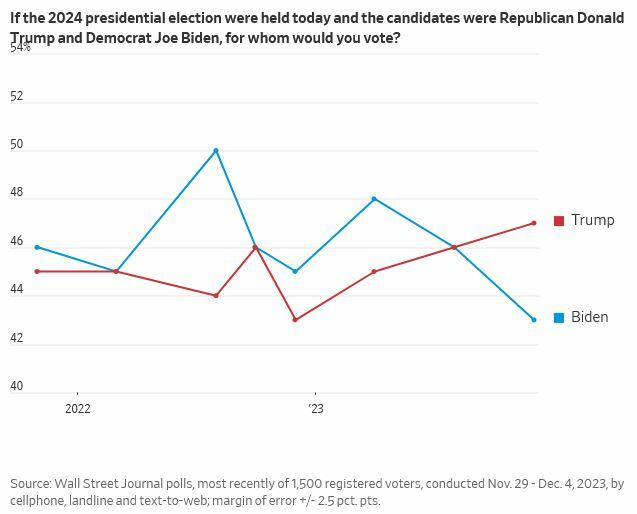
The Democrat president faces serious perception issues.
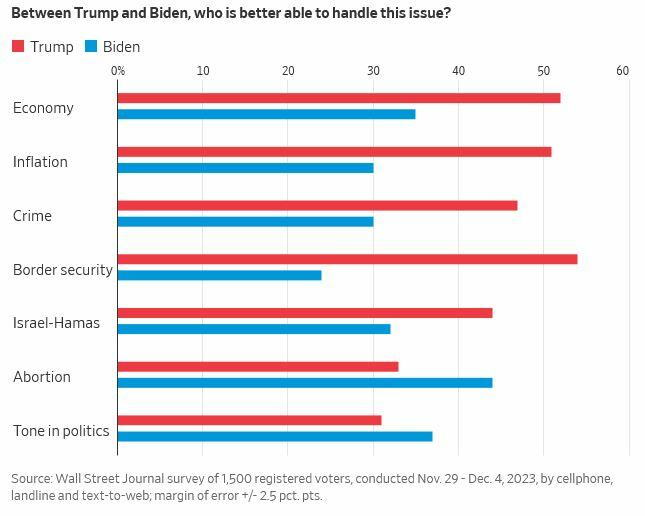
Voters say Trump is the better bet than Biden to secure the border (by 30 percentage points), tame inflation (by 21 points) and build the economy (by 17 points). Biden leads on who can best deal with abortion policy, and voters say that he more than Trump respects democracy. But the president is viewed as no better than Trump on cutting medication costs—a key Democratic initiative. -WSJ
"If this race is about policy and performance, then Donald Trump has a significant advantage," said Republican pollster Tony Fabrizio, who conducted the Journal survey with Democrat Michael Bocian. "If this race is about temperament and character, things like that, then Biden has an advantage."
"Things were thriving under Trump. This country is a business and it needs to be run by a businessman," said 53-year-old Aimee Kozlowski of Goffestown, NH, a Republican who plans to vote for Trump, and says that her competitive gymnastics facility has been hurt by inflation.
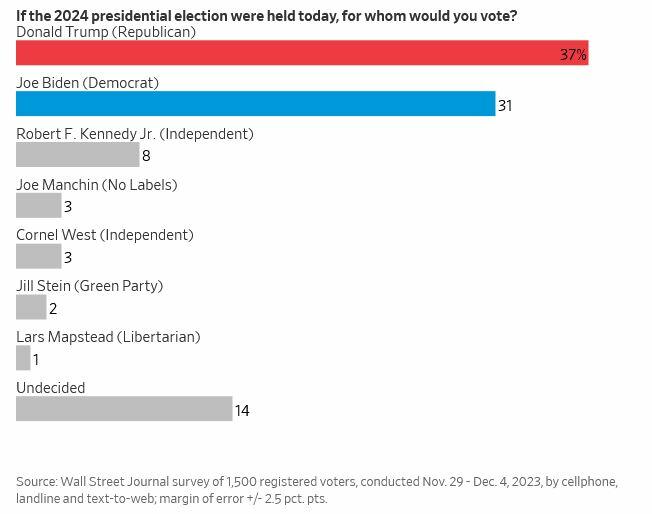
The poll also uncovers a dissonance between public economic pessimism and recent positive economic indicators, such as a robust GDP and low unemployment.
The president has been adjusting his messages on the economy to put more focus on taming inflation rather than on job creation. Creating high-paying jobs was a central goal of Democratic-backed legislation that funded new infrastructure and manufacturing, but voters see jobs as less of a concern than high prices. The White House recently unveiled a new supply-chain council aimed in part at stemming inflation, and Biden recently called on companies to “stop the price-gouging.”The president and his campaign have also amplified their focus on Trump’s most contentious comments, such as his description of opponents as “vermin” and his statement last week that he would be a dictator on “Day 1”—specifically to close the border and open more land for oil drilling—both of which suggest an authoritarian approach to a potential second Trump term. Trump’s allies say Democrats are trying to distract from economic issues and problems at the southern border. -WSJ
Of course, the Journal also found a never-Trump independent voter, Michelle Bannon, who says the former president is "not qualified at all," adding "I don’t know that Biden can go another four years, but I’ll cross my fingers and vote for him. He’s the lesser of two evils."
From 10,000 feet, Trump is smoking Biden in most polls in general.
The Venezuela-Guyana Dispute Explained In 3 Charts
In a territorial dispute spanning nearly two centuries, tensions between Guyana and Venezuela have once again reached a boiling point.
As Visual Capitalist's Bruno Venditti and Nick Routley detail below, the focal point of this dispute is the vast Essequibo region which encompasses around 70% of Guyana’s territory, and is roughly equivalent to the size of Florida.
Venezuela claims historical rights dating back to the Spanish colonial period when Essequibo fell within its boundaries.
In 1840, the British government drew the Schomburgk Line expanding the territory of British Guiana (now Guyana) far beyond the occupied area and to the strategically-located mouth of the Orinoco River.
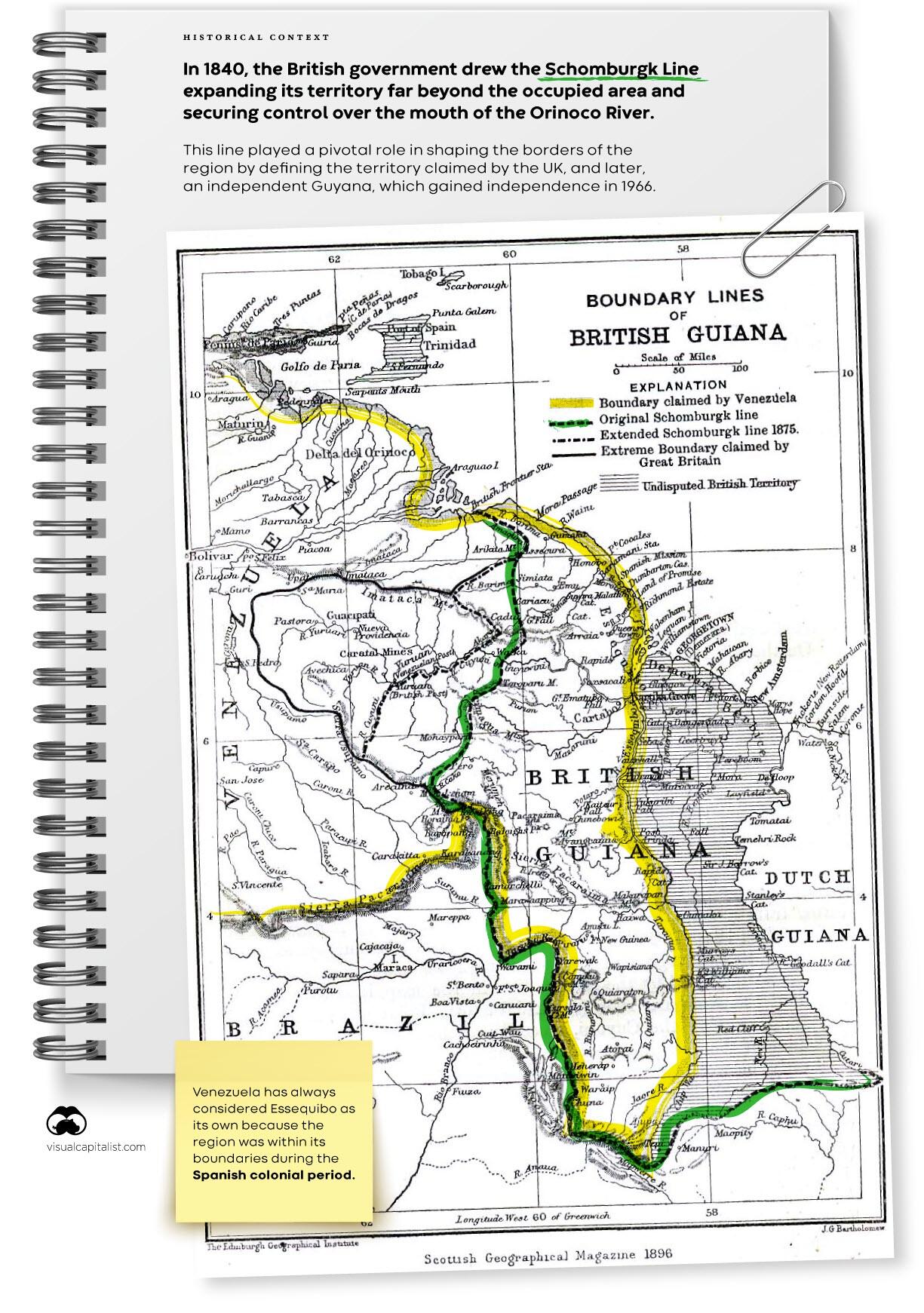
This line played a pivotal role in shaping the modern borders of the region by defining the territory claimed by the UK, and later, a decolonized Guyana, as the country gained independence in 1966. That same year, Venezuela and the UK signed an agreement aiming for a negotiated solution.
In 2004, President Hugo Chávez eased border tensions under the advice of Fidel Castro, stating that he considered the dispute to be finished.
Recent events, however, have reignited the dispute. Between 2015 and 2021, Guyana announced the discovery of about 8 billion barrels of oil, elevating a country with fewer than a million people to a prominent position among the top nations in terms of oil reserves. ExxonMobil, leading a consortium, operates three offshore projects in the country, earning nearly $6 billion in 2022 alone.
Venezuela’s Referendum and New Map
On December 1, 2023, the World Court ordered Venezuela to refrain from actions in the border dispute with Guyana. However, just two days later, on December 3, Venezuelans approved a referendum claiming sovereignty over Essequibo.
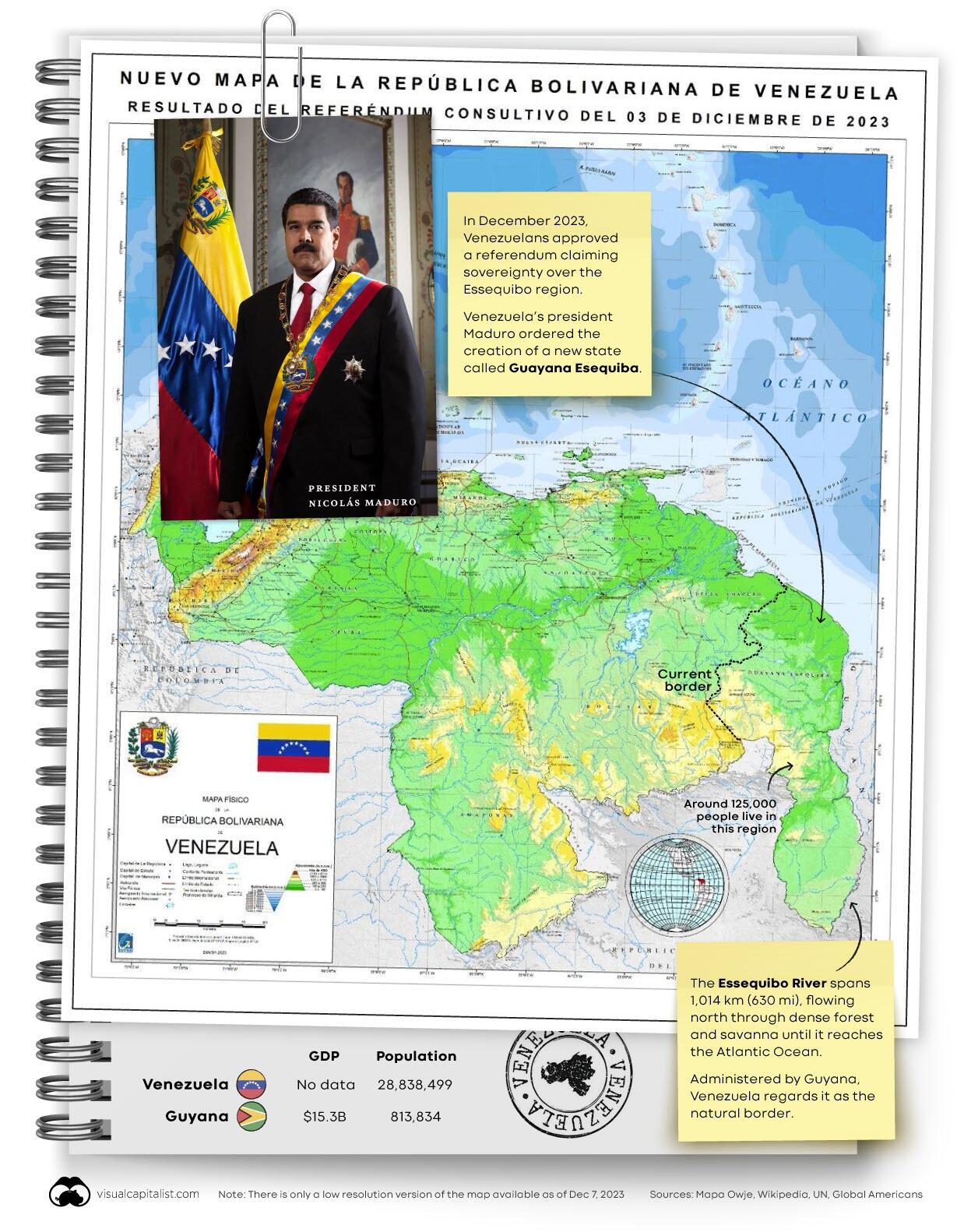
President Maduro subsequently ordered the creation of a new state, Guayana Esequiba, within Venezuela’s borders, and released a new map of the country.
Venezuela’s new territorial claims don’t stop on land, they extend far out into sea as well. Specifically, Venezuela is claiming a critical area called the Stabroek Oil Block, where ExxonMobil and others are already active.
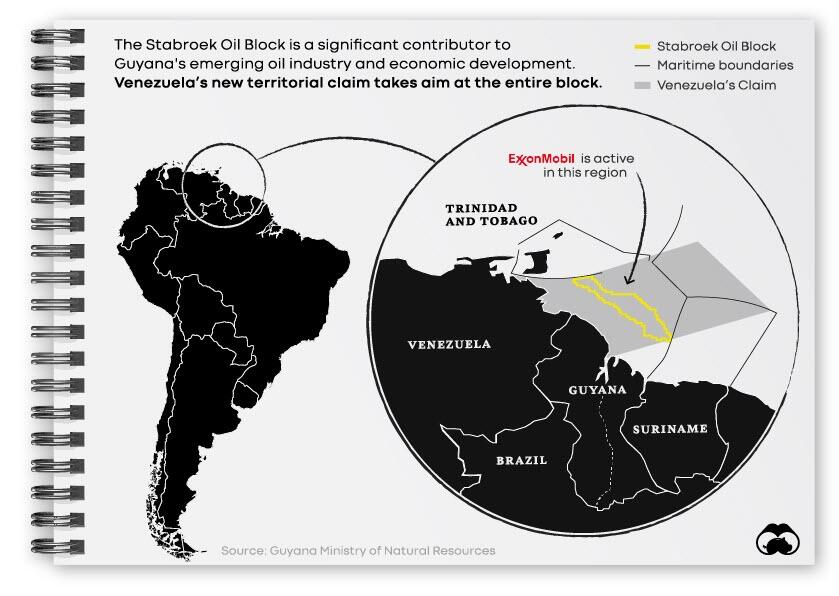
With a population of around 125,000 people, the disputed region is full of dense rainforest, making a military incursion from Venezuela feasible only by sea or through the Brazilian state of Roraima. Brazil, maintaining good diplomatic relationships with both countries, has already increased military personnel on the border. The U.S. announced joint military flight drills in Guyana on December 7.
Despite increased military presence in the region, many experts believe that President Maduro has no intention of actually annexing Essequibo, and that this recent claim is a tactic to bolster his own image within Venezuela.
Projet de loi « immigration » : Edouard Philippe se dit favorable à des « quotas » de régularisation
L’ancien premier ministre, interviewé par le « Journal du dimanche », considère par ailleurs comme « possible » l’existence d’un racisme « anti-Blancs ».
L’ancien premier ministre Edouard Philippe a proposé, dimanche 10 décembre de fixer « des quotas » de régularisations pour les travailleurs sans papiers exerçant dans les métiers en tension, tout en estimant que le projet de loi sur l’immigration, débattu à partir de lundi à l’Assemblée nationale, ne constitue pas « un appel d’air » migratoire.
« Je ne soutiendrai jamais aucun texte qui constituerait un appel d’air. Il faut regarder la réalité en face. Cet article [du projet de loi] n’a rien de cela, il a vocation à essayer de trouver une solution pour un certain nombre d’étrangers en situation irrégulière, qui exercent effectivement des métiers dont nous avons besoin et qui ne posent pas de problème d’ordre public, observe Edouard Philippe dans un entretien au Journal du dimanche. Pour rassurer ceux qui craignent un appel d’air, nous pourrions mettre en place des quotas. Nous pouvons fixer une limite au nombre de régularisations. Il y a déjà des garanties dans le texte, nous pouvons en ajouter. »
Cette clause sur la régularisation des travailleurs sans papiers dans les métiers en tension est l’un des points les plus durs de la discussion sur le projet de loi sur l’immigration porté par le ministre de l’intérieur, Gérald Darmanin. La droite et l’extrême droite y sont farouchement opposées, tandis que la gauche de la majorité macroniste tient à ce que le texte comporte un dispositif de régularisations.
« Racisme anti-Blancs »
Dans cet entretien, Edouard Philippe affirme que son parti, Horizons, qui occupe l’aile droite de la majorité, soutient sans ambiguïté le projet de loi. « Je veux dire mon soutien complet au texte qui a été proposé par Gérald Darmanin, dit-il. Il s’inscrit exactement dans ce que je crois et dans ce que je défends depuis mon passage à Matignon. Nous devons reprendre le contrôle de notre immigration et lutter contre l’immigration du fait accompli. »
Dans cet entretien, M. Philippe défend également le maintien de l’aide médicale d’Etat (AME) destinée aux étrangers sans papiers (rétablie mercredi 29 novembre à l’Assemblée), « pour des raisons de décence et pour des raisons tenant à l’intérêt général ».
Interrogé sur le drame de Crépol (Drôme), au cours de laquelle Thomas, adolescent de 16 ans, a été tué le 19 novembre d’un coup de couteau lors d’une fête de village, l’ancien premier ministre « ne veut pas [se] prononcer sur la procédure judiciaire en cours ».
Il estime toutefois qu’il est « bien possible » qu’il y ait une « forme nouvelle de racisme anti-Blancs » en France, « comme il y a une forme ancienne de racisme anti-Noirs, anti-Arabes ou antijuifs ». « Aucune de ces formes de racisme n’excuse l’autre. Elles sont toutes absolument condamnables et il faut lutter contre toutes aussi fermement. »
Why Online Luxury Is Broken
Reports of financial strain at Farfetch amid a stalled deal with Richemont have driven confidence in multi-brand e-commerce to all-time lows. With value propositions eroding and investment drying up, a way forward remains unclear.
The crisis at Farfetch has been well-documented over the past week — but its woes are hardly singular in online luxury.
Following a report in The Telegraph that Farfetch chief executive José Neves was in talks to delist the company, BoF reported on Monday that the fashion tech giant was seeking cash to fund operations. Those include tapping existing partners for investment and selling off assets like the brand incubator and distributor New Guards Group (the licensee of Off-White).
The news has put the fate of another under-performing luxury e-tailer in jeopardy: Farfetch had been set to acquire a 47.5 percent stake in competitor Yoox Net-a-Porter, with plans to purchase it entirely within the next three to five years; the deal had received a green light from EU regulators in October. YNAP parent, the Swiss luxury conglomerate Richemont — also an investor in Farfetch — wants the e-commerce site off its own books; in November, it reported YNAP sales fell 10 percent in the first half of 2023 and implied losses of €128 million ($137 million) from YNAP’s operations during that period.
But online luxury’s problems go beyond Farfetch and YNAP. Montréal-based Ssense, which does not disclose revenues, cut its workforce by 7 percent in January, citing slower growth. Last month, MatchesFashion reported 2022 results including widening losses of £33.7 million and a third consecutive year of slipping sales. Meanwhile, Munich-based online destination Mytheresa reported a sales growth slowdown in September. The company’s gross merchandise volume — a measure of goods sold on the platform — rose 3 percent year over year to €204 million, compared to a 13 percent increase in the previous quarter.
Even T Mall-owner Alibaba — which always had an advantage in its powerful network of exclusive logistics partners and integrations with Chinese payment and messaging apps — has shown signs of pressure amid rising competition from scrappier rivals like Pindoudou, Temu and Douyin. The group sought to raise funds by spinning off various units, including its cloud computing division earlier this year (the IPO has since been shelved). The e-commerce giant’s shares have fallen by roughly three quarters since their 2020 peak.
But why are today’s luxury e-commerce players struggling to survive — let alone thrive?
Some of the multi-brand luxury model’s challenges go back to its inception. Customer traffic — a key value add wholesalers offer brands — is expensive to attract online, thanks to rising rates at online ad giants Meta and Google, and nearly impossible to retain. Nearly all the players in the space offer a similar user experience, from their product assortments to sleek, black-and-white branding, leading to rampant comparison shopping. Pricing is often the only way to stand out, forcing a race to the bottom.
Logistics costs have also always been high. For the most expensive, least return-prone items like a $1,400 Prada handbag, offering a high-touch, luxurious experience can be profitable. But margins are slimmer when offering speedy shipping and easy returns for marked-down, end-of-season wardrobe fillers. Whenever websites charge customers for those services, it incentivises people to go shopping in person.
Investors have spent years pouring money into e-commerce darlings, betting that as adoption of e-commerce increased, operating at a bigger scale would ease the challenges of turning a profit. That hasn’t been the case. Even for behemoths like Farfetch, the landscape has only gotten more competitive, as nearly all brands operate their own e-commerce platforms, limiting the need for intermediaries.
In-person shopping is also seeing renewed interest post-pandemic, and luxury houses are investing heavily in rolling out bigger and better stores. Fashion capitals now feature mega-boutiques that are true destinations, offering immersive brand experiences that incorporate restaurants, art exhibitions, events and spa services. Plus, brands like Gucci and Hermès have rolled out new locations in smaller cities in the US such as Austin, Denver or Nashville, further limiting the appeal of ordering online.
For brands, there are upsides to investing in their own digital presence: even if some e-commerce sales are less profitable than they would be in store, being able to showcase their full offering on their own websites is worth it. When customers can do research online ahead of time, they come into stores determined and well-informed. As well, niche items are more likely to find buyers online, and brands are able to acquire heaps of valuable customer data.
The likes of Yoox Net-a-Porter and Farfetch, by contrast, don’t share the opportunity to cash in on their online showrooming activities in the physical realm. After getting out ahead of the e-commerce boom, both companies have tried providing white-label support to brands selling online. But big brands have increasingly chosen to bring those operations in house, while smaller labels often find that ready-made e-commerce platforms, like Shopify, suffice.
The macro-economic environment has also changed: The end of a decade of ultra-low interest rates is hitting the luxury economy hard, particularly among aspirational shoppers. With travel and experiences on hold during the pandemic, customers were able to fall back in love with stuff, shelling out for luxury bags and shoes.
Now, more customers have to choose between a vacation or a handbag — or homeownership. Luxury sales will likely rise 1 to 4 percent next year, compared to 8 percent growth at constant currency in 2023, consultancy Bain forecasts.
E-commerce players are likely to be doubly punished by rising interest rates, as higher yields on safe investments have led markets to become less interested in placing bets on loss-making businesses.
“These platforms that had promised to bring physical multi-brand retail, the grands magasins, online are finding out that online is a completely different world,” e-commerce expert and advisor Michel Campan said. “Ultimately, raising money is the thing these companies were actually good at. But eventually investors’ patience runs out.”