>>> What to look at today - 12th of January 2024

Stocks in Asia rose, supported by a continuing rally in Japanese shares. Oil climbed on Mideast tensions.  An Asian equity gauge rose 0.5% as the Nikkei 225 advanced more than 1%, on track for the biggest weekly increase since March 2022. Shares in China and Hong Kong fluctuated, while South Korea’s and Australia’s declined. US equity futures slipped after Wall Street benchmarks ended Thursday little changed, as solid inflation data failed to tame bets on Federal Reserve interest-rate cuts. 
US consumer price index data showed headline prices increased more than expected in December, while core inflation fell — although less than consensus estimates. Swaps pricing for a cut by March increased slightly on the day, back toward levels seen at the end of 2023. China’s consumer prices fell for a third straight month in December, a sign of weak domestic demand. That may justify the need for China’s central bank to cut a key policy rate and pump more cash into the financial system on Monday.  West Texas Intermediate rose more than 2% to above $73 after the US and its allies launched joint military strikes against Houthi rebels in Yemen following their attacks on ships in the Red Sea. The news of airstrikes also pushed gold and stocks of Asian shipping companies higher.  Commodity-linked currencies benefited from the rise in crude oil, with the Australian dollar and Norwegian krone seeing modest gains. Bloomberg’s gauge of the dollar dipped, suggesting global traders were mostly unfazed by the escalation. In Asia, Japan’s November current account balance came in below forecasts. Also, the country’s benchmark two-year government bond yield dropped to zero for the first time since August and an auction of 30-year sovereign bonds saw weaker demand than expected amid speculation the Japanese central bank will tweak its monetary policy at a meeting this month. Treasuries were tad lower Friday after the 10-year yield fell six basis points on Thursday and the policy-sensitive two-year yield dropped by around 11 basis points.  Federal Reserve Bank of Cleveland President Loretta Mester pushed back against the prospect of a March rate cut and said the inflation figures showed policymakers had further work to do.   Meanwhile, Wells Fargo recommends investors should start positioning for a sudden risk-off move as markets are too optimistic the Federal Reserve will cut in March. Elsewhere, more than $4 billion of shares traded between the 11 US spot Bitcoin exchange-traded funds on Thursday following Securities and Exchange Commission approval for the funds. Bitcoin was steady near $46,000. US After Hours BBCP +3.9% up on earnings; PSNY +0.5% modestly higher on Q4 deliveries.

Nikkei +1.50% Hang Seng -0.26% CSI -0.22% Shanghai -0.03% Shenzen -0.53%

Eur$ 1.0952 CNH 7.1705 CNY 7.1625 JPY 145.13 GBP 1.2777 CHF 0.8522 RUB 88.7053 TRY 30.0922 WTI$ 73.55 +2.11% Gold 2,036 +0.36% BTC 46,250 +0.20% ETH 2,618 +0.56%

S&P -0.12% Nasdaq -0.07% EuroStoxx +0.85% FTSE +0.40% Dax +0.07% SMI +0.31%

Macro :
- Goldman’s Rubner Says Brace for Dip-Buying Competition in Stocks
- US Beige Book, ECB Minutes, China GDP: Global Week Ahead

Keep an eye on :
- AIR FP : Airbus Says It’s on Track to Meet Ramp-Up Plans in 2024: CEO
- AKE FP : Arkema Acquires a Stake in Tiamat and Accelerates in Next Generation Batteries
- BLV FP : Believe Investors Eye Takeover of Music Co: Reuters
- BRBY LN : Burberry Sees Earnings Below Guidance
- ALCAR FP : Carmat, EIB Sign Agreement in Principle on Loan Repayment Terms
- CO FP : Casino Holders, Creditors Approve Accelerated Safeguard Plans
- DIS US : Disney’s Pixar to Undergo Layoffs Later This Year: TechCrunch
- DOCU US : Bain, Hellman & Friedman Vying to Buy DocuSign: Reuters
- BOSS GY : Safilo, Hugo Boss Renew Licensing Agreement Until 2030
- HFG GY : HelloFresh Fined £140K by UK Data Watchdog for Spam Texts
- JMT PL : J. Martins 4Q Sales Meets Estimates
- MC FP : China Anti-Dumping Probe Piles Pain on Europe’s Cognac Producers
- NOVN SW : Cytokinetics Plunge Deepens on Report Novartis Is Backing Away
- PAGERO SS : Avalara Makes Competing SEK45/Share Cash Offer for Pagero
- PHIA NA : Royal Philips to Pay at Least $445 Million in Proposed Settlement on Breathing Devices, Administrator Says
- SFL IM : Safilo, Hugo Boss Renew Licensing Agreement Until 2030
- SAN FP : Biden Admin Met With RSV Immunization Makers Sanofi, AstraZeneca
- STLAM IM : Stellantis Invests in Sodium-Ion Battery Tech Company Tiamat
- UBSG SW : UBS Proposes Gail Kelly as New Board Member, Wemmer Leaves
- X US : US Steel Deal Possible Before November Election: Nippon Exec.
- DF FP : Vinci Sees FY Free Cash Flow Above EU5.4B, Saw at Least EU4.5B
- VOLCARB SS : Volvo Car Says Winfried Vahland Leaves Board to Join Polestar’s

>>> Europe : Brokers Upgrades & Downgrades - 12th of January 2024

>>> Up
* AMS Osram Raised to outPerform from Market Perform at Bernstein
* Arkema Raised to Equal-Weight at Morgan Stanley; PT 105 euros
* ASR Nederland Raised to Overweight at JPMorgan; PT 55 euros
* Autoliv GDRs Raised to Buy at Berenberg; PT 1,224 kronor
* Autoliv Raised to Buy at Berenberg; PT $120
* Bunzl Raised to Equal-Weight at Morgan Stanley; PT 3,030 pence
* Bureau Veritas Raised to Overweight at Morgan Stanley
* Corticeira Amorim Raised to Buy at Bestinver; PT 11.10 euros
* International Flavors Raised to Buy at Jefferies; PT $112
* Lanson-BCC Raised to Outperform at Oddo BHF; PT 45 euros
* SGS Raised to Equal-Weight at Morgan Stanley; PT 81 Swiss francs

>>> Down
* AB InBev Cut to Neutral at BNPP Exane
* Ageas Cut to Underweight at JPMorgan; PT 39 euros
* Airtel Africa Cut to Neutral at JPMorgan; PT 130 pence
* Brenntag Cut to Equal-Weight at Morgan Stanley; PT 86 euros
* Carlsberg Raised to Outperform at BNPP Exane; PT 1,040 kroner
* Ceres Power Cut to Underperform at RBC; PT 150 pence
* Coca-Cola Europacific Raised to Outperform at BNPP Exane; PT $79
* Diageo Cut to Underperform at BNPP Exane
* Eurofins Scientific Cut to Underweight at Morgan Stanley
* IMCD Cut to Underweight at Morgan Stanley; PT 141 euros
* Johnson Controls Cut to Underperform at RBC; PT $50
* Know IT Cut to Hold at Nordea
* Lanxess Cut to Underweight at Morgan Stanley; PT 23.50 euros
* McPhy Cut to Sector Perform at RBC; PT 4 euros
* Merlin Properties Cut to Hold at Mirabaud Securities
* NN Group Cut to Neutral at JPMorgan; PT 44 euros
* Pandora Cut to Hold at ABG; PT 1,050 kroner
* Quilter Cut to Neutral at UBS
* Rentokil Cut to Equal-Weight at Morgan Stanley; PT 540 pence
* Sparebank 1 Oestlandet Cut to Hold at SEB Equities
* Wacker Chemie Cut to Equal-Weight at Morgan Stanley

>>> Initiation
* British Land Reinstated Buy at SocGen; PT 470 pence
* Derwent London Reinstated Hold at SocGen; PT 2,342 pence
* GCP Infra Rated New Outperform at RBC; PT 90 pence
* Great Portland Rated New Sell at SocGen; PT 384 pence
* Land Sec. Reinstated Hold at SocGen; PT 741 pence
* Workspace Rated New Hold at SocGen; PT 578 pence

>>> Call

CrunchBase : Funding To VC-Backed Startups In Israel Plummeted In Q4 Amid Turmoi

Funding To VC-Backed Startups In Israel Plummeted In Q4 Amid Turmoil

Venture funding to Israel-based startups in Q4 2023 hit its lowest point since early 2017, as just more than a half-billion dollars was invested in private companies with tensions and violence rising in the region.

Startups in Israel raised about $516 million in a paltry 42 deals, per Crunchbase data. That is the lowest dollar total since Israeli startups raised only $463 million in Q1 2017. The total is down about 69% from the previous quarter, which saw $1.6 billion roll to Israel-based startups, and 54% from Q4 2022.

For the year, 2023 funding in Israel declined nearly 52% from the previous year, totaling only $4.3 billion in 369 deals — down from $8.9 billion in 677 deals in 2022. Last year’s dollar total was the country’s lowest since 2018.

The fourth quarter obviously coincided with the Hamas attacks on Israel and the Israeli response.

“The economic performance of 2023 remains inseparable from October 7th, which shook us to our core,” said Nadav Zafrir, co-founder and managing partner at Israel-based incubator and investment firm Team8. “But it is precisely this core that has enabled us to weather multiple colossal challenges in the past, and we are confident that we will emerge stronger from the current crisis.”

Small rounds
A quick glance at the biggest rounds in Q4 give a good indication as to why the dollar amount for the quarter was so low. The largest rounds of the quarter went to:

  • AI startup AI21 Labs, which locked up an additional $53 million for its Series C announced in August;
  • Cybersecurity startup Gutsy, which raised a $51 million seed round; and
  • AI startup Cortica, which landed a $40 million Series D.
Those three rounds combined are less than Q3’s largest round raised by an Israeli startup — AI21 Labs’ original $155 million Series C from investors that include Google and Nvidia.

In fact, a half-dozen startups in the region raised $100 million or more in rounds in Q3 of last year whereas no startup came close to that number in Q4.

Investing during uncertainty
Of course, those numbers are not shocking considering the October attacks by Hamas changed nearly everything in the country.

Despite the fighting, investors in the region say they continue to see positive signs in both the country’s robust startup ecosystem, and investors’ attitudes toward the area.

“One of the most remarkable phenomena we witnessed (after the attacks) was the rallying of foreign investors, customers and partners who continued to support, fund and even acquire Israeli cybersecurity startups since October, despite the turmoil,” said Ofer Schreiber, senior partner and head of the Israel office for cyber venture firm YL Ventures. “These global industry leaders have a long history of working with the Israeli ecosystem and have expressed their confidence in its longevity and sustainability.”

Gili Raanan, founder and partner at Israel-based Cyberstarts, said even as the country goes to war, startups have adopted agile approaches to ensure business continuity, with minimal to no disruption to their operations.

“In my view, Israeli companies are emerging from 2023 stronger, building sustainable businesses adept at navigating unforeseen challenges,” he said. “Foreign investors recognize these positive developments, and I’m confident they will continue acknowledging Israel as the innovative hub that it is.”

Raanan said he anticipates M&A activity to grow alongside increased fundraising as global markets gradually recover.

“While significant IPOs might be premature in 2024, I’m optimistic about Israeli companies gearing up for this significant milestone in the lead-up to 2025,” he added.

Investors are hopeful the worst may be behind them.

“2023 may be the conclusion of a downward trend in tech investments,” Zafrir said. “We seem to have stabilized at pre-2020 levels and are optimistic that it might mark the beginning of a healthy ascent.”

(ZH) US Budget Deficit Soars By 50% In December As Fiscal Collapse Under Biden A

US Budget Deficit Soars By 50% In December As Fiscal Collapse Under Biden Accelerates

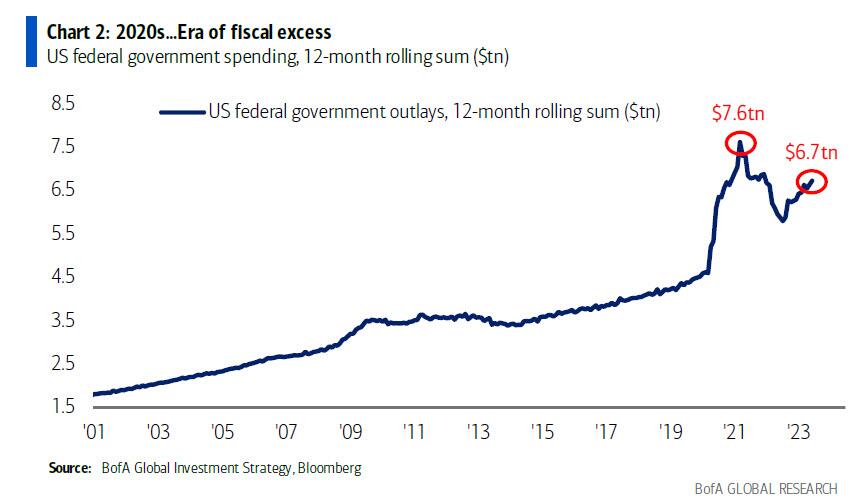
Remember when we showed that the "stealth" secret sauce behind Bidenomics was nothing more than a massive, multi-trillion debt-fueled spending spree, which led to the biggest peactime, non-crisis budget deficit in US history, with the total deficit for fiscal 2023 ending just over $2 trillion, or double the prior year, something which BofA's Michael Hartnett called the "era of fiscal excess"?
Well, we have news for you: if 2023 was bad, 2024 - an election year of course - is shaping up to be far worse.

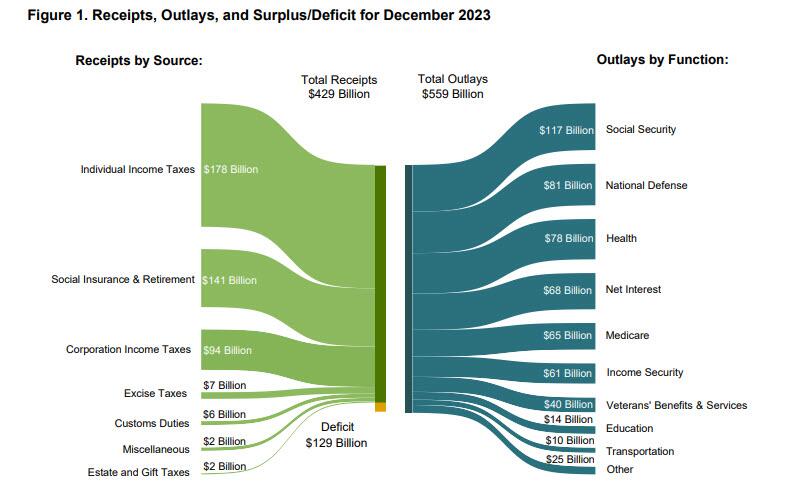
Moments ago the US Treasury reported the budget deficit picture for December and it will come as no surprise to anyone that the US has continued to spend like a drunken sailor, or rather, even more. As shown in the chart below, in the month of December, the US collected $429 billion through various taxes, while total outlays hit $559 billion...
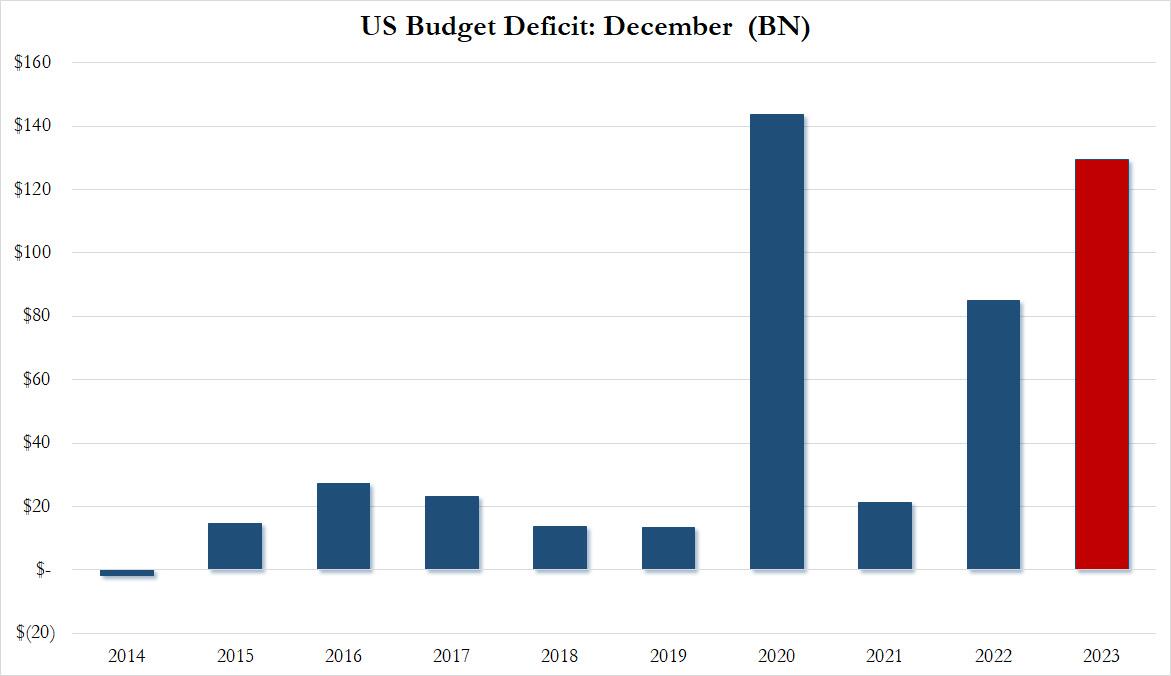
... resulting in a December deficit of $129.4 billion.
This may not sound like a lot, but December is actually one of those months when the US deficit is relatively tame, or used to be.
As shown in the next chart, traditionally the December deficit was barely in the $10-20BN range... until 2020 when it exploded to an all time high of $140BN. And while it dropped sharply in 2021, it rebounded dramatically in 2022, and rose to just shy of the December crisis high last month!
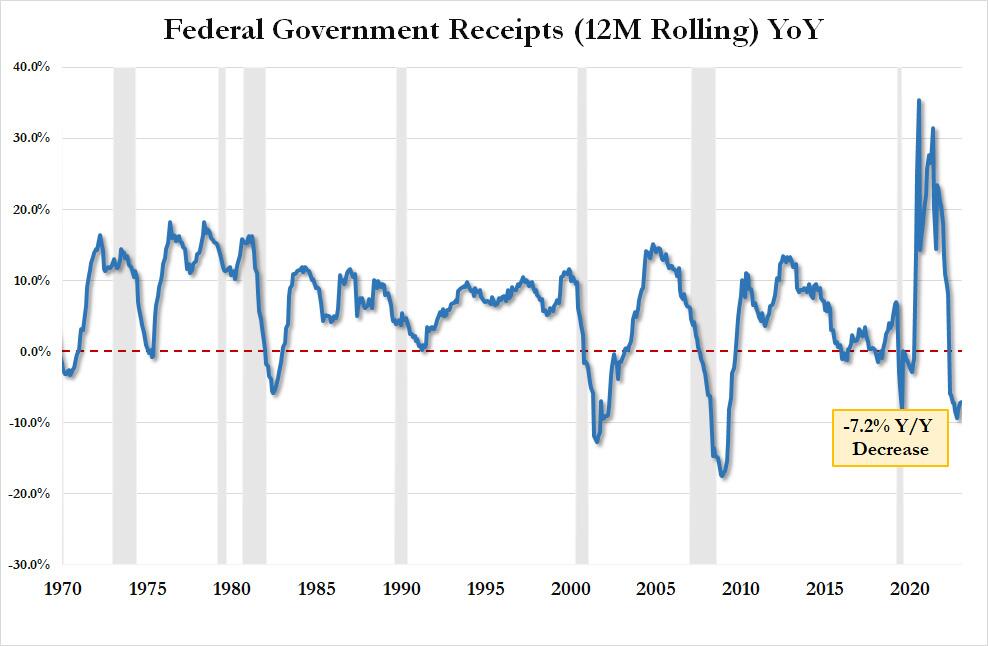
Here is some more context: tax receipts of $429.3BN in December were down 5.6% from the $454.9BN in December 2022 and down a whopping 11.8% from December 2021. On an LTM basis, US total tax receipts were $4.521TN, or down 7.2% YoY. This is now the 9th consecutive YoY decline in LTM tax receipts, something that historically has only taken place when the US was in a recession. As an aside, the "smart economists" were certain that the collapse in tax receipts would reverse after November when the postponed California taxes would be collected. Well, November has come and gone and the big picture is just as ugly.
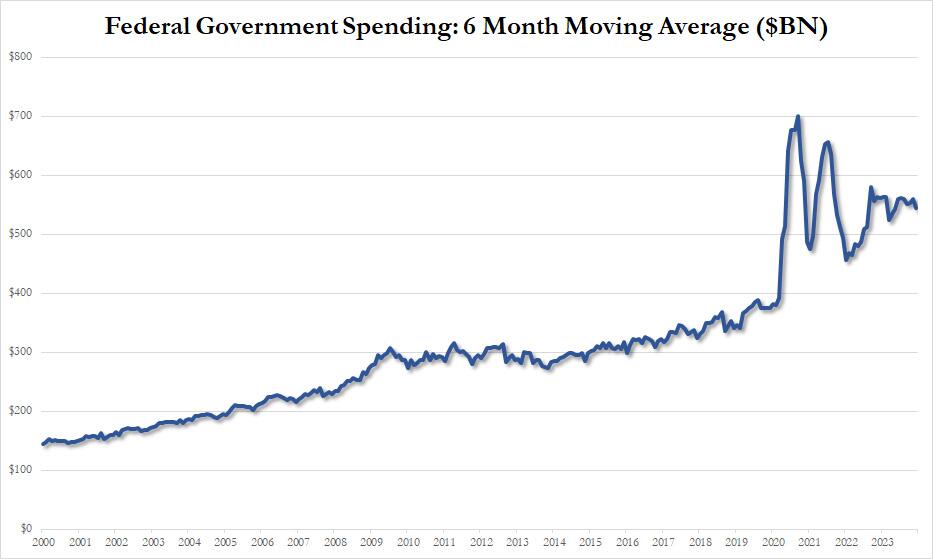
Looking at outlays, unlike tax receipts, there is danger of a decline... ever; and indeed in December the US spent a total of $559 billion, up 3.5% from the $540BN spent a year ago, and up even more from the $508BN in 2021. On a 6 month moving average basis, we are rapidly approaching the exponential phase even when accounting for the spending burst in 2020 and 2021.
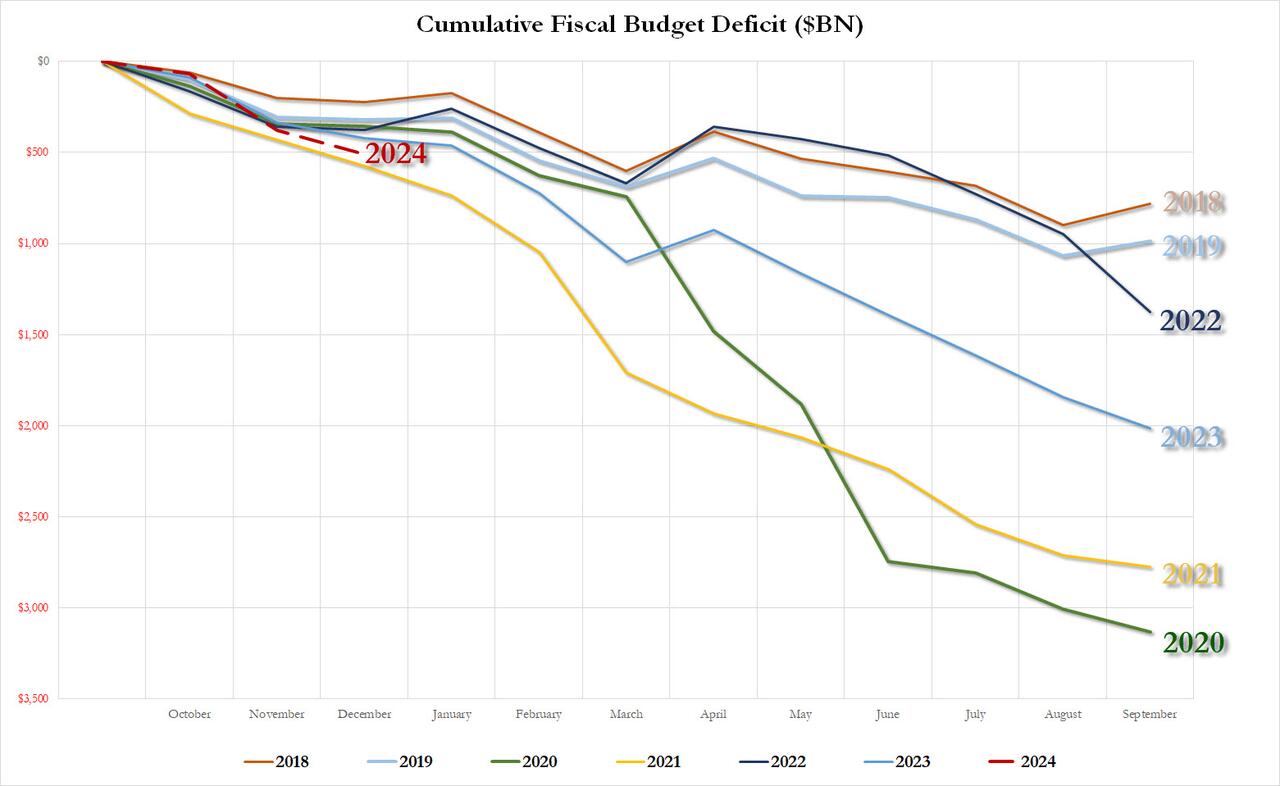
Putting it all together, we get the scariest chart of all: the YTD budget deficit three months into fiscal 2024 is already $509 billion, which would be the biggest deficit in US history after one quarter with the exception of the covid outlier year of 2021 when the US injected multiple trillions in stimmies.
As for the final, and most shocking, data point, the December budget deficit of $129.4 billion was more than $40BN higher than the $87.5BN median estimate, and was more than 50% higher compared to the $85BN December deficit in fiscal 2022.
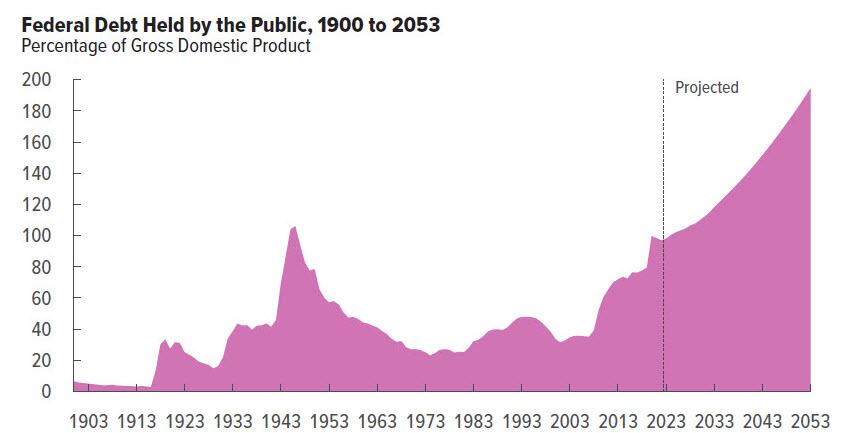
Needless to say, this is completely unsustainable and assures fiscal collapse for the US, not if, but when. Then again, we already knew this thanks to the CBO which was kind enough to chart the endgame:
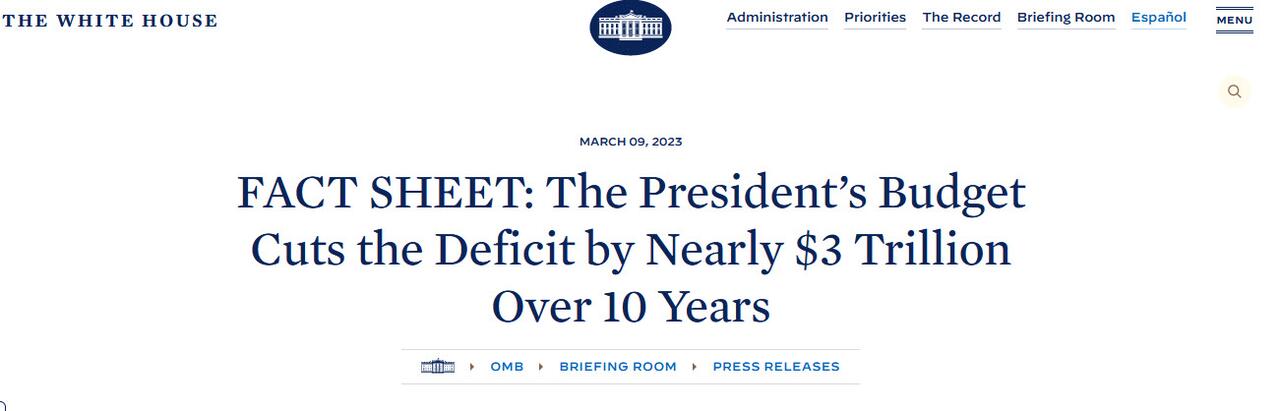
What is funniest about all this is that the US is on an accelerating path to ruin less than one year after the imposter in the White House published this laughable propaganda.
We can't wait to see what really happens to the budget deficit over the next 10 years. Spoiler alert: there won't be a happy ending.

FT : Albert Edwards sees ‘a multiyear bear market for bonds’

Albert Edwards sees ‘a multiyear bear market for bonds’

Friday interview: Albert Edwards
Albert Edwards, the provocative and voluble strategist at Société Générale, is known for two things: his long standing “ice age” theory, that the US and Europe will follow Japan into a period of stagnation and deflation, and for being a so-called “permabear” on stocks. Below, he discusses that reputation, the evolution of his long-term view, and the probability that we are still facing a recession and even a deflationary bust. The interview has been edited for clarity and brevity.

Unhedged: There is a critique or caricature of you as a one-note permabear, a clock that is right twice a day. The critics might say you have been bearish all the way through a great run for markets. Please respond.

Albert Edwards: My uber-bear views came about because of my ice age thesis, which I put in place at the back end of 1996. We used to work with Peter Tasker, who was our Japanese strategist at Dresdner Kleinwort, which I joined in 1988. We went through the Japan boom and bust together. And I came to the conclusion that what was playing out in Japan would also play out in the west, with a lag.

The Japanification of the US and Europe was basically like the secular stagnation thesis. In financial markets, cyclicality would de-rate relative to certainty. So equities would underperform government bonds. We’d reach the stage in the economic cycle where the traditional correlation between bonds and equities would break down. As inflation got lower, what you might call the Abby Cohen thesis [after the well-known Goldman Sachs strategist] said that lower bond yields are great for equities because the P/E [price/earnings] ratio will go up forever. But we thought that eventually, as you got down to sub-2 per cent inflation and bond yields fell further, the “P” would start coming down. That’s what happened in Japan.

That was for a couple of reasons. One is at very low rates of inflation, the economic cycle, certainly in Japan, became much more volatile than the profits cycle. So the cyclical risk premium goes up. Secondly, long-term earnings expectations, especially at the end of bubbles, usually became totally detached from nominal [gross domestic product] growth. And as nominal GDP growth got towards zero, we found that long-term earnings expectations collapsed.

So based on the experience in Japan, we thought US bond yields would collapse and once equity valuations finally topped out, you would enter a multiyear valuation bear market in absolute terms. Our bearish call on equities attracts the most attention. But our bond call worked out. The Japanification call worked very well. Our institutional clients understand our calls largely played out, other than the equity bear market.

Unhedged: Why was the equity bear market call wrong?

Edwards: Before the bubble burst in 2000, equity and bond yields had been coming down together. Once it burst, bond yields carried on falling, but equity yields started to rise from 2000. That decoupling was what I expected. But where my ice age call stopped working was from 2008 onwards when quantitative easing kicked in. Hosing money out for QE re-coupled equity and bond yields, which started falling together again. 

Unhedged: So QE changed your view on equities. What else has changed, in your mind, since the ice age argument was first made in 1996?

Edwards: Another thing I got wrong was cycles didn’t become more volatile. The [Federal Reserve] stepped up the gear in manipulating the cycle. And you got the longest economic cycle in US history, prior to the 2020 pandemic recession.

Before the pandemic, I had written that the next recession, when it comes, would end the ice age thesis. I thought that in the next recession, we would cross the Rubicon into MMT [modern monetary theory, the idea that capacity constraints, not budget constraints, are the relevant limit on government spending]. I didn’t realise it would be so easy! I didn’t realise you would get the level of populism around the world that we got, because of inequality. And I thought the next recession would be a deep one, because if you remember, in 2019, there was an incredible corporate debt bubble. That would force US authorities to step in aggressively. They did end up being aggressive, but it was because of the pandemic, which eliminated opposition to crossing the fiscal Rubicon.

In the global financial crisis, the US injected liquidity into the veins of Wall Street, so narrow money measures exploded but broad money didn’t. In the pandemic, they also did it into the veins of Main Street, printing money for direct transfers. That was bonkers; even the MMTers should’ve seen that. Given the capacity constraints, [inflation was sure to follow].

I had said the next recession would be the end of the ice age, and we would enter a multiyear secular trend of higher highs and higher lows for bond yields, inflation and interest rates. I had thought this would occur, but not as rapidly as it did.

Unhedged: Given higher highs and higher lows for rates and inflation, how do risk assets respond to that?

Edwards: Even though the ice age call didn’t work for the overall equity market, it was relevant within the equity market. Bond-sensitive sectors, such as defensives and growth, did incredibly well, relative to cyclicality and value. So if you’re an equity-only investor, the direction wasn’t right, but the sector allocation within equities was absolutely spot on. 

Within equity markets, particularly the US, they’ve become much more dominated by tech and bond-sensitive stocks, which benefit from lower bond yields. Apart from last year’s [artificial intelligence] narrative-driven rally, which supported tech despite rising yields, defensiveness has come to dominate the stock indices, which is what you’d expect after a multiyear bull market in government bonds.

Going forward, if my “great melt” thesis is right and we’re entering a multiyear bear market for bonds, it’s pretty problematic for equity markets dominated by bond-sensitive sectors, like the US, which have been lifted by falling bond yields. You’ll need really rapid earnings growth for tech stocks to power through higher bond yields.

Unhedged: Summing it up very simply, then, the great melt thesis amounts to fiscal incontinence → higher inflation → higher rates → trouble for rate-sensitive stocks. Is that right?

Edwards: That’s right. With tech back up to 31 per cent of total US market cap, a level only surpassed for a few months around September 2020, so much of [US stock outperformance] has been multiple expansion. Up until the Powell pivot in 2018-19 [when Jay Powell’s Federal Reserve switched from raising to lowering rates], tech wasn’t at a particularly substantial P/E premium relative to the market. After the Powell pivot, then it went bonkers, and even more bonkers during the last recession.

The big call I’ve made is that if a recession comes along, you’ll get lower bond yields, but that won’t benefit tech. What really destroyed tech in 2001 is that you’d had many years of good, strong earnings growth. Lots of those companies hadn’t been around for a very long time. The market didn’t really know what was cyclical and what was growth. Investors took the internet story and re-rated most stocks to be on growth valuations, even if they were cyclicals. Then recession came along. Stocks on 40x P/E suddenly had falling earnings. So people went, well, seems like we got both earnings and multiples wrong. The whole sector collapsed. I think this is the biggest risk for equities: that a recession exposes vast portions of tech as cyclicals masquerading as growth stocks. So lower bond yields don’t save them. You get a step derating and the baby gets thrown out with the bathwater.

Unhedged: But isn’t there a difference of degree between the dotcom boom and now? Back then, you had Cisco trading at 100 times earnings. Now, you have the Big Techs trading at, say, 27 or 30. There’s a big difference between 100 and 27.

Edwards: Absolutely. I’m not saying they collapse to the extent they did in 2001. But the same qualitative argument applies. We saw it in 2022, when we had profit disappointments. Tech was really hurting in 2022, until ChatGPT came along at the end of the year. If you look at tech trailing earnings relative to the market in 2023, they haven’t done so well. Forward earnings have gone up, but trailing earnings haven’t really. It’s a story which has yet to deliver.

If tech wasn’t 31 per cent of US market cap, you wouldn’t really worry. But it is. A tech collapse wouldn’t be like a traditional bear market where you’d get rotation out of cyclicality into defensiveness and growth. Maybe you get that flight out of cyclicality in the next recession, and defensiveness gets squeezed up to the moon, to a ridiculous valuation. This was the point Peter Tasker always used to make. One of the lessons from Japan was the extremes of valuation that defensives reached in the crisis. People wanted certainty and safety.

Unhedged: Japan’s crisis was deflationary, though.

Edwards: The monetarists were right in the wake of the pandemic. Look at broad money — Divisia M4 in the US. It rocketed up in the pandemic. MMT believers should have been screaming about capacity constraints. Stephanie Kelton’s book [The Deficit Myth] says you can print money to finance deficits until near the end of the cycle, when you hit capacity constraints. So the MMTers should have been screaming: don’t do this! This is going to create inflation! This was, if you like, the experiment during the pandemic, and monetarists were right. [The money printing] created inflation.


The monetarists are now saying that the broad money supply measures have collapsed, contracting at a rate consistent with a collapse from inflation into deflation. And the problem is all these central bankers have purged money supply not just from their models, but from their thinking. They’re very open about that. If you don’t like money supply, look at bank lending data. If the monetarists are right, if we get a recession now, it could be a deflationary bust. Now, that doesn’t negate the secular story, which is that the fiscal diarrhoea is there, and that can’t be and won’t be unwound because there’s no political will to retrench.

Unhedged: In a slowdown, you should expect to see pretty considerable margin compression. Suddenly demand is a lot more elastic. Companies start competing on prices again. That is supposed to lead to a potentially non-linear decrease in inflation, but it didn’t happen. We did get two quarters of pretty weak US GDP in the first two quarters of 2022, and there was a little bit of margin compression. But not that much. Why?

Edwards: What always causes recession is the business investment cycle. It’s only about 15 per cent of US GDP, but it’s so darn volatile. If you don’t get business investment downturns, you would not get recessions at all.

A lot of economists, like me, think business investment leads the economic cycle. So profit growth slows down and turns negative, and with a lag business investment follows. And then, with a bit of a lag, employment follows that. Whole economy profits did slow down year on year to zero. And business investment activity, including inventories, did slow down to zero year on year, without going negative.

What helped offset that? Margins stayed relatively high. Partly, that was because consumers had not worked through their savings, so companies didn’t feel compelled to cut their margins. Plus the fact that it was so difficult to hire workers during the pandemic. You just spent 18 months finding John Doe to fill that job gap; you’re not going to rush to fire him in this downturn. Plus, you have the rotation out of goods consumption during the pandemic into services, which are more labour intensive, so the labour situation held up better than it normally would. That helped underlying demand.

Unhedged: Can you put these points about the profit cycle in the context of the ice age and great melt theories?

Edwards: The initial burst of inflation was due to the factors which will continue to drive it: the monetary financing of fiscal incontinence. And then you had this one-off occurrence of price gouging. Interest rates ended up rising higher than they would’ve otherwise, because of profit-led inflation. What the regulators should have done was find some of the worst cases and go after them. That would’ve been a signal to everyone else.

But I do think margins clatter downwards as you go into this recession. Whole-economy margins are still at very elevated levels. Greedflation has delayed the recession. Lower net interest payments [from companies locking in low rates] have delayed the recession. But you drill down below the mega caps and the large caps, and bankruptcies for 2023 are up 72 per cent year on year. The level is surpassing that of 2020, before they put the bailout measures in place.

Below the top 100 companies, the corporate sector is in incredible pain, especially the unquoted sector. Eventually, as these zombie companies go bankrupt, this is what will start increasing [the chances of recession].

Unhedged: Accepting your views about the long-term trends, what does a rational institutional or individual portfolio look like right now? How do we translate your worldview into a portfolio?

Edwards: What we’re saying to clients is that a recession is coming. This has been the most predicted recession in history, and people have got it wrong, so they tend to give up. But I’m not embarrassed to get things wrong. I think it could be deeper than people expect. The zombie company effect could make it more severe, because it’s being delayed for so long.

I think a rational portfolio is still leaning towards an ice age-style allocation in the near term. The cyclical risks warrant leaning towards defensiveness and bond-sensitive stocks. But be very, very careful of tech, as we discussed. Expect US 10-year bond yields probably to end up with a “1” in front of them, though a low “2” is plausible, too. My view is that yields revert to a higher low, not the low-lows of the pandemic era.

Expect headline inflation of zero, and core inflation to come down. Apartment completions this year are just off the scale. Rents are going to absolutely collapse. So even the normal core inflation ex-food and energy could come down, because of the rent component. And core CPI ex-shelter is already below 2 per cent year on year.

So I think it’s a bond-friendly environment cyclically. But I would use this recession [when it comes] to rotate into cyclicality and value stocks on a strategic basis and rotate the portfolio away from bond-sensitive stocks.

Unhedged: And after the recession?

Edwards: I actually think in the next cycle, we could end up in the US with yield curve control [central bank bond-buying aiming to cap long-term bond yields]. There is no way there is going to be fiscal consolidation. For populist reasons, no politician has the stomach to do it, they will just be voted out. The Fed will be forced by politicians to hold down bond yields.

But what I would say, and I think this goes for everyone, is I think the short-term cyclical outlook is incredibly uncertain, more uncertain than normal. But in the medium term, think of the maddest thing you could think of, and actually, you might not be so wrong.
FT : UK universities risk falling into deficit as foreign student numbers fall

UK universities risk falling into deficit as foreign student numbers fall
Government rhetoric threatens international enrolments that help fund institutions, warns sector body

Large numbers of UK universities are at risk of falling into financial deficit due to a sharp decline in international students after hostile rhetoric by Rishi Sunak’s government, the head of the sector’s main lobby group has warned.

Vivienne Stern, the chief executive of Universities UK, which represents more than 140 universities, said the sector was facing the prospect of a “serious overcorrection” thanks to immigration policies that deterred international students from coming to study in Britain.

“If they want to cool things down, that’s one thing, but it seems to me that through a combination of rhetoric, which is off-putting, and policy changes . . .[they have] really turned a whole bunch of people off that would otherwise have come to the UK,” Stern told the Financial Times.

Stern’s plea came as it emerged that some top universities including York, which is a member of the elite Russell Group, were being forced to soften their entry requirements in order to maintain numbers of overseas students.

“The government needs to be very careful: we could end up with, from a policy point of view, what I would consider a serious overcorrection,” she added.

With the £9,250 domestic tuition fee effectively frozen for the past decade, UK universities have become increasingly reliant on non-EU students to make ends meet, with fees from non-EU students now accounting for nearly 20 per cent of sector income.

Universities are warning privately that numbers have softened sharply this year following a series of hostile policy moves by the government, with indications that enrolments may have fallen by more than a third from key countries including Nigeria and India.

One senior university insider told the FT that the sector as a whole had been “spooked” by data that showed the number of international students taking up places in January 2024 was “way below the bottom end of projections for everyone”.


In January, Sunak highlighted changes in government policy to stop international graduate students from bringing family members to the UK, adding the policy was “delivering for the British people”. 

The government also announced in December that it was reviewing the so-called “graduate route” enabling international students to work in the UK for two years after they graduate and announced a crackdown on “low-value courses”, even though only 3 per cent are failing to meet criteria set out by the regulator.

Data from Enroly, a web platform used by one in three international students for managing university enrolment, showed that deposit payments were down 37 per cent compared to last year.

New analysis for UUK by consultants PwC found that the combination of falling international student numbers, frozen tuition fees, rising staff wage bills and a softening in UK student numbers was leaving the sector facing a perfect storm.

“You take those things together, and you’ve got a big problem,” Stern said, warning that the government needed to wake up to the risk posed to a sector that contributes £71bn to the UK economy every year. 

The PwC analysis was based on 2021-22 financial returns for 70 UUK members in England and Northern Ireland and found that about 40 per cent are expected to be in deficit in 2023-24, falling to 19 per cent by 2025-26.

However, Paul Kett, a former senior Department for Education official who now advises PwC on education, said the numbers reflected assumptions about spending and income growth that now looked highly optimistic given the policy environment.

The PwC analysis found that if the growth in international students stagnated in the 2024-25 academic year, the proportion of universities in financial deficit would rise from 19 per cent to 27 per cent — but if numbers started to fall between 13 and 18 per cent then four-fifths would be in deficit.

On the other side of the ledger, it found that increasing fees 10 per cent for UK undergraduates in 2024-25 would shrink the share of universities in deficit from 19 per cent to 7 per cent.


The report said the effects of declining international enrolments could be compounded by other negative shocks, such as a rise in spending growth or a fall in domestic student numbers. It warned that mounting financial pressure could force universities to cut provision and delay investment, compromising quality for students.

Stern argued three interventions were necessary to put the sector on a stable footing: uprating tuition fees in line with inflation, increasing government teaching grants and stabilising the international market by dialling down negative rhetoric and ending question marks over the graduate route.

“You can take these individual scenarios that PwC looked at, and think that any one of them could tip a large number of institutions into a very difficult position, but the problem is that lots of those things are happening at once,” she said.

Robert Halfon, higher education minister, said: “We are fully focused on striking the right balance between acting decisively to tackle net migration, which we are clear is far too high, and attracting the brightest students to study at our universities,” he added.

FT : China’s consumer prices fall for third month as economic recovery lags

China’s consumer prices fall for third month as economic recovery lags
Deflation proves persistent in December despite policymakers’ efforts to stimulate growth

China’s consumer prices remained in deflationary territory for the third consecutive month in December, adding pressure on policymakers to restore confidence in the world’s second-largest economy.

The country’s consumer price index fell 0.3 per cent year on year last month, according to official statistics released on Friday. Producer prices dropped by 2.7 per cent.

Both measures fell slightly less than forecast, and marked a marginal improvement from November, when consumer prices declined 0.5 per cent and producer prices slid 3 per cent.

China’s economy fell into deflation in July and prices have since been flat or fallen in every month except August, adding another challenge for policymakers as they contend with weakened trade, fragile consumer sentiment and a rolling slowdown in the property sector in the wake of three years of strict anti-pandemic policies.

Beijing has undertaken a series of piecemeal stimulus measures, including loosening critical lending rates and stepping up access to credit in strategic sectors, in particular in the property sector, which typically accounts for more than a quarter of economic activity.


Officials are expected to target gross domestic product growth of about 5 per cent in 2024, similar to the 2023 mark, which was the lowest in decades.

“Fiscal and monetary policies started to move in the right direction in Q4 2023, but it takes time for these policies to be transmitted to the economy,” said Zhiwei Zhang, chief economic at Pinpoint Asset Management. “It is also unclear if these policies are strong enough to offset the deflationary pressure in the economy.”

Full-year inflation for 2023 was slightly positive at 0.2 per cent, but fell far short of an official upper target of 3 per cent. The producer price index, which reflects factory gate prices and is strongly affected by global costs of raw materials and commodities, has declined every month since October 2022.


Trade data released on Friday showed China’s exports climbed 2.3 per cent in December from a year earlier in dollar terms, exceeding forecasts and building on an expansion in November that reversed six months of declines.

Imports for December edged up 0.2 per cent, beating expectations of a decline and reversing November’s contraction.

But exports fell 4.6 per cent for 2023, the first full-year decline since 2016, as higher global inflation dented demand for Chinese goods. Full-year imports declined 5.5 per cent, the first fall since 2020.

China’s trade surplus came in at $823bn in 2023, down from last year’s record figure of $878bn.


Analysts at Capital Economics noted that the December exports growth was partly due to “exporters slashing prices to gain market share”, which ate into already low industrial profits.

“Without the support of price cuts, exporters will find it more difficult to shake off the post-pandemic pullback in global goods demand,” they wrote in a note.

The People’s Bank of China is expected on Monday to cut its medium-term lending facility — a policy tool that allows it to inject liquidity into the financial system — for the first time since August. A poll of Bloomberg economists anticipates a 0.1 percentage point cut, to 2.4 per cent.

Policymakers have also sought to reduce restrictions on home purchases in major cities and have moved quickly to address any signs of spillover risks after a wave of property developer defaults since late 2021, including Country Garden, the country’s largest private developer, last year.

Zhongzhi, a shadow banking conglomerate that controls various investment companies, declared bankruptcy last week, six months after missed payments came to light.

China’s CPI has in recent months been affected by volatile prices of pork, the largest item in the consumer basket of goods. Core inflation, which strips out energy and food, expanded 0.6 per cent in December, flat from the month before, while services inflation rose 1 per cent year on year.

>>> US After Hours Summary: BBCP +3.9% up on earnings; PSNY +0.5% modestly highe

After Hours Summary: BBCP +3.9% up on earnings; PSNY +0.5% modestly higher on Q4 deliveries
After Hours Gainers:
Companies trading higher in after hours in reaction to earnings/guidance: BBCP +3.9%, BFLY +3.7% (guidance)
Companies trading higher in after hours in reaction to news: ESPR +1.7% (issues prelim FY24 OpEx), PSNY +0.5% (reports Q4 deliveries, names new CFO), EQT +0.3% (Heads of Agreement for liquefaction services), LMND +0.2% (expands financing relationship), UBS +0.1% (letting customers trade Bitcoin ETFs, according to CoinDesk)
After Hours Losers:
Companies trading lower in after hours in reaction to earnings/guidance: None
Companies trading lower in after hours in reaction to news: XOMA -0.4% (FDA acceptance of NDA; names permanent CEO), MS -0.2% (to pay under $500 mln to resolve trading probe, according to Reuters), CPA -0.2% (December traffic data)

TechCrunch : BlackRock cuts Byju’s valuation by 95% to $1 billion

BlackRoclackRock has yet again cut the value of its holding in Byju’s, slashing the implied valuation of the Indian startup to $1 billion from $22 billion in early 2022, according to disclosures made by the asset manager.

At the end of October last year, BlackRock said it valued Byju’s shares at about $209.6 apiece, down from the peak of $4,660 in 2022. The asset manager, like other mutual fund investors, makes multiple disclosures about its portfolio in a year, but doesn’t explain its rationale behind any valuation adjustments. Its new valuation adjustment hasn’t been previously reported.

BlackRock, which owns less than 1% of Byju’s, didn’t immediately respond to a request for comment Thursday. Byju’s declined to comment.

This isn’t the first time BlackRock has cut the worth of its holding in Byju’s — and BlackRock isn’t the only investor that has severely downgraded how they value Byju’s, but the new adjustment is by far the most drastic. Prosus, which owns about 9% in Byju’s, said late last year that it valued Byju’s at “sub $3 billion.” At $22 billion, Byju’s ranked as India’s most valuable startup.

The valuation markdown is a stunning reversal in fortune for Byju’s, once the poster child of the Indian startup ecosystem. The startup, which spent more than $2.5 billion in 2021 and 2022 acquiring over half a dozen firms globally, was once showered a valuation as high as $50 billion by marquee investment bankers, TechCrunch earlier reported.

Byju’s has been backed by over a dozen movers and shakers in the industry, from Peak XV Partners to Lightspeed, UBS, and Chan Zuckerberg Initiative. The startup, which gained initial popularity in India because its tutors used intuitive ways — tackling complex concepts using real-life objects such as pizza and cake — has raised over $5 billion in equity and debt in the past decade.

Byju’s was preparing to go public in early 2022 through a SPAC deal that would have valued the company at up to $40 billion. However, Russia’s invasion of Ukraine in February sent markets downward, forcing Byju’s to put its IPO plans on hold, according to a source familiar with the matter. As market conditions worsened, so too did the business outlook for Byju’s. The company began facing mounting pressure from investors to address issues that it had previously left unresolved.

Byju’s today is reeling from a series of challenges: It’s struggling to raise capital, make payroll, and pay off its billion-plus debt. It missed its revenue target for the financial year ending in March 2022, the startup disclosed in a much-delayed account last month.

Byju’s CFO Ajay Goel left the startup in less than seven months to return to Vedanta in late October, following high-profile and abrupt departures of auditor Deloitte and three of Byju’s key board members in June. Prosus publicly slammed the Bengaluru-headquartered startup in July for not evolving sufficiently and disregarding the investor’s advice and recommendations despite repeated attempts.k cuts Byju’s valuation by 95% to $1 billion