CSU hurricane outlook shows which states could be threatened in 2024
Colorado State University’s first outlook for the 2024 hurricane season shows what could be a busy time period for forecasters, with around 23 named storms expected to form in the Atlantic basin and nearly half becoming hurricanes.
Dr. Phil Klotzbach, a senior research scientist at CSU, said his team has more confidence in this year’s outlook than previous April releases because of the state of the atmosphere and other favorable signals.
Within the report, the team highlighted states and regions where the chance of a cyclone passing through is either above or below climatological odds.
The outlook put the odds of a major hurricane making landfall along the US coastline at 62%, while the odds for a strike in the Caribbean were the highest at 66%.
Within the Lower 48, CSU said it was nearly a guarantee that at least one cyclone will pass within 50 miles of Florida during the season, with states in New England having the least probability.
 4
4Chances across all coastal states are about 10-20% higher than what is considered to be average, with Alabama seeing the highest increase.
Researchers said landfall probabilities are linked to the expected Accumulated Cyclone Energy, which is commonly referred to as the ACE index.
The ACE value of a tropical cyclone is calculated by its maximum sustained six-hour wind speed and the storm’s longevity.
 4
4A cyclone that is around longer with high sustained winds will have a higher ACE value than one that quickly forms and falls apart.
During the 2024 season, researchers expect the Atlantic Ocean, Gulf of Mexico and Caribbean to produce an ACE value of 210, which is 170% of what an average season would produce.
Nearly 60% of the total ACE is expected to occur west of 60°W longitude, which is where nearly the entire population of people impacted by tropical storms and hurricanes in the basin exist.
 4
4The outlook put the odds of a major hurricane making landfall along the US coastline at 62%, while the odds for a strike in the Caribbean were the highest at 66%.Colorado State University
 4
4Wind gusts blow across Sarasota Bay as Hurricane Ian churns to the south on Sept. 28, 2022 in Sarasota, Florida.Getty Images
“When you have an El Niño like we did last year, in general, the storm pattern is to take the storms up before they get to the islands, and before they get to the U.S.,” said FOX Weather Hurricane Specialist Bryan Norcross.
“Now that we’ve switched to La Niña this year, there’s colder water in the Pacific that tends to create a pattern that lets storms come a little farther west and also gets them more likely into the Caribbean. And of course, once the storm gets in the Caribbean, sometimes they get up into the Gulf, and affect Florida and so forth.”
A reduced or heightened probability does not guarantee or preclude an area from a direct strike.
Sean 'Diddy' Combs' Former Bodyguard Claims Music Mogul Had Tapes Of "Politicians" And "Princes"
The former bodyguard of Sean ‘Diddy’ Combs’ claims the music mogul had blackmail tapes of politicians, princes and other prominent individuals who were involved in his sex parties.
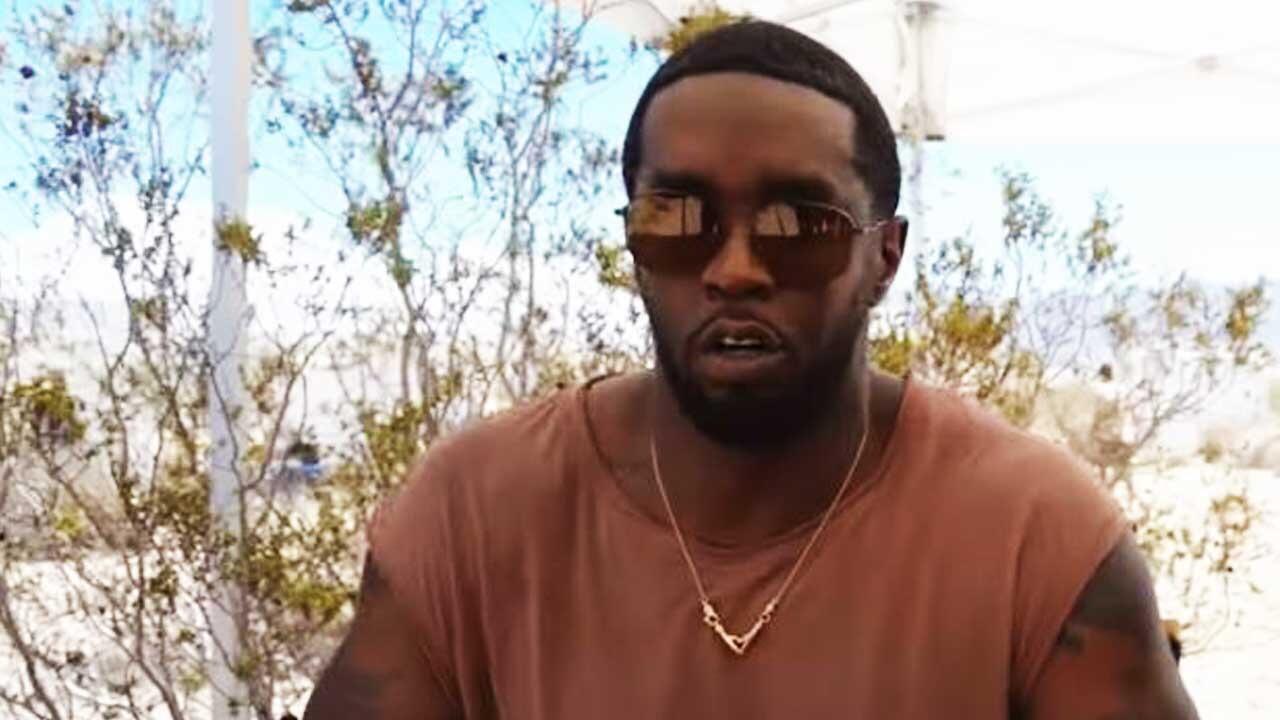
Combs, who has been hit with a barrage of physical abuse, rape and sexual trafficking allegations, had his homes in Miami and Los Angeles raided by the Department of Homeland Security last month, during which federal agents seized computers and other electronic devices.
Gene Deal, who was present the night when Notorious B.I.G. was fatally shot in 1997, made the sensational comments during an interview with ‘The Art of Dialogue’ YouTube channel.
“I don’t think it’s only celebrities gonna be shook. He had politicians in there, he had princes in there. He also had a couple of preachers in there,” said Deal.
“Can you imagine, he had every room bugged,” he added.
When asked why Combs’ media department had stayed silent on the allegations against him, Deal responded, “Either they took part in some of the stuff that happened, or they’re scared that it may mess up their brand.”
Fox News host Jesse Watters speculated that the tapes, if they exist, are now in the hands of the feds and “that’s a lot of blackmail.”
Deal’s comments echo those of rapper Rodney ‘Lil Rod’ Jones, who claimed Combs had hidden cameras throughout his home to record sex tapes involving celebrities during his “freak off” parties.
Combs has denied all the allegations against him and hasn’t been hit with any criminal charges as of yet.
A recent study revealed that Apple TV+ is the streaming platform with the highest rated content on IMDb, despite having the smallest catalog of them all. Now JustWatch has shared the streaming platforms’ market share figures for the first quarter of 2024, which show that Apple TV+ has grown in the US – but still lags behind its main competitors.
Apple TV+ market share in the US
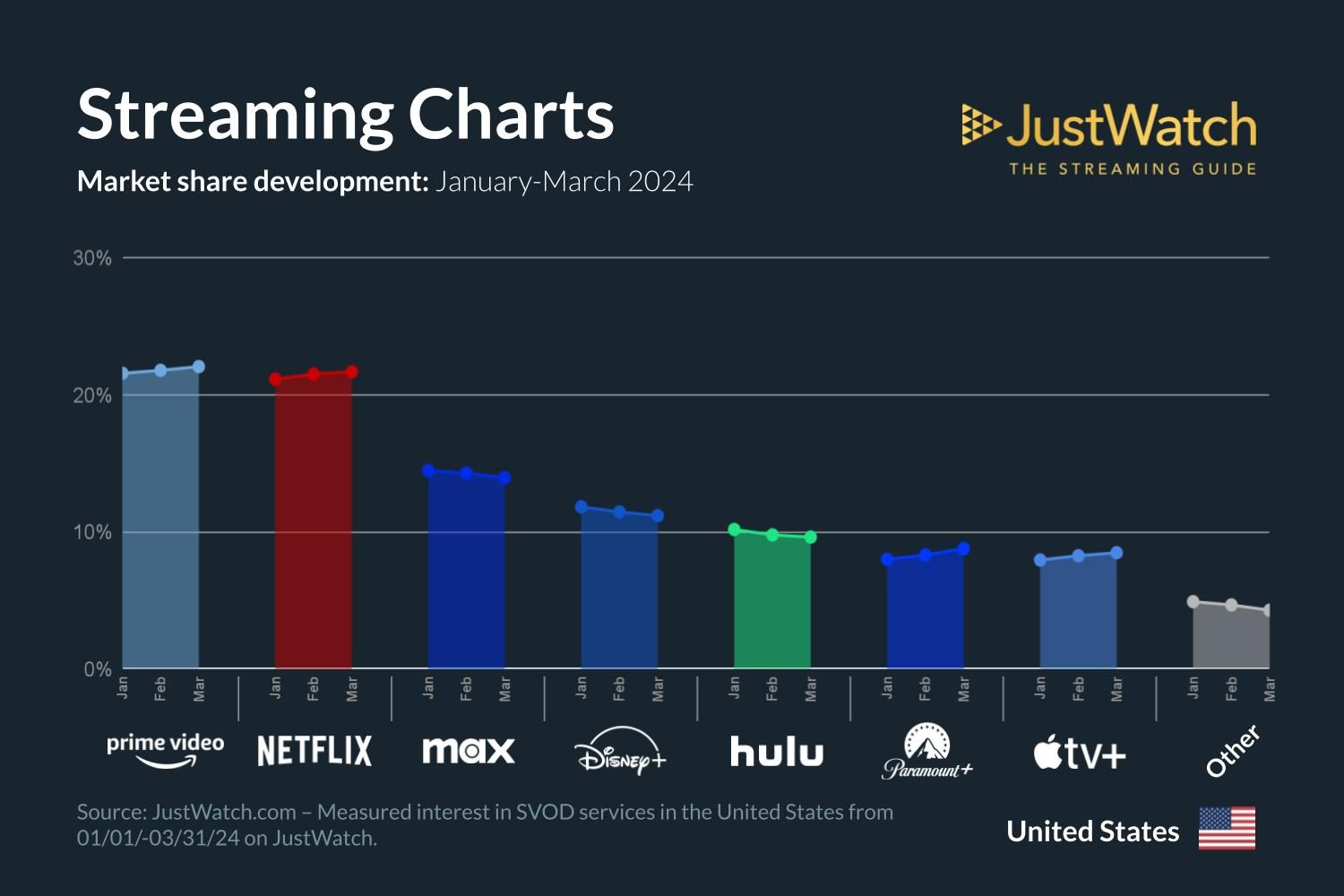
The JustWatch research covers the main streaming platforms available in the US. During Q1 2024, Apple TV+ share grew 1% compared to the previous period, now with 8% of the market share. It is followed by Paramount+, which also has an 8% share.
While growth is always a good thing, it will be a long run before Apple TV+ catches up with its other competitors such as Amazon Prime Video and Netflix, which are in first place with 22% and second place with 21%, respectively. Max (HBO) is the third most popular streaming platform in the US, with a 14% market share.
Amazon Prime Video and Netflix both grew as well, while Max, Disney+, and Hulu lost some subscribers.
You can take a look at the full market share ranking provided by JustWatch below:
- Amazon Prime Video: 22%
- Netflix: 21%
- Max: 14%
- Disney+: 11%
- Hulu: 10%
- Paramount +: 8%
- Apple TV+: 8%
- Others: 6%
Apple TV+ was launched in 2019 with a small catalog of original movies and shows. Currently, the platform has around 271 titles available – much less than Amazon Prime Video’s 13,000 titles. Even so, Apple TV+ content has already won multiple important awards since 2019.
PSA prostate cancer tests fail to detect some aggressive forms, study shows
UK research highlights risk of over-diagnosis and gaps in spotting serious variants of the disease
A widely used screening test for prostate cancer is over-diagnosing insignificant cases while still missing some of the most aggressive cancers, according to the largest study of its kind.
The trial, which involved more than 400,000 UK men aged 50-69, tested the effect of the Prostate-Specific Antigen “PSA” blood test, which is commonly used to decide when to send men with urinary symptoms for further checks.
Half of the study’s participants received a single invitation for a PSA test. After 15 years there was little difference in the number of men who died from prostate cancer, whether or not they had received the test, according to the research published in the Journal of the American Medical Association on Saturday.
An estimated one in six cancers found by the single PSA screening were over-diagnosed and would not have gone on to cause problems.
Professor Richard Martin, lead author and Cancer Research UK scientist at the University of Bristol, said: “The key takeaway is that the small reduction in prostate cancer deaths by using the test to screen healthy men does not outweigh the potential harms.”
Nearly seven men out of every 1,000 in the group invited for screening had died from prostate cancer, compared with nearly eight men out of every 1,000 in the group which had not.
Some men were having invasive treatment that they did not need many years earlier than they would have done without screening. Yet the test also failed to spot some cancers that did require treatment, he suggested.
“We need to find better ways to spot aggressive prostate cancers, so we can treat them early,” Martin added.
Pointing to the risks of unnecessary treatment, Cancer Research UK said over-diagnosis could have “a negative psychological impact”, and treatment of prostate cancer could also cause physical side effects including the possibility of infection following a biopsy, erectile dysfunction, and bladder and bowel problems.
The research charity noted there had been improvements in diagnosing and treating the disease in the years since the latest trial, conducted by the universities of Bristol, Oxford and Cambridge, began. These included the introduction of a magnetic resonance imaging scan (MRI) before a biopsy.
Dr Matthew Hobbs, director of research at Prostate Cancer UK, said such changes had “made the process safer and more accurate” but better evidence was needed to understand their full impact.
He added that the results from the latest trial were “extremely significant” because they backed up similar findings from an earlier study, conducted in eight European countries and published in 2019.
The charity has launched a £42mn trial “so that eventually each man with aggressive prostate cancer gets an early, accurate diagnosis”, he added.
Prostate cancer causes 12,000 deaths a year, making it the second biggest cancer killer of men in the UK. There is currently no national screening programme for the disease.
Why Saudi Arabia’s tennis rally is just getting started
The WTA Finals are supposed to be the grand finale on the women’s tennis tour. But the organisation of last year’s event drew a wave of criticism from players.
Problems ranged from insufficient practice time before the tournament to windy conditions in Cancún, the Mexican resort that was selected less than two months before the start date, despite talks between the Women’s Tennis Association and Saudi Arabia.
So it came as little surprise this week when the WTA confirmed that Riyadh will host the next three editions of the finals. The deal with the Saudi tennis federation means that prize money will leap to a record $15.25mn this year from $9mn in Mexico.
Prize money aside, the WTA says that Saudi Arabia is best placed to “deliver and fund a world-class event” and grow the women’s game.
But the real question is whether SRJ Sports Investments, which was set up by Saudi Arabia’s Public Investment Fund last year, can convince either the WTA, the men’s ATP Tour (or both) to allow it to buy into in the game’s commercial future.
The PIF struck a strategic partnership with the men’s ATP Tour just over a month ago, but that deal revolved around naming rights, events and strategy.
Against that backdrop, the WTA and the men’s ATP Tour are in talks to merge their media and commercial rights into a single entity.
It would appear that CVC Capital Partners, the former owner of the Formula One car racing series, played a smart move last year when it took a 20 per cent stake in WTA Ventures, the tour’s own commercial arm, for $150mn.
The private equity firm’s shareholding and board seats look like a canny deal at a strategically significant juncture in the future of tennis.
As for the Saudis, the question is whether a potential merger between the women’s and men’s tours can open up a gap for another investor to join the future of the tennis business.
However, the WTA and ATP have stressed that their talks were at a preliminary stage. In the meantime, buying into tournaments is another route for Saudi to expand its footprint in tennis.
A more viable target for Saudi could be winning the right to host a new ATP Masters 1000 tournament, a series featuring top-ranked male players, according to people familiar with proceedings.
As ATP Tour chair Andrea Gaudenzi told the FT last year, any outside investors must “stick to respecting the history of the sport and the product, working with the current stakeholder rather than against”.
Following the golf wars, in which the US PGA Tour fought Saudi-backed LIV Golf until a shock truce last year, Gaudenzi was keen to ensure that his new suitors wanted to work with the tours.
So far, courtesy of the strategic partnership with the ATP Tour and the deal to host the WTA Finals, it looks like the Saudis are playing ball.
But can they score a bigger prize down the line?
Luxury Brands Go Shopping for Upmarket Boutiques
Big luxury companies have spent more than $9 billion on real estate since the start of 2023
There’s no commercial real estate crash on New York’s Fifth Avenue or the Champs-Élysées in Paris.
Luxury brands are racing to buy properties on the world’s most famous shopping streets. One reason is the fear that, if they don’t buy their flagship store from the landlord, one of their rivals will do so and send them packing.
Kering, the owner of luxury brands including Gucci and Saint Laurent, handed Blackstone €1.3 billion, or $1.4 billion at current exchange rates, for a building this week on Milan’s Via Montenapoleone. It is one of Europe’s most expensive shopping streets, and Saint Laurent is already a tenant at one of the building’s retail units.
Blackstone’s investors got a great deal. The private-equity firm paid €1.1 billion in late 2021 for a portfolio of 14 properties that included the Via Montenapoleone building. Blackstone still owns a five-star hotel, two offices and some residential real estate in Milan that were part of the original purchase.
Based on the rent the Via Montenapoleone property is generating, the price Kering paid is equivalent to a roughly 2.5% cap rate—an astronomical price considering where interest rates are at the moment. Like a bond, the lower a cap rate the richer a price paid.
It is Kering’s second major real-estate purchase of the year. The company already spent close to $1 billion in January on a property on New York’s Fifth Avenue. Rivals are also snapping up real estate. Europe’s luxury brands have spent more than $9 billion buying boutiques on the world’s top shopping streets since the start of 2023 based on Bernstein’s analysis. Chanel and LVMH are both hunting for luxury properties in New York, according to real-estate sources.
Some of the deals look opportunistic. Rare properties are coming to the market because of the wider downturn in commercial real estate. Kering and Prada both bought stores on Fifth Avenue from real-estate investor Wharton Properties, which is experiencing distress in parts of its portfolio. The building that Kering bought at 717 Fifth Avenue had been threatened with foreclosure by one of Wharton Properties’ lenders.
It is also a great time to buy real estate because luxury brands have a financial edge over traditional property investors, says Will Silverman, a broker at Eastdil Secured who worked on the Fifth Avenue transactions. They can borrow more cheaply from the corporate bond market than what others would pay for a commercial mortgage.
The flurry of deals also shows how competitive the luxury industry has become. It is increasingly important for brands to own their flagship stores, and they are spending huge sums of money to make the shopping experience exceptional. Luxury brands’ store costs and investments were equivalent to 9% of their sales last year, according to Bernstein analyst Luca Solca. This is up from 6% before the pandemic.
Brands such as Christian Dior now have mini-museums in their main boutiques and entire floors dedicated to VIP clients where they can shop in privacy. Refurbishment costs run to tens of millions of dollars, so it makes sense to own certain key locations.
The purchases are precautionary, too: There is a threat that brands could lose their spot on major shopping streets if they remain renters. LVMH’s market capitalization has doubled and its annual sales have grown almost two-thirds since 2019, giving it enormous firepower to buy desirable real estate. Before founding LVMH, Bernard Arnault ran his family’s real-estate development company, so buying property is in the company’s DNA. The world’s most powerful luxury company owns at least six properties on Beverly Hills’ three-block Rodeo Drive and leases others, which makes it harder for other brands to secure a spot in the shopping mecca.
Keeping up with its rival will be expensive for Kering. Based on the deals it has done so far this year, Kering is on track to spend around 10% of its expected 2024 sales buying real estate. It did property deals equivalent to 9% of its annual sales in 2023. Investors might ask whether spending huge sums of money on property is really the best use of its capital.
But Kering will continue to rent rather than own most of its 1,800 stores worldwide. It might team up with co-investors to secure other key locations. Deep-pocketed Blackstone is bullish about luxury retail properties. That might be the best way to go toe-to-toe with LVMH.
Insurers Are Spying on Your Home From the Sky
Companies are using drones to check out roofs or to spot yard debris and undeclared trampolines
Cindy Picos was dropped by her home insurer last month. The reason: aerial photos of her roof, which her insurer refused to let her see.
“I thought they had the wrong house,” said Picos, who lives in northern California. “Our roof is in fine shape.”
Her insurer said its images showed her roof had “lived its life expectancy.” Picos paid for an independent inspection that found the roof had another 10 years of life. Her insurer declined to reconsider its decision.
Across the U.S., insurance companies are using aerial images of homes as a tool to ditch properties seen as higher risk.
Nearly every building in the country is being photographed, often without the owner’s knowledge. Companies are deploying drones, manned airplanes and high-altitude balloons to take images of properties. No place is shielded: The industry-funded Geospatial Insurance Consortium has an airplane imagery program it says covers 99% of the U.S. population.
The array of photos is being sorted by computer models to spy out underwriting no-nos, such as damaged roof shingles, yard debris, overhanging tree branches and undeclared swimming pools or trampolines. The red-flagged images are providing insurers with ammunition for nonrenewal notices nationwide.
“We’ve seen a dramatic increase across the country in reports from consumers who’ve been dropped by their insurers on the basis of an aerial image,” said Amy Bach, executive director of consumer group United Policyholders.
The increasingly sophisticated use of flyby photos comes as home insurers nationwide scramble to “derisk” their property portfolios, dropping less-than-perfect homes in an effort to recover from big underwriting losses.
Insurers say that customers agree to home inspections when they buy a policy and that photographing properties from the sky is less intrusive than the home visits used in the past. They say deploying fleets of surveillance planes lets them respond more quickly to disasters and charge rates that better reflect a property’s risk.
“If your roof is 20 years old and one hailstorm is going to take it off, you should pay more than somebody with a brand new roof,” Allstate CEO Tom Wilson said in an interview. He also said that the insurance giant is far along in using digital images to improve underwriting and that “there’s even more to come.”
The industry’s enthusiastic embrace of digital surveillance is sounding alarm bells among consumer advocates. One concern: whether customers can easily challenge images that might be out of date or inaccurate.
Picos, who lives in Auburn, Calif., said it is “absolutely wrong” that she was dropped without being able to see the evidence that precipitated the decision.
A spokesman for her insurer, CSAA Insurance, said it has changed its policy to allow customers to see images on request. Plane and satellite images are reviewed by employees and enable accurate and efficient inspections, the spokesman said.
Others across California are getting nonrenewal notices as well. State Farm last month said it would cull some of its policies in the Golden State; it plans to drop coverage on around 30,000 residential and 42,000 commercial properties. It didn’t specify how it would decide which policies to drop. A spokesman said the financial health of its Californian homeowners operation continues to be affected by factors such as inflation and catastrophe exposure.
Several states restrict the reasons insurers can cite for not renewing home policies after a set time, typically one to five years. One of the few reasons allowed is a customer’s failure to meet underwriting requirements, such as maintaining a house’s roof.
Home inspections purporting to show such problems are making it easier for insurers to drop customers, despite the state protections, said Betsy Clement, a managing director for insurance brokerage Arthur J. Gallagher. She added that her firm has seen an unprecedented level of nonrenewals since the start of 2022.
The images facilitating nonrenewals aren’t always up to date or accurately interpreted by insurers, according to industry insiders and consumer advocates.
Nichole Brink quit her job as an agent for Farmers Insurance last year, concerned the insurance giant appeared to be using aerial images as a battering ram to clear out unwanted customers.
“It’s like they’re using anything as an excuse to get people off their books,” said Brink, who still works in the insurance industry. Farmers appeared to be scrutinizing every property on its books, she said, adding that she saw nonrenewal notices sent for everything from trampolines to moss on the side of a vacation home.
Brink, who worked for Farmers in Michigan, said some customers were dropped based on aerial images that were two or three years old. One person wasn’t renewed because of a roof, despite its being brand new. In another case, a part of the image that Farmers said showed tree limbs turned out to be just shadows, she said.
The final straw came when Brink saw her own home flagged in a Farmers image because of a tree branch overhanging her barn. She switched insurers and jobs.
A spokesman for Farmers said it regularly reviews the properties it insures. When a potential problem is flagged, customers have at least 60 days to correct any inaccuracies or show the issue has been addressed, he said.
Consumer groups say that the use of inspections to drive nonrenewals is worrisome because of the limited rights customers have to challenge the images or complain that the surveillance is an intrusion on their privacy.
“The technology is way ahead of any consumer protections,” said Douglas Heller, director of insurance at the Consumer Federation of America.
Many people would likely object to having their homes and yards watched from above if given a choice, Heller said, citing customers’ relatively slow uptake of discounts for letting auto insurers track their driving.
“Part of the industry strategy is to avoid any situation where consumers get to say ‘yes’ or ‘no’ to this kind of spyware approach to underwriting and rating,” Heller said.
Aerial images are expected to become increasingly detailed and frequent. If satellite launches go as planned, images could be updated daily by 2030, according to Neil Pearson, a consultant who works with imagery companies.
“It could get interesting from a privacy standpoint as…a property could be monitored daily at high resolution,” he said. “It is a bit Orwellian.”