WSJ : Investors in Talks to Help Elon Musk’s xAI Raise $3 Billion, Adding to Ind

Investors in Talks to Help Elon Musk’s xAI Raise $3 Billion, Adding to Industry Arms Race
Funding round could value the artificial-intelligence startup at $18 billion, though details aren’t finalized

Investors close to Elon Musk are in talks to help xAI raise $3 billion in a round that would value the tycoon’s artificial-intelligence startup at $18 billion, people familiar with the matter said.

The venture-capital firm Gigafund and Steve Jurvetson, a prominent Musk backer and co-founder of another venture firm, are among the backers considering investing in the round, the people said.

Jurvetson is a longtime Musk friend who sits on the board of his rocket company, SpaceX, and was a director at Tesla until 2020. Gigafund was co-founded by Luke Nosek, also a SpaceX director, who like Musk is a member of the “PayPal mafia” group that started the payments company. Musk and Nosek together once tried to buy DeepMind, the AI company that is now part of Google.

Terms of the xAI fundraising haven’t been finalized and the plans could change.

The proposed fundraising marks another escalation in the artificial-intelligence arms race. Leading AI startups have raised billions of dollars in recent years to fund the computing resources needed to train advanced large language models, the technology powering generative AI chatbots.

ChatGPT-creator OpenAI has secured $13 billion in committed funding from Microsoft, while its rival, Anthropic, raised over $6 billion.

With xAI, Musk has been playing catch-up with his more well-funded rivals. He launched xAI publicly in July, making some investors skeptical that it has enough time to compete with other leading AI firms. The startup released its chatbot, Grok, in November and made it available to subscribers on his social-media platform, X. Last month, xAI introduced its latest AI model, called Grok-1.5, and said it would soon be available to early testers and existing Grok users.

A December securities filing showed that xAI was looking to raise $1 billion and had already secured nearly $135 million from four investors. It couldn’t be determined if that fundraising is a part of the current negotiations.

Musk has denied previous reports that he is raising additional money for xAI. “xAI is not raising capital and I have had no conversations with anyone in this regard,” he posted on X in late January.

He and representatives for xAI and X didn’t respond to requests for comment on Friday.

The current fundraising talks have gathered momentum recently, the people familiar with the matter said.

Some parties in the current financing conversations are discussing raising special investment funds that would pool money from other investors rather than relying solely on money from a couple major venture firms, the people said.

A cash infusion could help xAI attract top AI engineers in what has become the most competitive job market in Silicon Valley. Since founding xAI, Musk has been engaged in a fierce recruiting war to poach talent from other leading AI companies, including Google’s DeepMind, OpenAI and his own Tesla. Earlier this week, Musk said he also had to boost AI engineering pay at the electric-car company to ward off poaching from the likes of OpenAI.

Musk co-founded OpenAI as a nonprofit research lab in 2015 with its current CEO, Sam Altman, but left that company several years later after a dispute over control. Tensions between the two men spilled into the open recently when Musk sued OpenAI and Altman, alleging that they had abandoned OpenAI’s initial mission in pursuit of profit.

Since xAI’s founding, Musk has intertwined it with X. The artificial-intelligence startup has privileged access to X’s trove of posts to train its models, and its employees have at times been working out of the longtime Twitter headquarters building in downtown San Francisco. Musk tweeted last fall that X Corp. investors will own 25% of xAI.

WSJ : Paramount-Skydance Deal Would Give Shari Redstone’s Firm Over $2 Billion i

Paramount-Skydance Deal Would Give Shari Redstone’s Firm Over $2 Billion in Cash
Nonvoting shareholders would receive stock in merged entertainment company under terms being discussed and weighed by a special board committee

A sale of Paramount Global PARA -3.23%decrease; red down pointing triangle could work out very differently for controlling shareholder Shari Redstone and the rest of the entertainment giant’s investors.

Redstone’s National Amusements, which controls Paramount through a large voting stake and also owns a movie theater chain, is engaged in exclusive talks to sell itself to Skydance Media, The Wall Street Journal reported this week.

Under the terms being discussed, Redstone’s firm would receive over $2 billion in cash in the first step of the transaction, people familiar with the situation said. Then Paramount Global, owner of broadcaster CBS, cable brands like Nickelodeon and MTV and the Paramount film studio, would acquire Skydance in an all-stock deal valued at around $5 billion.

The bottom line: Redstone would get cash while investors with nonvoting shares would get stock in the combined company and wind up with a diluted shareholding.

Separately, Skydance could provide a substantial cash infusion to Paramount to bolster its balance sheet and help pay down debt, the people said.

A deal would require approval from a special committee of Paramount’s board, which has the responsibility of finding the best possible deal for all of the entertainment company’s shareholders. The company has been open to a deal for some time, but the rapid erosion of the cable TV business and difficulty of making money on streaming has complicated the sales pitch.

Paramount and Skydance are in exclusive merger talks for 30 days. Days before that period commenced, private-equity giant Apollo Global Management APO 3.23%increase; green up pointing triangle submitted an offer for Paramount valued at $26 billion, including assumption of debt, the Journal reported. It is possible that the emergence of Apollo’s interest could affect the Skydance negotiations.

Paramount’s special committee didn’t engage with Apollo, on advice of its bank, Centerview Partners, according to the people familiar with the situation.

Paramount has a market capitalization of $8.6 billion and $14.6 billion in debt. Skydance was valued at more than $4 billion in a 2022 funding round.

Redstone buys into the vision for the Skydance deal put forward by its CEO, David Ellison. With the backing of his father, Oracle co-founder Larry Ellison, he has laid out a plan to grow Paramount by investing in technology, moving aspects of the business to the cloud and putting more resources behind its studio.

Skydance has also explored a joint venture between Paramount+ and another streaming service, which could substantially cut costs. The Journal reported in February that Paramount had talks with Comcast’s Peacock about potential streaming partnerships, including a joint venture.

Skydance has partnered with Paramount on Tom Cruise’s “Top Gun: Maverick” and “Mission: Impossible—Dead Reckoning Part One,” as well as “Transformers: Rise of the Beasts” and additional “Mission Impossible” and “Top Gun” movies that are in the works. By merging the two companies, the combined entity would have much more flexibility around what it could do with those franchises, said another person familiar with the situation.

One of the reasons that Paramount directors opted to not move forward on Apollo’s offer was because Apollo hadn’t yet done “diligence”—a process to stress-test the financials and potential risks in a deal. The board didn’t want to risk losing the bid in hand from Skydance, said some of the people. Also, there were concerns that Apollo, which has a majority interest in Cox TV stations, would run into antitrust hurdles in acquiring Paramount, which also owns many TV stations.

Redstone has expressed wariness to associates about selling the company to a private-equity firm. Paramount also had concerns about Apollo’s financing. Apollo took a different approach with an earlier bid, when it offered $11 billion just for Paramount’s studio.

People close to the Apollo bid said the private-equity firm wouldn’t need additional debt financing to buy Paramount because its existing capital structure could be rolled into a new deal.

Redstone took control of National Amusements, her family’s media empire, five years ago and united its two wings, CBS and Viacom, through a merger in 2019, later rebranding the resulting company Paramount Global.

Over the years Redstone has fielded offers for parts of Paramount, especially its storied Hollywood studio, but has resisted breaking the company up. Another prized asset is broadcaster CBS, which has valuable NFL TV rights. National Amusements owns nearly 80% of the voting shares of Paramount.

The merger discussions come as Paramount has been struggling to make its streaming service, Paramount+, profitable. The company’s deal with Charter Communications for carriage of its cable channels is up this spring, while its deal with Comcast is up at the end of the year. Other parties have expressed interest in Paramount in recent months, including Warner Bros. Discovery and media executive Byron Allen.

WSJ : OpenAI’s Not-So-Secret Weapon in Winning Business Customers? ChatGPT

OpenAI’s Not-So-Secret Weapon in Winning Business Customers? ChatGPT
The maker of ChatGPT said 600,000 individuals pay for its ChatGPT business products—presenting an opportunity for OpenAI to win bigger company deals as it faces stiffer competition

OpenAI is aiming to use its popular chatbot ChatGPT—it said 600,000 individuals pay for business versions of it—as a way to gain an entry into businesses and sell them its enterprise artificial-intelligence services.

Those individuals are paying for ChatGPT Enterprise or ChatGPT Team, which make up what OpenAI calls its “business products,” according to OpenAI Chief Operating Officer Brad Lightcap. ChatGPT Enterprise is aimed at large companies with over 100 employees, and ChatGPT Team is geared at smaller firms with less than 100 employees, the company said.

OpenAI said it doesn’t disclose the number of businesses that pay for its services. It said 92% of Fortune 500 companies are using ChatGPT in some form, and 100 million people actively use ChatGPT on a weekly basis.

“We want to go maximize the number of companies that have a ChatGPT license, but if people are not actually using the technology underneath, then who cares? It’s shelfware,” Lightcap said in an interview. “As we build better products, we just want to see that number [of individual users] go up.”

The San Francisco-based AI company, which has been at the center of the current boom in generative AI, is up against many well-funded competitors in pursuing business customers, including tech giant Microsoft, its primary backer and partner. Unlike innovations in previous tech booms, generative AI is ideally suited for transforming the way businesses operate—and a growing number of firms are looking to cash in on it.

Owing much to its relationship with Microsoft, OpenAI has become one of the de facto vendors companies initially use to test generative AI, many chief information officers say. But increasingly, open-source models from companies such as Meta Platforms—which can be less expensive to use—are also putting pressure on OpenAI’s lead.

While OpenAI said it doesn’t have a market share figure, it referenced venture-capital firm Andreessen Horowitz’s survey, which found that 100% of the 70 enterprises it surveyed are using OpenAI’s models in some capacity, with 66% using its models in their operations, and 34% in testing.

With such a broad base of users—whether corporate IT-sanctioned or not—bringing ChatGPT into their workplaces, Lightcap said the chatbot is an “efficient” way for businesses to quickly understand the benefits of applying generative AI at work.

“Once you’ve introduced this appreciation for AI in your enterprise, through a product like ChatGPT, you’re starting to give your workforce an appreciation for how the model works,” he said.

Software companies have similarly aimed to sell their products through a “bottoms-up” or “freemium” approach, where individual employees or developers bring free or paid tools into their workplaces—thereby opening the door for vendors to upsell corporate executives on a packaged solution.

OpenAI now has a team of about 200 developers, researchers, and sales and support staff to help directly sell its AI technology to companies, according to Lightcap, making its discussions with CIOs, chief technology officers and chief executives, “a very direct sales motion.”

That figure is dwarfed by the size of enterprise sales groups at large, legacy software firms, which can number a thousand or more.

The most common business-use cases, so far, are “workforce enablement” or employee productivity, and companies that use OpenAI’s models to power their own products, such as customer support platforms, Lightcap said.

Home-improvement retailer Lowe’s is using a custom version of OpenAI’s GPT-4 model to improve search results on its website, and insurer Oscar Health used OpenAI models to build an assistant for managing claims, OpenAI said.

ChatGPT Enterprise is priced based on the number of users at a company, and ChatGPT Team costs $30 a month for each user when billed monthly. ChatGPT Plus, the company’s paid product for consumers, costs $20 a month. The free version of ChatGPT includes access to GPT-3.5, a less powerful version of its language model.

Launched last August, ChatGPT Enterprise is designed to address businesses’ concerns about securing their proprietary data, Lightcap previously said. It is built on GPT-4, the company’s advanced language model. Lightcap said OpenAI doesn’t train its models on businesses’ data.

ChatGPT Team, launched in January, also includes access to GPT-4, but with some restrictions on usage and fewer management and security controls than the enterprise version.

In addition to ChatGPT Enterprise, OpenAI helps businesses develop their own apps and products, Lightcap said. The cost of building custom apps and products for businesses varies greatly, he said, depending on underlying model training costs and service costs, but typically ranges in the millions of dollars.

Still, some CIOs say OpenAI needs more enterprise credibility before they’re willing to go all in on its services. Startups are considered more risky than established enterprise sellers, they say, and many don’t want to take on additional vendor risk.

In the wake of OpenAI’s leadership turmoil last November, some enterprises decided to spread out their AI bets across multiple vendors, and are using a mix of proprietary and open-source models.

Lightcap said the company is seeing the opposite. “Trying to manage this across a lot of vendors is complex,” he said. “We’re increasingly hearing companies tell us they really want to go with one partner.”

Businesses still have the choice, though, between working directly with OpenAI to access its technologies and using Microsoft’s Azure cloud service, which also provides access to OpenAI’s most powerful models.

Some CIOs say it’s easy to flip a switch and add AI services to their existing Microsoft software or Azure setup. Cloud providers also offer data privacy and content safety assurances, regulatory compliances and software that makes it easier for corporate developers to put the AI models to use.

“We have our own business now that’s very independent,” Lightcap said, referring to the firm’s relationship with Microsoft. “We look at ChatGPT really as the access point that any workforce in the enterprise should have to AI.”

FT : Terraform Labs and Do Kwon found liable for fraud in SEC case

Terraform Labs and Do Kwon found liable for fraud in SEC case
US regulator notches a victory in its crackdown on the crypto sector

A New York jury has found Terraform Labs and its co-founder Do Kwon liable for defrauding cryptocurrency investors as part of a scheme that allegedly triggered a $40bn loss in market value.

The civil verdict, handed down after a nine-day trial in Manhattan federal court, is a win for the US Securities and Exchange Commission as the regulator has unleashed a crackdown on the cryptocurrency sector. The SEC last year sued the collapsed stablecoin operator and Kwon for allegedly raising billions of dollars from investors by selling several interlinked digital securities, many of which were not registered with regulators.

These assets included TerraUSD, a stablecoin developed by Kwon whose sudden collapse in 2022 rocked the crypto industry, as well as the associated luna token, according to the SEC.

Terraform and Kwon “caused devastating losses for investors and wiped out tens of billions of market value nearly overnight”, Gurbir Grewal, director of the SEC’s enforcement division, said on Friday following the verdict.

They “deceived investors about the stability of the crypto asset security and so-called algorithmic stablecoin TerraUSD, and they further misled investors about whether a popular payment application used Terraform’s blockchain to process and settle payments”, he added.

Terraform on Friday said: “We are very disappointed with the verdict, which we do not believe is supported by the evidence. We continue to maintain that the SEC does not have the legal authority to bring this case at all, and we are carefully weighing our options and next steps.”

The agency’s chair Gary Gensler has increased scrutiny of a sector he has called a “Wild West” rife with non-compliance and misconduct. He has argued many digital tokens qualify as securities and fall under the SEC’s purview.

Grewal said: “For all of crypto’s promises, the lack of registration and compliance have very real consequences for real people.”

It also deals a fresh blow to Terraform and its South Korean chief executive, which have faced legal challenges after the breakdown of TerraUSD and luna, including criminal fraud charges.

Kwon, who resided in South Korea and Singapore at the time of the alleged fraud, is also in the midst of a fierce extradition battle. Wanted by the US and South Korea on criminal charges, he is being held in Montenegro and was not in attendance at the Manhattan civil trial.

In its complaint filed last year, the SEC accused Terraform and Kwon of masterminding a massive crypto fraud between April 2018 and May 2022, that allegedly resulted in a $40bn loss in market value.

The regulator had said the defendants marketed their digital assets with misleading statements, such as telling investors that a well-known South Korean mobile payment app used the Terra blockchain to settle transactions that would add value to the luna token.

Terraform filed for Chapter 11 bankruptcy protection in Delaware earlier this year.

A lawyer for Kwon did not immediately respond to requests for comment.

FT : Neurotech start-ups will not give rise to superhumans

Neurotech start-ups will not give rise to superhumans
The idea that the technology might accelerate general human capabilities remains fanciful

Global fascination with the exploits of Elon Musk explains the sudden interest in neurotech. This year, his start-up Neuralink announced its first successful human trial. Noland Arbaugh, 29, who is paralysed from the shoulders down, received a Neuralink brain computer interface, or BCI. Within days he was filmed playing Mario Kart with his mind. For now, trials are limited to patients. But Neuralink’s $5bn valuation envisions a future in which everyone can use a BCI. 

The idea of using hardware to detect and decode brain activity and transmit it to an external device is not new. The first invasive implant in a human took place in the late 1990s. Dozens of patients have received implants since then.

What has changed in recent years is the level of funding available for start-ups that see BCI use beyond medtech. According to PitchBook, neurotechnology companies raised a record $1.4bn across 115 deals last year. Leading the pack is Neuralink, which has raised close to $700mn to date. 


Exits are still relatively rare. PitchBook predicts that Neuralink is more likely to list than be bought. The devices being created are not cleared for commercial use. The idea that they might one day cure depression, eliminate the need for handheld devices or otherwise accelerate general human capabilities remains fanciful.

Procedures are invasive too. Companies such as Blackrock Neurotech, created in 2008, and Neuralink remove a piece of skull and add sensors directly on to the brain to pick up electrical signals. Texas-based Paradromics, founded by one of Neuralink’s founders and funded by the US Defense Advanced Research Projects Agency is making devices that pick up neural signals from the brain via a receiver in the chest. Synchron, which has raised $130mn from investors including another Neuralink founder, adds its sensors to the brain via blood vessels. 

The good news is that the brain feels no pain. Still, the nature of the procedures limits the audience for BCIs. Patients with degenerative diseases or paralysis have far more to gain than the average consumer.

To reach a consumer audience, neurotechnology start-ups will need to prove they can dramatically enhance human abilities. Alternatively, they will need to produce wearable devices that can record and even influence brain activity from the scalp, instead of being embedded within the brain.

Even then, there will be concerns about the use of intimate data collected. The investment case for consumer neurotech is decades away.

>>> US Close Dow +0.80% S1P +1.11% Nasdaq +1.24% RUssell +0.47%

Closing Stock Market Summary
The stock market closed the week on a positive note. The S&P 500 (+1.1%) and Nasdaq Composite (+1.2%) finished more than 1.0% higher than yesterday and closed near their best levels of the day. The upside moves were supported by a buy-the-dip mentality after a volatile start to the second quarter. The major indices are still lower on the week despite today's performance.

The positive bias was also in response to this morning's release of the March employment report, which reflected ongoing strength in the labor market. The takeaway is that a strong labor market seemingly bodes well for corporate earnings and outlook. On a related note, the earnings reporting period begins next week with big banks like JPMorgan Chase (JPM 197.45, +1.80, +0.8%), Citigroup (C 61.60, +0.69, +1.1%), and Wells Fargo (WFC 57.40, +0.72, +1.3%) reporting results on Friday.

Gains were broad based, but moves in the mega caps and semiconductor stocks had an outsized impact on index performance. The Vanguard Mega Cap Growth ETF (MGK) jumped 1.5% and the PHLX Semiconductor Index (SOX) gained 1.3%. Names like Meta Platforms (META 527.34, +16.42, +3.2%), NVIDIA (NVDA 880.08, +21.03, +2.5%), and Broadcom (AVGO 1339.43, +21.93, +1.7%) logged sizable gains.

All 11 S&P 500 sectors registered gains ranging from 0.2% to 1.6%.

Treasury yields settled higher in response to this morning's data, but that did not deter buying activity in the stock market. The 10-yr note yield jumped another seven basis points today to 4.38% and the 2-yr note yield settled nine basis points higher at 4.73%.
  • S&P 500:+9.1% YTD
  • Nasdaq Composite: +8.2% YTD
  • S&P Midcap 400: +7.5% YTD
  • Dow Jones Industrial Average: +3.2% YTD
  • Russell 2000: +1.8% YTD

Reviewing today's economic data:
  • The headlines from the March employment report were all good economically speaking. Nonfarm payrolls increased by 303,000, the unemployment rate dipped to 3.8%, average hourly earnings were up 0.3%, and the average workweek increased to 34.4 hours.
  • The key takeaway from the report is that it continued to support a solid earnings growth outlook even if it didn't necessarily support the outlook for the Fed to cut rates soon.

Looking ahead, there is no US economic data of note on Monday.

The Information : Saudi Arabia Pushes for AI Power With Megafund, Direct Investm

Saudi Arabia Pushes for AI Power With Megafund, Direct Investments
The Middle Eastern kingdom is pushing to get closer to startups in the hot AI sector with more direct stakes in them and a new $40 billion–plus AI fund that’s under discussion.

The eyes of Bader Al Mana—deputy chief investment officer at Sanabil, the venture arm of Saudi Arabia’s sovereign wealth fund—were heavy with jet lag last month as he spoke about his firm’s pursuit of investments in artificial intelligence startups at The Montgomery Summit in Los Angeles. Sanabil is focused on taking direct stakes in startups and building out its own AI playbook, he told the invite-only gathering of startup investors and entrepreneurs.

Behind the scenes, Saudi Arabia is working on making an even bigger splash in AI. The kingdom’s government has considered launching a megafund with Andreessen Horowitz focused on AI investments, according to a person briefed on the matter. Its size would rival Saudi Arabia’s $45 billion stake in SoftBank’s Vision Fund, the person said. Such a fund could rock the AI landscape in a period when many investors are cash constrained due to a dormant stock market and high interest rates.

The moves are part of Saudi Arabia’s effort to get much closer to tech startups than it was in the days when it was seen as a bottomless source of petro dollars that used venture capitalists to invest on its behalf. Amid the current investing frenzy in AI, the country sees its next wave of dealmaking as a way to develop homegrown versions of the technology. To do that, the Saudis are encouraging startups they invest in directly to establish a presence within the country’s borders, whether through physical offices or business deals with local corporations.

The Takeaway
• Representatives of Sanabil have been on a U.S. road show in recent months
• The discussions could lay the groundwork for a $40 billion–plus artificial intelligence fund
• Last year, Sanabil formed a task force focused on AI

Still, while investors in the Middle East and U.S. don’t doubt Saudi Arabia’s determination to become a more serious player in technology investing, some of them say AI startups may not want to start counting on that cash just yet. The skepticism stems from the fact that the country has already pledged to fund a number of costly projects, including its $500 billion futuristic city, Neom, and Qiddiya, an entertainment hub it’s building outside the capital of Riyadh with funding from Public Investment Fund, Saudi Arabia’s sovereign wealth fund. As a result, PIF’s cash reserves have dropped to $15 billion as of September, their lowest levels since December 2020, The Wall Street Journal reported.

Peter Jädersten, founder of Jade Advisors, which helps investors raise money from the Middle East, said there’s a growing sense of competition between Saudi Arabia and neighboring countries like the United Arab Emirates over who can diversify the economy away from petroleum faster, in part through headline-grabbing AI plans. Jadersten said it will be hard to know for sure how big Saudi Arabia’s AI fund will be and over what span of time the country plans to invest it, because its funds aren’t as transparent as those in the U.S. and elsewhere.

“If you announce that you’re going to raise $40 billion, how does the outside world know that they actually earmarked $40 billion?” said Jädersten, referring to the news about Saudi Arabia’s plans for the fund, which The New York Times first reported.

Representatives from PIF didn’t respond to a request for comment.

Whatever the size of the AI fund ends up being, funds associated with the Saudi government are making more direct investments in the tech sector than in the past. Sanabil, which manages over $100 billion in assets, has become especially active in getting the word out about its desire to take more direct stakes in companies, particularly those in AI.

Sanabil representatives recently completed a U.S. road show, with stops in Los Angeles and Miami, where they discussed Saudi Arabia’s AI ambitions with U.S. investors and entrepreneurs, according to people familiar with the talks. Among the startups they’ve recently invested directly in is Nile, an AI networking startup co-founded by Cisco’s ex-CEO, John Chambers.

The promise of more Saudi Arabian cash comes at a moment when AI startups are showing a voracious need for capital to fund the development of large-language models, which require huge upfront and ongoing costs. OpenAI CEO Sam Altman has said his firm may need to raise as much as $100 billion to keep up with computing costs, a vast sum expected to involve sovereign wealth funds.

“Saudi Arabia is going through a transformation and an awakening,” said Fahad AlSharekh, a tech investor in Kuwait. “They have focused on reinventing themselves on many, many fronts.”

Sovereign AI

That reinvention has been made possible in part by a gradual dimming of outrage in the U.S. over the kingdom’s hand in the 2018 murder of Saudi dissident journalist Jamal Khashoggi. Many founders and VC investors publicly distanced themselves from the country after the grisly killing. But that distaste began to fade a couple of years ago.

In one sign of that warming, Sanabil began disclosing its investments in dozens of U.S. VC firms, including Andreesseen Horowitz, Coatue Management, Greenoaks Capital Partners and Insight Partners, on its website, The Information reported last year. The investments gave Sanabil indirect exposure to many of the nation’s top startups but avoided attracting public attention, since VC funds rarely disclose their financial backers, known as limited partners.

The contacts with these powerful VC firms laid the groundwork for the firm to eventually begin investing directly in startups, several venture capitalists that raised money from Sanabil said. And that helped shape its AI strategy.

Last year, Sanabil formed a task force focused on AI to help it determine where to invest. As part of that effort, it spoke to several investment firms it had partnered with about their AI strategies. The goal was to understand the “house views of different market participants and then building our own house view and then really pursuing that from an investment perspective,” said Sanabil’s Al Mana at the Los Angeles conference last month.

“I think we’re in the first innings of doing that,” he said.

Getting closer to startups through direct investments stands to give Sanabil more power over the direction of those companies—for example, by influencing them to open offices within its borders or strike business deals with local companies.

In one such case, Sanabil and March Capital, a VC fund backed by Sanabil, co-led a $175 million round in Nile last August. Then, last month, Nile announced a joint venture with Saudi Telecom that will enhance “Nile’s market presence in Saudi Arabia,” CEO and co-founder Pankaj Patel, a former Cisco executive, said in a press release.

"We do not feel any pressure to expand in the Middle East because of our relationship with our investors, but the nature of our solution—AI-driven networking for the enterprise—makes it an excellent fit for markets focused on new construction opportunities,” Patel said in a statement to The Information. “The Middle East overall, and the Kingdom of Saudi Arabia in particular, are very attractive to Nile.”

Expanding the number of AI researchers in Saudi Arabia would help the country pursue what some people in the country call “sovereign AI”—an ability to produce AI through local infrastructure, such as data centers and energy.

Growing Deal Count

Still, some companies and investors are concerned with the U.S. regulatory scrutiny investments from the Gulf nation could attract.

In November, Prosperity7, a VC subsidiary of the Saudi Arabian Oil Co., sold its shares in U.S. AI chip startup Rain following pressure from the Biden administration and a review by the Committee on Foreign Investment in the United States. And in March, executives at U.S. AI startup Anthropic said they had ruled out investment from Saudi Arabia, citing national security concerns, according to a CNBC report.

But those concerns aren’t likely to slow the Saudi fund’s appetite—or the demand from startups for capital. Sanabil’s Al Mana said at The Montgomery Summit that he frequently gets up to 200 inquiries about capital a day. That constant drumbeat of curious founders and venture capitalists has overwhelmed some limited partners in the region.

“I just do not have the resources or time to reply to every single email,” said Al Mana.

Among the U.S. companies to raise funding from Sanabil in the last year are San Jose–based enterprise software company Acceldata and Databricks, a data and AI company valued at $43 billion.

Since 2021, Sanabil has participated in 62 direct VC deals, including about 20 investments in the U.S., according to PitchBook. That’s a huge increase from 2017 to 2020, when it completed only three VC investments. PitchBook doesn’t have estimates for how much money Sanabil has put into those startups.

Sanabil’s Middle East rivals are also looking to increase their direct investments, after having spent the last decade or more learning the ins and outs of tech investing.

Mubadala Investment Co., the $276 billion sovereign wealth fund of Abu Dhabi, over the last decade executed a playbook similar to the one Sanabil is pursuing. Mubadala forged relationships with U.S. VC funds and then backed U.S. companies like banking app Chime and Waymo, Google’s self-driving–car unit. In 2017, Mubadala opened an office in San Francisco and said it would go after even smaller deals, an unusual move for a sovereign wealth fund.

And the Qatar Investment Authority recently decided it would make more direct investments in tech, The Information reported. In 2022, QIA invested $375 million in Elon Musk’s Twitter takeover and led a $200 million financing for Boston-based cybersecurity company Snyk.

“When you have significant equity in companies, you can at least have access to information and you can understand what’s happening abroad,” said Tariq Qaqish, CEO of Salt Fund Placement, which helps international fund managers raise money from Middle Eastern sovereign wealth funds and family offices.
(ZH) Something Broke In Markets On Thursday

Something Broke In Markets On Thursday

This Friday is going to be a session for active short-term traders, and it will likely be unpleasant for investors.

Something broke in markets on Thursday. There are a few things that worry me about the latest bout of risk aversion. This is in context that I’ve been an unrelenting stocks bull since the December Fed meeting...

But now I’m uneasy...

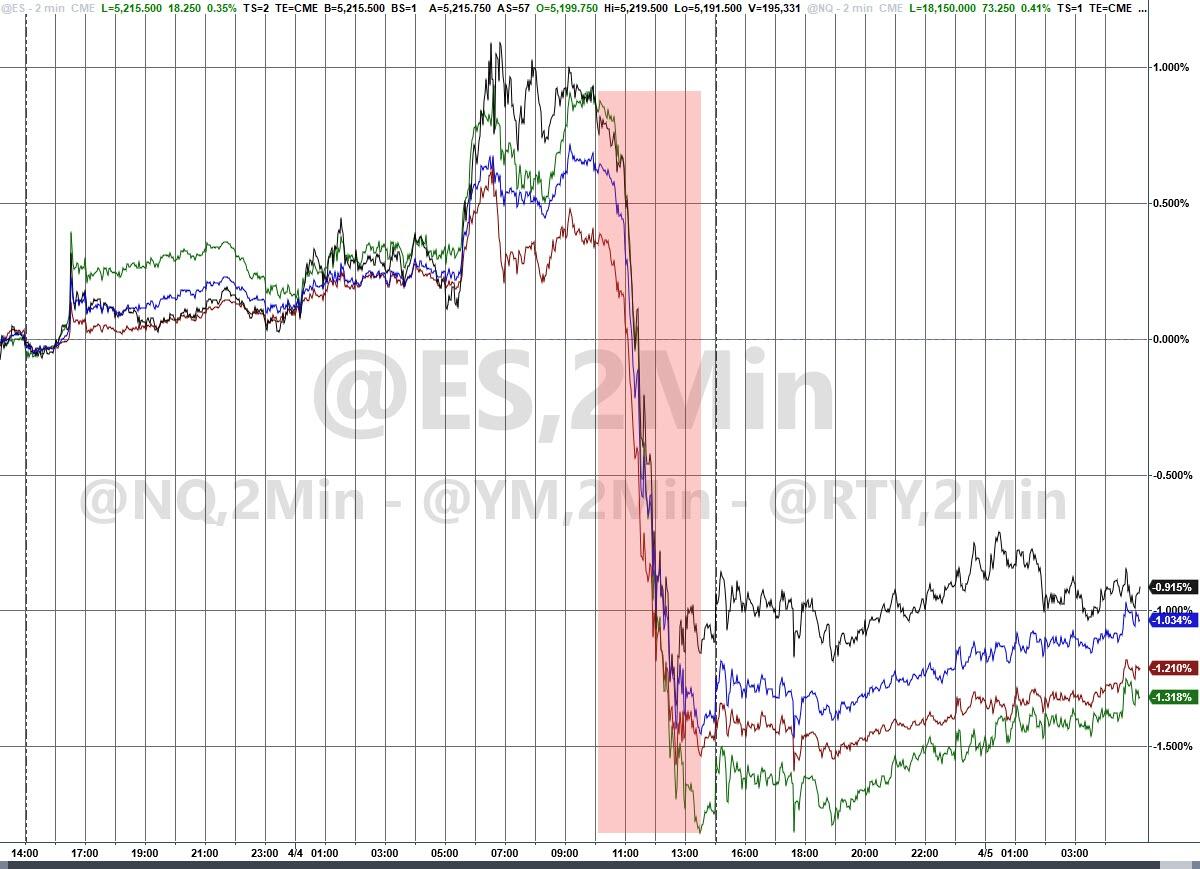
The Thursday selloff confused people.
Initially, many blamed the comments from Fed’s Kashkari about there potentially being no US rate cuts this year.
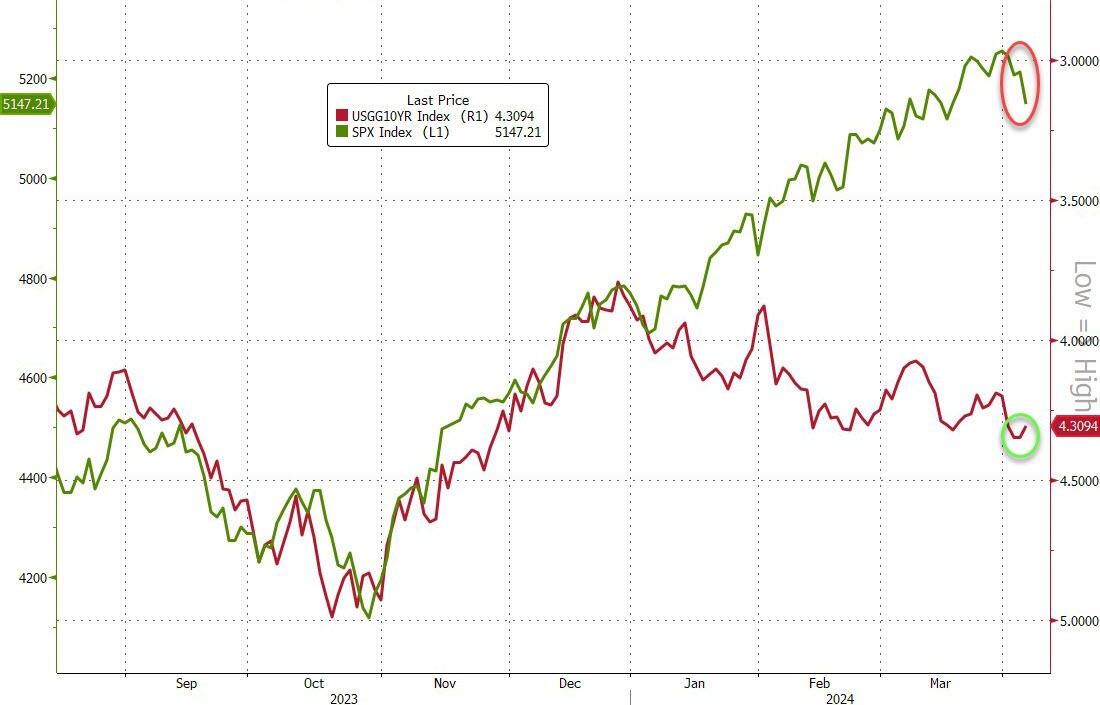
However, a quick look at a few charts shows that (a) yields fell rather than climbed, so his hawkish lines did not impact, and (b) equities started selling off before his headlines.
It’s never a good sign when people struggle to identify why stocks have a relatively large swoon.

If an asset is weak without an obvious catalyst, it suggests that it can really get destroyed if a genuine risk materializes.

For good order, the weakness in E-minis coincided with the oil price rise that in turn followed the Netanyahu headlines.

We have key US data this morning at a time of vulnerability for the market in terms of the Fed narrative.

We’ve run a long way on the idea of the Fed being dovish despite a strong US economy.

We’re getting closer to the point where we must acknowledge that either the Fed won’t be easing soon, OR the economy is in more trouble than we thought.

It means that we’re in the unusual-in-recent-times setup where a big surprise in either direction could hurt stocks today.
(For clarity and consistency, I would only see this as a multi-week consolidation/retrenchment and not some long-term bearish turning point).
Middle East tensions have escalated substantially just before the weekend, further supporting the idea of taking some risk off the table.
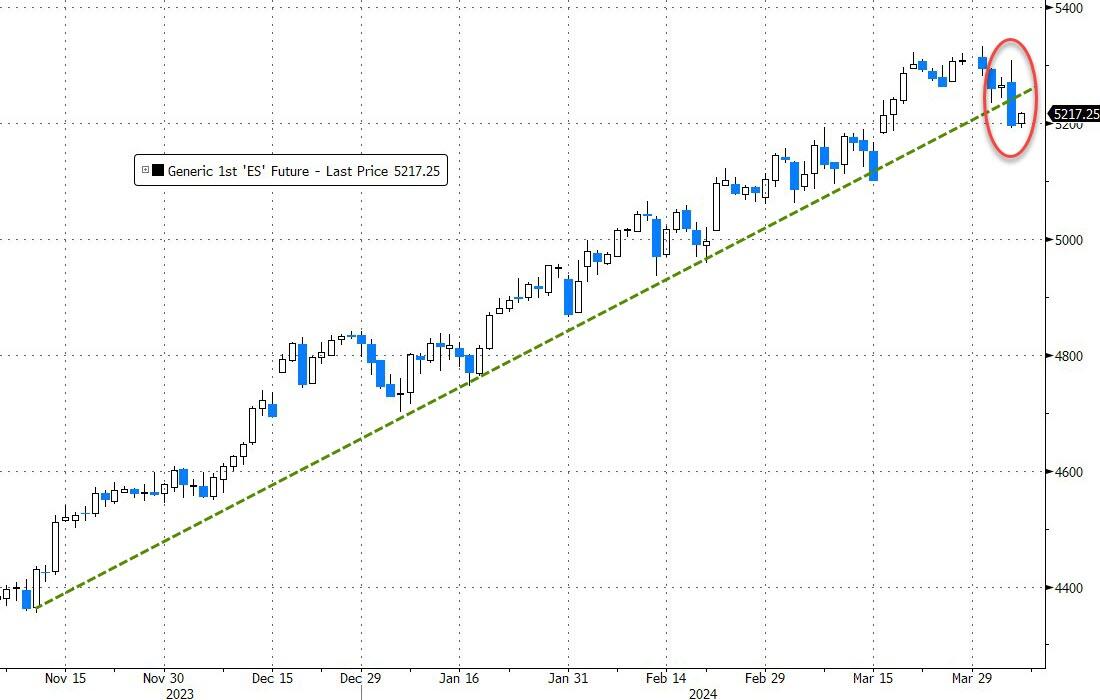
And, let’s face it, the 5-month E-minis chart below just looks horribly negative. If you’ve ridden the rally until here, this chart is your siren call to take some profits.
And if you’ve been desperate to fight these bubblicious markets, you have now been given the green light.

I remain structurally bullish for the year ahead and yet if I was back in a trading seat, I’d probably want to be tactically underweight into the weekend.

It’s that kind of contradiction that will make this Friday an unpleasant markets session for all but the most nimble of traders.

TechCrunch : As deal rumors fly, Alphabet and HubSpot would be a strange pairing

As deal rumors fly, Alphabet and HubSpot would be a strange pairing

Reuters reported on Thursday that Google’s parent company, Alphabet, is exploring the possibility of buying Boston-based HubSpot, a CRM and marketing automation company with a market cap of over $33 billion – a number that has been climbing on those reports.

If such a deal were to happen, the cost would likely be pretty substantial, involving some significant premium over the current value. It would have to be to motivate the company to sell and become part of the search giant. It’s worth noting that the two companies have a relationship already — a partnership to use Google ads to drive sales in HubSpot — which can sometimes be the start of an acquisition discussion like this.

While Google/Alphabet has been extremely acquisitive over the years, the largest deal that it’s ever made was spending $12.5 billion for Motorola Mobility in 2011. It later sold it to Lenovo for just $2.91 billion, so it would have reason to be gun shy on a much larger price tag. More recently the largest deal involved spending $5.4 billion for security intelligence platform Mandiant in 2022. Google usually stays under $3 billion, so a deal of this scope would be very much out of character for the company.

When you combine that with the austerity program that most tech companies have been on in recent years, and a warning from Google CEO Sundar Pichai in January that more job cuts were coming, it’s not the type of deal that seems likely in a belt tightening climate, and certainly one that might be tough to justify to employees if those kind of optics actually matter. Yet with a huge cash horde of $110 billion on hand as of the end of last year, it certainly has the cash to make the move if it wants to.

Another issue the company could face in trying to buy HubSpot is a hostile regulatory environment for large deals. The U.S., the U.K and the EU have been monitoring large deals closely these days. Some, like Adobe’s attempt to buy Figma for $20 billion didn’t make it to the finish line because of competitive concerns. It’s not clear that Alphabet would face those same concerns with a CRM tool. HubSpot faces pretty powerful competition from Adobe and Salesforce, two well-capitalized firms, so this wouldn’t give Google a lock on that market by any means, but if there’s a risk, there’s sure to be a termination fee involved to hedge against that, another factor the company would need to take into consideration.

The question is what is the likelihood of such a deal coming to fruition and what would it give the companies that they can’t get from the existing partnership. As one analyst said to me, it doesn’t feel likely, but you never know.