Challenges : A second tunnel under the Manche, between Jersey and France, will y

A second tunnel under the Manche, between Jersey and France, will you see again today in 2040?
The governments of Jersey and Guernesey intend to build a tunnel on the two islands in Normandy to boost the economy. At the current hour, several informal discussions with French political leaders are ongoing. In addition, the project does not worry the defenders of the environment.

There is a old serpent of the sea that seems to scratch the surface stronger than ever. « Il y a quinze ans, lorsque l'on parlait de construire un pont entre Jersey, Guernesey et la Normandie, les gens riaient. Nowadays, the construction project of a tunnel is serious and the public opinion of the island is favorable", assure Kirsten Morel, minister of the Economy of Jersey, enthousiaste, on the spot. To boost the economy of the two independent dependencies of the British Couronne, which comprise 170,000 inhabitants, the government of Jersey intends to create a second tunnel in La Manche towards the Anglo-Norman islands in Normandy, in the secteur of Granville ( Heat).

The project seems to have entered into a new dimension and now meets with an interministerial delegation from the Anglo-Norman islands and Philippe Gosselin, deputy of La Manche and president of the group of studies and associations between France and the Anglo-Norman islands, à l'Assemblée nationale en février dernier. Although the tunnel made it for the moment the object of «informal discussions», the Frenchman said «to take action» of this will of the former Ministers of the Economy, here he is, estimating that the tunnel will pour again every day « by 2040 ».

Front-line workers
Like the majority of Western countries, the islands of Jersey and Guernesey are concerned about the decline of their population here to lead to a main-d'œuvre shortage towards the horizon 2050. Thank you for a tunnel, Jersey, where the minimum salary is brut hour est de 11,64 livres sterling, soit 13,54 euros comtre 11,52 euros en France, expect also to attract des Français qui se rendraient à la journée sur l'île pour et travailler. Of the latter, the tunnel allows the Islanders to develop their own property in Normandy, even if the "prix moyen of a house on the island is between 700,000 and 800,000 livres", if only minister Kirsten Morel is disappointed.

This situation of front-line workers is more disturbing to the French. Philippe Gosselin redoute the escape of French workers, combined with an explosion of the prize of the normands logements with the arrival of jersiais cheteurs. It is also clear that the region is in a situation of "tension on the estate market".

Tourisme dopé
Kirsten Morel provides a "win-win" solution in tunnel construction. The route to Normandy near the islands allows for French tourism, not least in the Saint-Michel bay area, advances the ministers. An intensification of the tourist flow here is revealed by many Norman employees.

Another advantage of the advantages for Jersey is the construction of a tunnel: to limit the outbuilding of the islands with the Royaume-Uni. Since Jersey "imports 98% of its resources from the port of Portsmouth", located in the south of England, Kirsten Morel deplores the storms and the weather in La Manche which regularly supply the ferries to the island. With a fixed "attachment" to the European continent, the minister hopes to reduce the risks of shortages of products, especially food.

A financing is valued at a little more than a billion euros
Concerning the question of finance, the government of Jersey is worth one billion livres (1.17 billion euros) the construction of the tunnel. A montant here «is not the heart of the problem», analyzes Philippe Gosselin, car «a prêt d'un milliard étalé sur vingt ans ne coûterait que 50 millions par an aux investors».

In addition to the song for the benefit of "public funds from Jersia, France, Europe and the same private sector", details Kirsten Morel. Private investors here pourraient in effect « être interest » in the construction of the bridge, susceptible to « boosting their activity » in the long term, and to obtain a redevance thanks to « the establishment of a péage ».

Above all finances, the plan to start a fait accompli is to "evaluate all the benefits and advantages of the project", planned for 2025, which will count "10 million livres", specifies the ministers.

Bermuda, Ireland, Switzerland: are there the 15 largest fiscal paradises in the world?

Quid de l'environnement ?
In reality, the « main obstacles » to the construction of the tunnel « must be beyond environmental order», estimates Philippe Gosselin. The explanation that the infrastructure development of the tunnel on the sun normally pourrait is based on climate and resilience and is the object of Zéro artificialisation des suns (ZAN).

And as the Granville secteur includes several sites protected by Natura 2000, Alain Picard, vice-president of the Groupement Régional des Associations de Protection de l'Environnement (GRAPE) de Normandie, cries that the "environmental desire is not sacrificed on the 'autel du développement économique'. Concerned, the environmental activists also call for a "bouleversement of the fauna and flora" of the seabeds that the tunnels cross.

The first year, the membership group of the National Assembly chaired by Philippe Gosselin will return to the islands autonomously for "a match return". The opportunity for Anglo-Norman governments to specify the details of their project and to launch the ability to do so, essential to the realization of Kirsten Morel's "reveal politics".

Challenges : Un deuxième tunnel sous la Manche, entre Jersey et la France, pourr

Un deuxième tunnel sous la Manche, entre Jersey et la France, pourrait-il vraiment voir le jour en 2040 ?
Les gouvernements de Jersey et Guernesey entendent construire un tunnel reliant les deux îles à la Normandie pour booster leur économie. A l’heure actuelle, seules des discussions informelles avec des responsables politiques français sont en cours. D’autant que le projet n’est pas sans inquiéter les défenseurs de l’environnement.

C’est un vieux serpent de mer qui semble refaire surface plus fort que jamais. « Il y a quinze ans, lorsque l’on parlait de construire un pont entre Jersey, Guernesey et la Normandie, les gens riaient. Mais aujourd’hui, le projet de construction d’un tunnel est sérieux et l’opinion publique de l’île y est favorable », assure enthousiaste, au bout du fil, Kirsten Morel, ministre de l’Economie de Jersey. Pour booster l’économie des deux dépendances autonomes de la Couronne britannique, qui comptent 170 000 habitants, le gouvernement de Jersey entend creuser un deuxième tunnel sous la Manche afin de relier les îles anglo-normandes à la Normandie, dans le secteur de Granville (Manche).

Le projet semble être entré dans une nouvelle dimension depuis la rencontre entre une délégation interministérielle des îles anglo-normandes et Philippe Gosselin, député de la Manche et président du Groupe d’études et d’amitié entre la France et les îles anglo-normandes, à l’Assemblée nationale en février dernier. Bien que le tunnel ne fasse pour le moment l’objet que de « discussions informelles », l’élu français dit « prendre acte » de cette volonté du ministre de l’Economie jersiais, qui lui, estime que le tunnel pourrait voir le jour « en 2040 ».

Travailleurs frontaliers
Comme la plupart des Etats occidentaux, les îles de Jersey et Guernesey s’inquiètent du vieillissement de leur population qui pourrait mener à une pénurie de main-d’œuvre à l’horizon 2050. Grâce à un tunnel, Jersey, où le salaire minimum brut horaire est de 11,64 livres sterling, soit 13,54 euros contre 11,52 euros en France, espère ainsi attirer des Français qui se rendraient à la journée sur l’île pour y travailler. De surcroît, le tunnel permettrait aux Jersiais de devenir propriétaires en Normandie, alors que le « prix moyen d’une maison sur l’île est compris entre 700 000 et 800 000 livres », se désole le ministre Kirsten Morel.

Mais cette situation de travailleurs frontaliers inquiète côté français. Philippe Gosselin redoute la fuite de travailleurs français, combinée à une explosion des prix des logements normands avec l’arrivée d’acheteurs jersiais. Cela alors que la région connaît une situation de « tension sur le marché immobilier ».

Tourisme dopé
Kirsten Morel voit pourtant dans la construction du tunnel une solution « win-win ». L’accès routier à la Normandie depuis les îles permettrait de doper le tourisme français, notamment dans la zone de la baie Saint-Michel, avance le ministre. Une intensification des flux touristiques qui se révélerait être vecteur d’emplois normands.

Autre avantage de poids pour Jersey à la construction d’un tunnel : limiter la dépendance des îles avec le Royaume-Uni. Alors que Jersey « importe 98 % de ses ressources depuis le port de Portsmouth », situé dans le sud de l’Angleterre, Kirsten Morel déplore les orages et les intempéries dans la Manche qui empêchent régulièrement les ferries d’approvisionner l’île. Avec une « attache fixe » au continent européen, le ministre espère réduire les risques de pénurie de produits, notamment alimentaires.

Un financement évalué à un peu plus d’un milliard d’euros
Concernant la question de son financement, le gouvernement de Jersey évalue à un milliard de livres (1,17 milliard d’euros) la construction du tunnel. Un montant qui « n’est pas le cœur du problème », analyse Philippe Gosselin, car « un prêt d’un milliard étalé sur vingt ans ne coûterait que 50 millions par an aux investisseurs ».

D’autant que le chantier pourrait bénéficier de « fonds publics jersiais, français, européens et même privés », détaille Kirsten Morel. Des investisseurs privés qui pourraient en effet « être intéressés » par la construction du pont, susceptible de « booster leur activité » sur le long terme, et d’obtenir une redevance grâce à « l’instauration d’un péage ».

Mais avant tout financement, il faudra d’abord mener une étude de faisabilité pour « évaluer tous les coûts et avantages du projet », prévue pour 2025, qui coûterait « 10 millions de livres », précise le ministre.

Bermudes, Irlande, Suisse : quels sont les 15 plus grands paradis fiscaux du monde ?

Quid de l’environnement ?
En réalité, le « principal obstacle » à la construction du tunnel « devrait être d’ordre environnemental », estime Philippe Gosselin. Il rappelle que l’aménagement d’infrastructures d’arrivée du tunnel sur le sol normand pourrait se heurter à la loi Climat et résilience et son objectif de Zéro artificialisation des sols (ZAN).

Et tandis que le secteur de Granville compte plusieurs sites protégés du réseau Natura 2000, Alain Picard, vice-président du Groupement Régional des Associations de Protection de l’Environnement (GRAPE) de Normandie, craint que le « volet environnemental ne soit sacrifié sur l’autel du développement économique ». Inquiet, le militant écologiste évoque également un « bouleversement de la faune et la flore » des fonds marins que le tunnel traverserait.

L’année prochaine, le groupe d’amitié de l’Assemblée nationale présidé par Philippe Gosselin se rendra sur les îles autonomes pour « un match retour ». L’occasion pour les gouvernements anglo-normands de préciser les détails de leur projet et de peut-être lancer l’étude de faisabilité, essentielle à la réalisation du « rêve politique » de Kirsten Morel.

The Information : Jony Ive and Sam Altman’s AI Device Startup in Funding Talks W

Jony Ive and Sam Altman’s AI Device Startup in Funding Talks With Emerson, Thrive


A mysterious company started by former Apple designer Jony Ive and OpenAI CEO Sam Altman to launch an artificial intelligence-powered personal device has started funding talks with some of the biggest names in venture capital.
The startup has discussed deals with Emerson Collective and Thrive Capital, a major investor in OpenAI, whose conversational AI could theoretically power some of the device features, according to a person involved in the process and another person with knowledge of the talks. Ive wants to raise up to $1 billion in funding, said a second person who has been involved in the process.

The Takeaway
• The proposed AI device wouldn’t look like a phone
• OpenAI seems likely to play a role in the new startup
• OpenAI and other AI developers are already working on software that could run on personal or wearable devices

It isn’t clear whether OpenAI would own a piece of the Ive-Altman venture, which The Information first reported on last fall, but such a scenario seems likely.

Spokespeople for Thrive and Emerson didn’t comment. SoftBank CEO Masayoshi Son has been in talks with Altman and Ive since the company’s beginning, but the status of his involvement couldn’t be learned.

Emerson’s founder Laurene Powell Jobs is close personally to Altman and Ive, whom she has known for decades. Emerson Collective is a philanthropic organization and venture capital firm that has invested in payments provider Stripe, financial technology firm Chime and human resources software seller Gusto.

Some investors who aren’t in active talks with the new company cautioned that it could be difficult for some venture firms to back. With Ive and Altman attached, it is likely to draw a high initial price. And yet the company is incredibly young, with no product in an unproven category.

Building the AI device—which people in the discussions say wouldn’t look like a phone—would add to a dizzying array of projects Altman is pursuing beyond OpenAI. They included a separate company that would develop and manufacture server chips to power AI—possibly in competition with Nvidia. Altman has privately said OpenAI would likely own a piece of that firm and would be a customer of it.

The endeavor could put Ive in competition with his former company, Apple. Ive left Apple in 2019 and later started a design studio called LoveFrom, which worked for Apple for a time.

Many questions remain about Ive’s device company and its aims. Entrepreneurs are pursuing new hardware products to integrate with AI, trying to help users access chatbots and other apps while away from their screens. They include wearables like a pin by Humane—which has a camera, a microphone and speaker—and a device called the Rabbit designed to help users access services across apps. Altman is one of the largest investors in Humane.

OpenAI and other firms also are working on LLMs that could run on personal computers and other devices. And OpenAI co-founder Andrej Karpathy has described large-language models, the conversational AI that powers OpenAI’s blockbuster product, ChatGPT, as a kind of operating system because of their ability to retrieve files, write code and run programs, and understand audio, images and human commands.

OpenAI, Google, Meta Platforms and other LLM developers are working to make their models better at recognizing images, drawings and hand gestures, not just language. The companies want to embed the technology in smart glasses and other wearable devices with forward-facing cameras.

That could bring about voice-enabled AI assistants reminiscent of those in sci-fi films such as “Her.” Such assistants would aim to be as transformative as the smartphone by doing a range of things not possible today. They could act as a tutor for a student working on a paper or on math problems, or give people information about their surroundings when they ask for it, such as translating signs or explaining how to fix car troubles.

OpenAI recently discussed embedding its object recognition software into products from Snapchat’s parent company, which could result in new features for Snap’s Spectacles smart glasses, The Information has reported.

After The Information's initial report on the Ive-Altman device venture, the Financial Times later reported that the pair was in talks to raise as much as $1 billion from SoftBank and that Son wanted Arm, a publicly traded chip design firm his company owns, to play a large role in the project.

Thrive recently led a purchase of up to $1 billion worth of OpenAI shares, including from employees, at a price that valued the company at $86 billion. A year earlier, Thrive bought a substantial amount of OpenAI shares at a price that valued it at about $27 billion. Thrive is also a large shareholder in Stripe and credit-card startup Ramp.

Fortune : Elon Musk’s leadership beginning to splinter Tesla loyalists as car sa

Elon Musk’s leadership beginning to splinter Tesla loyalists as car sales drop: ‘He needs to focus and not be complaining or ranting about borders’

A growing number of frustrated Tesla investors are souring on the idea of another record payday for Elon Musk if he continues to operate as a “part-time” CEO.

Shareholders are expected to vote on a new compensation deal at this year’s annual meeting after a Delaware court voided a 2018 approval worth $56 billion, the biggest ever on record and more than the company has earned in its history since Tesla first reported a net profit in 2020.

The eye-popping number, in part, resulted from concerns that without giving Musk a big payday Tesla would have to actively compete with SpaceX and a bevy of his other companies for his limited time.

Lately, however, their CEO appears more interested in advocating against illegal immigration and diversity hiring than in fixing Tesla’s core business.

In the first three months of the year, quarterly car sales fell for the first time since the pandemic, with the big surprise coming from weak demand in the U.S. market.

Read more: Elon Musk might not be leading a hyper-growth EV maker, after all, and analysts are taking note: ‘We caution Tesla shares could fall much further still’

A study out this week claims his online persona is partly to blame, while Barron’s found he tweeted more about Disney than Tesla since the numbers came out.

“It’s very important to get that comp plan up and running because that is what keeps him focused,” complained Henning Schulze, now “significantly” underwater on his investment after three years.

“Still believing in Elon, don’t get me wrong,” the IT professional told other Tesla investors in a Spaces forum held immediately after this week’s disastrous Q1 volumes, but “he needs to focus and not be complaining or ranting about borders.”

Fortune contacted several Tesla veterans about whether they were also worried about the company’s trajectory.

Broken feedback loop
Many Tesla veterans distrust mainstream media, believing coverage has been consistently unfair, and suspect much is due to rival automakers buying negative headlines with their advertising dollars.

Those who do respond tend to already be disillusioned.

And while some have been critical of his brand of divisive politics, their complaints focused on Musk’s lackluster enthusiasm as Tesla CEO, which they feel too few are willing to call out.

Twitter once served as a useful mechanism to provide quick feedback to Musk from the community, but now some believe the Tesla CEO has let his popularity on the platform go to his head.

Some Tesla “fans” are now doing some things that are petty and potentially even illegal that affect my life directly – simply because they disagree with what I write.

This is a new low and it won’t work.

They are messing with the wrong person. I’ve been sued before, I had…

— Fred Lambert (@FredericLambert) March 13, 2024
“The feedback loop is completely broken and now Elon is basking in the praise of his super fans while branding all legitimate criticism as attacks,” says Fred Lambert, who has previously spoken about mistakenly putting Musk on a pedestal.

Speaking to Fortune, the editor-in-chief for EV motoring website Electrek says his involvement in the community goes back to the days when he volunteered as a Tesla subreddit moderator.

For nearly a decade he has run coverage for one of the very first online publications devoted to the technology, founded by 9to5Mac creator Seth Weintraub.

Recently, Lambert distanced himself from Musk after emails surfaced showing the tycoon had always favored OpenAI becoming a for-profit company—just one under his control and not Microsoft’s.

“He was always in it for himself,” Lambert wrote at the time, adding “This is not the man I used to consider my hero.”

Speaking to Fortune, Lambert believes the CEO made a strategic mistake by focusing on the expensive stainless steel Cybertruck at the expense of a $25,000 entry model teased at its September 2020 Battery Day, which he believes would have driven further growth. (Musk appears to now be prioritizing a robotaxi following a Reuters report on Friday that he’s put development of the entry model on ice)

Tesla Robotaxi unveil on 8/8

— Elon Musk (@elonmusk) April 5, 2024
Lambert is indicative of a growing schism in the community.

While most don’t care how Musk splits his time since they support the man first—and the company second—an increasingly vocal minority want to see Musk commit himself fully to Tesla’s original mission to decarbonize transport, fearing that this plan has been forgotten as the CEO pivots to robotics and AI—when he isn’t posting his thoughts on X.

Musk moves on to robots and AI, forgetting his broken promises
YouTuber Lee of New Zealand has published over 900 videos devoted to the company under the Tesla Economist account.

He tells Fortune he became increasingly critical after Musk broke one promise after the other, whether it is the never-ending wait for the Semi, the Roadster or the entry model.

Perhaps the biggest disappointment, however, has been the painfully slow progress made with Tesla’s vaunted next-generation 4680 cells and its related failure to reach scale with its innovative dry battery electrode coating, a game changer in terms of capital expenditure and manufacturing cost.

“The company itself has been going downhill ever since,” he says.

Musk still hasn’t delivered on the second part of his Master Plan, and yet he is already predicting Tesla’s future lies in robotics.

Meanwhile, the core car business has faltered and needed a series of price cuts just to hit its volume target of 1.8 million vehicles last year.

“I believe he saw this coming and dumped his stock early as a result” Lee says.

He also criticizes him for popularizing meme cryptocurrency like Dogecoin among his followers, knowing he can manipulate the price with a single tweet.

Much like his promotion of the Shiba Inu-themed digital token, he suspects a lot of Musk’s broken promises were little more than an attempt to pump the stock to meet the milestone targets of his mammoth (and now void) pay package.

My take:

I had been warning everyone since last year how bad Q1 was looking. As Q1 is always the worst performing Q. Although I didn't expect it quite this bad.

It is clearly demand related, whether too much competition, dated Tesla designs, EV market growth slowing, or maybe…

— Tesla Economist (@teslaeconomist) April 3, 2024
Now hope mainly rests on a sudden surge in software revenue from its advanced driver-assist system called supervised Full Self-Driving.

“It would appear the fate of the company is down to FSD,” said the Tesla content creator, “and it’s up to you how likely you think that will occur and how much it would be worth”

This month’s move to drop the “beta” qualifier in front of FSD in favor of “supervised” is seen by many as an attempt to claim testing and validation of the software is over so that it can recognize a chunk of the $926 million in deferred revenue to rescue what will surely be an otherwise challenging Q1 for profits.

The loss of Tesla’s unflappable finance chief weighs heavy
Ross Gerber, a co-founder of asset manager Gerber Kawasaki, has long been a vociferous supporter of Tesla.

Yet like many fans of the company’s original mission, he is critical of the debt-funded Twitter acquisition that has sucked up so much of Musk’s time.

Gerber put himself forward two years ago as a candidate for Tesla’s board of directors.

After poor Q1 sales—suggesting Musk’s took his eye off the ball to focus on servicing the $13 billion in debt he shouldered to buy Twitter—Gerber called for a wholesale boardroom reshuffle with new independent directors.

For over a year I’ve been warning about this potential reality. Now it’s here. It’s time for shareholders to assess the blame where due. The tesla BOD should be replaced immediately with independent directors as required by law. $tsla

— Ross Gerber (@GerberKawasaki) April 2, 2024
His reward for stepping out of line is a stream of abuse from Elon superfans.

Musk himself called the money manager this week “such an idiot that he can’t even tell he’s an idiot”.

The tycoon’s moodiness and volatility, for which he is on a ketamine prescription, were less of an issue so long as Tesla’s unflappable finance chief, Zach Kirkhorn, was at his side.

Last May, The Wall Street Journal even dubbed him “the executive who keeps Tesla rolling”, suggesting Kirkhorn led the field of potential candidates to replace Musk.

Three months later he was suddenly out at the company—no reasons given. Now the board has no clear successor should something happen to Musk.

“Zach was a great executive and potential leader. Elon eliminated him,” Gerber tells Fortune, “so there is no one to run Tesla other than Elon—no one good enough.”

Call for unity in the increasingly divided fan base
All three Tesla veterans Fortune spoke to have lost a good chunk of their standing in the Tesla community for warning the EV maker risks falling behind a competitive field led by China’s BYD.

A new threat in the form of Xiaomi has now also emerged, with the popular handset maker undercutting the Model 3 by thousands of dollars with a sporty electric car that looks suspiciously like the Porsche Taycan EV.

For now, the various factions are struggling to unite around a common direction for the company: should it stick to freeing the world from the clutches of the fossil fuel industry that’s destroying the planet—or build a robot for every man, woman and child?

Omar Qazi, one of the original figures behind the Third Row Tesla podcast and an unofficial brand ambassador with access to Musk himself, urged everyone in the community this week to unite behind their CEO.

Echo chamber warning.

— Gary Black (@garyblack00) April 3, 2024
“Elon Musk is the most important asset Tesla has,” he told Schulze and others in the forum. “And we’re in danger of losing him, in part because a lot of the sentiment of shareholders who say we should just kick the guy out, we should just fire him.”

Many are tired of hearing old war stories of how Musk would sleep in the factory during the Model 3 ramp six years ago, and would be more content if they knew he showed up every day to run the company like he used to rather than spend his limited time engaging in divisive political issues on X.

“That’s my litmus test to determine whether someone is a fan of Tesla or Elon—do they believe deserves a full-time CEO?” Lambert says. “But if he cannot snap out of this broken feedback loop, I just cannot see him having a more positive than negative impact going forward.”

>>> Swiss To Hold Referendum That Will Restrict Population To 10 Million Until 2

Swiss To Hold Referendum That Will Restrict Population To 10 Million Until 2050

In a move intended to restrict mass migration, Switzerland will hold a referendum to restrict their population to 10 million until 2050.


The vote will take place after the populist Swiss People’s Party (UDC) harvested 114,600 signatures in just nine months, meeting a government requirement for 100,000 signatures within 18 months for the referendum to go ahead.
If approved, the referendum will ensure Switzerland maintains “sustainable demographic development” by restricting the permanent resident population of the wealthy European country to 10 million for the next 25 years.
“Under the proposal, the Swiss government would have to take urgent measures as soon as the permanent resident population exceeds 9.5 million by, for example, suspending the ability for migrants to obtain residence permits, Swiss citizenship, or any other right to stay in the country,” reports Remix News.
The vote would also likely mean Switzerland would be forced to end its bilateral agreement with the European Union on free movement and pull out of the U.N. Global Compact for Migration.
UDC leader Marco Chiesa said the referendum would guarantee “the safety, services, and well-being of all of us” while serving “to preserve our values: independence, direct democracy, sovereignty, and freedom.”
“Since 2023, for the first time, more than 9 million people have been living in our country,” said UDC National Councilor and Group Chairman Thomas Aeschi.
“Last year, an additional 98,851 people immigrated to our country. Added to this are more than 30,000 asylum seekers.”
As in other European countries, mass migration to Switzerland has resulted in “housing shortages and rising rents, traffic jams on the roads, crowded trains and buses, falling standards of schools, increasing violence and crime, electricity shortages, income stagnating per capita, ever-higher health insurance premiums, indebted social services, and increased pressure on the beauty of the landscape and the preservation of nature,” according to the party.
The UDC previously warned that the country was being subsumed by mass migration, with new arrivals from Africa having welfare rates of 34 per cent.
Around two-thirds of prison inmates in Switzerland are foreign nationals, with Algerians representing the highest proportion.
Meanwhile, as we document in the video below, Japan appears to have chosen a very different course, opening up its borders to mass migration to solve a labor shortage.

(ZH) Intel Community Warns Of "Possible Threats To Public Gatherings" Across US

Intel Community Warns Of "Possible Threats To Public Gatherings" Across US

In early March, FBI Director Chris Wray warned a Senate panel that dangerous individuals had entered the United States illegally at the southern border.

"We have had dangerous individuals entering the United States have a variety of sources," Wray said at the annual "Worldwide Threats" congressional hearings.

Fast forward to Friday, an ABC News report citing a US intelligence bulletin warns that "radicals in the US might respond to ISIS calls for similar attacks in the wake of last month's deadly terrorist attack at a concert hall in Moscow."

The bulletin said "lone wolves" might be compelled to attack public venues following the attack at a popular concert hall complex near Moscow last month. It warned that individuals who are not members of ISIS could also unleash attacks.
Given this new warning, and what has the national intelligence community up at night, is President Biden and Democrat's disastrous open southern borders that flooded the nation with millions of unvetted migrants - some of whom are military-aged men from countries that deeply hate America.
The hearing last month with Wray emphasized how the nation is more vulnerable than ever because open southern borders have allowed bad actors to infiltrate deep within the borders under the guise of 'migrants.'
In late March, Sen. Marco Rubio (R-Fla.), the vice chair of the Senate Intelligence Committee, warned ABC's "This Week" that human smuggling group with reported ties to ISIS will "most certainly use [their network] to move operatives into the United States."
Just days ago, a US counter-terrorism official told the New York Post that ISIS-K terrorists are growing "bolder," and its members could be preparing to flood the nation through the southern border.
The source warned: "An attack on US soil is definitely a possibility."
Meanwhile, a rogue Iranian assassin is already roaming the US, hunting for current and former government officials.
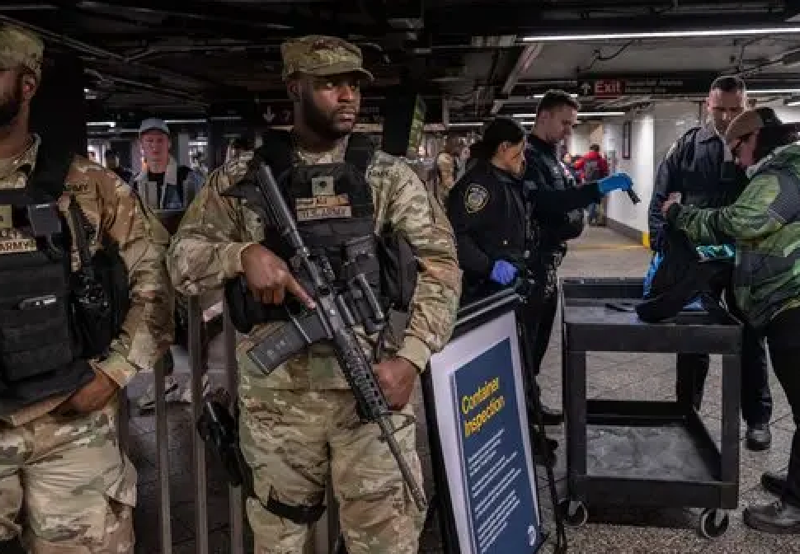
And, remember last month when New York Governor Kathy Hochul mobilized 1,000 National Guard troops and State Police officers, some of whom were armed with machine guns, to patrol NYC's subway system. This kind of response by the government wasn't due to migrants but likely terror threats.
All of this is happening right before the elections...

(ZH) Container Ship Reportedly "Lost Power" In NYC Harbor, Right Before Verrazza

Container Ship Reportedly "Lost Power" In NYC Harbor, Right Before Verrazzano-Narrows Bridge

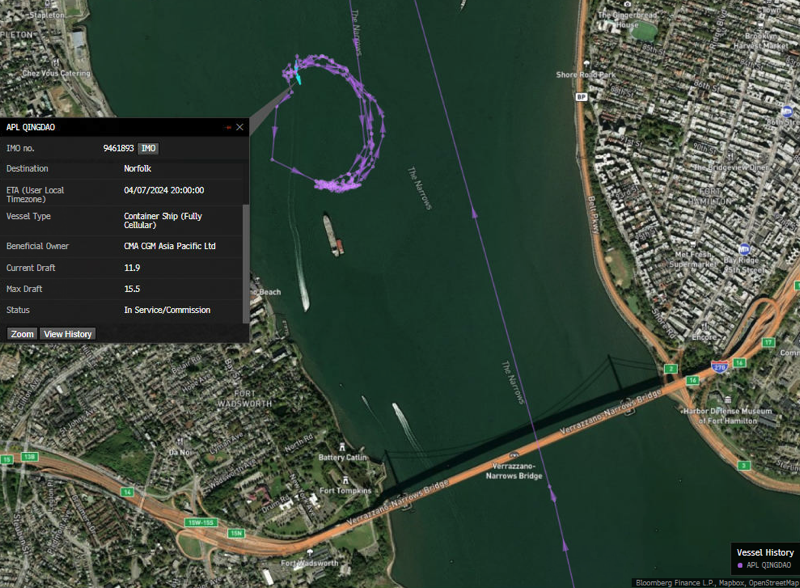
A massive container ship reportedly lost power on the Upper New York Bay - just before the Verrazzano-Narrows Bridge connecting the New York City boroughs of Staten Island and Brooklyn.

According to Captain John Konrad, CEO of gCaptain, a New York City tugboat captain informed him that the 354-meter container ship APL QINGDAO "lost power while transiting New York harbor."
"They had 3 escort tugs but 3 more were needed to bring her under control. They regained power & were brought to anchor near the verrazano bridge," the tugboat captain told Konrad.

Konrad said the vessel is registered in Malta and is owned and operated by a major French shipping company.
He did note, "We are still waiting for confirmation on the incident."
Adding validity to Konrad's report, the vessel's AIS tracking data shows it abruptly dropped anchor late Friday night - just before the 13,700-foot suspension bridge. As of Sunday morning, the vessel's navigational status is "anchored."
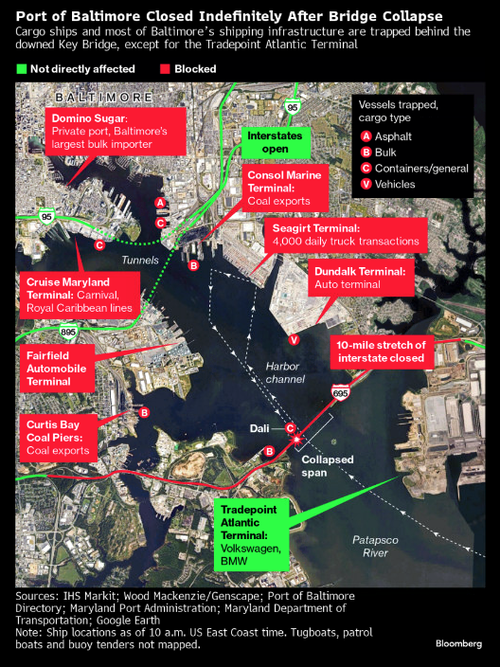
The incident comes nearly two weeks after a container ship lost power and collapsed the 1.6-mile-long Francis Scott Key Bridge in Baltimore, Maryland, paralyzing the Port of Baltimore.
Source: Bloomberg
"While the Verrazzano shares some characteristics with the Key Bridge, there are also important differences," an opinion piece in the Wall Street Journal recently read, adding:
"First, its massive vertical supports are positioned much closer to land than the Key Bridge's—1,000 feet away from the harbor's navigation channel—making them considerably less likely to be hit by an errant vessel. The towers also are surrounded by rock islands, which would force any ship heading toward the supports to run aground before striking the tower. Additional safety projects have further hardened protections, even adding an air gap sensor system that detects vertical clearances between the bridge and large vessels passing underneath."
The collapse of the Baltimore bridge has sparked discussions in corporate media about America's vulnerable infrastructure. Within government, high-level officials are likely concerned about terrorists crippling the nation through a series of infrastructure attacks. Maybe it's time the US government vet all foreign crews of commercial vessels entering America's waters...

Le Monde : Le successeur du porte-avions « Charles-de-Gaulle », un chantier géan

Le successeur du porte-avions « Charles-de-Gaulle », un chantier géant aux enjeux militaires et civils

Le projet militaro-industriel à 10 milliards d’euros s’organise pour doter la France d’un successeur au « Charles ». Sa propulsion nucléaire doit lui permettre dix ans d’autonomie de navigation et fait figure de bouffée d’oxygène pour une filière de l’atome fragile.

Le grand amphithéâtre de l’école navale de Lanvéoc-Poulmic, dans le Finistère, est bondé pour accueillir le capitaine de vaisseau Alban. Le conférencier a fait court, pour laisser du temps aux questions. Il le sait, les élèves officiers venus l’écouter n’en manquent pas. Le porte-avions de nouvelle génération, le PANG, intrigue autant qu’il fascine. Il sera le plus grand bâtiment jamais construit en Europe. Avec 75 000 tonnes, le PANG surpassera les 42 500 tonnes du porte-avions Charles-de-Gaulle.

Mis en service en 2001, le Charles, comme l’appellent les marins, devrait quitter la flotte en 2038. Le nouveau géant à propulsion nucléaire prendra alors la relève. Il pourra embarquer une quarantaine d’aéronefs, des Rafale Marine, des hélicoptères, des drones et peut-être le futur avion de combat issu du programme SCAF (système de combat aérien du futur). Il aura aussi besoin d’un équipage de 2 000 hommes et femmes pour un effectif total proche de 5 000 personnes. Qu’ils choisissent les sous-marins, l’aéronautique navale, les fusiliers marins, les commandos et bien sûr les bâtiments de surface, tous ces futurs officiers embarqueront un jour sur le successeur du Charles. « Il y a même parmi eux son futur pacha [surnom du commandant], souffle le commandant Alban. La marine l’a déjà identifié. »

Après des années de tempêtes politiques, de chants de sirène et de changements de cap, la construction du deuxième porte-avions nucléaire ne devrait plus être remise en question. Seule avec les Etats-Unis à disposer d’un tel bâtiment, la France tient à son PANG pour assumer son rang de grande puissance militaire. Autour du navire s’articulera une armada impressionnante composée de sous-marins d’attaque, de frégates multimissions, antiaérienne, de patrouille lointaine, de navire ravitailleur. Ce groupe aéronaval doit lui assurer une protection à 1 000 kilomètres à la ronde. Enfin, sa base aérienne la dotera d’une capacité d’attaque nucléaire. « C’est un outil de puissance par excellence mais aussi de diplomatie exemplaire », résume Thierry Burkhard, chef d’état-major français.

Le lancement de ce chantier industriel inédit depuis quarante ans a été entériné en mai 2023 avec le vote de la loi de programmation militaire 2024-2030. Dans le budget de 413 milliards d’euros alloué à la défense pour cette période, un premier montant de cinq milliards sera consacré au PANG. Au moins cinq milliards supplémentaires seront nécessaires pour boucler un projet estimé à 10 milliards. Il devra donc résister aux coupes budgétaires qui ne manqueront pas de se multiplier d’ici à sa première sortie en mer, espérée en 2036. Il n’est pas concerné par celles de 10 milliards d’euros, annoncées il y a quelques jours par le ministre de l’économie, Bruno Le Maire. Mais l’économie de guerre restera-t-elle une priorité pendant la prochaine décennie ?

Simone Veil ? François Mitterrand ?
En attendant, le nouveau porte-avions est devenu une réalité industrielle. Le chantier hors norme se met en place. En octobre 2023, lors du salon Euronaval, une toute dernière version du design du bâtiment a été dévoilée. L’avant-projet « sommaire » a été validé par l’Etat, ouvrant la voie à l’avant-projet « détaillé ». Le schéma industriel est en cours de définition. Fin 2025, début 2026, la commande sera officiellement notifiée par la direction générale de l’armement, en première ligne sur le projet. Ce dernier entrera alors en phase de développement-réalisation : en clair, la construction pourra démarrer.

Aux Chantiers de l’Atlantique, à Saint-Nazaire (Loire-Atlantique), on estime que l’usinage des tôles d’acier de la structure principale pourrait intervenir en 2031, avec une mise sur cale un an plus tard. La marine espère pouvoir bénéficier d’une période de tuilage de deux ans entre l’équipage du Charles-de-Gaulle et celui de son successeur. Le PANG disposera de ses propres effectifs car, « sur des métiers très spécifiques, comme navigateur timonier, ingénieur catapulte ou atomicien de propulsion, vous ne pouvez pas vous entraîner sur un autre poste que le vôtre, ni donc sur un autre porte-avions », précise le commandant Alban.

D’ici là, son nom aura été dévoilé. Richelieu a été écarté, comme la pionnière de l’aviation Marie Marvingt un temps évoquée. Les derniers pronostics penchent pour Simone Veil. A moins que les partisans de François Mitterrand ne l’emportent.

Quand il ne fait pas le VRP du PANG, le commandant Alban rejoint la tour de la direction générale de l’armement de Balard, au sein de l’état-major des armées dans le 15e arrondissement de Paris. Un étage y abrite les équipes qui planchent sur le projet.

Les ingénieurs du corps de l’armement et ceux détachés par les industriels occupent le gros des troupes. Le commandant Alban a composé une petite équipe – notamment avec des réservistes et des retraités – pour participer aux travaux. Celle-ci doit veiller à ce que les besoins opérationnels des marins et les conditions de vie à bord restent bien au cœur des débats. « Un plan d’amélioration est mené depuis plusieurs années sur le Charles-de-Gaulle, détaille son commandant, Georges-Antoine Florentin. Des réflexions sur l’habitabilité du PANG sont aussi lancées autour de plusieurs pistes : il faut pouvoir se régénérer pour être efficace en opération et trouver un équilibre entre intimité et lien social. »

Secret-défense
Aucun volet du projet ne doit être négligé malgré sa complexité et son organisation inédite, d’autant que beaucoup de compétences ont été perdues. Le chantier du Charles-de-Gaulle a débuté à la fin des années 1980 pour une mise en service en mai 2001 : depuis, toute une génération d’ingénieurs ayant travaillé sur le projet est partie en retraite, et DCNS, héritière des arsenaux de la marine royale fondés au XVIIe siècle, a changé de statut pour devenir la société Naval Group.

Les participants sont répartis en seize groupes de travail, dont certains sont même subdivisés en sous-groupes. Les réunions techniques s’enchaînent autour de dizaines de thèmes : sanitaire, habitabilité, propulsion, capacité à mettre en œuvre l’aviation… La task force des seuls industriels représente, elle, six cents personnes. Assurer une cohérence d’ensemble est quasi impossible. C’est certes l’enjeu de ces mois de définition du projet… Mais le secret-défense plane sur toutes les réunions, la dimension stratégique de « dissuasion » cloisonnant les discussions.

Comme le Charles-de-Gaulle, ou les sous-marins du programme Barracuda, le PANG voguera à l’atome : il sera équipé de deux chaufferies nucléaires. Le Commissariat à l’énergie atomique (CEA) est ainsi placé au cœur du projet. « Nous assurons la comaîtrise d’ouvrage avec la direction générale de l’armement. Naval Group et Chantiers navals de l’Atlantique se partagent la maîtrise d’œuvre », précise Laurent Sellier, directeur de la propulsion nucléaire à la direction des applications industrielles du CEA.

La solution la plus simple aurait consisté à redimensionner les chaufferies du Charles pour le nouveau bâtiment. Comme son prédécesseur, le PANG affiche un besoin impératif : que dix ans s’écoulent entre deux rechargements nucléaires. Mais la masse du nouveau bâtiment, l’allongement potentiel de ses missions et les nouveaux risques pouvant menacer le navire ont rebattu les cartes. De même, les caractéristiques de l’avion de nouvelle génération qui va être embarqué sont venues compliquer l’équation. Il pèsera probablement 30 tonnes, contre 20 pour le Rafale Marine. Le propulser à la même vitesse nécessite une poussée plus forte. Or, la catapulte est déjà l’un des gros consommateurs d’énergie à bord. Celle du nouveau porte-avions, tout électromagnétique, sera, elle aussi, gourmande. « C’est un équipement très dimensionnant, reconnaît Laurent Sellier, il implique un gros appel de puissance. »

Le CEA est donc quasiment reparti d’une feuille blanche, en utilisant ses supercalculateurs pour effectuer des simulations à partir des données d’exploitation recueillies sur le Charles. Il a repensé ses chaufferies qui vont passer de 150 mégawatts (MW) sur le porte-avions actuel à 220 MW sur le prochain. « Nous nous sommes reposé toutes les questions, pour être sûrs d’utiliser ce qui se fait de mieux et au meilleur coût, avec un souci d’efficience et de maîtrise des compétences », témoigne M. Sellier.

Une « bulle d’hypersupériorité »
Avec le projet PANG, la filière nucléaire française se voit offrir une occasion inespérée de remobiliser tous ses acteurs : concepteurs, fabricants, spécialistes de la maintenance ou de la conduite des chaufferies embarquées. Un enjeu crucial pour la stratégie de défense française de dissuasion, qui a besoin de conserver toutes ces compétences. Le porte-avions doit ainsi permettre de former une nouvelle génération d’ingénieurs, d’officiers et de techniciens du domaine nucléaire.

Côté industriel, TechnicAtome est chargé de la conception et de la réalisation des chaufferies et de leurs combustibles, et Naval Group fabriquera les cuves et les générateurs de vapeur puis réalisera l’intégration des composants. L’usinage dans ses ateliers doit commencer en 2025. L’ancienne DCNS a estimé à dix millions d’heures de travail sur quinze ans l’activité générée par le chantier et a annoncé 100 millions d’euros d’investissements pour adapter son outil industriel.

La coque de 305 mètres doit être assemblée dans les cales des Chantiers de l’Atlantique qui ont retrouvé leur vocation. Cela devrait mobiliser de 1 500 à 2 000 salariés pendant douze mois. Pendant ce temps, un effectif équivalent d’ingénieurs et d’experts continuera à plancher sur les différents blocs qui composeront le navire. Une partie de leur fabrication sera assurée par une centaine d’entreprises de sous-traitance. Les Pays de la Loire et la Bretagne seront les deux régions qui profiteront le plus des retombées économiques du projet.

L’autre sujet majeur concerne les technologies dont le bâtiment va être équipé. Thierry Burkhard le présente comme « une bulle d’hypersupériorité » ou encore comme « un outil qui redessine la géométrie de la bataille navale, aérienne et terrestre ». Pour garder cette supériorité, la marine doit anticiper les évolutions technologiques qui lui permettront de faire face à la multiplication de nouvelles menaces : missiles hypervéloces, drones, mines sous-marines ou satellites espions. « On a vu en mer Noire et en mer Rouge la vitesse avec laquelle de nouveaux systèmes pouvaient se propager », reconnaissait Pierre Eric Pommellet, PDG de Naval Group, début mars, lors du colloque Paris Defense and Strategy Forum.

Enfin, le porte-avions devra aussi être interopérable. « Quand on me demande si nous sommes prêts pour tout type d’opérations, je réponds que oui, mais pas tout seuls », avance l’amiral Nicolas Vaujour, chef d’état-major de la marine nationale. Autrement dit, si certaines missions nécessitent demain la collaboration de la France avec des armées partenaires, le bâtiment doit pouvoir embarquer des technologies communes.

Le chiffrage de ces systèmes à embarquer est lui aussi un casse-tête, et le dérapage financier est l’écueil que le porte-avions doit éviter. Le chantier du Charles-de-Gaulle était resté dans les clous, mais la révision du bâtiment, quinze ans après sa mise en service, avait coûté 1,3 milliard d’euros.

Les industriels français, dont certains sont sélectionnés au titre de la souveraineté, comme Thales pour ses radars, subissent la pression de la direction générale de l’armement. Si la définition de l’économie de guerre est de produire plus vite et moins cher, le PANG sait quel cap il doit tenir.

>>> USD/CNH : China's offshore CNH is trading down at the lower limit of the Yua

China's offshore CNH is trading down at the lower limit of the Yuan's 2.0% trading band; How will the PBOC respond this week?
- Due to Chinese holidays at the end of last week, the last PBOC Yuan fix was on Wed, Apr 3rd and was set at 7.0949
- USD/CNH last traded at the end of the week ~7.24, right at the bottom of the PBOC's 2.0% trading band limit. - China's PBOC has been consistently setting strong fixes in the 7.09 range recently, but it has not stopped the Yuan falling to its lowest allowable limit.
- How will the PBOC respond to avoid the 2.0% limit being breached? State-owned bank intervention to sell dollars and buy Yuan is likely, however the PBOC may be forced to set a weaker fix this week than it would prefer in order to keep within the band.
- The other alternative is to increase the trading band beyond its current 2.0% limit, a move that would likely create volatility.
- Today's Yuan fix (Monday Asia time) will be at Sunday 21:15ET / 01:15GMT
- As always, monitoring AUD/USD and JPY/USD as proxies for USD/CNH is also recommended.