>>> US Close Dow +0.+0.49% Russell 04% S&P +0.16% Nasdaq -0.21%

Closing Stock Market Summary
The S&P 500 (+0.2%) and the Nasdaq Composite (+0.5%) closed at or near their highs of the day after a surge of buying in the mega cap space in the afternoon trade. The Dow Jones Industrial Average closed slightly higher than yesterday and the Russell 2000 logged a 0.2% decline.

Apple (AAPL 213.25, +4.18, +2.0%), Amazon.com (AMZN 193.61, +7.27, +3.9%), and Tesla (TSLA 196.37, +9.02, +4.8%) were among the top performers from the mega cap space. NVIDIA (NVDA 126.40, +0.31, +0.3%) was another influential name in the mega cap space, trading down as much as 2.8% before turning higher ahead of the close.

FedEx (FDX 296.19, +39.81, +15.5%) also garnered attention today following better-than-expected earnings and an indication that demand is expected to improve through FY25. Meanwhile, General Mills (GIS 64.17, -3.09, -4.6%) was a standout loser after a fiscal Q4 earnings report that included a revenue miss driven by lower prices and lower volumes.

There was an underlying negative bias driving today's action. Decliners lead advancers by a roughly 4-to-3 margin at both the NYSE and at the Nasdaq.

The price action in Treasuries contributed to the underlying downside bias in equities. The 10-yr note yield settled eight basis points higher at 4.32% and the 2-yr note yield rose two basis points to 4.32% despite a solid $70 billion 5-yr note sale today. The market was also digesting a below-consensus New Home Sales report for May.

The equal-weighted S&P 500 registered a 0.4% decline and eight of the 11 S&P 500 sectors settled lower. The financial sector was among the worst performers, down 0.5%, while the consumer discretionary sector (+2.0%) led the pack.

  • Nasdaq Composite: +18.6% YTD
  • S&P 500:+14.8% YTD
  • S&P Midcap 400: +4.7% YTD
  • Dow Jones Industrial Average: +3.8% YTD
  • Russell 2000: -0.4% YTD

Reviewing today's economic data:
  • Weekly MBA Mortgage Applications Index 0.8%; Prior 0.9%
  • May New Home Sales 619K (consensus 650K); Prior was revised to 698K from 634K
    • The key takeaway from the report is that new home sales activity languished in May, but after accounting for the upward revision to April sales, the combined two-month period was actually better than what was embedded in the consensus estimate for May (650,000) and the original report for April (634,000). Even so, it is clear that higher mortgage rates and elevated prices continue to pressure new home sales (-16.5% yr/yr).

Thursday's economic calendar features:
  • 8:30 ET: May advance goods trade balance (prior -$99.4 bln), advance Retail Inventories (prior 0.7%), advance Wholesale Inventories (prior 0.2%), weekly Initial Claims (Briefing.com consensus 238,000; prior 238,000), Continuing Claims (prior 1.828 mln), May Durable Orders (consensus -1.2%; prior 0.7%), Durable Orders ex-transportation (consensus 0.2%; prior 0.4%), Q1 GDP -- third estimate (consensus 1.3%; prior 1.3%), and Q1 GDP Deflator -- third estimate (consensus 3.1%; prior 3.0%)
  • 10:00 ET: May Pending Home Sales (consensus 2.3%; prior -7.7%)
  • 10:30 ET: Weekly natural gas inventories (prior +71 bcf)
Reuters : US regulators could approve spot ether ETFs for launch by July 4, sour

US regulators could approve spot ether ETFs for launch by July 4, sources say

June 26 (Reuters) - The U.S. Securities and Exchange Commission could approve exchange traded funds (ETFs) tied to the spot price of ether as soon as July 4, as talks between asset managers and regulators enter the final stages, industry executives and other participants told Reuters.

Eight asset managers, including BlackRock (BLK.N), opens new tab, VanEck, Franklin Templeton (BEN.N), opens new tab and Grayscale Investments, are seeking SEC approval for the funds. Most of them had rolled out spot bitcoin ETFs in January, the culmination of a decade-long tussle with regulators. Grayscale again hopes to convert an existing trust into an ETF.

>>> Micron beats by $0.14, beats on revs; guides Q4 EPS in-line, revs in-line (1

Micron beats by $0.14, beats on revs; guides Q4 EPS in-line, revs in-line (142.36 +1.24)
  • Reports Q3 (May) earnings of $0.62 per share, excluding non-recurring items, $0.14 better than the FactSet Consensus of $0.48; revenues rose 81.5% year/year to $6.81 bln vs the $6.67 bln FactSet Consensus.
  • Co issues in-line guidance for Q4 (Aug), sees EPS of $1.00-1.16, excluding non-recurring items, vs. $1.02 FactSet Consensus; sees Q4 revs of $7.40-7.80 bln vs. $7.59 bln FactSet Consensus.
  • Co added, "We are gaining share in high-margin products like High Bandwidth Memory (HBM), and our data center SSD revenue hit a record high, demonstrating the strength of our AI product portfolio across DRAM and NAND. We are excited about the expanding AI-driven opportunities ahead, and are well positioned to deliver a substantial revenue record in fiscal 2025."

9to5 : Samsung smartphones outsell Apple, but majority of iPhones are flagship m


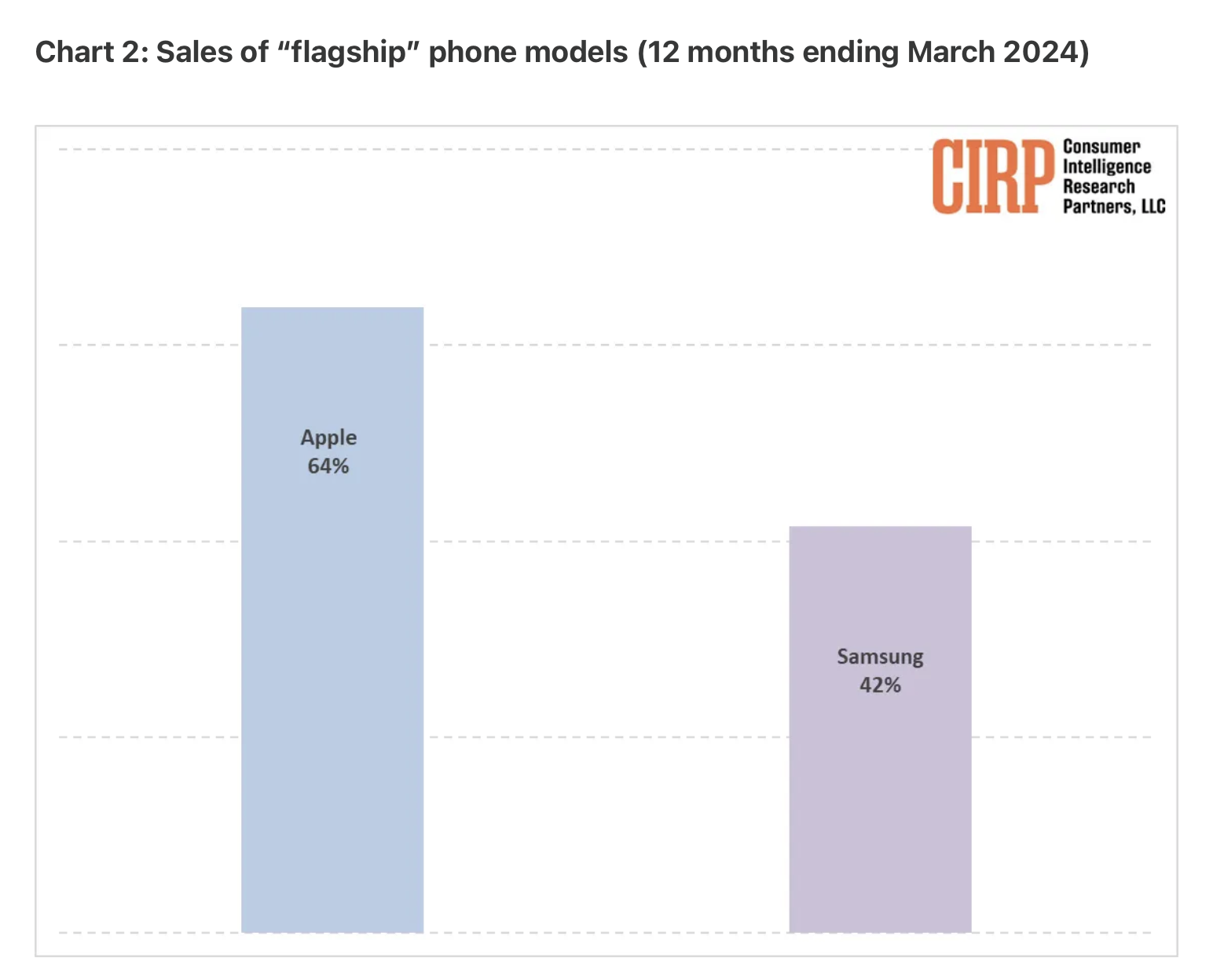
After doing some studies on Apple Music and Apple News, CIRP is out with a new report on smartphone sales in the US. For the last year, the study found that Samsung moved more smartphones than Apple, but the latter sold a much higher percentage of high-end devices.

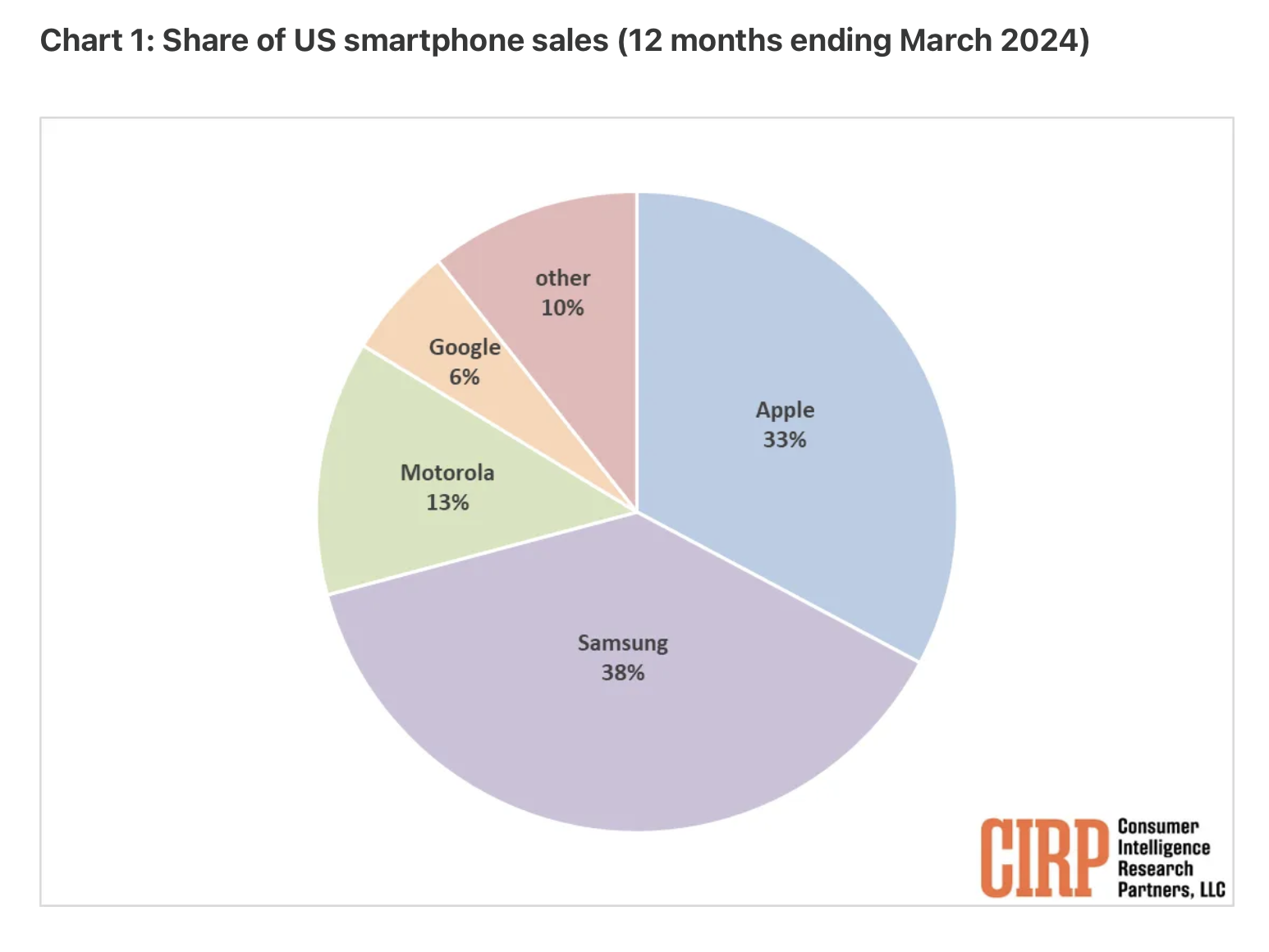
CIRP’s report looked at US smartphone sales from April 2023 through March 2024. While it’s not a surprise that Samsung took the largest share of smartphone sales when considering both Android and iOS devices, Apple was close behind.

According to CIRP’s data, Samsung’s smartphones had a 38% market share with Apple 5% behind at 33% market share.

Motorola came in third with 13%, “other” manufacturers had a combined share of 10% and Google came in last with 6%.

But looking a little deeper, CIRP reveals how Apple generates more revenue even though it sells fewer smartphone units than Samsung in the US.
image via CIRP
A majority of iPhone sales – 64% – are what CIRP considers “flagship models” That’s significantly higher than Samsung’s share of flagship models at 42%.

CIRP defines “flagship” as the “current model family” of smartphones – so in this case any of the iPhone 15 devices for Apple and for Samsung any of the Galaxy S23, S24, the Flip, or Fold smartphones.

The report highlights that the iPhone SE and older models make up about 1/3 of Apple’s US smartphone sales. And the reverse is true for Samsung with its more affordable and older models making up almost 60% of its US sales.

With that in mind, Apple sells more premium smartphones in the US than Samsung.
image via CIRP

FT : London court to judge good faith of convicted Vatican financier

London court to judge good faith of convicted Vatican financier
Businessman was found guilty by Holy See of embezzlement over a Chelsea property deal

The Vatican is being sued in the High Court in London by a financier who claims he was unfairly convicted by the Holy See over a UK property deal on which it lost more than £100mn.

Lawyers acting for Raffaele Mincione argued on Wednesday that Vatican authorities had made “incoherent and confused” allegations against the businessman, who was convicted of embezzlement and money-laundering by the Vatican state court and sentenced to five and a half years in prison for his role in the ill-fated transaction. However, Mincione has never served jail time and has been based in London.

In a bid to clear his name, Mincione is seeking a declaration from the London court that he acted “in good faith” in his dealings with the Vatican. The case — which is expected to feature testimony from Archbishop Edgar Peña Parra, one of the Vatican’s most senior leaders at the time of the vexed property deal — will consider Mincione’s prosecution by the Holy See court in proceedings since criticised as being arcane and unfair.

The civil trial in England stems from an investment the Holy See made in a former Harrods warehouse in Chelsea, one of the wealthiest areas of London. The Vatican lost more than £100mn in 2022 when it sold the property to private equity group Bain Capital.

The Holy See spent more than €350mn to acquire the property between 2014 and 2018, and the loss led to a broad review of the way in which the Catholic Church handles its finances.

Mincione was one of seven defendants — including one of the Vatican’s most powerful former officials, Cardinal Giovanni Angelo Becciu — convicted in December by the Vatican court in the landmark case for their roles in the controversial property deal.

The high-profile proceedings — seen as part of Pope Francis’s attempt to clean up the church’s notoriously scandal-tainted finances — were dubbed by Italian media as the “Vatican’s trial of the century” as it was the first time that such a high-ranking church official, or their financial advisers, had been brought to court for alleged wrongdoing.

Though a highly respected former Italian prosecutor presided over the trial as the chief judge, both the defence and independent legal scholars questioned the credibility and fairness of the Vatican court’s proceedings, which were also marked by multiple rule changes over the course of the investigation.

The London lawsuit was initially filed in 2020 prior to the Vatican trial and while the investigation into the deal was still under way.

In written arguments, Mincione’s barrister, Charles Samek KC, said the Vatican had made an “incoherent and confused allegation of conspiracy” and that its claims lacked “factual basis”.

Mincione, who is due to testify on Thursday, has previously argued that the Vatican was aware of the risks and that it had lost money because of its own poor decisions.

He has said the property’s value was justified by independent auditors and third-party consultants, and denies any wrongdoing.

Defending the Vatican against the claim, Charles Hollander KC said Mincione viewed the transaction as a way of “extracting money” from the Vatican.

“That involved a fraud on it, and misrepresentations made by Mr Mincione,” Hollander said in written arguments. “The events with which the Vatican court were concerned involve deep-seated corruption, fraud and embezzlement over a period of years.”

He added that the Vatican court “had the benefit of hearing from pretty well all relevant parties . . . reaching conclusions spanning a lengthy period of time based on the evidence before it”.

The Vatican has previously invoked the principle of sovereign immunity to avoid participating in foreign court proceedings, including prosecutions for financial scandals in Italy in the 1980s and child sex abuse cases in various countries in more recent years.

The Vatican publicly defended the integrity of its own court proceedings after the verdict in December, insisting that the the complex financial case — in which some of the accused were cleared of some, or all wrongdoing — had been conducted “with full respect for the rights of the defendants”.