Fortune : A French whale has bet $45 million on a Trump win so far. Who is this

A French whale has bet $45 million on a Trump win so far. Who is this person?

Polymarket revealed new information about a high roller who has bet $45 million on Trump winning the election, but many questions remain about who they are and what their intentions are.

The prediction market website told the New York Times DealBook that the person is a French national with “extensive trading experience and a financial services background.” The company didn’t elaborate further but did say it had contacted the whale and they had agreed to not “open further accounts without notice.”

The four accounts controlled by the whale—Fredi9999, Theo4, PrincessCaro, and Michie—have bet $45 million in total on a Trump victory through a series of small transactions, Bloomberg reported. The small transactions made by multiple accounts were likely meant to prevent the cost of betting on Trump winning the election from rising too quickly so they can get the best deal.

Who can bet on Polymarket?
Polymarket enables users to place bets on outcomes, including the presidential election, through cryptocurrency. Americans have been barred from using Polymarket since shortly after the platform was fined by the CFTC in 2022 for allegedly offering illegal options trading. Although a court win for rival prediction market Kalshi earlier this month has opened the door to election betting, Polymarket has not opened its platform to U.S. citizens and has started to crack down on American users.

Although some experts have claimed prediction markets are a more accurate way of predicting elections because real money is at stake, some have said the bets could be made to manipulate the presidential election. Others have cast doubt that prediction markets matter at all, pushing back on claims that wagers for Trump on prediction platforms could influence his election odds.

After investigating the mysterious French whale, Polymarket concluded that the trader is “taking a directional position based on personal views of the election.”

What is more clear is that the whale’s four identified accounts are making myriad bets on Trump—and against vice president Kamala Harris. Over a period of 10 hours as of midday Friday, one of the trader’s accounts, Theo4, made more than 450 distinct bets on Kamala Harris not winning the presidential election in amounts that ranged from less than $5 to tens of thousands of dollars.

Other bets made by the French whale’s accounts include wagers on whether a Republican will win the popular vote and the presidency (yes bet), whether a Democrat will win the Michigan Presidential election (no bet), and whether Harris will win the popular vote (no bet).

The trader’s most prolific account, Fredi9999, boasts $19 million in mostly political bets on the site, including a $13.8 million position betting on Trump to win the election.

Amid the controversy over its election bets and the French whale, Polymarket CEO Shayne Coplan said in a post on X that the company is non-partisan and transparent. He added that Polymarket was never meant to be centered on election betting.

“Polymarket is not about politics. The vision never was to be a political website, and it still isn’t,” Coplan wrote.

Challenges : Autoroutes : Le sénateur Hervé Maurey alerte sur le « cadeau » de l

Autoroutes : Le sénateur Hervé Maurey alerte sur le « cadeau » de l’Etat à Eiffage, Vinci et Sanef

Les contrats historiques des concessions d’autoroutes arrivent à expiration entre 2031 et 2036. Pour le sénateur Hervé Maurey, l’Etat reste trop laxiste envers les géants de la construction, Vinci, Eiffage, Sanef entre autres, qui les exploitent. Il préconise une refonte totale des règles à l’avenir.

Hervé Maurey n’y va pas par quatre chemins : tel qu’il est engagé, le processus de fin des concessions autoroutières exploitées par les géants de la construction comme Vinci, Eiffage et autre Sanef, est mal parti. « Je suis extrêmement inquiet de voir que la DGTIM [La Direction générale des infrastructures, des transports et des mobilités, N.D.L.R.] est davantage préoccupée par la volonté de ne pas créer de contentieux avec les sociétés d’autoroutes au lieu de se soucier de la bonne sortie de ces concessions », alerte le sénateur centriste, ce 23 octobre en présentant à la presse un rapport sur le sujet.

Un patrimoine estimé à 194 milliards d’euros
Selon l’élu de l’Eure, la puissance publique abdique face aux sociétés d’autoroutes au moment où se négocie la fin des concessions. Entre 2031 et 2036, viendront à expiration de manière échelonnée tous les contrats conclus entre la fin des années 1950 et le début des années 1970, soit environ 90 % du réseau autoroutier concédé. « Or, c’est dès le 31 décembre 2024 qu’elles doivent notifier l’état des infrastructures, c’est demain », rappelle le sénateur. Juridiquement, les détenteurs des concessions devront remettre gratuitement à l’Etat des infrastructures « en bon état d’entretien et libres de dettes », soit un patrimoine total estimé à 194 milliards pour l’Etat concédant.

Il faut prévoir cinq ans de travaux en fin de contrat pour que la société exploitante rende à l’Etat une infrastructure dite « en bon état ». Pour la concession de Sanef, qui se termine en 2031, cela doit donc être réalisé, en théorie, d’ici au 31 décembre, pour Escota (une société de Vinci Autoroutes, entre Marseille et Nice), d’ici à la fin février. Mais que veut dire « en bon état » ? Une notion floue d’après le rapporteur, notamment pour les ouvrages comme les ponts qui pourraient nécessiter des travaux lourds une fois les contrats historiques arrivés à échéance. « Qui paierait alors ces derniers ?, interroge-t-il. L’Etat ? Le concessionnaire suivant ? ». Difficile à dire.

Un cadeau de 1 à 5 milliards d’euros
Se pose également la question des investissements dits de « seconde génération », comme les projets d’élargissement d’autoroutes, de construction d’échangeurs ou de parking de covoiturage, prévus et préfinancés, mais non réalisés car ils ont finalement été jugés non nécessaires. Leur montant est évalué entre 1 et 5 milliards d’euros par le rapporteur. « Il n’y a pas de raison de faire un tel cadeau aux sociétés », juge Hervé Maurey pour qui il est urgent de revoir le rapport de force entre les sociétés privées et l’Etat.

Rejetant l’idée partagée un temps à Bercy par Bruno Le Maire de récupérer les surprofits des autoroutes en écourtant de manière anticipée leurs contrats, Hervé Maurey milite en revanche pour une révision du modèle à l’avenir. Toujours polémique, le sujet de la rentabilité excessive des contrats -40 milliards d’euros de revenus supplémentaires pour les sociétés d’autoroutes a été écarté par le régulateur des Transports (l’ART), rappelle l’élu même si ces activités sont extrêmement lucratives pour les groupes privés. « Les autoroutes restent des vaches à lait », relève-t-il, prenant l’exemple de Vinci chez qui la branche autoroutes représente 9 % du chiffre d’affaires global du groupe et 23 % des résultats.

42 agents pour contrôler 9 300 kilomètres de réseau
Aligné sur les propositions de l’ART, Hervé Maurey est par contre favorable à des concessions raccourcies à 15 ou 20 ans (contre 34 ans en moyenne) et à la mise en place de clauses de revoyure tous les cinq ans. Surtout, le sénateur souhaite mettre en place un contrôle commun de Bercy et de la DGTIM, sur le modèle des autoroutes italiennes. Une nouvelle gouvernance qui permettrait de pallier le déséquilibre en moyen humain, financier et juridique de l’Etat face aux géants du privé. Un simple exemple : Selon le rapport, la DGTIM dispose de 42 agents pour suivre les sociétés d’autoroutes et contrôler l’état des 9 300 kilomètres de réseau !

5 milliards de recettes fiscales pour l’Etat
Faut-il pour autant renationaliser les autoroutes comme le réclamait au printemps le Rassemblement national ? Ou les rendre gratuites ? Pour Hervé Maurey, il n’est pas question de mettre fin aux péages qui rapportent près de 5 milliards d’euros par an de recettes fiscales. « Si ce n’est pas l’usager qui paye, alors c’est le contribuable », rappelle-t-il. Mais à l’avenir cette manne devrait être davantage attribuée au financement du réseau routier non concédé et des infrastructures ferroviaires, « dans un état pitoyable ».

Challenges : 6,8 milliards d’euros de factures impayées : la ruse comptable du m

6,8 milliards d’euros de factures impayées : la ruse comptable du ministère des Armées pour préserver son budget

Pour préserver sa capacité d’investissement, le ministère des armées a traditionnellement recours au report de charges, ce qui consiste à payer l’année suivante des équipements déjà livrés. Problème : ces factures impayées atteignent désormais 6,8 milliards d’euros, et inquiètent les spécialistes.

Des chasseurs Rafale lors de l'exercice Arctic Defender en Alaska, en juillet 2024.Des chasseurs Rafale lors de l'exercice Arctic Defender en Alaska, en juillet 2024.
Ministère des Armées
On peut disposer d’un budget en hausse de trois milliards d’euros et toujours avoir des problèmes de fin de mois. C’est tout le paradoxe du ministère des Armées. Si l’outil de défense français fait l’objet d’un effort massif de réinvestissement, avec 50,5 milliards d’euros prévus en 2025 (+ 3,3 milliards), les argentiers de l’hôtel de Brienne doivent, plus que jamais, batailler pour faire rentrer l’édredon dans la valise. Comprenez les besoins des armées dans ce fameux budget. Car si les moyens promis sont au rendez-vous, les engagements financiers à honorer sont monumentaux : modernisation de la dissuasion (5,8 milliards), commandes de munitions (1,9 milliard d’euros) ou encore investissement dans le spatial (700 millions).

Pour résoudre cette quadrature du cercle militaire, les financiers du ministère ont traditionnellement recours à un outil méconnu, mais redoutable : le report de charges. En gros, cette technique comptable consiste à payer l’année suivante des livraisons (avions, navires, armement…) déjà effectuées. Avantage : l’armée reçoit ces équipements tout en reportant de quelques mois leur paiement, soulageant d’autant le budget de l’année. Les industriels, eux, reçoivent des intérêts moratoires en guise de dédommagement. Un schéma gagnant-gagnant dont tout le monde s’était jusqu’à présent plus ou moins accommodé.

20 % des crédits du ministère
Le problème, c’est que le montant total de ces factures impayées, que l’ancienne ministre des Armées Florence Parly avait sensiblement réduit, a dérapé depuis deux ans. De 3,8 milliards d’euros en 2022, le report de charges est passé à 6,1 milliards d’euros fin 2023, et devrait atteindre, selon nos informations, 6,8 milliards d’euros fin 2024. Il représente donc désormais 20 % des crédits budgétaires du ministère (hors soldes et pensions). Or si le montant des intérêts moratoires à verser aux industriels reste modeste (18,4 millions d’euros en 2023, contre 12,7 en 2022), l’utilisation de cette astuce comptable n’a rien d’anodin. Car le report des paiements de factures va automatiquement grever le budget 2025, qui se retrouvera à financer, en quelque sorte, une dette héritée de l’exercice précédent.

Pour résoudre l’équation, le ministère a deux choix : réduire d’autant ses dépenses, ce qui semble difficile vu les engagements pris ; ou reporter à nouveau le paiement de factures en fin d’année vers l’exercice 2026, ce qui repousserait encore une « bosse budgétaire » qu’il faudra bien un jour aplanir.

« Un outil pratique », selon Sébastien Lecornu
Comment le report de charge a-t-il pu exploser de près de 80 % en deux ans ? La rupture date de 2023. Face à une équation budgétaire difficile pour les armées, Élisabeth Borne, alors Première ministre, autorise le ministre des Armées Sébastien Lecornu à laisser filer le montant des factures impayées. Le plafond ne sera plus de 12 %, objectif officiel, mais de 20 %, soit deux fois plus que la limite fixée par la loi de programmation militaire (LPM) de 2019-2025. D’un coup de crayon, cet arbitrage rend plus de 2 milliards d’euros de marge de manœuvre financière au ministère.

Interrogé par Dominique de Legge, rapporteur spécial du budget de défense à la commission des finances du Sénat, lors d’une audition le 15 octobre, Sébastien Lecornu restait droit dans ses bottes. « Il y a des programmes dont vous avez besoin qu’ils avancent en même temps, et vous n’avez pas, avec les marches (les hausses annuelles de budget prévues par la LPM, ndlr), suffisamment de crédits de paiement pour le faire, expliquait le ministre. Je vous mentirais en vous disant, M. le sénateur, que le report de charge n’est pas un outil pratique : il permet de faire la jonction entre les annuités. »

Pas de quoi convaincre Dominique de Legge, qui évoque une « dérive inquiétante ». « Il va falloir mettre un terme à ce phénomène, qui commence à ressembler à de la cavalerie budgétaire », assure-t-il à Challenges. L’explosion du report de charges n’est pas non plus du goût de la Cour des comptes. L’outil est un « instrument critiquable au regard du principe de l’annualité des crédits », estimait-elle dans un rapport publié en avril dernier. « Le ministère des Armées s’est créé, et l’assume, une sorte de « fonds de roulement » en reportant besoins et crédits à l’exercice suivant », déploraient encore les sages de la rue Cambon dans ce rapport, soulignant que les factures impayées représentaient 2,2 mois de budget.

« Problème à 10 milliards d’euros »
Le niveau actuel de report de charges a un autre inconvénient majeur : il n’offre plus vraiment de marge de manœuvre pour encaisser d’éventuels coups durs budgétaires. Or des inconnues demeurent sur le budget des armées : 2,6 milliards d’euros ont été gelés par Bercy au premier semestre, dont le ministère doit négocier le dégel d’ici à la fin de l’année. Si Sébastien Lecornu a toujours gagné ses arbitrages les années précédentes (obtenant même des crédits supplémentaires en plus des dégels en 2023), rien ne garantit qu’il en sera de même cette année, vu la situation catastrophique des finances publiques. « Si cette somme n’est pas dégelée, on se retrouve avec un problème à 10 milliards d’euros : 6,8 milliards de reports de charge, et plus de 2 milliards de crédits annulés », pointe Dominique de Legge.

Le problème serait identique si les surcoûts des opérations extérieures (Opex) et missions intérieures (Missint) venaient à être facturés aux armées. Il est d'ore et déjà acté que la provision inscrite en loi de finances (800 millions d’euros) sera largement dépassée, entre le coût de la sécurisation des JOP de Paris (300 à 400 millions d’euros), les diverses missions en cours (Chammal au Levant, Daman au Liban, Lynx en Estonie, Corymbe dans le golfe de Guinée…), et l’énorme déploiement en Roumanie (mission Aigle), dont le coût en année pleine est estimé à 494 millions d’euros.

Certes, la loi de programmation militaire 2024-2030 prévoit une prise en charge de ces éventuels surcoûts par la solidarité interministérielle, en clair par un effort de tous les ministères proportionnel à leur budget. Mais là encore, il ne peut être exclu que la situation budgétaire fasse bouger les lignes, au détriment du ministère des Armées. La carte du report de charge ayant été utilisée jusqu’à l’os, il faudrait trouver d’autres moyens pour compenser ces pertes financières.

Les engagements non financés tutoient les 100 milliards
Le report de charges n’est pas le seul outil financier utilisé par le ministère pour préserver sa capacité d’investissement. L’hôtel de Brienne s’appuie également sur un autre dispositif aussi efficace que méconnu, dit « reste à payer ». Il s’agit, en gros, du montant total des engagements financiers pris par le ministère des Armées (porte-avions de nouvelle génération, sous-marins nucléaires lanceurs d’engins…), qui ne sont pas couverts par les budgets votés en loi de finances. Comme le report de charges, ce reste à payer s’est envolé ces dernières années, passant de 59,6 milliards d’euros en 2019 à 97,1 milliards en 2023. La barre des 100 milliards sera très probablement atteinte sur l’année 2024.

Si ce système de reste à payer est logique pour un ministère qui s’engage sur des programmes de long terme, le niveau atteint interroge la Cour des comptes. Celle-ci soulignait en avril que les restes à payer représentent près de 4 années de budgets d’équipement et de dissuasion (programme 146 du budget) et deux ans et demi de budget de « préparation et emploi des forces » (programme 178). L’équation budgétaire est tenable si les hausses de budget prévues par la LPM (3 milliards par an) sont tenues. Dans le cas contraire, le ministère pourrait se retrouver à devoir couper net dans certains programmes.

The Information : Musk, Putin and CEO Telephone Calls

Musk, Putin and CEO Telephone Calls

We’ve learned a lot lately about who CEOs like to telephone. We reported a couple of weeks ago that Microsoft CEO Satya Nadella likes to make two calls a day to CEOs of other companies, including startup chiefs, to ensure he stays up to date on the latest developments in tech. And Morgan Stanley’s former CEO and Disney chair-to-be Jim Gorman likes to call newly appointed CEOs across America to offer his “wisdom,” according to The Wall Street Journal.

Then there’s Tesla’s CEO, Elon Musk. He’s cool hanging out with other CEOs: Here’s a photo of him at the U.S. Open with former Activision Blizzard CEO Bobby Kotick, IAC chair Barry Diller and Warner Bros. Discovery CEO David Zaslav. But, according to the Journal, Musk is also in regular contact with Vladimir Putin, discussing “personal topics, business and geopolitical tensions.” Putin once asked Musk for a favor on behalf of China’s president Xi Jinping, the report said.

While Musk taking up with Putin may not be surprising—given the billionaire’s broad-ranging business interests and control of X—the Xi part sounds a little puzzling. Why would China’s president need Putin to talk to Musk on his behalf?

Tesla has a big factory in Shanghai—it was the first foreign car manufacturer allowed to operate in China without a local partner. Tesla is so trusted in China that the government uses its vehicles. Musk also visits China on occasion, meeting with top government officials. If Xi wanted something from Musk, why wouldn’t he just call him directly?

Whatever. The report showed why Musk is not only the biggest story in business news but increasingly a political story that nearly rivals Trump himself. And if Trump wins the election, the news media’s focus on Musk will only increase, given the ties between the two.

CrunchBase : The Week’s 10 Biggest Funding Rounds: Seaport Therapeutics And Zip

The Week’s 10 Biggest Funding Rounds: Seaport Therapeutics And Zip Top Big Money Week

Another big week for biotech, as startups in the sector scooped up multiple spots on this week’s list. However, there also were big rounds in industries like procurement, energy and robotics. All in all, a half-dozen companies raised rounds of $100 million or more. Not included in the top 10 this week was Waymo‘s $5.6 billion round, as a majority of the round was reported back in July.

1. Seaport Therapeutics, $225M, biotech: Seaport Therapeutics isn’t new to this list. In April, the Boston-based startup launched with a $100 million Series A co-led by Arch Venture Partners and Sofinnova Investments. The company is back this week with a $225 million Series B led by General Atlantic. The biotech company focuses on medicines for depression, anxiety and other neuropsychiatric disorders. Seaport will use the new money to advance its clinical-stage pipeline of medicines.

2. Zip, $190M, procurement: Procurement startup Zip saw its valuation jump 47% after raising a $190 million Series D led by Bond. The round values the San Francisco-based company at $2.2 billion. In May 2023, Zip locked up a $100 million Series C at a $1.5 billion post-money valuation. The startup helps companies with the burdensome process of buying new software and hardware, helping customers with sourcing, approving and paying for business tools. The company will use the new cash to invest in engineering and research and development, including a new internal AI lab to create AI-powered tools. The money also will be used to expand geographically. Founded in 2020, the company has raised more than $371 million, per Crunchbase.

3. AvenCell, $112M, biotech: Watertown, Massachusetts-based clinical-stage cell therapy startup AvenCell Therapeutics raised a $112 million Series B led by Novo Holdings. The company focuses on advancing cell therapies for the treatment of a wide range of hematologic malignancies and auto-immune diseases. Founded in 2021, this is the company’s first announced raise, per Crunchbase.

4. Nimble Robotics, $106M, robotics: Even in an uneven venture market, robotics is strong. More evidence of that came this week as Nimble, an AI robotics and autonomous e-commerce fulfillment startup, closed a $106 million Series C led by Cedar Pine and FedEx valuing the company at $1 billion. As part of the new deal, FedEx has entered into a commercial agreement to scale its FedEx Fulfillment service using Nimble’s technology and fully autonomous robotics model. Founded in 2017, the company has raised $221 million, per Crunchbase.

5. (tied) Redaptive, $100M, energy: Denver-based Redaptive, which funds and installs energy-saving and energy-generating equipment, raised a $100 million equity investment from CPP Investments. The company offers a platform that manages long-term energy efficiency programs, from project development to funding, project management and monitoring. Founded in 2015, the company has raised $1 billion in investment, per Crunchbase.

5. (tied) Valon Technologies, $100M, real estate: New York-based Valon, a mortgage servicing platform, raised a $100 million Series C led by WestCap. The company will use the new cash to accelerate its product development and market expansion. Founded in 2019, Valon has raised $230 million, per the company.

7. Be Biopharma, $82M, biotech: Be Biopharma, a biotech firm developing engineered B-cell medicines, raised $82 million from several investors. Founded in 2020, the Cambridge, Massachusetts-based company has received $264 million in funding, per Crunchbase.

8. SchooLinks, $80M, education: Austin, Texas-based SchooLinks, a software platform providing college and career readiness resources for K-12 students, raised an $80 million Series B led by Susquehanna Growth Equity. Founded in 2015, the company has raised nearly $91 million, per Crunchbase.

9. Finix, $75M, fintech: Payment processing startup Finix closed a $75M Series C led by Acrew Capital, LEAP Global Partners and Lightspeed Venture Partners. Founded in 2015, the San Francisco-based company has raised more than $200 million, per Crunchbase.

10. Carbon Robotics, $70M, agtech: Seattle-based Carbon Robotics, an AI-powered farming startup, locked up a $70 million Series D led by new investor Bond. Founded in 2018, Carbon has raised $157 million, per the company.

Big global deals
The biggest deal of the week came from China.
  • Beijing-based Didi Woya, a startup developing technologies for self-driving vehicles for rideshares, raised a $298 million Series C.

The Information : Legal Threats, Google Competition Loom Over Perplexity’s ‘Newb

Legal Threats, Google Competition Loom Over Perplexity’s ‘Newbie CEO’
Aravind Srinivas believes he has a new revenue model for AI—if he doesn’t sink his startup’s brand first.

Aravind Srinivas didn’t set out to earn a reputation as one of the media’s biggest tech villains. It just kind of happened.

Over the summer, Forbes and Wired angrily accused Srinivas’ AI search startup, Perplexity, of plagiarizing their paywalled content.

In one case, Perplexity had lifted portions of a Forbes story and used it in a new product that summarizes news stories. In the other instance, a Wired reporter found that Perplexity’s search engine tried to pass off Wired content as its own when that reporter asked the search engine to summarize a Wired story.

Then, last week, The New York Times Co. sent Srinivas a cease-and-desist letter demanding that Perplexity stop using its content for its AI-powered search engine. And days ago News Corp, the publisher of The Wall Street Journal and The New York Post, filed its own copyright-infringement lawsuit demanding that Srinivas’ startup keep its hands off the media company’s stories.

Srinivas wouldn’t comment on the latest salvos from The Times and News Corp, but when I brought up the Forbes and Wired drama with him a few weeks ago, he pleaded youthful ignorance. “I’m a newbie CEO trying to learn here,” said Srinivas, 30, who is both Perplexity’s CEO and its co-founder. “I underestimated how important people take us, to be honest. I was still thinking we are a product that most people don’t even know or care about. So all that attention was very new to me.”

Does Srinivas really believe that? It’s hard to imagine he portrayed himself in that way when he went to win money from investors like Jeff Bezos, Sequoia Capital and New Enterprise Associates, a group that has shoved more than $400 million into his hands over the last two years. At the same time, Perplexity’s valuation has increased from roughly $500 million a year ago to $3 billion in April.

And Srinivas has reportedly begun fresh fundraising discussions that would value Perplexity at an even more heady $8 billion.
Meanwhile, it has been a red-hot acquisition target.

Srinivas does have some numbers to impress investors. Perplexity has seen strong growth from a pair of subscription products: one aimed at consumers, another at corporations. The startup is currently generating around $50 million in annual recurring revenue, according to a person with direct knowledge of the number. That is up from around $2.5 million last October, according to a person with knowledge of the figure. Perplexity isn’t yet profitable and plans to continue raising money for the foreseeable future, Srinivas said.

Subscribers get access to Perplexity’s web-based search engine, which relies on large language models from other companies, such as OpenAI, to function. For $20 a month, consumers can select from a variety of LLMs. For $40, enterprise customers get a set of extra security features.
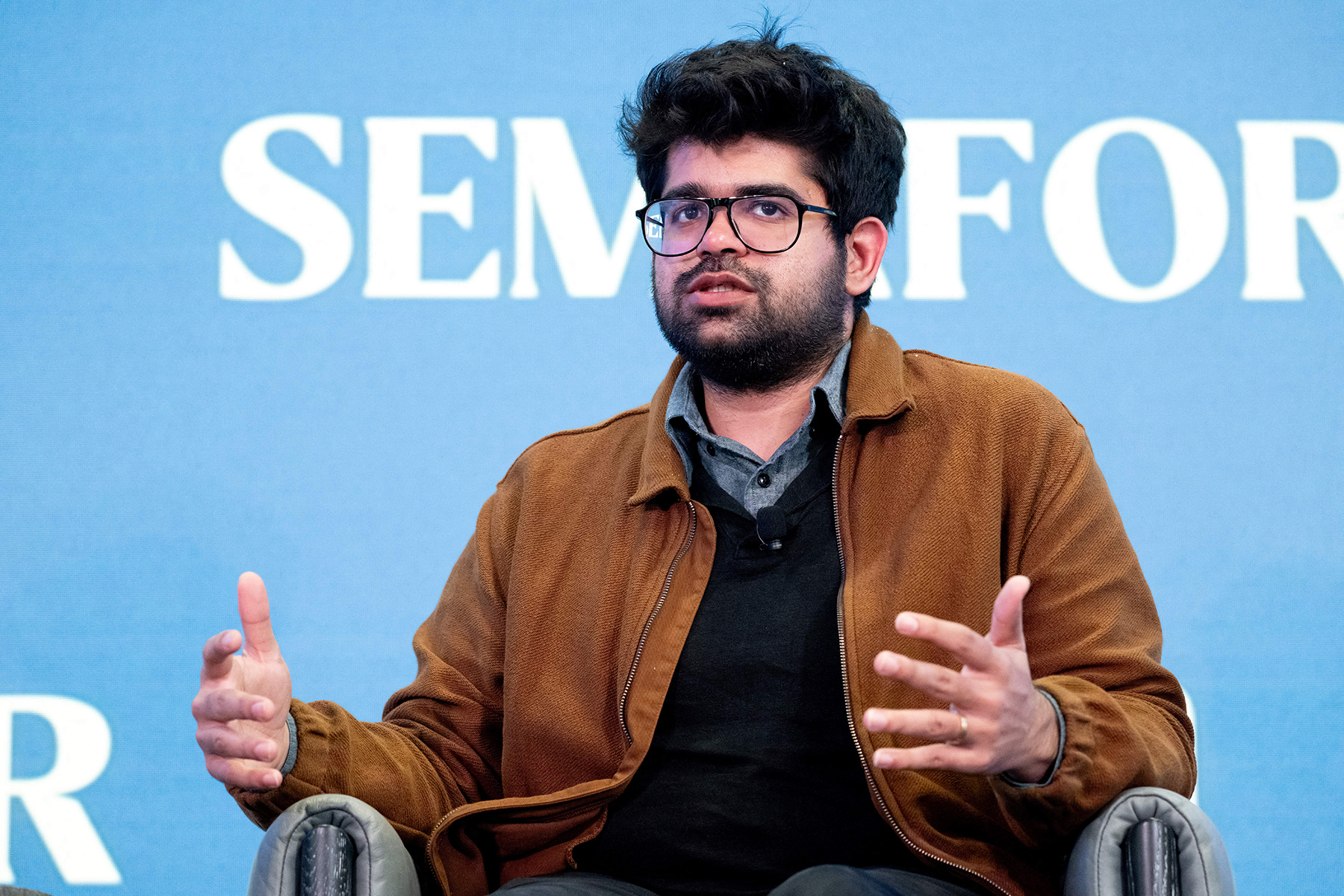
Perplexity CEO Aravind Srinivas appears at a conference hosted by Semafor, a news media startup, in April. Getty Images

Searching for an answer through Perplexity can often be faster than pawing through the traditional 10 blue links provided by Google.

Much of Perplexity’s popularity stems from frustration with Google search, which puts the onus on users to navigate to what they’re seeking. For example, ask Perplexity what the most popular dog breed in Florida is, and it’ll immediately tell you it’s a Labrador retriever. An old-fashioned Google search without AI assistance brings up links to websites like Dogster.com, which has the same information but takes a few more seconds to access.

To satisfy both Perplexity’s supporters and its detractors, Srinivas must pull off a high-stakes act. He has to find ways to continue growing Perplexity—partly through an ad-based model launching later this year—and persevere where others have given up.

Last year, for instance, Neeva, a once-promising AI search startup, sold itself to Snowflake, a data software firm, when Neeva co-founder Sridhar Ramaswamy realized after four years that the business likely wasn’t going to grow much further. “We had created an amazing product, but we weren’t quite seeing hockey-stick growth,” Ramaswamy recalled in a June interview with The Information.

Similarly, the 1,600-pound gorilla in the search business—namely, Google—could pose growth problems for Perplexity. In May, Google launched a feature called AI Overviews, which automatically summarizes search results à la Perplexity.

And Srinivas, who has gone far on newbie ambition and blithe self-confidence, must also contend with the legal threats from infuriated companies with the financial wherewithal to sue him into submission.

Srinivas finds himself in the same scenario as many AI founders who have hoovered up funding from investors even when their startups are flying high on unproven business models and facing mounting legal challenges.

Industry leader OpenAI has adopted a version of this strategy, though it is buttressed by significantly more capital and brand-name recognizability. OpenAI’s size and popularity has helped it convince media publishers to sign revenue-sharing content deals.

(Srinivas is also beginning to strike deals with publishers and is trying to persuade media companies to view OpenAI and other LLM creators as the greater enemy.)
Perplexity’s alleged scraping of copyrighted content has raised eyebrows among industry observers like Jason Kint, CEO of Digital Content Next, an online-publishing trade group. “I think there is a serious question whether this is a legitimate business considering the allegations of mass copyright infringement,” he said via email. “Perplexity’s leadership seems to believe…it deserves some sort of pass on centuries of law.”

Srinivas has already faced a period of doubt over whether Perplexity could make it as an independent company. While the startup’s revenue growth, head count and valuation have increased steadily this year, he spent a lot of 2023 considering whether to sell the company due to concerns over the cost of running its service and competition from the likes of Google and OpenAI, said two people with direct knowledge. Microsoft also announced a new AI-powered Bing feature in February 2023.

In the summer and fall of 2023, Srinivas told members of his executive team that Perplexity had received acquisition offers from three companies: X, OpenAI and Notion, according to a person with direct knowledge of the matter. Srinivas indicated that Perplexity’s talks with X were particularly detailed as Elon Musk, the social network’s owner, was interested in using Perplexity’s technology to improve X’s search functionality, the person said. Perplexity had earlier launched Bird SQL, a tool for searching X’s archive of tweets using conversational language.

Srinivas also told employees Microsoft had expressed interest in acquiring Perplexity and had discussed how to structure a deal that would make it pass regulators, said the person. All three offers were in the $150 million to $200 million range, the person added.

Perplexity was valued at $150 million after a funding round announced in March 2023. Details about the companies that made the offers and their amounts haven’t been previously reported. (An OpenAI spokesperson declined to comment; Microsoft wouldn’t comment; and X and Notion didn’t respond to requests for comment.)
“We knew this was going to be pretty competitive and difficult,” Srinivas acknowledged, considering Perplexity’s journey as a whole. “There are all sorts of uncertainties.”

When Srinivas first arrived in Silicon Valley, he met another AI enthusiast who espoused nothing but certainty: Ilya Sutskever, the OpenAI co-founder who interviewed Srinivas for an OpenAI internship in 2018. “When you meet Ilya, it’s very hard not to get that reality distortion field—he has that effect,” Srinivas recalled. “So when I interviewed, Ilya spent five minutes or 10 minutes talking to me, and I was like, ‘OK, this is the greatest genius the world has, and I need to be around this person.’”

He was captivated by Sutskever’s belief that OpenAI would quickly advance toward producing an AI capable of reaching humanlike intelligence—what the AI industry calls AGI or artificial general intelligence.

“They even had a road map toward it, which of course didn’t pan out,” said Srinivas, who was born in the southern India city of Chennai and earned a computer science doctorate at the University of California, Berkeley. “I bought into all the hype in the beginning.”
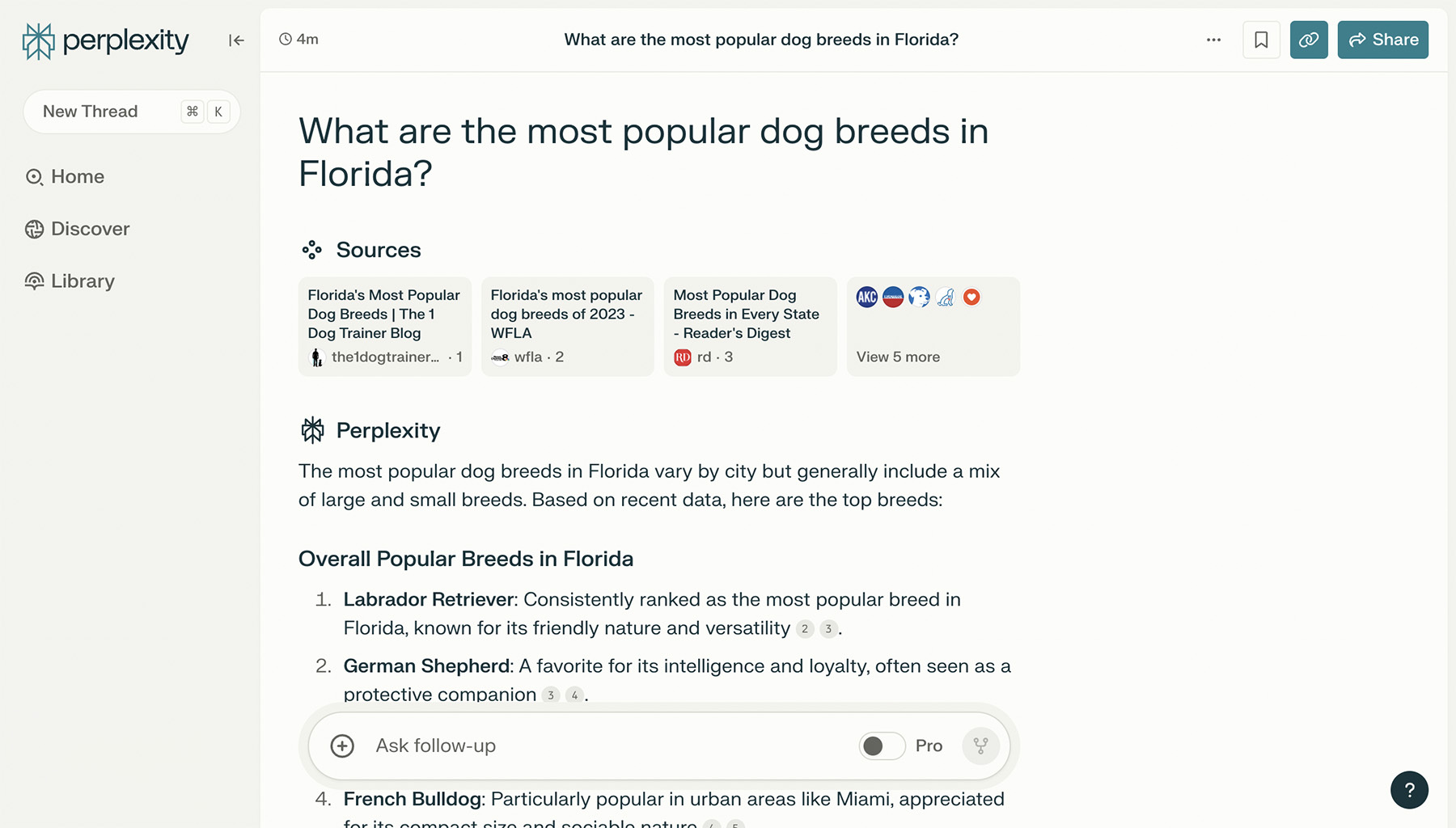
A screenshot from Perplexity's search engine after asking it this prompt: "What are the most popular dog breeds in Florida?"
Srinivas spent a few months as an OpenAI intern in summer 2018, then did two more internships: one at Google’s DeepMind lab in London and another at Google headquarters in Mountain View. He returned to OpenAI for a short spell in 2021 before leaving to start Perplexity a year later, co-founding it with three others: Denis Yarats, a former Facebook AI researcher; Johnny Ho, who’d been a quantitative trader; and Andy Konwinski, a Databricks co-founder.

Over the last several years, Perplexity has built its own search engine bot that crawls websites and indexes their information the same way Google creates its index. Perplexity also does customized training on open-source LLMs, such as Mistral and Meta’s Llama, to increase accuracy and pull up-to-date information from the web.

Why didn’t Perplexity build its own LLMs for its search engine? It was a matter of expense and the fact that many excellent ones already exist, Srinivas said: Using someone else’s was cheaper and faster.

“There’s a reason we don’t build [proprietary LLMs]. It’s not because we don’t know how to,” Srinivas said. “I am trained in AI research. My co-founder Denis is trained in AI research. My other co-founder, Johnny, is the world’s best competitive programmer. It’s not like we are complete noobs who don’t know how to build technology.”

As a result, Perplexity has kept its cash burn lower than some other AI startups, Srinivas said. He estimates that it is about “two orders of magnitude” less than that of OpenAI, which could lose as much as $5 billion this year.

Nonetheless, Perplexity sure spends big to access OpenAI’s APIs. It is on track to shell out between $15 million and $20 million over the next 12 months for its search engine to access OpenAI’s LLMs, said a person with direct knowledge of the figure. (An OpenAI spokesperson didn’t have a comment). Perplexity also offers paid subscribers access to Anthropic’s LLMs, though its spending with that company couldn’t be learned.

Rather than focus on the “relentless iteration of model after model,” Srinivas has pinned Perplexity’s hopes on creating a sleek, well-designed search engine that users find simpler to use than competing products from OpenAI, Microsoft and Google.

That leaves Perplexity open to the easy criticism that it hasn’t really built much of anything—other than a fancy wrapper around LLMs from other companies. When I raised this point with Srinivas, he tested my movie knowledge.

“There’s a scene in the ‘Steve Jobs’ movie,” he said. “I can play it for you.”
He pulled up a part from the 2015 film in which Jobs, played by Michael Fassbender, argues with Apple co-founder Steve Wozniak, portrayed by comedian Seth Rogen, over their ultimate worth to the company. Wozniak is angry that Jobs has achieved a genius-level aura even though Wozniak and others at Apple have been the ones toiling to develop the technology behind Apple computers.

“You’re a good musician,” Jobs tells Wozniak. “I play the orchestra.”

Yes, in Srinivas’ mind, what he’s doing with Perplexity is akin to that Jobs-style orchestration: He’s blending other people’s technology into one pretty product.

“There’s quite a significant group of people who think we have the best UX, best design, best orchestration, best packaging of the models in one single product,” he said, not missing a beat. And with his search engine offering multiple LLMs, he has a product that “builds more trust” than other competitors running on a single model can garner.

Yet Srinivas’ truthfulness was a subject of significant controversy this year.

In June, Forbes reported that Perplexity had taken an exclusive investigative story about an Eric Schmidt–backed drone project, packaged it with minimal changes to the text and sent it out as a news alert in a neatly formatted webpage—a new product for the startup—to Perplexity users.

At the top of the page appeared an illustration of Schmidt that Forbes had commissioned for a separate story on the billionaire. Only the tiniest attribution to Forbes, using a small icon of its logo, appeared in the lower left corner. Forbes Chief Content Officer Randall Lane deemed Perplexity’s actions a “cynical theft” in a public blog post. He said it was an example of “the inflection point that our AI progress now faces,” where AI startups are enjoying a boom time partially off the content produced by moribund journalism companies.

The New York Times Co. is one of several media giants going after Aravind Srinivas' Perplexity. Getty Images

Within media, plagiarism is a mortal sin, one of the only things that can lead to surefire dismissals in a newsroom, but to Srinivas, it was a correctable mistake, an example of an early product’s iteration in public. After Forbes complained, Srinivas promised to make attribution more prominent in the new Perplexity product.

Srinivas also sought to reframe the issue publicly and underline how much beleaguered publishers need companies like Perplexity, which could funnel new readers toward their content: Shortly after Forbes complained about Perplexity plagiarizing its articles, Srinivas said on X that Perplexity was the second-largest referral source for Forbes. The publisher disputed that figure and put the number much lower: Perplexity was actually the 54th-largest traffic source for Forbes stories, it said.

Several weeks later, Wired published an investigation into Srinivas’ startup that ran with a five-alarm headline: “Perplexity Is a Bullshit Machine.” According to Wired, Perplexity was scraping up content from Wired and other publications owned by publisher Condé Nast against their will, even though the publications had fenced off their content from bots. At times, Perplexity’s answers were inaccurate, too, Wired reported. In response, Condé Nast sent Perplexity a cease-and-desist letter in July, demanding that it stop using content from Condé Nast publications in its search results. (When News Corp filed its lawsuit against Perplexity, it also brought up the issue of accuracy, claiming that Perplexity had damaged its reputation by attributing false stories to its publications in search results.)

I asked Srinivas to respond to the complaints from Forbes and Wired about how Perplexity operates, which he described as “uncharitable conclusions.”

“They said we stole their content—we never stole,” he said. “We attributed sources all the time.” (As for the News Corp. allegations, Srinivas acknowledged that Perplexity “is still working on the solving the hallucination problem…an issue for all of AI right now.”)
Soon after the contretemps with Forbes and Wired, Perplexity announced a program in which publishers will get a cut of the revenue it makes when an answer delivered through the search engine references their sites. Perplexity hasn’t provided specific details, such as how much publishers will get, but it was able to sign up Time magazine, Der Spiegel, Fortune, Entrepreneur, The Texas Tribune and WordPress.com as early members.

“This is us trying to figure out our own path in a world where people with way more money than us are just paying off [content owners] to keep quiet,” Srinivas said in a thinly veiled criticism of OpenAI cutting content-sharing deals with publishers to forestall any legal action.

For now, Perplexity’s investors are sticking with Srinivas. Cack Wilhelm, general partner at IVP and a board member at Perplexity, described the controversy with Forbes and Wired as “a turning point” for Srinivas in terms of his ability to handle the corporate challenges headed his way. “He’d wake up every day sort of bracing for what was [going to happen] next,” Wilhelm said. “I think he has more of a Teflon stance now, like whatever is going to happen, we can handle it."

Contending with aggrieved media companies may be peanuts compared to what Srinivas next hopes to do: Go head to head with Google and others in digital advertising.

In August, Perplexity began circulating a pitch deck to advertisers that outlined its plans to begin running ads later this year. The startup plans to feature the ads near where people see answers to their queries.

Perplexity may charge as much as 10 times the going rate for typical search advertisements (or roughly a $50 CPM), according to a person with direct knowledge of the matter. That’s an extraordinary request, and it has made Perplexity a target of skeptics in advertising industry circles.

"Marketing budgets are tight, and I just don't see a justification for [advertisers] spending that much money," said Noam Dorros, a Gartner analyst who covers the web advertising industry.

How does Srinivas hope to justify the higher ad rate? He believes Perplexity’s ads are more valuable because they will serve up an advertiser’s content at a moment when someone is better primed to purchase an item than if they had looked for the same thing through a traditional internet search. That’s because Perplexity’s succinct, conversational search engine doesn’t require siphoning through dozens of links.

“If you can target even more efficiently, you should pay up more,” Srinivas said.

“We are not going to try and do ads in the same way Google did. We’re trying to figure out a different approach here.…I think by mid-2025 we will have a clear answer of what’s working, what’s not working and what’s the best pricing point.”

That’s a fine perspective, but Google, after apparently having some initial hesitation about AI, fearing that the technology would disrupt its ads business, now appears to be moving full steam ahead with AI. After taking early heat for delivering incorrect responses through AI Overviews, Google has ironed out the kinks, and it began showing ads on the service in early October.

Meanwhile, OpenAI in July announced it is working on its own search service, SearchGPT, which could fuel more competition with Perplexity’s product.

In the coming months, Srinivas also plans to make an announcement about the size of Perplexity’s search index, details of which he has held close to his vest, according to a person with direct knowledge and another who was briefed on the matter.

Google hasn’t revealed the size of its search index, but industry estimates have pegged it at around 400 billion to 500 billion documents. Perplexity is considering building a smaller search index—encompassing tens of billions of documents—as well as its own website ranking system, said the person with direct knowledge of its plans. This is a better fit for delivering AI-powered search results and is also a step toward relying less on data from Google and Bing, said the person.

Srinivas seems to think Perplexity has as much of a shot at figuring out AI search advertising as Google or anyone else, given that the market is largely undefined at this point. Armed with that confidence, he will now test the waters to see if advertisers are willing to pay more to be associated with the startup.

“I’ve seen comments of people saying, ‘This company’s toast,’” Srininvas said. “I’m fully aware of all the criticism.”

TechCrunch : OpenAI says it won’t release a model called Orion this year

OpenAI says it won’t release a model called Orion this year

OpenAI says that it doesn’t intend to release an AI model code-named Orion this year, countering recent reporting on the company’s product roadmap.

“We don’t have plans to release a model code-named Orion this year,” a spokesperson told TechCrunch via email. “We do plan to release a lot of other great technology.”

The Verge reported on Thursday that Orion, which is expected to be OpenAI’s next frontier model, would launch by December, and that trusted partners would be the first to preview it ahead of a rollout through ChatGPT. According to The Verge, Microsoft, a close OpenAI collaborator and investor, expects to gain access to Orion as early as November.

OpenAI previously told TechCrunch that The Verge’s report wasn’t accurate, but declined to elaborate further.

Orion, a step up from OpenAI’s current flagship, GPT-4o, is reportedly trained in part on synthetic training data from o1, the company’s “reasoning” model. OpenAI plans for the foreseeable future to continue developing new “GPT” models alongside reasoning models like o1, which it sees as addressing fundamentally different use cases.

OpenAI’s statement leaves substantial wiggle room. It could be that the company’s next major model isn’t, in fact, Orion. Or perhaps OpenAI will release a new model by December, but one less capable than Orion.

At this point, it’s anyone’s guess.

TechCrunch : What is Apple Intelligence, when is it coming and who will get it?

What is Apple Intelligence, when is it coming and who will get it?

After months of speculation, Apple Intelligence took center stage at WWDC 2024 in June. The platform was announced in the wake of a torrent of generative AI news from companies like Google and Open AI, causing concern that the famously tight-lipped tech giant had missed the boat on the latest tech craze.

Contrary to such speculation, however, Apple had a team in place, working on what proved to be a very Apple approach to artificial intelligence. There was still pizzazz amid the demos — Apple always loves to put on a show — but Apple Intelligence is ultimately a very pragmatic take on the category.

Apple Intelligence (yes, AI for short) isn’t a standalone feature. Rather, it’s about integrating into existing offerings. While it is a branding exercise in a very real sense, the large language model (LLM) driven technology will operate behind the scenes. As far as the consumer is concerned, the technology will mostly present itself in the form of new features for existing apps.

We learned more during the Apple’s iPhone 16 event, which was held on September 9. During the event, Apple touted a number of AI-powered features coming to their devices, from translation on the Apple Watch Series 10, visual search on iPhones and a number of tweaks to Siri’s capabilities. The first wave of Apple Intelligence is arriving at the end of October, as part of iOS 18.1, iPadOS 18.1 and macOS Sequoia 15.1. A second wave of features are available as part of iOS 18.2, iPadOS 18.2 and macOS Sequoia 15.2 developer betas.

The features launched first in U.S. English. Apple has since added Australian, Canadian, New Zealand, South African, and U.K. English localizations.

Support for Chinese, English (India), English (Singapore), French, German, Italian, Japanese, Korean, Portuguese, Spanish, and Vietnamese will arrive in 2025. Notably, users in both China and the EU may not get any access to Apple Intelligence features, owing to regulatory hurdles.

What is Apple Intelligence?
Cupertino marketing executives have branded Apple Intelligence: “AI for the rest of us.” The platform is designed to leverage the things that generative AI already does well, like text and image generation, to improve upon existing features. Like other platforms including ChatGPT and Google Gemini, Apple Intelligence was trained on large information models. These systems use deep learning to form connections, whether it be text, images, video or music.

The text offering, powered by LLM, presents itself as Writing Tools. The feature is available across various Apple apps, including Mail, Messages, Pages and Notifications. It can be used to provide summaries of long text, proofread and even write messages for you, using content and tone prompts.

Image generation has been integrated as well, in similar fashion — albeit a bit less seamlessly. Users can prompt Apple Intelligence to generate custom emojis (Genmojis) in an Apple house style. Image Playground, meanwhile, is a standalone image generation app that utilizes prompts to create visual content than can be used in Messages, Keynote or shared via social media.

Apple Intelligence also marks a long-awaited face-lift for Siri. The smart assistant was early to the game, but has mostly been neglected for the past several years. Siri is integrated much more deeply into Apple’s operating systems; for instance, instead of the familiar icon, users will see a glowing light around the edge of their iPhone screen when it’s doing its thing.

More important, new Siri works across apps. That means, for example, that you can ask Siri to edit a photo and then insert it directly into a text message. It’s a frictionless experience the assistant had previously lacked. Onscreen awareness means Siri uses the context of the content you’re currently engaged with to provide an appropriate answer.

Who gets Apple Intelligence and when?
The first wave of Apple Intelligence arrives in October via iOS 18.1, iPadOS 18., and macOS Sequoia 15.1 updates. These include integrated writing tools, image cleanup, article summaries, and a typing input for the redesigned Siri experience.
Many remaining features will be added with the forthcoming release of of October, as part of iOS 18.1, iPadOS 18.1 and macOS Sequoia 15.1. A second wave of features are available as part of iOS 18.2, iPadOS 18.2 and macOS Sequoia 15.2. That list includes, Genmoji, Image Playground, Visual Intelligence, Image Wand, and ChatGPT integration.
The offering will be free to use, so long as you have one of the following pieces of hardware:
  • All iPhone 16 models
  • iPhone 15 Pro Max (A17 Pro)
  • iPhone 15 Pro (A17 Pro)
  • iPad Pro (M1 and later)
  • iPad Air (M1 and later)
  • iPad mini (A17 or later)
  • MacBook Air (M1 and later)
  • MacBook Pro (M1 and later)
  • iMac (M1 and later)
  • Mac mini (M1 and later)
  • Mac Studio (M1 Max and later)
  • Mac Pro (M2 Ultra)
Notably, only the Pro versions of the iPhone 15 are getting access, owing to shortcomings on the standard model’s chipset. Presumably, however, the whole iPhone 16 line will be able to run Apple Intelligence when it arrives.

Private Cloud Compute
Apple has taken a small-model, bespoke approach to training. Rather than relying on the kind of kitchen sink approach that fuels platforms like GPT and Gemini, the company has compiled datasets in-house for specific tasks like, say, composing an email. The biggest benefit of this approach is that many of these tasks become far less resource intensive and can be performed on-device.

That doesn’t apply to everything, however. More complex queries will utilize the new Private Cloud Compute offering. The company now operates remote servers running on Apple Silicon, which it claims allows it to offer the same level of privacy as its consumer devices. Whether an action is being performed locally or via the cloud will be invisible to the user, unless their device is offline, at which point remote queries will toss up an error.

Apple Intelligence with third-party apps
A lot was made about Apple’s pending partnership with OpenAI ahead of WWDC. Ultimately, however, it turned out that the deal was less about powering Apple Intelligence and more about offering an alternative platform for those things it’s not really built for. It’s a tacit acknowledgement that building a small-model system has its limitation.

Apple Intelligence is free. So, too, is access to ChatGPT. However, those with paid accounts to the latter will have access to premium features free users don’t, including unlimited queries.

ChatGPT integration, which debuts on iOS 18.2, iPadOS 18.2, and macOS Sequoia 15.2, has two primary roles: supplementing Siri’s knowledge base and adding to the existing Writing Tools options.

With the service enabled, certain questions will prompt the new Siri to ask the user to approve its accessing ChatGPT. Recipes and travel planning are examples of questions that may surface the option. Users can also directly prompt Siri to “ask ChatGPT.”

Compose is the other primary ChatGPT feature available through Apple Intelligence. Users can access it in any app that supports the new Writing Tools feature. Compose adds the ability to write content based on a prompt. That joins existing writing tools like Style and Summary.

We know for sure that Apple plans to partner with additional generative AI services. The company all but said that Google Gemini is next on that list.