Legal Threats, Google Competition Loom Over Perplexity’s ‘Newbie CEO’
Aravind Srinivas believes he has a new revenue model for AI—if he doesn’t sink his startup’s brand first.
Aravind Srinivas didn’t set out to earn a reputation as one of the media’s biggest tech villains. It just kind of happened.
Over the summer, Forbes and Wired angrily accused Srinivas’ AI search startup, Perplexity, of plagiarizing their paywalled content.
In one case, Perplexity had lifted portions of a Forbes story and used it in a new product that summarizes news stories. In the other instance, a Wired reporter found that Perplexity’s search engine tried to pass off Wired content as its own when that reporter asked the search engine to summarize a Wired story.
Then, last week, The New York Times Co. sent Srinivas a cease-and-desist letter demanding that Perplexity stop using its content for its AI-powered search engine. And days ago News Corp, the publisher of The Wall Street Journal and The New York Post, filed its own copyright-infringement lawsuit demanding that Srinivas’ startup keep its hands off the media company’s stories.
Srinivas wouldn’t comment on the latest salvos from The Times and News Corp, but when I brought up the Forbes and Wired drama with him a few weeks ago, he pleaded youthful ignorance. “I’m a newbie CEO trying to learn here,” said Srinivas, 30, who is both Perplexity’s CEO and its co-founder. “I underestimated how important people take us, to be honest. I was still thinking we are a product that most people don’t even know or care about. So all that attention was very new to me.”
Does Srinivas really believe that? It’s hard to imagine he portrayed himself in that way when he went to win money from investors like Jeff Bezos, Sequoia Capital and New Enterprise Associates, a group that has shoved more than $400 million into his hands over the last two years. At the same time, Perplexity’s valuation has increased from roughly $500 million a year ago to $3 billion in April.
And Srinivas has reportedly begun fresh fundraising discussions that would value Perplexity at an even more heady $8 billion.
Meanwhile, it has been a red-hot acquisition target.
Srinivas does have some numbers to impress investors. Perplexity has seen strong growth from a pair of subscription products: one aimed at consumers, another at corporations. The startup is currently generating around $50 million in annual recurring revenue, according to a person with direct knowledge of the number. That is up from around $2.5 million last October, according to a person with knowledge of the figure. Perplexity isn’t yet profitable and plans to continue raising money for the foreseeable future, Srinivas said.
Subscribers get access to Perplexity’s web-based search engine, which relies on large language models from other companies, such as OpenAI, to function. For $20 a month, consumers can select from a variety of LLMs. For $40, enterprise customers get a set of extra security features.
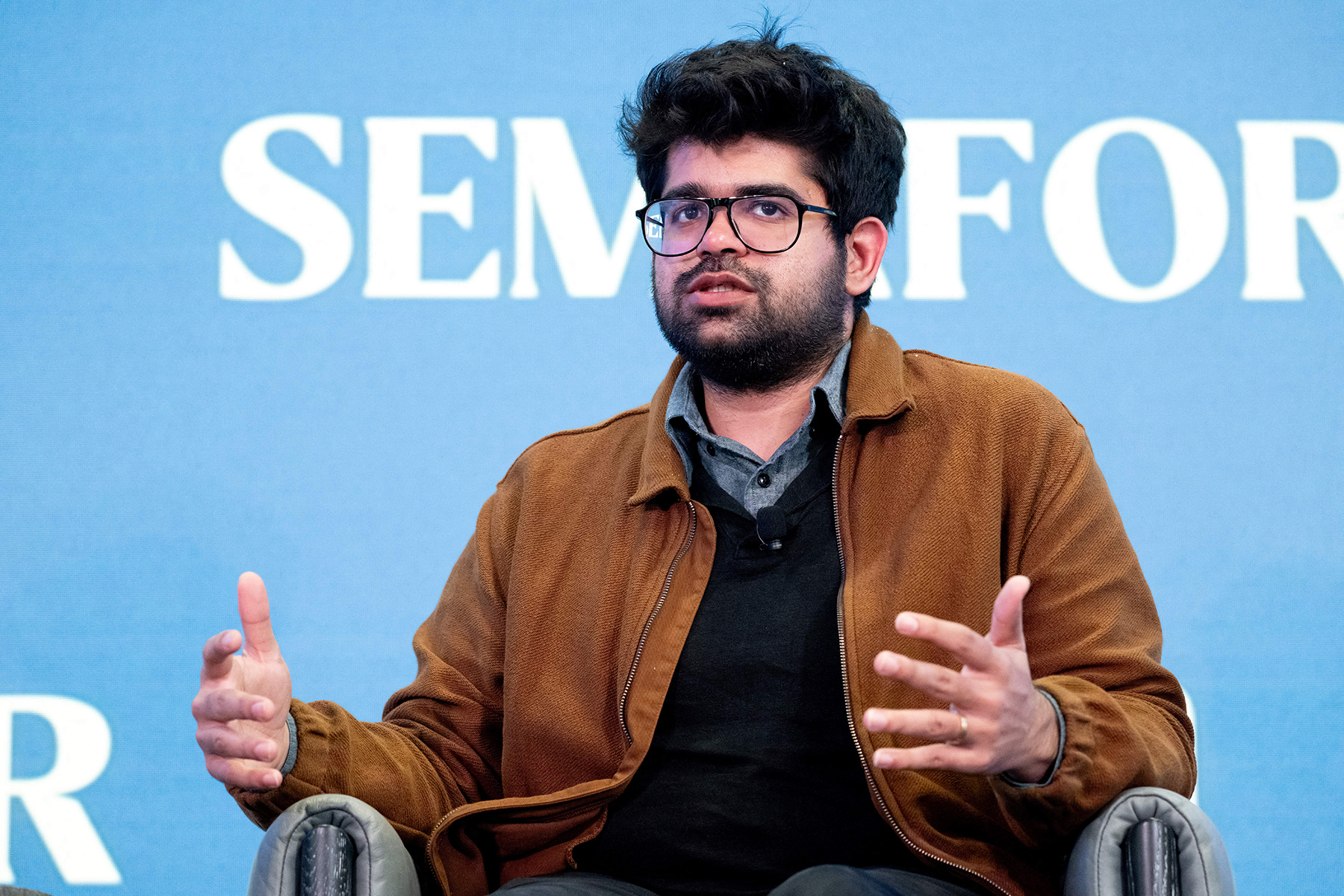
Perplexity CEO Aravind Srinivas appears at a conference hosted by Semafor, a news media startup, in April. Getty Images
Searching for an answer through Perplexity can often be faster than pawing through the traditional 10 blue links provided by Google.
Much of Perplexity’s popularity stems from frustration with Google search, which puts the onus on users to navigate to what they’re seeking. For example, ask Perplexity what the most popular dog breed in Florida is, and it’ll immediately tell you it’s a Labrador retriever. An old-fashioned Google search without AI assistance brings up links to websites like Dogster.com, which has the same information but takes a few more seconds to access.
To satisfy both Perplexity’s supporters and its detractors, Srinivas must pull off a high-stakes act. He has to find ways to continue growing Perplexity—partly through an ad-based model launching later this year—and persevere where others have given up.
Last year, for instance, Neeva, a once-promising AI search startup, sold itself to Snowflake, a data software firm, when Neeva co-founder Sridhar Ramaswamy realized after four years that the business likely wasn’t going to grow much further. “We had created an amazing product, but we weren’t quite seeing hockey-stick growth,” Ramaswamy recalled in a June interview with The Information.
Similarly, the 1,600-pound gorilla in the search business—namely, Google—could pose growth problems for Perplexity. In May, Google launched a feature called AI Overviews, which automatically summarizes search results à la Perplexity.
And Srinivas, who has gone far on newbie ambition and blithe self-confidence, must also contend with the legal threats from infuriated companies with the financial wherewithal to sue him into submission.
Srinivas finds himself in the same scenario as many AI founders who have hoovered up funding from investors even when their startups are flying high on unproven business models and facing mounting legal challenges.
Industry leader OpenAI has adopted a version of this strategy, though it is buttressed by significantly more capital and brand-name recognizability. OpenAI’s size and popularity has helped it convince media publishers to sign revenue-sharing content deals.
(Srinivas is also beginning to strike deals with publishers and is trying to persuade media companies to view OpenAI and other LLM creators as the greater enemy.)
Perplexity’s alleged scraping of copyrighted content has raised eyebrows among industry observers like Jason Kint, CEO of Digital Content Next, an online-publishing trade group. “I think there is a serious question whether this is a legitimate business considering the allegations of mass copyright infringement,” he said via email. “Perplexity’s leadership seems to believe…it deserves some sort of pass on centuries of law.”
Srinivas has already faced a period of doubt over whether Perplexity could make it as an independent company. While the startup’s revenue growth, head count and valuation have increased steadily this year, he spent a lot of 2023 considering whether to sell the company due to concerns over the cost of running its service and competition from the likes of Google and OpenAI, said two people with direct knowledge. Microsoft also announced a new AI-powered Bing feature in February 2023.
In the summer and fall of 2023, Srinivas told members of his executive team that Perplexity had received acquisition offers from three companies: X, OpenAI and Notion, according to a person with direct knowledge of the matter. Srinivas indicated that Perplexity’s talks with X were particularly detailed as Elon Musk, the social network’s owner, was interested in using Perplexity’s technology to improve X’s search functionality, the person said. Perplexity had earlier launched Bird SQL, a tool for searching X’s archive of tweets using conversational language.
Srinivas also told employees Microsoft had expressed interest in acquiring Perplexity and had discussed how to structure a deal that would make it pass regulators, said the person. All three offers were in the $150 million to $200 million range, the person added.
Perplexity was valued at $150 million after a funding round announced in March 2023. Details about the companies that made the offers and their amounts haven’t been previously reported. (An OpenAI spokesperson declined to comment; Microsoft wouldn’t comment; and X and Notion didn’t respond to requests for comment.)
“We knew this was going to be pretty competitive and difficult,” Srinivas acknowledged, considering Perplexity’s journey as a whole. “There are all sorts of uncertainties.”
When Srinivas first arrived in Silicon Valley, he met another AI enthusiast who espoused nothing but certainty: Ilya Sutskever, the OpenAI co-founder who interviewed Srinivas for an OpenAI internship in 2018. “When you meet Ilya, it’s very hard not to get that reality distortion field—he has that effect,” Srinivas recalled. “So when I interviewed, Ilya spent five minutes or 10 minutes talking to me, and I was like, ‘OK, this is the greatest genius the world has, and I need to be around this person.’”
He was captivated by Sutskever’s belief that OpenAI would quickly advance toward producing an AI capable of reaching humanlike intelligence—what the AI industry calls AGI or artificial general intelligence.
“They even had a road map toward it, which of course didn’t pan out,” said Srinivas, who was born in the southern India city of Chennai and earned a computer science doctorate at the University of California, Berkeley. “I bought into all the hype in the beginning.”
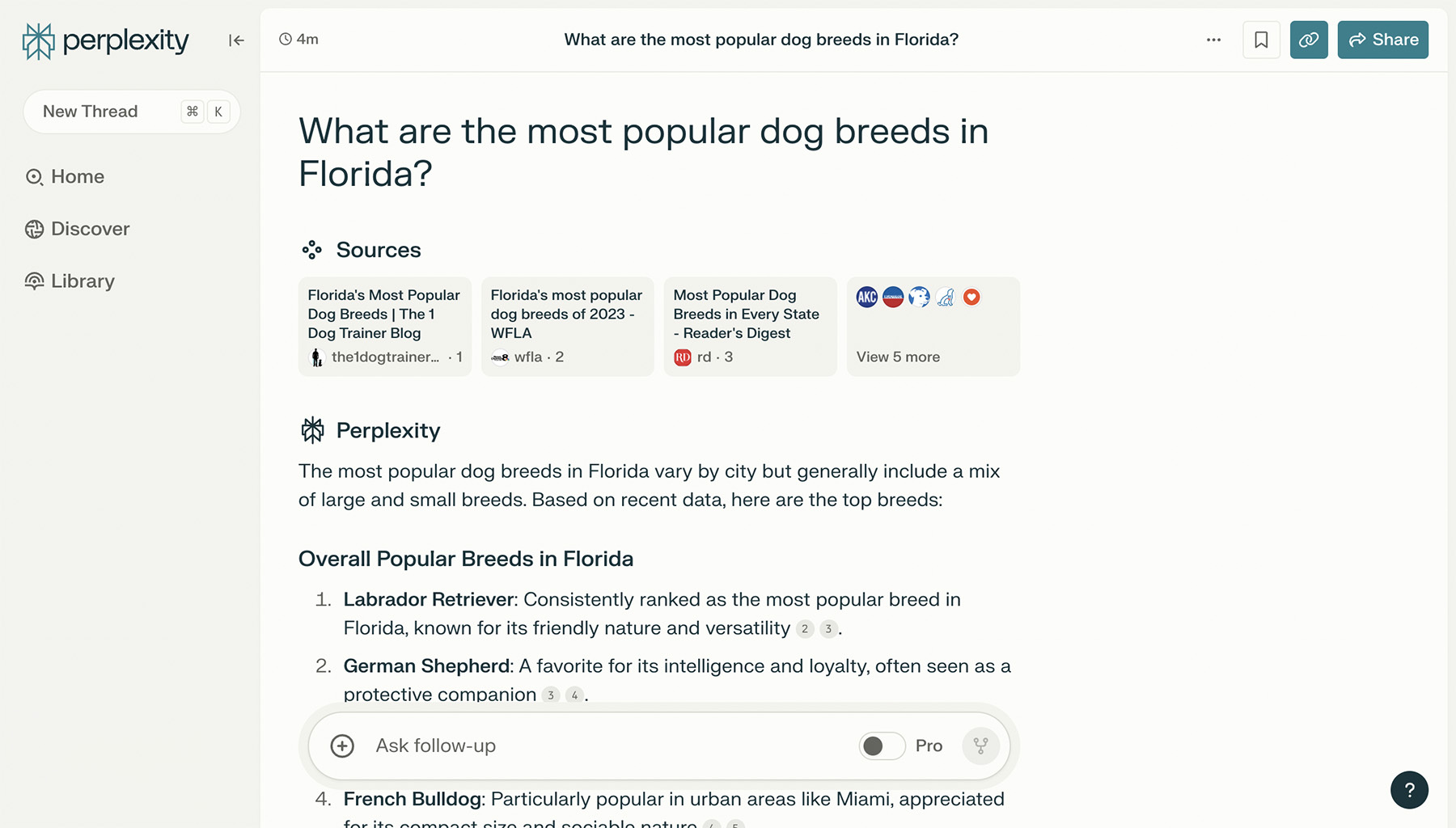
A screenshot from Perplexity's search engine after asking it this prompt: "What are the most popular dog breeds in Florida?"
Srinivas spent a few months as an OpenAI intern in summer 2018, then did two more internships: one at Google’s DeepMind lab in London and another at Google headquarters in Mountain View. He returned to OpenAI for a short spell in 2021 before leaving to start Perplexity a year later, co-founding it with three others: Denis Yarats, a former Facebook AI researcher; Johnny Ho, who’d been a quantitative trader; and Andy Konwinski, a Databricks co-founder.
Over the last several years, Perplexity has built its own search engine bot that crawls websites and indexes their information the same way Google creates its index. Perplexity also does customized training on open-source LLMs, such as Mistral and Meta’s Llama, to increase accuracy and pull up-to-date information from the web.
Why didn’t Perplexity build its own LLMs for its search engine? It was a matter of expense and the fact that many excellent ones already exist, Srinivas said: Using someone else’s was cheaper and faster.
“There’s a reason we don’t build [proprietary LLMs]. It’s not because we don’t know how to,” Srinivas said. “I am trained in AI research. My co-founder Denis is trained in AI research. My other co-founder, Johnny, is the world’s best competitive programmer. It’s not like we are complete noobs who don’t know how to build technology.”
As a result, Perplexity has kept its cash burn lower than some other AI startups, Srinivas said. He estimates that it is about “two orders of magnitude” less than that of OpenAI, which could lose as much as $5 billion this year.
Nonetheless, Perplexity sure spends big to access OpenAI’s APIs. It is on track to shell out between $15 million and $20 million over the next 12 months for its search engine to access OpenAI’s LLMs, said a person with direct knowledge of the figure. (An OpenAI spokesperson didn’t have a comment). Perplexity also offers paid subscribers access to Anthropic’s LLMs, though its spending with that company couldn’t be learned.
Rather than focus on the “relentless iteration of model after model,” Srinivas has pinned Perplexity’s hopes on creating a sleek, well-designed search engine that users find simpler to use than competing products from OpenAI, Microsoft and Google.
That leaves Perplexity open to the easy criticism that it hasn’t really built much of anything—other than a fancy wrapper around LLMs from other companies. When I raised this point with Srinivas, he tested my movie knowledge.
“There’s a scene in the ‘Steve Jobs’ movie,” he said. “I can play it for you.”
He pulled up a part from the 2015 film in which Jobs, played by Michael Fassbender, argues with Apple co-founder Steve Wozniak, portrayed by comedian Seth Rogen, over their ultimate worth to the company. Wozniak is angry that Jobs has achieved a genius-level aura even though Wozniak and others at Apple have been the ones toiling to develop the technology behind Apple computers.
“You’re a good musician,” Jobs tells Wozniak. “I play the orchestra.”
Yes, in Srinivas’ mind, what he’s doing with Perplexity is akin to that Jobs-style orchestration: He’s blending other people’s technology into one pretty product.
“There’s quite a significant group of people who think we have the best UX, best design, best orchestration, best packaging of the models in one single product,” he said, not missing a beat. And with his search engine offering multiple LLMs, he has a product that “builds more trust” than other competitors running on a single model can garner.
Yet Srinivas’ truthfulness was a subject of significant controversy this year.
In June, Forbes reported that Perplexity had taken an exclusive investigative story about an Eric Schmidt–backed drone project, packaged it with minimal changes to the text and sent it out as a news alert in a neatly formatted webpage—a new product for the startup—to Perplexity users.
At the top of the page appeared an illustration of Schmidt that Forbes had commissioned for a separate story on the billionaire. Only the tiniest attribution to Forbes, using a small icon of its logo, appeared in the lower left corner. Forbes Chief Content Officer Randall Lane deemed Perplexity’s actions a “cynical theft” in a public blog post. He said it was an example of “the inflection point that our AI progress now faces,” where AI startups are enjoying a boom time partially off the content produced by moribund journalism companies.

The New York Times Co. is one of several media giants going after Aravind Srinivas' Perplexity. Getty Images
Within media, plagiarism is a mortal sin, one of the only things that can lead to surefire dismissals in a newsroom, but to Srinivas, it was a correctable mistake, an example of an early product’s iteration in public. After Forbes complained, Srinivas promised to make attribution more prominent in the new Perplexity product.
Srinivas also sought to reframe the issue publicly and underline how much beleaguered publishers need companies like Perplexity, which could funnel new readers toward their content: Shortly after Forbes complained about Perplexity plagiarizing its articles, Srinivas said on X that Perplexity was the second-largest referral source for Forbes. The publisher disputed that figure and put the number much lower: Perplexity was actually the 54th-largest traffic source for Forbes stories, it said.
Several weeks later, Wired published an investigation into Srinivas’ startup that ran with a five-alarm headline: “Perplexity Is a Bullshit Machine.” According to Wired, Perplexity was scraping up content from Wired and other publications owned by publisher Condé Nast against their will, even though the publications had fenced off their content from bots. At times, Perplexity’s answers were inaccurate, too, Wired reported. In response, Condé Nast sent Perplexity a cease-and-desist letter in July, demanding that it stop using content from Condé Nast publications in its search results. (When News Corp filed its lawsuit against Perplexity, it also brought up the issue of accuracy, claiming that Perplexity had damaged its reputation by attributing false stories to its publications in search results.)
I asked Srinivas to respond to the complaints from Forbes and Wired about how Perplexity operates, which he described as “uncharitable conclusions.”
“They said we stole their content—we never stole,” he said. “We attributed sources all the time.” (As for the News Corp. allegations, Srinivas acknowledged that Perplexity “is still working on the solving the hallucination problem…an issue for all of AI right now.”)
Soon after the contretemps with Forbes and Wired, Perplexity announced a program in which publishers will get a cut of the revenue it makes when an answer delivered through the search engine references their sites. Perplexity hasn’t provided specific details, such as how much publishers will get, but it was able to sign up Time magazine, Der Spiegel, Fortune, Entrepreneur, The Texas Tribune and WordPress.com as early members.
“This is us trying to figure out our own path in a world where people with way more money than us are just paying off [content owners] to keep quiet,” Srinivas said in a thinly veiled criticism of OpenAI cutting content-sharing deals with publishers to forestall any legal action.
For now, Perplexity’s investors are sticking with Srinivas. Cack Wilhelm, general partner at IVP and a board member at Perplexity, described the controversy with Forbes and Wired as “a turning point” for Srinivas in terms of his ability to handle the corporate challenges headed his way. “He’d wake up every day sort of bracing for what was [going to happen] next,” Wilhelm said. “I think he has more of a Teflon stance now, like whatever is going to happen, we can handle it."
Contending with aggrieved media companies may be peanuts compared to what Srinivas next hopes to do: Go head to head with Google and others in digital advertising.
In August, Perplexity began circulating a pitch deck to advertisers that outlined its plans to begin running ads later this year. The startup plans to feature the ads near where people see answers to their queries.
Perplexity may charge as much as 10 times the going rate for typical search advertisements (or roughly a $50 CPM), according to a person with direct knowledge of the matter. That’s an extraordinary request, and it has made Perplexity a target of skeptics in advertising industry circles.
"Marketing budgets are tight, and I just don't see a justification for [advertisers] spending that much money," said Noam Dorros, a Gartner analyst who covers the web advertising industry.
How does Srinivas hope to justify the higher ad rate? He believes Perplexity’s ads are more valuable because they will serve up an advertiser’s content at a moment when someone is better primed to purchase an item than if they had looked for the same thing through a traditional internet search. That’s because Perplexity’s succinct, conversational search engine doesn’t require siphoning through dozens of links.
“If you can target even more efficiently, you should pay up more,” Srinivas said.
“We are not going to try and do ads in the same way Google did. We’re trying to figure out a different approach here.…I think by mid-2025 we will have a clear answer of what’s working, what’s not working and what’s the best pricing point.”
That’s a fine perspective, but Google, after apparently having some initial hesitation about AI, fearing that the technology would disrupt its ads business, now appears to be moving full steam ahead with AI. After taking early heat for delivering incorrect responses through AI Overviews, Google has ironed out the kinks, and it began showing ads on the service in early October.
Meanwhile, OpenAI in July announced it is working on its own search service, SearchGPT, which could fuel more competition with Perplexity’s product.
In the coming months, Srinivas also plans to make an announcement about the size of Perplexity’s search index, details of which he has held close to his vest, according to a person with direct knowledge and another who was briefed on the matter.
Google hasn’t revealed the size of its search index, but industry estimates have pegged it at around 400 billion to 500 billion documents. Perplexity is considering building a smaller search index—encompassing tens of billions of documents—as well as its own website ranking system, said the person with direct knowledge of its plans. This is a better fit for delivering AI-powered search results and is also a step toward relying less on data from Google and Bing, said the person.
Srinivas seems to think Perplexity has as much of a shot at figuring out AI search advertising as Google or anyone else, given that the market is largely undefined at this point. Armed with that confidence, he will now test the waters to see if advertisers are willing to pay more to be associated with the startup.
“I’ve seen comments of people saying, ‘This company’s toast,’” Srininvas said. “I’m fully aware of all the criticism.”