--> Could be another element for the short FAcebook pushed by Citron
Snapchat Launches a Colossal Expansion of Its Advertising, Ushering in a New Era for the App
Unveils new API and $1 billion goal

Snapchat needs to achieve significant revenue growth to reach its aggressive goals. Adweek
Imran Khan was an internet-focused investment banker at Credit Suisse, where, in September 2014, he orchestrated Chinese ecommerce giant Alibaba's high-profile IPO. Three months later, his star rose even higher when he was named Snapchat's first
chief strategy officer, charged, many observers figured, with prepping the tech darling for its own eventual IPO. But in fact, Khan's marching orders from CEO
Evan Spiegel at the outset were more fluid than one might imagine.
"I was, like, the 171st employee. And in a small company, you don't have a defined role—you just jump in and start doing things," recalls the executive.
You just jump in and start doing things. Those eight words could serve as a pithy user manual for newcomers to Snapchat and its
array of unusual features that have confounded more than a few folks who were born before 1985. It's part of the job of Khan, 39, to "get" what Gen Y loves so much about the app, transforming their days into mobile reality TV episodes with stories (what Snapchat calls posts) they share with friends, a kaleidoscope of colorful filters, face-swapping effects and other, often wacky functions.
Khan and his army (the company is now 900 employees strong) have basically flipped the script on the advertising community, where, not so long ago, it was widely assumed that Snapchat's leadership was too immature to fully take advantage of its teen-idol status among millennials. And yet, Snapchat has rapidly built its ad business since
emerging as the talk of last year's Cannes Lions International Festival of Creativity. And next week, when the industry again converges on the
Riviera, the company may well find itself the belle of the ball once more. Today, the company announces the launch of Snapchat Partners, its long-anticipated advertising API (application programming interface), which will hook up more than 20 tech-minded companies. The API promises to expand advertising dramatically on the platform in the long run. "Different marketers have different objectives, and we just want to make it easier for them to buy ads on the platform," Khan explains. "We want [brands] to have a place where they can tell their stories, you know, in a better way."

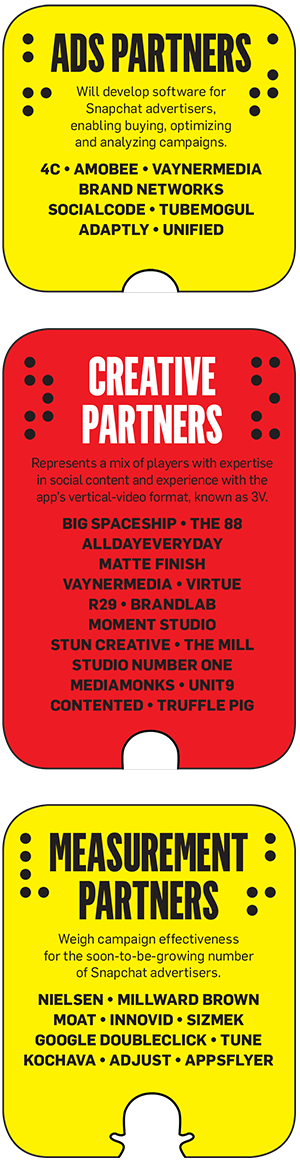
The API means that Snapchat ads will, for the first time, be sold by third parties, and will be divided by two kinds of collaborators: Ads Partners and Creative Partners. The first group will develop software for Snapchat advertisers, enabling buying, optimizing and analyzing of campaigns. Ads Partners includes 4C,
Amobee,VaynerMedia, Brand Networks, SocialCode,
TubeMogul, Adaptly and Unified.
The Creative Partners, meanwhile, represent a mix of players with expertise in social content and experience with Snapchat's vertical-video format, 3V, which the company plans to rebrand in the coming weeks as Snap Ads. That group includes Big Spaceship, The 88, Alldayeveryday, Matte Finish, VaynerMedia, Virtue, R29, BrandLab, Moment Studio, Stun Creative, The Mill, Studio Number One, MediaMonks, Unit9, Contented and
Truffle Pig, which is the agency Snapchat launched at Cannes last year in partnership with WPP and The Daily Mail. (It's worth noting that
VaynerMedia is the only player that will be both an Ads Partner and Creative Partner at launch.)
API inventory will be sold via an automated, auction-based system. Snapchat would not disclose much financial detail about the relationships on its API, but Ads Partners members, via their software, will sell video inventory to be automatically invoiced to Snapchat, after which the vendors will collect their fees.
The ads won't be spotted in the wild for a few weeks yet, as Snapchat Partners just got clearance to coordinate with brand marketers. Snapchat will work closely
with its partnersto ensure marketers have their ducks in a row—the quality of the ads will be a priority, for example. In fact, Snapchat will inspect every ad, much as Instagram did for years.
What does all this mean for ad pricing? Snapchat's premium video ad inventory—when sold directly by the company, as it has been for the last year or so—has so far been priced on a cost-per-thousand-impression rate that is sometimes competitive with TV, meaning in the $40-60 range, per industry sources. Marketers can expect both API videos and the newly launched Snap Ads
Between Stories to be less expensive, though special events like July 4th or Black Friday will likely jack up prices due to the supply-and-demand forces in an auction-based system. Snapchat predicts that the wider availability of its video ads will be a hit among brands, claiming they get five times greater consumer engagement—or "swipe ups," in the company's vernacular—when compared to clickthrough rates on most mobile ads.
Snapchat could, in theory, attract the ad spend marketers might otherwise throw at mobile banners or lose to ad fraud—neither of which exists on the platform, a proverbial "walled garden" of the social sector. If Khan's sales team does its job, Snapchat—reportedly with
150 million daily users, presented with full-screen ads on their smartphones—could stand to steal away a chunk of millennial-focused brands' TV budgets. The stats are irresistible to advertisers chasing the coveted demo, with Snapchat on any given day reaching 41 percent of consumers 18-34 in the U.S., according to Khan.
This spring, Snapchat implemented auto-advance stories, letting users swipe right to quickly catch up with their friends' stories. Going forward, Snapchatters will begin seeing video ads—the aforementioned Snap Ads Between Stories—in between their buddies' messages. Ten test partners are in tow, including Universal Pictures, Paramount Pictures, Verizon, Procter & Gamble, Warner Bros. and Express. "We are spending a tremendous amount of time and investment with Snapchat," says
Jim Hilt, CMO at Express.What of those faithful Snapchatters who fear the user experience will turn into an advertising hailstorm? They can go ahead and fold up their umbrellas, assures
Peter Sellis, the company's head of monetization. "We have to be thoughtful about the inventory, ad load and the ad experience. But we also know that we cannot build custom ad-tech solutions for every big type of advertiser, for every vertical. And so these [partners] really excel in those kinds of ways," he says.
With the rollout of Snap Ads Between Stories, Snapchat is promising once again to avoid pelting users with marketing messages. "By doing this the right way, focused on creativity and doing it early, it allows us to be extraordinarily conservative," says Sellis. "Something that I think often gets lost is that ad effectiveness can be inversely correlated with the number of ads that the viewer sees. If you see 50 ads in a day, the probability of you remembering them is low."
Snapchat may be as hot as summertime right now, but not all advertisers are feeling the warmth. Nearly one-third of brands with a Snapchat account, according to a
study from L2, don't bother posting even once a month on the mobile app. Expect that number to plummet before the holiday season, as more marketers wake up to what others are saying about the platform.
Lance Neuhauser, CEO of 4C, an API partner with Facebook, Instagram, Twitter, Pinterest, LinkedIn and now Snapchat, says he's never seen advertiser interest in an emerging social media platform grow as fast as it has for this app—not even Facebook. "We've been told that new buckets are actually being opened up for Snapchat specifically," he explains. "We've been told that there are new budgets raring to go."
Cathy Boyle, mobile analyst at eMarketer, predicts that over the next year more marketers will experiment with Snapchat—and, she adds, "the brands that have already been in the experimental phase will then likely begin shifting more dollars toward the platform."
The L2 study, which examined hundreds of marketers across sectors, also reveals that brands average 26 posts per week on Snapchat, significantly outpacing Instagram, where only the fashion category averages double-digit posts. What's more,
Thalamus, an advertising company research portal, reports that Snapchat is searched by media planners more than any other term on its site.
Digital marketers who are not getting religion with the app seem to be on the brink of an embarrassing confessional. According to the gospel of L'Oréal, marketers must be ahead of the curve about engaging with consumers where they spend their digital hours. "And right now,
that's Snapchat," says Marie Gulin-Merle, U.S. marketing chief for the cosmetics giant.
Last week, Snapchat brass appeared to lean in while addressing campaign measurement—one of brands' biggest concerns about the platform—by forging a deal with
Moat to provide an ad performance score. The score appears to take aim at the digital ad industry's de facto measurement authority, the Media Ratings Council, which states, controversially, that a chargeable impression needs to include only 50 percent of a mobile or desktop screen while an ad runs for just two seconds.
The new Snapchat-Moat metric comes from a different set of criteria, generating a quality score from 0 to 100, by calculating screen real estate (3V ads are full-screen) and time exposed to video and audio. For now, the score is meant to guide advertisers as they weigh a campaign's effectiveness, but Clement Xue, head of revenue operations at Snapchat, says it may become Snapchat currency, i.e., the system that determines how advertisers pay for Snapchat impressions.
Xue and his team are taking a particularly strong stance on audio, stressing its importance in ad effectiveness. That would seem to fly in the face of players like Facebook. Advertisers with the world's largest social network have, for the last year or so, been advised to create spots with the idea that they won't be heard in the Facebook news feed, where the
default audio setting for video ads is off. Snapchat's default is set to on, and the company says more than two-thirds of its videos are viewed with sound. "We ultimately believe that [audio] drives results, and we have seen that through our studies," Xue explains.
Snapchat recently worked with Austin,
Texas-based MediaScience to survey 320 consumers aged 16-56, which compared, during 552 sessions, Snapchat video ads to those on TV, Facebook, Instagram and YouTube. The study encompassed biometric testing to capture emotional responses, as well as eye-tracking and exit surveys. Snapchat says its ads garnered twice the visual attention of Facebook, 1.5 times more than Instagram and 1.3 times better than YouTube. When compared to those platforms and TV, Snapchat claims that its ads generated greater emotional response and twice as much purchase intent.
Shock Top, an Anheuser-Busch brand, participated in a different study, repurposing its Super Bowl spot by cutting it from 30 seconds to 10 seconds and reformatting it for vertical video. On Snapchat, it saw brand awareness among largely millennial consumers improve 15 points and purchase intent rise 22 percent. Meanwhile, 90-second ads grew purchase intent, at times, by 40 percent—notable considering the subjects were supposedly impatient Gen Y consumers. "It drove people to purchase," says Shock Top vp Jake Kirsch. "[These are] folks who are just coming of age when it comes to premium beers."
Snapchat is also now working with Google's
DoubleClick to pump out ad data, bringing the mobile app's measurement partners to 10. Internally, Xue's team has built a service called Snapchat to Store that yields stats on whether its ads lead to visits to brick-and-mortar stores. In a clear grab at retail budgets, the service looks at the impact of the platform's video ads, sponsored Lenses and sponsored Geofilters.
On that topic, both Snapchat and its API partners are mum about what the new ads platform means for the app's branded Geofilters and Lenses. For now, their focus is on video ads, but it is easy to imagine sponsored
Lenses and Geofilters being added to the Snapchat Partners mix—there is simply too much money to be made. Up to now, sponsored Lenses have cost hundreds of thousands of dollars for a 24-hour window, and brands dig them.
For example, heading into Cinco de Mayo, Taco Bell launched a sponsored Lense that turned consumers' heads into
giant taco shells, resulting in 224 million views in one day—a Snapchat record, beating Gatorade's Super Bowl campaign, which garnered more than 165 million views. The average user engaged with Taco Bell's ad for 24 seconds before sharing it with friends. The results surprised even the brand. "I will say, with a bit of a wink and a smile, that when I started to see some of the creative ideas for this, this is where I suddenly felt a little old because I thought, I don't know if this is on brand," says Marisa Thalberg, Taco Bell's chief marketing officer. Thalberg's team has tracked the brand's Snapchat engagement, finding an average of 100,000 views per video with a completion rate of better than 80 percent. Thalberg notes that when it comes to such campaigns, she's learned to give her social media team a lot of leeway. "We don't corporatize this," she says. "We don't hyper-manage it."
Taco Bell's Cinco de Mayo campaign was created in-house, in cooperation with the Snapchat team—and that marketer-working-directly-with-platform storyline has become more common. Kansas City agency VML, which handled Gatorade's Super Bowl effort, says it has floated ideas to Snapchat before pitching them to clients, underscoring how tech is impacting creative. In terms of execution,
VML's "dunk" filter for Gatorade, which went viral on Super Bowl Sunday, resulted from the agency putting together a 3-D rendering of the beverage brand's iconic orange water cooler, handing it to Snapchat, then letting the company essentially take it from there. One can see why Snapchat will rely on its API partners to start handling the technical aspects of campaigns moving forward.
Snapchat does face a challenge maintaining its upward trajectory in the minds of marketers. It requires custom content more than perhaps any digital channel to date, rendering ads potentially too expensive for some marketers. And while it offers targeting based on location, gender, wireless carrier, device type and content affinity, media buyers accustomed to Facebook's interest-level, hyper-targeting options may want more. "I haven't heard any promises from them in terms of
advanced targeting," says Sae Cho, manager of social influence at Horizon Media.
Big-time marketers demand big-time scale, of course, and while Snapchat has reportedly achieved 150 million global daily users and is now bigger than Twitter, it has nowhere near Facebook's
1 billion-plus user base. But the app is poised to become even larger in the coming months. Adweek commissioned research firm
Survata to conduct a study of 2,000 U.S. consumers aged 16-54, which found that of those who had not downloaded Snapchat, 11 percent of the overall sample and 15 percent of millennials said they planned to try it, while nearly 28 percent said they were not aware of the app. Just last week, eMarketer projected that Snapchat will grow 27 percent this year to nearly 59 million users in the U.S.
That growth is essential if it is to hit its goals. According to
recently leaked documents from inside the company, Snapchat, a $59 million business as of last year, aims to haul in $250 million to $350 million this year and $500 million to $1 billion by the end of 2017. To accomplish that, the company will have to convince a greater slice of the population that they need
another social network on their mobile devices; it must persuade consumers that an app that opens as a camera—often confusing to first-time users—is a vital addition to their digital lives. And it is no small feat to go from more than 150 million daily users to, say, 300 million. Just ask Twitter.
Khan shrugs off any question about whether Snapchat will struggle to rope in users who remember the '60s, '70s or '80s, noting that
half its users are 25 or older. "It doesn't matter if you are 60 years old or if you are 20," he contends. "Everybody likes to see their friends' Stories."
One of the truer measures of a social platform's impact is not how it makes money for shareholders but rather how players within its ecosystem thrive. BuzzFeed and Daily Mail are particularly bullish on their experiences as Snapchat Discover publishers. BuzzFeed says the weekly watch time of its videos has grown 33 percent on Discover this year, and the company has consistently convinced advertisers like Macy's, Hulu and Lay's to come aboard.
At the Digital Content NewFronts in New York last month,
Daily Mail editor in chief and publisher Martin Clarke relayed a story about how his son—normally apolitical, he says—recently asked about GOP presumptive presidential nominee Donald Trump because of something he saw on the mobile app. "Snapchat Discover is exposing our news and our content to a brand-new audience," Clarke proclaimed.
And just as Facebook ultimately gave birth to vendors like Buddy Media, Wildfire and Involver a few years ago and as Instagram, more recently, essentially spawned notable interactive agency Laundry Service, Snapchat is inspiring marketing entrepreneurs. Delmondo and Nativ are two influencer-focused startups to base their business on Snapchat.
"Our revenue will probably hit $1.5 million this year," says Nick Cicero, CEO of
Delmondo, which he founded in December 2014 and which counts UFC and AT&T as clients. He reckons that annual revenue of $5 million isn't far off. Those are more-than-decent expectations for a startup.
Snapchat also has very large ad players trying out new strategies. For example,
Nissan has been testing the platform's new app-install ads, nabbing 38,000 downloads in one month for its auxiliary Diehard Fan mobile app. Nissan vp of marketing communications Jeremy Tucker says Snapchat was a natural fit because the ads invited "users to add virtual elements to their own photos and share with friends."
From the API and new ad products to additional measurement tools, Snapchat's growing enterprise would appear to be catching up to its runaway buzz. Yet, much groundwork has been laid, including the hiring of sales teams in New York, Chicago, Dallas, Los Angeles, Detroit, Toronto, London and Sydney. Khan has become a red-eye Jedi; he and his team are jetting around the globe on agency visits. They've also invited partners and prospects to
Snapchat's home base in Venice, Calif., to powwow about the possibilities around Geofilters and other branded placements.
Just 18 months ago, Snapchat had virtually no ad business to speak of. How did the company do so much so quickly? Hiring 730 people had something to do with it, of course. But Khan also credits Snapchat's digital predecessors such as Facebook, Google, AOL and Yahoo. "They all really paved the way to educating the market, the value of the digital," he explains.
Still, those such as Kenny Mitchell, senior director of consumer engagement at Gatorade, point to Khan as the catalyst, comparing his achievements at Snapchat to what
Facebook COO Sheryl Sandberg did right out of the gate after leaving Google. "We feel good about where they are heading," says Mitchell.
But will Khan steer Snapchat to Wall Street like Sandberg did with Facebook in 2012? Like Khan himself did with Alibaba? The likely answer is yes, and it could happen in a matter of months as opposed to years. Khan brushes aside such speculation, characterizing an
IPO as "a financing event."
"I think advertising is a very large opportunity," he says, "and we're just getting started."