Early premarket gappers
Gapping up: AFOP +17.7%, DEPO +13.3%, DLTH +9.4%, MRO +5%, ICPT +4.7%, ABMD +4.6%, WLL +4.3%, OAS +4%, CS +3.9%, DB +3.6%, SCTY +3.4%, MRCY +3.2%, SDRL +3.2%, SAN +2.8%, RIG +2.6%, ING +2.1%, E +2%, BP +2%, RDS.A +2%, RIO +1.9%, YHOO +1.7%, BHI +1.4%, TOT +1.4%, AA +1.3%, BHP +1.3%, FCX +1.2%, BBL +1.1%
Gapping down: VKTX -22.3%, RT -14.2%, SEAC -10.1%, DRRX -9.8%, GPS -8.6%, PSMT -4.2%, PSLV -3.9%, AKS -3.6%, ANGO -2.3%, X -1.9%, MOMO -1.7%, GFI -1.3%, WDFC -1%, GOLD -0.9%, GDX -0.7%, PAAS -0.7%, ABX -0.6%
RTRS - ITALY CUTS 2016 GDP GROWTH FORECAST TO 1.2 PCT VS 1.6 PCT, CUTS 2017 TO 1.4 PCT VS 1.6 PCT - DRAFT TRSY FORECASTING DOCUMENT
China citizens protest ChemChina-Syngenta deal amid GMO worries
Around 400 Chinese citizens have signed a letter to protest the purchase of Swiss-based seeds and pesticides company Syngenta by state-owned ChemChina, saying the deal would eventually lead to genetically modified crops being sown across swathes of the country.
Critics of genetically modified organisms argue the technology poses risks to public health and the environment, while advocates say such fears have not been scientifically proven and that high-yielding genetically altered crops would help ensure food security as the world's population grows.
Although relatively few people signed the letter, it marks a rare example of open opposition to state-supported corporate strategy in a nation where the government often clamps down hard on any criticism.
It also underscores fears among some of the public that the government is gearing up to gradually loosen laws that prevent the cultivation of any GM varieties of staple food crops, with Beijing already permitting the import of some GMO crops for use in animal feed.
The $43 billion all-cash deal unveiled in February is the largest foreign acquisition ever by a Chinese firm as China is looking to secure food supplies for its population. Syngenta has a portfolio of top tier chemicals and patent-protected seeds, many of which are genetically modified.
"The acquisition of Syngenta and the promotion of its genetically-modified and agro-chemical agriculture in the country would destroy the country's own agriculture and food security," the protesters said in the letter, seen by Reuters. They argue GMO strains would contaminate Chinese staple crops.
"ChemChina must immediately stop the suicidal acquisition from causing a disaster to the Chinese nation."
Syngenta did not respond to requests for comment. A ChemChina spokesman said he had heard about the letter and that the company was waiting to learn more about it.
Yang Xiaolu, one of the protesters on the list, said the letter was handed over late last month to the State-owned Assets Supervision and Administration Commission of the State Council (SASAC), which overseas companies owned by the central government.
A SASAC spokeswoman said her office had not yet seen the letter, but was looking into the matter.
Yang, a long-time anti-GMO activist, is also among the three plaintiffs who were taking China's Ministry of Agriculture to court in April last year in a bid to make public a toxicology report supporting the approval of Monsanto's popular weed killer.
Reuters was unable to verify other names listed on the anti-GMO letter.
China's commerce ministry spokesman Shen Danyang said in February that the ministry supported the acquisition which would help secure global food supply.
The protest comes amid worries that Beijing is losing control over the supervision of GMO technology.
Last month, agriculture minister Han Changfu admitted that GMO corn was illegally grown in some parts of the country, but found "no large areas of illegal planting" after Greenpeace said a majority of samples taken from corn fields in 5 counties in Liaoning province, tested positive for GMO contamination.
--> Have a look I still think this Company is going no where, still a 1.5bil mkt cap...
GoPro goes all-in on VR without a winning hand
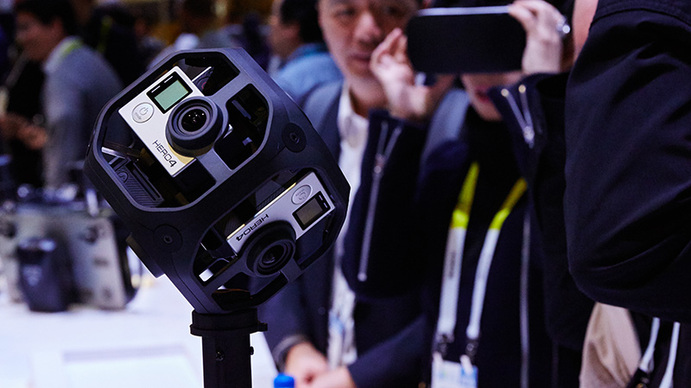
Flat video is so last century and GoPro is pulling out all the stops. Through a series of product launches — most recently the new Omni — the company signals that it has your back in the battle against bi-dimensional consumption of moving pictures. The strategy confirms the obvious — i.e. that it knows which way the wind is blowing. But I think it’s too little, too late.
All in on 360 video
With the new Omni, you can combine the power of six HERO4 Black cameras to shoot full 360 degree video; perfect for immersive video experiences, VR and photometry use cases.
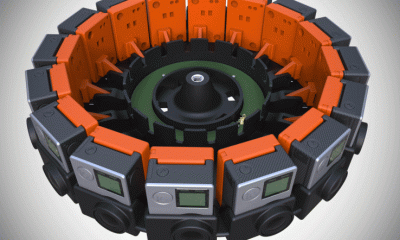
GoPro Odyssey
Omni was first announced at CES earlier this year, but is being demoed live for the first time at theNAB conference in Vegas in a couple of weeks — one of the biggest shows in video and multimedia content production.
Full-surround systems for GoPro are not a new thing — there have been quite a few attempts to string together a ton of the GoPro cameras to create camera arrays.
GoPro itself has been promoting its GoPro Spherical solutions over the past year, too, with special channels dedicated to its GoPro VR kit on YouTube and more spherical video featured on its Facebook page, as well.
Not the first VR rodeo
Last year, the company announced a partnership with Google’s Jump platform in the form of the GoPro Odyssey. The device looks sexy as all heaven (if you’re into that sort of thing). It comes with no fewer than 16 GoPro cameras and a bank-breaking $15,000 price tag. Obviously, the target audience veers deep into specialist markets that require stereoscopic 360 video (the Omni “only” does monoscopic video).
If spending $15,000 on a surround video kit doesn’t fill you with tingly sensations, there’s also been the other extreme: Building your own. There are a lot of plans and guides available online for how to 3D print or build your own rigs out of metal, wood or perspex — with some solutions being more elegantthan others. The problem with these solutions has been the synchronization between the cameras, both in terms of frame rate (ensuring that each camera is shooting video frames at the same time at exactly the same number of frames per second) and alignment (making sure the cameras are adjusted just so to create a seamless 360-degree experience is an exercise in fine-engineering or some seriously hard-core post-processing efforts).

Plans and CAD drawings for DIY, 3D printed rigs have been available for a while, such as this version of a “360 Video GoPro rig” by Friloba
Does GoPro make sense in a crowded market?
GoPro has kept a tight lid on the pricing and availability of Omni, but given that six GoPros on their own will set you back around $3,000 — and the fact that acomparable rig already exists for around $600 — it’s reasonable to expect a price tag of around $3,500 for the full kit, including cameras. If you already have a ton of GoPro cameras kicking about, you’ll be able to save some cash by buying the Omni kit without the cameras, too.

Samsung is going big on VR, too, with Google Street View compatible pictures spawned by its Gear 360 camera
While it is exciting that it’s possible to use these relatively high-quality GoPro cameras for VR purposes, I can’t help but wonder whether it might be too little, too late; there are a lot of other VR cameras in the marketplace already, with more being launched on an almost-weekly basis. GoPro is going to be feeling the pressure from all sides.
The bottom end of the 360-degree-video market is well-served by established players like Ricoh’s Theta S,Pananasonic’s 360 Fly, Kodak’s SP360 action camera and Samsung’s Gear 360.
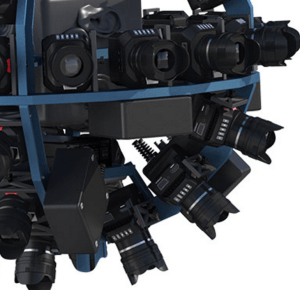
Got $150K handy? This 42-camera rig will give you a gigapixel worth of resolution. Woof.
In addition to the incumbents, there are a host of smaller startups, including the $800 Bublcam, the upcoming $1,000 Vuze camera, the $500 Allie Home camera, Sphericam’s $3,000 second-generation 360 camera and Giroptic’s $500 360cam.
What all these cameras have in common is that they are all-in-one solutions that deliver video that’s ready to use. That makes them vastly easier and faster in a production environment: they don’t have the challenges inherent in multi-camera setups, and its operators won’t need to collect several memory cards, sync, stitch and render the video before it’s ready for editing.
GoPro is going to be feeling the pressure on the high end as well. You can easily spend $150,000 on a high-end off-the-shelf 360-degree video rig, and if you’re going the custom-built route, the sky is the limit: There are plenty of experts in Hollywood who will build anything you want. None of that might sound like a true challenger — $150,000 is a lot more than $4,500 — but the truth is that there are much more affordable solutions available — and they are dropping in price rapidly.
Squeezed from all sides
Using the six 4k cameras in an Omni rig will give you a lot more resolution to play with than an all-in-one camera, and the product may just hit the sweet spot for the rapidly expanding VR video crowd, but in placing itself in this exact place in the market, the company is putting itself in a really scary place indeed: Not entry-level enough for mainstream, and not high-end enough for professionals.
The problem GoPro is facing is that they haven’t done anything innovative in a long time. The cameras are good enough, and becoming synonymous with action cameras won’t have done their sales any harm, but at the heart of it, GoPro is essentially selling commodity hardware at a tremendous markup. Sales figures — and its corresponding stock price challenges — are telling a story all its own.
Without a history of innovation on the camera side (Hero Session doesn’t count), and no evidence of a high-quality all-in-one solution in the pipeline, GoPro is between a rock and a hard place. The cheaper, simpler all-in-one cameras are a credible threat for many use cases, and as quality (and especially resolution) improves, defending a multi-camera set-up is going to get harder and harder. Simultaneously, the high-end multi-camera solutions will be dropping in price, and become a good alternative for users who are playing the quality über alles game.
Launching a six-camera setup rig like the Omni is a ballsy move, I’ll give them that, but I can’t help but feel that this is a short-term play in a long-term industry. It may help a little bit, but in order to survive in this market, they’d better have something far more impressive up their sleeve, and soon.
Lessons in a Busy Week of Deal Busting
Corporate America fought the law and the law won.
This is the clear conclusion looking at this week’s deal-killing actions. So far, the government has destroyed the $152 billion deal between Allergan and Pfizer by instituting stricter tax rules, sued to block the $35 billion Halliburton-Baker Hughes merger on antitrust grounds, and sued the $16 billion activist fund ValueAct Capital for failing to file an antitrust notification regarding its investments in Baker Hughes and Halliburton. The press described the ValueAct lawsuit in apocalyptic terms as a “lawsuit to define activism.”
And it’s only Thursday.
With the flurry of events there are always general lessons, and here are four.
Welcome to the Administrative State
In today’s world, government action is going to come from the agencies, not from Congress. The agencies are increasingly aggressive in exercising power. This is the Treasury Department’s third set of rules aimed at curbing so-called inversions, where an American company merges with a foreign company and moves abroad to cut its tax bill. As the law professor Victor Fleischer noted, the Treasury’s rules may go too far, subjecting them to a possible legal challenge. But it doesn’t matter, since no one would delay a deal for the years necessary to challenge these regulations. Allergan and Pfizer waited less than 24 hours to end their carefully drawn deal after the announcement of Treasury’s actions.
Action goes beyond inversions. The government’s suit against Baker Hughes and Halliburton, which comes while oil production is depressed, is yet another time when companies miscalculated the government’s willingness to intervene. And in the realm of national security, the interagency Committee on Foreign Investment in the United States has been actively challenging deals, putting a chill on the ardor of Chinese acquirers.
In the future, whether it is tax, antitrust or national security, deal makers today will have to worry about the regulators acting alone, which may be enough to kill most deals whether or not the government wins. Mergers and acquisitions lawyers are about to be eclipsed by their regulatory colleagues, and those firms with the best antitrust and other regulatory practices will have an edge.
Chutzpah Gets You Nowhere
Back in November I called the Pfizer-Allergan tie-up “silly.” The fact that the chief executive of Pfizer, Ian C. Read, actually believed the government would let this deal go through showed how divorced from reality executives can be. Mr. Read gets a raspberry for wasting everyone’s time and money. There is a silver lining, though. With the hundreds of millions of dollars saved on adviser fees, Pfizer can now use its cash to lobby Congress to reform our broken tax system.
The government has shown its willingness to push back on both antitrust and national security grounds in almost every borderline case. Every deal maker has been on notice since the government killed the AT&T and T-Mobile deal in 2011 despite AT&T having to pay a $4 billion breakup fee. Despite allowing some airline mergers to go through, the government has cast a wary eye on large mergers that shrink markets to a few players. Deal makers need to take this regulatory risk more seriously, particularly in today’s political environment — it’s not a time to say that we can announce a deal and bully the government to accept our position.
Blame the Advisers, in Part
The investment bankers and lawyers invented inversions and stoked the craze, killing it in their zeal to sell this lucrative concept. Bankers were a big loser this week.
Are the advisers to blame for all of this? On one hand, they are merely advisers and recommending a course of action. It is the client who ultimately makes the decision. On the other hand, there is no doubt that while peddling this type of transaction the advisers knew of the serious risks of government backlash but did not back down as inversions caught on in corporate America.
This is also true in the case of these antitrust-bending deals — surely the lawyers must have advised their clients of the real risks, and yet the clients plowed ahead. It all means that perhaps it is time for advisers to do some deep reflection on when and how to tell clients no.
It’s Not the End of Shareholder Activism
The ValueAct lawsuit was probably the most surprising of the three announcements this week. In general, any acquisition of more than $78.2 million is required to be reported before it occurs to the Federal Trade Commission or Justice Department under the Hart-Scott-Rodino Antitrust Improvements Act. This gives the government a 30-day period to review the transaction for antitrust purposes. Failure to file this notification could incur a penalty of up to $16,000 a day.
There is an exception to this filing requirement, however, if the transaction is “solely for the purposes of investment.” The government has accused ValueAct of violating this standard since ValueAct intended to “obtain access to management, to learn information about the merger and the companies’ strategies in private conversations with senior executives, to influence those executives to improve the chances that the merger would be completed, and to influence other business decisions.”
It’s hard to know what to make of these accusations. They look an awful lot like what any big shareholder does in the ordinary course of business, which is why there is talk of this suit chilling or even stopping some activism.
But here’s the thing. The government’s complaint fails to mention that ValueAct did actually file a notification in November 2015 after its own evaluation led it to be more actively engaged and seek a board seat at Baker Hughes. At first glance, the government’s stance on what “solely for the purposes” means would prevent activists from presenting compensation proposals or discussing business strategy with management, which are different than seeking to push the company to do something. Ultimately, we need ValueAct’s side of the story to make any definitive assessment. It could all be just a product of the intense scrutiny that the Halliburton-Baker Hughes deal has received, and ValueAct is collateral damage.
The suit won’t end shareholder activism, though it may push more activist funds to file notifications and pay the filing fee, which can be as much as $280,000, a nice revenue boon for the government. In other words, this is an important case, but it probably should not change what people are doing until we have a better view of the facts and more sober thinking.
And that goes with the theme of this week. Deal makers finally got a sobriety check. The latest takeover boom is ending, thanks in part to United States regulators.
EUR strength is the primary reason for European equity weakness. Lacklustre is perhaps the best way to characterise the current performance of European equities. While weak earnings trends and heightened geopolitical risk (e.g. Brexit) may be partly responsible, FX markets are arguably the greatest influence on tactical performance with EUR strength corresponding with falling equity prices and vice versa. Despite the last 12m of ECB QE initiatives the EUR trade weighted index is now at its highest level since Jan-15.
FX has never had such a strong influence on equity markets. The last month has seen a very significant divergence in regional equity performance with US and EM stocks rising and European and Japanese equities falling. Expectations of a more dovish Fed and a commensurate move lower in USD have been the key drivers of this divergence. We struggle to remember a time when FX had such a dominant influence on equity markets, an assertion supported by the below chart that shows an extreme negative correlation between the EUR trade weighted index and the performance of MSCI EMU.
European equities at all-time low relative to US stocks. Over the last month MSCI Europe has underperformed MSCI USA by 5.6% in local currency terms, a level of underperformance that has only been exceeded in four months over the last decade. Post this move MSCI Europe trades at a record relative price low to MSCI USA whether measured in USD or local currency.
If you think European equities are bad, spare a thought for Japan. As poor as European equity performance has been in recent months, it has been materially worse in Japan. Over the last 3M MSCI Japan has underperformed MSCI Europe by 11.7%, a degree of underperformance that has rarely been exceeded over the last ten years. Japan’s underperformance to global equities has been even greater (-15% over the L3M). With expectations now growing that the Japanese authorities will have to take further (potentially large) action in the face of ongoing Yen strength the stage may be set for a rally in Japanese stocks.