>>> This week's biggest % gainers/losers

This week's biggest % gainers/losers

This week's top 20 % gainers
  • Healthcare: EDIT (25.75 +38.66%), SAGE (65 +37.07%), NOVN (5.64 +35.25%), GBT (26.95 +25.35%), CRBP (8.8 +23.94%), CYNO (66.18 +20.21%)
  • Materials: TMST (19.88 +18.83%)
  • Industrials: GOL (28.55 +28.2%), DGI (35 +20.69%), TGH (17.3 +20.56%)
  • Consumer Discretionary: GRPN (4.67 +30.31%), MDCA (9.03 +29.86%), KATE (23.19 +21.48%), LILAK (26.55 +18.21%)
  • Information Technology: HIMX (6.94 +37.15%), ANET (119.06 +20.53%), ACIA (66.45 +18.61%)
  • Financials: FIG (7.99 +34.97%)
  • Energy: STNG (4.3 +20.11%)
  • Consumer Staples: UN (48.79 +18.31%)
This week's top 20 % losers
  • Healthcare: CFMS (5.91 -28.77%), MOH (48.23 -19.43%)
  • Materials: NAK (2.26 -32.74%), TECK (21.34 -14.3%), AUY (3.09 -12.46%)
  • Industrials: KNL (22.77 -15.85%),
  • Consumer Discretionary: TLYS (10.88 -17.82%), BGFV (13.45 -16.2%), SPWH (5.26 -13.99%), TTS (17.65 -13.69%), LTRPA (15.4 -12.75%)
  • Information Technology: SYNT (18.63 -16.21%)
  • Financials: OZM (3 -16.9%), LC (5.63 -15.72%), PHH (12.38 -14.8%), ONDK (4.89 -13.91%), ORC (10.84 -12.44%)
  • Energy: INT (38.32 -16.31%)
  • Consumer Staples: AVP (4.61 -20.24%)

>>> Nestle CEO Schneider sees excellent M&A opportunities

Nestle CEO Schneider sees excellent M&A opportunities (translated)
18 FEB 2017
Nestle [NESN:VX], a Swiss consumer products group, believes there are excellent M&A opportunities in the health, foods, and beverages markets, Euro am Sonntag reported. The German-language magazine quoted Ulf Mark Schneider, the chief executive of Nestle. However, Schneider made clear in the report that Nestle needs to restructure its underperforming segments before it starts making acquisitions.
Nestle has a market cap of CHF 229.833bn.
The original article was published in this week’s print edition of Euro am Sonntag (“Invest” section).

>>> Unilever has no protective construction, could sell vital divisions to hold

Unilever has no protective construction, could sell vital divisions to hold off suitor Kraft-Heinz - report (translated)
18 FEB 2017
Unilever [LON:ULVR; AMS:UNA], the Anglo-Dutch consumer goods group, has no protective construction to ward off suitors, Het Financieele Dagblad noted in an analysis of Kraft-Heinz's USD 143bn bid for the business. In addition, the company could look to sell business units to make itself a less attractive target.
Dutch insurers ASR and NN together hold 15% voting rights in the business. Unilever's management could try and convince these companies to refrain from committing their shares to the suitor, the Dutch-language report noted.
In addition, it could look for a suitor which outclasses Kraft Heinz' bid. The item named big PE groups KKR and CVC as having the firepower to jointly acquire the business, however, it has been years since these companies engaged in M&A at this scale.
Alternatively, Unilever could reduce its attractiveness to a suitor by selling unspecified vital business units, the report noted. However, such a transaction will require majority support from the shareholders. In addition, Unilever could opt to acquire a big target itself, however, it is unlikely Kraft Heinz will be deterred by such a deal, the report noted.
In another report on the approach, Het Financieele Dagblad noted Unilever's employees council is concerned about what a takeover would mean for the future of the business. This item cited Hermann Soggenberg, Chairman of Unilever's European employees council.
In another item, Het Financieele Dagblad reported Dutch Prime Minister Mark Rutte said he is carefully monitoring developments related to the approach and its potential social impact. Rutte is a former employee of Unilever, the item added.

MacRumors : iPhone 8 to Feature 5.8-Inch OLED Display With 5.15-Inch Main Screen

iPhone 8 to Feature 5.8-Inch OLED Display With 5.15-Inch Main Screen and Virtual Buttons Below
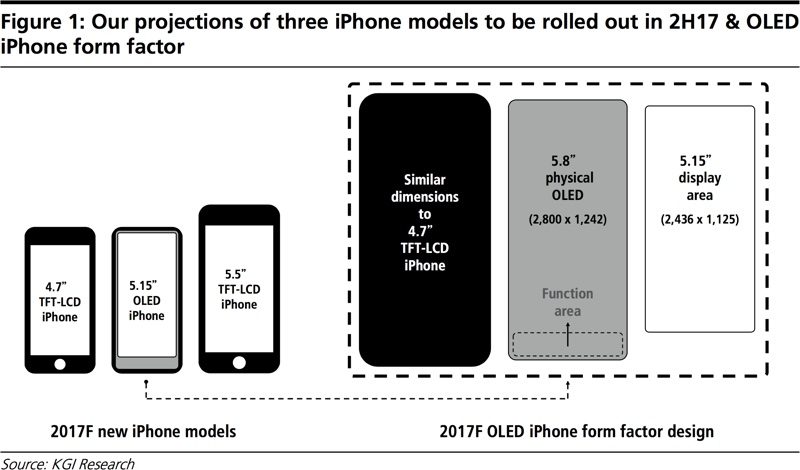
The upcoming 2017 iPhone will feature a 5.8-inch display with 5.15 inches of usable screen space according to new predictions shared by KGI Securities analyst Ming-Chi Kuo. Kuo believes the iPhone 8 will use a 5.8-inch OLED display panel, but that some space will be reserved for virtual buttons.

As has been rumored, the display is said to take up the entire front panel of the iPhone, effectively eliminating bezels, which means Apple will eliminate both the current Home button and the current Touch ID fingerprint recognition technology used in iPhones.

Size wise, Kuo says the OLED iPhone will have measurements similar to the 4.7-inch iPhone, allowing for one-handed operation. Such a size is possible with a 5.8-inch panel because there will be no extra space outside of the display, as can be seen in the mockup below. It will feature a display similar in size to the 5.5-inch iPhone, but in a 4.7-inch package.


Alongside the 5.8-inch OLED iPhone, Kuo continues to believe Apple will also offer standard 4.7-inch and 5.5-inch LCD iPhones, but it is not yet clear what features those devices will adopt. In previous research notes, Kuo has said they will include glass bodies and wireless charging, but he has not gone into detail on other potential features. He does, however, say that the OLED iPhone will be "the only bright spot" in the 2017 iPhone lineup, suggesting only minor improvements for the other two rumored devices.

Because the OLED iPhone will eliminate the Home button, it is expected to adopt "other biometric technologies," which other rumors suggest could include things like iris or facial recognition.

Battery life may also be another major change in the OLED iPhone, with Apple expected to introduce a stacked logic board design to support bigger batteries and longer battery life. In today's report, Kuo says the iPhone 8, though similar in size to the 4.7-inch iPhone 7, will feature a battery capacity similar to the larger 5.5-inch iPhone 7 Plus.

With the radical design changes, battery improvements, and the new biometric features, Kuo expects the OLED iPhone to cost in excess of $1,000, a pricing rumor that was also shared by Fast Company last week. Kuo does not expect the high price point to significantly impact sales due the "innovative user experience" offered by the device.

He believes Apple will ship 100 million iPhones during the second half of 2017, with 60 percent of those to consist of the higher-end OLED iPhone.

9to5.com : What’s next for tvOS & Apple TV? How Apple’s set-top box could upgrad

What’s next for tvOS & Apple TV? How Apple’s set-top box could upgrade your living room

The once ‘hobby’ Apple TV has been gaining quite a bit of attention from Apple over the last year. tvOS 10 brought in a new Dark mode option for users system wide, while version 10.1 brought in the new TV app.

With rumors of Apple integrating its own TV bundle service to the system coming and going, here are a few things that could be in the pipeline for Apple TV and tvOS.

The lack of a hardware update last year may seem to suggest that the Apple TV isn’t a priority for Apple, but software updates seen over the past year prove otherwise. With tvOS 10, Apple brought a dark mode look, smarter Siri search, a new Apple Music design, and control over HomeKit accessories. tvOS 10.1 saw Apple’s release of its ‘TV’ app unifying a range of providers.
Apple is working on lots of original content and rumors of eventually doing a streaming service have persisted over the past year. The recent hire of former Amazon Fire TV Chief, Timothy D. Twerdahl, may point to Apple getting more serious about their living room box. As the Apple TV pushes past being a hobby accessory, let’s take a look at how that will play out for Apple Music content and what happens next for the standalone service and Apple TV.
TV App |
A new report from Bloomberg notes that the TV app, at its current incarnation, is a stripped down version of what it originally was set to be. At first the app was designed to be a portal for accessing live shows and sports, but that never came to light when Apple’s content deals broke down.
Regardless of that, the ‘TV’ app is proof that Apple wants to push towards a more central video consumption experience. The app simplifies the watching experience by bringing together multiple streaming services. By continuously upgrading this and showcasing new networks, apps, and TV shows Apple can push other streaming services to join. As more users begin to use the TV app as their “channel guide” this also creates a platform for organic discovery of Apple’s own upcoming original content.

Streaming Service |
One of the most talked about next steps in Apple’s media center platform would be to incorporate a streaming service of their own. The most recent report from Bloomberg noted that the $30 – $40 a month streaming content deal broke down as result of Apple and partners not coming to terms. Rumors of Apple partnering with various companies have persisted over the past year, with the company even having considered purchasing Time Warner. While Apple hasn’t released anything during that time, it did give way for other major companies to do so.
DirecTV has launched its DirecTV Now service and Hulu is launching its streaming service in the coming months. The difficulties both for services securing relationships with major networks helps highlight one of the potential reasons Apple hasn’t launched its own video streaming service. Eddy Cue, head of services at Apple, best summarizes Apple’s position in this area:
Whether we’re providing it or somebody else is, it really doesn’t matter to us. What we’re trying to do is build the platform that allows anybody to get content to consumers. If a Time Warner [Cable] or a DirecTV wants to offer a bundle themselves, they should do it through Apple TV and iPad and iPhone.
While it’s unclear if we’ll see a service offered directly by Apple, 84% of our readers said they would pay for an Apple web TV streaming service.

Original Content |
In-line with their own streaming service rumors, a heavy amount of reports around Apple original content have also surfaced. Around this time last year Apple was rumored to be working on a six-episode long drama featuring Dr Dre. This would be the start of Apple’s reported foray in creating original video content for Apple Music.
While not exactly offering a streaming service of their own, a catalog of original content could help bolster the Apple Music appeal. The WSJ reported that Apple is “planning to build a significant new business in original television shows and movies” and that they hope to have the content out by the end of 2017.
We’ll soon find out what the public opinion is as Apple showed their teaser of the Apple Music specific Carpool Karaoke at this past Sunday’s 59th Annual Grammy Awards. Planet of the Apps, Apple’s reality TV show around application development, is also set to premiere this spring.
During Apple’s Q1 2017 earnings call Tim Cook explained:
“In terms of original content, we have put our toe in the water doing some original content for Apple Music, and that will be rolling out through the year.”
As more of Apple’s own original content comes to light, it becomes clear that the Apple TV should be marketed as the central hub to consume this content. Convincing users they can ditch their tiny screens and watch comfortably on the couch could help the Apple TV gain mass appeal.
Siri |
As a Siri-powered Amazon Echo-like device enters prototype testing, the Apple TV was at one point considered a home for the personal assistant. A recent report indicates that the microphone we find in the Siri Remote today was actually intended to be installed into the Apple TV originally. Bloomberg reported that Apple decided against building the standalone assistant into the Apple TV before setting sights on its own speaker. That doesn’t mean that the Apple TV isn’t still a prime location for integration with a Siri speaker.
In an earlier rumor, the Siri speaker was said to include a facial recognition camera as well. The camera would allow the speaker to “automatically pull up a person’s preferences, such as music and lighting they like”. Both these tasks are something the Apple TV already handles today. Making the Apple TV the perfect companion to a Siri speaker gives customers another reason to have one around.
HomeKit/Accessories |
The tvOS 10 upgrade brought HomeKit control to Siri on the Apple TV. With just the Siri Remote, users could dim and control their HomeKit accessories from the couch. With tvOS 10.0.1, the Apple TV brought support for App Launch and Wi-Fi Accessory Configuration. These two new features would allow accessories to launch and configure themselves using just the Apple TV.
The only remaining piece here would be for Apple to build out a ‘Home’ app for tvOS turning it into a true HomeKit hub. Having the Apple TV as a one-stop shop for HomeKit configuration and control would make the device all the more useful.

While third-party accessory makers can continue to build out more integrated devices for the Apple TV, Apple themselves had even considered making their own MFi controller. Building out an Apple-made gaming controller could help the company drive the gaming experience to the living room Apple TV.
Possible Hardware Upgrades |
The most obvious hardware improvement for the next Apple TV would be 4K video support. A new report states that Apple is currently testing out a 4K Apple TV variant (codename “J105”) that could see a release later this year. As 4K TV prices continue to drop, the current Apple TV starts to feel like it’s lagging behind. The delay could be for a few reasons.
To start, the iTunes movie catalog only offers HD resolutions up to 1080p. On top of that, Apple may not feel that the Apple TV’s storage capacity is large enough. That takes us to the second most obvious hardware improvement: upgrade the Apple TV’s capacity. Last year’s iPhone 6s could shoot in 4K video, but you wouldn’t even be able to experience that on the current-gen Apple TV. Current iPhone storage capacities reach up to 256 GB making the Apple media center’s 64 GB of storage feel paltry. A more recent discovery points the delay to the 4K variant needing a faster processor. This would not only increase manufacturing costs but eat more into Apple’s margins, something they most likely weren’t ready for.
Another hardware upgrade the Apple TV could see is by replacing Apple’s rumored defunct router business. Building an AirPort router into the Apple TV makes sense as it gets closer to being an always-on HomeKit hub and Siri speaker companion.
Even with all the recent reports about the Apple TV, one that has died down is the speculation of a physical TV. Having been rumored for years, reports from last August shared that Steve Jobs had planned to work on the project even after stepping down as CEO. Though the holy grail TV set rumor persisted, the product may never see the light of day.

With everything Apple has been working on over the past year, the Apple TV is set to have a productive year. The software Apple has been pushing to the device highlights new and original content for discovery, and shows Apple is getting serious about TV viewing on the device. With Planet of the Apps and Carpool Karaoke hitting Apple Music soon, we’ll see if it can help turn the Apple TV into the premiere way to watch. Having the Apple TV become a hub for Siri and better HomeKit control would be an ideal way to turn the Apple TV into a living room mainstay. While integrating a router may not be a clear choice, doing so could allow Apple to make the Apple TV more of a must-have device.
Apple usually updates the hardware and software for the Apple TV late in the year around its fall events. The last Apple TV was unveiled September 2015 where Cook declared that “the future of TV is apps.”

FT : ‘Aggressive’ vulture funds swoop in on Irish property

‘Aggressive’ vulture funds swoop in on Irish property
Distressed debt specialists criticised for exacerbating homelessness crisis

In 2007, Anna Flynn bought a three-bedroom house in Gorey, a small market town in the south-east of Ireland about an hour’s drive from Dublin.

Recently divorced, the accountancy assistant used the proceeds from the sale of her family home to put down a €100,000 deposit on the semi-detached house worth €350,000.

“It was at the height of the [Celtic tiger] boom. Everyone said, ‘You had better buy, otherwise you will price yourself out of the market’,” says Ms Flynn.

It was advice Ms Flynn would later regret taking. As the global financial crisis began to take shape, Ireland’s unemployment rate soared, its property market collapsed and its banking system came under huge strain.

Ms Flynn’s mortgage wound up in the Irish Bank Resolution Corporation, a bad bank set up by the Irish government to house non-performing assets, after her mortgage provider was bailed out.

Ms Flynn’s mortgage, along with thousands of others, was later sold to a so-called vulture fund, an asset manager that specialises in buying distressed debt.

These investment managers, dubbed vulture funds over fears that they behave in a predatory manner, have since become mired in controversy in Ireland. The government is now facing calls to regulate their activities more closely.

Funds run by many international investment companies, including Cerberus Capital Management, Goldman Sachs and Lone Star, were given this label after snapping up mortgage debt, properties and development land in Europe at knockdown prices after the crisis.

They provided much-needed capital for Ireland’s economy, at a time when many other investors had retreated from the country following an international bailout in 2010.

These investment companies have since become some of Ireland’s biggest landlords and mortgage providers, and generated big profits after the republic’s property market recovered. Residential property prices rose 8 per cent in 2016, according to official figures.

But the fund managers have faced criticism for their treatment of homeowners and tenants. They stand accused of not paying their fair share of taxes and of exacerbating a homelessness crisis in Ireland by evicting mortgage holders from properties.

Michael Byrne, a researcher at the School of Social Policy at University College Dublin, Ireland’s largest university, says: “The aggressive strategies used by vulture funds lead to human tragedies.”

The investment managers make money in two ways. Some acquire debt for less than its face value, but the mortgage holder is expected to repay the full original sum. In other cases, where a homeowner is not making sufficient repayments, the fund can repossess the house and sell it for a higher price than it paid for the loan secured against the property.

David Hall, chief executive of the Irish Mortgage Holders Organisation, a non-profit that represents 2,300 homeowners in financial distress, says: “Many people are at the wrong end of a dance with vulture funds. They wanted to hold on to their house. But vulture funds are not interested in the housing crisis. [They] just care about [their] shareholders.

“[The actions of vulture funds] has completely tarnished the reputation of asset managers in Ireland. Banks are pariahs, but the asset management industry is seen now as a rung below that. Vulture funds are as low as you can get.”

Since 2011 Ireland has emerged as a hotspot for distressed property assets, after its bad banks sold off swaths of loans that had once been held by struggling financial institutions. In 2014, the republic’s bad banks were the largest vendors of distressed property assets in Europe.

Many homeowners whose mortgages were acquired by international investors are critical of the treatment they received.

Ms Flynn lost her job as Ireland’s recession deepened and fell behind on mortgage payments. She says Mars Capital, an affiliate of Oaktree Capital, the private equity firm, acquired her mortgage from the Irish bad bank and was “very, very difficult to deal with”.

“All [Mars] wanted was for me to leave the house; they didn’t want a solution [to ensure I could retain my home],” the mother of four says.

Such an experience is not exceptional, according to Mr Hall. He says banks will usually attempt to help the homeowner retain their property, by providing a reduced interest rate for example.
“Vulture funds do none of this. They come in with a sledge hammer and they are self-confessed predators,” he says.

Ms Flynn, who got a job in retail to try to stay on top of repayments, became physically and mentally ill during her dealings with Mars. She says the company repeatedly tried to take her to court, eventually securing an eviction notice against her.

“[The experience] was horrendous. I became mentally ill and I did try to take my life twice. I ended up in treatment in hospital. It was just the pressure of it, and it then snowballed and I couldn’t cope. It was the worst experience of my life.”

Alex Forrester, group managing director of Mars Capital, says the company cannot comment on individual cases. However, he adds: “Our view is to always treat customers fairly and our primary objective is to use our resources to help them to return to long-term sustainability.”

Mars, which has acquired 5,000 mortgages in Ireland, says few cases have been taken to court.

Lone Star, which owns and manages 8,200 residential loans in Ireland, says “legal enforcement is pursued as a last resort”. To date, Lone Star says there have been 11 repossessions in the country, of which seven were abandoned properties.

Cerberus Capital declined to comment on its Irish investments. Goldman Sachs did not respond to a request for comment.

The Irish government has been broadly supportive of international investors buying property and mortgage debt, although it acknowledges this has caused some problems.

A spokesperson for the Department of Finance says: “We — both the state and the people of Ireland — did not have the investment capital to make these investments [in property and mortgages] during the crisis.

“Strong interest from the global capital markets led to significant levels of much-needed capital investment in our economy during periods of high risk and uncertainty.”

The government has taken steps to address concerns about these asset managers, including introducing rules in 2015 requiring companies that buy loans to be regulated.

Last autumn the minister for finance said the government would close a loophole that allowed these investment companies to pay little tax on the profits they make from restructuring Irish mortgages.

The government has also introduced the “Tyrrelstown amendment”, which prevents a large number of residents in a single development being evicted simultaneously.

For Ms Flynn, life is finally improving. Soon she expects to surrender her house to Mars, which will then sell it to a local housing association. Under the plan, she will become a life-long tenant in the house.

It means she will have lost all the equity she had in the property, but the Dublin native is relieved. “When I knew that I would keep [living in] my home, the weight was lifted. Just that freedom — I can’t describe it,” she says.

“I don’t want to sound like a victim because I’m not. Things are looking up for me now, because I’ve got this deal. And I’m healthy now, thank god. I have a lot to be thankful for. They were bad years but I got through them. I just want to get on with my life now.”

But according to Mr Hall, the government’s actions have not gone far enough. Like many in Ireland, he wants the government to ensure no more assets from Ireland’s bad banks end up in the hands of vulture funds. The government is facing calls from opposition politicians to ensure these investment companies face more stringent regulation.

Last month, Pearse Doherty, a member of Ireland’s parliament and finance spokesperson for Sinn Fein, the political party, said: “We must stop giving advantages to these vultures and instead give the homeowner, the small businessman, the farmer, a level playing field.

“The vultures are not invincible. Concrete political and community action can clip their wings.”
FT Lex : Unilever/Kraft Heinz: knives out Premium

Unilever/Kraft Heinz: knives out Premium
The deal makes sense strategically and its logic rests on cost savings

What would Lord Leverhulme, the philanthropic founder of Lever Brothers, have made of 3G Capital? On Friday Kraft Heinz, backed by the private equity group, confirmed it had presented a $143bn cash and shares bid to Unilever. The success of its overture will hinge on whether his successors will embrace a tougher version of shareholder capitalism.

Strategically, the combination makes sense for Kraft. Its profits are generated overwhelmingly in the US, whereas Unilever is much stronger in emerging markets. The European company also has a position in personal goods, where margins tend to be higher. Both companies have struggled to increase sales recently.

Any deal is likely to face stiff political opposition, just as bids for Cadbury and AstraZeneca did. Kraft Heinz will doubtless tout the backing of folksy investment hero Warren Buffett, who owns 43 per cent of it.


But the deal’s logic rests on cost savings. Kraft would need to cut more than $3bn from Unilever’s annual costs to cover the premium offered and still enhance earnings. It would only need to get Unilever’s operating margins half way to its own level for the deal to wash its face, on current terms.

Unilever has rejected those, and its shares rose 11 per cent after news of the approach. Kraft Heinz will need to offer more. Two things suggest it could. One is the possibility of fresh equity from Mr Buffett and 3G, raising its firepower. The other is its own record: Kraft Heinz’s margins before interest, tax, depreciation and amortisation have doubled since 2013, driven by cost reductions.

>>> Weekly Market Update

Weekly Market Update: Reflation Trade Ignores Trump’s Stumbles

Fed Chair Yellen's remarks to Congress on Tuesday added extra fuel to the Trump and reflation trades, as the markets saw the likelihood of the next rate hike getting closer. The odds of a March rate move edged higher as she confirmed that all policy meetings are ‘live’, stating that waiting too long to raise rates may be detrimental to the economy and could cause the Fed to raise rates later at a hasty pace. A chorus of other Fed speakers largely echoed Yellen, with members agreeing that with the employment and inflation mandates nearing targets, three or so rate hikes this year would be appropriate.

Stocks rallied along with the Fed-speak: the Dow jumping 1.2% over two days, and touching a new all-time high at 20,639 before leveling off in the back half of the week. Bonds sold off, with the 10-year Treasury yield spiking above 2.51%, before bond prices rallied again and stocks sold off, as investors pondered how markets are reacting to macro factors. For the week, the DJIA gained 1.7%, the S&P500 rose 1.5%, and the Nasdaq added 1.8%.

ECB meeting minutes released this week show the central bank was unanimous in its decision to keep its stimulus at current levels. Members also noted there would be a trade-off between changes to its ‘capital key’ menu of eligible securities and bond-buying in the short part of the curve that yield less than the deposit rate. Initially, peripheral EGBs went into a rally, with 10-year BTPs losing 7bps in yield. German Bunds also recovered in price Friday as the market reassessed the extent of the trade-off between short-term bonds and capital key revisions.

In politics, Trump largely avoided making any market moving remarks this week, but he lost some key appointments. He accepted the resignation of national security adviser Mike Flynn after reports of his conversations with the Russian ambassador came to light. Labor nominee Andrew Puzder also withdrew his name from consideration after several Republican senators balked at his appointment. Trump also gave a long and rambling press conference on Thursday berating the mainstream media again for 'fake news' and unjustified criticism towards himself and administration.

Corporate news this week was dominated by major merger developments and a persistent flow of earnings releases. On the M&A front, Aetna and Humana formally ended their $37B combination attempt on Tuesday, though Aetna remains on the hook for the $1B termination fee. And after a court blocked the Cigna and Anthem combination last week, Cigna moved on Tuesday to formally end its merger agreement, seeking damages exceeding $13B; Anthem filed a temporary restraining order aiming to halt any merger termination. On Friday morning, Kraft Heinz confirmed it had made an approach for Unilever in a cash and stock deal valued at $143B, but Unilever rejected the proposal as it sees no merit for shareholders. Yahoo was said to have reached a tentative deal with Verizon for a $250-350M price reduction in the sale of its operating business after hacking reports surfaced. On the earnings side, Deere reported a beat on the top and bottom line, and surprised the street by raising its outlook on equipment sales.

SUNDAY 2/12
(JP) JAPAN PRELIMINARY Q4 GDP Q/Q: 0.2% V 0.3%E (4th straight quarterly growth); Y/Y: 1.0% V 1.1%E

MONDAY 2/13
(CN) CHINA JAN CPI M/M: 1.0% (11-month high) V 0.2% PRIOR; Y/Y: 2.5% (32-month high) V 2.4%E
(CN) CHINA JAN PPI Y/Y: 6.9% V 6.5%E; 5th straight increase and highest since Aug 2011
(US) NY Fed JAN Survey of Consumer Expectations: inflation expectations highest since summer 2015; household spending expectations lowest since Jan 2016

TUESDAY 2/14
CSGN.CH Reports Q4 Net loss CHF2.35B v loss CHF2.07Be; Pretax profit CHF692M v loss CHF2.01Be; Rev CHF5.38B v CHF5.10Be
(DE) GERMANY Q4 PRELIMINARY GDP Q/Q: 0.4% V 0.5%E; Y/Y: 1.7% V 1.8%E; GDP NSA Y/Y: 1.2% V 1.4%E
(IT) ITALY Q4 PRELIMINARY GDP Q/Q: 0.2% V 0.3%E; Y/Y: 1.1% V 1.0%E
(UK) JAN CPI M/M: -0.5% V -0.5%E; Y/Y: 1.8% V 1.9%E; CPI CORE Y/Y: 1.6% V 1.7%E (highest annual reading since Jun 2014)
(UK) JAN PPI INPUT M/M: 1.7% V 1.0%E; Y/Y: 20.5% V 18.5%E
(DE) GERMANY FEB ZEW CURRENT SITUATION SURVEY: 76.4 V 77.0E; EXPECTATIONS SURVEY: 10.4 V 15.0E
(EU) EURO ZONE Q4 PRELIMINARY GDP Q/Q: 0.4% V 0.5%E; Y/Y: 1.7% V 1.8%E
AET Aetna and Humana Mutually End Merger Agreement; Aetna to pay $1B breakup fee
(US) JAN PPI FINAL DEMAND M/M: 0.6% V 0.3%E; Y/Y: 1.6% V 1.5%E
(US) Fed Chair Yellen: waiting too long to tighten would be unwise; more policy adjustments will likely be needed if the economy remains on track - semi-annual testimony
CI Cigna terminates merger agreement with Anthem; files suit seeking damages exceeding $13B - filing
Berkshire Hathaway discloses latest quarterly holdings; adds to stakes in airline industry - 13 F-HR filing
(US) Weekly API Oil Inventories: Crude: +9.9M (4th straight build) v +14.2M prior
000725.CN Apple reportedly considering BOE Technology as its first China supplier for iPhone screens - financial press

WEDNESDAY 2/15
ACA.FR Reports Q4 Net €291M v €315Me; Rev €4.58B v €4.29Be; to reduce stake in Amundi to 70% (currently holds 74.2%)
HEIA.NL Reports FY16 Net €2.10B v €2.13Be, Op Profit €3.54B v €3.47Be, Rev €20.8B v €20.6Be
BN.FR Reports FY16 Net €1.72B v €1.79Be, Op €3.02B v €2.89B y/y, Rev €21.9B v €22.4B y/y; Announces €1B efficiency program
(SE) SWEDEN CENTRAL BANK (RIKSBANK) LEAVES REPO RATE UNCHANGED AT -0.50%; AS EXPECTED
(UK) JAN JOBLESS CLAIMS CHANGE: -42.4K V +0.5KE; CLAIMANT COUNT RATE: 2.1% V 2.3%E
(UK) DEC AVERAGE WEEKLY EARNINGS 3M/Y: 2.6% V 2.8%E; WEEKLY EARNINGS (EX BONUS) 3M/Y: 2.6% V 2.7%E
(UK) DEC ILO UNEMPLOYMENT RATE 3M/3M: 4.8% V 4.8%E
(US) JAN ADVANCE RETAIL SALES M/M: 0.4% V 0.1%E; RETAIL SALES EX AUTO M/M: 0.8% V 0.4%E
(US) FEB EMPIRE MANUFACTURING: 18.7 V 7.0E (highest since Sept 2014)
(US) JAN CPI M/M: 0.6% V 0.3%E; CPI EX FOOD AND ENERGY M/M: 0.3% V 0.2%E; CPI INDEX NSA: 242.839 V 242.479E
(US) JAN INDUSTRIAL PRODUCTION M/M: -0.3% V 0.0%E; CAPACITY UTILIZATION: 75.3% V 75.4%E
(US) FEB NAHB HOUSING MARKET INDEX: 65 V 67E
(US) DOE CRUDE: +9.5M V +3.5ME; GASOLINE: +2.8M V +0.5ME; DISTILLATE: -0.7M V -1ME
(US) Atlanta Fed cuts Q1 GDP forecast to 2.2% from 2.7% on 2/9
(US) Association of American Railroads weekly rail traffic report for week ending Feb 11th: 518K carloads and intermodal units, +2.6% y/y
(US) Top Senate Republicans reportedly urge White House to withdraw Labor Sec-designate Puzder's nomination - CNN
(US) DEC TOTAL NET TIC FLOWS: -$42.8B V +$30.2B PRIOR; NET LONG-TERM TIC FLOWS: -$12.9B (first decline in 3 months) V +$34.4B PRIOR
AMAT Reports Q1 $0.67 v $0.66e, R$3.28B v $3.29Be
CSCO Reports Q2 $0.57 v $0.56e, R$11.6B v $11.6Be; Increases dividend 11.5% to $0.29/shr (implied yield 3.5%)
(CN) China Jan Foreign Direct Investment (FDI): CNY80.1B v CNY81.4B prior, Y/Y: -9.2% (First decline in 27 months) v +1.4%e
992.HK Reports Q3 Net $98M v $146Me; R$12.2B v $11.7Be

THURSDAY 2/16
NESN.CH Reports FY16 Net CHF8.5B v CHF9.6Be, Op Profit CHF13.7B v CHF13.8Be, Rev CHF89.5B v CHF89.7Be; proposes dividend of CHF2.30/shr
SU.FR Reports FY16 Net €1.75B v €1.85Be; adj EBITA €3.48B v €3.48Be, Rev €24.7B v €24.7Be
(ID) INDONESIA CENTRAL BANK (BI) LEAVES 7-DAY REVERSE REPURCHASE RATE UNCHANGED AT 4.75%; AS EXPECTED
(US) JAN HOUSING STARTS: 1.25M V 1.23ME; BUILDING PERMITS: 1.29M V 1.23ME
(US) INITIAL JOBLESS CLAIMS: 239K V 245KE; CONTINUING CLAIMS: 2.076M V 2.05ME
(US) FEB PHILADELPHIA FED BUSINESS OUTLOOK: 43.3 V 18.0E (highest since Jan 1984)
TGH Believes used shipping container prices have bottomed - earnings slides
(US) Atlanta Fed raises Q1 GDP forecast to 2.4% from 2.2% on 2/15

FRIDAY 2/17
(UK) JAN RETAIL SALES (EX-AUTO FUEL) M/M: -0.2% V 0.7%E; Y/Y: 2.6% V 3.9%E
DE Reports Q1 $0.61 v $0.51e, R$5.63B v $4.63Be; Raises outlook
ULVR.UK Kraft Heinz confirms made approach on possible combination; Unilever declines proposal
(US) Weekly Baker Hughes US Rig Count: 751 v 741 w/w (+1.3%) (5th straight rise)
S Softbank reportedly preparing to approach Deutsche Telekom's T-Mobile US about a possible merger with Sprint - press

FT Lex : Unilever/Kraft Heinz: knives out Premium

Unilever/Kraft Heinz: knives out Premium
The deal makes sense strategically and its logic rests on cost savings

What would Lord Leverhulme, the philanthropic founder of Lever Brothers, have made of 3G Capital? On Friday Kraft Heinz, backed by the private equity group, confirmed it had presented a $143bn cash and shares bid to Unilever. The success of its overture will hinge on whether his successors will embrace a tougher version of shareholder capitalism.

Strategically, the combination makes sense for Kraft. Its profits are generated overwhelmingly in the US, whereas Unilever is much stronger in emerging markets. The European company also has a position in personal goods, where margins tend to be higher. Both companies have struggled to increase sales recently.

Any deal is likely to face stiff political opposition, just as bids for Cadbury and AstraZeneca did. Kraft Heinz will doubtless tout the backing of folksy investment hero Warren Buffett, who owns 43 per cent of it.


But the deal’s logic rests on cost savings. Kraft would need to cut more than $3bn from Unilever’s annual costs to cover the premium offered and still enhance earnings. It would only need to get Unilever’s operating margins half way to its own level for the deal to wash its face, on current terms.

Unilever has rejected those, and its shares rose 11 per cent after news of the approach. Kraft Heinz will need to offer more. Two things suggest it could. One is the possibility of fresh equity from Mr Buffett and 3G, raising its firepower. The other is its own record: Kraft Heinz’s margins before interest, tax, depreciation and amortisation have doubled since 2013, driven by cost reductions.