Local EM Debt a Good Bet Amid Bubbling Bonds
For once, the greenback may not be the most secure place if interest rates rise sharply.
Fed up with miserly returns on treasury bills and investment-grade corporate bonds, individual investors are nudging into an asset class until now seen as too risky: bonds that emerging-market nations issue in their own currency. The largest exchange-traded fund in the area, iShares JPMorgan EM Local Government Bond, has doubled in size this year to nearly $7 billion, and many mutual fund managers report that their assets have risen by 15% to 20%.
The allure of local-currency debt is clear: yields that average north of 6% on five-year paper. The catch is that you reap those yields in rupees, pesos, reais, or whatever. That has been a boon lately, as soft currencies at last rebound against a less-than-almighty dollar. The iShares ETF (ticker: SEML.UK) has returned more than 12% year to date. The longer-term record is less comforting: down a total of 7% over the past five years. Any hawkish clearing of the throat from the Federal Reserve could end the uptick, or so it would seem.
Yet major investors are optimistic on local debt, at least relative to a bubbling bond universe. “Fixed income isn’t particularly attractive right now,” says Steven Oh, global head of credit and fixed income at Pinebridge Investments in New York. “But EM local currency is the best of an unattractive lot.”
THE BULLISHNESS RESTS on two assumptions. First, President Donald Trump’s economic agenda will continue to go nowhere, spelling continued weakness in the dollar. Candidate Trump promised aggressive antitrade measures and domestic pump-priming through tax cuts and infrastructure spending, which were supposed to spur inflation and rate hikes. That sent the greenback soaring after his November election, to a 15-year high against a trade-weighted index by year end. The dollar has given back those gains and more. “Trumponomics has been neutralized both from the trade side and the fiscal-stimulus side,” says Gorky Urquieta, who helps manage $13.5 billion in emerging market debt at Neuberger Berman. “We’re looking for further revaluation from the dollar supercycle.” Translation: Neuberger has been shifting from Eurobonds into local-currency paper, betting on further greenback depreciation.
The second premise is that emerging markets are getting stronger after years of limping export earnings and widening current-account deficits. Gross-domestic-product growth across the developing world should accelerate this year for the first time since 2013, the World Bank predicts. Commodity prices have stabilized, and exporters from Russia to Chile have made currency adjustments. Overindulgent importers like India and Brazil have all but balanced their accounts. Inflation is subsiding, and central banks are cutting interest rates, a positive backdrop for bond buyers even as the U.S. and Europe look to raise rates. “The fundamental drivers are much improved over the past few years, which allows central bankers to step away from emergency policy,” says Andrew Keirle, who manages the $327 million T. Rowe Price Emerging Markets Local Currency Bond fund (PRELX) in London. “The building isn’t on fire anymore.”
The experts do add some warning labels to their enthusiasm for local-currency debt. Most importantly, be prepared to ride out some bumps. “This is a complex, volatile asset class,” Pinebridge’s Oh says. “You don’t want to be the tourist money that rushes for the exits at a technical reversal.”
A storm may be brewing for bonds globally, as former Fed Chairman Alan Greenspan recently warned. But when it breaks, a yield of 6% or 7% denominated in the baht or rupiah could look quite attractive.
Moataz Abed, the trader who seems to have been in contact with an e-mail address that blasted out a list of anonymous Bloomberg chat participants, works at Noble Group, a China-based energy trading company that has tried to root out names of unidentified analysts, The Post has learned.
The Noble suit claimed that former Noble employees, then working for Iceberg, were trying to bring down Noble’s stock price.
Abed was e-mailed from an address belonging to Janus Henderson, a London asset manager from whose e-mail the unmasked list seems to have been sent. It’s unclear what connection the two have. Reps for both companies didn’t return requests for comment.
No one has accused Abed or anyone at Janus Henderson of any wrongdoing. Abed didn’t return an e-mail and Bloomberg chats seeking comment.
Chat room participants are warned that their identities aren’t completely anonymous. Before signing up, users have to agree to terms that include a warning highlighted in red.
The metals chat included participants from all over the world — from major hedge funds like Balyasny to pension funds in California and Rhode Island.
Eight participants were from Goldman Sachs, the firm with the highest number of anonymous users, records indicate.
Leon Black’s Apollo Global Management conspired to swipe a $20 million stake in a Dutch logistics company held by a group of former executives, a lawsuit filed in a Florida federal court contends.
Apollo pulled off the alleged fraud in 2013 by arranging a debt-for-equity restructuring of the then-struggling Ceva without notifying the management of the Netherlands company, the suit claims.
The private equity firm bought up a chunk of Ceva’s discounted debt before pulling the trigger on the debt-equity swap, according to court papers.
The restructuring allowed Apollo to maintain ownership of the Ceva — but left the equity held by the executive worthless. Since the former brass were left out of the debt-swap, their $20 million stake in Ceva went up in smoke, court papers allege.
The suit, filed in a Jacksonville court, names Apollo plus senior partner Gareth Turner and former principal Mark Beith.
For Apollo the timing of the new suit may not be ideal.
Presently, French company SNCF Geodis is in talks to buy Ceva in a deal that could leave Apollo’s pockets stuffed with profits, sources familiar with the situation said.
Apollo jumped into the logistics business in 2007 when it bought two companies, TNT Logistics for $1.9 billion, and Eagle Logistics for $2 billion. It combined the two and named the new entity Ceva.
Black’s PE firm then offered Ceva brass the chance to purchase shares in the combined entity, telling them, “Apollo and Management will be aligned to share in value creation,” the suit alleges.
At one point when Ceva was struggling financially, Morgan Stanley, working for the logistics company, produced a Jan. 28, 2013, report that indicated Ceva’s value could be as high as $3.75 billion — an amount high enough to satisfy debt obligations and provide value to equity holders, the suit alleges.
Yet, Ceva, instead of exploring a sale or an IPO, decided Morgan Stanley’s findings were “flawed and inconclusive,” the suit alleges.
The debt-for-equity swap followed.
The executive found out about their suddenly worthless stock in a letter: “In light of . . . Ceva’s financial condition, we have been advised that it is unlikely that there will be any recoveries for shareholders,” the letter said, according to the suit. “The directors regret having to write you with this information.”
Apollo declined comment.
Snap stock is up after the world’s biggest ad buyer said it will spend even more money on Snapchat
WPP says it plans to double spending on Snap ads this year.
Snap investors received some good news on Friday courtesy of one of the world's biggest ad buyers.
WPP CEO Martin Sorrell, whose firm manages billions of dollars in advertising budgets, told CNBC that WPP plans to double its spending on Snapchat ads this year.
Sorrell said WPP will spend about $200 million with Snapchat, which is much less than the firm spends with others like Google or Facebook, but still significant for Snap. If $200 million is double what WPP spent last year, that means the agency was responsible for roughly 25 percent of all of Snap's sales in 2016.
The fact that they are increasing that spend is a good sign for Snap investors. Snap stock is up almost 4 percent on the day.
Snap has had a rough year. After a seemingly successful IPO in early March, the company's stock is near an all-time low thanks to a less-than-stellar first quarter and increased competition from Facebook and Instagram.
In fact, Sorrell's comments came less than 48 hours after CNBC published a story claiming ad buyers were rapidly losing interest in Snap. Not all ad buyers, apparently.
So this is a bright spot for Snap, even if only temporarily. Snap reports Q2 earnings next week.
Update: Cheddar’s Jon Steinberg pointed out that Sorrell has talked about this spending jump before on Cheddar. Wall Street must have missed it, forgotten, or just appreciated the reminder on Friday. The stock is now up more than 4.5 percent.
Now it’s Snapchat copying Facebook’s ads Power Editor
Snap Inc desperately needs ad revenue to redirect its sinking share price. So after a year of getting mercilessly copied by Facebook, Snapchat is returning the favor by launching its take on the Facebook ads Power Editor. This new “Advanced Mode” for its Snapchat Ads Manager lets big advertisers rapidly deploy complex ad campaigns with tons of creative variants.
By allowing big ad agencies and brands to efficiently target, test and update their ad campaigns, they may be willing to spend more money on Snap. While the benefits won’t kick in in time for Snap’s pivotal Q2 earnings call next week, Advanced Mode could help the upstart put a dent in the Google/Facebook ad duopoly down the line.
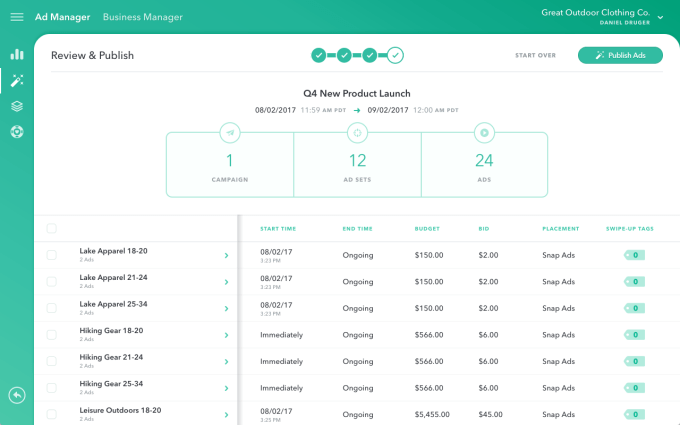
Snap launched its self-serve Ads Manager in May, and added vertical video creation tool Snap Publisher in July. With the addition of Advanced Mode, advertisers will be able to:
- Automate multiple ad campaigns with a permutation builder so they can quickly create hundreds of ad creative and targeting variants
- Utilize Snap spreadsheets for bulk design and editing of campaigns
- Save targeting audiences to use on future campaigns
- Employ performance metrics that can be grouped and ordered by different metrics with data exportation
- Automate campaign naming
Snap also got an ads boost today that has perked up its share price when the world’s largest ad agency WPP’s CEO Martin Sorrell told CNBC that WPP was doubling its Snap ad buy from $100 million in 2016 to $200 million in 2017. Though he contextualized that, noting that WPP will spend $2 billion on Facebook ads this year, and had previously told online video news channel Cheddar about the increased buy.
Facebook debuted its Power Editor in 2011 (which I covered the launch of because I’ve been doing this forever). It was the last piece of its ads suite that started with direct ad sales, then self-serve ads and then a self-serve API. Snap launched direct ad sales in 2014, then an Ads API in 2016, before testing its self-serve tool in May, and now launching Advanced Mode.

The Facebook Ads Power Editor

Snapchat Ads Manager’s Advanced Mode
The similarities in strategy aren’t too surprising considering Snap’s first COO Emily White was recruited from Facebook-owned Instagram, and it later hired Facebook Audience Network head Sriram Krishnan to work on its ad tools.
These Advanced Mode tools could help Snapchat get to the ad load and scale necessary to monetize its slow-growing audience. If it can’t add tens of millions of new users per quarter, Wall Street will want it to prove it can earn a higher average revenue per user. That means squeezing as much money as it can from each user with these improved ad targeting options.
While Facebook might be running Snap’s product playbook, Snap is making progress by running Facebook’s monetization playbook.
Tesla: Buy the Car, Not the Stock
The new lower priced Model 3 gets rave reviews, but the stock is priced for perfection.
Four years ago, a Barron’s cover story doubted Elon Musk’s Tesla could reduce the cost of batteries quickly enough to launch a mass-market electric car by 2017. Happily for our warming planet, we were wrong. At a July 28 ceremony, Musk delivered the first production units of the Model 3, which Tesla will sell for a base price of $35,000. Before the end of 2018, the 46-year-old visionary expects to produce the car at annual volumes of half a million units.
July 28 “was one of the most important days in the history of the company,” said Musk on a conference call last week. “It’s something we’ve been striving for, for 14 years.”
Here at Barron’s, we’re investment writers, not car reviewers, so the more important error in our cover story (“Recharge Now!”, June 8, 2013) was suggesting that Tesla shares (ticker: TSLA) wouldn’t rise far beyond their then price of $102. They finished last week at $357, which values the enterprise at $65 billion—almost as much as General Motors (GM) and Ford Motor (F) combined. While we urge anyone who can afford a zero-emissions car to buy one, Tesla shares have outrun most analysts’ reasoned cases for buying the stock. Musk warns the Model 3 production ramp will put Tesla through manufacturing and supply-chain hell, so quality or volume problems could yet provide cheaper entry points for investors who want to back this superhero before his climactic face-off against Bayerische Motoren Werke (BMW.Germany) and Daimler (DAI.Germany).
Like Apple and Amazon.com, Tesla is well ahead of its rivals. But as Cowen analyst Jeffrey Osborne notes, the iPhone has always been profitable, and Amazon has at least been cash-flow positive. The fires of Musk’s ambition in the auto and trucking industries, not to mention solar power, will consume billions more dollars in losses and dilutive fundraising.
Last Wednesday, Tesla reported June-quarter sales of $2.3 billion. Despite a 25% gross margin on its cars, Tesla lost $336 million, or $2.04 a share, and that was after selling $100 million worth of “zero emissions” tax credits to other carmakers. Those losses and the capital spending for the Model 3 production line consumed more than $1 billion of cash in the quarter. Ramping capacity to build the Model 3 at an annual rate of 250,000 units will require another $2 billion in capital spending before year-end 2017.
Tesla’s capital-spending plans “will make your eyes water,” wrote Morgan Stanley’s Adam Jonas on Wednesday, adding that “time will tell if they are tears of joy.” In May, Jonas tamped his enthusiasm for the stock down to a Neutral rating when Tesla shares shot past his price target of $305. Bears like Cowen’s Osborne have targets far lower.
Musk’s leadership has forced proud car makers like Daimler and BMW to commit themselves to battery-powered lineups in the next few years. Tesla has a head start. Initial reviews of the Model 3 are glowing, and Tesla reports a remarkable 450,000 in pre-orders with a $1,000 deposit on each. But Tesla’s stock price leaves little on the table, even if you believe Musk will run circles around every other car company. Buying the stock here will do more for your planet than your portfolio.
Finisar Is the Most Attractive iPhone Supplier
With the next iPhone expected this fall, it’s time for Wall Street to speculate on the winners.
The introduction of a new iPhone isn’t just a media event. In Wall Street’s eyes, it’s an entire industry.
Apple (ticker: AAPL) could ship some 217 million iPhones in the fiscal year ending next month, rising to 246 million next year, according to analysts’ estimates.
The rate of unit growth has slowed of late, perhaps 13% next year compared with 37% in 2015. But the iPhone is still one heck of an opportunity for a chip maker. This one product from a single company is among the biggest markets for semiconductors. The entire personal computer market, by comparison, may ship just 262 million units this year, according to Gartner.
Those kinds of numbers make chip investors lick their chops. Apple’s push to add new features and change the specs each year can immediately put a given chip maker in the spotlight and provide several years of sales, as a given part returns in subsequent versions of the iPhone. Past beneficiaries include Cirrus Logic (CRUS), which makes chips to manage the audio quality in an iPhone, and Skyworks Solutions (SWKS), a maker of power amplifiers that boost the phone’s signal, and its competitor Qorvo (QRVO).
With the next iPhone expected this fall—what some are calling the iPhone X, in honor of the iPhone’s 10th anniversary—it’s time for Wall Street to speculate on the winners.
Apple’s fiscal third-quarter financial report last week provided encouragement to chip watchers. It forecast revenue higher than expected for the September quarter, and September is when Apple usually announces a new iPhone. The forecast implies at least some units of the new device should arrive this quarter, contributing to chip sales.
JOINING CIRRUS AND SKYWORKS could be some relatively new names, a couple of which have been favorites of this column. Startup CEVA (CEVA) is not your ordinary chip firm. It doesn’t actually produce chips—it licenses designs to chip makers such as Intel (INTC). CEVA collects royalties when Intel and others ship their chips. The business is similar to that of ARM Holdings, the U.K. company that was bought by Japan’s SoftBank Group (9984.Japan) last year for over $30 billion.
CEVA is expected to benefit because of losses by Qualcomm (QCOM), the wireless chip giant that had been the exclusive supplier of a key radio part for the iPhone known as the baseband. Apple last year reduced the chips it takes from Qualcomm for the iPhone 7, instead building some iPhones with parts from Intel.
CEVA’s global share of baseband chips, based on sales made by licensees, is 40%, according to an estimate by stock analyst Gary Mobley of Benchmark. That’s the same as Qualcomm’s share, he writes, even though Qualcomm is bigger than any one of CEVA’s individual licensees. Mobley thinks CEVA’s share of the market can go higher. Qualcomm’s pain is CEVA’s gain.
Among the most talked-about aspects of the next iPhone is what’s known as augmented reality. The iPhone will be able to perceive the depth of the space you’re in. With that information, it can take precise measurements of your living room, for example. That is made possible by lasers and by photodetectors that sense the light from the laser as it bounces off objects.
This column wrote about those components earlier this year, noting that possible beneficiaries include Finisar (FNSR), Lumentum Holdings (LITE), II-VI (IIVI), and Viavi Solutions (VIAV) (“Stalking the Component Makers for the iPhone X,” Feb. 11, 2017).
Finisar shares surged in June when it announced quarterly results that included an order for “3-D sensing,” a code name for augmented reality. Some believe Finisar will split that business with Lumentum. Lumentum will offer more insights when it reports quarterly results this Wednesday. Similarly, watch for II-VI’s results on Monday, and Viavi’s on Aug. 15.
Add to the list Taiwan’s Himax Technologies (HIMX). It was a supplier to Alphabet (GOOGL) for the ill-fated Google Glass headset. The stock received two upgrades last week, from Baird Equity Research and from Credit Suisse, after both firms concluded Himax will benefit by selling special diffractive lenses for 3-D sensing in the iPhone.
APPLE CAN BE A KINGMAKER, but it can also turn its suppliers into knaves, as a lawsuit with Qualcomm shows. Apple alleges Qualcomm withheld a billion dollars in rebates it is owed. But it also accuses Qualcomm of being too big for its britches. Apple Chief Executive Tim Cook has said that Qualcomm essentially wants to take credit for the iPhone. Qualcomm pegs the cost of the sofa to the price of the house, Cook said—his way of belittling the supplier. Qualcomm, which has countersued, claims Apple greatly downplays Qualcomm’s role in the iPhone.
It’s not a great thing when your top customer sues you, and Qualcomm stock is down 19.3% this year. But at nearly a quarter-billion units per year, the iPhone is an industry every chip maker sees as worth the risk.
One thing to keep in mind about Apple suppliers is that their shares often trade up in advance of the arrival of a new iPhone. Past winners, such as Cirrus and Skyworks, have sometimes peaked in the first half of the year as investors pile in, hoping to get a piece of the action.
Among the names mentioned here, CEVA and Himax have had strong runs this year, up 27.9% and 39.2%, respectively. That doesn’t mean they won’t go higher, because the exact revenue potential for them from the iPhone is still unfolding. Finisar, on the other hand, has been hit by issues in the fiberoptic communications market. Its stock is down 20.9% this year—and so it may be one of the best names for a bounceback on iPhone strength.