WWD : Richemont Ramps Up Digital, Drafts New Senior Executives

Richemont Ramps Up Digital, Drafts New Senior Executives
Luxury group creates role of technology chief, names digitally-minded group HR director.

MILAN – In its quest to refresh the senior management team and adopt a more digitally-minded approach, Compagnie Financiere Richemont has created the new position of chief technology officer, naming Jean-Jacques van Oosten to the role.

The parent of Cartier, Van Cleef & Arpels and IWC, said Thursday that van Oosten, who has a 21-year background, primarily in the retail and digital sectors, will join the senior executive committee on Jan. 1, 2018. His latest role was as group chief digital officer and chief executive officer of Rewe Digital, a division of the German retail and tourism group.

Previously, he had held chief information officer positions at Travis Perkins Group, Tesco, Kingfisher, EDS and Unilever. Through his consulting company, van Oosten has advised retailers on their multic-hannel strategy, roadmap and transformation programs. He graduated from the London Business School and holds a PhD in molecular genetics.

Richemont has also named a new group human resources director, Sophie Guieysse, who is to join the senior executive committee on Oct. 1 after a career spent partly at LVMH Moet Hennessy Louis Vuitton.

Since 2016, Guieysse has been advising Dior on the future of luxury in the digital sphere, and prior to that she had spent 10 years at the Canal Plus group as human resources director and member of the executive committee. She has worked in various human resources roles at LVMH, and her last position at that company was as the group’s director of human resources.

She will succeed Thomas Lindermann, whom Richemont said was leaving for personal reasons. Lindemann, a 20-year veteran of Richemont, was named group human resources director and member of the group management committee in 2005.

Richemont’s chairman Johann Rupert said the creation of the chief technology officer position and van Oosten’s appointment “reaffirms Richemont’s commitment to meet the demands of today’s environment.”

Like many of the big luxury groups, Richemont has been relatively slow to embrace digital and think in terms of multi-channel sales strategies, but that stance began to change earlier this year with the appointment of new, younger board members.

Rupert pointed out that both van Oosten and Guieysse come with strong digital backgrounds.

Van Oosten, Rupert said, has more than fifteen years of experience in “scaling, transforming and internationalizing online and multi-channel businesses” while Guieysse brings experience across diverse cultural environments in the luxury and digital sectors.

“These appointments will strengthen significantly the group’s ability to address current challenges and bring Richemont into a new era of agility and performance,” he said.

The appointments come less than a month after the Richemont board approved a clutch of new, younger members with digital backgrounds as the company seeks to look at business through a multi-channel lens.

TechCrunch : Citymapper ties with Gett to launch shared taxi commuter route in L

Urban transport navigator app Citymapper is experimenting with creating another transport service based off of analysis of the journey data its users generate — and using software it built to identify underserved transport routes.
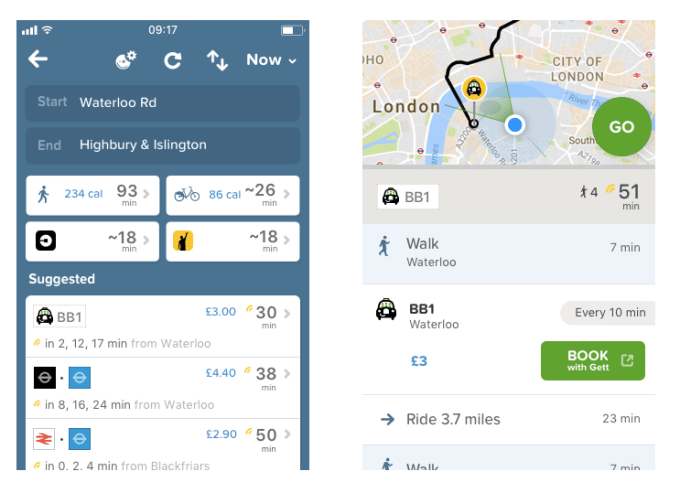
Today it’s announced a tie-up with Gett‘s UK black cab hailing app to run two commuter lines of shared taxis in London, morning and evenings, between Highbury in North London and the Waterloo transport hub in the south.
It’s calling this “Project Black Bus” — black being the typical color of London’s traditional taxis. The Citymapper-Gett partnership presumably involves a revenue share between the pair on any booked journeys.
This is not Citymapper’s first experiment with extending London’s existing public transport network with some commercially routed additions. It already runs a(n actual) bus service — which it announced in July — with the bus route also picked based on analysis of its users’ city mobility data.
In that case it’s an East London late night route catering to partygoers. The route uses Citymapper’s own fleet of buses, distinct from Transport for London’s red fleet. The vehicles are also smaller than the average London bus and include a plethora of screens to help users understand where in the city they are — as well as USB ports to charge up their devices.
The bus service, which is called the CM2 line — technically it’s the second bus route Citymapper offered, after it ran a very brief bus trial in a different part of London — is fully integrated with Citymapper’s transport app, as you’d expect.
And so too is the new pooled taxi service — which it’s calling BB1: short for “Black Bus 1” (implying this is the first in a line (ha!) of such pooled taxi routes.
Users of its app will see the route in their suggestions — with an option to “Book with Gett”.
“Cabs can be shared by multiple passengers, just like on a bus, for a fixed price of only £3! (and psst.. the first ride is free). But unlike buses, you can get on and off anywhere on the route,” the company writes in a blog post announcing the new service.
With £3 pricing it’s significantly undercutting the cost of an Uber (and even an UberPool) — or indeed a black cab — for making the same journey. But the ride will cost more than taking a single trip on a TfL London bus.
The BB1 line will operate during the busiest commuter hours: So between 7–10am and between 5–8pm. Citymapper says it will start next Monday, September 25.
The company says it picked this route because there’s no direct Tube link covering this route, and also claims that existing public transport options “would require three buses or tubes”.
“It serves one of the largest gaps in the tube in zone1: Angel to Farringdon. It uses side streets that avoid jams and benefit from bus lanes,” it adds.
However this is actually a fairly vigorous massaging of the truth. While it’s certainly true there is no direct Tube link between Highbury & Islington and Waterloo, an existing TfL bus (the number 4) will take you all the way from Highbury Corner to Waterloo Road without you having to get up and change.
The same trip can also be done in just two Tube journeys: Either taking the Victoria Line & Bakerloo, or Victoria Line & Northern. So it’s not really that much of a faff to make this journey with existing London public transport options. (Also worth noting: Highbury has an overland train station too, with trains which can take you as far as Moorgate.)
Plus, as Citymapper’s BB1 route lets people get on and off anywhere on the line portions of the journey will certainly be directly replicating existing public transport routes.
And London’s extensive TfL bus network offers various route options to serve portions of the route, including Angel to Farringdon, if not being completely ‘door-to-door’; i.e. you may need to walk a bit either end. (Indeed, Citymapper’s own founder, Azmat Yusuf, has said of London’s bus network: “If you can figure out how to use the buses you can go anywhere.”)

Of course there will always be some people for whom traveling by cab is the preferred option, especially if it’s made more affordable for them to do so. (Uber’s popularity in London attests to that — it claims some 3.5 million users in the city.)
Even if rush hour congestion in London tends to make any form of street-level road-based transport one of the least quickest, least smart ways to get around (biking excepted).
Blogging about why it’s getting into taxi pooling via a tie-up with Gett, Citymapper implies it’s hoping to reduce urban congestion by encouraging existing taxi users to share their journeys — by making use of the fixed, pooled route — and thus reduce the number of cabs on the road at any one time.
Although if it ends up encouraging London commuters off of existing TfL buses and Tubes and onto London’s congested roads the service could well have the opposite effect — a risk which goes undiscussed in its blog.
Instead Citymapper argues that pooled taxi routes can offer a more flexible transport option to add to the mix, with routes able to be ‘edited and evolved to meet user needs’, adding that: “Regular buses can’t do that.”
Of course “regular buses” can’t change their route all the time because very large numbers of people rely on those routes. Whereas cabs that can carry — at most — five individuals at a time are not buses. And are never going to be buses.
Even if Citymapper is seeking to paint this taxi pool line in the livery of a bus — subtitling its blog as: “Black cabs running like buses.” And directly appropriating the word “bus” (“black bus”) for what is actually a commercial shared taxi commuter service. (For a little more perspective London’s bus fleet carries some 6.5M passengers per day.)
We asked Citymapper why it decided that shared taxis are the best option for this transport route — i.e. rather than running another of its ‘smart buses’.
At the time of writing the company had not responded.
Another consideration is how much the London transport regulator was involved in the planning process of the BB1 route.
If, as Citymapper says, the route is making use of side-streets there’s a potential for it to funnel more traffic down residential routes — which are exactly the sorts of factors taken into consideration by regulators when they are planning new bus routes.
So we also asked Citymapper how it considered the impact of running this taxi commuter route on local residents. And also whether it involved TfL in the route-planning process.
We’ve also reached out to the London transport regulator for its views on the service — and will update this post when it responds.
Safe to say, Citymapper is not the only startup seeing money-making opportunities in pulling a portion of users of existing public transport networks onto commercial alternatives. (Nor the only startup under pressure to start monetizing usage of its free app — Citymapper said in December it would start doing just that this year, having raised ~$50M in VC funding since 2011 from investors who clearly want to see a return on that cash.)
Ride-hailing behemoth Uber pioneered this process with its UberPool service which dynamically matches passengers with others riding in the same direction, charging a lower fare than for a full Uber as they share the car.
This strategy may be smart for the companies involved, but the question of how smart it is for already heavily congested and highly polluted cities is a whole other question.
>>> US Gapping up

Gapping up
In reaction to strong earnings/guidance
:

  • N/A.

M&A news:

  • CCC +62.1% (to be acquired by Kuraray for $21.50 per share)
  • CRH +1.9% (acquires Ash Grove Cement for $3.5 bln)

Other news:

  • ITUS +11.4% (renews research agreement for continued development of Cchek and enters into an exclusive option agreement to license intellectual property covering a proprietary CAR-T technology w/ The Wistar Institute)
  • BCRX +9.9% (announces FDA approval of a sNDA for RAPIVAB)
  • AMPH +6.8% (received FDA approval of its ANDA for sodium bicarbonate injection 8.4% in 50 mL Luer-Jet Prefilled Syringe System)
  • ABUS +6.6% (continued strength)
  • PRQR +5.5% (presents data 'in a relevant disease model, establishing proof of concept for its novel and proprietary Axiomer RNA editing platform technology)
  • TPRE +4.5% (to join S&P SmallCap 600)
  • APC +4.3% (Anadarko Petroleum announces $2.5 bln share-repurchase program; co also reaffirms the guidance it had previously provided for the deepwater Gulf of Mexico, DJ and Delaware basin assets )
  • FOLD +4.2% (confirms being granted orphan drug designation by the FDA for ATB200/AT2221)
  • GVP +3.6% (GSE Systems, Inc. acquires Absolute Consulting, Inc., a provider of technical consulting and staffing solutions to the global nuclear power industry, for $8.75 mln in cash )
  • APRN +3.3% higher after Albertsons announced the acquisition of Plated, a premier meal kit service)
  • KND +2.7% (sees $20 mln pre-tax hit to Q3 earnings due to Hurricanes Harvey and Irma)
  • AERI +2.6% (confirms FDA Advisory Committe meeting scheduled for October 13 to review its NDA for Rhopressa for the treatment of patients with open-angle glaucoma or ocular hypertension)
  • AMD +1.5% (extending late move higher on reports that Tesla is wokring with AMD for an AI self-sdriving chip)
  • MDXG +1.3% (responds to 'deceptive short seller articles' )

Analyst comments:

  • RDY +6.1% (upgraded to Overweight from Equal-Weight at Morgan Stanley)
  • GBT +3.5% (initiated with a Buy at Needham)
  • DB +1.2% (upgraded to Hold from Reduce at HSBC Securities)

>>> US Gapping down


Gapping down
In reaction to disappointing earnings/guidance
:

  • SCHL -5.1%, MLHR -2.7%, DPS -0.7%, (lowers 2017 EPS guidance by $0.03 per share to reflect anticipated impact from supplier default)

Select metals/mining stocks trading lower:

  • HMY -2.1%, VALE -1.8%, CLF -1.5%, MT -1.2%, GDX -1.2%, ABX -1.1%, AU  -1%, IAG -1%, RIO -0.9%, GOLD -0.8%, GG -0.8%, AUY -0.7%, NEM -0.6%, GLD -0.6%, BHP -0.5%

Other news:

  • RWLK -8.8% (files for $15 mln ordinary share offering)
  • JUNO -3.8% (announces $225 mln share offering)
  • IOVA -3.5% (prices offering of 7,692,308 shares of common stock at $6.50 per share)
  • CRTO -2.4% (Gotham City Research confirmed plans to release second portion of CRTO series)
  • NVDA -1.7% (extending late move lower on reports that Tesla is wokring with AMD for an AI self-sdriving chip)
  • USG -1.2% (continued strength -- gypsum/wallboard related names were notably higher on anticipated price increase)
  • CMG -1.1% (pulling back as yesterday's queso related optimism fades)
  • XLRN -1.1% (prices offering of 5,405,406 shares of common stock at $37.00 per share)
  • RIG -0.8% (Chevron terminates driling contract for elected to exercise its contractual option to terminate the drilling contract for the ultra-deepwater drillship Discoverer Clear Leader, effective November 2017, prior to its expiration in October 2018)
  • SCG -0.7% (served with a subpoena issued by the United States Attorney's Office for the District of South Carolina seeking documents relating to the Company's new nuclear project at V.C. Summer Nuclear Station)

Analyst comments:

  • JKS -3.2% (initiated with a Sell at Axiom Capital)
  • ERIC -1.8% (downgraded to SEll from Hold at Carnegie)
  • TEX -1% (downgraded to Hold from Buy at Deutsche Bank)
  • HBI -0.8% (downgraded to Neutral from Buy at Instinet)

>>> US Early premarket gappers


Early premarket gappers

Gapping up:

  • CCC +61.4%, BCRX +12%, ABUS +6%, APC +4.7%, TPRE +4.2%, VERI +4.2%, GBT +3.8%, GVP +3.6%, AMPH +3.5%, AMD +2.8%, KND +2.7%, AERI +2.6%, APRN +2.1%, CRH +2%, MDXG +1.3%, LUNA +0.6%

Gapping down:

  • RWLK -2.9%, MLHR -2.7%, CRTO -2.4%, NVDA -2.1%, IOVA -2.1%, JUNO -2%, USG -1.3%, XLRN -1.3%, RIG -1.2%, HBI -0.8%

>>>> The iPhone X is the Beginning of the End for Phones (WORTH READING)

The iPhone X is the Beginning of the End for Phones
--> Link to article : http://bit.ly/2xhFbbW
Another year, another phone announcement. On September 12 Apple unveiled its tenth-anniversary iPhone fittingly named the ‘iPhone X’ and showed off what it calls the “future of phones” featuring a fancy edge-to-edge screen and futuristic augmented reality cameras.
But while I was watching the event, all I could think about was that this phone might be the last smartphone to matter at all. That it marks the beginning of the end of phones as we know it, and we’re at the precipice of them just becoming tools.
What triggered this response wasn’t so much that the iPhone X was amazing — it’s that Apple figured out how to put cellular into a Watch.
Smartphones, as a category, are racing to the bottom. Each other year a trend sets the stage for what phone makers will try to cram in to help market yet another phone in various different ways.

The big trend a few years ago was high-end fingerprint unlocking (started by Touch ID), followed by focusing on camera performance, and now, cramming as much screen onto the front of the device as possible. Bezel-less phones are here, and they’re a thing.
Essential, Samsung and LG have all released phones with ‘edge-to-edge’ displays that look so similar to each other it’s hard to even make an informed decision anymore.
Do you want a black rectangle or a white one? A slightly bigger rectangle or a thinner rectangle? The rectangle with a camera bump or without it?
We’ve seen this before. In around 2004, suddenly computers became boring after being a hot-ticket item you’d need to replace every year or two. Intel’s dual-core processors hit the market and suddenly meant that upgrading your computer didn’t really mean much anymore because your old one was ‘good enough’ and continued to work for many more years.
As a result, the PC market collapsed almost entirely over the following years.
HP, one of the world’s biggest laptop makers, imploded.
Sony pulled out of the industry.
Toshiba continues to be in chaos to this day.

Behold, PC innovation in 2001. (Source: PC World)
When was the last time you bought a new laptop? Chances are you’re reading this on something you bought four or five years ago. The same is happening to phones right now and the iPhone X is likely the last device that will matter in the category.
Apple Watch, even though it was glossed over, was far more interesting. The company has figured out how to cram a full LTE connection inside of it, so you can stream music or answer calls entirely without a phone.
I realized, all of a sudden, as Tim Cook said the new iPhone is a whopping $999, that’s the future I want. If I could ditch my phone entirely and wear a cellular Apple Watch so I’m reachable, then carry an iPad Pro with me, would I even need a phone?
Besides the lack of a small, powerful camera in my pocket, I don’t think so. It’s likely that cameras as an accessory — like Snap’s Spectacles — will solve that problem, along with real AR glasses, in the near future.
Using a Watch to stay connected but not having a phone would do wonders for my concentration, too.
Rather than responding to every single thing as it comes in, having it on my wrist would allow me to know what’s going on but save responding until I’ve got a larger keyboard in front of me to type on.
Such a ridiculous setup could also loosen the grip Instagram, Facebook and others have on our attention span. No more ending up at the bottom of social networks when you planned to just read a message.


The future, I think, is a bunch of accessories connected directly to the internet, rather than a internet slab in your pocket.
An always-online watch and pair of glasses for on the go, and an iPad for work might be all you need.
There’s a chance you still need an iPhone in your pocket as the processing power for these devices, but if we’re able to get super-fast connections at the level that 5G promises, maybe it can just be done entirely in the cloud instead.
The biggest hole in this plan is even the LTE Apple Watch requires an iPhone to work at all, which is a bummer, but mostly related to battery life.
That future doesn’t seem that far off, really. iPhone X is a futuristic phone, but I think it’s the last big release we’ll see. Apple’s focus on the powerful front-facing camera array is a telling sign here: it’s doubling down on future platforms too, and maybe the phone isn’t central to that.

As phone innovation trails off, the focus of phone makers will rapidly move away from the phone and to other ways to get you connected, hence why Facebook, Magic Leap and many many others are spending billions on glasses as the next platform of computing.
There are only so many ways to make a rectangle appealing, and I think we’ve run out. It’s only a matter of time until we start looking elsewhere.