Five billion-dollar businesses for the driverless future
Massive opportunities in urban transportation are emerging as the industry transitions from per-vehicle to per-mile economics
Growing up, I dreamed of owning cars I would be proud to wax, polish, and cruise around my neighborhood. Today, I dread the prospect of being weighed down by a rapidly depreciating hunk of plastic and metal. Now all I want is a pleasant transportation experience.
Millennials share my sentiment toward vehicle ownership, and many of them are embracing the convenience of ride sharing.
The trillion-dollar auto industry is being turned on its head. Automotive companies are getting squeezed as car sales drop and newcomers eat their margins.
As part of this shift, the industry is transitioning from per-vehicle to per-mile economics. Historically, the automotive industry has been measured by how quickly it assembles cars, pushes them to customers, lends money against them, and collects money to maintain and upgrade them.
Tomorrow, the industry will be measured by how many miles it moves passengers, and how much margin it generates on every mile traveled.
Vehicles will travel 3.17 trillion miles in 2017 — a 7.8% increase from five years ago. The trend will continue: The rise of electric vehicles and automated driving mean we can expect a lower environmental and labor impact, as well as lower prices.
Automakers should not worry about being put out of business. Some will not survive the evolution. A but a number of them will be key players in tomorrow’s per-mile realm. Some will become white-label, commodity producers of vehicles for Uber, Lyft, or Zoox fleets. Others, such as GM, Audi, and BMW, may choose to compete with the ride-sharing giants and operate their own fleets.
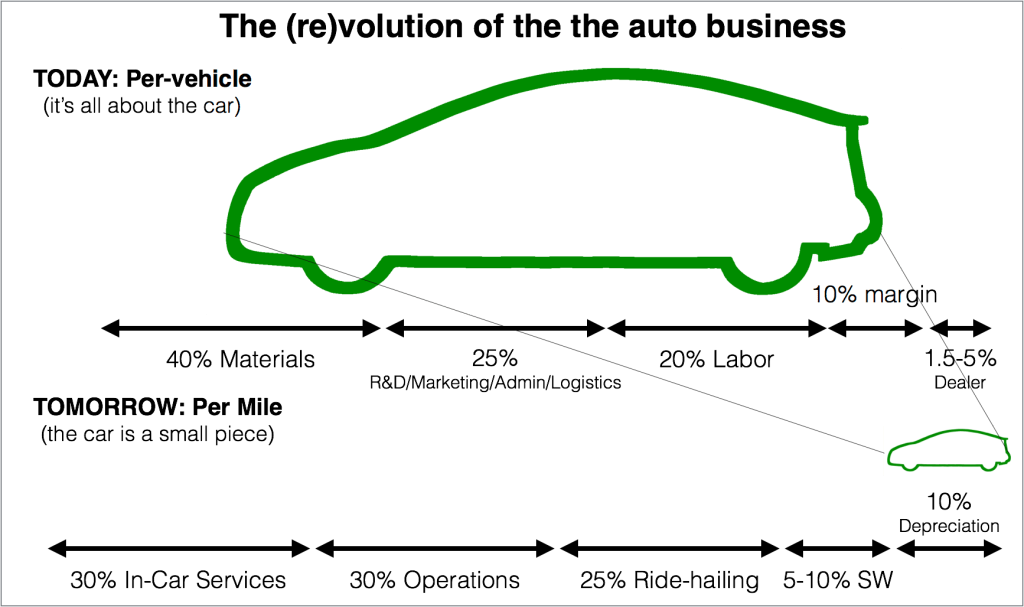
In the driverless future, traditional car companies will get less of the margin for every mile traveled by consumers. Emerging services will usurp the rest.
Which businesses are positioned to capture the majority of the dollars for the many billions of miles driven? A few possibilities:
- Insurance: Robo-taxi technology has almost arrived. So far, there isn’t a legal framework in which an operator can offer autonomous services. Such a framework would help to set limits on the liabilities of passengers, operators, and technology vendors. When the limits of those liabilities are known, insurers can design and offer policies for each group. Startups will need to take a leadership role in helping insurance companies model the risk of computer vision, AI and other technology malfunctioning. Given the expectation of slower auto sales, incumbent insurance companies should be delighted to pursue this nascent market, which could turn into the bulk of their business someday.
- Compliance: Limiting operators’ liabilities will require strict safety regulation compliance. These regulations could include building and running simulations on the AI, as well as monitoring and auditing tele-operations (i.e., humans remotely overseeing the autonomous vehicles).
- Distribution: Today, Uber and Lyft own the primary channels to ridesharing. Their vast network of drivers and colossal cash coffers have allowed them to lock down the industry and squash competitors. So far, neither of them is building their own vehicles. Traditional automakers have an opportunity to rethink the experience of passengers, as well. If they start from first principles, they will find themselves designing and building very different vehicles than what they’ve made in the past. New and emerging companies, such as Zoox (disclosure: my firm is an investor), are being built from the ground up to design and operate sophisticated transportation robots for this new era of driverless transportation.
- In-vehicle services: Forget mobile devices; “driverless” is the new platform. Highly personalized, rich environments can be created to stimulate and engage with passengers. Voice interfaces can tune the experience in the vehicle, and serve as a concierge for not only that a single trip or a series of trips over multiple vehicles and in multiple locales. Imagine tours provided by robotic cars that “know” passenger tastes, preferences, and previous destinations. Your driverless tour guide showing you around Bangkok “knows” your preferences from your prior tours in Rome and Sao Paulo. They can tap into your social media profile to recommend dining, shopping and entertainment experiences.
- Autonomous technology: It is well-established that companies who build unique technology that enables autonomous driving are positioned to reap massive benefits. Non-auto-tech companies are seeing the opportunity and snapping up innovative companies. Intel paid a premium for MobileEye and positioned itself as a major Tier 2 automotive supplier. The channel that Intel acquired through this purchase will enable Intel to sell many other technologies, such as chips, sensors, and software, into the automotive supply chain.
Trillions of dollars worth of new opportunities abound in the coming era of autonomous travel. If history has taught me anything, it’s that this new paradigm will spur entirely new ways of living that we haven’t yet considered. As for myself?
As a gearhead, I’m most looking forward to getting from A to B by robot, and manually pushing performance cars to their limits on racetracks.
Hellman & Friedman set for $5bn Nets A/S takeover
Deal would rank as largest European leveraged buyout in almost five years
Hellman & Friedman is on the verge of clinching a $5bn (DKr31.1bn) takeover of Nets A/S, Scandinavia's largest payments processor, in a deal that would rank as the largest European leveraged buyout in almost five years and the latest transaction in a fast consolidating sector.
The US private equity group is racing to complete an agreement with Copenhagen-based Nets A/S and its largest shareholders, buyout firms Advent International and Bain Capital, that may be announced as soon as Monday, according to people involved in the process.
H&F, whose deal team is being led by its deputy chief executive, Patrick Healy, will acquire a majority of Nets, with a group of co-investors who are helping to fund the takeover.
The San Francisco-based firm, which the Financial Times revealed had entered into exclusive negotiations with Nets this month, is working with Singapore’s sovereign wealth fund GIC, as well as two North American-based limited partners, the people said.
Advent and Bain, which acquired Nets in 2014 in a consortium with Danish pension fund ATP Group for DKr17bn, are planning to re-invest into the deal and will emerge with a small minority stake.
The exact terms of the Nets deal are not yet known but the equity value of an agreement is expected to be around $5bn — a figure that is not substantially higher than the $4.5bn valuation Nets went public with almost exactly a year ago.
JPMorgan Chase is advising Nets on the talks.
Nets finished last week at DKr152 a share, giving it a market value of DKr30.5bn ($4.9bn). Shares in the company have climbed by 36 per cent in the past six months, fuelled by speculation of a takeover and a series of deals in the European payments processing sector, including for the UK’s Worldpay and Paysafe.
The flurry of activity comes as competitors are looking to acquire assets to build scale, strip out costs and capitalise on a shift away from cash and cheques towards digital payments.
Given that digital payments are already a prominent feature in the Nordic region, H&F may look to use Nets as a platform to strike other deals across Europe’s fragmented payments space.
The transaction highlights the lengths to which private equity firms are going to deploy capital, with the deal set to become the largest European leveraged buyout since March 2013. It would surpass a recently agreed €4.1bn takeover of German generic drugmaker Stada, which saw Bain and Cinven pay a staggering 50 per cent premium to see off rival suitors.
In the three months to June, Nets reported a 4 per cent year-on-year increase in revenues to DKr1.9bn, while earnings before interest, tax, depreciation and amortisation rose almost 7 per cent to DKr680m, excluding one-off items.
The company, which had net debt of DKr8.4bn at the end of June, has grown through acquisitions to become the leading card payments processor in Denmark, Norway and Finland and the second-biggest in Sweden. In the second quarter, the total value of transactions it processed rose 6.5 per cent year-on-year to DKr129bn.
Cariparma tables final offer for three Italian regional banks
Cariparma, an Italian bank owned by Credit Agricole [EPA:ACA], has tabled its final offer for Cassa di Risparmio di Cesena (Caricesena), Cassa di Risparmio di Rimini (Carim) and Cassa di Risparmio di San Miniato (Carismi) by the end of the month, according to the Italian-language daily Il Messaggero, which cited documentation relating to the offer.
The report said that the final offer contains some new elements, including a EUR 50m capital increase for Caricesena by the Fondo Volontario, a bank rescue unit of the Bank of Italy. Fondo Volontario presently holds 95.7% of Caricesena, the item noted.
The item cited Maioli as saying that he expected a deal to be inked on either 29 September while closing with the transfer of the banks to Cariparma's control is expected on 29 December.
The report noted that the deal is dependent on the securitision of non-performing loans totalling a gross EUR 3.152bn in order to remove the bad debt from the three lenders' books. The report said that an agreement on the securitisation of the NPL appears to have been found, with the EUR 416m senior tranche of the NPL portfolio being financed via a bridge loan. The report said that the rest of the securitisation consists of a t EUR 634m mezzanine tranche and a EUR 170m junior tranche.
The item added that Cariparma will agree to take the three lenders for 130 on the proviso that they are adequately capitalised.
Oliver Blume: the Porsche CEO on the electric car revolution
Can the carmaker compete with Tesla?
Oliver Blume became chief executive of Porsche two years ago. It all happened so fast that when he went home to tell his family, they thought he was joking.
It was September 2015, and the prestige sports car maker’s parent, Volkswagen, was mired in the biggest crisis of its 80-year history. Martin Winterkorn, the chief executive, had just resigned after admitting the company had cheated on emissions tests on up to 11m diesel-engine cars worldwide.
Within days, Matthias Müller, head of Porsche, was appointed to succeed Mr Winterkorn. Before news broke, Mr Müller summoned Mr Blume, then Porsche’s head of production, and took him by the hand: “Tomorrow I will be in Wolfsburg” — VW’s headquarters — “and now it’s up to you,” Mr Müller said.
The 49-year-old German effects an “aw-shucks” attitude as he describes his surprise at being offered one of the most glamorous jobs in the industry: “I never thought aboutplanning one day to be CEO,” he says. “I think it’s impossible to plan.”
He mentions this approach to his career four times during his interview with the Financial Times at the UK’s Goodwood Festival of Speed, where Porsche is exhibiting cars. Mr Blume says he sees little value in mapping out a future; rather, he prizes daily competence that finds its rewards later. That competence was tested during his first weeks at the helm, which were “crazy”. Overnight, the number of people he was responsible for tripled to nearly 30,000.
His chief task is to lead the luxury brand into a new era of electric, autonomous and web-connected cars. So far, so good: Porsche deliveries rose 7 per cent to 126,497 in the first half of 2017; operating profits accelerated 16 per cent to €2.1bn, and profit margins increased to more than 18 per cent. An average Porsche, if there is such a thing, sells for $99,000, and generates $17,250 in profit.
For all the talk of new tech rivals such as Tesla upending traditional brands, Porsche has been thriving since it was acquired by VW in 2012, with double-digit growth in China leading the way.
“The industry isn’t changing from one day to the other,” he says. “Therefore you have to be very clear how to construct this period of transition. We will continue with our combustion engines; it’s very clear that’s our core business — very purist sports cars.”
Sales have nearly doubled in the past five years thanks in part to Porsche’s sport utility vehicles: its Cayenne and Macan SUVs made up nearly 70 per cent of sales last year.
The typical Porsche driver in Germany is a man over the age of 50, but in China — home to 27 per cent of its sales last year — typical buyers are under 40 and, increasingly, female, according to the company.
Despite strong sales, the challenges are enormous. “Ten or 20 years ago, it was obvious that when you thought about a new product, you were thinking about design,” he says. Now, instead of perfecting one iteration to the next, Porsche faces wholesale disruption and must balance “staying close to our roots with doing something very innovative”.
Analysts have criticised the German car industry for being late to the electric revolution, but Porsche was ahead of most when it unveiled the Mission E, the brand’s first electric car introduced as a concept two years ago at the Frankfurt Motor Show. The four-door sedan, expected to cost about $85,000 — roughly similar to Tesla’s high-end Model S 100D — claims a range of 500km and can be charged to 80 per cent capacity in 15 minutes.
Porsche has invested €1bn in the project and this month in Frankfurt Mr Blume said his “big priority” was to bring the car to production in 2019.
He beams when asked about its features, which include menus navigated by eye-tracking and images projected on to the windshield instead of rear-view mirrors. “The human-machine interface will be totally different and will show how Porsche thinks about the future,” he says.
The Mission E has been called “the Tesla-killer” by some journalists, but Mr Blume insists Elon Musk’s US electric vehicle company is not a rival. “What Porsche is doing is to follow our own way. We did it in the past and we’ll do so in the future. Therefore it’s not so important what Tesla does.”
Mr Blume credits Mr Musk, Tesla’s co-founder and chief executive, with introducing innovations that have “moved the whole industry”, such as iPad-like displays, but he considers Tesla only “the first step” in the evolution of electric cars.
Porsche, like other traditional carmakers, he says, must always generate profits — something Tesla has not yet achieved for a full year. The US company is listed, but behaves more like a start-up, with its emphasis on spending on research and development. “For us, [generating profits] is the main topic, and for Tesla it’s not,” he says.
Mr Blume has spent his entire career at the Volkswagen Group. After studying mechanical engineering at Braunschweig university — the town is a hub for VW employees commuting to Wolfsburg — he landed an internship with Audi in 1994.
As he climbed the ladder to executive roles, he received a doctorate in engineering from Tongji University in Shanghai, then spent five years in Barcelona as head of planning for Seat.
In 2009, he was appointed head of production planning for the VW brand, before he joined Porsche’s board in 2013.
If the Mission E is a success, and Mr Blume can then build an electric SUV while managing to increase sales, the executive would be in a strong position to again succeed Mr Müller — whose contract expires in 2020 — this time as head of the VW Group.
But Mr Blume, who speaks carefully and methodically, sometimes even numbering his paragraph-sized responses, is coy about his ambition.
“I just think about the job I’m doing now,” he says.
Tullow Oil to resume drilling in Ghana after resolving dispute
Border disagreement with Ivory Coast had halted expansion of key field for two years
Tullow Oil is preparing to resume drilling in Ghana after the resolution of a maritime border dispute with Ivory Coast that has halted expansion of an important new field for two years.
An international tribunal declared on Saturday that the sovereign rights of Ivory Coast had not been violated by Tullow’s development of oil and gas fields in Ghanaian waters close to the two countries’ border.
The ruling clears the way for UK-listed Tullow to resume development of the Tweneboa, Enyenra, Ntomme fields, collectively known as Ten, which have been operating below their potential capacity since starting production last year.
Tullow said it expected to resume drilling around the end of this year, allowing the opening of additional wells that would increase production towards its target for 80,000 barrels per day, 60 per cent above the current level of about 50,000 barrels.
The Ten fields, 45km off Ghana, have been the focus of a long-running dispute with Ivory Coast, which claimed some of the resources were in its waters.
This has created uncertainty for Tullow investors because Ten accounts for about 30 per cent of the company’s production and its rights to some of the oil would have been thrown into doubt had Ivory Coast won the case.
Tullow took a risk by pressing on with the $4bn development in defiance of objections from Ivory Coast but the company was barred from drilling further wells in 2015 until international arbitrators reached a decision.
The International Tribunal of the Law of the Sea, the intergovernmental organisation overseeing maritime law, unanimously rejected Ivory Coast’s claims.
Tullow said the Ten fields, which have estimated reserves of 300m barrels of oil and oil equivalent, had been confirmed to be laying wholly within Ghanaian waters.
It would “now work with the government of Ghana to put in place the necessary permits to allow the restart of development drilling”.
“While the Ten fields have performed well during the period of the drilling moratorium, we can now . . . take the fields towards their full potential,” said Paul McDade, Tullow chief executive.
Tullow investors will hope the ruling marks a turning point after a turbulent few years during which the company incurred heavy debts developing Ten in the teeth of a brutal downturn in oil prices.
The company pioneered the opening of Ghana’s oil and gas reserves with development of the Jubilee field, 20km east of Ten, which came onstream in 2010.
Jubilee has also experienced production setbacks after suffering damage last year to the floating production vessel that serves the field. A permanent fix to the problem is not due to be completed until 2019.
Sector rotations and counter trends in currencies
Can equity markets go higher, and is there dollar upside versus the euro?
Here are the key questions for markets and investors as the final trading week of the quarter looms.
Can sector rotations drive equity markets higher?
So far this month, US equity investors have been bargain hunters. Some of the most prominent laggards this year, such as energy shares, have assumed a leadership role. Financials have also found buyers, while the high-flying tech sector — including biotechs — has experienced a loss of altitude, with Apple’s share price having just suffered its worst week in 17 months.
Reflecting renewed hopes of US fiscal stimulus, the rotation has also embraced small-caps, while Dow Transports have picked up the pace this month, although that barometer still lags behind the Dow Industrials for the current quarter. All of which has been enough to drive the S&P 500 further into record territory.
A rotation towards energy and autos this month has driven European markets, with investors expecting Angela Merkel to gain a fourth term as chancellor after Germany on Sunday goes to the polls. That has some looking at whether eurozone markets will benefit from Germany, and whether France will inject new life into the eurozone project. President Emmanuel Macron pushed through high-profile labour law changes in France on Friday, designed to bolster the economy.
Others caution that earnings and the performance of the euro hold the key for whether eurozone shares can manage another significant run higher before the end of the year.
A notable outlier in performance terms this month has been UK equities, with the main FTSE benchmarks sitting in negative territory. With the pound at its highest level since the vote for Brexit in June 2016, pressure on UK blue-chips with foreign based revenues, has duly registered. Still, of all the bargains out there, UK shares may have more room to prosper as the economy shows signs of resilience.
Guy Monson, chief investment officer at Sarasin & Partners estimates that UK shares are 10 per cent to 15 per cent undervalued against their foreign rivals and at some stage we may well see a positive re-rating of UK assets.
Another central banking symposium?
Twenty years after the Bank of England gained its independence, the old lady is holding a two-day gathering of papers and panel discussions: Independence 20 Years On. Mark Carney, BoE governor, and Mario Draghi, president of the European Central Bank, close proceedings on Friday afternoon — investors will monitor the tempo.
TD Securities notes that after the ECB’s confab in Sintra in June marked a hawkish turn, “markets may be looking for the same with this gathering, as global growth has continued to improve”.
Is there dollar upside versus the euro?
Strong eurozone data at the end of last week briefly pushed the single currency back above $1.20 and erased the dollar’s rebound after the US Federal Reserve signalled policy tightening and a smaller balance sheet beckon.
It appears that the combination of a stronger euro economy and political stability more than offsets efforts by the Fed in reducing its liquidity punchbowl for the foreign exchange market.
Not so fast, cautions Bank of America Merrill Lynch, which thinks there is scope for a US reflation trade before the end of the year as “some form of tax deal is likely”.
That does not bode well for US bond yields, and while a firmer dollar would hit emerging markets, the case for owning shares in Europe and Japan brighten as the euro and yen weaken.
Where next for the pound?
UK prime minister Theresa May has spoken on Brexit and investors will wait to see whether negotiations gather pace ahead of a planned EU summit in October.
The pound was briefly rattled during Mrs May’s speech in Florence, and after a rebound experienced another bout of selling in late New York trading after Moody’s downgraded the UK’s sovereign credit rating due to uncertainty over its exit from the EU. That left the currency at $1.35 to the dollar and about 88.5p versus the euro. The pound has now made two failed tilts at a rise beyond $1.36 and a break below 88p in the past week.
For the currency market the question is whether interest rate expectations can remain the main driver of sterling. That suggests a serious tilt at $1.36 and 88p, says Neil Mellor at BNY Mellon, although he adds: “We suspect the market may require a little more than an assertive Bank of England”.
AGN - Receives Refusal to File Letter from FDA for Vraylar® (cariprazine) Supplemental New Drug Application (sNDA) for the Treatment of Negative Symptoms in Schizophrenia
- Announced that it received a Refusal to File (RTF) letter from the U.S. Food and Drug Administration (FDA) regarding its Supplemental New Drug Application (sNDA) for Vraylar (cariprazine) for treatment of negative symptoms associated with schizophrenia in adult patients. VRAYLAR is an oral, once daily atypical antipsychotic approved in the United States for the treatment of schizophrenia and the acute treatment of adult patients with manic or mixed episodes associated with bipolar I disorder.
- Upon its preliminary review, FDA determined that the sNDA for treatment of negative symptoms was not sufficiently complete to permit a substantive review.
- "We are disappointed with the FDA decision on our submission. We will request a meeting with FDA to discuss and determine our next steps. Vraylaris an important treatment option for patients suffering from bipolar I disorder and schizophrenia. We remain committed to our mental health program and to cariprazine and its potential as a treatment option for patients suffering from negative symptoms associated with schizophrenia," said David Nicholson Ph.D., Chief Research & Development Officer, Allergan. - Cariprazine is approved in Europe for the treatment of schizophrenia. The approval includes data from the 460-patient negative symptoms study which was conducted by Gedeon Richter and published in the Lancet on February 6, 2017.
- The Company will seek immediate guidance, and is in the process of planning a meeting with the FDA, to respond to the issues, and to seek clarification of what additional information will be required.
Provides update on maritime boundary arbitration between Ghana and CTee d'Ivoire
Announced today that the Special Chamber of the International Tribunal of the Law of the Sea (ITLOS) has issued its final decision in the maritime boundary dispute between the Governments of Ghana and Côte d'Ivoire. The maritime boundary delimited by the Special Chamber’s decision has no impact on the TEN field’s production or reserves or otherwise on the company’s interests in Ghana. The TEN partnership expects to resume TEN development drilling around the end of the year to ramp up production with additional wells to the FPSO capacity of 80,000 barrels of oil per day
Aircraft Makers and Suppliers Face off
Both wings of the aerospace industry seek more high-margin parts and services businesses. Why everyone’s watching Boeing.
Whether United Technologies actually clinches its proposed $30 billion acquisition ofRockwell Collins remains to be seen. It’s likely, but not a slam-dunk—in part because a key customer, Boeing, is wary of it.
Speaking at an investor conference recently, Boeing CEO Dennis Muilenberg said, “We remain skeptical whether that’s going to add value for us and, in particular, whether it will add value for our customers.”
UTC’s aggressive expansion strategy illustrates trends unfolding in the industry that investors should heed. For one thing, traditional turf boundaries are shifting. The attempt by UTC (ticker: UTX) to absorb Rockwell (COL) is just the latest in a spate of recent M&A deals. This year, Rockwell itself spent $8.6 billion to acquire B/E Aerospace, whose products include airplane seats and galley systems. And in another proposed multibillion-dollar tie-up, aerospace supplier Safran (SAF.France) is trying to buy Zodiac Aerospace (ZC.France), which makes products for aircraft cabins.
THESE ACTIONS ILLUSTRATE A BATTLE between major commercial aircraft manufacturers, namely Boeing (BA) and Airbus (AIR.France), and some of their suppliers. For all the talk of suppliers cooperating with manufacturers—and there’s plenty of that—there’s also lots of maneuvering to see who will dominate the lucrative business of being an aerospace hardware and service provider.
“Boeing feels that they take a lot of market and development risk, but they don’t have the return profile for taking that risk, relative to others in the supply chain,” says Jason Adams, an aerospace analyst at T. Rowe Price. The jetliner maker’s commercial operating margins are around 10%, compared with 15.9% at UTC Aerospace Systems and more than 20% at Rockwell.
The industry’s sprawling aftermarket operations include providing spare parts and servicing aircraft, very profitable pursuits that typically continue for decades after an airplane has been delivered. Compared to selling a plane, these businesses are much less cyclical and generate plenty of recurring revenue. So, says Nick Heymann, an analyst at William Blair, “the air framers want a bigger part of the action.”
Boeing has a very ambitious plan to grow its services business, which generates about $14 billion in annual revenue, to $50 billion over the next five to 10 years, split between commercial and governmental clients. Boeing says it currently has only 7% of the commercial services market. “Our unique [original equipment manufacturer] knowledge gives us an advantage in parts and spares” and other areas, Muilenberg asserted at the conference.
No doubt, UTC and other suppliers are closely monitoring Boeing’s attempt to further diversify its revenue stream. About one-third of UTC Aerospace Systems’ sales of $14.5 billion last year came from Boeing and Airbus.
By acquiring Rockwell, UTC could offer a lot more aircraft content, particularly in important areas like internet connectivity and data analytics that can help with preventive maintenance and other tasks. The deal “gives [UTC] complementary products, especially avionics and information-management services,” notes Cai von Rumohr, an aerospace analyst at Cowen Equity Research. Nonetheless, he has downgraded UTC’s stock to Market Perform, calling the proposed transaction’s price hefty.
“Rockwell Collins is arguably the industry’s leading avionics supplier,” says T. Rowe Price’s Adams. Avionics includes instruments and display panels used in cockpits. Information-management systems are becoming critical for providing airplanes with everything from more thorough weather forecasts to real-time data that, for example, lets more cargo be loaded shortly before takeoff.
In fact, Heymann views all the dealmaking as just the latest strategic wave embraced by the airlines over the past decade. One involved “selling tickets at the best pricing,” he says. Another was about better seat utilization to improve aircraft capacity. Then came a move to add passenger fees on various items, including extra bags. “That’s pretty much reached its limits,” Heymann notes. As for suppliers, their goal, for years, was to deliver lighter components. “But now, it’s data,” he says.
FOR SURE, THERE’S PLENTY OF ROOM for the suppliers and air framers to coexist and prosper, even as the competition gets more heated over who’s doing the supplying. “The fundamentals for aerospace are in very good shape,” says Rajeev Lalwani, an aerospace and defense analyst at Morgan Stanley. “There are big backlogs out there. Air traffic has been increasing 7,% 8%, 9%, and free cash flow is healthy.” Still, Lalwani gives the upper hand to the manufacturers, who “can dictate who’s on the aircraft” in terms of suppliers.
“Boeing has a lot of runway to increase its aftermarket share,” says Adams. “They have the potential to be a real disruptor.” But it will take time for the big plane maker to really flex its muscles in that market, and it won’t be easy to become a major player in avionics, given the head start companies like Rockwell and Honeywell International(HON) have. The market doesn’t seem too worried about Boeing’s future, however. Its stock has returned 102% over the past 12 months.
In the meantime, there could be more M&A as suppliers try to get bigger, make their product portfolios larger and more relevant, and gear up to take on the plane manufacturers.