REuters - Apple, Samsung face new iPhone damages trial: U.S. judge

(Reuters) - A U.S. judge has ordered a new trial to determine how much Samsung Electronics Co (005930.KS) should pay Apple Inc (AAPL.O) for copying the look of the iPhone.

U.S. District Judge Lucy Koh in San Jose, California issued an order late on Sunday, 10 months after the U.S. Supreme Court set aside a $399 million award against Samsung for mimicking the iPhone’s look for its Galaxy and other devices.

The Supreme Court said damages could be based only on parts of a device that may have infringed patents, not necessarily the entire device.

Koh said the jury instructions at the Apple-Samsung trial “did not accurately reflect the law” and may have prejudiced Samsung by preventing jurors from considering whether any infringement covered “something other than the entire phone.”

The $399 million is part of a $548 million payment that Samsung made to Apple in December 2015.

Apple had argued that no new trial was warranted, and that the $399 million award should be confirmed. It did not immediately respond on Monday to requests for comment.

Samsung, in a statement, said it welcomed Koh’s order

NYT : Tech Giants Are Paying Huge

Tech Giants Are Paying Huge Salaries for Scarce A.I. Talent
Nearly all big tech companies have an artificial intelligence project, and they are willing to pay experts millions of dollars to help get it done.

SAN FRANCISCO — Silicon Valley’s start-ups have always had a recruiting advantage over the industry’s giants: Take a chance on us and we’ll give you an ownership stake that could make you rich if the company is successful.

Now the tech industry’s race to embrace artificial intelligence may render that advantage moot — at least for the few prospective employees who know a lot about A.I.

Tech’s biggest companies are placing huge bets on artificial intelligence, banking on things ranging from face-scanning smartphones and conversational coffee-table gadgets to computerized health care and autonomous vehicles. As they chase this future, they are doling out salaries that are startling even in an industry that has never been shy about lavishing a fortune on its top talent.

Typical A.I. specialists, including both Ph.D.s fresh out of school and people with less education and just a few years of experience, can be paid from $300,000 to $500,000 a year or more in salary and company stock, according to nine people who work for major tech companies or have entertained job offers from them. All of them requested anonymity because they did not want to damage their professional prospects.

Well-known names in the A.I. field have received compensation in salary and shares in a company’s stock that total single- or double-digit millions over a four- or five-year period. And at some point they renew or negotiate a new contract, much like a professional athlete.

At the top end are executives with experience managing A.I. projects. In a court filing this year, Google revealed that one of the leaders of its self-driving-car division, Anthony Levandowski, a longtime employee who started with Google in 2007, took home over $120 million in incentives before joining Uber last year through the acquisition of a start-up he had co-founded that drew the two companies into a court fight over intellectual property.

Salaries are spiraling so fast that some joke the tech industry needs a National Football League-style salary cap on A.I. specialists. “That would make things easier,” said Christopher Fernandez, one of Microsoft’s hiring managers. “A lot easier.”

There are a few catalysts for the huge salaries. The auto industry is competing with Silicon Valley for the same experts who can help build self-driving cars. Giant tech companies like Facebook and Google also have plenty of money to throw around and problems that they think A.I. can help solve, like building digital assistants for smartphones and home gadgets and spotting offensive content.

Most of all, there is a shortage of talent, and the big companies are trying to land as much of it as they can. Solving tough A.I. problems is not like building the flavor-of-the-month smartphone app. In the entire world, fewer than 10,000 people have the skills necessary to tackle serious artificial intelligence research, according to Element AI, an independent lab in Montreal.

“What we’re seeing is not necessarily good for society, but it is rational behavior by these companies,” said Andrew Moore, the dean of computer science at Carnegie Mellon University, who previously worked at Google. “They are anxious to ensure that they’ve got this small cohort of people” who can work on this technology.

Costs at an A.I. lab called DeepMind, acquired by Google for a reported $650 million in 2014, when it employed about 50 people, illustrate the issue. Last year, according to the company’s recently released annual financial accounts in Britain, the lab’s “staff costs” as it expanded to 400 employees totaled $138 million. That comes out to $345,000 an employee.

“It is hard to compete with that, especially if you are one of the smaller companies,” said Jessica Cataneo, an executive recruiter at the tech recruiting firm CyberCoders.

The cutting edge of artificial intelligence research is based on a set of mathematical techniques called deep neural networks. These networks are mathematical algorithms that can learn tasks on their own by analyzing data. By looking for patterns in millions of dog photos, for example, a neural network can learn to recognize a dog. This mathematical idea dates back to the 1950s, but it remained on the fringes of academia and industry until about five years ago.

By 2013, Google, Facebook and a few other companies started to recruit the relatively few researchers who specialized in these techniques. Neural networks now help recognize faces in photos posted to Facebook, identify commands spoken into living-room digital assistants like the Amazon Echo and instantly translate foreign languages on Microsoft’s Skype phone service.

Using the same mathematical techniques, researchers are improving self-driving cars and developing hospital services that can identify illness and disease in medical scans, digital assistants that can not only recognize spoken words but understand them, automated stock-trading systems and robots that pick up objects they’ve never seen before.

With so few A.I. specialists available, big tech companies are also hiring the best and brightest of academia. In the process, they are limiting the number of professors who can teach the technology.

Uber hired 40 people from Carnegie Mellon’s groundbreaking A.I. program in 2015 to work on its self-driving-car project. Over the last several years, four of the best-known A.I. researchers in academia have left or taken leave from their professorships at Stanford University. At the University of Washington, six of 20 artificial intelligence professors are now on leave or partial leave and working for outside companies.

“There is a giant sucking sound of academics going into industry,” said Oren Etzioni, who is on leave from his position as a professor at the University of Washington to oversee the nonprofit Allen Institute for Artificial Intelligence.

Some professors are finding a way to compromise. Luke Zettlemoyer of the University of Washington turned down a position at a Google-run Seattle laboratory that he said would have paid him more than three times his current salary (about $180,000, according to public records). Instead, he chose a post at the Allen Institute that allowed him to continue teaching.

“There are plenty of faculty that do this, splitting their time in various percentages between industry and academia,” Mr. Zettlemoyer said. “The salaries are so much higher in industry, people only do this because they really care about being an academian.”

To bring in new A.I. engineers, companies like Google and Facebook are running classes that aim to teach “deep learning” and related techniques to existing employees. And nonprofits like Fast.ai and companies like Deeplearning.ai, founded by a former Stanford professor who helped create the Google Brain lab, offer online courses.

The basic concepts of deep learning are not hard to grasp, requiring little more than high-school-level math. But real expertise requires more significant math and an intuitive talent that some call “a dark art.” Specific knowledge is needed for fields like self-driving cars, robotics and health care.

In order to keep pace, smaller companies are looking for talent in unusual places. Some are hiring physicists and astronomers who have the necessary math skills. Other start-ups from the United States are looking for workers in Asia, Eastern Europe and other locations where wages are lower.

“I can’t compete with Google, and I don’t want to,” said Chris Nicholson, the chief executive and a co-founder of Skymind, a start-up in San Francisco that has hired engineers in eight countries. “So I offer very attractive salaries in countries that undervalue engineering talent.”

But the industry’s giants are doing much the same. Google, Facebook, Microsoft and others have opened A.I. labs in Toronto and Montreal, where much of this research outside the United States is being done. Google also is hiring in China, where Microsoft has long had a strong presence.

Not surprisingly, many think the talent shortage won’t be alleviated for years.

“Of course demand outweighs supply. And things are not getting better any time soon,” Yoshua Bengio, a professor at the University of Montreal and a prominent A.I. researcher, said. “It takes many years to train a Ph.D.”

>>> US Gapping down

Gapping down
In reaction to disappointing earnings/guidance
:
  • HAS -4.6%, STT -2.1%
Select metals/mining stocks trading lower:
  • HMY -3%, AUY -1.1%, KGC -0.5%, GG -0.5%, GLD -0.5%, ABX -0.5%, .
Other news:
  • CNXR -46.9% (to voluntarily delist from Nasdaq, will list on the OTCQX Market effective on or about November 9)
  • DBVT -45.7% (announces topline results of phase III clinical trial in peanut allergic patients four to 11 years of age; missed primary endpoint)
  • SHIP -19.4% (files for $20 mln common stock offering)
  • ATRS -13.8% (receives Complete Response Letter for XYOSTED from the FDA)
  • GBT -9.7% (to discontinue its GBT440 program for the treatment of idiopathic pulmonary fibrosis based on results from three proof-of-concept studies)
  • MYO -9.2% (files for $6 mln common stock and warrants offering)
  • GEO -1.3% (files mixed securities shelf offering)
  • ZSAN -0.6% (entered into a common stock purchase agreement with Lincoln Park Capital for up to $35 million)
Analyst comments:
  • CLF -2.7% (downgraded to Neutral from Overweight at JP Morgan)
  • MELI -2.4% (downgraded to Sector Weight from Overweight at KeyBanc Capital Mkts )
  • FL -1.4% (downgraded to Neutral from Buy at Buckingham Research)
  • GE -1.3% (downgraded to Underweight from Equal-Weight at Morgan Stanley; downgraded to Neutral from Buy at UBS)
  • RIO -1.1% (downgraded to Sector Perform at RBC Capital Mkts)
  • EFX -0.9% (downgraded to Sector Perform at RBC Capital Mkts)
  • RRC -0.8% (downgraded to Neutral from Overweight at JP Morgan)
  • BIIB -0.7% (downgraded to Neutral from Buy at Citigroup)

>>> US Gapping up

Gapping up
In reaction to strong earnings/guidance
:
  • PETS +8.9%, STX +8%, ARNC +4.2%, VFC +3.8%, SALT +3.7%, PCH +2.5%,TMUS +1.4%, HAL +1.2%, ITW +1.1%, KMB +0.9%, .
M&A news:
  • BSFT +16.9% (confirms deal to be acquired by Cisco (CSCO) for $55/share in cash)
  • DEL +7.6% (Potlatch (PCH) and Deltic Timber (DEL) agree to all-stock merger)
Other news:
  • AIMT +45.8% (food allergies focused biotech co surging higher following DBVT news (DBVT missed primary endpoint in Phase 3 trial)
  • EVOK +23.8% (announces 'positive' topline results from its comparative exposure pharmacokinetic study)
  • AGEN +14.3% (launches subsidiary focused on its cell therapy business, named AgenTus Therapeutics)
  • PSTI +4.8% (EPO has issued the company a patent titled, 'Methods for Treating Radiation or Chemical Injury' for its PLX-R18 cell therapy)
  • DGLY +3.8% (announced the release of the VuLink Pro, which enhances the existing patented technology)
  • VKTX +2.7% (announces 'positive' results from a 25-week proof-of-concept study of VK0214)
  • ARWR +1.5% (presents data on ARO-AAT; co expects to file a clinical trial application in the first quarter of 2018 to begin first-in-human studies of ARO-AAT)
  • TIG +1.3% (receives Orphan Drug Designation from the FDA for Cx601)
  • TSLA +1.3% (WSJ discusses that Tesla (TSLA) has agreed to build Shanghai China factory)
  • HTHT +1.1% (declares special dividend of $0.16 per ordinary share or $0.64 per ADS)
  • CZR +0.8% (Barron's profiles positive view on Caesars), .
Analyst comments:
  • SRRA +8.5% (upgraded to Buy from Hold at Jefferies)
  • DCPH +3.7% (initiated with a Overweight at JP Morgan)
  • ILMN +1.7% (upgraded to Buy from Hold at Deutsche Bank)
  • SAIC +1.6% (upgraded to Buy from Neutral at Citigroup)
  • CX +1.6% (upgraded to Neutral from Sell at Citigroup)
  • CLVS +0.9% (initiated with a Overweight at Barclays)
  • DPS +0.6% (upgraded to Outperform from Market Perform at Wells Fargo)
  • NVDA +0.5% (target raised to $230 from $180 at Jefferies)

Wired : CANTINA TALK: IS ANYONE NOT SWITCHING SIDES IN STAR WARS: THE LAST JEDI?

CANTINA TALK: IS ANYONE NOTSWITCHING SIDES IN STAR WARS: THE LAST JEDI?
LUCASFILM
CAN YOU FEEL it? No, it's not a disturbance in the Force—if anything, the Force is stronger than ever right now. But what you might be sensing is the buzz for Star Wars: The Last Jedi reaching Screeching Porg levels of hype. Now that the new poster and trailer are out in the world, excitement for the next Skywalker Saga installment is at its highest point yet. Excitement for the title of the standalone Han Solo movie? Not so lofty. (Seriously, it's just called Solo: A Star Wars Story? All those months of secrecy for that?) Oh, and for those following along on television, Star Wars Rebels is back for its fourth season as well. With all that to contend with, you might be wondering what else is happening in the Star Wars galaxy. A lot, actually. Read on.
Is Luke Going to Go to the Dark Side?
Source: Internet speculation provoked by a poster, of all things
Probability of Accuracy: File this one under "probably unlikely, considering."
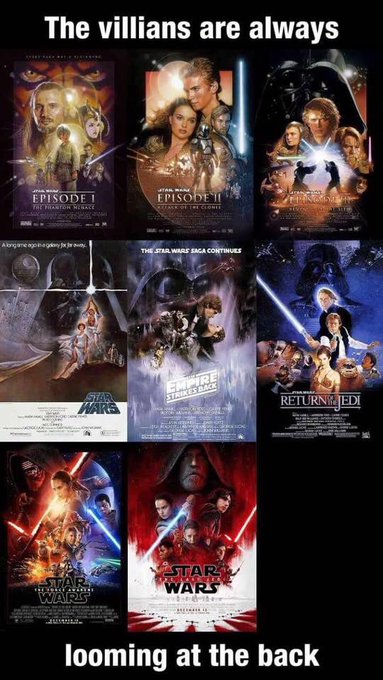
The Real Deal: Following the release of the new trailer and poster for Star Wars: The Last Jedi, it should come as no surprise that there is a lot of online speculation about what it all means. But one particular piece caught a lot of attention: an argument in favor of Luke Skywalker being a bad guy. "In the new poster for The Last Jedi it is a giant, looming Luke positioned to the rear, taking his dear old dead cyborg dad’s place," the argument went. "Moreover, a new display for the film’s IMAX release sees two split posters based on the traditional division in the Force between dark and light. Skywalker not only appears on the light side, with Rey, Finn, Chewie and Leia, he is also on the dark side with Captain Phasma and Ren." Convinced? The argument had one fan, at least—Mark Hamill himself.
Follow
@HamillHimself

✔@HamillHimself

NEWS FLASH for all you "Villains Looming at the Back of Posters" theorists: Luke was ALWAYS the villain! (from a certain point of view)

(That almost guarantees that Luke isn't a villain, really.)

Is Kylo Ren Going to Leave the Dark Side?
Source: Even more speculation, this time using the new trailer as fodder
Probability of Accuracy: If that last speculative piece seemed unlikely, this one seems like even more of a leap of faith, if not of logic.
The Real Deal: Speaking of that Last Jedi trailer, and the speculation it's provoked, some are convinced that the teaser reveals Kylo Ren is going to switch sides in the new film. The evidence is more than a little flimsy, and basically comes down to "Why else would he be holding his hand outwards as if in friendship?" OK, there are more than enough leaps in logic and supposition there to make that a pretty baseless argument. Also, that moment (watch it at 2:12 in the trailer below) could just as easily signal Rey switching allegiance to the dark side. But given director Rian Johnson's love of playing with expectations, who's to say that the villain won't turn into a good guy midway through the trilogy?

Laura Dern Is Really, Truly in The Last Jedi
Source: Laura Dern, via television
Probability of Accuracy: It's a visual reveal, so accuracy isn't really an issue, per se.
The Real Deal: Meanwhile, how charming is Laura Dern? Charming enough that, when revealing an official look at her Last Jedi character Vice Admiral Holdo on The Ellen DeGeneres Show, she actually told the audience, "See, I am in Star Wars! I told you guys!" Come on, that's ridiculously charming.

The promo for Holdo is particularly interesting in light of the new trailer for The Last Jedi, which notably featured none of the additions to the cast—not Holdo, not Paige or Rose, the newcomers to the Resistance, and not DJ, Benicio Del Toro's mysterious new character. OK, so maybe they're not trailer material, but they are in the movie, right? If Dern says she is, is it safe to say the others will show up somewhere? Fans will have to wait until December 15 to find out, apparently.

Step Into Star Wars Next Year
Source: The Void, which is actually a virtual reality company and not an existential concept, honest
Probability of Accuracy: It's an official announcement, so "Probably 100 percent accurate" seems like a safe bet.
The Real Deal: Can't wait for Star Wars Land to open in 2019? We have some good news for you: The ability to step in the world of Star Wars is far, far closer than you thought. Disneyland in Anaheim is going to be offering a VR experience called Star Wars: Secrets of the Empire starting on January 5. Created by The Void, Lucasfilm, and ILMxLab, the experience lets four people at a time go undercover as stormtroopers and ... well, let's let the trailer speak for itself.

Pretty cool, huh? Early tickets are already available, and let's be honest, almost certainly sold out for months by this point.

They're … Not Dead?
Source: Solo director Ron Howard
Probability of Accuracy: This one is entirely confirmed, and also entirely awesome.
The Real Deal: If fan service is what it's going to take to get fans into Solo: A Star Wars Story, then, dammit, fan service is what they're going to have:
As teased on Twitter by director Ron Howard, and later confirmed by all involved, the comic book characters Tag and Bink will make their on-screen debut in next year's flashback movie, played by screenwriter Jon Kasdan and first assistant director Toby Hefferman. For those who aren't familiar with Tag and Bink, they're essentially the Rosencrantz and Guildenstern of Star Wars, two background characters who somehow manage to be present for every big event of the first two trilogies in a series of comic books written by Kevin Rubio. This is, essentially, exactly what fans of Star Wars deep cuts need from Solo—and Rubio and Tag and Bink artist Lucas Marangon are pretty excited about it, too.

>>> Engie in talks to sell LNG operations to Total

Engie in talks to sell LNG operations to Total – report (translated)
23 OCT 2017
French energy group Engie [EPA:ENGI] is understood to be holding discussions with peer Total [EPA:FP] regarding the potential sale of its liquefied natural gas (LNG) operations.
An unsourced report from French newsletter La Lettre de L’Expansion claimed that a deal could be reached within the next few weeks.
The report noted that Engie is the largest LNG importer in Europe with 14 LNG carriers and three LNG terminals in France.

>>> Foxconn to deliver 25-30 Million iPhone X Models for Q4 due to Improved Yiel

Last week Patently Apple posted a report titled "Apple's Supply Chain confirms that they'll meet iPhone X Demand for the Holiday Season," contrary to some of the doom and gloom reports that have been posted online. Today another supply chain comes to light that is very positive if it actually pans out.

The new supply chain report today notes that shipments of iPhone X from Foxconn Electronics (Hon Hai Precision), Apple's sole contractor for the device, will reach around 2-3 million units before Apple begins to deliver the model on November 3, according to a Chinese-language Economic Daily News report.

Citing data from Taipei-based KGI Securities analyst Ming-chi Kuo, Foxconn will manage to ship 25-30 million iPhone X in the fourth quarter of 2017, down slightly from a previous forecast.

The report further noted that iPhone X shipments are expected to record a 50% on-quarter growth in the first quarter of 2018 on improved yield rates.

The worst case scenario for the production of 3D sensing modules used by iPhone X is over, with the two suppliers LG Innotek and Sharp to begin ramping up shipments in November and December, respectively, Kuo said.

Sharp has managed to improve the yield rate for the production of 3D sensing modules through technical support from General Interface Solution (GIS), a touch module specialist under Foxconn, the paper said.

>>> Berkely Group - A good short here fundam. & on chart ...CS mentionned

Look a quick chart of BKG and have a look to CS dwg of hombuolder this morning...mentionned BKG as an underpeformed..

The sector underperforms 80% of the time in the six months after the first rate hike; the sector's P/B is at an all-time high; London house prices are falling, yet the national homebuilders seem to be discounting a c5% rise; and political tailwinds can get no better. We highlight Berkeley Group rated Underperform.
full note attached

Stock is trading on strong resistance and RSI Divergence could see 3600 quickly

WSJ : Russia’s Kaspersky to Allow Outside Review of Its Cybersecurity Software

Russia’s Kaspersky to Allow Outside Review of Its Cybersecurity Software
Company hopes sharing source code will build trust after allegations its software helped Russia spy on Americans

Kaspersky Lab, the Moscow-based cybersecurity firm whose software U.S. officials suspect helped the Russian government spy on Americans, promised to make its source code available for an independent review.

The company said Monday the review is part of a “global transparency initiative” that it hopes will improve the trustworthiness of its products. It said it would hand over the source code for its software in the first quarter of next year but didn’t specify who would undertake the review or how widely the code would be disseminated.

The initiative follows a number of reports that the Russian government used Kaspersky software as an espionage tool. The Wall Street Journal reported earlier this month that Kaspersky’s antivirus software was used by Russian operatives to help them secretly scan computers around the world for U.S. government documents and top-secret information.


In addition, hackers working for the Russian government used Kaspersky software to steal details of how the U.S. penetrates foreign computer networks and defends against cyberattacks, the Journal separately reported.

Amid those revelations, a number of Kaspersky clients have said they would stop using the firm’s products. That includes the U.S. Department of Homeland Security.

Kaspersky has previously denied any complicity with Russian officials—or any government—in efforts to spy on other countries. The company’s chief executive, Eugene Kaspersky, has said his firm is being made a pawn in a wider geopolitical war of words between the West and Moscow.

In addition to opening up its software for third-party review, Kaspersky said it plans to implement additional controls to govern how it processes data. It will also open up three “Transparency Centers” around in the world, with locations in Asia, Europe and the U.S. by 2020.

The company said the additional controls would be implemented in cooperation with an independent third party but gave no other details. It said the transparency centers would be places for customers to access reviews of the company’s code and software updates.

“We need to reestablish trust in relationships between companies, governments and citizens,” Mr. Kaspersky said in a statement.