ABN Amro to make buys in France and Germany, earliest in 2019 - report (translated)
26 NOV 2017
ABN AMRO Group NV [AMS: ABN] wants to make buys in France and Germany, earliest in 2019, Dutch daily Het Financieele Dagblad reported citing ABN Amro CEO Pieter van Mierlo as well as Choy van der Hooft, responsible for the Dutch offices. The bank focusses on staying market leader in The Netherlands. In France and Germany, ABN Amro is the third player.
According to the CEO, the bank has to grow to keep up. However, Van Mierlo now mostly aims at creating synergy within the organisation. Several different departments have to function as one organisation and work together.
Van Mierlo also wants to double the investment in sustainable funds. Of the EUR 197bn in managed capital, ABN Amro wants to invest EUR 16bn in such funds.
OPEC Plus Adds Uncertainty to Oil Market
Russia’s importance to a deal to extend oil export cuts means that it holds the cards for OPEC and the deal will be less certain
Before the formalities begin this week in Vienna, the only question oil ministers will have left is who pays for the Sacher torte.
That is unusual for normally fractious meetings of the Organization of the Petroleum Exporting Countries. Even less usual is that, of the two crucial parties at the table, the pivotal one isn’t even a member—it is Russia. Saudi Arabia, the world’s top crude exporter and traditional OPEC kingpin, is facing political upheaval at home as 32 year-old Crown Prince Mohammed bin Salman purges political rivals. An export revenue slump is the last thing he needs.
For those concerned with the price of oil rather than geopolitics, Prince Mohammed and Russia’s Vladimir Putin being strange bedfellows isn’t what matters. The consensus seems to be that they are headed toward a deal that will see “OPEC-plus”—a collection of countries that control over half the trade in crude—extend cuts from the first quarter of 2018 through the end of that year.
But the devil may be in the details. Russia, in particular, is a tricky partner because it doesn’t have a single large, state-owned oil company to corral. Furthermore, Mr. Putin is on firmer ground at home and in a strong negotiating position. Any agreement may contain wiggle room that hinges on aspects such as compliance or prices that could increase how much crude actually comes onto the market next year.
With Brent crude up 22% in the past three months, investors may not want to push their luck betting on continued strength once a “successful” meeting of exporters concludes in Vienna
GE: New Insider Buy Of 3 Million Shares On Behalf Of Loews Signals B

Snapchat seeks salvation in long-form and “hands-on” AR ads
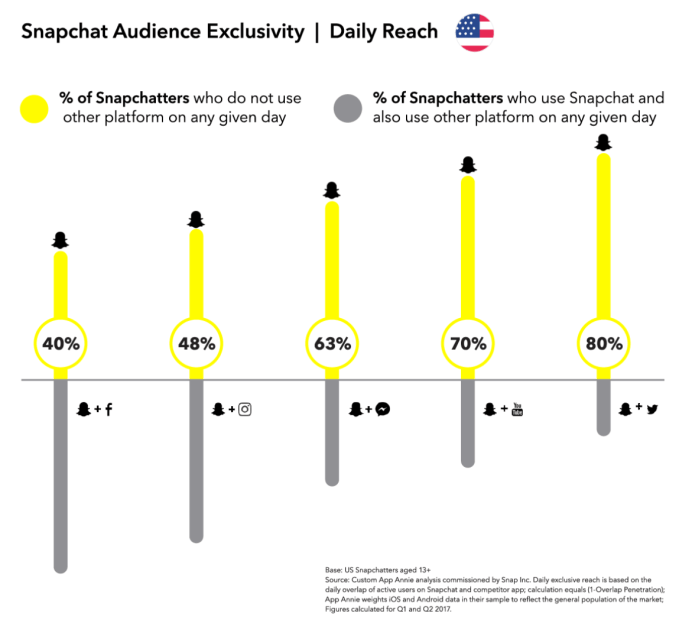

Snap Inc’s stock tanked after missing revenue expectations by $30 million last quarter, so Snapchat is looking to win over businesses with immersive new ads formats. This week it introduced two new forms of ads: Promoted Stories which string together multiple Snaps into a longer-form slideshows openable from a tile on the Stories page that’s shown to everyone in a given country, and Augmented Reality Trial ads that let people play with an AR version of a product overlaid on the world around them.
Together, these new formats could make Snap’s ads less skippable and more memorable, coaxing money out of businesses hoping to make a mark on premier audience of US teens. Both Promoted Stories and AR Trial ads go a step beyond what Facebook can offer, but could soon be copied like the rest of Snapchat.
Snapchat’s ads were predominantly either single Snap ads inserted between Stories or Discover content that could easily be skipped with a single tap, or sponsored creative tools that let you try on goofy masks or project 3D mascots into the world but that didn’t offer much utility. This may have left advertisers skeptical about the lasting impact on buying behavior.
“Our advertising partners have been asking for ways to tell deeper stories on mobile” Snap’s Director of Revenue Product Peter Sellis told TechCrunch in a statement. HBO is piloting the format with Promoted Stories about why you should stay in and watch Game Of Thrones on Black Friday, while in Europe clothing brand ASOS highlights “night-out worthy looks.”
Now advertisers can string together a series of three to ten photos and videos to create a Promoted Story that auto-advances or that users can tap through to follow a detailed narrative about a brand or see multiple angles of a product. They can look like a user Story or a mini magazine-esque Publish Story like what appears in Discover, and each Snap can be swiped up to open a website, app install, or article.
These Promoted Stories are labeled “ad”, get their own preview tile, and are purchased on a full-country one-day takeover basis with users having to actively tap to view. Advertisers get back a range of analytics from preview tile impression through to conversions. Snap says it can reach 88 million people in the US with Promoted Stories, surpassing the 74 million Instagram Stories users, and approaching half as many as Facebook’s 190 million mobile audience members. For the coveted youths age 13 to 24, Snap reaches 47 million people — supposedly 9 million more than Facebook and 15 million more than Instagram’s feed.
To avoid falling into the same pit as Twitter, with its highly-skippable and unobtrusive ads, Snapchat hopes Promoted Stories will ensnare users even if they instinctively try to click past an ad’s first Snap.
Meanwhile, AR Trial Ads take Snapchat’s World Lens ads and make them functional instead of just fun. Previous World Lens ads remade your reality into a creepy Stranger Things scene or let you stick a dancing Bud Light mascot in your videos. With AR Trial ads, BMW will let you actually place its new X2 vehicle in an augmented view of the space around you, tap to change its color, and walk around it like it’s actually there. The ads can also be swiped up to view a business’ website.
“We wanted to insert ourselves in an organic way into the Snapchat environment and its users’ world. That is the most meaningful way to address our fans in a style that fits the channel” head of Digital Marketing Jörg Poggenpohl wrote to TechCrunch in a statement. A previous BMW sponsored face lens ad in Europe reached 13 million Snapchatters who played with it for an average of 24 seconds.
Snapchat’s new AR Trial ads let you play with products in augmented world
That’s the magic of these AR ads. Even if you never share the content with friends, you still get extended exposure to the brand just playing with the selfie mask or 3D objects. Actually resizing and walking around a car company’s vehicle will probably leave a bigger impact than just scrolling past some Facebook News Feed display ad. If you reshare that content in private messages or Stories, BMW gets bonus exposure to people who see the brand enmeshed with their friends’ content so they don’t just skip past it like the banners we’ve all grown numb to.
Herein lies Snapchat’s challenge and opportunity. After bloodbath earnings calls and extremely weak user growth, Snap has to figure out how to squeeze more money out of the same number of people. It added just 4.5 million users last quarter, slipping below 3% user growth for the first time ever, down from 17% before Instagram Stories launched.
If it can’t reach the most users, it has to boost average revenue per user as high as possible without completely overwhelming the Snapchat experience with ads. These new formats are a smart way to do that because you’re never forced to watch them. You can choose to tap the Promoted Stories tiles or play with the AR tools.
By offering immersive experiences users choose to dive into rather than cramming light-touch ads down people’s throats, Snap could earn enough to stabilize its businesses and cut its losses. It can’t keep incinerating over $400 million a quarter and expect to have enough cash to develop a killer augmented reality hardware device before giants like Apple invade the market.
Altice should avoid fire sales, no urgent balance sheet requirement – bankers (MergerMarket.com)
Average debt maturity over six years
Disposals do not address underlying issues
Turnaround of French business key to recovery
Altice [AMS:ATC] can address its share price fall without resorting to a fire-sale of non-core assets, particularly as there is no urgent balance sheet requirement, bankers familiar with the situation said.
The company has lost around half its market value this month following disappointing performance at its French operation, SFR, and brokers’ downgrades. Following market speculation, the company released a statement this week saying it will not pursue "meaningful M&A opportunities" but instead focus on turning around the French business and disposing non-core assets.
Altice added it had initiated a process to dispose of towers. This specifically refers to those in France and Portugal, the first banker said. In France the potential bidders are TDF, Cellnex [BME:CLNX] and American Tower [NYSE:AMT]; in Portugal they are Cellnex and Telxius [BME:TLX], this banker said.
Although disposing of the assets will be a welcome gesture for investors, Altice should not overreact and compromise too much on the valuation it wants, the bankers said.
It could decide not to sell any of the non-core assets and still vastly improve its share price through turning the French business around and refraining from large deals, the bankers said.
The fact the group does not have any urgent debt maturities is in its favour, two of the bankers pointed out. Its average debt maturity is 6.3 years, Altice has said. It added it has EUR 1.66bn of cash on its balance sheet. As a result, disposing of small assets should be more about keeping shareholders on side than any desperate requirement.
Altice’s debt/EBITDA ratio target is broadly in line with the market, a sector lawyer said. Altice Group and Altice Europe's net leverage is 5.5x and 5.0x respectively, according to Q1 results published in May. It’s target leverage for Altice Europe given in May is around 4.0x, for Altice US around 5.0-5.5x.
But Altice peers have notably reduced their leverage. Telefonica [BME:TEF] has net debt/OIBDA of 2.72x and Vodafone’s [LON:VOD] net debt/EBITDA is 2.2x.
Recent press reports have linked the share price fall to the potential disposal of Altice’s Dominican Republic business. But the asset has been for sale for the past two years, one of the bankers said.
Altice has been trying to sell the company at 11x EBITDA, putting off buyers, this banker said. Again, while it may reduce price expectations for this asset as a concession for jittery shareholders, there is no balance sheet-related compulsion to do so, the banker said.
There are also rumours that the company may sell Portugal Telecom, another banker said. Armando Pereira, Portuguese-born and one of Altice’s founding partners, could oppose an exit however, this banker said.
Additionally, disposals will not solve Altice’s underlying problem, the bankers said. It needs to improve the French business, which is dragging the group’s value down, the bankers said.
This cannot be achieved through cost-cutting, the bankers said. A lot has already been done and Altice committed to protecting jobs when it bought French operator SFR in 2014, the first banker said. However, this was only a three-year commitment.
It will have to sacrifice profits to solve the French issue, the second banker said. The French market is highly competitive with four players, with Iliad [EPA:ILD] undercutting rivals.
Altice has begun its work by changing the management team. Armando Pereira is now Altice Telecom COO, with a primary focus on France. Alain Weill, SFR Media CEO, is appointed SFR Group Chairman and CEO, and Altice Media COO.
Wider management changes include that Patrick Drahi is now president of the board and Dexter Goei replaces Michel Combes as CEO.
In terms of long-term M&A strategy, these changes will not have much of an impact, the bankers said. Founder Drahi was already driving the company’s acquisition strategy.
Altice did not respond to a request for company comment.
Unilever will make large takeovers in near future - report (translated)
Unilever [LON:ULVR] [AMS:UNA] will be doing large takeovers in the near future, reported Het Financieele Dagblad based on unnamed sources. The headhunter that is hired to find a successor for CEO Paul Polman is looking for someone who is able to do transforming takeovers, sources said.
The new takeovers will be of the scale of Bestfoods, earlier this century, the report said. Bestfoods was acquired by Unilever for over EUR 24bn, which makes it the largest takeover in Unilever's history. Earlier this year, a takeover attempt of Kraft Heinz [NASDAQ: KHC] had failed. According to sources with knowledge of the company, the conglomerate realises those kind of takeovers are necessary, the report said.
Bulls Give Thanks for Another Seasonally Strong Thanksgiving Week
A festive mood struck Wall Street this week and it translated into further gains for the major indices, which culminated in new record highs for the S&P 500 and Nasdaq Composite.
The Russell 2000 led the way as domestically-oriented small-cap stocks were pushed up on tax reform optimism.
The Nasdaq Composite followed close behind with a 1.6% gain that was led by the familiar contingent of Apple (AAPL), Amazon.com (AMZN), Facebook (FB), Alphabet (GOOG), Netflix (NFLX), and Microsoft (MSFT), as well as ongoing strength in the semiconductor stocks.
The Philadelphia Semiconductor Index jumped 2.7% for the week, underpinned by M&A activity that featured a bid by Marvell Technology (MRVL) to acquire Cavium (CAVM) and reports suggesting Broadcom (AVGO) might return next week with a higher offer to acquire Qualcomm (QCOM) after the latter company rejected its $70 per share cash-and-stock offer.
Beyond the news itself, though, the broader market was carried along by an embrace of the seasonality trade, which is to say participants rode the notion that this Thanksgiving week is often accented with a positive bias.
There was no denying the positive bias this time around.
The seasonality factor hit home in earnest on Tuesday when the major indices logged gains between 0.7% and 1.1% despite the Department of Justice filing a lawsuit to block the AT&T (T) - Time Warner (TWX) merger and a lack of any clear-cut news to explain the unmitigated bullish bias. That bullish bias took the S&P 500 above 2600 for the first time ever, squeezing short sellers and feeding a fear of missing out for sidelined participants.
There was only a slight retracement on Wednesday when the S&P 500 dropped two points despite an acknowledgment in the minutes for the October 31-November 1 Federal Open Market Committee meeting that "...several participants expressed concerns about a potential buildup of financial imbalances" given elevated asset valuations and low financial market volatility.
Those concerns could come home to roost at another time, but this week wasn't governed by any unsettling concerns.
The market traded up, and through, reports that talks in Germany to form a coalition government had failed (although reports Friday suggested a coalition might be struck after all); it traded up, and through, Fed Chair Yellen's announcement that she will be resigning from the Board of Governors upon the swearing in of Jerome Powell as Fed Chairman; and the stock market traded up, and through, another week in which a curve-flattening trade persisted in the Treasury market.
The spread between the 2-yr note yield and the 10-yr note yield narrowed to 60 basis points from 63 basis points a week ago and 125 basis points when the year began. A narrowing spread often piques concerns as being a harbinger of a slowdown in economic growth.
There wasn't much economic data this week, although the few reports that there were generally surprised on the upside. The Leading Economic Index, Existing Home Sales, and University of Michigan Consumer Sentiment reports were all better than expected.
The Durable Goods Orders report for October was weaker than expected (-1.2%), yet the disappointment over that headline was mitigated by the understanding that the weakness was driven by volatile aircraft orders. Excluding transportation, durable goods orders rose 0.4% on the heels of an upwardly revised 1.1% increase (from 0.7%) for September.
The coming week will feature a longer lineup of economic data, including the New Home Sales (Monday), Consumer Confidence (Tuesday), revised Q3 GDP (Wednesday), Personal Income and Spending (Thursday), ISM Index (Friday), and Auto Sales (Friday) reports.
That data will be competing for market participants' attention along with the confirmation hearing for Jerome Powell (Tuesday), Fed Chair Janet Yellen's economic outlook testimony before the Joint Economic Committee (Wednesday), the meeting between OPEC members and Russia to discuss extending production cuts (Thursday), and the expected vote on the Senate's tax bill (Thursday).
Clearly, then, there will be a lot to chew on for market participants in the coming week after they digest the fulfilling gains of another seasonally-strong Thanksgiving week.
- Russell 2000 +1.8%
- Nasdaq Composite +1.6%
- S&P Mid Cap 400 +1.0%
- Dow Jones Industrial Average +0.9%
- S&P 500 +0.9%
A Green Friday
The stock market meandered its way through an abbreviated session on Friday and scored modest gains to close out the week. The bulk of today's gains were registered shortly after the opening bell. After that, there was mostly sideways trading action.
Despite the modest gains, they were still good enough to propel the S&P 500 and Nasdaq Composite to new record highs.
Leadership throughout today's thinly-traded session was provided by the information technology sector (+0.5%), which was helped along by reports suggesting Broadcom (AVGO 282.38, +7.01, +2.6%) might return next week with an increased offer to acquire Qualcomm (QCOM 68.91, +0.78, +1.1%).
That news contributed to the outperformance of the semiconductor stocks, which was reflected in the 1.0% gain for the Philadelphia Semiconductor Index. Their leadership, and gains in the likes of Facebook (FB 182.78, +1.91, +1.1%) and Amazon.com (AMZN 1186.00, +29.84, +2.6%), served as the driving influences behind the Nasdaq's record run.
Amazon.com was a focal point throughout the day as it is thought by many to be in the best position to capitalize on Black Friday sales and holiday selling activity in general.
Early reports have made it sound like the online sales activity at least is off to a good start. Adobe Analytics reported that $1.52 billion was spent online by 5:00 p.m. ET on Thanksgiving Day, up 16.8% from last year, and that online sales as of 10:00 a.m. ET on Friday were up 18.4% year-over-year.
Amazon.com's stock strength, however, wasn't exclusive. Well-known retailers such as Macy's (M 21.07, +0.44, +2.1%), Best Buy (BBY 57.00, +0.51, +0.9%), Gap (GPS 29.64, +0.47, +1.6%), and Kohl's (KSS 45.09, +0.46, +1.0%) also exhibited relative strength. Their gains supported a 0.2% advance for the S&P 500 consumer discretionary sector.
Gains in the materials (+0.5%), real estate (+0.4%), and energy (+0.3%) sectors also helped prop up the broader market.
Elsewhere, oil prices jumped 1.5% to $58.87 per barrel. That move was aided by a weaker dollar, geopolitical angst, short-term supply disruptions tied to a Keystone pipeline outage, and speculation that OPEC and Russia are primed next week to agree to an extension of their oil production cut program.
The latter meeting will take place on Thursday and will be a key event in a week that will feature several key events, including Jerome Powell's Fed Chair confirmation hearing (Tuesday), current Fed Chair Janet Yellen's economic outlook testimony before the Joint Economic Committee (Wednesday), and an expected vote on the Senate's tax bill on Thursday.
In terms of this week, it was another winning week. The Russell 2000 led the way with a 1.8% gain, followed by the Nasdaq Composite, up 1.6%, the S&P Mid Cap 400, up 1.0%, the S&P 500, up 0.9%, and the Dow Jones Industrial Average, up 0.8%.
Year-to-date returns are as follow:
- Nasdaq Composite +28.0%
- Dow Jones Industrial Average +19.1%
- S&P 500 +16.2%
- S&P Mid Cap 400 +12.0%
- Russell 2000 +11.9%
New car sales go into reverse in the UK
A Brexit-induced price rise and increases in taxation bring sales boom to an end
After several years at full throttle, new car sales in the UK have gone into reverse.
Sales of new vehicles have fallen for seven straight months since April, according to the Society of Motor Manufacturers and Traders, the industry trade body. So far this year, new car registrations are down 4.6 per cent compared with the same period in 2016.
Analysts and economists say a potent mixture of factors explain why the market has turned, ranging from higher car prices because of Brexit-induced inflation to government moves to increase vehicle taxes.
But experts’ starting point is to flag how there were six strong years of car sales between 2011 and 2016, so now fewer people are looking to buy vehicles compared with previously. The average age of a UK car on the road is just under eight years, according to the SMMT.
“The cycle has naturally had a strong run,” says Mike Allen, an analyst at Zeus Capital. “We were due a downturn.”
The UK vote to leave the EU has had some impact on new car sales, because sterling’s fall in value since the Brexit referendum last year has stoked inflation — including vehicle prices.
New car prices increased by 3.2 per cent between January and October compared with the same period last year, according to the Office for National Statistics, the UK statistics agency.
Almost every mass market carmaker raised prices as they faced higher costs when importing vehicles to Britain.
Even companies that manufacture cars in British factories, such as Nissan and Toyota, were forced to pay more for the components they ship in from continental Europe.
Meanwhile consumer confidence in the UK following the EU referendum is hovering close to its lowest level since 2013, according to data issued by the European Commission, and that may well have hit car sales.
A car is the most expensive item most people buy after their house, and economists say vehicle purchases are closely tied to consumer confidence.
“Car sales are very sensitive to consumer confidence,” says Samuel Tombs, economist at Pantheon Macroeconomics. Usually it takes about six months to see the effects of a drop in confidence feed through to car sales, he adds.
Another factor weighing on the car market may be regulators’ concerns at the growth of cheap financing deals.
There has been widespread use of so-called personal contract purchases — where customers pay a deposit and monthly payments for a fixed period before having the option to buy the car outright — since the financial crisis, when the Bank of England cut interest rates to historic lows.
But the Financial Conduct Authority launched a review of these deals in the summer, and a Bank of England survey of credit conditions in the third quarter identified weaker growth in car dealership financing.
However these PCP deals also force consumers to make a decision about a new car when their contract ends — helping to drive sales that motorists would otherwise have delayed.
The deals also lessen the impact of price rises, spreading them across monthly payment.
Analysts and dealers therefore say that without the high penetration of PCP deals — around 80 per cent of new car sales — it is highly likely new car sales would actually have fallen much further.
A further factor influencing car sales was the introduction in April of higher taxes on more expensive vehicles and those that emit the most carbon dioxide.
As a result, sales in the first quarter boomed as people bought cars early to avoid the more onerous taxes. New vehicle registrations in March rose 8.4 per cent compared with the same month last year.
A bigger negative for new car sales could be the government’s efforts to safeguard the environment by encouraging people to buy electric vehicles rather than petrol or diesel cars.
In July Michael Gove, the environment secretary, proposed a ban on sales of new petrol and diesel cars from 2040, although hybrid vehicles were excluded. Then last Wednesday Philip Hammond announced in the Budget that buyers of new diesel cars would face a one-off payment of up to £500.
The Volkswagen scandal in 2015 highlighted how vehicles powered by diesel engines emit significant amounts of nitrogen oxides — key contributors to air pollution — and there are signs of a consumer backlash against the fuel.
Diesel car sales fell 14.9 per cent between January and October compared with the same period last year, while alternative fuel vehicles including electric and hybrid models rose 34.8 per cent.
“There’s a lot of uncertainty about the government’s stance on diesel cars and emissions generally,” says Ian Crowder of the Automobile Association.
The uncertainty over how far the government will go to try to discourage vehicles reliant on fossil fuels, as well as broader questions on the form Brexit will take, are likely to weigh on the car market for some time to come.
For this reason, in its latest set of forecasts issued in October, the SMMT predicted that car sales will fall not just this year but also in 2018 and 2019.