White House Considers Former Bush-Era Economists for Fed No. 2 Job
Richard Clarida and Lawrence Lindsey are interviewed for vice chairman role
The White House has interviewed two economists who served in senior positions in the George W. Bush administration to serve as the vice chairman of the Federal Reserve Board, according to people familiar with the matter.
The two are Richard Clarida, a managing director at money manager Pimco who is also a professor of economics and international affairs at Columbia University, and Lawrence Lindsey, who runs an economic-advisory firm in Washington.
Mr. Clarida served as assistant secretary for economic policy at the Treasury Department from 2002 to 2003. Mr. Lindsey was a top economic adviser to Mr. Bush from 2001 to 2002 and served as a governor on the Fed’s board from 1991 to 1997. Both men would satisfy the Trump administration’s desire to fill the vice-chair post with an economist with a strong grounding in monetary policy.
The Trump administration is also considering Mohamed El-Erian, the former chief executive of Pimco and a former deputy director of the International Monetary Fund.
It isn’t clear whether there are other candidates, or when a final nominee may be named. The process of selecting the central bank’s No. 2 official began in earnest last month after President Donald Trump nominated Fed governor Jerome Powell to succeed Fed Chairwoman Janet Yellen when her term expires in February.
Mr. Powell has served on the Fed’s board since 2012 but will be the first non-economist to lead the central bank in nearly four decades. Investors have been hungry for clues about how closely Mr. Powell and Mr. Trump’s other nominees will hew to Ms. Yellen’s policy of slowly raising interest rates from very low levels.
While Mr. Powell’s views on monetary policy are largely in line with Ms. Yellen’s, the role of vice chair has taken on greater importance because Mr. Powell had little background in monetary policy until this decade, and because Mr. Trump will have an opportunity to replace half of the Fed’s seven-member board over the coming year.
Ms. Yellen has said she will resign her seat as a governor when her term as chair ends on Feb. 3 and her successor is sworn in. That will give Mr. Trump up to four vacancies on the Fed’s board. Besides Ms. Yellen, the Fed’s board only has one other Ph.D. economist, Lael Brainard, who was nominated by President Barack Obama.
Mr. Trump has nominated Marvin Goodfriend, an economist at Carnegie Mellon University, to fill one of the vacant board seats.
Mr. Lindsey didn’t respond to inquiries seeking comment. Mr. Clarida declined to comment through a spokeswoman.
Both men are well-credentialed economists who have done scholarly work on or have real-world experience in central banking, and both have appeared frequently in the media commenting on the Fed and monetary policy.
In recent months, Mr. Clarida has spoken favorably in interviews about the direction of monetary policy under Ms. Yellen this year. The Obama administration considered nominating Mr. Clarida to a vacant Fed seat in 2011, but he withdrew from consideration and the Obama administration ultimately selected Mr. Powell for that seat.
As a Fed official in 1996, Mr. Lindsey warned of a stock-market bubble and said the Fed had an obligation to prevent the bubble from growing out of control. Mr. Lindsey was chided by his colleagues during the Bush administration for estimating a relatively high price tag for the Iraq War in the run-up to the 2003 invasion, a forecast that proved prescient when the final cost easily outpaced all estimates.
While the White House controls the nomination of the vice chair, officials are likely to ensure that their nominee can work well with Mr. Powell.
Earlier this year, Mr. Trump nominated another veteran of the George W. Bush administration, Randal Quarles, as the Fed’s vice chairman of supervision. He was confirmed by the Senate earlier this year and took office in October. Mr. Lindsey served as a policy adviser in the George H.W. Bush administration, where Messrs. Powell and Quarles also served in top Treasury posts.
The Wall Street Journal reported Mr. El-Erian’s potential candidacy last month. Mr. El-Erian is also considered by many Fed watchers to be a potential candidate to lead the New York Fed, which will name a new president next year. He has master’s and doctorate degrees in economics from Oxford University and has spoken and written frequently in recent years on monetary, regulatory and fiscal policy, including publishing a bestselling book on central banks last year titled, “The Only Game In Town.”
In recent years, Mr. El-Erian has voiced somewhat hawkish critiques of the Fed’s policy stance, including decisions to hold interest rates at ultralow levels despite signaling plans to raise them. In recent months, he has suggested that the Fed’s inflation target of 2% might be too high given structural forces holding down consumer prices.
Carrefour, Fnac Darty merger likely – report (translated)
27 DEC 2017
French supermarket chain Carrefour [EPA:CA] is likely to merge with Fnac Darty [EPA:FNAC], Belgian business daily De Tijd reported, citing a report in the French newspaper Les Echos that in turn cited analysts.
Carrefour needs a merger or an acquisition to survive, the report continued. On 23 January, the company will announce its plans, and a merger with the electronics retail chain seems most likely, according to the report.
The new CEO of Carrefour, Alexandre Bompard, previously worked at Fnac Darty. Earlier this month, both the retail chains signed a cooperation agreement, which further makes the merger possible, the report added.
Afin de résoudre le problème du modèle économique de l'hypermarché, mis à mal par la montée en puissance de l'e-commerce et les nouveaux modes de consommation, Alexandre Bompard va devoir faire évoluer en profondeur l'organisation du groupe.
Si Georges Plassat, malgré les mots très durs de son successeur sur son bilan, a su, sous sa présidence, remettre Carrefour dans les clous des fondamentaux de la grande distribution, à défaut de l'avoir préparé au commerce de demain, Alexandre Bompard a une tout autre mission : celle de briser les tabous. Car pour avoir été pionnier des hypermarchés, découvreur de nouveaux territoires à l'international, lanceur de tendances, le groupe, longtemps fier de son « quart d'heure d'avance » est aujourd'hui à la croisée des chemins.
Son fer de lance, l'hypermarché, ne sait plus où donner de la tête. Or, malgré la dimension multiformats du groupe, il contribuait encore pour 41 % du bénéfice avant impôt (Ebit) de Carrefour France en 2016, les activités hexagonales représentant 44 % de l'Ebit total. De fait, le concept du « tout sous le même toit » est attaqué de toute part : les sites marchands et leur choix infini, les déstockeurs et leurs offres attractives, les supermarchés avec leurs services de proximité, Leclerc et les maxidiscompteurs, enfin, avec leurs prix imbattables. Sans parler des enseignes non-alimentaires , qui ont sorti les hypers des marchés du sport, du bricolage, de la mode bon marché, et des restaurants avec ou sans salle qui livrent leurs plats à domicile via des applications mobiles.
Face à cela, plus question de tergiverser : le premier distributeur français doit prendre plusieurs tournants stratégiques pour résoudre son problème de modèle économique. Pour ce faire, son nouveau patron devra briser pas moins de quatre tabous.
· Finie, la conquête du monde
Pionnier de la grande distribution dans les pays émergents, longtemps premier distributeur européen- encore le plus international parmi les exploitants de grandes surfaces alimentaires, Carrefour n'est plus un groupe conquérant. Le groupe s'est certes essentiellement retiré de pays où il avait échoué (Japon, Corée du sud), ou dans lesquels il n'était pas seul maître à bord (Turquie). Mais en vendant la Colombie, Georges Plassat a renoncé à un marché porteur. Alexandre Bompard devrait accélérer le mouvement. La Chine, l'Argentine, la Pologne sont citées, la Roumanie, voire le Brésil pourraient l'être. Le groupe a démenti avoir mandaté des banques, pas qu'il pourrait vendre.
· Magasins à céder
Dans l'histoire de la grande distribution, le mouvement était jusqu'ici à la concentration opérationnelle, les petits groupes indépendants, voire certains commerçants des grands réseaux coopératifs passant sous le giron des groupes intégrés. C'est fini. La tendance s'inverse. Carrefour devrait ainsi placer en location-gérance des hypermarchés de villes petites et moyennes. Cinq sont cités ici et là, ceux de Cahors, Château-Thierry, Flers, Montluçon et Vernon, une vingtaine au total pourraient être concernés.
· Plan social en vue
Les coûts de personnel chez Carrefour France atteignent 18 % des charges totales, contre 16 % historiquement. Depuis la fusion avec Promodès en 1999, l'entreprise s'est complexifiée. Selon la CGT, Alexandre Bompard aurait décidé de trancher dans le vif. Quelque 1.200 postes seraient menacés au siège de Massy (Essonne), le siège historique de Promodès à Mondeville (Calvados) pourrait fermer, soit au total plus de 1.500 postes concernés. Dans les hypermarchés, plusieurs annonces auraient été faites au comité central d'entreprise, sur l'automatisation des stations-service, la suppression d'emplois administratifs et à la réception logistique, et celle des postes de vendeurs dans les rayons d'électrodomestique. Au total, ce seraient plus de 5.000 emplois concernés, selon le syndicat, sur près de 115.000 en France.
· Le concept unique a vécu
Réduction des surfaces, concession de certains rayons, développement du « food service », « satellite drive » avec une usine de préparation centralisée et des lieux de retrait sur des sites dans des zones de flux, etc. L'hypermarché a vécu comme « cathédrale » de la consommation, avec un large choix qui n'est plus fondamentalement utile. Carrefour va devoir retrouver l'agilité de ses débuts.
Sollicitée, la direction du groupe n'a pas souhaité faire de commentaires.
Vidéo - Les
Californian growers and retailers brace for cannabis competition
As the state prepares to fully legalise marijuana, established players are wary of new generation of start-ups
When he was a child, John Casali used to listen out for federal helicopters hunting the hippie marijuana growers who had migrated to a remote patch of the northern California coast which became known as the Emerald Triangle.
“It was kind of disturbing as a kid,” he says, shielded by huge redwoods that surround the small family farm he still runs in the area. That was not his only brush with the law: as a 22-year-old, he was jailed for eight years in 1992 for growing cannabis.
But in the surprising second act of a life shaped by changing official attitudes to marijuana, the convicted criminal today is a member of his local chamber of commerce; he holds a county permit to grow medicinal cannabis on the same farm; and he is wading through paperwork for a full state licence, which will finally be issued in the new year.
California has long been a cannabis pioneer. The state became a hub for the drug-induced counterculture of “turn on, tune in, drop out” of the 1960s, from hash-smoking hippies of Haight-Ashbury in San Francisco to Cheech & Chong driving around the streets of Los Angeles in a van made from weed. California was both the first state to criminalise pot in 1913 and then the first to legalise medical marijuana in 1996.
From the start of January, California is set to become the latest — and by far the largest — state to fully legalise recreational use of marijuana by adults. The decision completes a cultural and political shift all along the west coast of the US where the drug has been gradually decriminalised, offering people like Mr Casali a route out of an illegal industry and into a legitimate business.
Full legalisation should be a vindication for Mr Casali and other members of the old-school cannabis industry that long battled with the authorities and made the case for new rules. A potential cannabis market worth an estimated $5bn a year, according to to Vivian Azer, an analyst at Cowen investment bank, is about to open up in the state with the biggest economy.
But instead, many are anxious about the potential threat from another symbol of California — venture capital-backed start-ups. A new generation of businesses has emerged in the state intent on smartening up marijuana’s image and professionalising operations. As getting high becomes more mainstream, tall glass bongs and rolled cannabis cigarettes are being replaced by discrete, high-tech vaporisers. At the same time, big agricultural producers are looking to grow cannabis at scale.
Many of the old-school entrepreneurs feel the state has botched the new rules for the sector, leaving a loophole that could allow large farms to dominate small cultivators and imposing business procedures so stringent that unconventional businesses — some of which have never kept formal accounts — are bound to slip up.
With final regulations released only weeks before they were due to come into effect, cannabis operators are scrambling to prepare. They are also trying to navigate the tensions between state and federal drug policy, which will become ever sharper when a state the size of California officially legalises the substance. At the national level, marijuana remains in the same criminal classification as heroin and LSD. This means that legal cannabis operators cannot bank with nationwide financial institutions and are often left dealing with cash.
To add to the uncertainty, US attorney-general Jeff Sessions has made his hostility towards legalisation clear. Saying he does not believe marijuana has medical uses, Mr Sessions has threatened to axe the single paragraph of federal law which prevents the national government from prosecuting medical marijuana users and growers.
“States can pass whatever laws they choose, but I’m not sure we’re going to be a better, healthier nation if we have marijuana being sold at every corner grocery store,” he said this year.
That means many in the industry will still be looking over their shoulder once legalisation becomes a reality. “Just because it’s legal with the state, doesn’t mean it’s legal with the Feds [Federal Bureau of Investigation],” said Mr Casali. “We’re in this little grey area.” If the federal government raided his farm like they did in 1992, he would have enough plants to get life in prison. He knows the costs all too well. During his eight years in a federal facility, Mr Casali’s mother and stepfather died in a commercial fishing accident.
As marijuana prepares to go fully mainstream in California, many of the new entrants believe the first step needs to be a rebranding exercise to present cannabis as a social lubricant in the same light as alcohol. “I think we’ve all had enough of the stereotypical stoner,” says Evan Eneman, managing partner at Casa Verde, a venture capital company that invests in cannabis tech. (The rapper and entrepreneur Snoop Dogg is also a partner). Mr Eneman says that if weed is going to be widely accepted, it needs to appeal to professionals like him.
In San Francisco, bright blue billboards trumpet cannabis’s benefits to the city’s highly strung technology workers. “Hello marijuana, goodbye anxiety”, says one advert from Eaze.com, a cannabis delivery start-up. Driven by $51.5m of funding from investors including the Winklevoss twins and DCM Ventures, Eaze wants to be an Uber for pot.
Whether these VC-backed companies will be able to prosper in what is a low-margin business remains unclear. But they are already undercutting the old-school incumbents.
Kevin Reed, proprietor of the Green Cross dispensary and a fixture of San Francisco’s cannabis scene, is closing the delivery service on which he originally founded his company, saying he can no longer afford to compete with upstarts like Eaze. His revenues this year, normally between $15m-$18m a year, are down 37 per cent.
In a meeting room cum packaging station above his dispensary, where black walls are decorated with artwork by Dr Seuss, Alabama-born Mr Reed rolls a joint and tries to be cheerful about the imminent legalisation. But he is struggling to be upbeat because the fees and taxes which come with it threaten to double his prices.
With a combination of state and municipal sales and excise taxes that could exceed 45 per cent, some in the industry warn that legal operators will be unable to compete with the black market — and some who have tried to play by the rules, such as Mr Reed, feel betrayed.
“Now that our industry is being forced into profit, a lot of the compassion is going to be sucked up in fees and taxes,” Mr Reed says. He has been on the California State Legalization Task Force for two years, but concludes “they didn’t take a whole lot of our f***ing advice”.
Mr Casali, the grower from northern California, says new taxes would eat away at his profits. “I can only produce a very little amount of cannabis,” he says Mr Casali. “Big Ag can drive that price down . . . we’re all seeing the prices plummet right now.” In the late 1980s he could charge $5,500 a pound. Now, he says, it’s $600-700.
A last-minute change made to California’s cannabis regulations lifted the limit on the number of permits a single operator can own. This has left small-scale farmers worried that the new laws have made them even more vulnerable to consolidation from big commercial operations, which are now free to buy up as much land and as many permits as they want, potentially creating large-scale commercial farms whose increasing output might lower prices further.
The revision “rolls out the red carpet for large corporations to crush the livelihood of small family farmers who should be given a fair chance to succeed in a regulated market”, wrote California senator Mike McGuire and assembly member Jim Wood in a letter to California’s licensing authority.
But officials have defended the plans, saying that the regulations will foster a balanced commercial cannabis sector with room for both big and small businesses, with boutique enterprises able to attract higher prices through organic, farm-to-table style branding.
Lori Ajax, chief of the state’s Bureau of Cannabis Control, disputes the idea that the new regime will fuel a black market as growers try to evade the new taxes. “People are looking to be able to go to a legal store, buy it, ask questions, know that it’s tested and safe,” she says, adding that licensing fees are scaled according to business size.
Her agency is one of three dealing with cannabis — the public health department is regulating manufacturers, while the food and agriculture department is regulating cultivators. With many cannabis operators growing, manufacturing and selling their own product, they have a host of different applications to complete — and that’s after they’ve gone through a completely separate process to secure permits at the county level.
Within days of its system opening, Ms Ajax’s Bureau already had 1,300 applicants. She expects a festive season tied to her desk in Sacramento: the final regulations were not submitted until November, giving businesses scant time to get lengthy applications together before the new year.
“We don’t expect everyone to have a state licence come January 1,” says Ms Ajax. She says operators will be given a fair chance to get legal: “If we want to minimise the black market, I think we have to give time for people to transition.”
The new regulations are painstaking. In a system called track and trace, the state of California aims to account for the whereabouts of the produce of every single cannabis plant — from the seed being planted all the way to a small amount of dried weed in a hash brownie — in real time.
“These burdens are higher than I’ve ever seen in any industry,” says Ben Curren, chief executive of Green Bits, a software system that aims to streamline compliance for cannabis businesses.
“Most small businesses have trouble doing payroll and taxes,” he says. “You now have to run like [US chain] Target or something, where you know where every single thing in your store is every single moment of the time.”
But Ms Ajax is optimistic that regulation will foster a commercial cannabis economy that resembles California’s alcohol industry — which she previously oversaw — where consumption is in part driven by branding.
Consumers are “going to want to know about who the cultivator is, a lot more branding and whatnot”, she says. “I think you’re going to find a savvy consumer market who is going to want to go to those stores.”
Some companies are trying to make a virtue of their small scale in their branding. Mr Casali works with Flow Kana, a farm-to-table cannabis brand that uses the premium language of winemaking — describing different growing regions as “appellations”. It emphasises its growers’ relationship to the land and their organic, sustainable farming practices.
For Mr Casali, although the regulations may not be perfect, any rules are an improvement on life as an outlaw. “I feel so much better having gone through this process [of securing permits],” he says. “I don’t feel scared every day I wake up.”
Comments on impact of US tax reform; sees Q4 impact which it has yet to fully determine
- expects the potential economic impact of the recently enacted US tax reform legislation to be favourable to Shelland to its US operations, primarily due to the future reduction in the US corporate income tax rate from 35% to 21%.
- This change in US tax legislation (effective January 1, 2018) will impact Shell’s fourth quarter 2017 results but the analysis of the actual impact is not yet complete. Shell intends to determine and announce the actual impact including any fourth quarter movements, and balance sheet adjustments, as part of its fourth quarter 2017 results. However, on the basis of the third quarter 2017 financial statements, Shell would have incurred an estimated charge to earnings of $2.0 to 2.5 billion primarily driven by a re-measurement of its deferred tax position to reflect the lower corporate income tax rate. This charge represents a non-cash adjustment and will be reflected as an identified item.
Safran...
Subject: FBI Software For Analyzing Fingerprints Contains Russian-Made Code (Safran)
From: LAURENT CHEKROUN (MAKOR SECURITIES LO) At: 12/26/17 21:22:54
To: LAURENT CHEKROUN (MAKOR SECURITIES LO ) Subject: FBI Software For Analyzing Fingerprints Contains Russian-Made Code (Safran)
FBI Software For Analyzing Fingerprints Contains Russian-Made Code, Whistleblowers SayIn a secret deal, a French company purchased code from a Kremlin-connected firm, incorporated it into its own software, and hid its existence from the FBI, according to documents and two whistleblowers. The allegations raise concerns that Russian hackers could compromise law enforcement computer systems.The fingerprint-analysis software used by the FBI and more than 18,000 other US law enforcement agencies contains code created by a Russian firm with close ties to the Kremlin, according to documents and two whistleblowers. The allegations raise concerns that Russian hackers could gain backdoor access to sensitive biometric information on millions of Americans, or even compromise wider national security and law enforcement computer systems.The Russian code was inserted into the fingerprint-analysis software by a French company, said the two whistleblowers, who are former employees of that company. The firm — then a subsidiary of the massive Paris-based conglomerate Safran — deliberately concealed from the FBI the fact that it had purchased the Russian code in a secret deal, they said.In recent years, Russian hackers have gained access to everything from the Democratic National Committee’s email servers to the systems of nuclear power companies to the unclassified computers of the Joint Chiefs of Staff, according to US authorities.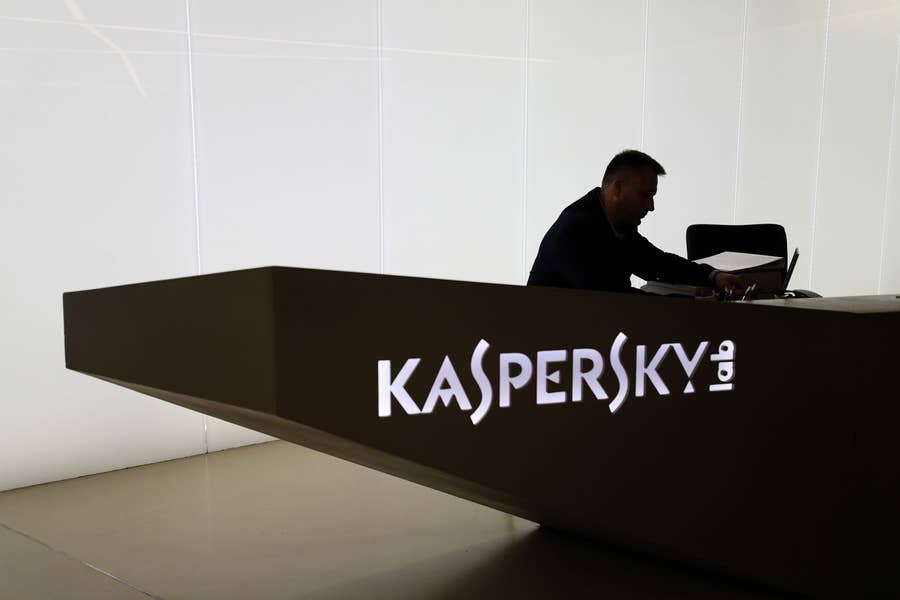 Sergei Savostyanov / Sergei Savostyanov/TASSThe headquarters of the Russian cybersecurity company Kaspersky Lab.This September, the Department of Homeland Security ordered all federal agencies to stop using products made by the Moscow-based company Kaspersky Lab, including its popular antivirus software, and media outlets reported that Russian hackers had exploited it to steal sensitive information on US intelligence programs. The department later clarified that the order didn’t apply to “Kaspersky code embedded in the products of other companies.” The company’s founder, Eugene V. Kaspersky, has denied any involvement in or knowledge of the hack.The Russian company whose code ended up in the FBI’s fingerprint-analysis software has Kremlin connections that should raise similar national security concerns, said the whistleblowers, both French nationals who worked in Russia. The Russian company, Papillon AO, boasts in its own publications about its close cooperation with various Russian ministries as well as the Federal Security Service — the intelligence agency known as the FSB that is a successor of the Soviet-era KGB and has been implicated in other hacks of US targets.“The fact that there were connections to the FSB would make me nervous to use this software.”Cybersecurity experts said the danger of using the Russian-made code couldn’t be assessed without examining the code itself. But “the fact that there were connections to the FSB would make me nervous to use this software,” said Tim Evans, who worked as director of operational policy for the National Security Agency’s elite cyberintelligence unit known as Tailored Access Operations and now helps run the cybersecurity firm Adlumin.The FBI’s overhaul of its fingerprint-recognition technology, unveiled in 2011, was part of a larger initiative known as Next Generation Identification to expand the bureau’s use of biometrics, including face and iris recognition technology. The TSA also relies on the FBI fingerprint database.In hopes of winning the FBI contract, the Safran subsidiary Sagem Sécurité, later renamed Morpho, licensed the Papillon technology to boost the performance of its own fingerprint-recognition software, the whistleblowers said. Both of them worked for Morpho: Philippe Desbois was the former CEO of the company’s operations in Russia, and Georges Hala worked for Morpho’s business development team in Russia.
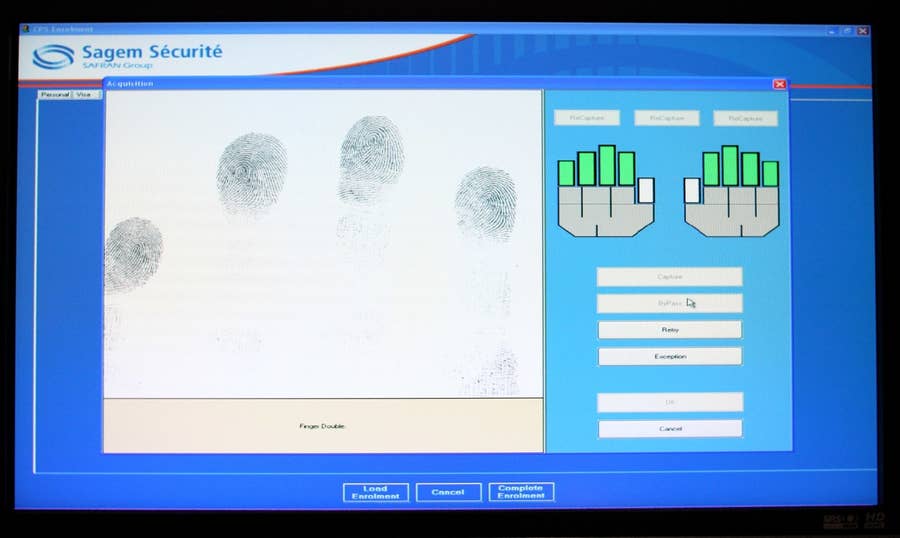 Jean-paul Ney / Getty ImagesSagem presented a new biometric passport in 2007.BuzzFeed News reviewed an unsigned copy of the licensing agreement between the French and Russian companies, which both men said they had obtained while working for Morpho; it is dated July 2, 2008 — a year before the company beat out some of the world’s largest biometrics firms, including an American competitor, to secure the FBI business. It grants Sagem Sécurité the right to incorporate the Papillon code into the French company’s software and to sell the finished product as its own technology. It also stipulates that Papillon would provide updates and improvements during the five-year period that ended on the last day of 2013. In return, Sagem Sécurité agreed to pay an initial fee of roughly 3.8 million euros — equivalent to almost $6 million at the time — plus annual fees.Got a tip? You can email tips@buzzfeed.com. To learn how to reach us securely, go to tips.buzzfeed.com.The contract, which is also referenced in court documents, says that to Papillon’s knowledge its software does not contain any “undisclosed ‘back door,’ ‘time bomb,’ ‘drop dead,’ or other software routine designed to disable the software automatically with the passage of time or under the positive control of any person” or any “virus, ‘Trojan horse,’ ‘worm,’ or other software routines or hardware components designed to permit unauthorized access, to disable, erase, or otherwise harm the software, hardware, or data.”The contract reviewed by BuzzFeed News also contains a section titled “Publicity” that says, “The parties agree to keep strictly confidential and not to disclose by any means to any third party the existence and the contents of this Agreement.”Desbois — who has filed a whistleblower lawsuit in federal court accusing Safran of fraudulently collecting about $1 billion from federal, state, and local agencies — said at least three high-level company officials stressed to him on multiple occasions that the existence of the agreement needed to remain a closely held secret. Disclosure, he said he was told, might jeopardize contracts in the US market, which the company coveted.“They told me, ‘We will have big problems if the FBI is aware about the origin of the algorithm.’”“They told me, ‘We will have big problems if the FBI is aware about the origin of the algorithm,’” he recalled.Neither Desbois nor Hala was personally involved in the integration of Papillon code into the French company’s products or the sale of the software to the FBI, but both said they had conversations with engineers who did work on the integration. Desbois said multiple company officials told him that the technology sold to the FBI contained the Papillon algorithm.“You know the word omertà?” Desbois said, referencing the Mafia code of silence made famous by the movie The Godfather. “It was always the intonation like we have done something bad that is a secret between us and that we should not repeat it to anybody.”
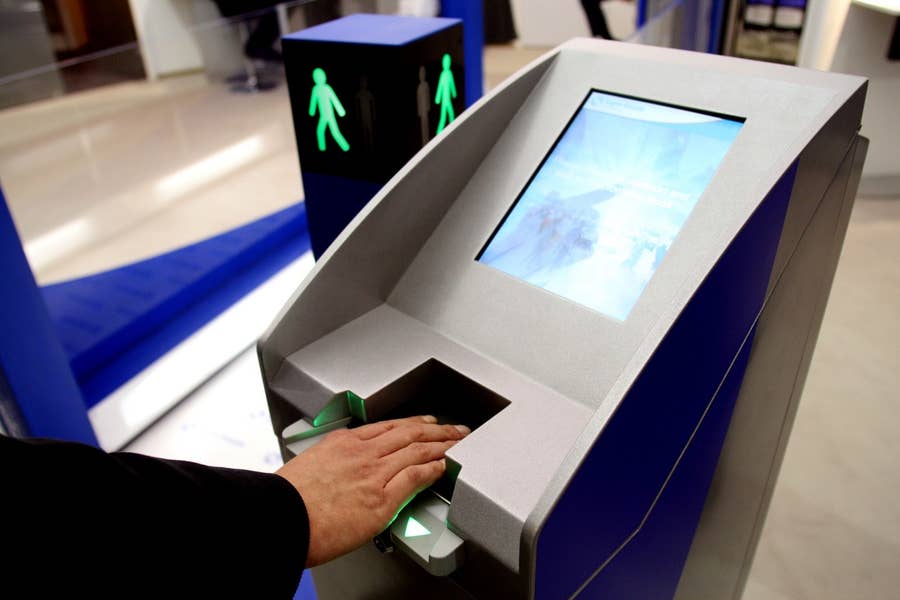 Jean-paul Ney / Getty ImagesSagem demonstrated a new biometric passport in 2007.“Deep collaboration”In promotional material and on its website, Papillon boasts of its work with Russia’s Ministry of Internal Affairs, which oversees police and immigration agencies, among others, and is run by a longtime police official who was appointed to the post in 2012 by President Vladimir Putin. The products that Papillon sells “are created with the instructional assistance” of the ministry, and the company is “closely cooperating with the Ministry of the Interior, Ministry of Defense and Ministry of Justice of Russia,” according to company publications. A Russian government website says that the Internal Affairs Ministry “renders methodic assistance” to Papillon.“Papillon is not an independent company,” said Hala, one of the whistleblowers. “Papillon was an emanation of the Internal Affairs Ministry, so Papillon was always under the control of the ministry.”Papillon’s deputy director for marketing, Ivan Shapshal, disputed that. “We are fully a private company,” he said. “Do we do special tasks for the intelligence agencies of Russia? No, there is no reason for us to do this. It is just a risk. It does not help us make money.”Among the Russian agencies that use the company’s fingerprint-recognition technology is the FSB. “Year by year,” one Papillon publication says, “the company expands its cooperation with” the FSB, as well as Russian agencies in charge of immigration, customs, and drug control. Other clients include the governments of Turkey, Kazakhstan, Serbia, and Albania.“We will be happy to be close to any security agency in the world for money.”Shapshal said his company’s fingerprint-recognition technology helps Russian police solve roughly 100,000 cases per year. “If our software can help police solve more crimes, we are happy to be ‘very close’ to them, as you say,” he said. “We will be happy to be close to any security agency in the world for money.”Papillon’s founder and director is Pavel Zaitsev, who worked as an engineer and programmer at Russian military installations from 1985 to 1991, according to a biography published with an article he wrote for a trade publication. Many of the company’s staffers, a Russian government website says, “gained experience working at the plants of Military-Industrial Establishment in Miass” — the city in the Ural Mountains where the company later established its headquarters.Hala said there was “deep collaboration” between Papillon and the FSB. “It’s not a secret,” he said. Hala said he attended multiple meetings involving Russian government officials and Papillon executives in which FSB officials expressed strong support for Papillon and “controlled absolutely the discussion.”The Internal Affairs Ministry, the FSB, and the Russian Embassy in Washington, DC, did not respond to requests for comment.Neither the FBI nor any of the companies involved denied directly that the fingerprint software used by the bureau contains Russian code.The FBI declined to answer repeated questions about the software but said in a statement, “As is typical for all commercial software that we operate, appropriate security reviews were completed prior to operational deployment.”Safran declined to respond to questions about its actions as owner of the subsidiary that provided the software to the FBI, noting that it has since sold that subsidiary. But in legal filings, Safran has not denied the existence of the contract to license the Russian code, instead arguing that the allegations of fraudulent sales were not specific enough and that the company was not legally responsible for the actions of its subsidiary.Safran sold the subsidiary this year to a US private-equity firm, which renamed the company Idemia. An Idemia spokesperson said the fingerprint-recognition technology was “almost entirely developed and manufactured in France or in the United States” but that two software components contained source code developed “by other companies.”The spokesperson, Céline Stierlé, refused to name those companies.“We don’t comment on such things because we cannot confirm or deny.”More broadly, she said the whistleblowers’ claims “are old allegations that are not supported by facts and that have been rejected by federal and state authorities and by the courts,” referring to the lawsuit filed by Desbois, one of the former employees who spoke with BuzzFeed News.This year, a federal judge dismissed the case but did not evaluate the merits of most of the allegations. Instead, the judge focused on technical issues, finding that the suit hadn’t alleged enough specifics about, for example, when and how fraudulent claims for payment may have been submitted to the government. Also, the judge wrote, any false claims would have been submitted by a subsidiary that was not named as a defendant in the case — and the parent companies that were named couldn’t necessarily be held legally responsible. The case is on appeal.As for the Russian company, Papillon, executive Shapshal responded to a question about the contract giving the French company rights to its code by saying, “We don’t comment on such things because we cannot confirm or deny.”But he insisted that the company’s code did not include any vulnerabilities, saying that if anyone were to check “then you will see there is no back door.”
 Regis Duvignau / ReutersA Safran Group building in France.“Weigh carefully the risks”As the FBI evaluated the companies vying to provide the fingerprint-recognition software in 2009, the possibility that the contract might go to a company subject to influence by a foreign government, even an ally, unsettled some members of Congress. The part-ownership of Safran by the French government prompted a letter to then-FBI director Robert Mueller from Rep. John Kline of Minnesota, a Republican member of the House Intelligence Committee.“Allowing a foreign government to provide services regarding sensitive information to our law enforcement and intelligence communities could potentially pose a grave counterintelligence threat to the US government,” Kline wrote. “I urge the FBI to assess whether any domestic companies are capable of this work and weigh carefully the risks versus the benefits of granting a foreign government access to this sensitive data.”“Allowing a foreign government to provide services regarding sensitive information to our law enforcement and intelligence communities could potentially pose a grave counterintelligence threat.”An FBI spokesman at the time said that the bureau “assesses all risks and vulnerabilities associated with any foreign influence or security concerns for vendors under consideration for contracts, including subcontracts, with the FBI.”Later that year, the FBI and Lockheed Martin — the primary contractor in charge of incorporating various vendors’ products into the bureau’s system — announced the selection of a Morpho subsidiary, MorphoTrak. Among the competitors not chosen was the US company Cogent Systems.A Lockheed Martin spokesman refused to discuss the contracting process and said the company had divested its unit responsible for the FBI program. A representative for Leidos, which is now the project’s primary contractor, declined to comment.Desbois’s whistleblower lawsuit alleges that a US-based MorphoTrak engineer named Frank Barret was aware of the Papillon deal and led a team that helped prepare the software for use by the FBI. On the front step of his home in California, Barret refused to read and respond to the allegations in the complaint but said, “Everything I’ve said to the investigators, everything I’ve said in this trial, is true.” Asked to clarify, he closed his front door. When BuzzFeed News followed up the next day, Barret threatened to call the police.Both Desbois and Hala said they discovered the existence of the agreement licensing the Russian company’s code after they questioned their bosses’ instructions not to compete with Papillon for certain contracts. It was then, they said, that company officials explained that the two companies had an unwritten agreement not to encroach on each other’s business in certain countries — an arrangement that violates antitrust laws, the whistleblower claim alleges. Desbois and Hala said that they obtained a copy of the licensing agreement because they wanted to see for themselves whether it spelled out the terms of the noncompete pact; it did not.Papillon executive Shapshal declined to comment on the antitrust allegations. Idemia spokesperson Stierlé said that “this allegation, like the others, was part of the litigation” and that “it too was found to be deficient and lacking in even the most basic level of detail and was rejected by the court.” Actually, the judge found that the whistleblowers’ allegations did not provide specifics on who falsely certified to the US government that the company hadn’t violated antitrust laws, or when and how this had occurred.Desbois’s whistleblower lawsuit accuses Safran of defrauding the US government out of about $1 billion, and if the suit is successful he stands to collect millions. Hala is not involved in the case. Both Desbois and Hala said they left Morpho voluntarily and on good terms.
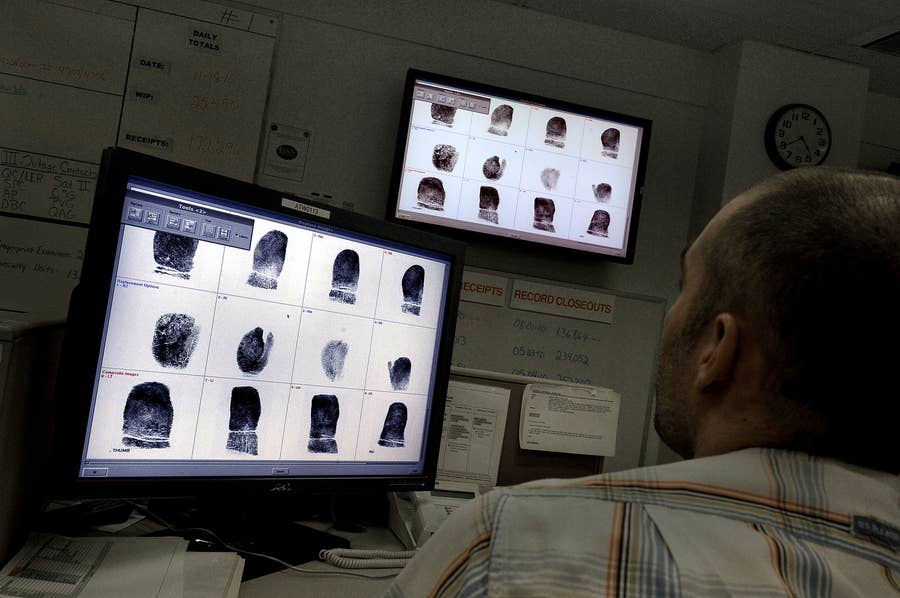 The Washington Post / Getty ImagesInside the FBI's background check center.The federal government so far has declined to intervene in the lawsuit, as it has the option to do in whistleblower suits alleging fraudulent claims for payment. In court filings, however, Justice Department lawyers noted that this wasn’t necessarily an indication that the case lacked merit, and they preserved their right to step in later. The complaint also accuses the defendants of misrepresenting the fingerprint technology in sales to the government of California; lawyers for the state also have declined to intervene.The FBI contract is now a centerpiece in much of MorphoTrak’s marketing material. In 2011, the FBI said the new fingerprint-recognition software significantly increased both the speed and accuracy of matches, boosting the latter from 92% to more than 99.6%.“In terms of prestige, to be able to say ‘My technology is used by the FBI,’ it really helps with sales.”“In terms of prestige, to be able to say ‘My technology is used by the FBI,’ it really helps with sales,” said former employee Stephane Guichard, who led a US-based team that implemented and maintained the fingerprint-matching software for state and local agencies that had purchased it but was not involved in the software’s development or the FBI contract.Guichard and two other former MorphoTrak employees who worked on government contracts in the US said they didn’t know about the licensing agreement with Papillon, and they expressed surprise that their former employer would use Russian technology. “Personally, it would have concerned me a little bit,” said Phillip Moore, who worked as an account manager and sales manager. It would have raised “basic trust issues with what they would supply us,” he said.By the end of 2013, as the final stage of the FBI project phase-in became operational, Morpho reported that the US market accounted for more than a third of its roughly $2 billion in revenues.Safran recently announced that it planned to refocus solely on aerospace and defense, and, earlier this year, it sold Morpho, which had recently been renamed Safran Identity & Security, to the US private-equity firm Advent International, with the French government investment bank Bpifrance also taking a stake. The reported price was about $2.5 billion.The company, now named Idemia, has provided fingerprint-recognition software to the Department of Defense and agencies in 28 states and 36 cities or counties across the US — from the Orange County Sheriff’s Department to the New York Police Department. Through its subsidiaries, Idemia is a powerful lobbying force in Washington, and it is currently fighting to kill legislation that would endanger its status as the sole provider of fingerprint services for the TSA PreCheck program.