(TheDailyBeast) Trump Accuser Jessica Drake Silenced

Trump Accuser Jessica Drake Silenced
The porn star came forward to accuse then-candidate Trump of sexual misconduct in October 2016.
EXCLUSIVE
HANDOUT
The Daily Beast was informed late Friday that porn star Jessica Drake is not allowed to discuss President Donald J. Trump on account of a non-disclosure agreement she signed barring her from any such talk. NDAs are often deployed as part of settlements to silence accusers.
“Jessica’s NDA blankets any and every mention of Trump, so she’s legally unable to comment,” her publicist, Josh Ortiz, informed The Daily Beast. “Jessica signed a non-disclosure agreement after her allegations of misconduct, and she can’t do as much as peep his name publicly.”

On Saturday evening, following the initial publication of this story, Ortiz radically changed his tune.
“I made an incorrect assumption due to a grave misunderstanding regarding Jessica Drake’s ability to speak or comment about matters relating to President Trump," Ortiz said in a statement supplied by Drake's lawyer, Gloria Allred. “I have never been told directly, or indirectly, Jessica Drake signed a Non Disclosure Agreement or reached any settlement in regards to any interactions with President Trump. My misunderstanding resulted in incorrect information being provided to The Daily Beast and undue stress to Jessica Drake, for which I am truly sorry.”
BuzzFeed, citing an unnamed source, reported on Saturday that “Drake could not talk about Trump, but was unable to confirm if that was because of a non-disclosure or some other agreement.”
The White House has not yet responded to requests for comment.

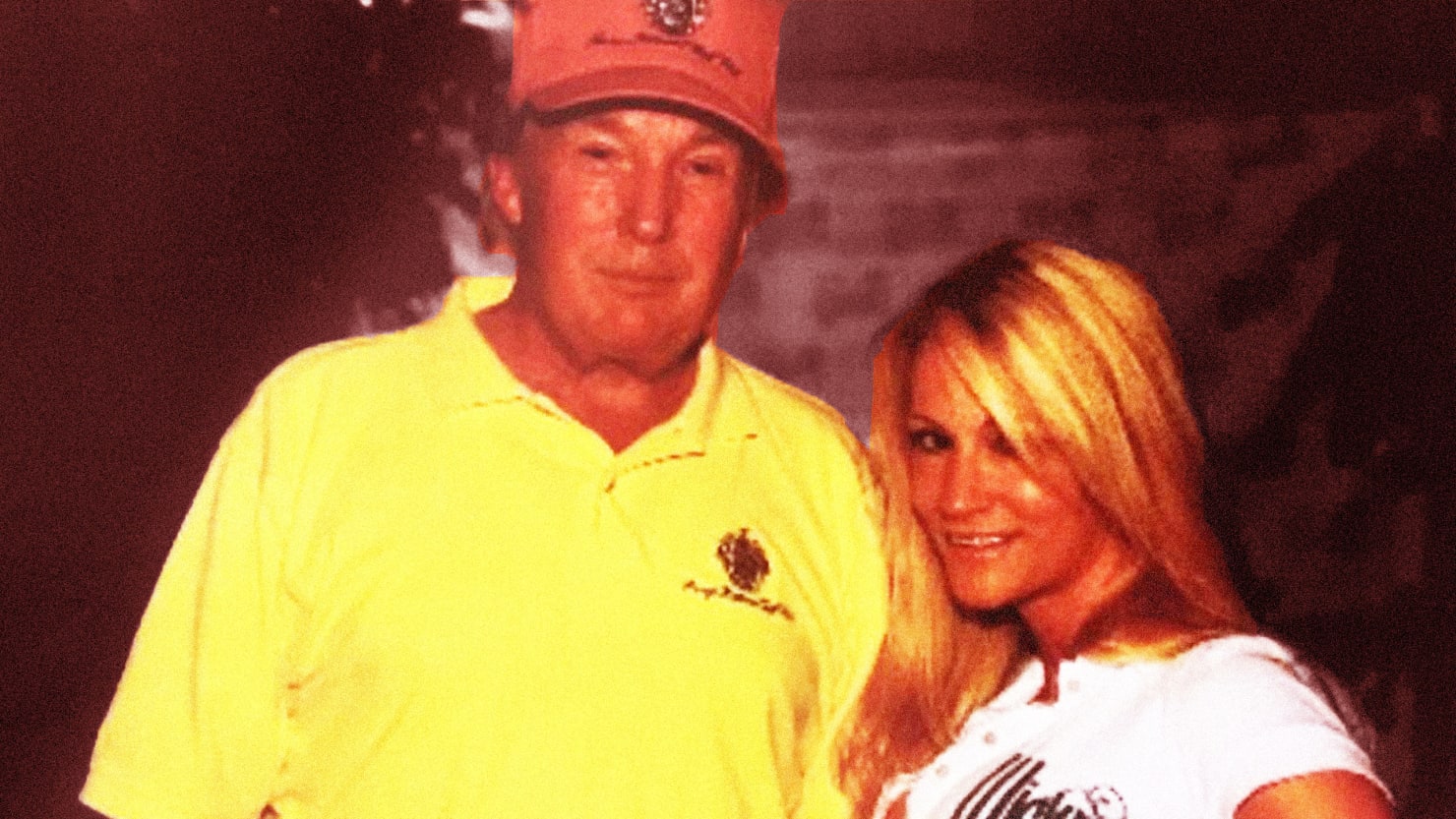
In late October 2016, Drake became the 14th woman to accuse then-candidate Trump of sexual misconduct. At a public press conference, Drake, flanked by her attorney Gloria Allred, claimed that after she met Trump in July 2006 at Nevada’s American Century Celebrity Golf Championship, where she was working a promotional booth on behalf of the adult film company Wicked Pictures, he made a pass at her. Trump’s wife, Melania, had recently given birth to their son Barron at the time.
RELATED IN ENTERTAINMENT
“[Trump] flirted with me and invited me to walk along the golf course with him, which I did. During that time, he asked me for my phone number, which I gave to him. Later that evening, he invited me to his room. I said I didn't feel right going alone, so two other women came with me,” said Drake in prepared remarks.

“When we entered the room, he grabbed each of us tightly in a hug and kissed each one of us without asking permission,” Drake continued. “He was wearing pajamas. A bodyguard was also present. He asked me about details on my job as an adult film star—about shooting porn, and he also asked us about our personal relationships and whether we were married or single. We answered his questions. It felt like an interview. About 30 or 45 minutes later, we left his room.”
She alleged that Trump later called her and asked, “'What do you want? How much?” and then offered her $10,000 for sex. “This is not acceptable behavior for anyone, much less a presidential candidate,” Drake said at the presser.
The Drake NDA news comes on the heels of a Friday report in The Wall Street Journal that President Donald J. Trump’s longtime lawyer, Michael Cohen, had arranged a $130,000 payment to porn star Stormy Daniels “as part of an agreement that precluded her from publicly discussing an alleged sexual encounter with Mr. Trump.”
Daniels (birth name: Stephanie Clifford) is alleged to have been in talks with ABC’s Good Morning America about going public with her story just prior to the presidential election. The Daily Beast had also pursued an interview with Daniels for several months prior to the election after three sources confirmed that she and Trump had had a curious encounter. She finally backed out on Nov. 3, just five days before the election.

One of those sources, porn star Alana Evans, said that after Daniels met Trump in July 2006 at the American Century Celebrity Golf Championship—the very same golf tournament that Drake alleges she met Trump—she and Trump invited Evans to their hotel to “have some fun.” The following day, Daniels confided in Evans—her neighbor and close friend at the time—that “I ended up with Donald in his hotel room. Picture him chasing me around his hotel room in his tighty-whities.”
Cohen provided the following statement to The Daily Beast: “These rumors have circulated time and again since 2011. President Trump once again vehemently denies any such occurrence as has Ms. Daniels.” In addition, he provided a letter dated Jan. 10, 2018, allegedly signed by Daniels, that denied any “sexual and/or romantic affair” with Trump as well as the receipt of any “hush money” from Trump. Daniels could not be reached for further comment.
Around the time Drake came forward, then-candidate Trump issued a vow of revenge, threatening to sue every woman who came forward to accuse him of sexual misconduct. “Every woman lied when they came forward to hurt my campaign,” Trump announced at a rally in Gettysburg, Pennsylvania on Oct. 22, 2016. “Total fabrication. The events never happened. Never. All of these liars will be sued after the election is over.”
Thus far, he has not sued a single one.

>>> What to look at this Week End - 13th & 14th of January 2018

Weekly Performance
Dow +4.39% S&P +0.67% Nasdaq +5.18% Russell +3.68% Canada +0.61% Mexico -0.44% Brazil +3.86% (+7.33% in USD) Nikkei +3.90% (+5.43% in $) Hang Seng +4.99% CSI +4,82% Shanghai +3.68% Shenzen +2.61% EuroStoxx +3.10% FTSE +1.18% CAC +3.85% DAX +2.53% Ibex +4.17% MIB +7.21% SMI +1.76%
The rally in stocks extended into yet another week with 2018 looking very much like most of 2017 thus far. The NASDAQ and banks led early on, before cyclical groups like retailers and small caps took the lead as the week wore on. WTI crude prices probed fresh 2.5 year highs into the mid-$60 range while Brent approached $70/bbl. The energy complex saw a breakout to the upside with stock prices significantly outperforming the gains in oil. Utilities, REITS and other bond proxies lagged that of the overall market as rising Treasury yields served as a headwind. For the week the DJIA gained 2%, the S&P500 added 1.6%, and the Nasdaq rose 1.8%.

Macro :
- Goldman’s Hatzius Says EU Growth Limits Political Risk: Figaro
- CSA Reviewing Approach for Issuers W/U.S. Marijuana Activities
- Trump Briefing on Solar Tariffs Is Said to Be Postponed
- Bid to Collect Internet Sales Tax Gets U.S. High Court Review
- Buy Bitcoin, Ether, Ripple and Litecoin, Evercore ISI Says

Keep an eye on :
- ABLX BB : closed -5.88% in New York $42.28 --> E34.66 -5.30% vs Europe Close
- ADS GY : Adidas Plans to Boost U.S. Market Share to 15-20%, BZ Reports
- ADP FP : ADP Paris Airports FY Traffic Rose 4.5% To 101.5m Passengers
- AIR FP : SpaceX Rocket Test Fire Rescheduled to Jan. 15: Florida Today
- AIR FP : Airbus May Pay EU70-80m Fine in Eurofighter Case: Sueddeutsche
- AIR FP : Airbus May Pay Taiwan EU104m in Arbitration of 1992 Accord
- AF FP : Air France-KLM Still Interested in Alitalia Sale Process: Sole
- AF FP : Air France-KLM Denies Having Made Offer to Take Over Alitalia
- ARAMCO IPO : Aramco U.S. IPO Odds Strained by Trump’s Israel Moves: Height
- ATC NA : French Carriers to Spend EU3b on Mobile Masts: Junior Minister
- BAYN GY : Bayer, Mylan Dismiss Patent-Infringement Case Over Nexavar Drug
- EN FP : French Carriers to Spend EU3b on Mobile Masts: Junior Minister
- CLLN LN : Carillion Makes Last Ditch Bid for U.K. Bailout, Mail Reports
- CLLN LN : Carillion Said to Seek GBP300m From Govt to Stay Afloat: Mail
- FCA IM : FCA US Voluntarily Recalling Estimated 153,859 Minivans
- FCA IM : Fiat CEO Sees Room to Double Profit by 2022 on Global Jeep Push
- DIS US : Facebook COO Sandberg and Twitter CEO Dorsey to step down from Disney board due to potential conflicts of interest - press
- DIS US : Disney: ’Last Jedi’ Becomes No. 10 Global Release of All-Time
- GKN LN : Carlyle Is Said to Be Weighing Bid for GKN: Sunday Times
- HNAGRZ CH : HNA’s Tianjin Tianhai Says It Has No Plans to Sell Ingram Micro
- ILD FP : French Carriers to Spend EU3b on Mobile Masts: Junior Minister
- ISAT LN : Inmarsat Buyout May Make Sense, Maritime Concerns Overdone: RBC
- IWG LN : IWG poised to receive second takeover bid - FT
- LoW US : D.E. Shaw Is Said to Build Activist Stake in Retailer Lowe’s
- MS IM : Mediaset Could Take 20% in Tim, Canal Plus Joint Venture: Sole
- NEO FP : Neopost Rallies on Report Buyout Firms Looking at Pitney Bowes
- ORA FP : French Carriers to Spend EU3b on Mobile Masts: Junior Minister
- PMO LN : Premier in Talks to Sell Batchelors Brand to Nissin: S. Times
- PUB FP : Nestle Is Said to Retender French Media-Buying Budget: Les Echos
- PUM GY : Puma could be potential takeover target of Anta Sports Products.
- RNO FP : Nissan’s Ghosn Says U.S. Tax Bill May Stabilize Car Sales: Fox
- RR/ LN : Rolls-Royce Confirms Reviewing Strategic Options for L’Orange
- 9984 JP : SoftBank Invests EU460m in Online Car Dealer Auto1: FT
- 9984 JP : SoftBank Eyes $18B IPO for Mobile Unit: Nikkei
- TEVA US : Teva Senior Unsecured Ratings Cut to Junk by Moody’s
- TIT IM : Mediaset Could Take 20% in Tim, Canal Plus Joint Venture: Sole
- TWX US : Wal-Mart Said to Restructure Store Roles to Streamline Business
- TKA GY : Cevian Holds About 18% of Thyssenkrupp Shares: Spokesman, Cevian’s Forberg Calls for Structural Change at Thyssen: FAS
- 6502 JP : Toshiba Seeks $4B Yen Tax Relief By Selling Some Assets: Nikkei {6502 JP Equity HLDR <GO>}
- VIV FP : Mediaset Could Take 20% in Tim, Canal Plus Joint Venture: Sole

FT : Race to build a million-mile car becomes a reality

Race to build a million-mile car becomes a reality
On the eve of the Detroit auto show, the car of the future will need to last a lot longer

Futuristic images of cars were splashed across the Consumer Electronics Show this week, as the world’s largest tech gathering ogled the concept cars of the coming driverless era.

But there is one crucial detail that was not mentioned in the fancy presentations: the new cars may need to last for a million miles.

“This is a topic we are working heavily on,” says Johann Jungwirth, chief digital officer at Volkswagen.

Durability and longevity will be essential for self-driving vehicles, he explains, because they will be part of transportation fleets that are in near-constant use.

“I can see the vehicle life going up to 500,000 or even 1m miles or more,” he says, adding that refurbishment programs will help extend vehicle life. “That is one criteria that is becoming more important in the future.”

This shift will represent a massive disruption for carmakers, as the advent of autonomous fleets of electric vehicles has the potential to upend their traditional business models.


McKinsey, the consultancy, estimates that by 2030 one in 10 vehicles sold will be used for ride-sharing, and that sales of private vehicles will slow as a result.

All the major carmakers, many of whom will be displaying their latest products in Detroit this week at the North American International Auto Show, are testing self-driving cars: GM says it will have a pilot fleet of robo-taxis on the road next year; Volkswagen has said that it will have large-scale fleets deployed in multiple cities in 2021.

Concept cars like Toyota’s e-Palette, Volkswagen’s Sedric, and Mercedes’ F015 show that automakers plan for the designs of these vehicles to be radically different from anything on the market today.

In the auto industry, the practice of designing long-life vehicles is not without precedent. Long-haul trucks and special-purpose vehicles such as London’s black taxis are made to last for up to 1m miles with proper maintenance.


Car owners typically replace their vehicles after 10 years or 100,000 miles, and those vehicles sit idle for most of the time. But as transportation services such as Uber, Lyft and China’s Didi continue to grow — and potentially become autonomous — transport fleet owners will have very different requirements.

“The economics are going to be driven by the depreciation of the vehicle, particularly for transportation-as-a-service, so the longer you can keep that vehicle on the road, the better the economics will look,” says Chris Urmson, chief executive of Aurora, a Silicon Valley autonomous vehicle start-up, and one of the pioneers of Google’s self-driving car team.

To make these autonomous fleets last longer, carmakers and components suppliers imagine that different parts of the vehicle will be replaced at different rates.


Paul Warburton, vice-president of automotive at Fujitsu, the Japanese technology group, compares the future vehicles to how passenger aeroplanes are maintained — long-term investments that get upgraded during their lifetime with new seats and engine parts.

Many aeroplanes, he points out, are still flying when they are 30 years old. “You will run them for a longer period, and keep them maintained to a higher standard,” he says.

Like aeroplanes, the vehicles will be serviced on a predictive basis with maintenance done in advance so that the car never breaks down on the side of the road. “For example, for seat manufacturers, the seat will sense it every time they are used, and when the seat it worn out, it will be replaced,” Mr Warburton says.

He predicts that this will mean big changes for components makers which will become responsible not only for providing parts but also for servicing them. “Components will start to be delivered as a service,” he says. “The only way for them to survive is for them all to reinvent themselves as service companies.”

Certain components will be made to last longer — such as the chassis of the car and door hinges — while other car parts will be designed for regular replacement.

“You can imagine a chassis that will last for a million miles, but a battery system that would need to be replaced regularly,” Damien Scott, chief commercial officer at Renovo, an autonomous car start-up.


The interior of the car might be replaced or reconditioned every year, he adds, while the software system will be constantly updated over the air.

As for the engine, the shift to electric motors will be a key part of extending vehicle life. Because these have fewer moving parts than an internal combustion engine, they can last longer.

Nevertheless, some component makers say the changes coming to the auto industry have not yet had a direct effect on them.

“There hasn’t really been a change in specification yet,” says Upton Bowden, head of advanced technology for Visteon, a components supplier that was part of Ford. “What we used to do in the past, we know that isn’t going to work in the future, the question is, how do we have to change?”

When it comes to vehicle lifespan “is it 20 years? Or 200,000 miles? It quite possibly could be along the lines of what you see in commercial trucking today,” he says.

Delphi, the components group that specialises in powertrains, also says it has not seen a significant shift. “The vehicle itself and what the [carmakers] provide, will change a lot,” says Mary Gustanski, chief technology officer. “But the products that Delphi provides really won’t,” she says, pointing out that the company already makes certain heavy-duty vehicle components to have a long life.


Underpinning all of this is the question of what the business model of transportation will look like once the technology becomes widespread.

Today’s self-driving cars cost hundreds of thousands of dollars because of the sensors and computing power required. Most pilot test cars are also hand-assembled.

While that price tag will come down once autonomous cars are manufactured at scale, the vehicles will still cost more than regular cars.

“The reality is that all the hardware on these cars is pretty expensive,” says Karl Iagnemma, chief executive of nuTonomy, an autonomous car company that was recently acquired by Aptiv. “But we are very confident that the economics of a robot taxi service can support a vehicle platform that is higher cost.”

A key unresolved question is who will own the fleets of vehicles: transport companies like Uber or Lyft; rental car businesses such as Hertz or Avis; or the carmakers themselves.

Recommended
UK sees an opening to overtake US and China in driverless cars
Self-driving cars face a new test: snow
China impedes foreign carmakers’ autonomous tests
Some carmakers, such as GM, have said they do not want to own their own self-driving fleets. But others, like Volkswagen, say they will experiment with selling transportation services in certain cities.

At Uber, the company is testing both options: it has ordered a fleet of 24,000 self-driving Volvos that will be delivered over the next three years, while also allowing carmakers including Daimler to plug their own self-driving cars into the Uber network.

Jeff Miller, Uber’s head of automotive alliances, waxes eloquent when discussing all the possibilities for future car designs for these fleets, including their longevity. “That will definitely be one element when you make a purpose-built vehicle, because you get to start from scratch,” he says. “You get the opportunity to design a different motor, brake, door hinges, everything that has a much longer life. Those are all interesting engineering challenges that could be solved once the market is validated,” he says.

“You could absolutely make a million mile car, just no one has done it yet.”

WWD : Brands, Magazines Drop Testino, Weber After Model Allegations

Brands, Magazines Drop Testino, Weber After Model Allegations
Burberry, Michael Kors, Conde Nast and more said they no longer would work with the photographers after allegations in a New York Times story.

MILAN — Fashion brands and magazine titles quickly moved to sever ties with famed photographers Mario Testino and Bruce Weber after the allegations of sexual exploitation by both photographers in a New York Times story published on Saturday.

Meanwhile, speculation raged during the men’s shows in Milan today over which other well-known photographers might be caught up in the scandal, with some stylists and fashion editors saying up to 10 more names could come out. Sexual exploitation and harassment has long been known to take place during fashion shoots for the last several decades, but both brands and magazine editors have generally turned a blind eye to it, observers said.

Both Testino and Weber made their careers and fortunes on shooting ad campaigns, while editorial work pays much less. On Saturday, both Michael Kors and Stuart Weitzman said they would no longer be working with Testino on future advertising campaigns.
The sexual misconduct story comes amid a widening scandal in the fashion industry involving photographers’ treatment of male and female models alike. On Saturday, WWD posted an open letter by male model Christopher Cates calling for models to stand up to harassment.
Conde Nast issued a statement Saturday condemning sexual exploitation of any kind.
“We are deeply disturbed by these accusations and take this very seriously, as previously noted in our statement regarding sexual harassment,” said Bob Sauerberg, Condé’s chief executive officer, and Anna Wintour, the publisher’s artistic director and the editor-in-chief of Vogue, which has worked regularly with Testino for decades. Testino had a major role in the documentary on Vogue, “The September Issue,” for example, and he has been a regular guest at the Met Gala overseen by Wintour.
“In light of these allegations, we will not be commissioning any new work with Bruce Weber or Mario Testino for the foreseeable future,” their statement said.
A Condé spokesperson said separately that two projects with the photographers have already gone to press: A W fashion shoot with Weber and a Vogue shoot with Testino. “However, no new shoots will be commissioned,” the spokesperson said.
Separately, Condé Nast International said in a statement that “in light of these allegations Condé Nast International will not be commissioning any new work with Mario Testino or Bruce Weber for the foreseeable future.”
A company spokesperson for Michael Kors Holdings Ltd., said, “We recently learned of the allegations concerning Mario Testino. In light of the seriousness of these accusations, we will not be working with Mr. Testino on future advertising campaigns.”
Wendy Kahn, chief executive officer and brand president of Stuart Weitzman, said in a statement, “We are deeply saddened by the allegations in today’s article. We take these accusations very seriously and providing a safe and secure working environment where everyone feels respected is our foremost priority. As a result, we will not be working with Mario Testino for the foreseeable future.”
It is understood that Burberry, which has not worked with Testino since 2016, has no plans to do so for the foreseeable future. Testino’s most recent campaign for Burberry was for My Burberry Black with Lily James in August 2016.
A Burberry spokesperson said, “We take allegations of this nature very seriously. Burberry is committed to providing a just, safe and fair working environment and we have a zero-tolerance policy against any form of harassment, abuse or discrimination. The safety, security and welfare of the people with whom we work is a priority for Burberry and we seek to ensure all our partners adhere to our principles and policies and comply with all applicable laws and regulations.”


Testino’s spokeswoman said they aren’t issuing a statement at this time, and Weber officials did not respond immediately to a request for comment.
Last October, Condé Nast confirmed it would no longer be working with the photographer Terry Richardson who is known for his sexually explicit work.
As reported by WWD last fall, the Times has been working on a story about harassment in the fashion world since October. The Times also reported Saturday that Condé had issued a code of conduct for photographers and models — which Sauerberg and Wintour claimed it had been preparing since October — that includes not using models under age 18; no alcohol on sets, and that photographers, makeup artists and stylists should not be alone with models.

Katie Grand, the editor of Love magazine, the London-based Condé Nast title, said she worked closely with Condé Nast International, Edie Campbell and Ciara Byrne on the Condé Nast Charter. “I sincerely hope this will inspire change within our working environments and urge more men to come forward. It’s positive that we have found the language to speak about the abuse of men, who have been silent for so long.”
Diane von Furstenberg, chairwoman of the Council of Fashion Designers of America, which issues its own set of guidelines to ensure models are healthy during the runway shows, said, ” The fashion world has always been aspirational and a dream for young people to work in. It is therefore very important and timely for us all in the industry to make efforts to protect models and all employees against abuse of power in the workplace.”
Reached for comment Saturday, David Lipman, owner of Lipman Studio, a New York-based ad agency, said, “I’m very sad today. Mario [Testino] is my friend.” Over the years, Lipman has worked with Testino on campaigns for such major brands as Burberry, Stuart Weitzman, St. John, Lord & Taylor and Smartwater.
“I’m bewildered by all of it. I worked with him hundreds of days and that’s never happened on any of my shoots. He’s not a quiet man, he’s Peruvian and has great humor and is great fun, and when I read it, I questioned it,” said Lipman.
When asked whether he would follow Condé Nast’s new code of conduct, he said, “I think I am who I am and that will never change. I stand for high morals and I love sexuality and love beauty. We all have to be responsible.” He recalled when he was young and there were drugs on the 70s shoots that he wasn’t part of and certain photographers got blackballed.
Lipman noted that since he started his new ad agency he hasn’t worked with Testino “for no reason but it hasn’t worked out.”
Kim Vernon, president and chief executive officer of Vernon Company, a consulting firm, was previously executive vice president and chief marketing officer of Calvin Klein Inc., where she did approximately 60 shoots a year. “I think Condé Nast is taking the appropriate action by ceasing to work with both of these photographers, and I think it’s commendable the difficult decision that Michael Kors made. I think Condé Nast’s decision to create and enforce a code of ethics is very positive. As one of the most respected media companies in the world, it sets a strong example,” she said.
“One of the key elements of the code relates to the ‘personal’ shoots that have often piggy-backed on the main shoot,” said Vernon. “From a brand perspective, most of the abuses have happened during those editorial shoots, where the castings and sets are owned by the photographer, not related to a brand advertising campaign casting or set. Over the years, I was on many, many sets, with provocative creative, and never once was a model compromised. Any model uncomfortable with a pose, or partial nudity, was exempt. So I am very clear, you can create provocative pictures without compromising an individual,” said Vernon.
She said that all brands who usually pay top rates to photographers, stylists, etc. should insist on positive and healthy working environments on their sets, and media companies should do the same.
She added that the age limitation is not a new concept and those rules were put in place years ago when she was at Calvin Klein. “But the real issue are the agents, who have at times, encouraged models to ‘do what it takes’ to work with top photographers and get campaigns. We had models arriving to the set and lying about their age several times, which clearly the agents knew of. “As for alcohol and minors in a working environment, it is simply not acceptable and am a bit surprised this needed a mandate.”
James Scully, a casting director, said that a lot of photographers, modeling agents, casting directors, and editors sat in on those Condé Nast meetings for several months to develop a code of conduct. “It wasn’t a knee-jerk reaction to what happened,” he said. “I think the Kering and LVMH charter [for the well-being of models] opened a conversation to the ethics on the job.
“I think it’s just the beginning. We’re now in a world where secrets don’t exist anymore, and this new generation has no problem calling people out. Maybe this will even out some things. It’s a cleansing out of sorts,” he said.
Kensington Palace has declined to comment on the story. Testino has been shooting the British royals for decades starting with Princess Diana, and in 2014 he was awarded an honorary OBE or Officer of the Most Excellent Order of the British Empire from Queen Elizabeth for his services to photography and charity.
He shot the official engagement photograph of Kate Middleton and Prince William in 2010, and was the official photographer for Princess Charlotte’s christening in 2015. He has also photographed Prince Charles with Princess William and Harry.

WSJ : Amazon’s Grocery Sales Increased After It Devoured Whole Foods

Amazon’s Grocery Sales Increased After It Devoured Whole Foods
Natural foods chain’s products helped push online sales up after merger last year

Whole Foods’ brand items like bacon, coconut water and frozen blueberries helpedAmazon.com Inc. AMZN 2.23% gobble up more U.S. grocery sales last year.
Products carrying the natural foods chain’s brand helped push sales at Amazon’s online grocery-delivery service, AmazonFresh, up 35% to $135 million in the last four months of 2017 over the previous four months, according to data analytics firm One Click Retail. Amazon bought Whole Foods last summer.
Top selling items included organic baby spinach, shredded Parmesan cheese, organic riced cauliflower, unsalted butter and smokehouse bacon, the analysis found.
Amazon is building out its grocery delivery service to capture more of an increasingly competitive market. Amazon sold an estimated $11 million of Whole Foods’ 365 Everyday Value natural and organic products last year, small compared with the private-label sales of its supermarket competitors. Kroger Co.’s . natural and organic brands are nearing $2 billion in sales a year, while Albertsons Cos. said this month that its organic line does $1 billion in annual sales.
But food analysts said Whole Foods products are helping AmazonFresh compete with online grocery companies. “It…may be bringing new people into AmazonFresh,” said Jim Hertel, senior vice president at food retail consultancy Inmar Willard Bishop Analytics. “That would be a real positive.”
Blair Reeves, a 36-year-old software product manager in Manhattan, doesn’t shop at Whole Foods stores but has regularly bought the chain’s 365 Everyday Value brand of products since they began appearing on AmazonFresh. “They are the first choice whenever you search for spaghetti or milk or butter,” he said.
Online grocery sales account for less than 3% of the roughly $800 billion grocery market. Analysts expect that share will grow into the double digits in the next five years. Amazon sold nearly $2 billion in groceries in the U.S. last year, according to One Click, which analyzes patterns in e-commerce transactions.
Just $350 million of that was through the AmazonFresh service, where shoppers tend to purchase perishable produce and meat, according to One Click. The remainder was delivered through Amazon’s standard platform as well as its Pantry and superfast Amazon Prime Now service, where shoppers tend to purchase bulky foodstuffs like water, coffee and Soylent meal-replacement drinks.
Amazon is selling Whole Foods products on those platforms too. Rising grocery sales on Prime Now proves the worth of selling Whole Foods products there, Morgan Stanley said in a recent report.
Jill Gifford, a 47-year-old stay-at-home mother in Renton, Wash., has ordered Whole Foods salsa, taco shells and macaroni on Prime Now. She said she might keep buying those products there instead of driving to her local Whole Foods.
Whole Foods and Amazon spokeswomen declined to comment.

Recode.net : Uber’s valuation dropped 20 percent, according to some investors

Uber’s valuation dropped 20 percent, according to some investors
Three firms say Uber shares are worth a lot less than they were at their last valuation.

Several mutual funds have dropped their estimates of the value of Uber in the leadup to a secondary transaction that similarly dropped the worth of what is the world’s most valuable startup.
At least three Uber shareholders — Fidelity Investments, Principal Funds and Blackrock — in recent weeks have disclosed that they no longer feel Uber is worth as much as they once thought, new documents show. Those disclosures come after SoftBank successfully purchased hundreds of millions of shares of the company at a $48 billion valuation, a 30 percent discount from the $69 billion that private investors valued the company at in 2016.
Fidelity, a large Uber shareholder, said a month ago that its holding of Uber purchased in 2014 was worth $228 million. In its newest disclosure, as of Nov. 30, it said the same stock was worth about $180 million. That’s a 21 percent drop in share price.
Fidelity’s relationship with Uber has shown signs of strain in recent months. The company, which led Uber’s Series D financing round, signed onto the effort to oust Travis Kalanick from his job as Uber CEO. And this past December, Fidelity made an investment in Uber’s primary competitor in U.S. markets, Lyft.
Principal Funds similarly devalued the ride-hailing company. Principal, as of Nov. 30, said it valued the holdings of the company at $7.2 million in its LargeCap Growth Fund I, down from $8.9 million. That’s a 19 percent drop.
And Blackrock, which only discloses its valuations every six months, said as of Oct. 30 that the company was valued at about $268 million. As of April 30 — when Kalanick was still in charge and even though the company was careening from crisis to crisis — the mutual fund felt Uber was worth $317 million. That’s a 16 percent decline.
Some other mutual funds, such as T. Rowe Price, did not change their valuation of Uber in their most recent disclosures.
Fidelity and Principal declined to comment. Blackrock did not respond to a request for comment.
Mutual fund disclosures are published at a lag, but offer the closest thing to real-time evidence of how its investors claim to feel about certain companies — though not everyone in Silicon Valley feels they are the best barometer of a company’s worth.
SoftBank, though, was very successful when it priced its tender offer at a $48 billion valuation. The tender was oversubscribed as so many shareholders sought to sell, raising the question of whether that valuation was actually too high and the company was worth even less.
SoftBank purchased $1.25 billion in new shares of Uber at the existing valuation, partially in part to appease some existing investors who did not want to see their shares — on paper — decrease in value.
The markdowns also come in the wake of a data hack in November that targeted 57 million customers, a breach that some investors also worried would shave dollars off the company’s value.

(TechCrunch) Everyone hates us, and it’s not because of our sex parties

Everyone hates us, and it’s not because of our sex parties
Next Story
It was, briefly, the zeitgeist’s perfect Silicon Valley story: a sex-and-drugs party hosted hosted by since-ousted top-tier VC Steve Jurvetson, at an official Draper Fisher Jurvetson event,attended by multiple billionaires including Elon Musk. So said Paul Biggar, founder of CircleCI, in a widely read Medium post, expanding on Vanity Fair’s excerpt of Emily Chang’s new book.
(To be clear, it was Axios who subsequently named Jurvetson and DFJ.)
Is that actually what happened? Did a major Valley VC firm host a decadent sex-and-MDMA party as part of one of its official events smack in the midst of last year’s widespread sexual-harassment revelations? Uhhhhhh. Well. As it turns out, not so much. Biggar notes that he didn’t actually see anything outrageous or salacious happening by the time he left, and, it seems others have vouched that, afterwards … such things continued to not happen:

I want to share some longer remarks on the so-called Silicon Valley elite “sex party” that’s making the rounds. (Be warned: the truth is boring.)

  • 3131 Replies

  • 299299 Retweets

  • 878878 likes


I want to share some longer remarks on the so-called Silicon Valley elite “sex party” that’s making the rounds. (Be warned: the truth is boring.) pic.twitter.com/T4BrLTeFof

I am *not* even close to the only one saying this. pic.twitter.com/N8cmBRWdgz

  • 33 Replies

  • 3131 Retweets

  • 125125 likes


In fairness to Chang, she was writing about secret Valley sex parties in general, mentioned in passing that “while some parties may be devoted primarily to drugs and sexual activity, others may boast just pockets of it,” and cited this particular event — and a woman there being given drugs by one man, and then hit on by another in an inappropriate and exploitative way — as an example.
So what happened at that party? It sounds like the answer is “at least two instances of shitty behavior which are basically, infuriatingly, pretty typical examples of how the tech industry treats women.” But it also sounds like it was basically a fairly tame, if themed and Burning-Man-ish, event which some culturally conservative people saw and immediately misinterpreted as a sex party.
Which is exactly why I call it the perfect Silicon Valley story: everyone is looking for lightning-rod reasons to hate the Valley right now. The sex-party narrative is like a Rorschach excuse. Right-wingers can condemn it as an example of tech’s corrupt, decadent liberalism. Leftists can excoriate it as an instance of tech’s bone-deep sexism and exploitative hegemony of privileged white men.

This is just one especially vivid example. Slings and arrows from across the political spectrum are being aimed at tech. Liberals point out that it has treated women abominably for decades, while Asians face a “bamboo ceiling” and other nonwhite people are all but excluded; they blame Facebook for the election, Twitter for allowing Donald Trump and neo-nazis to run rampant, Amazon and Google for avoiding taxes, etc.
Conservatives, meanwhile, accuse tech of a lack of “viewpoint diversity” — which bespeaks a bizarre miscomprehension that their belief systems are rejected purely because they’re different, when in fact they are rejected because climate-change denialism, and denying the systemic oppression of people who weren’t born white men, are as demonstrably & morally incorrect as e.g. flat-eartherism and eugenics, and treated accordingly. Slightly more plausibly, they accuse Facebook of censoring conservative news, while targeting Twitter for shadow-banning right-wingers.
Oliver Darcy

✔@oliverdarcy

While the "shithole" story continues to dominate on mainstream outlets, over in the RW media universe, Breitbart still giving all its attention to allegations Twitter is biased against conservatives...

  • 417417 Replies

  • 130130 Retweets

  • 234234 likes


But wait, there’s more! As the rent crisis wracks America, its victims, desperate for affordable housing in desirable places, hate the tech industry for gentrifying the cities — San Francisco, Seattle, Los Angeles, NYC, Boston, etc — where people most want to live.
Meanwhile, as the media hemorrhages money, it becomes ever more reliant on Facebook and Google — even as that duopoly devours most of the advertising dollars that used to go to the media. And as both media and finance go tech, East Coasters (and Londoners) see that their center-of-the-universe influence, which they once thought unassailable, has moved to California and beyond. Is it really that surprising, when you follow the money, that the American media’s love affair with the tech industry is coming to a bitter and increasingly furious end?
The reason why is obvious. We have the money, now. Seven of the ten largest publicly traded companies in the world are tech companies, and three of them are headquartered within cycling distance of one another in Silicon Valley, surrounded by a nimbus of dozens of unicorns. With that wealth comes huge (at least perceived) power — not just financial, but the power to shape the future, to influence the masses, to shape mass political movements.
Do you see a lot of popular narratives whose heroes are privileged, unelected engineers and investors whose previously sizable wealth has grown into immenseriches and enormous power? Uh, no. In fact you may have noticed that, in virtually every popular story, such people are the bad guys. There’s a reason for that: historically, power corrupts.
People everywhere are already eager for lightning-rod trumped-up reasons to hate the Valley and the tech industry as a whole. And it’s not like we haven’t given them at least a few real ones. So it might be time to start thinking less about money and power, and more about values, and how we might actually make sacrifices in service of those values — because history indicates that blatant, widespread hypocrisy is one of several effective ways to transform a lightning rod into an angry mob wielding pitchforks and torches.

(ZH) Prince Alwaleed Moved To Highest Security Saudi Prison After Refusing To Pa

Prince Alwaleed Moved To Highest Security Saudi Prison After Refusing To Pay $6 Billion For Freedom

Goodbye Ritz Carlton. Saudi Arabia's billionaire prince Alwaleed Bin Talal, has been carted off to Al Ha'ir prison - the Kingdom's highest security prison - after refusing to pay a reported $6 billion to Crown Prince Mohammed Bin Salman to secure his freedom, following a massive consolidation of power on November 4, 2017 in which over 300 princes, ministers and other elites were rounded up in an "anti-corruption" purge.
Sources told the news site that nearly 60 detainees were transferred to the most high security prison in the Kingdom. The prisoners include Prince Al-Waleed Bin Talal as Prince Turki Bin Abdullah and a number of government officials who refused to make the large financial payments for their release. -Middle East Montior

Al'hair prison
Among those arrested on allegations of corruption is Prince Alwaleed Bin Talal, the Saudi King's nephew who is worth more than $17bn according to Forbes, and owns stakes in Twitter, Lyft and Citigroup. According to a Daily Mail source, the crown prince had lulled Alwaleed into a false sense of security, inviting him to a meeting at his Al Yamamah palace, then sent officers to arrest him the night before the meeting.
'Suddenly at 2.45am all his guards were disarmed, the royal guards of MBS storm in,' said the source.
'He's dragged from his own bedroom in his pajamas, handcuffed, put in the back of an SUV, and interrogated like a criminal.
'They hung them upside down, just to send a message.
Purged princes and the like were taken to the Riydah Ritz Carlton Hotel, where they have reportedly been allowed to buy their freedom by giving up their billions in oil wealth for their lives.

Purged Royals inside Riydah Ritz Carlton
As the Daily Mail reported in November, mercenaries purportedly employed by Academi - a successor to infamous US security contractor Blackwater, have been stringing up some of MBS’s “guests” at the Riyadh Ritz Carlton by their feet and savagely beating them during interrogations. The claims have spread rapidly on Arabic-language social media, and even Lebanon’s president Michel Aoun has accused MbS of using mercenaries.
Meanwhile, none of Prince Alwaleed's powerful friends appear to be coming to his defense. As CNBC points out:
One of the most stunning aspects of bin Talal's detention is how quiet his long list of influential friends have been about it. This week brought at least some mention of his plight with a statement from two former French presidents who expressed concern over Alwaleed's status. But let's face it: a few words from a couple of French ex-presidents is peanuts.
So now we have bin Alwaleed in an actual prison, with a government aggressively taking cash and assets, and still no significant outcry from his foreign friends.

Bin Salman came to power last summer after King Salman changed the order of succession and made Bin Salman crown prince. In addition to his "anti-corruption" puge to consolidate power and wealth, the country has embarked on an ambitious plan called "Vision 2030"- which aims to modernize Saudi Arabia and break its dependence on oil production, as well as combat human rights violations.

In late September, Saudi Arabia took the unprecedented step of allowing women to drive. “The royal decree will implement the provisions of traffic regulations, including the issuance of driving licenses for men and women alike,” the Saudi Press Agency said, according to Al Aribaya
Meanwhile, A Saudi Government panel has asked that all marriage contracts for girls under the age of 18 be approved by family courts - the latest step in a series of sweeping reforms under the lead of their new Crown Prince, Mohammad bin Salman. While falling short of outlawing child marriage, the request marks the first major legislation involving the long-standing practice primarily overseen by Saudi clerics and local judges - not family courts.
The proposed legislation was part of a series of recommendations by the Committee of Islamic and Judiciary Affairs last Monday, which also called for "competent" family courts to oversee premarital virginity tests for girls under 18.
“The committee acceded to have those under 18 submit their marriage contracts, as well as a pre-marital tests to a competent court to determine their case" -Councilwoman Dr. Eqbal Darandari
“Some Shoura members disagreed with this decision because they believed it meant we condone underage marriage," said Darandari, adding "Others suggested that only those between the ages of 16-18 can transfer their cases to a judge, and those below 16 cannot get married. Some members demanded this be applied to underage boys, as well.”
Dr. Darandari is among several Saudi legislators who believe in an an age limit for underage girls' to marry. "Girls’ voices must be heard and their opinions taken into consideration. I don’t believe a pre-marital test is enough. In my opinion, I think we need a female committee — made of a doctor, lawyer, psychologist and social worker — that studies the girl’s state in order to assess whether or not she can get married.”
She also warned of the damage which can occur to children who are forced into marriage.
“Those that are fifteen or younger can undergo severe physical and psychological damage through marriage, and they’re probably unequipped for it. I believe there should be sanctions to those who do not adhere to that, and in the case of a marriage during that delicate age, a girl’s right to demand a divorce if things don’t work out should be guaranteed.” -Dr. Eqbal Darandari
So there you have it - Bin Salman is attempting to modernize his country, while wrestling power from long-standing oil families. And for those who don't comply with their cucking, it's off to prison where the beatings shall continue until morale improves...