>>> Europe : Brokers Upgrades & Downgrades - 26th of September 2025 V2(+)

>>> Up
* Allegro Raised to Neutral at Goldman; PT 40 zloty
* Ayvens Raised to Outperform at BNPP Exane; PT 12 euros
* Croda Raised to Overweight at Barclays; PT 3,100 pence
* Glenveagh Raised to Buy at Deutsche Bank; PT 2.15 euros
* InterContinental Hotels Raised to Overweight at JPMorgan
* Kenvue Raised to Buy at Rothschild & Co Redburn; PT $22 (+)
* Knorr-Bremse Raised to Buy at M.M. Warburg; PT 92 euros (+)
* Microsoft PT Raised to $625 from $582 at Morgan Stanley
* SwedenCare Raised to Buy at Pareto Securities; PT 40 kronor

>>> Down
* Accenture PT Cut to $280 from $300 at Evercore ISI
* Aena Cut to Underweight at JPMorgan; PT 21 euros
* Brunello Cucinelli Cut to Neutral at Oddo BHF; PT 83 euros
* Colruyt Cut to Underweight at JPMorgan; PT 28.60 euros
* Hanza Cut to Hold at Nordea
* Norbit Cut to Neutral at SpareBank; PT 200 kroner

>>> Initiation
* Rheinmetall Rated New Market Perform at Bernstein
* Sobi ADRs Rated New Underperform at BNPP Exane; PT $14.70
* Zurich Airport Reinstated Overweight at JPMorgan

>>> Call
* Colruyt Double-Downgraded at JPMorgan on Unsupportive Outlook
* IHG Gets Double-Upgrade as JPMorgan Flags Earnings Visibility
* Rheinmetall Priced For Perfection, Bernstein is Market Perform
* Zurich Airport New Overweight at JPMorgan, Aena Downgraded

>>> What to look at today - 26th of September 2025

A four-day slide in global stocks deepened as concerns over lofty valuations and mixed signals from Federal Reserve officials on interest rates sapped investor sentiment. The MSCI All Country World Index declined 0.1% in the longest losing streak in a month. Asian shares fell 0.8%, the most in September, with drug companies slumping after President Donald Trump announced a 100% levy on branded or patented pharmaceutical products. S&P 500 futures were little changed while Nasdaq 100 futures dropped 0.1%. Contracts for Europe rose 0.4%.
The Trump administration is also weighing a plan to slash the US’s reliance on semiconductors made overseas, the Wall Street Journal reported. A Bloomberg gauge of the dollar held near the three-week high, heightening focus on the Fed’s preferred inflation gauge which is due for release Friday. After a $15 trillion rebound in global equities from April’s lows, traders now face a wall of uncertainty as tariff headlines return to unsettle markets. The Fed’s next policy move, the upcoming earnings season, and the threat of a US government shutdown are also weighing on sentiment. Attention now turns to Friday’s inflation report after strong US GDP data complicated the outlook for further rate cuts.
Following the rally, the S&P 500’s 12-month forward price-to-earnings ratio recently touched a high of 22.9, a level that this century was exceeded in just two prior instances: the dot-com bust and the pandemic rally in the summer of 2020 when the Fed reduced rates to near zero.
A Bloomberg gauge of the so-called ‘Magnificent Seven’ fell almost 1% Thursday. Global investors are also reducing chip stocks in South Korea following their hefty gains this month, said Huh Jae-Hwan, an analyst at Eugene Investment & Securities. Samsung Electronics Co. fell over 4%, its first decline in five days, while SK Hynix Inc. slipped over 5%. Money markets slightly reduced bets on rate cuts after the GDP data, projecting about 40 basis points of Fed reductions before the year is over. Divisions within the Fed over the path of rates added to the uncertainty. Fed Governor Stephen Miran said the US central bank risks damage to the economy by not moving rapidly to lower interest rates, dissenting against the decision to lower rates last week by a quarter percentage point, favoring a half-point cut. Michelle Bowman said inflation is close enough to the central bank’s target to justify more rate cuts because the job market is weakening. Fed Bank of Chicago President Austan Goolsbee expressed continued concern about tariff-driven inflation and pushed back against any call for “front-loading” multiple rate cuts. His Kansas City counterpart Jeff Schmid signaled the central bank may not need to cut again soon. Fed Bank of Dallas President Lorie Logan said the US central bank should abandon the federal funds rate as its benchmark in implementing monetary policy, and consider an overnight rate tied to the more robust market for loans collateralized by US Treasuries.  Investors will now turn their focus to Friday’s inflation data. The Fed’s preferred gauge of underlying inflation likely grew at a slower pace last month, offering policymakers some breathing room to address jobs cooling. A report on Friday is forecast to show the personal consumption expenditures price index excluding food and energy rose 0.2% in August, compared with 0.3% in July. On an annual basis, the so-called core measure is seen holding at a still-elevated 2.9%. In other corners of the market, oil headed for its biggest weekly gain in more than three months as Trump increased pressure on buyers of Russian energy. Gold traded just below a record — on track for a sixth weekly gain. US After Hours COST -0.7% modestly lower on earnings; CNXC -21.6%, LGCY -12.9%, LPTH -6.9% lower on earnings; CRNX halted, but FDA approves PALSONIFY for acromegaly.

Nikkei -0.61% Hang Seng -0.39% CSI -0.24% Shanghai -0.15% Shenzen -0.78%

Eur$ 1.1680 CNH 7.1413 CNY 7.1327 JPY 149.65 GBP 1.3354 CHF 0.7992 RUB 83.9633 TRY 41.5677 WTI$ 65.21 +0.35% Gold 3;747.5 -0.05% BTC 109,400 +0.19% ETH 3,948 +1.54%

S&P -0.03% Nasdaq -0.10% EuroStoxx +0.40% FTSE +0.22% Dax +0.27% SMI -0.09%

Macro :
- Goldman President Criticizes Barriers to Migration Amid H-1B Row
- US Approves Possible $1.23b Military Sale to Germany
- Trump Takes Aim at Chip Makers With New Plan to Throttle Imports -- WSJ
- Germany’s new deregulation chief vows to be more subtle than Elon Musk
- US Version of TikTok Will Be Valued at $14b, Vance Says
- Trump Plans New Tariff Push With 100% Rate on Patented Drugs

Keep an eye on :
- ACS SM : ACS in Talks to Sell 50% of Data Center Unit to GIP: Economista
- BA US : Boeing Scores Turkish Air Order for 50 Planes, Options for More
- BC IM : Cucinelli Says Fully Complies With EU Rules on Russia Activities & WWD
- LLY US : Eli Lilly Gets FDA Approval for Breast Cancer Drug Inluriyo
- ENI IM : Eni and Egypt Discuss Supporting Nation’s Oil and Gas Production
- EQNR NO : PRIO Gets ANP’s Ok to Buy 40% Stake in Peregrino From Equinor
- EL FP : Essilor’s Stellest Lens Gets FDA Marketing Authorization
- GIMB BB : Gimv, EGS Beteiligungen Back Spineart CHF25M Capital Increase
- ALHGR FP : Hoffmann Green Announces the Great Success of Its Capital Increase of Circa €7.9 Million to Further Accelerate Its Commercial
- IPR PL : MFE Resumes Talks to Buy Portugal’s Impresa: Il Messaggero
- INSTA NO : Instabank Offers NOK150m Shares via DNB Carnegie
- LULU US : Lululemon Bets on China’s Wellness Boom, Releases Report With Top Academy - WWD
- MFEB IM : MFE Resumes Talks to Buy Portugal’s Impresa: Il Messaggero
- META US : Meta in Talks With Google to Use Gemini to Improve Ad Targeting
- AERO SW : Montana Aerospace Sells Energy Unit at €204m Enterprise Value
- NOBA SS : Noba Bank Says Offering Oversubscribed ‘Several Times’
- ORCL US : Oracle, Silver Lake, MGX to Own 45% of TikTok US: CNBC
- ORSTED DC : US in Talks With States Over Offshore Wind Dispute, Group Says
- PRX NA : Prosus Unit OLX to Buy French Auto Trader in $1.3 Billion Deal
- SFZN SW : Siegfried to Name Beat Walti as Chairman, Succeeding Casutt
- TE FP : TechnipFMC Wins ‘Substantial’ Contract for Exxon Project
- TSLA US : Tesla Urges US to Keep Emissions Rules Meant to Boost EV Sales
- 8TRA GY : Trump Plans to Impose 25% Tariff on Truck Imports From Oct. 1
- UCG IM : UniCredit could make board more German to win over Commerzbank
- QURE US : uniQure Offering of 5.79m Shares Prices at $47.50 Each
- VOLVB SS : Trump Plans to Impose 25% Tariff on Truck Imports From Oct. 1
- VOW GY : VW Loses Appeal Over Legality of Updated Diesel Emission Device
- VOW GY : Watch Automakers as VW Curbs Production on Slow EV Demand

>>> Europe : Brokers Upgrades & Downgrades - 26th of September 2025

>>> Up
* Allegro Raised to Neutral at Goldman; PT 40 zloty
* Ayvens Raised to Outperform at BNPP Exane; PT 12 euros
* Croda Raised to Overweight at Barclays; PT 3,100 pence
* Glenveagh Raised to Buy at Deutsche Bank; PT 2.15 euros
* InterContinental Hotels Raised to Overweight at JPMorgan
* Microsoft PT Raised to $625 from $582 at Morgan Stanley
* SwedenCare Raised to Buy at Pareto Securities; PT 40 kronor

>>> Down
* Accenture PT Cut to $280 from $300 at Evercore ISI
* Aena Cut to Underweight at JPMorgan; PT 21 euros
* Brunello Cucinelli Cut to Neutral at Oddo BHF; PT 83 euros
* Colruyt Cut to Underweight at JPMorgan; PT 28.60 euros
* Hanza Cut to Hold at Nordea
* Norbit Cut to Neutral at SpareBank; PT 200 kroner

>>> Initiation
* Rheinmetall Rated New Market Perform at Bernstein
* Sobi ADRs Rated New Underperform at BNPP Exane; PT $14.70
* Zurich Airport Reinstated Overweight at JPMorgan

>>> Call
* Colruyt Double-Downgraded at JPMorgan on Unsupportive Outlook
* IHG Gets Double-Upgrade as JPMorgan Flags Earnings Visibility
* Rheinmetall Priced For Perfection, Bernstein is Market Perform
* Zurich Airport New Overweight at JPMorgan, Aena Downgraded

>>> Stoxx 600 Pre-Market Indications

  • Thyssenkrupp (TKA TH) +1.3%
  • Volvo (VOL1 TH) -1.1%
  • Aumovio (AMV0 TH) -1.1%
  • Roche (RHO5 TH) -1.2%
    • Trump Plans New Tariff Push With 100% Rate on Patented Drugs
  • GSK (GS71 TH) -1.3%
  • Bayer (BAYN TH) -1.4%
  • Genmab (GE9 TH) -1.5%
  • Daimler Truck (DTG TH) -1.8%
    • US to Impose Tariffs on Heavy Trucks, Kitchen Cabinets
  • Merck KGaA (MRK TH) -2.1%
  • Novo (NOV TH) -2.4%
  • Aena (A441 TH) -3.2%

>>> TradeGate Pre-Market Indications

DAX:
  • Merck KGaA (MRK TH) -1.6%
    • Trump Plans New Tariff Push With 100% Rate on Patented Drugs (3)
  • Daimler Truck (DTG TH) -2%
MDAX:
  • Traton (8TRA TH) -2.3%
SDAX:
  • Mutares (MUX TH) +1%
  • Kontron (KTN TH) -1%
  • PVA TePla (TPE TH) -1%
  • Springer Nature AG & Co KGaA (SPG TH) -3%

CrunchBase : Who Is Governing AI Companies? For Nearly Half Of AI Startups In Ca

Who Is Governing AI Companies? For Nearly Half Of AI Startups In California, The Answer Is Only Men
This report was produced through a collaboration between the California Partners Project, illumyn Impact and Crunchbase.

Executive summary
If social media has taught us anything, it’s that new technologies can have widespread and often unanticipated effects. They can change not only how we work but also how we think and how we relate to each other.

Artificial intelligence has an unprecedented potential to shape our future in exciting and unforeseeable ways. As business leaders and government agencies around the world grapple with the responsibility of managing the risks that accompany the promised rewards of AI, one immediate and evidence-based place to start is building a diverse board of directors. Yet our research indicates that, on that front, AI company boards fall woefully short.

Boards that fail to reflect a wide range of experiences and viewpoints are not well-positioned to oversee companies whose products may determine how bank loan applications are evaluated, how healthcare issues are diagnosed, or how educational resources are allocated. Although no single measure can ensure responsible AI development, diverse board leadership is vital for companies creating technologies that will fundamentally reshape how we live, work and interact.

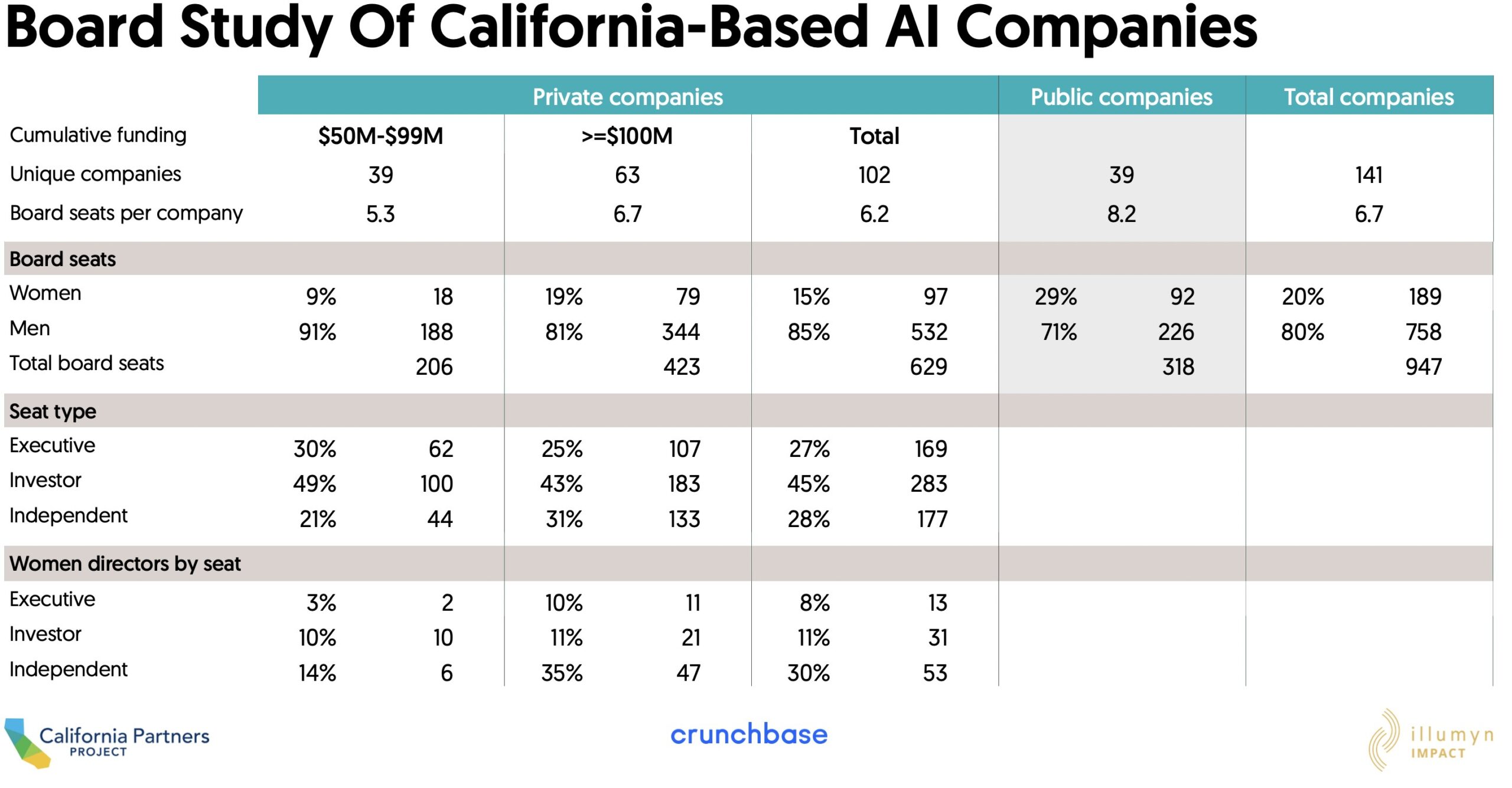
Within this study, we look at gender diversity, which is reasonably measurable, as a proxy for diversity of perspectives, life experience, areas of expertise and other demographics. To understand the gender mix on AI boards, we analyzed the board composition of more than 140 AI companies headquartered in California, where venture-backed AI development is concentrated. Our study focused on 102 private companies that have raised at least $50 million in cumulative funding. As we’ve seen time and again, transformative innovations are as likely to come from today’s nascent startups as they are from established industry leaders. Governance of these companies during their high-growth, pre-IPO period is arguably as important as it is after they go public. We also looked at the boards of 39 publicly traded AI companies for comparative purposes.

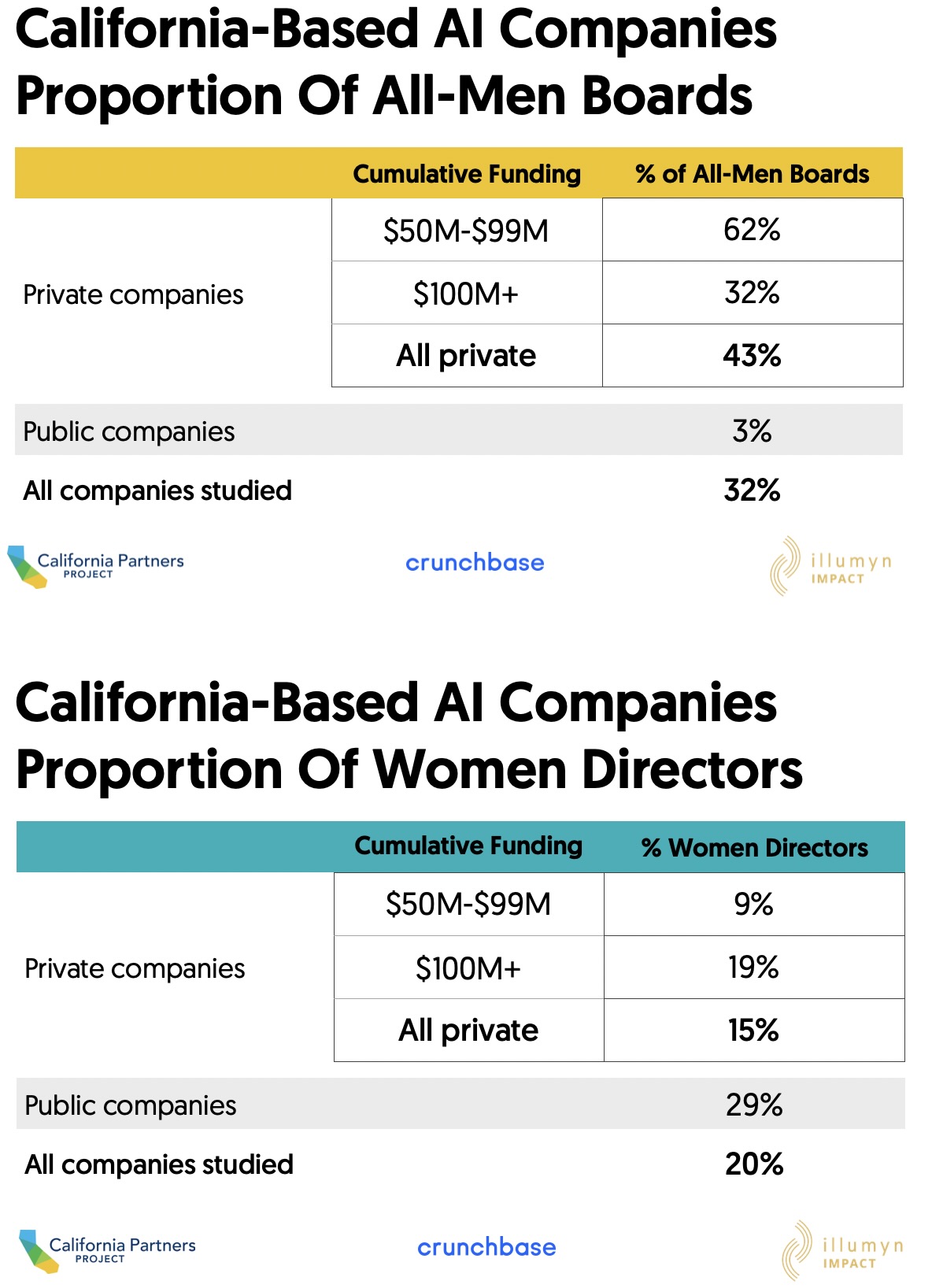
Our analysis revealed a striking lack of gender diversity among the people who govern some of the world’s most influential AI startups. Women comprise only 15% of the boards of private AI companies. More than 40% of these private boards don’t have any women directors.

Two root causes contribute to this gender disparity — one structural and one behavioral. First, investors and founders collectively hold the majority of private company board seats, and women are still underrepresented in those categories. Second, when appointing independent directors, boards often limit their consideration to familiar candidates instead of seeking qualified experts outside their immediate networks.

The good news: There are plenty of executive women and people of color on the cutting edge of AI innovation who are ready to bring their voices and operating expertise to the boardroom.

Companies that prioritize building a diverse board need only to look beyond their existing networks to find a wealth of AI board talent. Consider this precedent: Five years ago, one-third of all public companies in California had no women board members. With focus and effort, all-male boards are now the rare exception.

Given the rapid pace of AI development, companies need to act now, while the technology and its applications are still emerging. CEOs and board members who bring more women and people of color into their boardrooms will help create a productive and healthy AI-powered future for all of us.

Key findings
Among the AI companies headquartered in California included in our study:
  • 15% of private company board members are women;
  • 43% of private company boards don’t include any women directors;
  • Women who serve on private company boards are most likely to hold an independent director seat;
  • 26% of private company boards don’t include any independent directors; and
  • Publicly traded companies typically have more gender-diverse boards than private companies, but still average only two women per eight-person board.

Women average just one seat in AI boardrooms
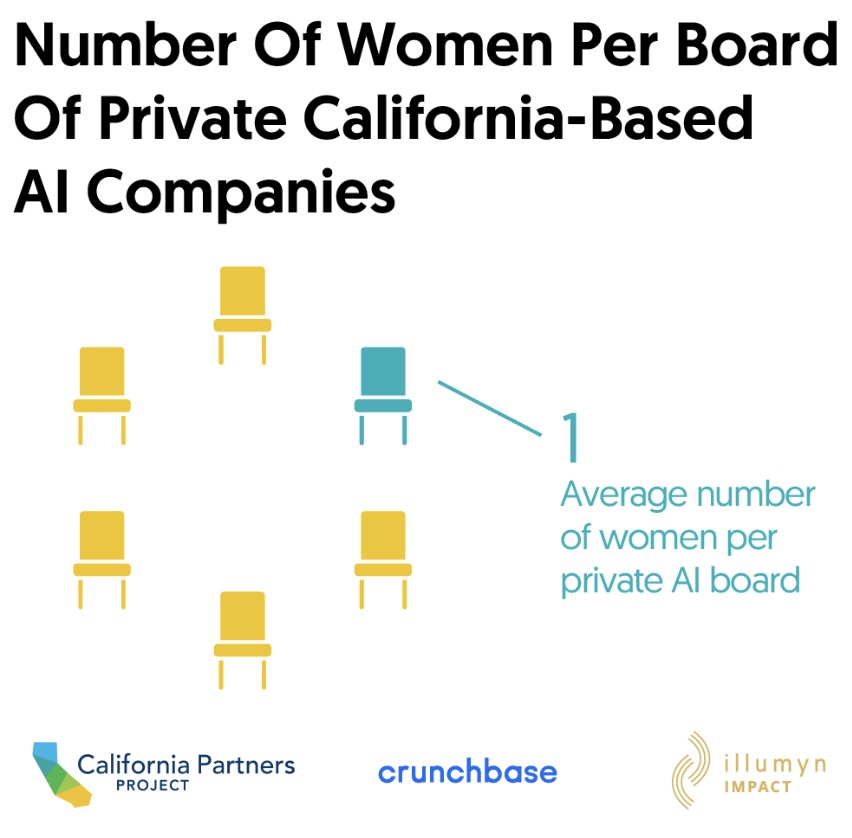
Across all of the California-based AI private companies studied, women hold an average of one seat on a six-person board. Among 102 private companies, only five boards (5%) have an equal or greater number of women than men in the boardroom.

More than 40% of private AI companies have all-male boards
Among the over 100 privately held AI companies headquartered in California included in our study, 44 (43%) don’t have any women in the boardroom.
Gender diversity is slightly higher on the boards of companies with more capital. Among those with cumulative funding of at least $50 million but less than $100 million, 62% have all-male boards. For companies with at least $100 million in funding, that number drops to 32%. This shift likely stems from the addition of independent directors who bring operational and market expertise.
Among publicly traded companies, women hold an average of two board seats, double the average among private company boards. Research suggests that, to capture the full economic benefits of diversity, boards should include at least three women directors. Just half of the public companies we studied meet that threshold.
For private company boards, independent director appointments offer the fastest route to diversity
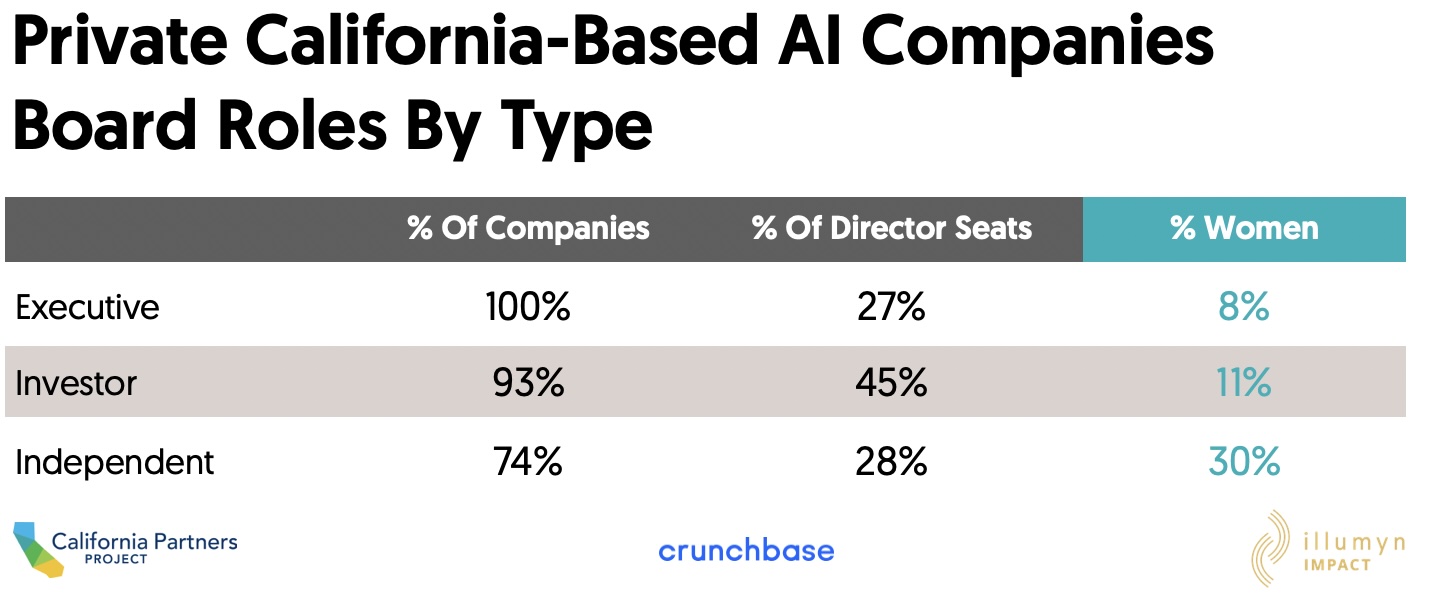
Most private company board seats (72%) are held by company executives (the CEO and co-founders, typically) and early investors. Women hold only 10% of these board seats, a reflection of the underrepresentation of women among venture capital investors and the entrepreneurs they fund. Women hold less than 20% of investing partner roles in venture capital firms. Companies with women-only founders secured just 3% of AI venture funding in 2023, a number stagnant since 2015.
More than half (55%) of the women directors included in our study hold independent board seats. That is, they are neither tied to the company’s founding or management team nor investors in the company. Whereas public companies must have a minimum number of independent directors, private companies have no such requirements. Therefore, independent directors are typically added later in a company’s lifecycle, often as part of preparation for an IPO. The percentage of companies without any independent directors decreases as the level of funding increases — from 36% for those with $50 million to $99 million to 21% for those with $100 million or more.
Our findings suggest that women are more likely to be appointed to private company AI boards as the second independent director. On boards with only one independent director, women hold 17% of those independent director seats. Among companies with more than one independent director, 67% had at least one woman in that role.

Summary
Women are underrepresented on the boards of AI companies — especially high-growth, earlier-stage startups. While board diversity is not a panacea, it is one essential element for the companies developing technology with the potential to influence society in profound ways.
To increase the number of women board members, companies should:
  • Accelerate the appointment of independent directors;
  • Commit to adding directors who expand the diversity of perspectives, skills and experiences on the board; and
  • Reach outside existing networks to identify well-qualified candidates.
Companies don’t need to trade off technical expertise and governance experience to bring diverse voices into their AI boardrooms. They simply need to look beyond their immediate networks.

Methodology
This study follows the methodology utilized in the annual Him For Her and Crunchbase studies of diversity on private company boards.
Leveraging the Crunchbase database, we identified 409 companies in the AI industry with headquarters in California. Among them were 40 publicly traded companies and 369 privately held companies with at least $50 million in cumulative funding as of July 1, 2024. To ensure that each company’s board profile was current, we included only companies that publish their board of directors on their website.
We then referenced company website data, Crunchbase profiles and other publicly available information to characterize the board members. The study included only board directors; board observers and/or advisers were excluded from the data set. For private company boards, we segmented board members according to type of board seat: executive, investor or independent. In the few cases in which founders and past executives remained on the board despite no longer having an operating role at the company, we classified them as “executive directors” in recognition of their original relationship to the company. We identified gender by referencing professional profiles on Crunchbase and, when not available, other sites.

WWD : Lululemon Bets on China’s Wellness Boom, Releases Report With Top Academy

Lululemon Bets on China’s Wellness Boom, Releases Report With Top Academy Tsinghua
Lululemon CEO Calvin McDonald hailed the report as "a call to action, encouraging people to embrace active and healthy lifestyles."

LONDON — Athleisure brand Lululemon earlier this week supported the release of a China Wellbeing Report published by the research center for positive psychology under the department of psychological and cognitive sciences at China’s top academy, Tsinghua University.

Kaiping Peng, principal investigator of the report and a professor in the department of psychological and cognitive sciences at Tsinghua University, said understanding and enhancing the well-being of the Chinese people is one of the most vital subjects today.

To tackle the issue, Peng and his team surveyed more than 50,000 Chinese people and used AI to analyze Chinese written materials, including classic works of Confucianism, Buddhism and Taoism, novels and essays from the Ming and Qing dynasties, archives of People’s Daily content, as well as user-generated social media content, to unearth the cultural DNA of Chinese well-being.

The report showed that the respondents placed the least emphasis on social well-being, with only 24.3 percent reporting focusing on it in the past year, whereas mental and physical well-being scored 62.9 percent and 53.8 percent, respectively.

It also showed that there are significant intergenerational differences when it comes to overall well-being and sources of stress. Younger generations, especially Gen Z, expressed a stronger sense of “Neijuan,” a popular term describing an endless cycle of internal competition, than older groups, who tend to report greater well-being.

At the end of the report, seven tips were offered to improve well-being, including finding joy in movement and experiencing the joy of “flow,” a state of mind psychologist Mihaly Csikszentmihalyi invented to describe when one is fully in a suitable challenge with an optimal level of difficulty, the person forgets time and themselves and becomes an organic part of the activity.

Other tips included maintaining a balanced diet; cultivating optimism and taking a proactive approach to “Neijuan”; accepting and caring for your emotions; retaining childlike curiosity; reducing screen time and being present in real life; building meaningful connections, and giving back to the community.

In an interview, Peng said the report is also aimed at showing how the Chinese perceive well-being differently from the West. The professor has more than 6.5 million followers on Chinese social media and has published 15 books and more than 300 papers in the area of positive psychology.

“The Chinese people embody a collectivist spirit, so our sense of well-being is rooted in social relationships and collective harmony. Social harmony takes precedence, and we often link our personal well-being to the well-being of our families, clans, communities and society at large,” he said.

“Westerners tend to view well-being as a personal choice, emphasizing individual achievement and self-actualization. They place greater emphasis on personal rights, freedom, independence and uniqueness. Thus, well-being stems from pursuing and achieving personal goals, valuing passion and dreams, even if it means forging ahead alone,” Peng added.

Secondly, Peng observed that the concept of personal well-being in China is closely tied to others’ evaluations. For instance, parents’ well-being largely depends on their children’s success, while children’s well-being is closely tied to their parents’ health and recognition.

“In Western societies, the self is independent, so well-being is more of an internal psychological state. While interpersonal relationships are certainly important, the ultimate responsibility for well-being still lies with the individual,” he said.

Lastly, Peng noted that well-being in the Chinese mindset is a long-term, dynamic equilibrium because of Taoist and Confucian influences, while Westerners’ take on it places greater emphasis on amplifying positive emotions, pursuing a sustained state of high positive affect through joy and contentment.

“Of course, amidst globalization, Chinese and Western perspectives on well-being are increasingly influencing each other. Today’s young Chinese are increasingly seeking new balances between family responsibilities and personal dreams, collective recognition and self-expression,” he added.

Calvin McDonald, chief executive officer of Lululemon, said the brand and Tsinghua have a shared commitment to advance well-being and foster healthier communities.

He visited the Beijing-based Tsinghua in May and was impressed by the energy on the campus as he cycled through the grounds alongside members of the Tsinghua community.

Through the Lululemon Center for Social Impact, the brand last year donated to the Tsinghua University Education Foundation, which enabled the university’s Center for Counselling and Psychological Development to continue to offer physical and mental health programs for the students.

This year, the two decided to work together to delve deeper into the research of what well-being means for Chinese people today, and how brands like Lululemon can better cater to Chinese consumers with insights gained from the report.

“The report goes beyond academic research. It’s a call to action, encouraging people to embrace active and healthy lifestyles,” McDonald said.

“By combining Tsinghua’s academic leadership with Lululemon’s global expertise in well-being and community engagement, we have a unique opportunity to unlock new pathways to support individuals’ well-being and contribute meaningfully to communities and the broader society,” he added.

In Peng’s expert eyes, socially oriented sports such as group yoga, golfing, dancing, boxing, spinning, and even China’s traditional dragon boat racing have a more pronounced and powerful effect on enhancing well-being.

“Exercise itself releases endorphins, a natural pain-relieving hormone, while social interaction releases oxytocin, a love hormone that enhances trust, belonging and emotional bonds between people while reducing feelings of loneliness. When endorphins and oxytocin combine, they create a particularly potent chemical effect in the brain that promotes happiness,” he said.

The report provides academic approval and guidance to Lululemon’s strategy in mainland China, a region that contributed $1 billion in net revenue in fiscal 2024.

San Yan Ng, managing director of Lululemon China, said the brand has been connecting itself with the idea of well-being since 2021, by hosting a series of “Wellbeing for All” events and conversations to help people explore their own path to well-being.

Now, with the report showing that the sense of well-being has been deeply rooted in the cultural DNA of the Chinese people, and that the Chinese perspectives of well-being are multifaceted, inclusive and transcendent, the brand’s fifth “Wellbeing for All” activation will see Lululemon stores across China transform into community hubs, hosting yoga, running and training activities, and hosting well-being-themed conversations with opinion leaders from various fields.

In October, Lululemon will also partner with the Los Angeles-based artist Geoff McFetridge to present the concept of a Wellbeing Playground in Shanghai.

One can argue that Lululemon has helped popularize the concept of networking during group sports activities in China since 2016. In May, the brand hosted a yoga class with more than 5,000 attendees in the Workers’ Stadium in Beijing, the biggest of its kind in China’s history.

The brand, which currently operates more than 160 stores in mainland China, has been smart about curating the right mix of ambassadors to reach different demographics in China, with director, actress, screenwriter Jia Ling, as well as singer, songwriter, actress and fashion icon Chris Lee.

Lululemon’s Chinese New Year campaigns in the past few years, featuring Lee, Academy Award-winner Michelle Yeoh, table tennis legend Ni Xialian and emerging actor Ken Wu, have also met with positive reactions for their nuanced executions, blending sportswear with functionality and Chinese sensibility.

The success of Lululemon in mainland China remains crucial, as it continues to be a bright spot for the brand amid a tough trading period in North America.

In the second quarter of 2025, ending Aug. 3, net revenues and comparable sales in mainland China grew 25 percent and 17 percent, respectively. While the Americas division saw revenues inch up 1 percent, and comparable sales drop 4 percent in the period.
WWD : Brunello Cucinelli CEO Denies Allegations of Russian Market Irregularities

Brunello Cucinelli CEO Denies Allegations of Russian Market Irregularities, Shares Plunge
The luxury company confirmed full compliance with EU regulations regarding operations in the Russian market, following allegations by hedge fund Morpheus Research, which holds a short position in the publicly listed Cucinelli.

MILAN – Brunello Cucinelli on Thursday afternoon firmly rejected a short-seller’s allegations of irregularities in the company’s business activities in Russia. This, however, was not enough to avoid a sharp decline in its shares on the Italian Stock Exchange.

Trading was suspended earlier in the day and, after resuming, shares closed down 17.3 percent to 85.08 euros.

Morpheus Research, which is betting Cucinelli’s stock will fall, issued a report alleging the company misled its shareholders and continues to operate stores in Moscow.

But during a re-see of the spring collection, Cucinelli’s CEO Luca Lisandroni calmly and clearly told WWD that “today we have really contrasting feelings. On one hand we are enthusiastic about the quality of the results and the great appreciation for the spring season’s collection, with an excellent selling campaign.”

On the other hand, he said: “We are deeply disappointed by the strong turbulence created on our shares by a short-selling fund. We are perfectly aware that these kind of funds bet on the difficulties of a company. In this case, probably not finding any critical element, the fund produced and spread a defaming report on our activities in Russia.”

He reiterated that the company has “always acted in full respect of rules as it has already been ascertained by the Customs Agency’s inspections we have been subjected to.”

The hedge fund published its report based on a three-month investigation “involving interviews with former Cucinelli employees and partners, an extensive analysis of trade data, and visits to Cucinelli’s Russian stores.” This led to doubts “on Cucinelli’s claims,” and the fund “reveals that Cucinelli has misled shareholders. We found that Cucinelli continues to operate several stores in Moscow with a wide offering of items priced at thousands of euros.”

In addition, the report highlights “that Cucinelli has resorted to aggressive discounting to manage bloated inventory that dwarfs direct peers, with items ending up in stores like TJ Maxx, risking dilution to the brand’s exclusive positioning.”

Putting things into context, Lisandroni said that Russia accounts for around 2 percent of company sales compared with 9 percent in 2021.

“Please allow me to indicate that in this case there is a particular coincidence between those who produced the news and those who could benefit from an economic return thanks to the short position held on our shares,” said Lisandroni.

The executive concluded by expressing how, “being certain of having acted correctly” and through the “many messages” received by long-term analysts and investors that have “immediately reiterated their confidence and the strong credibility of our company’s reputation, we find strength and peace. We will do all that is possible to protect our investors, our collaborators and in general all the stakeholders for the love of the truth.”

In a separate statement, the company said: “The value of exports to our Russian subsidiary has fallen from 16 million euros in 2021 to 5 million euros in 2024, figures that are available annually in our financial statements.” The figures are seen as providing “a clear and accurate perspective on this matter and rule out any speculation regarding the use of the Russian market to reduce stock or clear excess inventory,” it said.

After Russia invaded Ukraine in 2022, the EU prohibited the export of luxury goods over 300 euros to Russia, which led many luxury brands to close their stores in the country.

The company’s statement went on to underscore that the Italian Customs Agency’s inspections “have confirmed full compliance with procedures, and no reports from foreign customs authorities have been received that could suggest any commercial triangulation.”

Cucinelli’s conscious decision was to maintain its local structure in Russia when the country invaded Ukraine in 2022 to “ensure full salaries for employees and salespeople and honoring lease contracts, as we have always done worldwide, even in extraordinary circumstances.”

A customer assistance service within Cucinelli’s showroom is available upon request and provided by the staff, and the products “are those legally shipped to Russia within the limits set by the European Union, along with the residual inventory delivered prior to the introduction of sanctions. This enables us to locally generate the resources needed to sustain salaries and rents.”

The Morpheus Research report alleges that, “in addition to selling through its own Russian stores, Cucinelli also sells through high-end stores like Tsum, controlled by Russian luxury conglomerate Mercury Group, which appears to be supporting Cucinelli’s growth in the region in spite of EU sanctions.”

Cucinelli’s statement clarified that operations with wholesale multibrand structures remain active, but “in full compliance with EU regulations, supplying them only with the portion of the collection permitted within the established value limits.”

The company is considering legal action to protect its reputation and the interests of its stakeholders, the statement concluded.

Morpheus Research’s allegations follow similar ones reported by Pertento Partners, which also holds a short position in Brunello Cucinelli, during the summer.

The Information : Snowflake Tries to End the AI Data-Access Wars

Snowflake Tries to End the AI Data-Access Wars

Snowflake is reversing an incendiary trend of software incumbents such as Salesforce and Atlassian walling off data in their applications from artificial intelligence startups that threaten them.

On Tuesday, Snowflake said a consortium of more than a dozen other enterprise app and database providers—including, ironically, Salesforce—have committed to operating business intelligence and other analytics apps so that chatbots or other conversational AI can pull data from all of them at once.

For instance, a salesperson that’s about to meet with a customer might want to know about that customer’s spending habits, whether they might be a good candidate to try a new product, and whether they have unresolved customer-support problems.

Right now, such information might be held in several different databases or applications at the salesperson’s company, such as Salesforce’s Tableau or data “catalog” firm Alation, said Josh Klahr, a product management leader at Snowflake, which is known for selling databases.

And the data stored in those services comes in many forms, making it hard for conversational AI to know what data to grab. The consortium, which also includes business intelligence provider ThoughtSpot, aims to ensure the data—including everything from numbers to nouns and verbs—are stored in a standardized format the AI can understand.

AI-powered search is already one of the hottest applications of the technology in the enterprise, and one such provider, Glean, was an early breakout success.

But Salesforce’s Slack as well as Figma, Notion, Atlassian and others have been making it harder for Glean and enterprise software customers to execute cross-app searches with AI, as we have reported in recent months. Even OpenAI, which also wants to enable ChatGPT customers to access data across numerous productivity apps, has been caught in the crossfire.

Klahr said enterprise software customers expect more flexibility from their vendors, and new standards such as Model Context Protocol will make it even easier for AI tools to find and use data across all types of apps, no matter where the data are stored. (MCP eliminates the grunt work that developers of agents need to do for AI to get information from apps or take actions involving them, such as making a purchase or spinning up a marketing campaign.)

“Our customers are very interested in openness and interoperability—bets that don’t lock them into” a particular software vendor forever, Klahr said. One Snowflake customer, asset management giant BlackRock, was listed in the initial members of the consortium.

Of course, the Snowflake-led consortium represents only a small fraction of the BI and analytics market, so it’s largely a symbolic gesture at the moment. We asked spokespeople from Google and Microsoft, which controls the most popular BI app, what they thought of Snowflake’s effort but they didn’t provide an immediate comment.

Why Large Companies Are Struggling With AI

Hemant Taneja, CEO of General Catalyst, believes many large companies aren’t getting a return on their AI investments because they haven’t developed a comprehensive strategy for adopting it.

Some of the challenges are technical ones. To effectively use AI, companies need to organize and prepare their data and then train AI models on it, Taneja said in an interview Wednesday on TITV, The Information’s new streaming show.

Adopting AI also requires firms to rethink existing management structures to account for situations where AI will manage human employees—or humans will manage AI agents. Senior leaders also need to show they’re committed to all of these changes, he said.

In a recent study, the Massachusetts Institute of Technology claimed that 95% of corporate efforts to use artificial intelligence failed to boost the bottom line for the surveyed companies. According to Taneja, such disappointments happen because companies aren’t following all of these necessary steps.

“They can see what’s possible, but then they get stuck,” Taneja said in the TITV interview. “You have to have all four of these ingredients to really [drive adoption and get value].”

(Makor) ORSTED DC Rights issue - Update as of Sep 25th


All,


Daily update on ORSTED's rights issue:

·                  Average Net spread today was 40bps versus 59bps yesterday 

·                  0.9% of all rights traded today (59m)

·                  So far, 6.9% of all rights have traded

·                  Arbitrage intensity was significantly higher than 1 today, implying some fundamental positioning (indeed, stock had relatively large intraday move) 

·                  There is no oversubscription but still some optionality on being allocated unsubscribed shares (hence difficult to precisely assess as depending on board's decision) 


Laurent Chekroun
​​​​
Equity Sales
Makor Securities London Ltd. | Makor Group
E: LCHEKROUN@makor-cm.com
M: +41 79 350 71 09
O: +33 1 42 33 02 05
W: www.makor-group.com
6th Floor, 30 Panton Street, London, SW1Y 4AJ
This message has been sent by Makor Securities, London, part of Makor Group, which is authorised and regulated by the FCA (625054). This message is for professional clients and eligible counterparties only, not intended for "retail clients".  The information contained in this message is confidential and is for the exclusive use of the intended recipient. If you receive this message in error please inform us and delete all copies of it. The information is not intended as an offer or solicitation to buy or sell any financial instrument. All comments and statements are to be considered the opinions of the author not the Company and are not intended to be relied upon. We cannot guarantee that this message or any attachments are virus free and accept no liability for any viruses or the consequences thereof. v20230124