Why Bristol-Myers Squibb Can Be a Sweet Pill for Investors
Bristol-Myers Squibb has trumpeted its deal for Celgene as an opportunity to create the No. 1 producer of cancer treatments and an earnings powerhouse. Wall Street isn’t convinced.
Investors worry that the combination will do little to improve the prospects for two drugmakers whose shares were among the worst performers in a strong group last year. Since the $74 billion acquisition was announced on Jan. 3, the shares of Bristol-Myers (ticker: BMY) have fallen about 8%, to $48.
With the selloff, however, the stock now looks inexpensive. And if the Street warms to the transaction, the shares could rally. It’s also possible that Bristol-Myers, long a rumored takeover candidate, could attract a bid from the likes of AbbVie (ABBV), Amgen (AMGN), or Pfizer (PFE).
Bristol-Myers’ most valuable asset is its cancer-treatment franchise in the area of immuno-oncology, led by the drug Opdivo, whose sales topped $6 billion last year. Immuno-oncology “is a hot area where many companies want to play,” says Wolfe Research’s Tim Anderson, who has an Outperform rating on Bristol-Myers. For drugmakers that are not already developing cancer treatments that harness the body’s immune system, the only way to catch up is through a deal, he says—and “the only company with a broad-based product in this area is Bristol-Myers.”
Bristol-Myers, with a market value of $78 billion, trades for 11 times projected 2019 earnings of $4.12 a share and for only eight times estimated 2020 profits of about $6. The 2020 price/earnings ratio is the lowest among the major drug companies. Its shares boast a 3.4% dividend yield.
The 2020 estimate is based on Wall Street projections incorporating Bristol-Myers’ guidance that the Celgene (CELG) purchase, expected to close in the third quarter, will increase earnings by at least 40% in the first full year. Such earnings accretion is highly unusual for a big deal, but is possible as Bristol-Myers is paying just 10 times projected 2019 earnings for Celgene. Bristol-Myers also estimates that the transaction will produce $2.5 billion of annual cost synergies by 2022.
But will the hunter become the hunted? A bid for Bristol-Myers doesn’t seem likely now, but the idea has been gaining traction on Wall Street.
Credit Suisse analyst Vamil Divan wrote last week that whether a rival will try to acquire Bristol-Myers “is easily the No. 1 question we have been asked over the past few days.” His list of possible suitors is led by Pfizer, AbbVie, and Amgen, with AbbVie potentially the most interested because of its dependence on its anti-inflammatory blockbuster, Humira, which has lost European patent protection. A potential buyer of Bristol-Myers would presumably scuttle the Celgene deal, triggering a $2.2 billion termination fee.
When the deal was announced, investors homed in on the looming loss of patent protection for Celgene’s dominant blood-cancer drug, Revlimid. Yet Matthew Phipps, a William Blair analyst, says that a combined company could earn $8 a share by 2022, when Revlimid begins to face generic competition. Put a multiple of 10 on those earnings and Bristol-Myers’ stock could be much higher. “The initial move down in Bristol-Myers was an overreaction,” Phipps says. “I’m still recommending Bristol-Myers, but it’s a more complicated story.”
Revlimid isn’t due to face full generic competition until 2026. Earlier and more severe generic competition for the drug is possible, however, and Wall Street tends to assign low multiples to drug companies with major patent issues.
In the deal, Bristol-Myers is emphasizing six promising drugs in its pipeline—including four targeting cancer—with a potential for $15 billion in combined annual sales. It also expects to generate more than $45 billion in free cash flow during the first three years after the combination, a good chunk of which is expected to reduce debt. Bristol-Myers will carry about $50 billion of net debt after the deal.
For investors, Celgene also offers an intriguing play. Its shares trade for $87.50, a $10 discount to the cash and stock portion of the deal, which calls for Bristol-Myers to pay $50 a share in cash, plus one of its shares for each of Celgene’s.
Celgene holders will also receive a contingent value right, or CVR, for each Celgene share. The CVR will pay off if three drugs in its current pipeline are approved by the Food and Drug Administration by late 2020 and early 2021. The CVR is an all-or-nothing bet, with a payoff of $9 a share. Investors stand to earn a 11% return on Celgene to the deal price, assuming no value for the CVR, which could trade for $2 or more initially. Celgene stock could fall if a buyer swoops in for Bristol-Myers and ends the deal.
BTIG analyst Thomas Shrader thinks there is a 50/50 chance of a payoff on the CVR because he puts the approval prospects of the three drugs at 70% to 90%.
The main challenge for investors and analysts involves projecting sales for Opdivo and Revlimid. Phipps’ view is that Opdivo, despite being largely supplanted by Merck ’s (MRK) Keytruda in the large lung-cancer market, can still generate higher sales by being used against other cancers. Revlimid generated about $9.7 billion in sales in 2018, or about 65% of Celgene’s total revenue. Its sales could rise in the coming years before facing limited generic competition in 2022.
Bristol-Myers is a prime example of rapidly changing fortunes in the drug business. A few years ago, it was the leader in immuno-oncology and sported one of the sector’s highest valuations. Now, it has one of the lowest, making it a cheap pharmaceutical play—one sweetened by a secure dividend and the chance of a takeover.
few articles in the press talking about that....should push to a correction on the all sectors, valuations should be impacted by that move
* TechCrunch :Here’s everything Google announced at CES 2019
{GOOGL US Equity EEO <GO>}
{AAPL US Equity EEO <GO>}
Google is not cheap and we should see stock trades lower...
have a look to this article on Google CES 2019 announcement...not sexy...
* WSJ : The Big Hangup: Why the Future Is Not Just Your Phone
* TechCrunch :Here’s everything Google announced at CES 2019
Google made a flurry of announcements at CES this week, many of them coming rapid fire this morning.
Don’t have time to dig through it all? That’s OK. Here’s the condensed version:
- Google says that Assistant, its voice-powered AI, will be on 1 billion devices around the world by the end of this month.
- Meanwhile, Google is also rolling out an update today that brings Google Assistant into Google Maps on both iOS and Android. It’s a bit more powerful on the latter, as Google has more flexibility on their own platform, but it’s a very useful addition on both.
- Google says that Assistant will soon be able to control Sonos speakers. They’ve been promising that for more than a year now, but it should be coming sooner than later. It’ll land on Sonos speakers with built-in mics first (Sonos One and Sonos Beam), but you’ll also be able to use Google Home devices to control mic-lacking Sonos speakers (like the Play:one or many of the older speakers) down the road.
- 2019 Samsung TVs will get Google Assistant compatibility later this year. If you have a Google Home or something similar, you’ll be able to link it up with your Samsung TV, allowing you to turn it on/off, adjust the volume, change the channel and switch inputs with your voice.
- Dish is adding Google Assistant to its Hopper set-top boxes, allowing you to speak to Assistant through your Dish voice remote.
- Google Assistant will soon be able to check you into flights (United only at first, with other airlines on the way) when you say “Hey Google, check into my flight.” It can also now book hotels for you.
- Lenovo is building an $80 Google Assistant-powered smart clockmeant for your nightstand.
- Assistant’s new “Interpreter Mode” can translate conversations on the fly in 27 different languages.
- Google is previewing a new initiative called Assistant Connect, allowing manufacturers to make simple devices that tap your existing Google Home gear to do any required heavy lifting. Their example is an e-ink display that can show weather/calendar information — it doesn’t actually connect to the internet by itself, but has a connected Google Home handle and it passes that info on to the display.
- Google worked with both Anker and JBL to build accessories that pop into your car’s 12v outlet (that thing once known as the cigarette lighter, back when that seemed like a totally normal and not super-weird thing) and make Assistant work a bit better in the car. Both can connect over either Bluetooth or AUX. They’ve got built-in echo/noise cancellation tuned for road noise, and are built to let you use Assistant without having to unlock your phone.
As you can probably tell, Google went all in on Assistant at CES this year; effectively every single one of their news items has to do with Assistant in one way or another. They built a two-story building right outside the convention center, entirely dedicated to demonstrating Assistant. Google has made it pretty clear at this point that it sees Assistant as the next evolution of Google searches, so expect Assistant to play a role in almost everything consumer-facing the company does moving forward.
VC Spending Hit An All-Time High In 2018 Thanks To Tech Bubble 2.0
CNBC just published a piece about how venture capital spending hit an all-time high in 2018, surpassing the dotcom bubble record:
Venture capital just had its highest spending year in history.The amount of money firms spent on private companies hit a new all-time record in 2018— well above the previous watermark from the dotcom boom.Last year, venture capital firms spread roughly $131 billion across 8,949 deals, according to data published by Pitchbook and the National Venture Capital Association Thursday. The previous record was a $100 million total notched in the year 2000.Although the dollar amount jumped by more than 57 percent from $83 billion last year, the number of deals went down. Deal count fell by about 5 percent this year from a roughly 9,400 total last year.Cameron Stanfill, Pitchbook venture analyst who co-authored the report, said sky-high price tags for start-ups accounted for the new record total despite having fewer deals.“There is a lot of money competing for a finite amount of companies, and that’s pushing prices up,” Stanfill told CNBC in a phone interview.
Though most people look at record VC spending as a sign of a strong, healthy economy, my research has found that the current VC boom is the result of another tech bubble that inflated due to the Federal Reserves ultra-stimulative monetary policies of the past decade (read my recent article about this).
Unfortunately, this tech bubble is going to end just like the late-1990s dotcom bubble did – in another disastrous bust.
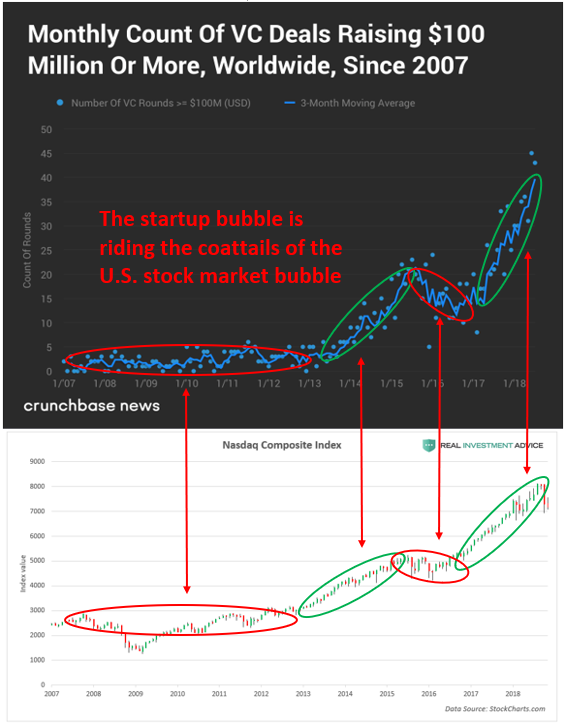
The chart below shows the monthly count of global VC deals that raised $100 million or more since 2007. According to this chart, a new “unicorn” startup was born every four days in 2018.

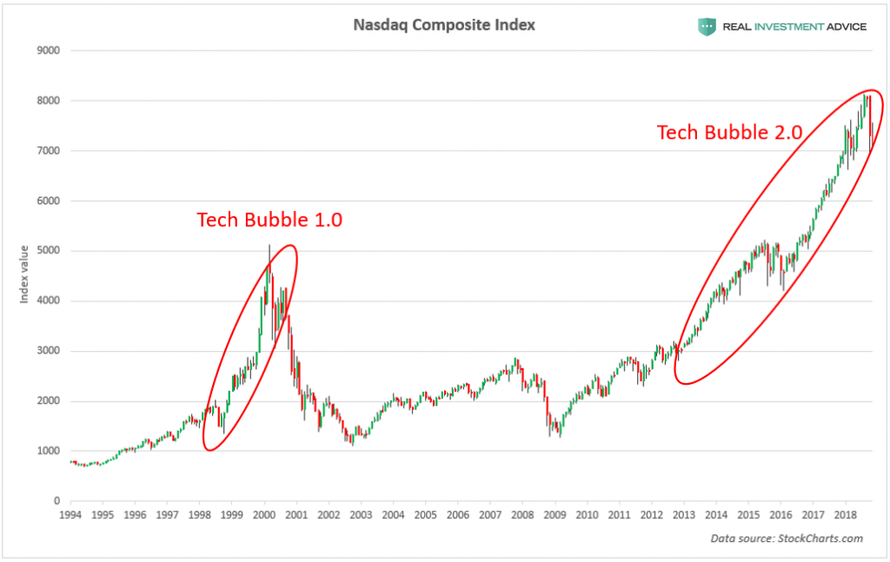
The chart below shows the Nasdaq Composite Index and the two bubbles that formed in it in the past two decades. Lofty tech stock prices and valuations encourage the tech startup bubble because publicly traded tech companies have more buying power with which to acquire tech startups and because they allow startups to IPO at very high valuations.
In the chart below, I compared the monthly global VC deals chart to the Nasdaq Composite Index and they line up perfectly. Surges in the Nasdaq lead to surges in VC deals, while lulls or declines in the Nasdaq lead to lulls or declines in VC deals.
“If we see investors switch sentiment from ‘greed’ to ‘fear,’ many growth stories priced for future perfection may continue to rely on private capital to avoid pricing in that environment,” Silicon Valley Bank CEO Greg Becker said in the report.
Please watch my video presentation to learn why the U.S. stock market (and, therefore, the VC and startup arena) is experiencing a bubble. Though this presentation is a couple months old and the market has fallen since then, it’s still relevant for understanding how the bubble inflated and why much further downside is still ahead.
Now that the Nasdaq has fallen sharply, it wouldn’t be surprising to see VC activity wane. Unfortunately, I believe that we’re only in the early stages of the stock market and tech bust – a bubble that took nearly a decade to form does not disappear in a mere three months!
Fasanara 2019: Markets In Critical Transformation, Chaotic Behaviour Has Just Began
A Glimpse At 2019
Markets In Critical Transformation, Chaotic Behaviour Has Just Began.
Our inability as market participants to properly frame market fragility and the inherent vulnerability of the financial system makes a market crash more likely, as it helps Systemic Risk go unattended and build further up. For the first time in a while, elusive economic narratives started to fail at blaming market weakness on secondary-order factors: Trade Wars, the FED, Oil prices. Attempts at dismissing market events as no more than a temporary turbulence miss the bigger picture and cast the fishing net on unaware investors looking for a dip to buy. In contrast, over the last month, conventional market and economic indicators (e.g. breaks of multi-year equity & home price trend-lines, freezing credit markets, softening global PMIs/orders) have all but confirmed what non-traditional measures of system-level fragility signalled all along: that a market crash is incubating, and the cliff is near. Nothing has happened yet.
1. Early Tremors, Not Market Bottoms
After a slow start, the season of market chaos has taken off.
In the last few months, global markets have visibly entered the ‘phase transition zone’, a process of critical transformation that will eventually lead to a new equilibrium at significantly different levels, after severe ruptures and a possible full-cycle market crash.
Rather than 'a short-term correction in a structural bull market', or a 'temporary turmoil in healthy economic conditions', this is the beginning of a structural adjustment after a decade of liquidity abundance and market manipulation, which reflexively changed the structure itself of the market for private investors in hazardous ways, making it insensitive to fundamentals, passive or quasi-passive, overly-correlated and overly-concentrated. In a word, 'Fake Markets’ have now reached their nemesis and have woken up from a long lethargy. Fake Markets are defined, as of mid-2017, as ‘markets where the magnitude and duration of artificial flows from global Central Banks or passive investment vehicles have managed to overwhelm and narcotize data-dependency and macro factors. A stuporous state of durable, un-volatile over-valuation, arrested activity, unconsciousness produced by the influence of artificial money flows.’
At a time when it was far less obvious, the unstable equilibrium of the market state was indicated a year ago by the ‘early warning signals’ ('EWS') provided for by the application of Complexity Science to financial markets. Distinctly, the general properties for complex systems in transition, after reaching the Tipping Points which compromise further expansion, were showing up, one after another: ‘conditional slowing down’, ‘flickering’, ‘auto-correlation’, pockets of stress, absence of traditional market buffers and consequent loss of system resilience, entropy/Ricci curvature in measurement of a low-diversity market structure. This was the basis for the tipping point analysis we proposed in Jan 18 ‘Fragile Markets On The Edge Of Chaos’ (link) and presented in the ‘Tipping Points & Crash Hallmarks’ investor deck (slide 30 at this link).
Looking at markets as organisms at the systemic level, hence complex and dynamic inter-webs of connections that adapt to local conditions as emerging properties arise, helps predict shifts in regimes better than over-analysing each of its constituent parts in isolation.
In the past two months, the more traditional indicators of conventional market analysis have confirmed what complexity indicators ('EWS') had indicated all along: (i) multi-year breakdowns in trend-lines for major equities, bond and real estate markets; (ii) sharp tightening in financial conditions and inverted US rate curves; (iii) sudden gaps in equity multiples, typical during recessions; (iv) high yield bonds and leveraged loans breaking down, together with frozen capital markets; (v) weakening economic activity indicators from China to Europe to now the US; (vi) together with Apple and Samsung opening the season of supposedly-shocking profit warnings with fanfare.
We made our case in a recent interview with CNBC, available at this link.
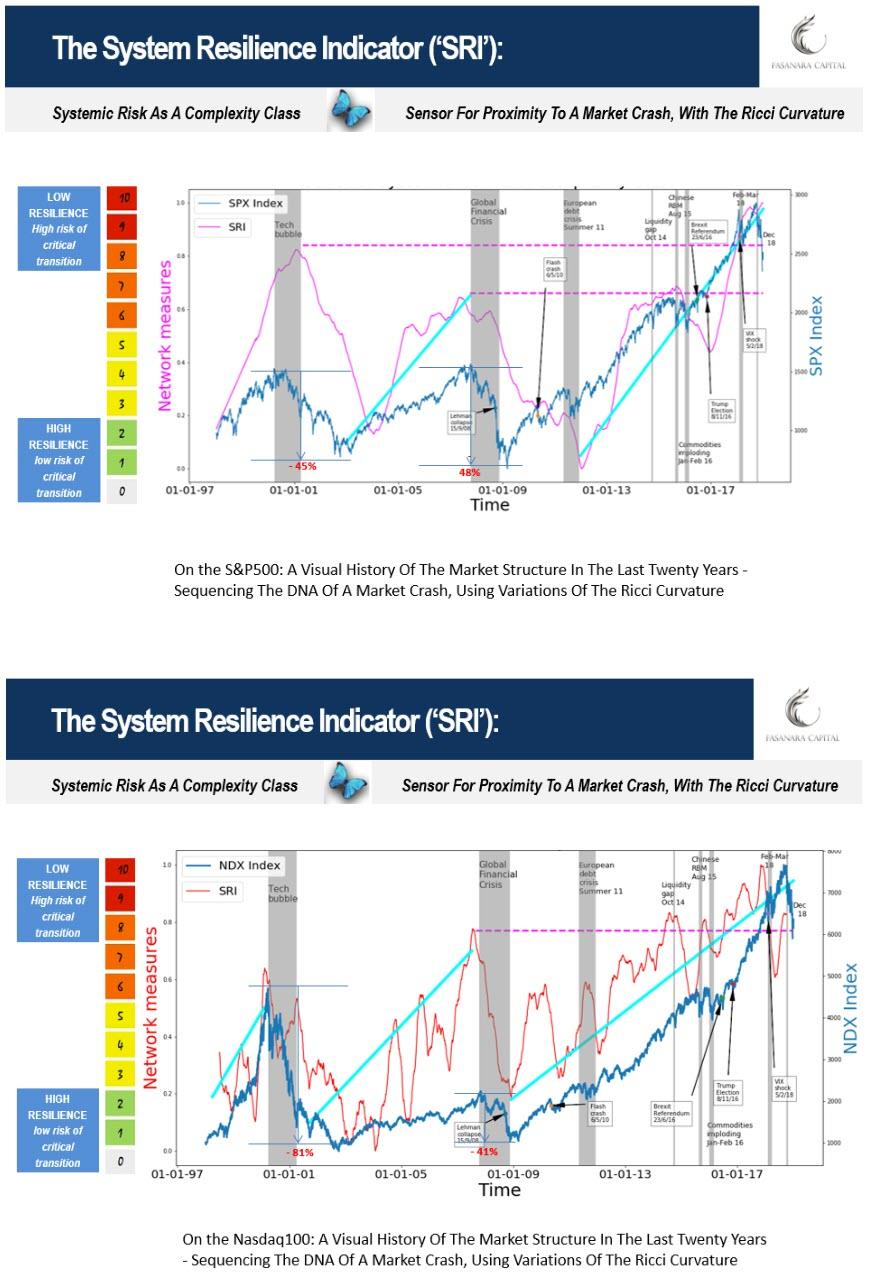
Source: System Resilience Indicators (‘SRIs’), A Mambuca, A. Balata, M. Lamperti link
2. Elusive Narratives Fail, Unveiling a Deeper Malaise
It is informative to see how the narrative machine failed in recent times, something we have not seen in a while, marking a definite shift from previous years of market docility. Over the past quarter, various attempts at justifying market dynamics, based on traditional market analysis and handy narratives, have neatly failed in rapid succession:
- In November, market weakness was blamed on a suddenly imploding oil price, after a 2-year period of stability and relentless ascent. The trigger for peace in markets was then expected to be an OPEC agreement on the 7th of December. The OPEC agreement materialized, on the high end of expectations, and yet markets continued their turmoil, without much else as apparent explanation.
- Market woes were then blamed on the trade wars between China and Trump. The contenders exchanged warm smiles and reached a promising 3-month truce during the G20 meeting in Argentina on the 30th of November. Yet, crumbling markets could not catch a break. This was all the more disconcerting as markets melted during traditionally strong seasons: Thanksgiving, Black Friday and December. Highlighting the problem of investing with probabilities on your side, during abnormal market conditions and critical transitions.
- Elsewhere, market softness was attributed to rising interest rates, as yield on US 10-year Treasuries peaked in early November. However, rates fell roughly 70 basis points since, and markets kept tumbling.
- To most, the favourite suspect for weakness is the end of QE and the tightening of global liquidity. While this is relevant and plays a key part, it is only a piece of the puzzle. Our Tipping Point Analysis (‘TPA‘) tried to put other key elements in perspective. Expectations to see market weakness fading should a major Central Bank decide to get back behind the wheel, through another round of liquidity (China it is often rumoured/hoped, or a FED QE4 or the ECB) would likely fail, this time around, after any respite rally, however strong, upon announcement. A greater disease is at play, which has been papered over and ignored for far too long, leading markets into over-concentration, low diversity and over-extension into bubble territory.
- Another easy scapegoat is the FED policy and Jeremy Powell resilience in the face of political pressure. Again, we doubt it. A non-hike last December would have only confirmed the legitimacy of market panic, and likely lead to no different end results. The idea that markets got disappointed by a ‘FED on autopilot’ instead of a ‘data-driven FED’ is relevant but too easy a common rationalisation, no more than other fickle ex-post narratives at play. Markets are no longer in the FED’s hands, either way. The spell is broken.
3. Mainstream Investment Strategies Face a Tougher New Year
In the short-term, a rebound in stock prices is likely, based on statistics for previous cases of heavily oversold market conditions. Fund flows for retail investors (selling) and ‘institutional investors’ (buying) also seem to indicate that a temporary turn of fortunes for troubled markets is likely, as recently indicated by JPMorgan. However, again, it is unsafe to apply statistics on non-normal market conditions. What is true 'most often than not' is a vicious trap during phases of regime change. Every crash will necessarily go through a failed buy-the-dip, by definition. Picking up dimes in front of a steamroller, just because statistically it worked out fine, may be ill-fated during end-of-cycle market shifts. In systems theory parlance, far-from equilibrium dynamics applying to systems crossing critical thresholds, which then transition across their basin of attraction, after a long period of system degradation and over-extension due to self-amplifying positive feedback loops. A system in transition, after hitting capacity constraints in synchronicity, tends to behave chaotically. Dislocations and price anomalies become the new normal, until the transition to a new attractor is completed, and a new equilibrium emerges.
It now then gets complicated for a number of mainstream investment strategies who are predictably not designed to recognise market conditions as abnormal.
By construction, traditional investment strategies are ill-equipped to deal with markets in transformation, be it active, passive or in between.
- Long volatility funds emerged as winners in February, when the market’s engine first clogged and gave hints of trouble ahead. However, they worked not as well during Q4, as the turmoil intensified, due to implied volatility and the VIX index not moving proportionally to the market decline. The VIX is affected by structural flows that systematically sell volatility, thus jeopardising its role of both a measure of risk and a crash hedge, when used in isolation. Chances are that its underwhelming performance will happen again, and possibly even during a dramatic flash crash. Other common hedging tools have also failed, which signify more dislocation for a broken market: Gold, the Swiss Franc and the Japanese Yen (until its own flash crash few days ago).
- World-renowned long-short investors, like David Einhorn and Dan Loeb, had a difficult time in 2018. The inability of seasoned and skilled investors to cut it in the current markets is itself a sign of anomaly and un-traditional market behaviour. It would be easy to categorise it as poor judgement in a bad year. The insensitivity to fundamentals of passive and quant investors, and their rising share of total flows, also only partially explain it. We rather see it as a confirmation signal for a deeper malaise, the broader theory of transformational markets acting weirdly while in critical transition, ready to snap and let go of potential energy. Their untypically large underperformance is part of the long list of price anomalies which we kept updating ever since mid-2017, as they emerged with increasing frequency.
- Quant and systematic funds are in no easy landscape, now that markets have entered chaotic territory. The definition for quant funds is necessarily loose. With big differences, it includes ruled-based strategies with various degrees of rigidity in auto-piloting. We refer to them loosely as ‘quasi-passive’ strategies. From market making programs and high frequency trading shops, to risk budgeting / risk parity funds, to CTA trend-following and range trading vehicles, to some of the low volatility and short volatility strategies, to behavioural risk premia funds, down to the bottom end of fully-passive index trackers. The basic problem common to them all is the time series their models were trained upon, their machines learned from, over the past decade, which was itself a rigged time series: a decade-long un-volatile trend-up in equity & bond prices and trend-down in volatility, under the protracted push of QE/NIRP, and their reflexive loops with the private investors' community (slide 20 and 21 here). What is the quality of a strategy when the data that such strategy is derived upon is poor in quality itself? A question worth asking then, is how did the quant/algo funds make sure not to learn the bad habits in a manipulated data series? Their recent bad performance, in line with markets, does not help the cause.

- CTA funds will find it hard to provide the 'crisis alpha' they are trusted upon for. We discussed it in a recent chat with other market practitioners during the Naked Short Club (link). Rapid inversions of the price action, constantly putting them on the back foot, asymmetry/skewness of moves, before potential gap downs and flash crashes. The shape and tempo of price dynamics will likely not be kind; a market looking to clear pain levels, as is typical of illiquid August markets.
Needless to say, these are generic considerations for the broad categories of investment strategies and exceptions apply. If anything, it will be the ideal market environment to prove one’s worth as a strategy and capacity for true alpha.
In frail and now broken markets, rich in anomalies and acting oddly while in transition, the one historical analogue to fear is not so much 1987, where automated trading exacerbated a market downfall, but rather the Quant Quake in August 2007: at that time, renowned quant funds, including the famed Goldman Sachs QIS fund, lost 30% in short order, without any apparent reason. Perhaps, as is proposed, it was due to over-crowding across similar positions and across funds of a different nature, and a fast liquidation breaking-out somehow somewhere that spread across as a pandemic. Still, to date, nobody knows with certainty what the trigger was. A decade has gone by, and the jury is still out, which speaks volumes of market brittleness. That fast crisis moment could play again in rehearsal soon, except with a 10-fold impact, and more durably than for a few days only, given that the basic ingredients of over-crowding and over-correlation have now percolated across investment strategies of most types.
For those interested, we analysed market behaviour for different clusters of investors in several previous notes (amongst which, here and here). The tree of 'positive feedback loops' below, attempts at putting them together in a single place, reverse engineering how their systemically-relevant high correlation built up over time. Inevitably incomplete but it gives the idea of where it all emanated from.
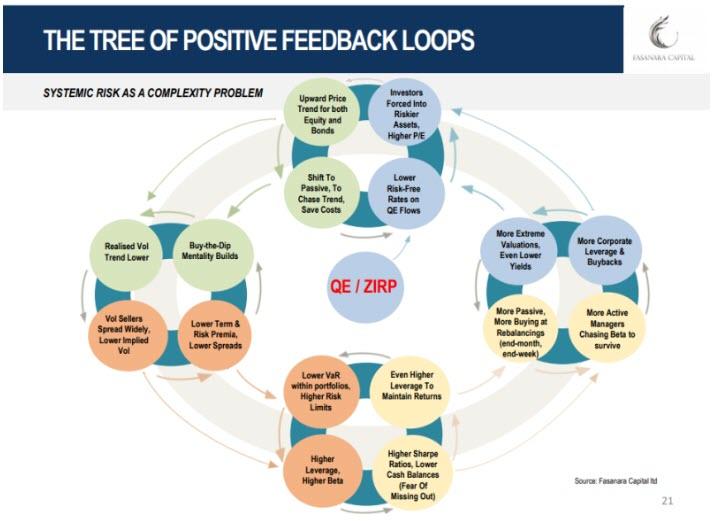
Source: slide 21
4. Triggers For Market Chaos: A Timeline For Q1 2019
Here below we draw a tentative timeline for key events in what is likely to be an action-packed new year. on-exhaustive list, just a few obvious suspects. Given our overall view for market system instability, it becomes crucial to monitor upcoming catalyst events, as any of them may be able to accelerate the large adjustment we anticipate.
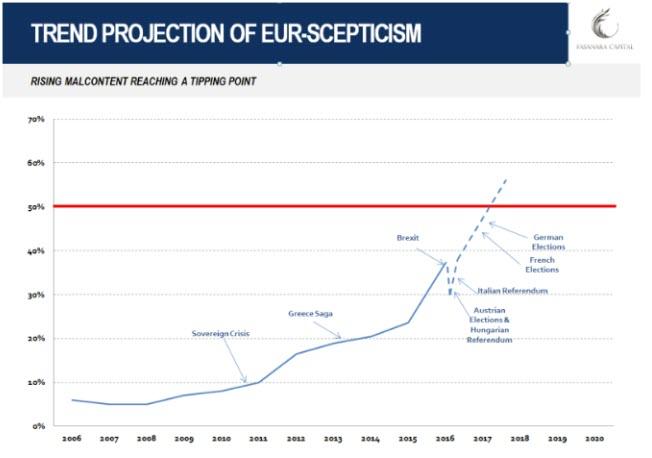
1. Inflammable Market Structure. The list of catalysts starts with a non-catalyst. No trigger needed. The market structure itself remains top of the pile of concerns to us. A prolonged period of QE/NIRP and manipulation of price discovery for risk assets has morphed the structure and micro-structure of the market itself, heavily affected correlation across investment strategies, created over-concentration on a few juggernaut asset managers, motivated a shift into passive and quasi-passive investment biases, increased retail’s access to markets and made their fickle behaviour ever more relevant. These self-reinforcing loops make for an inflammable market environment, which may implode on its own devices, under its own weight, at some tipping point in close proximity.2. Trump Factor. The Mueller investigation will come to a conclusion in the next few months, with revelations likely to damage the Trump Presidency, in full or in part, especially now that Democrats control the House. To an extreme, the case may affect the longevity of the Trump presidency, at which point the chances to see him going down quietly without a fight are slim. When boxed in a corner, the President may be compelled to engage in tactics to redirect attention away from domestic issues. This includes geopolitical confrontations with China or Russia, or any other less obvious frontline. Given that the Equity Bubble postponed its deflation thanks to tax cuts from an assertive Trump administration in full-control, any change to that working assumption has immediate and violent ramifications for asset prices.3. China’s GDP and Trade War US-China. Growth numbers out of China will be high on the watchlist this year, as they may accelerate global softness in economic indicators.In this respect, trade wars with the US may find a respite in the short term, after a deal may be engineered where both sides give concessions in a politically face-saving manner. However, the confrontation with China is real and destined to last for a long time. It is not the fleeting caprice of President Trump: it resonates far-and-wide across American society, from AI to cyber security, to copyright infringement, to political and military influence globally. The size of China, a 13trn economy, is such that globalisation can no longer simply grow the pie bigger for all; rather it becomes a race for a bigger slice of the stalling pie. The reach for global hegemony is on and pressing, at a time when China’s ascent is self-evident and overtaking the US economy in size within the next decade, at current rates. Time is up to do something to tame it, in line with the well-known Thucydides trap’s dynamics.Thus, we expect trade tensions to escalate in the years ahead and affect China’s growth rates. Such growth rates affect global GDP, as they contributed a big chunk of its growth in recent years, which in retrospect affect global risk assets. Additionally, China growth rates may have a dramatic impact on an economy over-burdened with debt and running fast towards a ‘Minsky point’ - the moment of debt saturation where income does not even cover interest rates expenses, let alone capital, and where a deceleration in credit expansion is all it takes to set the tall pile of debt on fire.In the short term, clearly, the first moment to watch is the agreement which is being discussed and should be revealed soon. At the end of February, the truce on tariffs agreed between China and the US expires, and tariffs will increase on another $200bn worth of imported goods from China. The other moments to watch are the releases of China's GDP growth numbers. Analysts 'fear' a slowdown to 6.2% (from 6.7%). To us, it seems an awfully high number, anyways, and one which is easy to use for shock value. The base is set so high that the potential for a surprise effect looms large on what have now become less-complacent, moody markets.4. Trade War US-Europe. The calendar of key events includes the ruling of the US Commerce Department, expected for February, which may slap tariffs on automobile imports if considered to be a national security threat. Such designation would avoid a technical breach to WTO rules. German car manufacturers would be more directly impacted, but ramifications go beyond that, to include a fully-fledged trade war with Europe, and a final blow to the relevance of international committees such as G-20 or WTO. Incidentally, the WTO will run out of the minimum three judges quorum by December, should the US keep blocking appointments, which would eliminate a key dispute resolution mechanism for global trade disputes.5. European Parliament Elections. The dissolution of the European Monetary Union, and its EUR-peg across member states, is far from inevitable. Yet, as we argued in recent years, it stubbornly keeps on standing right alongside a well-defined trend-line, when extrapolating the linear trend of political and economic events from the last decade. Populism grew year after year within the Union, and far broader than that, with each new year we can say that it is larger than the year before, and reaching power in more countries than it did in the year before. The direction of travel is unmistakable. Again, a de-construction of the EUR-peg is far from unavoidable, but no new year in the last five has helped avert it. In recent times, we added to the list: a wholly populist government in Italy; diminished Macron and Merkel presidencies; more political rioting in Central and Eastern Europe; and a more assertive and non-integrationist Nordics’ bloc led by Holland (the 'New Hanseatic League' link).Here below is the chart on populism within the EU, which we first presented in 2016. Linearly interpolating the trend, it would show populism to stand around 60-70% at present times. Incidentally, it is higher than that in Italy today, according to various estimates...Source: Why the EUR-peg is likely to break, Sept 2016, linkIn and by itself, the Union remains an unfinished project, inherently unstable and structurally unsustainable. As wih all things unsustainable, it will eventually stop if one is to judge by 'Stein's Law'. The best chance of recent times stood with President Macrn, as he envisioned the only alternative path forward for the Union that was proposed, and an idea for restructuring it so to address its most severe flaws and make it more sustainable. His voice remained isolated, falling on the deaf ears of Chancellor Merkel, despite it being offered at a propitious time of relative momentum in the EU economy and early in Macron’s presidency, where political capital is more easily spent. Two years later, the idea seems dead in its tracks. President Macron is past his prime, facing urging domestic issues and a nose-diving popularity. Chancellor Merkel is on her final legs and no longer able to help form a strategic vision (assuming she ever wanted true integration). While the opportunity was wasted, Italy got clearly and durably out-of-line with the EU status-quo regime, now leading a resurgent movement of anti-EU sentiment across the continent. Restructuring the EUR-peg, may be seen, at some point down the road, as the lesser evil to take to preserve the EU construct, which we all desire.In this light, European Elections in May will be a key event to watch, well and beyond Brexit. We view Brexit as an overly-hyped topic: unlikely to create havoc even in the case of a Hard Brexit. In our opinion, the hard non-consensual Brexit remains itself an unlikely scenario. The real vulnerability lies with the Union. Brexit is only a dot in a long-standing trend-line of events which have progressively vandalized the Union 's weak foundations. In the long term, European elections may be far more damaging than any shape or form of Brexit in determining the future direction of the EU, its long-term vision (if any), and therefore its ultimate fate.6. Inverted US Yield Curve. The Fed will not cut deposit rates anytime soon, while long-term rates can fall further on equity weakness. The US curve is already inverted in the 2-5yr segment and it is only 15 basis points far from inversion in the 2-10yr part. Inverted curves have historically been correlated to upcoming economic recessions, to which they proved to be remarkably consistent predictors - although the debate runs vibrant when it comes to define causation links. A recent study (link) of the St Louis FED analyses why an inverted yield curve might itself cause a recession, in addition to predict one. Firstly, through the banking channel, as banks are likely to cut back on lending when they cannot lend higher than they borrow at, which in turn puts brakes on economic activity. Secondly, banks showed a tendency to tighten lending standards in the presence of inverted curves, given the more uncertain economic outlook and subsequently lower risk tolerance. Thus, an inverted yield curve might do more than predict a recession: it might actually cause one. We may want to add to the list another factor: in the recent cases of curve inversion (1980, 1990, 2000, 2006) the curve was inverted but at much higher overall levels of rates, signalling broader manoeuvring space for monetary policymakers. This time around, inversion happens at closer to the zero bound than before. Inverted curves and the lower leverage available to policymakers to manage those curves may convince banks that the information content of such curves is even more significant, curtailing lending further.When cash returns more than long-term investments, be it bond coupons, equity yields or capital investments such as plants and machineries, the incentive is high to stay in cash. The dynamic slows down spending and investing, further curtailing economic growth. Less lending, less spending.This will therefore be an interesting dynamic to watch over the course of 2019, at a time when the risk of a US recession is top of the list of concerns in investors' mind.7. Ukraine & Turkey Elections. 2019 will see a few key election rounds (in addition to European elections): Ukraine and Turkey (local) in March; Indonesia, Afghanistan and India in April; South Africa in May (likely); and Argentina in October. Ukraine and Turkey are particularly relevant. In Ukraine, military confrontations with Russia have quietly resumed ever since last November and are unlikely to fade until the next presidential elections at the end of Q1. Given the time overlap with the Muller investigation coming to a head in the US and approaching European elections, any flare up in hostilities is likely to be met with a prompt response, and therefore carries a double weight. Coincidentally, at the end of February, the ultimatum of President Trump on Russia on the Intermediate-Range Nuclear Forces Treaty will also expire, triggering a 6-month notice to end its commitment to the 1987 treaty. A potentially relevant mix of events, making bloated headlines in thin-skin markets.8. Oil Price. It could be a wild card in 2019. Trump wants it low, to help US consumers and provide the equivalent to a 'tax cut' (his emphasis). Exponential technological innovation makes it super-low (and obsolete) in the long-run, which should always be thought of as a long-term attractor, an inescapable ultimate destination, at below $20 a barrel. End of QE deprives commodities of its strongest bidder during the last decade, something which should not be forgotten. A strong Dollar correlates well with a weak Oil. Global growth hitting a soft patch would further undermine global demand. The retreat of the US from Syria softens the chance of a confrontation with Iran, and with it the geopolitical risk premium that Oil deserves. The visibly diminished role of OPEC and Saudis in setting Oil prices at the margin is a trend set to continue. This is all the more relevant as energy and commodity stocks have been rather resilient in recent times, despite markets in turmoil, and may adjust in gap at some point soon. Saudi itself is at some risk in such a scenario, including the USD/SAR peg.
The Critical Transformation Hypothesis
Before we go, to finish on a cheerful note, we reiterate our basic view, the Critical Transformation Hypothesis.
In a big long nutshell, we believe that Systemic Risk in financial markets are best analyzed through the prism of Complexity Science, using the analytical tools available to non-linear socio-ecological systems, where a shift in positive loops comes in anticipation of a dramatic transformation.Chaos Theory and Catastrophe Theory can then help shed light on the current set-up in markets. Years of monumental Quantitative Easing / Negative Interest Rates monetary policy affected the behavioural patterns of investors and changed the structure itself of the market, in what accounts as self-amplifying positive feedbacks. The structure of the market moved into a low-diversity trap, where concentration risks of various natures intersect and compound: approx. 90% of daily equity flows in the US is today passive or quasi-passive; approx. 90% of investment strategies is doing the same thing in being either trend-linked or volatility-linked; a massive concentration in managers sees the first 3 asset managers globally controlling a mind-blowing USD 15 trillion (at more than 20 times the entire market cap of several G20 countries); approx. 80% of index performance in 2018 is due to 3 stocks only; a handful of tech stocks – so-called ‘market darlings’ - are disseminated across the vast majority of passive and active investment instruments. The morphing structure of the market, under the unequivocal push of QE/ZIRP new-age ideologism, is the driver of asimultaneous overvaluation for Bonds and Equities (Twin Bubbles). According to the most reputable valuation metrics, these Twin Bubbles are unmatched in modern financial history, so measured against most valuation metrics ever deemed reputable; a condition which further compounds potential systemic damages. The market has lost its key function of price-discovery, its ability to learn and evolve and its inherent buffers and redundancy mechanisms. In a word, the market has lost its ‘resilience’. It is, therefore, prone to the dynamics of criticality, as described by Complexity Science in copious details. This is the under-explored, unintended consequence of extreme experimental monetary policymaking. A far-from-equilibrium status for markets is reached, a so-called unstable equilibrium, where System Resilience weakens and Market Fragility approaches Critical Tipping Points. A small disturbance is then able to provoke a large adjustment, pushing into another basin of attraction altogether, where a whole new equilibrium is found. In market parlance, a market crash is incubating - and has been for a while. While it is impossible to determine the precise threshold for such a critical transition zone within a stochastic world, it is very possible to say that we are already in such phase, where markets got inherently fragile, poised at criticality for small disturbances, and where it is increasingly probable to see severe regime shifts. Fragile markets now sit on the edge of chaos. This is the magic zone, theorized by complexity scientists, where rare events become typical. That said, what is a risk is also an opportunity. The opportunity to position oneself to capture the moment of adjustment draws nearer. It may happen faster and more brutally than most anticipate. The signposts are scattered around us, in plain sight. Our thoughts are expanded upon in this video slideshow.
Veni, vidi, Versace: Donatella’s next act
The indomitable matriarch of luxury fashion has sold the family business. But don’t you dare call it Korsace
Inside 12 Via Gesù, the ornate Renaissance palazzo that houses the operations of the Versace fashion dynasty, preparations are under way for the label’s Autumn/Winter 2019 men’s show. Clothes are being edited into “looks” of acidic colours and rich patterns.
Rich is a word often associated with Versace: prints, comprised of photographs of Versace shoes and jewellery, laid over the house’s signature baroque prints, are hysterical in their decorative excess. Donatella Versace, the label’s creative director, family matriarch, major-domo and — apparently, today — dominatrix, strides between the rails of clothing in high heels. The dominatrix thing is fitting: another print in the collection cross-hatches the body with illustrated gold-buckled harnesses, a callback to her brother Gianni Versace’s Autumn/Winter 1992 “Miss S&M” collection, where supermodels were trussed up in high-fashion iterations of sadomasochistic fetishgear. Ms Versace is more conservatively dressed, bar the signature sex-shop shoes: a black silk shirt, strict skirt, two gold tie-pins, no tie. Her hair is poker-straight, platinum, incandescent; her smile is wide, Cheshire. She is dressed for business.
Well she might be. This Versace catwalk show is the first since the label was acquired by Capri Holdings, formerly Michael Kors Holdings Limited, on December 31 2018. The price was €1.83bn, approximately £1.66bn on the date of announcement, and the deal followed months — years even — of speculation about the sale of this gaudy jewel of Italian fashion. The house was steeled for an initial public offering in the autumn of 1997, but when the founder, Gianni Versace, was murdered in July of that year plans were shelved indefinitely as Versace — family and business — figured a way to cope with their loss. Donatella Versace has led the house creatively since then, through various twists and turns of fate, favour and finances. It has now hit pay dirt.
“Honestly, I didn’t have any intention to sell the company,” she states, gesturing. Her hand trails a pink diamond the size of a quail’s egg: incidentally, the Versace family owned 80 per cent of the house at the time of this sale. She continues, “Because the company was going finally up, up, up.”
Indeed — the brand returned to profit in 2017, posting earnings of €15m against revenues of about €680m. In the wake of a “Tribute” collection mining the house’s archives, shown in September 2017, Versace womenswear sales have doubled according to sources close to the brand. John Idol of Capri Holdings confirms that Versace has performed “very strongly”, with double-digit growth in 2018.
“At one point I said, why would we sell now?” Versace posits, hypothetically. “You know, I have no patience in general — but everybody, as well, said, why wait? I mean this is the moment. This occasion comes once in life. I mean it was not only [Capri Holdings] — other people, all together, came to me . . . ” Versace leans in, conspiratorially. “For years, nobody looks at me — then the biggest groups, the biggest fashion groups, they all came here offering to buy the company! It was gratifying, in a way. But the person who really struck me — the way he thinks, the intelligence — was John Idol.”
How does she feel about the “Korsace” epithet bandied about in the wake of the acquisition announcement? On social media, many have questioned if Versace has sold its soul. “I was so upset to read some comments about it,” Versace demurs. “I don’t know why people thought Versace is becoming like Michael Kors? A medium, lower line. I mean with all due respect to Michael Kors . . . ” she pauses. “The thing that is very important for us to underline is that Versace will always be a luxury brand. We don’t produce one item outside of Italy. I’m very proud to say that. This is a strategy. Our sneakers are amazing — our Chain Reaction sneakers are amazing. I don’t wear sneakers,” Donatella laughs, “but, they are done in Italy. They’re not done in China, or anywhere else. At the moment they’re very successful: if I made those sneakers in another country we could do 15,000 more. I don’t care.”
Footwear — and accessories generally — is a category that has been sketched out for growth in Versace’s stratagem. Ready-to-wear makes up about 54 per cent of the house’s sales, according to the brand’s chief executive Jonathan Akeroyd — a fact Donatella Versace is also proud of. The split in sales between mens and women’s fashion is near-equal. Akeroyd says: “Generally speaking, the expectation would be for men’s to be weighted around some 20 per cent [of sales]. Actually, it’s 50 per cent. It’s a position of strength.”
The menswear she has created for AW19 (being shown this weekend) is strong in look: a forceful statement, strident in colour, wide in shoulder, set to a soundtrack of operatic arias by Maria Callas, and the music of the American drag queen RuPaul. “It’s a collection for the guy who doesn’t look at his abs,” Versace says — meaning a shift away from the hulked-up Himbo that was, for a while, synonymous with the label.
The Versace look has always been specific, distinct. It sells plenty of slick suiting to businessmen — but it’s for businessmen who want a more emphatic shape, a defined waist.
Who is the Versace client? For Donatella, he doesn’t exist. “I know there is not a loyal client,” she states. “There isn’t, at all. Fashion doesn’t have a loyal client. There is somebody who will buy a pair of Gucci or a pair of Balenciaga shoes, and mix with Versace jeans or a Versace leather jacket. I like that. Because it makes you more creative. To work on the archive but make it contemporary. It’s not the suit, it’s not the beautiful evening dress only, it’s about that beautiful evening dress you are well known for becoming a T-shirt.” Incidentally, this collection features just that, a T-shirt riffing on “That Dress”, the Liz Hurley safety-pin number that distracted everyone from just about everything else at the Four Weddings and a Funeral premiere in 1994.
But enough about the past: Donatella Versace is ebullient about the future. After stepping on to the pre-collection carousel with a show last December staged in New York’s stock exchange (Versace loves a bit of symbolism), the house plans to continue to participate in the “Around the World in 80 Looks” ethos of globe-trotting pre-collection fashion shows.
Next up is China. “Because it’s a huge market for us,” she states. Akeroyd says that Asia accounts for 46 per cent of Versace’s overall business: Gianni Versace opened his first store in China in 1983, well ahead of the influx of western luxury brands. “But if we go to China, I want to go to the Forbidden City,” Donatella says. “That, or nothing. I know it’s commercial, but no one has gone there before. Never a fashion show.”
Versace is currently working on gowns for the Academy Awards — but she remains tight-lipped, relatively, about the specifics of what will be worn by who. “We don’t pay them, by the way,” she states. “Ten years ago nobody cared about the red carpet and we were doing that. We were all over the red carpet . . . Now everybody is on top of the actress and giving money to the stylist. This is ridiculous.” Versace’s red carpet dressing, famously, triggered Google to create its “image search” option, promoted by the frantic googling of the actress Jennifer Lopez in a Versace gown. “That’s a Versace image, the power of that image,” Donatella Versace says, with pride. That power evidently pays
F.B.I. Opened Inquiry Into Whether Trump Was Secretly Working on Behalf of Russia
WASHINGTON — In the days after President Trump fired James B. Comey as F.B.I. director, law enforcement officials became so concerned by the president’s behavior that they began investigating whether he had been working on behalf of Russia against American interests, according to former law enforcement officials and others familiar with the investigation.
The inquiry carried explosive implications. Counterintelligence investigators had to consider whether the president’s own actions constituted a possible threat to national security. Agents also sought to determine whether Mr. Trump was knowingly working for Russia or had unwittingly fallen under Moscow’s influence.
The investigation the F.B.I. opened into Mr. Trump also had a criminal aspect, which has long been publicly known: whether his firing of Mr. Comey constituted obstruction of justice.
Agents and senior F.B.I. officials had grown suspicious of Mr. Trump’s ties to Russia during the 2016 campaign but held off on opening an investigation into him, the people said, in part because they were uncertain how to proceed with an inquiry of such sensitivity and magnitude. But the president’s activities before and after Mr. Comey’s firing in May 2017, particularly two instances in which Mr. Trump tied the Comey dismissal to the Russia investigation, helped prompt the counterintelligence aspect of the inquiry, the people said.
The special counsel, Robert S. Mueller III, took over the inquiry into Mr. Trump when he was appointed, days after F.B.I. officials opened it. That inquiry is part of Mr. Mueller’s broader examination of how Russian operatives interfered in the 2016 election and whether any Trump associates conspired with them. It is unclear whether Mr. Mueller is still pursuing the counterintelligence matter, and some former law enforcement officials outside the investigation have questioned whether agents overstepped in opening it.
The criminal and counterintelligence elements were coupled together into one investigation, former law enforcement officials said in interviews in recent weeks, because if Mr. Trump had ousted the head of the F.B.I. to impede or even end the Russia investigation, that was both a possible crime and a national security concern. The F.B.I.’s counterintelligence division handles national security matters.
If the president had fired Mr. Comey to stop the Russia investigation, the action would have been a national security issue because it naturally would have hurt the bureau’s effort to learn how Moscow interfered in the 2016 election and whether any Americans were involved, according to James A. Baker, who served as F.B.I. general counsel until late 2017. He privately testified in October before House investigators who were examining the F.B.I.’s handling of the full Russia inquiry.
“Not only would it be an issue of obstructing an investigation, but the obstruction itself would hurt our ability to figure out what the Russians had done, and that is what would be the threat to national security,” Mr. Baker said in his testimony, portions of which were read to The New York Times. Mr. Baker did not explicitly acknowledge the existence of the investigation of Mr. Trump to congressional investigators.
No evidence has emerged publicly that Mr. Trump was secretly in contact with or took direction from Russian government officials. An F.B.I. spokeswoman and a spokesman for the special counsel’s office both declined to comment.
Rudolph W. Giuliani, a lawyer for the president, sought to play down the significance of the investigation. “The fact that it goes back a year and a half and nothing came of it that showed a breach of national security means they found nothing,” Mr. Giuliani said on Friday, though he acknowledged that he had no insight into the inquiry.
The cloud of the Russia investigation has hung over Mr. Trump since even before he took office, though he has long vigorously denied any illicit connection to Moscow. The obstruction inquiry, revealed by The Washington Post a few weeks after Mr. Mueller was appointed, represented a direct threat that he was unable to simply brush off as an overzealous examination of a handful of advisers. But few details have been made public about the counterintelligence aspect of the investigation.
The decision to investigate Mr. Trump himself was an aggressive move by F.B.I. officials who were confronting the chaotic aftermath of the firing of Mr. Comey and enduring the president’s verbal assaults on the Russia investigation as a “witch hunt.”
A vigorous debate has taken shape among some former law enforcement officials outside the case over whether F.B.I. investigators overreacted in opening the counterintelligence inquiry during a tumultuous period at the Justice Department. Other former officials noted that those critics were not privy to all of the evidence and argued that sitting on it would have been an abdication of duty.
The F.B.I. conducts two types of inquiries, criminal and counterintelligence investigations. Unlike criminal investigations, which are typically aimed at solving a crime and can result in arrests and convictions, counterintelligence inquiries are generally fact-finding missions to understand what a foreign power is doing and to stop any anti-American activity, like thefts of United States government secrets or covert efforts to influence policy. In most cases, the investigations are carried out quietly, sometimes for years. Often, they result in no arrests.
Mr. Trump had caught the attention of F.B.I. counterintelligence agents when he called on Russia during a campaign news conference in July 2016 to hack into the emails of his opponent, Hillary Clinton. Mr. Trump had refused to criticize Russia on the campaign trail, praising President Vladimir V. Putin. And investigators had watched with alarm as the Republican Party softened its convention platform on the Ukraine crisis in a way that seemed to benefit Russia.
Other factors fueled the F.B.I.’s concerns, according to the people familiar with the inquiry. Christopher Steele, a former British spy who worked as an F.B.I. informant, had compiled memos in mid-2016 containing unsubstantiated claims that Russian officials tried to obtain influence over Mr. Trump by preparing to blackmail and bribe him.
In the months before the 2016 election, the F.B.I. was also already investigating four of Mr. Trump’s associates over their ties to Russia. The constellation of events disquieted F.B.I. officials who were simultaneously watching as Russia’s campaign unfolded to undermine the presidential election by exploiting existing divisions among Americans.
“In the Russian Federation and in President Putin himself, you have an individual whose aim is to disrupt the Western alliance and whose aim is to make Western democracy more fractious in order to weaken our ability, America’s ability and the West’s ability to spread our democratic ideals,” Lisa Page, a former bureau lawyer, told House investigators in private testimony reviewed by The Times.
“That’s the goal, to make us less of a moral authority to spread democratic values,” she added. Parts of her testimony were first reported by The Epoch Times.
And when a newly inaugurated Mr. Trump sought a loyalty pledge from Mr. Comey and later asked that he end an investigation into the president’s national security adviser, the requests set off discussions among F.B.I. officials about opening an inquiry into whether Mr. Trump had tried to obstruct that case.
But law enforcement officials put off the decision to open the investigation until they had learned more, according to people familiar with their thinking. As for a counterintelligence inquiry, they concluded that they would need strong evidence to take the sensitive step of investigating the president, and they were also concerned that the existence of such an inquiry could be leaked to the news media, undermining the entire investigation into Russia’s meddling in the election.
After Mr. Comey was fired on May 9, 2017, two more of Mr. Trump’s actions prompted them to quickly abandon those reservations.
The first was a letter Mr. Trump wanted to send to Mr. Comey about his firing, but never did, in which he mentioned the Russia investigation. In the letter, Mr. Trump thanked Mr. Comey for previously telling him he was not a subject of the F.B.I.’s Russia investigation.
Even after the deputy attorney general, Rod J. Rosenstein, wrote a more restrained draft of the letter and told Mr. Trump that he did not have to mention the Russia investigation — Mr. Comey’s poor handling of the Clinton email investigation would suffice as a fireable offense, he explained — Mr. Trump directed Mr. Rosenstein to mention the Russia investigation anyway.
He disregarded the president’s order, irritating Mr. Trump. The president ultimately added a reference to the Russia investigation to the note he had delivered, thanking Mr. Comey for telling him three times that he was not under investigation.
The second event that troubled investigators was an NBC News interview two days after Mr. Comey’s firing in which Mr. Trump appeared to say he had dismissed Mr. Comey because of the Russia inquiry.
“I was going to fire Comey knowing there was no good time to do it,” he said. “And in fact, when I decided to just do it, I said to myself — I said, you know, this Russia thing with Trump and Russia is a made-up story. It’s an excuse by the Democrats for having lost an election that they should’ve won.”
Mr. Trump’s aides have said that a fuller examination of his comments demonstrates that he did not fire Mr. Comey to end the Russia inquiry. “I might even lengthen out the investigation, but I have to do the right thing for the American people,” Mr. Trump added. “He’s the wrong man for that position.”
As F.B.I. officials debated whether to open the investigation, some of them pushed to move quickly before Mr. Trump appointed a director who might slow down or even end their investigation into Russia’s interference. Many involved in the case viewed Russia as the chief threat to American democratic values.
“With respect to Western ideals and who it is and what it is we stand for as Americans, Russia poses the most dangerous threat to that way of life,” Ms. Page told investigators for a joint House Judiciary and Oversight Committee investigation into Moscow’s election interference.
F.B.I. officials viewed their decision to move quickly as validated when a comment the president made to visiting Russian officials in the Oval Office shortly after he fired Mr. Comey was revealed days later.
“I just fired the head of the F.B.I. He was crazy, a real nut job,” Mr. Trump said, according to a document summarizing the meeting. “I faced great pressure because of Russia. That’s taken off.”
Fund groups gain reprieve from EU money market rules
Regulators forced to provide two-month extension at last minute
Fund managers including BlackRock, Morgan Stanley Investment Management and State Street Global Advisors have been allowed to delay implementing EU rules after an eleventh-hour alteration to the regulation.
With a reform to Europe’s €1.3tn money market fund sector due to come into force on January 21, many large asset managers were ready to comply. Some had it scheduled for Monday.
Money market funds help investors manage cash flow. They typically invest in cash and super-safe short-term debt.
The industry’s plans were derailed after a last-minute decision by the regulator to force companies to remove a tool, the so-called share-cancellation mechanism, which is used by many money market funds to deal with negative interest rates in the eurozone.
EU regulators that oversee the largest proportion of money market funds in Europe told managers this week to remove references to the mechanism then resubmit their implementation plans.
Given the time allowed, the Irish and Luxembourg financial regulators, the Central Bank of Ireland and the Commission de Surveillance du Secteur Financier, had to backtrack on the deadline, giving fund managers two more months to comply.
In a joint statement on Friday, the watchdogs said funds will now have to comply with the regulation by March 21, provided that they submit their amended plans by the original deadline of January 21.
MSIM was planning to bring its euro-denominated money market fund into compliance on Monday but told investors that it would delay implementation. It said it had been instructed “at short notice” by the CSSF not to proceed.
BlackRock has pushed back the implementation date for its euro fund to March, yet planned to proceed on Monday with the conversion of its dollar and sterling-denominated funds, which are not affected by the rule change.
Goldman Sachs Asset Management, which was also due to convert its funds to the new regime on Monday, declined to comment.
SSGA, Legal & General Investment Management, Invesco, DWS, HSBC Asset Management and UBS Asset Management also intend to delay implementation for euro-denominated funds.
The moves demonstrate how the news caught fund managers off-guard.
Last summer the European Commission told the Financial Times that the mechanism would not be permitted under the new money market rules.
Yet this was not confirmed by the CBI and the CSSF until late last year, by which time many asset managers had finalised preparations.
Marina Cremonese, senior analyst at Moody’s Investors Services, said: “[Asset] managers would have been ready on time if the message from the regulator had been clear from the start.”
Alastair Sewell, regional head of Fitch Ratings’ fund and asset manager group in Europe, said: “The [money market fund] regulation was approved in 2017 [yet] the matter [of share cancellation] was settled in very late 2018 and early 2019, very close the original deadline.”
The delay appears to have been caused by a stand-off among national regulators. While the CSSF and CBI advocated the use of the use of share cancellation, other EU national regulators such as France’s Autorité des marchés financiers were aligned with the commission’s position.