Facebook's Secret 'Hate Agent' Formula Leaked By Insider
An internal Facebook document reveals that the social media giant monitors its users' offline behavior as part of how the company determines whether a person should be classified as a "Hate Agent," according to Breitbart's Allum Bokhari who has reviewed the document.

Titled "Hate Agent Policy Review," the document reveals that Facebook employs a series of "signals" which include a person's behavior both on and off the platform. Once determined to be a "hate agent," a person is banned from the platform.
If you praise the wrong individual, interview them, or appear at events alongside them, Facebook may categorize you as a “hate agent.”Facebook may also categorize you as a hate agent if you self-identify with or advocate for a “Designated Hateful Ideology,” if you associate with a “Designated Hate Entity” (one of the examples cited by Facebook as a “hate entity” includes Islam critic Tommy Robinson), or if you have “tattoos of hate symbols or hate slogans.” (The document cites no examples of these, but the media and “anti-racism” advocacy groups increasingly label innocuous items as “hate symbols,” including a cartoon frog and the “OK” hand sign.)Facebook will also categorize you as a hate agent for possession of “hate paraphernalia,” although the document provides no examples of what falls into this category. -Breitbart
Facebook may even brand someone a hate agent for "statements made in private but later made public," according to the report.
This piece by @LibertarianBlue is insane.@Facebook monitors your OFFLINE behavior to decide if you're a "Hate Agent" via:
— who you were seen with
— comments about immigration
— your tattoos
— if you are NEUTRAL about someone
— things you say IN PRIVATEhttps://www.breitbart.com/tech/2019/06/13/exclusive-facebooks-process-to-label-you-a-hate-agent-revealed/ …

1,264 people are talking about this
Bokhari also notes from his previous reports that Facebook categorized right-wing pundit Paul Joseph Watson as "hateful" in part because he interviewed British activist Tommy Robinson on his YouTube channel. Similarly, prominent conservatives Candace Owens and Brigitte Gabriel are on the list, along with UK politicians Marie Waters and Carl Benjamin.
The Benjamin addition reveals that Facebook may categorize you as a hate agent merely for speaking neutrally about individuals and organizations that the social network considers hateful. In the document, Facebook tags Benjamin with a “hate agent” signal for “neutral representation of John Kinsman, member of Proud Boys” on October 21 last year.
Facebook divides hate speech into three tiers depending on the severity of the offense;
Tier 1 attacks, which target a person or group of people who share one of the above-listed characteristics or immigration status (including all subsets except those described as having carried out violent crimes or sexual offenses), where attack is defined asAny violent speech or support in written or visual formDehumanizing speech such as reference or comparison to:Insects; Animals that are culturally perceived as intellectually or physically inferior; Filth, bacteria, disease and feces, Sexual predator, Subhumanity, Violent and sexual criminals, Other criminals (including but not limited to “thieves,” “bank robbers,” or saying “all [protected characteristic or quasi-protected characteristic] are ‘criminals’”); Mocking the concept, events or victims of hate crimes even if no real person is depicted in an image.
Tier 2 attacks, which target a person or group of people who share any of the above-listed characteristics, where attack is defined as; Statements of inferiority or an image implying a person's or a group's physical, mental, or moral deficiency; Physical (including but not limited to “deformed,” “undeveloped,” “hideous,” “ugly”); Mental (including but not limited to “retarded,” “cretin,” “low IQ,” “stupid,” “idiot”); Moral (including but not limited to “slutty,” “fraud,” “cheap,” “free riders”); Expressions of contempt or their visual equivalent, including (but not limited to) "I hate", "I don't like" , "X are the worst" , Expressions of disgust or their visual equivalent, including (but not limited to), "Gross" , "Vile" , "Disgusting" , Cursing at a person or group of people who share protected characteristics
Tier 3 attacks, which are calls to exclude or segregate a person or group of people based on the above-listed characteristics. We do allow criticism of immigration policies and arguments for restricting those policies.
If you have done any of the above over the past two years, Facebook considers it a 'hate signal.'
Sent from Bloomberg Professional for Android
Sent from Bloomberg Professional for Android
Sent from Bloomberg Professional for Android
Sent from Bloomberg Professional for Android
Chewy/BC Partners: golden retriever
A absurd IPO market can solve a private equity/hedge fund fight
Negotiations between private equity firms and creditors are stressful. Emotional support animals are needed. BC Partners, without a shaggy labrador to hug, depended on red-hot online pet supply company Chewy, owned by its bricks-and- mortar chain PetSmart.
Chewy priced its initial public offering at $22 a share late on Thursday. Those shares promptly started trading on Friday at nearly $40, implying an enterprise value of a whopping $15bn. Just a year ago, hedge funds owning PetSmart debt were brawling with BC Partners over accusations that the private equity firm had fraudulently seized the value of Chewy from the grasp of loan and bondholders. But a hot IPO market means that even vastly unprofitable unicorns such as Chewy have an exit route, retrieving (as it were) a hopeless situation.
BC Partners acquired Petsmart in 2015 for $9bn. It then added Chewy for $3bn in 2017. The core PetSmart has suffered from the decline of traditional physical retailing. The acquisition of Chewy seemed like a reasonable hedge. A year ago, when Chewy’s private valuation was around $4.5bn, BC Partners executed two manoeuvres to,in effect, shift some of Chewy’s value to subsidiaries, out of the reach of creditors. PetSmart’s junior bonds traded down to below 50 cent on the dollar. A recent legal settlement between BC and hedge funds allowed the IPO to go forward.
Hard-nosed, cynical private equity and hedge fund types must be shocked by the value public equity investors are putting on Chewy. Its revenue in 2018 was $3.5bn. That is 50 times greater than five years ago but losses have also mounted.
As a part of the listing, BC Partners is selling $800m of its stake. The litigation settlement calls for Petsmart to commit to paying off debt. The next question is whether Chewy’s public shareholders will grow uneasy with its business model before PetSmart can fully monetise its investment. For now, however, Petsmart’s dog days are over.
The S&P Could Drop 250 Points Next Week If Two Things Happen
Earlier today we demonstrated that while both rate and commodity vol is spiking, in the case of bonds even surpassing the December 2018 peak (much to the delight of Jeff Gundlach), equities remain suspended in a cloud of bizarre calm, with the VIX simply refusing to drift higher.
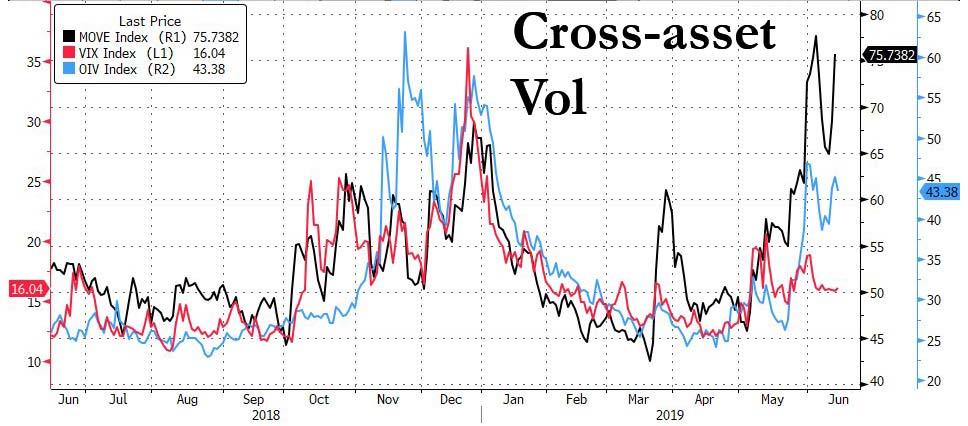
That will, however, change with a vengeance next week, when two of the year's most important events take place - the FOMC decision in which the Fed may signal (or outright effectuate) the start of a rate cut cycle, as well as the greatly anticipated G-20 meeting where Trump and Xi may (or may not) meet and resolve (or fail to do so) the escalating trade war between the two superpowers.
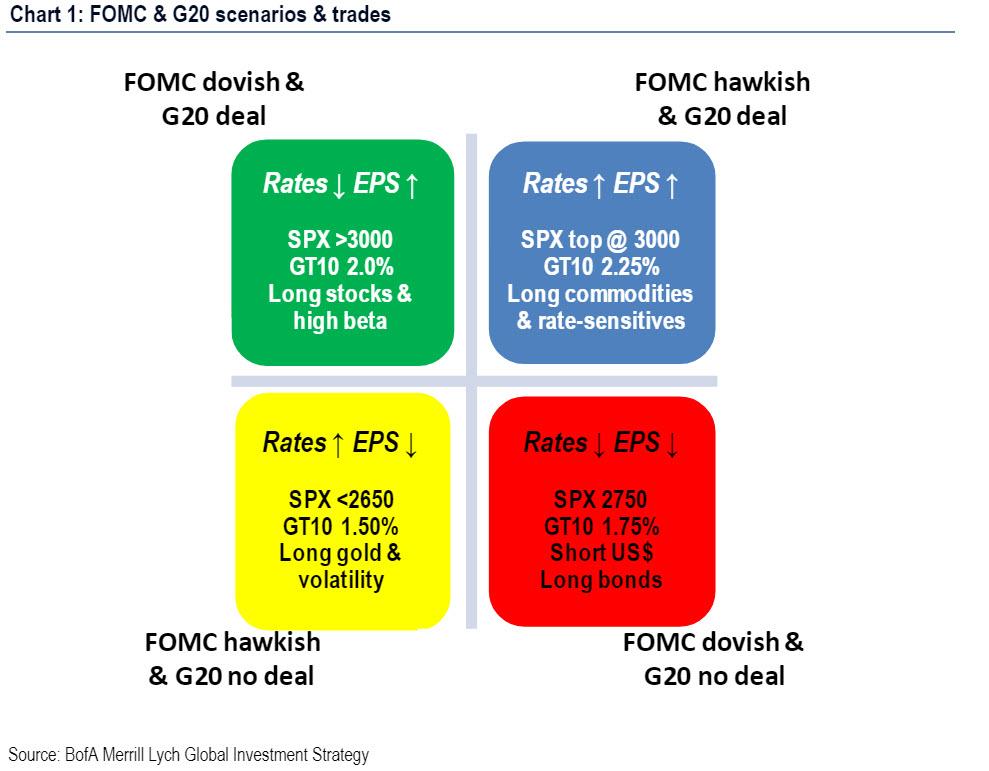
And since there are two events, both of which have binary outcomes, there is a total of 4 possible scenarios, which have been qualified and quantified by BofA's CIO Michael Hartnett. Of these 4, two are most remarkable: the best/best and the worst/worst cases. The first one sees a Dovish Fed statement, coupled with a G-20 deal, which according to BofA will send the S&P > 3000, and the 10Y yield to 2.00%, while the worst possible outcome would be if there is a 1) a hawkish Fed surprise and 2) no Deal at the G-20, which would send the S&P below 2,650, or potentially resulting in a 12% drop in the market, while sending 10Y yields to 1.50% and pushing gold above its 5 year breakout zone as the VIX surges.
This is summarized in the chart below.
In other words, and this should come as no surprise, the fate of the market next week is dependent on binary outcomes in the only two areas that matter i) policy and ii) trade wars. Hartnett frames the current tensions as follows:
- On policy: "markets stop panicking when policy makers start panicking"…past 10-years policy makers have driven rates lower & risk assets higher (in 2018 rates hiked & risk assets slumped)… we say credit & stocks higher until Big Top signaled by a. policy ammunition spent or bank policy impotence; Australia bond yields (all-time low) & stocks (all-time high) an example how rates can conquer all.
- On trade wars: US trade wars are a cyclical policy response to rising inequality and populist desires for redistribution (tariffs are Trump's favored policy tool for this economic objective); in addition, the US-China tech war is a long-run clash for global hegemony in tech & military supremacy and is unlikely to be resolved soon; G20 may or may not result in escalation of tariffs (see FOMC/G20 scenarios, outcome probabilities & trades below), but Huawei indicates there may be "no tech peace in our time"; we continue to believe investors need to discount investment consequences of both the War on Inequality, and shift from bullish disinflation via tech disruption to potential bearish stagnation via disruption of global tech.
Needless to say, with no quick resolution expected in trade war, and the Fed's decision in turn a function of trade war escalation, one can see why traders are perplex, if not paralyzed ahead of next week's "black box" decisions.
In addition to the pure "best" and "worst" case scenarios, discussed above, Hartnett envisions two more possible intermediate outcomes - i) a G-20 deal but no Dovish Fed, which would result in an S&P top at 3,000 (which the market will hit relative soon, then reverse and slide for the duration of the second half), with 10Y yields rising to 2.25% and upside to commodities, and ii) a dovish Fed, but no G-20 deal. This in turn would lead to a drop in the S&P to 2,750 and 10Y yields sliding to 1.75%, while also hammering the USD.
Below is the full breakdown from Hartnett on the four possible scenarios to result from next week's critical events:
Scenario 1: FOMC dovish & G20 deal
- Rates down, EPS up
- GT10 2%, SPX >3000
- Big trade: long stocks & high beta assets
- Likely outperformers: small cap (e.g. IWM), semiconductors (e.g. SMH), industrials (e.g. IYJ), EM bonds (e.g. EMB)
- Likely underperformer: staples (e.g. XLP)
Scenario 2: FOMC hawkish & G20 deal
- Rates up, EPS up
- GT10 2.25%, SPX top at 3000
- Big trade: long commodities & rate-sensitive assets
- Likely outperformers: banks (e.g. XLF), materials (e.g. IYM), EAFE (e.g. EFA)
- Likely underperformers: REITS (e.g. REET), utilities (e.g. XLU)
Scenario 3: FOMC dovish & G20 no deal
- Rates down, EPS down
- GT10 1.75%, SPX 2750
- Big trade: short US dollar, long bonds
- Likely outperformers: Treasuries (e.g. TLT), IG bonds (e.g. LQD), REITS (e.g. REET), utilities (XLU), China (e.g. FXI)
- Likely underperformers: US$, banks (e.g. XLF), materials (e.g. IYM), EAFE (e.g. EFA)
Scenario 4: FOMC hawkish & G20 no deal
- Rates up, EPS down
- GT10 to 1.5%, SPX <2650
- Big trade: long gold, long volatility
- Likely outperformers: T-bills, gold (e.g. GLD)
- Likely underperformers: IG bonds (e.g. LQD), US & EM tech (e.g. IYW, EMQQ), software (e.g. XSW).
Sent from Bloomberg Professional for Android
Sent from Bloomberg Professional for Android