Sent from Bloomberg Professional for Android
High-Speed Traders Back Exchanges in Fight With SEC Over Rebates Plan
Citadel, GTS and IMC say regulator’s initiative is ‘ill-conceived’ and would harm investors
Three big high-speed trading firms asked a federal court to halt a Securities and Exchange Commission initiative that would limit the rebates that U.S. stock exchanges pay to attract investors’ orders.
Citadel Securities LLC, GTS Securities LLC and the U.S. arm of Amsterdam-based IMC BV said in a joint court filing late on Thursday that the SEC’s plan, called the Transaction Fee Pilot, was an “ill-conceived” program that would harm investors.
“We know that the outcome of the Transaction Fee Pilot will be negative, even if we cannot predict the full scope of the harm that the SEC’s experiment will impose upon issuers, markets, and investors,” they said.
Like other electronic traders, the three firms collect rebates from exchanges, and the SEC’s pilot could have a big impact on their businesses.
The firms submitted the filing to support a legal challenge by the New York Stock Exchange, Nasdaq Inc. and Cboe Global Markets Inc. CBOE -0.55% The exchanges are suing the SEC to block the pilot, which is intended to help the regulator study the impact of lowering both the fees exchanges collect for trades and the rebates they pay brokers and traders for posting orders.
Such rebates are controversial. Critics say they harm investors by encouraging brokers to send orders to the exchange that pays the highest rebate, rather than the one that gives the investor the best result. Exchanges counter that rebates help markets function more smoothly by encouraging more trading activity.
The SEC has put the pilot on pause while the challenge is heard by the U.S. Court of Appeals for the District of Columbia Circuit.
If implemented, the pilot would run from one to two years, and it would subject more than 1,400 stocks to special rules reducing fees and rebates. For some stocks, rebates would be banned, allowing the SEC to analyze whether eliminating them benefits investors. Other stocks would remain untouched, serving as a baseline for the SEC’s analysis, much like a placebo group in a medical study.
The pilot has divided Wall Street. Supporters include asset managers that oversee trillions of dollars of investor funds, such as Fidelity Investments and Vanguard Group, who say it will expose whether rebates represent a conflict of interest for brokers.
NYSE, Nasdaq and Cboe are outspoken foes of the pilot, and in February they took the extraordinary step of suing their own regulator in a last-ditch effort to block it. In a joint filing last week, the exchanges blasted the pilot as “dangerous experimentation with the security market.”
Citadel Securities, GTS and IMC declined to comment beyond what was in the brief. NYSE, Nasdaq and Cboe declined to comment. An SEC spokeswoman declined to comment.
With Thursday’s filing, the exchanges have won support from three of their largest customers. Together, Citadel Securities, GTS and IMC account for more than 20% of daily U.S. stock-trading volume.
The three are also so-called designated market makers at NYSE. That lets them qualify for extra-large rebates from the exchange, in return for meeting certain obligations in quoting NYSE-listed stocks. NYSE is a unit of Atlanta-based Intercontinental Exchange Inc.
The exchanges and high-speed trading firms say the pilot would hurt investors by widening “bid-ask spreads”—the difference between the price at which a stock can be bought and the price at which it can be sold.
When such spreads widen, investors pay more to trade in and out of stocks.
Gapping down
In reaction to disappointing earnings/guidance:
- AVGO -9.2%, FNSR -0.4%
M&A news:
- ITI -6.9% (launches public offering of shares of common stock, acquires Albeck Gerken)
- VMW -0.4% (to acquire multi-cloud application delivery service company Avi Networks; not expected to have material impact on FY20 op results)
Semiconductor/technology stocks lower after Broadcom misses estimates and lowers guidance on broad-based slowdown in demand:
- QRVO -5.2%, STM -4.5%, ADI -3.6%, SWKS -3.3%, MRVL -3.1%, TXN -3%, MU -3%, XLNX -2.9%, SOXX -2.9%, SMH -2.6%, MXIM -2.5%, LITE -2.5%, NVDA -2.4%, AMD -2.4%, QCOM -2.3%, AMAT -2.3%, WDC -2.2%, LRCX -2%, INTC -1.9%, ON -1.8%, KLAC -1.8%, AAPL -1.1%, XLK -0.9%
Other news:
- MCRB -21.2% (prices offering at $2.25)
- WHF -4.8% (announces public offering by selling stockholders)
Analyst comments:
- ATRO -3.4% (SunTrust d/g to Sell)
Gapping up
In reaction to strong earnings/guidance:
- CMCM +0.5%
Other news:
- ARQL +48.3% (ARQ 531 data)
- BXG +20.8% (Bass Pro settlement)
- KURA +11.2% (Updated tipifarnib data)
- FVRR +6% (IPO extending today's move higher); UPWK +6% (FVRR sympathy)
- VRS +4.9% (ticking higher; explores strategic alternatives and approves adoption of stockholder rights plan),
- KPTI +4% (Selinexor data)
- LPX +2.2% (curtailed Peace Valley production; BMO upgrades)
- LLY +0.8% (positive arthritis data)
- ASH +0.3% (higher after Eminence Capital discloses 8.3% active),
Analyst comments:
- RRGB +4.1% (Maxim upgrades to Buy)
- FB +1.6% (RBC out positive)
Early Premarket Gappers
- Gapping Up: ARQL +35.93%, ETON +9.38%, VNCE +8.20%, JNUG +6.70%, FVRR +6.54%, VRS +5.03%, NUGT +4.91%, AU +3.88%, KL +2.92%, CRWD +2.87%, ASH +2.38%, FNV +2.34%, LPX +2.17%
- Gapping Down: MCRB -16.96%, AVGO -9.10%, SOXL -8.22%, ITI -6.86%, NIO -5.16%, APRN -4.89%, STM -4.53%, WHF -4.34%, SWKS -4.01%, XLNX -3.92%, WDC -3.86%, SGH -3.77%, QRVO -3.65%, BYND -3.64%, MU -3.54%, AMD -3.47%, AMAT -3.27%, FRO -3.25%, NVDA -3.21%, KZR -3.16%, QCOM -3.03%, LRCX -2.88%, ON -2.88%, TXN -2.68%, SMH -2.64%, MRVL -2.27%, INTC -2.14%, KRNT -1.99%, TSLA -1.83%
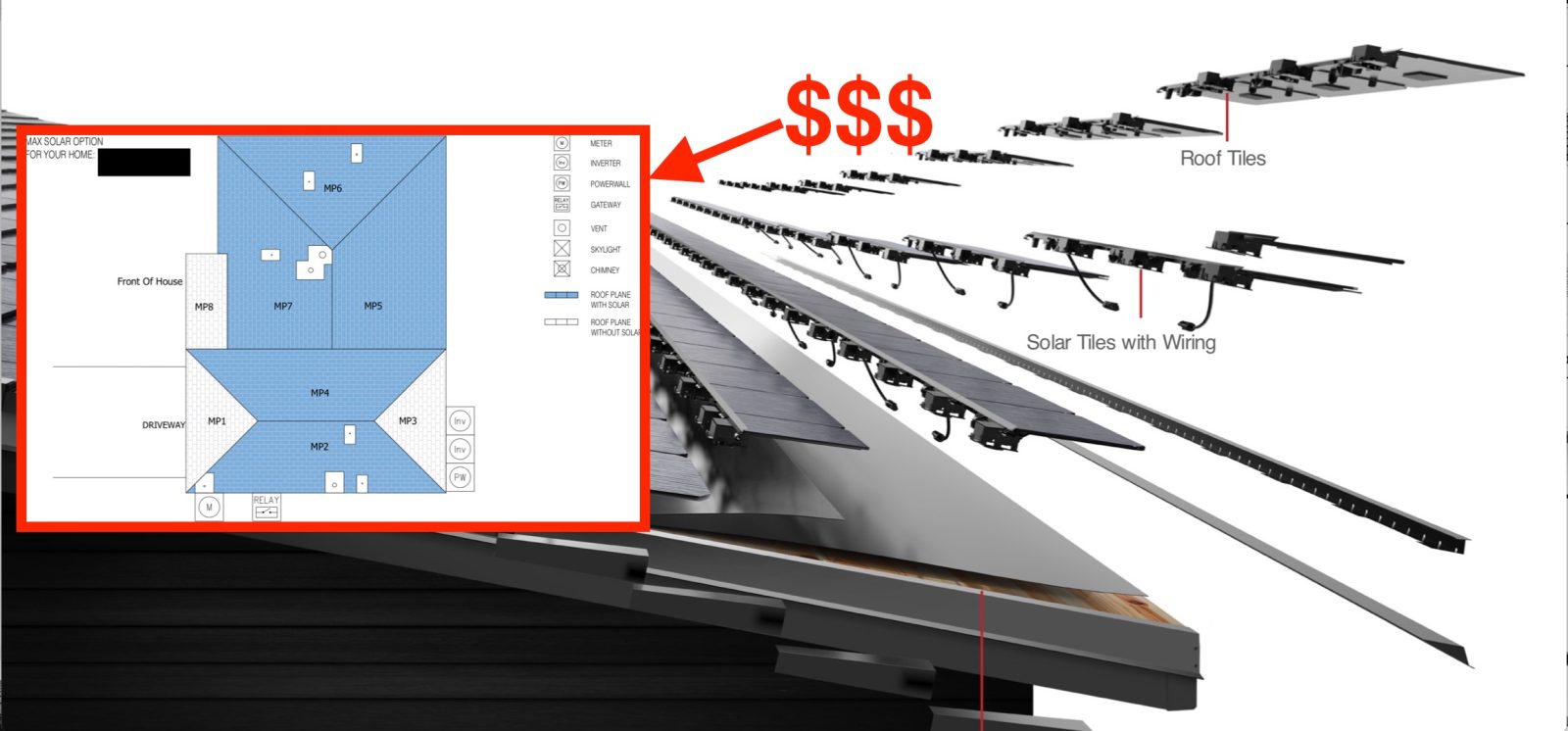
We got our hands on an actual Tesla Solar Roof quote sent to a potential customer and the price is shockingly high, but it could still make sense for some homeowners.
As we reported yesterday, Tesla is currently completing the third version of its Solar Roof, which they claim will bring the price down significantly.
In the meantime, solar roof deployment is limited and the price is quite expensive.
A reader sent Electrek an actual quote that Tesla submitted to him for his house in the Bay Area and it gives us our best look at the breakdown of the cost of a Tesla Solar Roof, all the accompanying hardware, and installation.
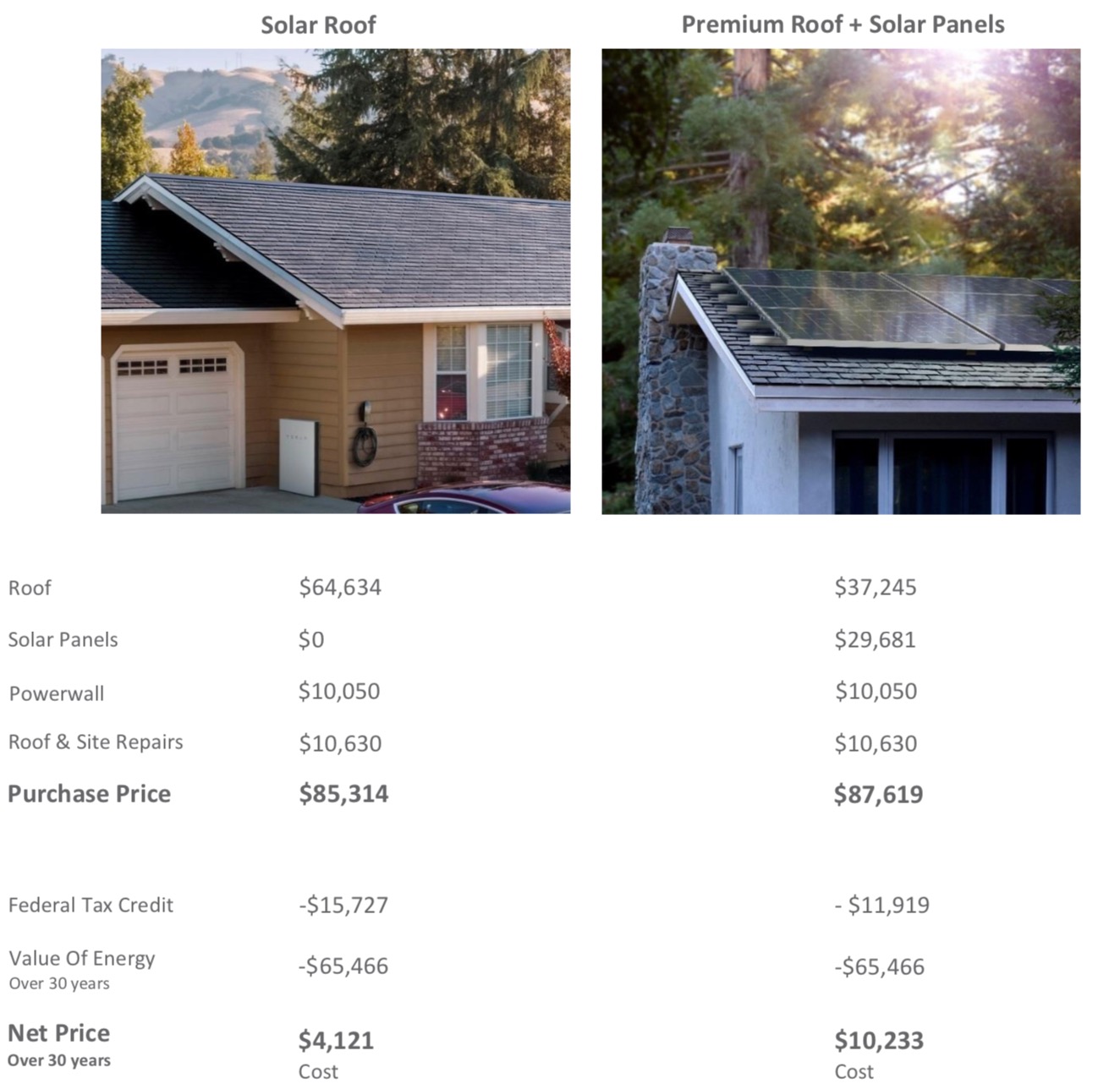
For a 9.45 kW system on a 1,862 square foot roof, Tesla is charging $64,634 for the solar roof, along with$10,050 for a Powerwall, and another $10,630 for roof and site repairs.
It adds up to a shocking total of $85,314 for the entire solar roof system and work.
The solar roof alone adds up to almost $35 per square foot, which is much higher than the $21.85 price Tesla first guided for the product.
However, the system quoted by Tesla for this particular customer featured a high number of roof tiles with solar cells:
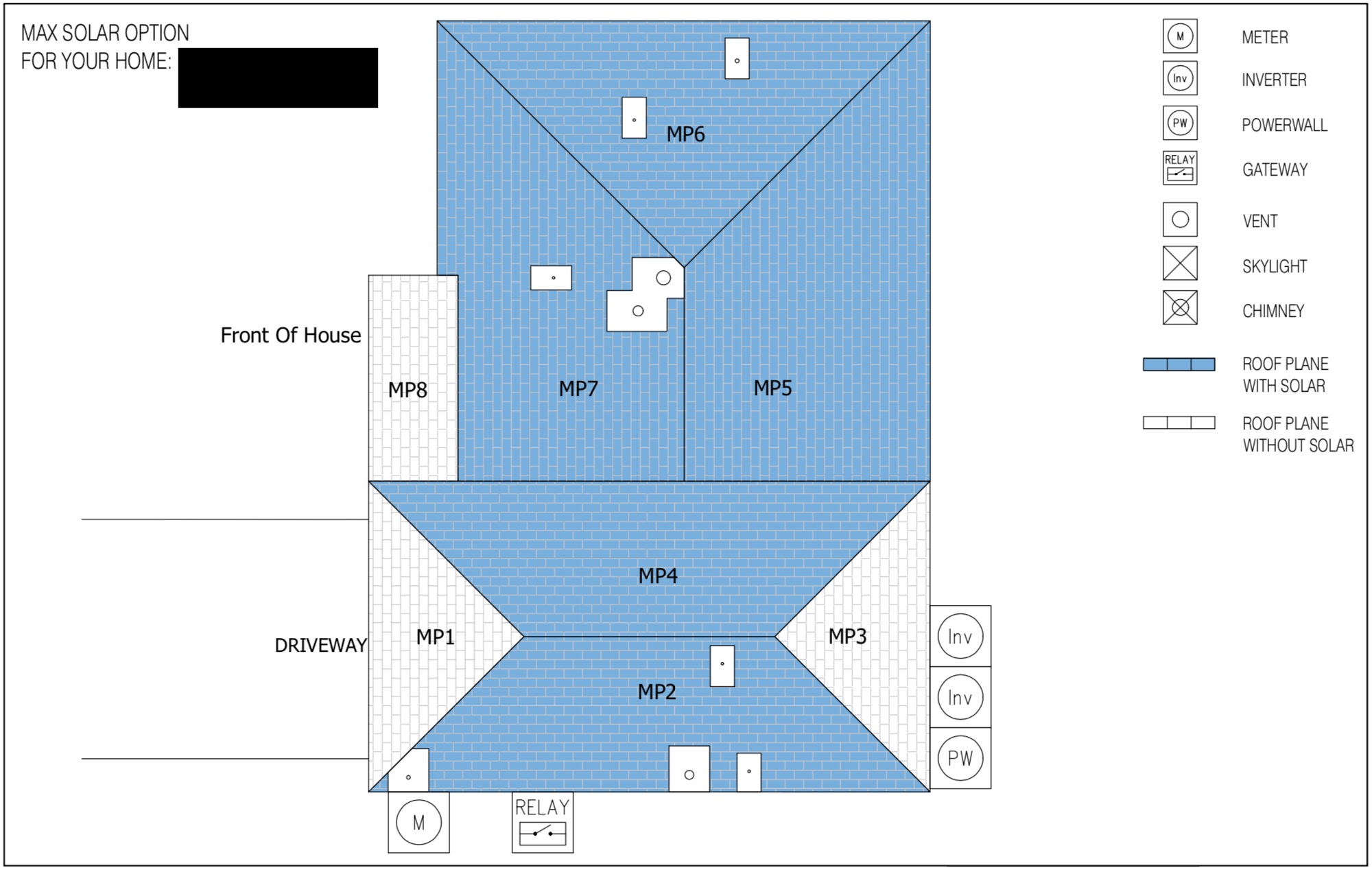
Tesla’s solar roof systems can also be designed with a higher mix of tiles without solar cells in them.
As you can see, the roof also features several vents disturbing the layouts of the tiles and since Tesla’s goal with the solar roof is to improve the aesthetic of installing rooftop solar systems, they came up with a solution.

At $85,000, the whole project is extremely expensive, but Tesla argues that it makes sense financially.
In the quote, the company notes that the homeowner would have access to a $15,727 federal tax credit and they predict the value of the energy over 30 years (the period under warranty for power generation) at $65,466.
Based on that, they consider the net price of the system over 30 years to be $4,121.
Tesla includes a cost comparison with a solar panel system of equivalent capacity on top of a new premium roof:
At Tesla’s 2019 shareholder’s meeting earlier this week, Musk said Tesla is working on longevity testing for the new version of its solar roof tiles and that they are now installing the solar product in 8 states.
The CEO also said that he believes the price of the Solar Roof V3 could end up equivalent to a shingle roof plus electric bill, which would be significantly less expensive than this.
Musk said that they are starting “early trials” of the new versions of the Tesla Solar Roof tiles:
Tesla Solar Toof Tile V3.0 starting early trials https://electrek.co/2019/06/13/tesla-solar-roof-tile-techonology-custom-fittings/ …


3,282 people are talking about this
Here’s a copy of the Tesla Solar Roof quote:
President Trump; affirms yesterday's Gulf of Oman attacks have Iran written all over it - Fox and Friends
- We will see what happens but will remain very tough on sanctions
- Iran will not be able to close the Straits of Hormuz; we won't allow it
Airbus prepares to steal march on Boeing with long-range aircraft
European group’s launch at Paris Air Show comes as worries on health of industry rise
Airbus is preparing to steal a march against rival Boeing with the launch of a new long-range aircraft that could pre-empt the US company’s plans for a similar plane.
The European aircraft maker has been courting potential airline customers about a longer-range version of its single-aisle A321 jet and could launch the model on its home territory at next week’s Paris Air Show — the industry’s showcase event where the world’s two biggest jet manufacturers like to trump each other in a public battle of orders.
Potential airline customers, including IAG, the owner of Aer Lingus and British Airways, have already expressed an interest.
The expected move by Airbus comes at an uncertain time for the industry, which has been buffeted by a number of headwinds, from the Max crisis to escalating trade tensions between the US and China and the spectre of Brexit, prompting some to ask whether a possible tailing off of the decade-old order boom for jets is in the offing.
The longer range jet, dubbed the A321XLR, could be flying from 2023-24 — a full two years before Boeing’s planned new mid-market plane, designed to bridge the gap between the US company’s biggest narrow body passenger jet and the 787 Dreamliner twin aisle.
Boeing has been considering the launch of the jet but its fate is unclear as the group grapples with the crisis surrounding its 737 Max. The planes remain grounded and there is still no timetable for when the model will return to the skies after two crashes in March and October, killing more than 300 people, because of problems associated with the aircraft’s software.
The XLR variant would have a higher maximum take-off weight and some 500 nautical miles more range than the A321LR, Airbus’ current longest-range single-aisle — allowing it to fly from the middle of the US, for example, to the centre of Europe. Airbus will launch the jet if it has signed up enough customers and use the variant to compete against any moves by Boeing in the hotly contested middle of the market.
Airbus and Boeing tend to hold back some big orders to make a splash at the show, which could be a test of how robust the industry is with speculation that both companies will announce some orders for their wide-body planes, their largest aircraft usually configured with multiple aisles.
Dennis Muilenburg, Boeing chief executive, will also face his first major public outing at the Paris show in the wake of the Max issue.
Speaking at an analyst conference at the end of May Mr Muilenburg stuck to his optimistic outlook for the industry over the longer-term, arguing that the old days of boom and bust were over.
“The fundamental nature of traffic has changed . . . it’s no longer a cyclical environment. It’s a much more steady growth kind of environment,” he said, adding that “it’s a long-term sustainable trend”.
If the long-term outlook remains strong then this year is looking less healthy. Orders for both aircraft manufacturers in the first five months were anaemic while cancellations have increased. Boeing on Tuesday said it delivered some 50 per cent fewer planes in May compared with a year earlier as deliveries of its best-selling 737 Max jet remained suspended following the second deadly crash in March.
IBA Group, the independent aviation consultancy, is also predicting a significant drop in orders, both firm and intended, based on memoranda of understandings, at the show from 996 in 2017 to just 440 at this year’s show.
Stuart Hatcher, IBA chief operating officer, said he thinks the airline industry is “gearing up for a downturn” following an “unprecedented number of aircraft returning from failed operators”. While he still expects traffic to grow, it will do so at “a more sedate level”.
The International Air Transport Association (Iata), the trade body that represents airlines, this month (June) lowered its profit forecast for the industry, citing rising fuel prices and weakening world trade. It said airlines are expected to earn $28bn this year, down from a previous forecast of $35.5bn in December.
Eric Bernardini, global leader of the aerospace, defence and airlines practice at consultancy AlixPartners, said the Max crisis has “shone a spotlight on an industry performing well, but one with inherent tough issues”.
“Despite strong performances across the board of late, with increased budgets and passenger numbers, industry participants could be in for a rough ride in the coming years,” he said. He cites diminished consumer trust as a result of safety concerns, the sustainability of supply chains, rising input costs, and an increasing focus on the environment by outsiders, as key challenges.
“All this is set against a backdrop of further global economic slowdown, meaning the year ahead will be a challenging one,” he added.
Richard Aboulafia, analyst at the Teal Group, cautions against panicking.
“The twin aisle market peaked in 2015 and has been on a plateau since. Single aisles are more traffic-growth dependent but let’s not panic. The only thing that would make me panic would be a comprehensive meltdown on the China trade front.”
Both Boeing and Airbus remain insulated from any short-term market dips given their substantial order backlogs, which together amount to more than 13,000 aircraft — or about seven years of production.
Peter Barrett, chief executive of aircraft leasing group SMBC Aviation Capital and a Boeing Max customer, said his company’s “mantra at the moment” to the manufacturers is “focus on delivering what you’ve promised and on time”.
Away from the orders battle, one of the more prominent themes of this year’s Paris show will be electrification as the industry strives to meet stringent emission targets. All of the incumbents, as well as several start-ups, are preparing to showcase electric prototypes.
There could also be more news over whether Spain will formally join the Franco-German project to build a future European combat aircraft. Germany and France in February signed a joint concept study linked to a Future Combat Air System (FCAS) programme, which is a rival to Britain’s own future fighter programme, dubbed Tempest. A Spanish decision to join the Franco German project could dash hopes of broader collaboration between European nations that would include Britain.