>>> Barron’s weekend summary: positive features on FDX, TGT, and select banks

Barron’s weekend summary: positive features on FDX, TGT, and select banks

* Cover story: Investing in Softbank Group “offers a radically discounted bet on the future,” with cheap shares that are arguably priced 30-50% below the value of their underlying assets; Understanding the company and the vision of its leader, Masayoshi Son, takes effort, but could lead to a big payoff for investors.

* Features: 1) Positive on FDX: Investors have sent shares down over concerns about AMZN’s move into logistics, but as e-commerce volume grows, capital spending declines, and better execution results in higher profits, shares could rally to $220, which with a dividend yield of 1.6% could deliver a 33% total return; 2) Positive on TGT: Retailer has managed to withstand pressure from AMZN and the growth of online shopping, while benefiting from the closure of rivals’ stores—and with improved Web operations and low prices, the stock has yet to reach its potential highs; 3) Story looks at what people need to look out for when buying annuities—income generating annuities can be effective tools for those concerned about outliving their money, but investors need to be cautious and inquisitive; 4) Barron’s annual list of the top 100 annuities now includes categories that represent more products and better reflect investors’ buying habits, as well as variable and fixed-index annuities with the highest potential average income based on probability analyses; 5) Positive on KEY, SBNY, USB: Many banks are sensitive to falling interest rates, but investors expect these three to be better positioned for a Federal Reserve interest rate cut, thanks in part to a lower percentage of variable-rate loans versus some peers.

* Tech Trader: Cautious on NFLX: The streaming giant’s strengths—including scale, value, and a vast library—may not be enough to make up for shortfalls in show quality, and its aura of invincibility may be wearing off after its recent report of lower-than-expected subscriber growth.

* Trader: One hundred and thirty three companies in the S&P 500 are set to report earnings this week, but “the lack of broader market action might end up just being the calm before the storm”; Look for that second-quarter consumer strength to boost earnings at the likes V, CMG, AAL, and AMZN when they report this coming week—the contrast between the economy’s consumer and industrial segments remains stark; Fintech companies continue to outpace traditional banks, which have underperformed the broad market over the past year, but the shares may be overpriced, and the best way to play the sector remains V, MA, and PYPL. Profile: Michael Cirami and Eric Stein, co-directors of Eaton Vance, believe that staying out of troubled assets is critical to boosting returns and reducing volatility (top 10 countries for debt holdings in the Eaton Vance Emerging Markets Debt Opportunities fund: Egypt, Nigeria, Ukraine, Serbia, Peru, Bahrain, Sri Lanka, Argentina, Indonesia, Thailand).

* Interview: Ziad Bakri—who manages $16.3B across T. Rowe Price’s health-sciences strategy, including the $13.2B Health Sciences fund—talks about picking biotech stocks and the Medicare for All debate (picks: SAGE, BDX, TMO, Roche Holding, UNH, ANTM, CI, NVCR).

* Follow-Up: In a cover story last September, Barron’s argued that gold looked appealing, as did depressed gold stocks; the metal tends to do well when inflation-adjusted interest rates are low, which is the case now.

* European Trader: Germany, an export-oriented economy, has been hit hard by turmoil in global trade, and if a current slump continues, the government of chancellor Angela Merkel may have to temper its longstanding aversion to deficits and debt.

* Emerging Markets: Mexico’s economic outlook is going from bad to worse eight months into President Obrador’s administration, with the resignation of respected finance minister Carlos Urzua and major problems at state oil company Pemex—though the country’s assets are priced for risk.

* Commodities: “Natural gas finally has broken out of the tight trading range it’s been stuck in for the past six months, though it’s done it the hard way, by falling to a more than three-year low. However, there could be good news in the bad news.”

* Streetwise: Online ordering, delivery, and a new loyalty program have given CMG more ways to serve and learn about its customers, but those are effectively table stakes in today’s restaurant business, and the company hopes to rollout more key initiatives as part of its comeback.

>>> Weekend Papers Summary

Weekend Papers Summary

* NYT (Saturday): Iran’s seizure of at least one British oil tanker in the Strait Hormuz marks a sharp escalation of tensions with the West and raises fears of a military clash, even as both sides seek room for negotiations; Donald Trump’s advantage in the Electoral College, relative to the national popular vote, may be even larger than it was in 2016, according to a New York Times analysis of election results and polling data; In a surprising split among Iranian hard-liners, some—including former president Mahmoud Ahmadinejad, long an anti-American—now say it’s time to sit down and resolve 40 years of animosity with the U.S. by talking directly to Trump; Demonstrating the limited influence of allies or advisers trying to steer him away from pre-election racial and cultural fights, Trump walked back his disavowal of a racially loaded chant at a campaign rally less than 24 hours after making it; Conventional wisdom in Hollywood has long held that big, lumbering “tentpole” movies require protracted promotional campaigns, often starting more than a year before release, but in today’s on-demand economy, shorter campaigns are the new normal; James Bullard, president of the Federal Reserve Bank of St. Louis, said he would be glad to lead the central bank if given the chance, which could be a possibility if Trump is re-elected and decides to replace chairman Jerome Powell; (Sunday): Front page story suggests that a new “red scare” is taking shape in Washington amid growing skepticism and mistrust of China, one sign of which is the revival of long-defunct groups such as the Committee on the Present Danger, which campaigned against the Soviet Union in the 1970s and 1980s; British Airways and Lufthansa abruptly canceled all flights to Cairo on Saturday for security reasons, a day after the British government warned of a heightened risk of terrorist attacks against planes over Egypt; President Aleksandr Lukashenko of Belarus, in power since 1994, is increasingly looking to China for money and inspiration, but many in the country are protesting the construction of a China-funded lead-acid battery factory that may spew deadly toxins; Sunday Business: There are an estimated 25M safe deposit boxes in the U.S., but there are no federal laws governing them and no rules requiring banks to compensate customers if their property is stolen or destroyed; Sunday Review: Editorial says the gap between the poor and the wealthy in Illinois is one of the largest in any state, but the poor pay taxes at higher rates in 45 of the 50 states, according to the Institute on Taxation and Economic Policy.

* WSJ (Weekend): “Federal Reserve officials signaled they are ready to lower interest rates by a quarter-percentage point later this month, while indicating the potential for additional reductions, despite the recent surge in market expectations of a half-point cut”; To see how much coverage each Democratic presidential candidate is getting, UK-based media-monitoring firm Signal A.I. has been tracking 10,000 print media, 1,500 broadcast outlets and more than 2.6M online sources world-wide since January; Many of the nation’s largest drug manufacturers and distributors failed to implement even the most basic systems to halt suspicious drug orders as the opioid epidemic came into sharp focus, according to plaintiffs lawyers; The White House and House Speaker Nancy Pelosi continued talks over how to pay for a two-year agreement to raise overall spending limits and at the same time raise the U.S. government’s borrowing limit; A federal judge ruled that the Trump administration can proceed with its expansion of certain health plans that don’t comply with the Affordable Care Act; Trump administration aid cuts to Honduras, Guatemala and El Salvador aren’t slowing migration because the billions of dollars in remittances that migrants in the U.S. send back home dwarf any official assistance they receive from their countries or origin; The Republican tax overhaul passed in 2017 lowered the cost of being married for many couples, but being married is often more expensive than being two single filers come tax time—and that has prompted many couples to avoid legally tying the knot; The Baltic Dry Index, a closely watched index that tracks the cost of shipping commodities around the world, is at its highest level since 2014, but some analysts say that shouldn’t necessarily be taken as a bullish sign for the global economy; H.O.T.S.: A surge in online drug sales could pose a threat to CVS, WBA, and WMT; MSFT’s strong results and forecast help justify its trillion-dollar value; The oil market’s mild reaction to a series of incidents this week involving Iran should please the White House, but there are other reasons to be concerned.

* FT (Weekend): Israel-based spyware company NSO told buyers that its technology can surreptitiously access all of an individual’s data from the servers of companies such as AAPL, GOOGL, FB, AMZN, and MSFT, a situation observers fear repressive regimes could take advantage of; Big Read piece says “Hundreds of companies and labs are trying to use neurotechnology to connect human thought to computers,” but TSLA chief Elon Musk’s Neuralink is one of the few that also wants to merge the brain with artificial intelligence; Lex Column: In a year during which high-profile initial public offerings have stumbled, WeWork faces an uphill struggle to convince skeptics; National Australia Bank’s new leader, Ross McEwan, needs to increase trust just as he previously did at RBS; What MSFT lacks in fashionable services it makes up for with scale; Comment: Now that new leaders for the European Union have been chosen, says Carl Bildt, Brussels needs to prevent the bloc from further sliding into irrelevance as a disruptive U.S., assertive China, and revanchist Russia dominate the global stage.

* NY POST (Saturday): “Markets swung in and out of the green Friday as traders digested a slew of comments from Fed officials over the last few days that diminished hopes of a half-point rate cut”; (Sunday): +/- DIS: Story says Disneyland executives use the park’s wearable “MagicBands” and smartphone apps to spy on guests and collect data on buying habits, what rides their kids like, and who their favorite characters are.

(ZH) A Bank With $49 Trillion In Derivatives Exposure Is Melting Down Before Our

A Bank With $49 Trillion In Derivatives Exposure Is Melting Down Before Our Eyes
Could it be possible that we are on the verge of the next “Lehman Brothers moment”?

Deutsche Bank is the most important bank in all of Europe, it has 49 trillion dollars in exposure to derivatives, and most of the largest “too big to fail banks” in the United States have very deep financial connections to the bank. In other words, the global financial system simply cannot afford for Deutsche Bank to fail, and right now it is literally melting down right in front of our eyes. For years I have been warning that this day would come, and even though it has been hit by scandal after scandal, somehow Deutsche Bank was able to survive until now. But after what we have witnessed in recent days, many now believe that the end is near for Deutsche Bank. On July 7th, they really shook up investors all over the globe when they laid off 18,000 employees and announced that they would be completely exiting their global equities trading business

It takes a lot to rattle Wall Street.
But Deutsche Bank managed to. The beleaguered German giant announced on July 7 that it is laying off 18,000 employees—roughly one-fifth of its global workforce—and pursuing a vast restructuring plan that most notably includes shutting down its global equities trading business.
Though Deutsche’s Bloody Sunday seemed to come out of the blue, it’s actually the culmination of a years-long—some would say decades-long—descent into unprofitability and scandal for the bank, which in the early 1990s set out to make itself into a universal banking powerhouse to rival the behemoths of Wall Street.
These moves may delay Deutsche Bank’s inexorable march into oblivion, but not by much.
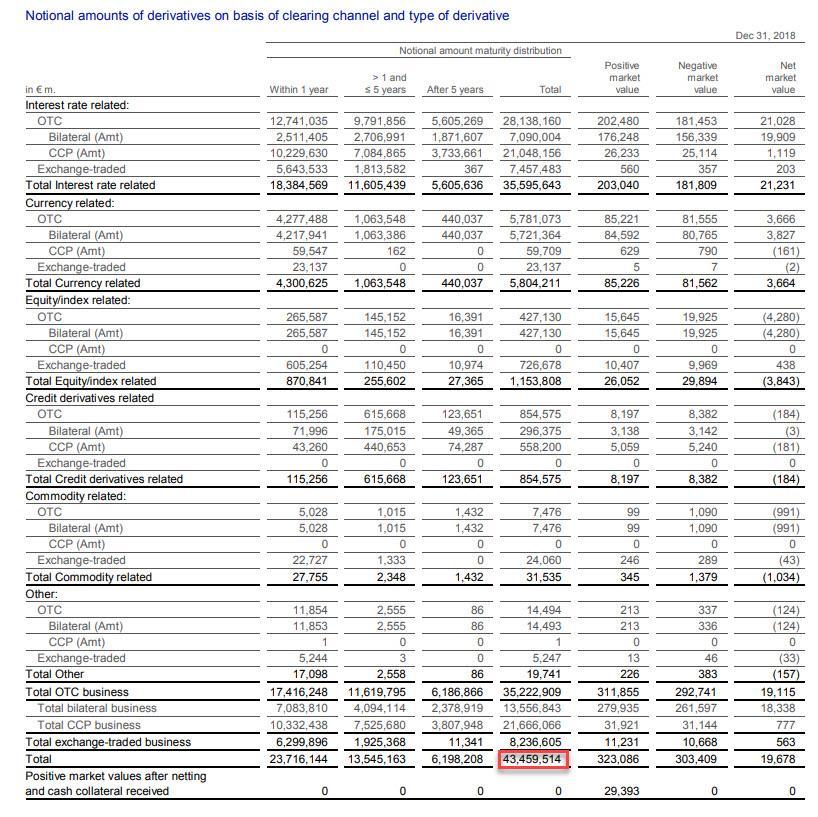
And as Deutsche Bank collapses, it could take a whole lot of others down with it at the same time. According to Wall Street On Parade, the bank had 49 trillion dollars in exposure to derivatives as of the end of last year…
During 2018, the serially troubled Deutsche Bank – which still has a vast derivatives footprint in the U.S. as counterparty to some of the largest banks on Wall Street – trimmed its exposure to derivatives from a notional €48.266 trillion to a notional €43.459 trillion (49 trillion U.S. dollars) according to its 2018 annual report. A derivatives book of $49 trillion notional puts Deutsche Bank in the same league as the bank holding companies of U.S. juggernauts JPMorgan Chase, Citigroup and Goldman Sachs, which logged in at $48 trillion, $47 trillion and $42 trillion, respectively, at the end of December 2018 according to the Office of the Comptroller of the Currency (OCC). (See Table 2 in the Appendix at this link.)
Yes, the actual credit risk to Deutsche Bank is much, much lower than the notional value of its derivatives contracts, but we are still talking about an obscene amount of exposure.
And this is especially true when we consider the state of Deutsche Bank’s balance sheet. According to Nasdaq.com, as of the end of last year the bank had total assets of 1.541 trillion dollars and total liabilities of 1.469 trillion dollars.
In other words, there wasn’t much equity there at the end of December, and things have deteriorated rapidly since that time. In fact, it is being reported that a billion dollars a day is being pulled out of the bank at this point.
I know that most Americans don’t really care if Deutsche Bank lives or dies, but as the New York Post has pointed out, the failure of Deutsche Bank could quickly become a major crisis for the entire global financial system…
But the important fact to remember is that Deutsche Bank traded these derivatives with other financial firms. So, is this going to be another Lehman Brothers situation whereby one bank’s problems becomes other banks’ problems?
Pay close attention to this.
If the situation gets out of hand, the Federal Reserve and other central banks will have no choice but to cut interest rates even if it’s not the best thing for the world economies.
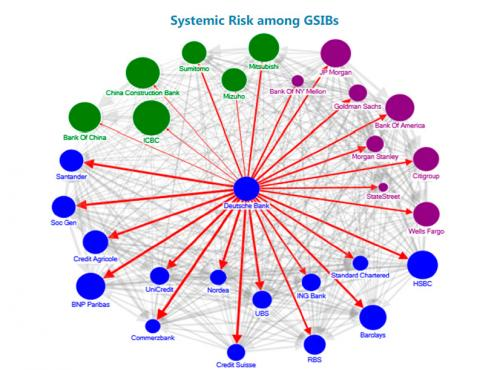
In particular, some of the largest “too big to fail banks” in the United States are “heavily interconnected financially” to Deutsche Bank. The following comes from Wall Street On Parade
We know that Deutsche Bank’s derivative tentacles extend into most of the major Wall Street banks. According to a 2016 reportfrom the International Monetary Fund (IMF), Deutsche Bank is heavily interconnected financially to JPMorgan Chase, Citigroup, Goldman Sachs, Morgan Stanley and Bank of America as well as other mega banks in Europe. The IMF concluded that Deutsche Bank posed a greater threat to global financial stability than any other bank as a result of these interconnections – and that was when its market capitalization was tens of billions of dollars larger than it is today.
Until these mega banks are broken up, until the Fed is replaced by a competent and serious regulator of bank holding companies, and until derivatives are restricted to those that trade on a transparent exchange, the next epic financial crash is just one counterparty blowup away.
As long as I have been doing this, I have been warning my readers to watch the global derivatives market. It played a starring role during the last financial crisis, and it will play a starring role in the next one too.
The fundamental structural problems that were exposed during 2008 and 2009 were never fixed. In fact, many would argue that the global financial system is even more vulnerable today than it was back during that time.
And now it appears that the next “Lehman Brothers moment” may be playing out right in front of our eyes.
Now more than ever, keep a close eye on Deutsche Bank, because it appears that they could be the first really big domino to fall.

FT : The FCA and its labyrinthine rulebook need a serious shake-up Slow, ineffic

The FCA and its labyrinthine rulebook need a serious shake-up
Slow, inefficient and high-handed are all epithets flung at the UK financial watchdog

Here’s a small vignette from the latest report of the financial services complaints commissioner that says a lot about the prevailing culture at the UK’s main regulator, the Financial Conduct Authority.

In 2016, an investor purchased bonds from Horseshoe Credit Union, a non-profit-making lending co-operative. She wasn’t naive; she first did her homework, checking the FCA’s register to make sure it was regulated, and also with the Financial Services Compensation Scheme to check there was no evidence of default. All seemed in order, so she invested.

Unfortunately, it turned out that the credit union had been dissolved four years previously and its identity cloned by fraudsters. The FCA had simply failed to update its register, despite long awareness of the closure. The investor lost £45,000. Her offer of compensation from the watchdog? A paltry £150.

Or take a more recent case involving London Capital & Finance, an investment firm that collapsed in January, taking with it £236m of investors’ funds. An independent financial adviser, Neil Liversedge, warned off clients after being alerted to the existence of its “mini-bond” scheme, claiming that “it raised more red flags than the Soviet Union”.

He wrote to the FCA in November 2015 warning that this was not a suitable investment for the retail market. At the time, LCF’s website marketing had taken in less than £10m. He received no reply.

Slow, inefficient, high-handed, and lacking a grip on its own rules. These are not welcome epithets for any regulatory organisation. Yet they have all been flung at the FCA in the past week.

Much attention has been focused on the tutting about the tortuous way in which complaints are handled. In the words of the commissioner, “complainants, many of whom are anxious/and or angry and/or vulnerable, have found that the [FCA] has exacerbated their difficulties”. But we’ll get to that later.

First, it’s worth reflecting on the admission of the FCA’s chairman, Charles Randell that it was “almost impossible to explain” the FCA’s regulatory perimeter (ie the boundary where its regulatory writ kicks in). Now clearly it is not ideal if you don’t know exactly when your edicts might apply and to which firms or products — especially when this confusion can have a critical impact on the wealth of members of the public.

It’s particularly bad news if that weakness has been spotted by scammers, whose dubious financial schemes now dot the internet. But that’s just one of many problems with the agency’s rules.

The FCA exists to police a series of clear general principles, such as the obligation to treat customers fairly and conducting business with integrity. But beneath this are reams of detailed regulation, setting out processes and prescriptive rules. It runs to about 10,000 pages and is yours for £3,641.

The regulations are so complex that they sometimes bamboozle the regulators themselves. Take a lawsuit last year, when the FCA was criticised in the High Court for not understanding its own rules concerning pensions after the watchdog changed its mind on some critical evidence mid-case.

The rules often conflict with — and eclipse — the general principles. When fund manager Neil Woodford cleverly worked round regulations designed to stop him piling illiquid investments into a fund offering daily liquidity, he was surely not being transparent with investors. It’s not good enough to bleat, as FCA boss Andrew Bailey did, that Mr Woodford was “following the letter but not the spirit of the rules”.

Capping all this is the question of recourse — or rather the lack of it. Not only are investigations slow (think of the aeons taken on the HBOS and RBS Global Restructuring Group cases), but the FCA often in effect marks its own homework. Take its probe into Lendy, a peer-to-peer lender that collapsed in May leaving investors with big questions about the assiduousness of the FCA’s own oversight.

Lord Myners, the former City minister, has called for an independent review of Lendy on the grounds that it might not only have more credibility but could report far more quickly. That speaks volumes, and not in a good way.

The answer is not ever more mind-bendingly detailed rules, but greater focus on principles and more vigorous use of the checks and balances the system already provides. Directors of dubious schemes should face the most ferocious sanctions following findings of malpractice, as should auditors who sign off on their duff accounts. Meanwhile, recourse should be far quicker, whether in investigating regulated firms and people or responding to customer complaints.

Mr Bailey might usefully ponder the fate of Britain’s accounting watchdog, the Financial Reporting Council, which was recently scrapped for failing to live up to its duty to investors. To avoid spiralling towards that plug hole, the FCA needs a new approach.

WSJ : The Money’s More Than Free. Why Won’t Europeans Borrow? Which explanation

The Money’s More Than Free. Why Won’t Europeans Borrow?
Which explanation you prefer determines whether you think the European Central Bank is right to be considering another cut

When it comes to interest rates, the U.S. and Europe are upside down.

A big worry about the expected interest-rate cut in the U.S. is that it will encourage too much borrowing, inflating bubbles in debt and equity markets. A big worry about the expected interest-rate cut in Europe is that it will discourage borrowing, with many companies, households and governments paying down debt even with negative central-bank rates.


Of course, the two regions face plenty of shared troubles: inflation is stubbornly low, pay rises are surprisingly low given how low unemployment is, and populist politicians are harder to predict.

But the behavior of American capitalists is at least easy to understand. When rates are cut by enough, speculators borrow to buy riskier assets; companies borrow to buy each other and their own stock; and, to some extent, entrepreneurs borrow to expand their businesses.

Those looking enviously across the Atlantic at negative interest rates in the eurozone may be surprised by the lack of a debt-driven boom. There are dozens of companies with old bonds now trading at negative yields, some maturing as far out as 2023. Yet only a handful of companies have issued euro-denominated bonds with a negative yield (done by paying no coupon and selling them for more than they repay at maturity).

European companies stubbornly refuse to borrow. Since the European Central Bank brought in negative rates in June 2014, nonfinancial corporate debt to GDP in the eurozone is up by just 0.5 percentage point, to 105%, according to the Bank for International Settlements, and it is still far lower than in 2015.

Why won’t Europeans borrow? Which explanation you prefer determines whether you think the European Central Bank is right to be considering another cut.

My favorite is that it is cultural. Frugal northern Europeans don’t want to borrow no matter the interest rate, while free-spending southerners don’t have access to cheap money due to their troubled banking systems and relatively high government-bond yields.


Those in between, such as French, Belgian and Dutch companies, are increasing their debts, but only just offsetting the deleveraging in places such as Spain, Italy and Portugal. Three of the companies that have issued negative-yielding euro bonds— Sanofi , Thales and LVMH —are French, in the rare position of being both willing and able to take advantage of the ECB’s low rates. Further rate cuts will do little in the north or south, but push the middle to borrow even more.

But there is clearly an effect from other explanations, too. Aging German savers seem to save even more when interest rates are cut to reach their target retirement pot. The weak European economy doesn’t present many opportunities to make money, so there is little reason to borrow to build a new factory.

The recent slowdown in Europe’s economy is in large part due to the impact of the U.S. trade battle with China and White House threats of tariffs on European cars, to which the export powerhouse of Germany is particularly exposed. German manufacturers are unlikely to want to borrow more given the risks to their sales, no matter the interest rate.

In Europe, as elsewhere, shareholders punish companies with high capital spending by giving them a lower valuation, as Citigroup chief global equity strategist Robert Buckland points out. But there are few shareholder activists in Europe pushing for more debt to be used to buy back stock, unlike in the U.S.

Worse, European companies rely more than those in the U.S. on banks, and negative rates amount to a tax on the banking system, which is still in poor health.


Negative rates do help by supporting existing borrowers, including governments, important when many European countries are still struggling with heavy debt loads.

And it is plausible that negative rates have worked, after a fashion. Eurozone investment since rates went negative in June 2014 has been slightly ahead of the U.S., as measured by gross fixed capital formation, which takes no account of depreciation. Roughly the same number of jobs have been created in both economies since then, too.

Still, further negative rates are unlikely to do much to encourage the frugal north to borrow, and will only apply a minor salve to the troubles of the south. The debt boom in the middle is already starting to look a bit excessive. European governments really need to stop relying on the central bank to solve their problems. Unfortunately, they can’t agree to do anything else.

WSJ : Tech Rally Powers Record Gains for Stocks Investors crowd into assets that

Tech Rally Powers Record Gains for Stocks
Investors crowd into assets that offer the prospect of significant returns as economic growth softens


The biggest technology companies are propelling major U.S. indexes’ record run, highlighting investor enthusiasm for the hottest stock sector as economic growth softens.

Together, Microsoft Corp. MSFT 0.15% , Apple Inc., Amazon.com Inc. AMZN -0.68% and Facebook Inc. have accounted for 19% of the S&P 500’s total return this year, according to S&P Dow Jones Indices data through Thursday. That rate is roughly in line with the contributions made by the biggest tech stocks in 2017 and much of last year, before a fourth-quarter reversal helped roil markets.

Giant asset managers including Vanguard Group, State Street Corp. and T. Rowe Price Associates Inc. TROW -1.06% generally increased their stakes in these firms as well as Alphabet Inc. GOOG -1.42% and Netflix Inc. in the first quarter of the year, FactSet data show.

The concentrated gains contrast with much of the market. Seven of the S&P 500’s 11 sectors remain solidly below records, and shares of small companies that stand to benefit if the Federal Reserve cuts interest rates are well below their recent peaks.

The divergence shows investors are putting a premium on assets that offer the prospect of significant growth, which is perceived as scarce with falling rates and lukewarm economic data. Investors in the coming days will weigh second-quarter results from Amazon, Alphabet and Facebook, while Apple is set to report July 30.

“Many people just want them whether interest rates are rising, declining or staying where they are,” said Jamie Cox, managing partner at Harris Financial Group, which owns shares of Microsoft and Amazon and has been increasing its position in Microsoft recently.


Fears that trade tensions will slow global growth have kept many investors cautious, pushing them toward the FAANG stocks—Facebook, Amazon, Apple, Netflix and Google parent Alphabet—as well as Microsoft. Many view these firms as less dependent on economic activity and attractive because they tend to participate in hot areas for investment such as cloud computing and artificial intelligence.

“If you don’t own a core holding in some of the leaders, you might be missing out,” said Mona Mahajan, U.S. investment strategist at Allianz Global Investors. “Those few names are probably benefiting disproportionately because they have real growth stories behind them.”

At the same time, some investors are keeping an eye on signs the rally might be vulnerable.

Netflix, among the most popular shares in recent years, tumbled more than 10% Thursday after subscriber data in its latest quarter disappointed Wall Street. Fund managers surveyed by Bank of America Merrill Lynch earlier this month ranked U.S. tech stocks the second-most-crowded trade across markets, trailing only U.S. Treasurys. Crowded trades are ones viewed as so likely to pay off that bad news often results in large losses.

“The ones we tend to be a little more leery about are the ones that are growing just because of momentum,” said Omar Aguilar, chief investment officer for equities and multiasset strategies at Charles Schwab Investment Management.

The FAANG group and Microsoft are in the top 10% of most crowded S&P 500 stocks, according to an analysis by Ann Larson, managing director of global quantitative research at AllianceBernstein.

Her firm uses a model to assess popular trades that factors in top holdings by active managers, stakes they have been building in the past several quarters, earnings estimates, stock performance and bank analyst ratings. The analysis also shows that technology is currently the most crowded sector.

The biggest tech firms aren’t the only ones benefiting. Semiconductor stocks have recovered from a dismal May and climbed in five consecutive weeks even as companies warn that tariffs are hurting their businesses. Shares of smaller social-media companies are rallying in lockstep, with Twitter Inc. up 28% in 2019 and Snap Inc., the parent company of Snapchat, more than doubling this year.

FT : US retailers quicken exit from malls as online shopping bites Sears, Victor

US retailers quicken exit from malls as online shopping bites
Sears, Victoria’s Secret and Charlotte Russe among household names closing outlets

Retailers vacated US shopping centres at the fastest pace in at least nine years in the second quarter as the relentless rise of online shopping and collapse of debt-laden chains begin to hit the commercial property market.

More than 7,400 store closures have been announced this year, with Sears, Victoria’s Secret and Charlotte Russe among a raft of household names to shut outlets in malls across the country.

Robust consumer spending has supported better-performing chains, while landlords have found alternative uses for some vacant shopping centre sites, from storage spaces to hotels. Record low construction of new retail space has also helped so-called net absorption in malls, a measure of the difference between space that becomes available and is occupied, to rise in 16 of the past 22 quarters.

However, in a sign the market could be starting to turn, net absorption dropped in the three months to the end of June by the most on property broker CBRE’s records going back to 2010.

The red flag from the property market comes as investors worry anew about the outlook for some of the country’s biggest bricks and mortar retailers.

Concerns over mall stalwart JC Penney’s near-$4bn debt burden sent its shares down 17 per cent on Friday. The 117-year-old department store chain said it was taking external advice on how to strengthen its balance sheet but added it had not hired advisers to “prepare for an in-court restructuring or bankruptcy”.

Within the past two weeks discount retailer Fred’s has warned it plans to close 129 outlets while fashion chain Charming Charlie filed for Chapter 11 bankruptcy protection.

“We’ve been the busiest we’ve ever been in our history,” said Scott Carpenter, head of retail liquidation at Great American Group.

Despite the wave of closures, overall vacancy rates in US retail remain low. Figures due to be published this week by CBRE show only 5.3 per cent of total space in malls was available for lease in the second quarter.

The 3.3m sq ft decline in net mall absorption equates to a tiny fraction — an estimated 0.4 per cent — of the total stock. Anthony Buono, CBRE’s global president of retail, also cautioned against reading too much into one quarter.

Yet analysts said the aggregate totals masked turmoil at the bottom end of the US shopping centre market. While occupancy rates average about 97 per cent for highest performing “A++” grade malls, they stand at only about 67 per cent for the worst quality “D” grade centres, according to estimates from Green Street Advisors.

Out-of-favour properties risk being caught in a downward spiral, since lease terms allow some retailers to vacate early or require rents to be cut when anchor tenants leave.

Huxley Somerville, head of US commercial mortgage-backed securities at ratings agency Fitch, said the decline in malls’ net absorption was a sign some landlords were struggling to find replacement tenants for abandoned units.

“Each time a store closes, and is not able to be replaced . . . the landlord becomes more squeezed in their ability to pay on debts,” he added.

The 7,426 store closures announced this year, as tracked by Coresight, compare with little more than 3,000 openings. The closures are already about a quarter more than the 5,864 during all of last year.

Some retailers are in expansion mode, however. They include athleisure brand Lululemon, which this month opened a 20,000 sq ft site in Chicago that features a meditation area and yoga studio. “In the better properties, there is very strong demand for space,” Mr Buono said.

FT : Time to make essential cancer drugs more affordable Governments can do more

Time to make essential cancer drugs more affordable
Governments can do more to pressure makers to bring down prices

Since 1977, the World Health Organization has managed and updated a list of drugs it calls “essential”. They ask governments, particularly in developing countries, to make these medicines widely available. Adding a drug to the list is controversial, because it can expand access but also places new demands on healthcare budgets.

This week the WHO added 12 medicines for five cancer treatments to its list, including several that are new and highly priced.

In the past, WHO’s Essential Medicines List has focused almost entirely on cheap off- patent medicines. In recent years, first with drugs for HIV, and more recently for hepatitis, cancer and autoimmune diseases, there are pressures to include new drugs, some of them extremely expensive. This presents challenges for government healthcare budgets because their use can potentially divert resources from more cost-effective therapies.

Yet, as we have seen from HIV and hepatitis treatments, governments can bring down the price of medicines through voluntary licensing of the patent rights from commercial drugmakers, or more coercively through compulsory licensing or price controls.

My partner and my co-author’s partner are alive because of access to effective cancer drugs. One of those medicines was only this week added to the WHO list. Two other drugs my partner used were rejected, even though they are seen as effective treatments.

We urge the WHO to develop a second list of medicines — those that would be labelled “essential” if they were available at affordable prices.

Some of the newly added essential cancer medicines are available at relatively low prices in some countries, or they can be manufactured cheaply. The production cost of afatinib, which is used to treat lung cancer, has been estimated at $8.85 per month, and lenalidomide, for the treatment of multiple myeloma, is $2.55 per month.

Patents will block competition and thwart the entry of low-priced drugs in many countries. But governments can and should remove those barriers. Previously when authorities have shown they are willing to use compulsory licensing, drug companies have responded by offering voluntary licensing through the UN-backed Medicines Patent Pool.

But this has rarely happened outside the field of infectious diseases such as HIV, tuberculosis and hepatitis. In 2016, Andrew Witty, then GSK chief executive, said the company would consider submitting patents on new drugs to the MPP, but his successor has not followed through with cancer medicines.

Our plea for making these new essential cancer medicines affordable in the developing world is bound to spark concern that the low prices will deter research and development spending for new drugs. But most of today’s drug sales are in high income countries, and returns from developing countries for many cancer drugs are inconsequential.

These concerns over innovation incentives do not require us to tolerate high prices and unequal access. They could be addressed through other measures that delink R&D spending from drug prices, including research grant programmes or “market entry rewards” that provide payouts for the development of drugs that meets specific needs.

We also call on the WHO to change its approach to drugs that treat metastatic cancer. The essential medicines committee rejected the inclusion of two important medicines used in the treatment of metastatic breast cancer, saying this was not considered a priority.

This is at odds with evidence that cancer is often diagnosed late in lower income countries, when cancer has progressed further. Also, as first line treatments improve and extend lives, that creates a need for treatment for cancer that has metastasized.

Barron's : Germany’s Strong Stock Market Belies a Weakening Economy

Germany’s Strong Stock Market Belies a Weakening Economy

So much for the European Union’s so-called economic powerhouse: Germany will be the slowest-growing European economy this year—save for Italy, crippled by many years of weak growth and a populist government. German gross domestic product will grow only by 0.5% in 2019 versus 1.5% in 2018, according to the government’s own forecast. That compares to an average euro-zone growth rate estimated at around 1.2% this year.

Germany, an export-oriented economy, has been hard hit by the turmoil in global trade. Thus, its slowdown shouldn’t come as a surprise. If the current slump continues and worsens, the governing coalition of Chancellor Angela Merkel might finally pay heed to the many economists and international organizations urging Berlin to temper its longstanding aversion to deficits and debt. The German government has proved skilled in recent years at playing deaf to the choir of economists—not only foreign; some are even German—exhorting Berlin to stop obsessing about public finance.

Merkel & Co. need not worry that efforts to boost the economy by moving away from an economic model based on savings and huge current-account surpluses will dent the German stock market. That’s because Germany’s biggest companies are global players, and their profitability no longer is tied to the economic vagaries—or policies—of their home country.

To look at the performance of German stocks since the beginning of 2019, you’d hardly notice something is amiss. The benchmark DAX index has performed in line with other European bourses since January and is up 18% this year. That is comparable to gains in the French CAC 40 and the Euro Stoxx pan-European indexes, and well ahead of the United Kingdom’s Brexit-affected FTSE 100 (+12%).

In its latest report on Germany, the International Monetary Fund praised the cautious attitude of Berlin governments past and present, but emphasized that now should be the time to reap the fruits of a decade of thriftiness. The IMF says Berlin ought to “support potential growth through public investment...and to provide further tax relief for low-income households which, along with stronger wage growth, would restore their purchasing power.”

There is “ample fiscal space” to do so, the IMF noted. The German government, after all, has booked a fiscal surplus for five years in a row, and debt is fast shrinking toward 50% of GDP—well below the EU’s theoretical 60% limit, not to mention the 80% average in the rest of Europe.

The IMF also noted that disposable income and spending among German households have declined for five consecutive years. Those numbers hardly suggest unmitigated economic success.

If Merkel’s government finally wakes up to the necessity of boosting demand and consumption, most large German companies will take it in stride. The DAX index is heavy with automobile manufacturers and industrial-goods giants. It counts only two consumer-goods makers—and one of them, Adidas (ADS.Germany), has a footprint, so to speak, that extends well beyond its home market. Less than a third of the company’s sales are booked in Europe. Adidas shares are up more than 54% this year—a clear illustration of the disconnect between Germany’s economy and its big companies’ finances.

Barron's : The Biggest Investing Bet on Tech Is Cheap—and Controversial

The Biggest Investing Bet on Tech Is Cheap—and Controversial

SoftBank Group owns a dizzying array of assets, from Japan’s reigning baseball champions to a $116 billion stake in Alibaba Group Holding.

The company’s iconic leader likes to compare SoftBank’s portfolio to the stars in the Milky Way, saying they “will continue shining for 300 years.” He tells investors with all seriousness that he draws inspiration “from the way the bacterium has evolved since four billion years ago, when it is said to have originated as the source of organisms.”

It is any wonder that SoftBank (ticker: SFTBY) is so little understood?

And yet, investing in SoftBank Group offers a radically discounted bet on the future. The stock is cheap. Crazy cheap. On a sum-of-the-parts basis, its shares are arguably priced 30% to 50% below the value of their underlying assets. Understanding what you get when you buy a share of SoftBank takes effort—but stick with it, the payoff could be big.

At the heart of the story is SoftBank’s founder and CEO, Masayoshi Son, the second-richest man in Japan (after Tadashi Yanai, founder of Fast Retailing , which owns the Uniqlo clothing-store chain). Masa, as he is known, accumulated his wealth as a technology investor and entrepreneur. He’s been ceaselessly wheeling-and-dealing for almost four decades.

In a rare interview, Masa tells Barron’s that SoftBank is a “strategic investment company for the growth of technology, especially around AI.”

Besides Alibaba Group Holding (BABA), SoftBank has big stakes in Yahoo Japan (4689. Japan) and Sprint (S). It also owns 66.5% of the third-largest wireless company in Japan: SoftBank Corp. (9434. Japan), which last year had the second-biggest initial public offering of all time.

The third and most important part of the equation is that SoftBank Group shares come with the Vision Fund, a $103 billion venture fund whose investments include Uber Technologies (UBER), WeWork, Slack Technologies (WORK), and DoorDash, among many others. At SoftBank’s current stock price, that bet is effectively free.

Masa, who turns 62 next month, compares his approach to that of a zaibatsu, or a Japanese conglomerate, but then explains that, in fact, it is totally different.

And that 300-year investing time line? “There were many long dynasties in Asia,” he tells Barron’s. “We’re creating an ecosystem that can last for a long time. That’s what I’m interested in. The industrial revolution started a few hundred years ago, and still is an important part of modern life. The information revolution will last for the next few hundred years. We’re looking at the long horizon to design the architecture of our ecosystem to last, not just for my life.”

The challenge for investors is that you can’t find a reasonable comparison. SoftBank is not really a conglomerate; and it isn’t structured as a closed-end fund or fund-management business. The Japanese stock (9984. Japan) isn’t widely owned by U.S. institutions, nor is it well-covered by U.S.-based equity analysts. The stock is listed on the Tokyo Stock Exchange; in the U.S., the ADRs trade only on the pink sheets, though with substantial volume, lately averaging about 900,000 shares a day. They closed on Friday at $23.43.

“It’s easy to attack Masa’s investment style, given its aggression and willingness to pay high valuations in private companies,” says Walter Piecyk, a technology analyst with BTIG, “but overall, it’s a group of very interesting investments that investors can participate in at a discount.”

The most obvious potential catalyst for the stock will be the evolution of the Vision Fund, which includes several dozen unicorns—company’s worth at least $1 billion in the private market—with a flood of initial public offerings possible in the years ahead.

Chris Lane, an analyst with Bernstein Research, is bullish on SoftBank shares, largely based on the promise of the Vision Fund.

“Masa is probably better at this than anyone, in most cases getting in early enough that the investments will ultimately prove to be value-creating,” Lane says. He thinks that in a few years, as SoftBank adds a second fund, and perhaps others after that, net exits will outweigh new investments.

SoftBank has even generated a 27% return on its stake in Uber, despite the ride-sharing company’s weak performance following its initial public offering.

“People think Masa just wants to buy things and own everything,” Lane says. “Our view is, he wants to make money, sell smart, and get out at the right time.”


Indeed, investing in SoftBank means investing in Masa.

An ethnic Korean born in 1957 as Son Jeong-ui, Masayoshi Son grew up on Japan’s Kyushu Island, where his father was a pig farmer. Masa moved to California for high school at age 16, spent several years at Holy Names University in Oakland, and studied economics and computer science at the University of California at Berkeley. There, he got an early start on tech deal-making. At age 19, working with some Berkeley professors, he sold an electronic language translator to Sharp for about $1.7 million.

In 1981, a year after graduating, Masa launched SoftBank, with a focus on distributing packaged software in Japan. SoftBank’s name is a reference to those early years—Masa thought of the various programs he offered as a software bank.

It’s not a bank—and it’s never been one. But it sure does have a lot of cash to play with. And it has funded a who’s who of technology names.

Over the decades, SoftBank has bought, launched, or invested in an astonishing variety of iconic properties. In the 1990s, it bought Comdex, once the world’s biggest tech trade show, as well as Ziff-Davis, publisher of PC Week and other trade publications. A big bet on Yahoo in 1996 paid off with a huge return, and led to the company’s current wager on Yahoo Japan.

An Expanding Ecosystem of Investments
SoftBank and the $103 billion venture fund it manages, the Vision Fund, have made many investments in start-ups, as well as in established tech and telecoms companies.


But much of its portfolio was tied to companies that thrived and died with the dot-com bubble. By 2001, SoftBank owned stakes in 600 internet businesses—ETrade, GeoCities, Kozmo.com, Webvan—a portfolio that helped sink SoftBank’s market capitalization from $175 billion to less than $3 billion, based on current exchange rates.

Masa and SoftBank survived the bursting of the dot-com bubble, restructuring and rebuilding in the following years and setting the stage for the current thriving version of the company.

SoftBank consists of three major elements: big stakes in public companies; businesses it owns outright; and the Vision Fund.

It all starts with its interest in the Chinese e-commerce giant Alibaba. In 1999, SoftBank invested $20 million in the company, which was founded by Masa’s buddy Jack Ma. Today, SoftBank holds a 26% position in Alibaba, worth about $116 billion. Masa’s Alibaba bet could be one of the best investments ever made by anyone.

The value of the Alibaba stake alone exceeds SoftBank’s current market cap. To be sure, the embedded capital gains—basically the entire value of the holding—imply a substantial tax liability if the company were sold. But discount the stock by 30%—the Japanese capital-gains tax rate—and the adjusted value would still be around $80 billion, about 80% of the current SoftBank market cap.

In another investing coup, SoftBank in 2006 bought Vodafone Japan, then a struggling mobile phone carrier, for $15 billion. Just before that transaction, Masa had met with Apple (AAPL) CEO Steve Jobs, who told him about the pending launch of the iPhone. Masa received a commitment from Jobs to get exclusive rights to offer the first iPhones in Japan.

Jobs kept his word. Securing those rights set the stage for the rapid growth of the Japanese mobile phone company now known as SoftBank Corp., or SoftBank KK. In December 2018, SoftBank KK was spun off in the largest Japanese IPO ever. SoftBank Group’s 66.5% stake in SoftBank KK is worth $42 billion.

In 2012, SoftBank bought a majority position in Sprint for $22 billion; its 84.4% of the wireless carrier is valued at $24 billion at current prices. Sprint has a pending merger with T-Mobile US (TMUS) in a deal that would swap each Sprint share for a fractional share of T-Mobile; SoftBank would own 27% of the combined company. Regulators, however, continue to negotiate with the parties over terms of the transaction, and completion is far from assured.

Through SoftBank KK, the company also owns 48% of Yahoo Japan; that holding is worth about $10 billion, but is reflected in the mobile company’s valuation.

More important to the sum-of-the-parts calculation is the U.K.-based chip design house Arm Ltd., which SoftBank bought in 2016 for $32 billion. Masa sees Arm, which dominates the market for mobile microprocessor designs, as an important technology player in AI, sensors, 5G wireless, and autonomous vehicles. A quarter of Arm is held inside the Vision Fund, the rest is owned directly by SoftBank Group. In calculating the value of SoftBank’s assets, it seems reasonable to use the purchase price—about $24 billion—for the parent’s 75% stake.

However, that might understate Arm’s value. Since the deal closed, the company has been aggressively investing in its business, hiring more than 2,000 people and adding new capabilities in artificial intelligence, the Internet of Things, and other areas.

In an interview, Arm CEO Simon Segars says there is no way Arm could have made those kinds of investments in the sharp glare of the public markets. “Masa engages deeply on long-term strategy—he wants to make sure conservatism doesn’t get in the way of ambition,” he says.

Segars anticipates an IPO for Arm in 2023, in line with when he expects some of the company’s new investments to pay off. He thinks that will start with the broad rollout of 5G wireless, which should drive more handset sales and “radically simplify” the Internet of Things, leading to more sources of data and growing use of AI, including for autonomous driving.

SoftBank Group’s financial statements list $4.6 billion in other assets, including the robotics company Boston Dynamics, acquired from Alphabet (GOOGL) in 2017 for an undisclosed price; the investment-management firm Fortress Investment Group, purchased for $3.3 billion in 2017, and the Fukuoka SoftBank Hawks baseball team, which he bought in 2004. The Hawks have won the league championship in four of the past five years.
Before you take out your calculator, let’s talk about SoftBank’s balance sheet. The company has just $40 billion in net debt, even though its consolidated balance sheet shows $150 billion in debt, reflecting the borrowings of both Sprint and SoftBank KK. SoftBank, however, has no legal obligation to repay the obligations of the two telecom units, should something unpleasant happen to them.

Add up all of those pieces, and by our calculation you get about $170 billion in net value, or about $140 billion if you subtract the potential 30% tax hit on the Alibaba stake. And we haven’t even gotten to the Vision Fund—that’s where the really interesting opportunity lies.

The Vision Fund was set up to make outsize bets on companies changing the world through the power of technology generally and AI in particular. Masa is a huge believer in artificial intelligence; it is the thread that flows through almost every investment SoftBank makes and almost every conversation Masa has with investors and entrepreneurs.

The Vision Fund has commitments for a combined $103 billion from a small group of investors, including $45 billion from Saudi Arabia’s Public Investment Fund and $15 billion from Abu Dhabi’s Mubadala Investment Co. Its smaller investors include Foxconn Technology (2354. Taiwan), Apple (AAPL), Qualcomm (QCOM), and Sharp (6753. Japan). SoftBank itself committed $32.5 billion.

The fund’s capital is split about 40%-60% between preferred and common shares.

The preferred looks more like debt, with a 7% fixed annual coupon, independent of the underlying fund’s performance. (The Vision Fund would make up any shortfall from cash on hand.) Aside from SoftBank itself, all investors were required to take 1.57 preferred shares for each common share. SoftBank holds only common. SoftBank Group, as general partner, also receives a 1% management fee, plus a performance fee of 20% on the preferred on all returns above a certain threshold.

That structure ensures that strong fund performance provides tremendous returns to SoftBank Group itself. And, so far, so good. For the fiscal year ended March 31, the fund generated a 45% return on the common, a blended 29% return for the limited partners, reflecting the capped 7% return on the preferred, and a 62% return for SoftBank Group, reflecting both its more concentrated exposure to the common and management and performance fees.

As of March 31, SoftBank Group estimates the total value of its stake in the Vision Fund at $26.2 billion, which reflects $18.6 billion of paid-in capital, plus distributions to date, its share of unrealized portfolio gains, and accrued management and performance fees. The simplest approach is to value the stake at that level, although that doesn’t give them full credit for the rich stream of returns and management fees that are likely if the fund’s bets are net winners. (Asset managers like the Blackstone Group [BX] tend to be valued at multiples of their management and performance fees.)

Throw that $26.2 billion into the calculation, and SoftBank Group now looks undervalued by about $65 billion, or close to two times its current market cap if you use the full value of the Alibaba stake. Not reflected here is Softbank’s announced intention to raise a second Vision Fund, expected to be comparable in size to the first.

Under what Masa calls the “cluster of No. 1 strategy,” the Vision Fund looks for companies with a market share of 50% to 80%—and then takes stakes of at least 20% to 30%, investing aggressively to drive growth fast and globally. Through March 31, the fund had invested $64 billion; SoftBank expects the fund to make total bets somewhere between $85 billion to $90 billion, saving cash for follow-on rounds.

A handful of the Vision Fund’s portfolio companies already have gone public, including Uber Technologies, Guardant Health (GH), Slack, Ping An Healthcare & Technology (1833. Hong Kong), and ZhongAn Online Property & Casualty Insurance (6060. Hong Kong). As of March 31, before the Slack listing, the fund had unrealized gains from IPOs of $1.5 billion.

The fund scored gains of $4.4 billion on two other investments: Flipkart, an India-based e-commerce company acquired by Walmart (WMT) in 2018, and a briefly owned stake in the chip maker Nvidia (NVDA), in a rare departure from the fund’s focus on start-ups.

More exits are ahead. The Vision Fund holds positions in several dozen unicorns including WeWork, which leases office space and then rents it out on a short-term basis, the food delivery service DoorDash, and the Chinese social networking company ByteDance, parent of the short-video platform TikTok. In total, there are currently about 80 investments in the fund. (A nearby chart gives a fuller look at the broad portfolio.)

To date, the fund has bet most heavily on transportation and logistics companies, which account for 44% of its portfolio. That includes the ride-sharing and food-delivery wagers.

The Vision Fund’s giant cash pile allows it to operate in ways that other venture funds simply can’t. As a result, it gets a look at almost every promising start-up. From inception through March 31, the Vision Fund considered 2,257 opportunities, and invested in 71, about 3% of the total, SoftBank says. A little under half of the investments to date are in the Americas; most others are Asia-based, with a smattering in Europe. While the fund has 130 investment professionals, Masa has the final say, and doesn’t hesitate to reject deals.

For companies that win Masa’s approval, the capital and connections can be life-changing.

Guardant Health CEO Helmy Eltoukhy says his company was able to “move even faster and scale more aggressively” following a $360 million investment round that the Vision Fund led in 2017. The cancer diagnostics company, which uses AI techniques for data analysis, had previously raised about $200 million.

“We had a series of meetings with Masa,” he says. “He became personally engaged. He’s really an out-of-the-box thinker, with a gut feel for where things are going... You never know with Masa where you’ll end up. You explore opportunities you might not have thought of before.”

For instance, Guardant and SoftBank set up a joint venture to accelerate the company’s activities in Asia—a tactic SoftBank has used with a number of portfolio companies. Guardant went public in October 2018; the stock has since appreciated about 400%.

Mihir Shukla, CEO of Automation Anywhere, a pioneer in “robotic process automation,” says it took Masa “30 seconds” to understand his company’s seemingly complex story. Its brush with Masa turbocharged Automation Anywhere. Previously bootstrapped, it raised $550 million in its first financing round last year, $300 million of that from SoftBank.

Shukla says he speaks with Masa at least once a month. “We’ve had so many amazing conversations,” he says. “One of the things I love is that he thinks big.”

Could it all go wrong for SoftBank? Sure. Anyone worried that we’re in Bubble 2.0 will see in the Vision Fund shades of SoftBank’s unfortunate widespread market exposure 20 years ago. There are no assurances that Arm will go public, or that Sprint’s deal with T-Mobile will close, or that the early strong returns from the Vision Fund will continue. Some real-estate industry analysts see considerable risk in WeWork’s business model, and that company’s initial offering could face the same tepid reception that Uber received.

And SoftBank’s close ties to Saudi Arabia have created uncomfortable moments for Masa and the fund, in particular following the murder of the Saudi journalist Jamal Khashoggi; Masa says Khashoggi’s death was “a sad thing that should have never happened.” It remains to be seen if Saudi dollars will be as central to Vision Fund 2 as they were to the first fund.

But for all that, the math simply works in the favor of investors.

New Street Research analyst Pierre Ferragu boils it down this way: At the current valuation, investors get both the Vision Fund and Arm for less than zero. “There’s way more upside than downside,” he says.

In part, SoftBank Group has responded to the wide discount to its underlying asset value by buying back shares. In February, the company set a $5.5 billion stock repurchase plan.

Masa, meanwhile, says he’s confident that “people will understand, sooner or later, the real value of our company...valuation will catch up.”

You may want to buy the stock now, before it does.