Sent from Bloomberg Professional for Android
Sent from Bloomberg Professional for Android
Sent from Bloomberg Professional for Android
Sent from Bloomberg Professional for Android
Sent from Bloomberg Professional for Android
China keeps door open to September talks in Washington, despite trade war escalation
* Wei Jianguo, a former vice-minister of commerce, says Washington meeting in September likely to happen as planned
* Source briefed by US government said video conferences planned to lay groundwork for next round of face-to-face talks
Despite the significant escalation in tensions between China and the United States this week, negotiators are still expected to convene in Washington in September for another round of trade talks, sources have said.
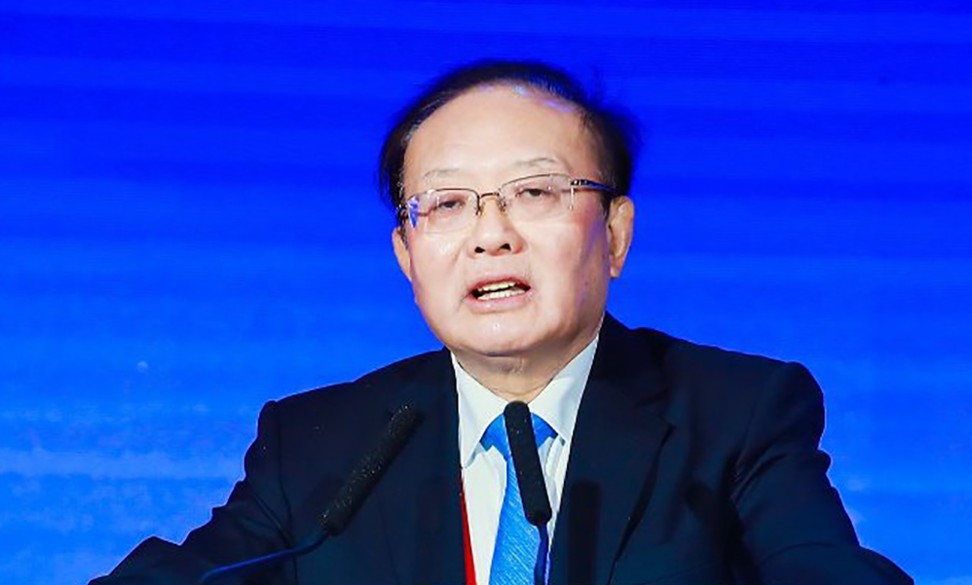
The next face-to-face negotiations are “likely to happen as planned”, even though the prospects of a deal are dim, according to Wei Jianguo, a former vice-minister of commerce responsible for foreign trade. that “it is possible that the meeting could ease the tensions a bit on some aspects”, but declined to elaborate further.
Wei’s comments to the South China Morning Post echoed those of Larry Kudlow, US President Donald Trump’s top economic adviser, who hours earlier said he still expected Chinese negotiators to visit the US for another round of talks.
“The president and our team is planning for a Chinese visit in September,” Kudlow told CNBC in an interview on Tuesday. “We’re willing to negotiate. Movement towards a good deal would be very positive and might change the tariff situation. But then again, it might not.”
China’s Ministry of Commerce did not immediately reply to a faxed request for a response to Kudlow’s comments.
However, a source who has been briefed on trade talks by the US government said that video conferences are scheduled this month, to lay the groundwork for revisiting substantive issues in a face-to-face setting in September.
“It will be interesting to see if the Chinese will still decide to travel to the US next month,” said the source, who wished not to be identified.
The current Chinese vice-minister for commerce, Wang Shouwen, a key member in China's trade negotiating team, has appeared at a series of public events in recent days but declined to comment on whether the talks will go ahead.
At a press conference on the expansion of the on Tuesday, Wang declined to respond to a question on potential countermeasures Beijing could take in retaliation to Trump’s tweet on new tariffs.
Wei Jianguo, Former Vice-Minister of Commerce. Photo: Handout
“The question goes beyond the topic of the press conference and we will have other more suitable occasions to talk with you,” Xi Yanchun, a spokeswoman for the State Council Information Office, told a reporter from Commercial Radio Hong Kong, who asked the question.
Negotiators led by Vice-Premier Liu He had been planning to fly to Washington after talks in Shanghai failed to yield a deal, but Trump’s tweet on a new tariff raised questions over whether the trip would go ahead. Should Liu partake in further talks, it will be viewed by some as a sign that both sides are keen to avoid an all-out trade war, despite the significant escalation in trade tensions over recent days.
Since the last week, tensions have mounted between the world’s two biggest economies after Trump threatened to impose 10 per cent tariff on US$300 billion of Chinese products from September 1, a threat that came just a day after talks finished.
China responded by suspending purchases of American agricultural products and to weaken beyond the key level of seven to the US dollar on Monday. In retaliation, the US Treasury Department officially labelled China a currency manipulator, a move which trade lawyers say could pave the way for additional tariffs and sanctions.
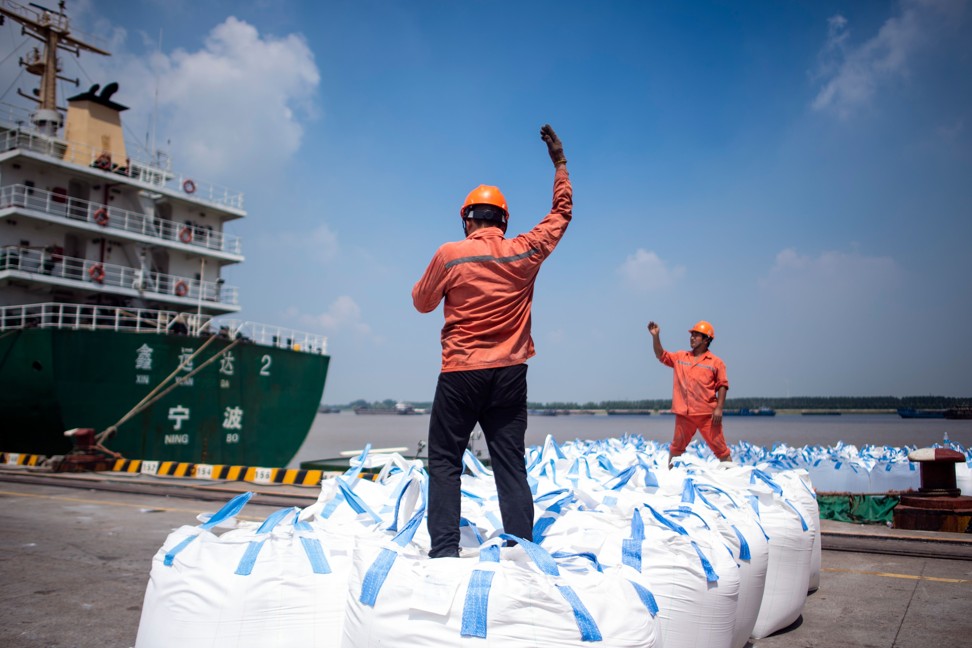
Workers unloading bags of chemicals at a port in Zhangjiagang in China's eastern Jiangsu province. Trade between China and the United States has been severely hit by the ongoing dispute. Photo: AFP
However, despite the escalation, neither side has officially withdrawn from September’s talks, although details such as the date or venue have not yet been disclosed.
Another meeting between top negotiators, including Treasury Secretary Steven Mnuchin and US trade representative Robert Lighthizer, as well as China’s Commerce Minister Zhong Shan, may offer some relief to global markets, which were roiled by the currency dispute this week, since it would suggest that both sides are still committed to talking.
After Trump announced an increase in tariffs on US$200 billion of Chinese products to 25 per cent in May, a Chinese trade delegation , a trusted economic aide to President Xi Jinping, still flew to Washington as planned.
Trump and Xi met on the sidelines of G20 leaders summit in Osaka at the end of June, agreeing to a trade war truce. However, the truce only lasted for a month, as Trump complained that China was not buying US farm products as he claimed Xi had promised in Japan.
Can $5bn Klarna avoid the fate of other Swedish unicorns?
Country has previously lost other homegrown tech start-ups to rivals in US and Asia
Almost nobody makes unicorns quite like Sweden.
Spotify, Mojang, King, iZettle — all are examples of billion-dollar companies born in Sweden that have made Stockholm the world’s biggest unicorn factory per capita behind Silicon Valley.
However, today all four companies are largely controlled from outside the Nordic country. Spotify’s main centre of gravity is now in New York, while the makers of games Minecraft and Candy Crush as well as payments company iZettle were sold off to deep-pocketed US companies: Microsoft, Activision Blizzard and PayPal respectively.
Enter Klarna. The buy-now, pay-later start-up founded in Stockholm became Europe’s largest unlisted fintech this week, valued at $5.5bn — more than double its estimated worth at the start of this year.
The path Klarna and its 37-year-old chief executive and co-founder Sebastian Siemiatkowski now take is doubly interesting.
Firstly, it has the chance to be one of the main global players seeking to disrupt the traditional retail banking industry. The $460m it raised this week from venture capitalists, an Australian bank and pension funds will be used to speed up its longstanding attempts to crack the US market where after some years of struggling it is finally showing signs of success.
The second aspect may be even more crucial for Sweden and Europe: can they hold on to their leading technology groups or simply watch them get swallowed up by US or Asian rivals?
Mr Siemiatkowski is certainly aware of the issue. The decision of iZettle a year ago to pull its planned stock market listing and instead agree to be bought for $2.2bn by PayPal reignited anxiety around promising European tech companies often selling out rather than taking the longer and tougher route of trying to rival some of the biggest US groups.
The spotlight is now on what Klarna plans to do next. Mr Siemiatkowski says the company — founded by him and two friends at business school in 2005 — is as close as it has ever been to an initial public offering today, but that for now pursuing growth is the priority.
Asked about iZettle and the temptations to sell out, he replied: “We are very humbled to be in this city that has given rise to companies like Spotify and King and others. The most important thing is, as Ingvar Kamprad [the founder of Ikea], said: most things are still not done. There is this massive industry — retail banking — that hasn’t put customers first. This is almost an unlimited addressable market.”
A person close to some of Klarna’s backers said: “It’s down to the founder’s mentality. Does Sebastian have the appetite to do another 10 years? And I think he does.”
Klarna still has plenty of challenges. Unlike many fintechs, it is profitable and has been for some time. But last year its operating profit dropped 70 per cent to $19m on revenues up a third to $627m.
Klarna earns money both from online stores such as Asos, Hennes & Mauritz and Adidas, as well as consumers, by offering a deceptively simple solution that it claims boosts sales substantially as fewer shoppers abandon their baskets over difficulties paying.
In return for a fee from merchants, it offers the customers the chance to buy now and pay later, while assuming their credit risk and the burden of collecting the money from the seller. The service is free for most customers but if they pay late or decide to pay in instalments, Klarna collects the interest.
That has put it in the sights of the Swedish government and some debt counsellors, who worry about whether and how it aids young and vulnerable people in getting into debt. Mr Siemiatkowski said Klarna was keen to stay “humble and transparent” as well as learn from its mistakes but that its basic aim was merely to make online shopping as easy as buying in a shop. He highlighted how Klarna had become one of the 10 companies Swedes trusted the most, scoring better than any bank.
Mr Siemiatkowski argued that now was the time for “a huge disruption” of the retail banking and payment card industry by putting customers first. An IPO seems to be the next logical step with Klarna’s founder saying it had “most of the things in place that we need”, even if this week’s fundraising showed it could access large sums of money away from public markets.
Whatever it does next will be closely scrutinised at home and abroad. Only a handful of Sweden’s 100 largest companies were started in the past 50 years, an extraordinary situation mirrored across much of Europe. The continent’s future vitality may depend on how many Klarnas it can develop and cling on to.