WSJ : Activist Wants AT&T to Be More Like Verizon

Activist Wants AT&T to Be More Like Verizon
Elliott says Verizon rightly focused on its wireless business instead of pursuing media deals

An activist investor’s attempt to force a strategy revamp at AT&T Inc. spotlights the diverging paths the two largest U.S. wireless carriers have taken in search of growth.

Elliott Management Corp.’s detailed criticism Monday of decisions made by AT&T’s leaders effectively praises rival Verizon Communications Inc. ’s focus on upgrading its wireless network over becoming a media giant.

While AT&T has spent heavily on entertainment and advertising assets, Verizon has put building a faster 5G network at the center of its strategy. Investors have rewarded Verizon with a similar market valuation, even though AT&T has nearly 30% more annual revenue.

Displacing Verizon is a “potential reset of incredible importance,” Elliott wrote to AT&T’s board, arguing that the Dallas-based company’s wireless business isn’t just losing market share but is also becoming less profitable.

AT&T and Verizon have long been the two largest wireless providers in the U.S. by subscribers, but each has taken a different approach to generating new revenue in a wireless market. Technology giants and startups made billions on the back of the wireless connections that the carriers provided, leading each to seek ways to capture more of that spending.


“AT&T to a certain extent diversified away from the wireless business, despite the fact that the wireless business has been very good over the last few years, whereas the pay-TV and the traditional media business has been under more pressure than expected,” said John Hodulik, an analyst at UBS Group AG.

Many of the suggestions the activist made are already being implemented or are under discussion at AT&T, he said. Entering this week, AT&T has posted a total shareholder return—or stock-price changes plus dividends—of roughly 20% over the past year, compared with 14% for Verizon.

AT&T spent $49 billion to buy satellite-TV provider DirecTV and another $81 billion on Time Warner Inc., aiming to control content as well as connectivity. But cord-cutting has sapped customers from the pay-TV industry, prompting AT&T and others to launch streaming services.

On Monday, AT&T defended its current strategy and “the unique portfolio of valuable assets” it has assembled. “We look forward to engaging with Elliott,” AT&T said. “Indeed, many of the actions outlined are ones we are already executing today.”

Verizon spent $130 billion in 2014 to take full control of its wireless business but avoided a blockbuster media deal. It paid about $9 billion to buy AOL in 2015 and Yahoo two years later, but struggled to generate revenue and took a hefty charge to write down its internet business. Now, it focuses on partnering with content providers like YouTube TV.

Hans Vestberg, who became Verizon’s chief executive last year, restructured the company’s business lines and has made wireless connectivity and finding new applications for 5G technology top priorities.

Verizon is also in the process of cutting $10 billion in costs, a plan that has included a large voluntary severance program as well as outsourcing efforts. A Verizon spokesman declined to comment.

Elliott called on AT&T to follow suit and cut more costs from its operations. “While revenue per employee was nearly identical at both companies just over a decade ago (~$400k), today Verizon’s revenue per employee (~$900k) is nearly 30% higher than AT&T’s (~$700k),” Elliot wrote.

Elliott told AT&T’s leaders that the next generation of wireless service presented an opportunity for the carrier to reclaim wireless market leadership. AT&T should gain, Elliott said, from its spectrum holdings as well as benefits associated with being the provider of the federally backed FirstNet communications system for emergency responders.

WSJ : Aramco Plans Two-Part Saudi Listing to Expedite IPO

Aramco Plans Two-Part Saudi Listing to Expedite IPO
Saudi’s national oil giant is considering a 1% offering in 2019 and another 1% next year on the Tadawul

Saudi Arabia is planning a two-part listing of Saudi Arabian Oil Co. on its domestic stock market to ensure that the exchange can easily absorb what would be the kingdom’s largest initial public offering, according to advisers familiar with the process.

Aramco, as the national oil giant is usually known, is considering a 1% offering of the company this year and another 1% next year on the local market, the advisers said, as the government seeks to accelerate a centerpiece of Crown Prince Mohammed bin Salman ’s economic reform program.

The Saudi royal aims to list 5% of Aramco in an effort to raise billions of dollars to diversify his oil-dependent economy. The Crown Prince has indicated he wants a $2 trillion valuation for the world’s most profitable oil company—though analysts put the company’s value at closer to $1.5 trillion.

Even at the lower estimate, a 1% sale is likely to raise $15 billion from Saudi and international investors and would be the largest initial public offering on the $500 billion domestic market, known as the Tadawul. Saudi Arabia opened up its domestic market in 2015 to institutional foreign investors, who can participate in IPOs.

The offering will commence “very soon,” Aramco President and Chief Executive Amin Nasser told reporters at the World Energy Congress in Abu Dhabi on Tuesday. He said the company was prepared to list in multiple markets: “The primary listing is to list locally, but we are also ready for listing outside in other jurisdictions.”

JP Morgan, Morgan Stanley and National Commercial Bank, which is owned by the Saudi government, are expected to be the lead underwriters on the listing, people familiar with the details said.

Since reviving the IPO in August, Saudi officials have tossed around ideas that might expedite the process and lift the valuation closer to the Crown Prince’s hoped-for $2 trillion. They plan to list Aramco first domestically and then internationally in 2020 or 2021, possibly in Tokyo, The Wall Street Journal reported last month.

Reuters first reported plans for a two-part domestic listing Monday.

The comments from Aramco’s CEO came ahead of a gathering of the Organization of the Petroleum Exporting Countries’s joint ministerial monitoring committee later in the week. Saudi Arabia is OPEC’s de facto leader.

While the price of Brent crude oil, the global benchmark, was up 0.8% at $63.09 a barrel Tuesday, it has fallen more than 18% over the past year, as investors grow increasingly anxious over the health of the global economy and demand for oil.

The Saudi government removed powerful energy minister Khalid al-Falih on Sunday, less than a week after he was removed as chairman of Aramco. Mr. Falih publicly supported a stock offering, but also worked to delay and reduce its scope due to concerns about low oil prices and a possible world recession, according to Aramco executives, advisers and Saudi officials. He also fretted about listing in New York because of the potential for shareholder lawsuits.

Longstanding oil official Prince Abdulaziz bin Salman, the son of the king, has replaced Mr. Falih as energy minister. Yasir al-Rumayyan, the head of Saudi Arabia’s sovereign-wealth fund and a confidante of the crown prince, now chairs Aramco. Analysts view the changes as proof the Saudi government is now serious about the IPO after years of delays.

To ensure the IPO’s success and potentially boost the valuation, Prince Mohammed wants wealthy Saudi families to act as anchor investors in the domestic share sale, one adviser to Aramco said. When the prince first broached the idea of a listing in 2016, he met with some of the country’s richest families to encourage them to back the IPO, the adviser said.

“[The Crown Prince] is expecting to see big names in Saudi buying those shares,” the adviser said of the Aramco listing.

However, in 2017, Prince Mohammed locked up hundreds of businessmen and royals in Riyadh’s Ritz Carlton hotel, in what the government described as a corruption crackdown.

Critics have labeled the roundup a purge of political opponents, which coupled with the killing last year of journalist Jamal Khashoggi, has dampened business sentiment. Bankers have shown they are willing to move past these events to win business in Saudi Arabia, but it is unclear foreign investors are ready to bet on the market.

Stock analysts say an Aramco IPO could suck cash from other Tadawul-listed companies, as Saudi investors rebalance their portfolios to invest in the landmark listing. So far, the kingdom’s largest share sale was the $6 billion listing in 2014 of National Commercial Bank.

Tadawul officials have said the exchange is ready to absorb the entire 5% listing of Aramco, up to $100 billion.

Over the past four years, the market has instituted new legal and regulatory rules and opened its market to international investors. Foreign institutional buyers will be able to access an Aramco IPO via the kingdom’s Qualified Foreign Investor system, which mandates that foreign investment companies must have $500 million or more in assets under management.

Foreign investors have poured $20 billion into the Tadawul this year after its addition to two major emerging-market indexes, run by MSCI Inc. and FTSE Russell. Saudi Arabia now makes up 2.8% of the weight of the MSCI index, the largest of the two. An Aramco listing would further boost the weighting, drawing potentially billions more in foreign passive and active investment.

>>> Vivendi back to the office: mega offer to buy all Mediaset EXCLUSIVE. The

Vivendi back to the office: mega offer to buy all Mediaset

EXCLUSIVE. The business banker de Vecchi (Citigroup) met Berlusconi on behalf of Bolloré. On the table a shock proposal: take over the majority of the Biscione at over 30% compared to the current stock market values.

New governments , new majorities . And scenarios that cannot fail to reverberate in the business world . It will be a coincidence, but while Giuseppe Conte delivered his speech on confidence in the Senate , one of the most prominent business bankers , Luigi de Vecchi , president of Citigroup's Continental Europe division, crossed the threshold of Palazzo Grazioli where Silvio Berlusconi was waiting for him . That of de Vecchi, however, which for a long time has known the Cav, was not a courtesy visit.

Luigi de Vecchi, president of the Continental Europe division of Citigroup.

THE OFFER OF BOLLORÉ AL CAV

The banker probed the land on behalf of the one who, after being his ally, is now the sworn enemy of Fininvest , or Vincent Bolloré . According to the rumors that Lettera43.it was able to collect, the proposal of the Breton financier to the Cav would be those difficult to refuse. That is an offer to buy the majority stake in Mediaset at the same market value , above 3.5 euros, which Vivendi recognized when it launched the takeover of Biscione in December 2016 and that led it to conquer 29, 9% of the company.


CONFLICT RELATIONSHIPS BETWEEN VIVENDI AND MEDIASET

In short, de Vecchi would have proposed to Cav an operation that exceeds the current values ​​on which the Mediaset share travels by more than 30% . A proposal, that of Vivendi, which comes at a time when relations between the two groups are perhaps at the height of conflict , with the French who had strenuously opposed the mega cross-border merger between Mediaset and its Spanish subsidiary from which it was born Mediaset Investment NV ., A company under Dutch law wholly and directly controlled by Mediaset, which will become the new holding company of the Mediaset Group.

(ZH) 'Quant Quake 2.0' Fallout: Nomura Warns Of "Horrific" Returns For Momo Stoc

'Quant Quake 2.0' Fallout: Nomura Warns Of "Horrific" Returns For Momo Stocks Ahead
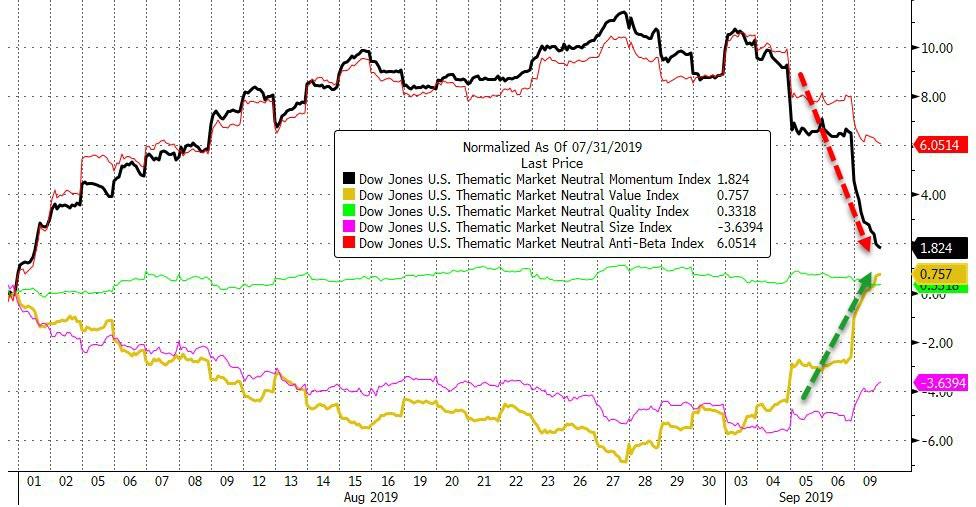
The shock of yesterday’s US Equities factor reversals will go down in infamy alongside the August 2007 “Quant Quake” and the Fed/March/April 2016 “Market-Neutral Unwind” as one of the more stunning trades in modern market history...
...And yet, as Nomura's Charlie McElligott exclaims, hilariously, nobody watching financial TV or Joe Schmoe retail investor looking at just simple Index returns in isolation (or even a more sophisticated investor looking at the Vol complex yday) would have had any idea of the calamity occurring under the surface, as it was all about a blowout in sector- and thematic- dispersion which then acted to offset / “mask” the “top down” moves.
Stepping into today’s trade and CRITICALLY as it pertains to said devastating “internals” within this US Equities performance dynamic of the past few sessions, overnight we see US Rates / USTs pausing the bleed of the past week and actually “bull-flattening” - which should help “locally” to stop the violence of the Equities “Momentum” unwind, which at its “macro core” was “kicked-on” by the recent Duration selloff / “Bear-Steepening” in US Rates.

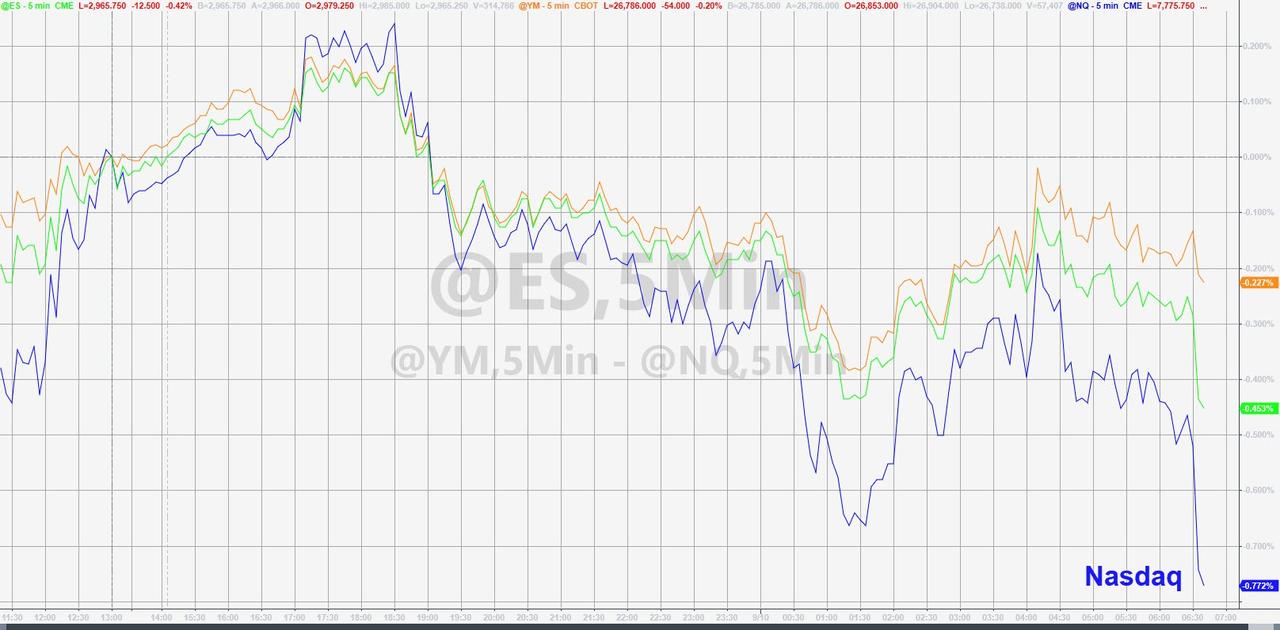
But for now, Nasdaq is notably underperforming...
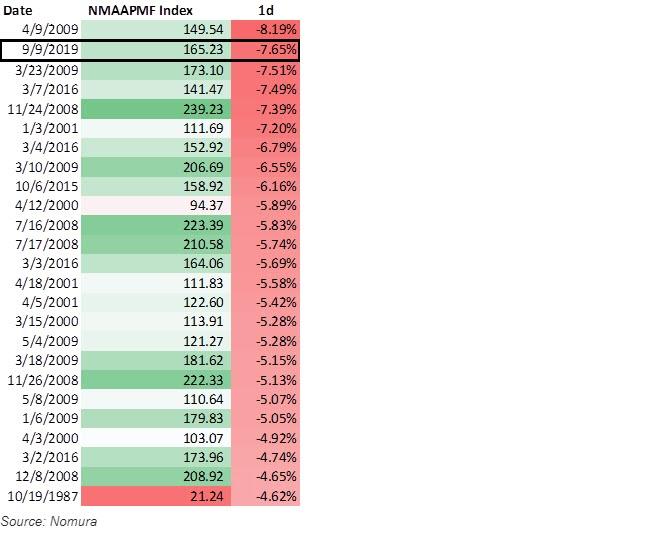
Just how unprecedented was the “Momentum Shock” unwind? Yesterday’s -7.7% move in US Equities “1Y Price Momentum Factor” was the second largest 1d drawdown in the history of our factor data going back to 1984 (the worst day being -8.2% on April 4th, 2009), while my US Equities HF L/S model was -3.3% on the day, tied for the second-worst 1d performance move for the leveraged fund proxy since the jarring 2015 “Growth Scare” trade (all of which encompassed a China FX deval, a disinflationary “Crude Shock,” US HY E&P default scare, a one-quarter US Earnings recession and the first Fed hike of the cycle).
What would make the Momentum unwind stop or pause? As mentioned above, a resumption of the Duration / Rates rally (particularly “bull-flattening”) would staunch the pain, and could easily be driven by more “bad global growth data” or an “dovishly inline with market expectations” ECB this week
But what could make the Momentum unwind accelerate? Two potential catalysts I’m watching:
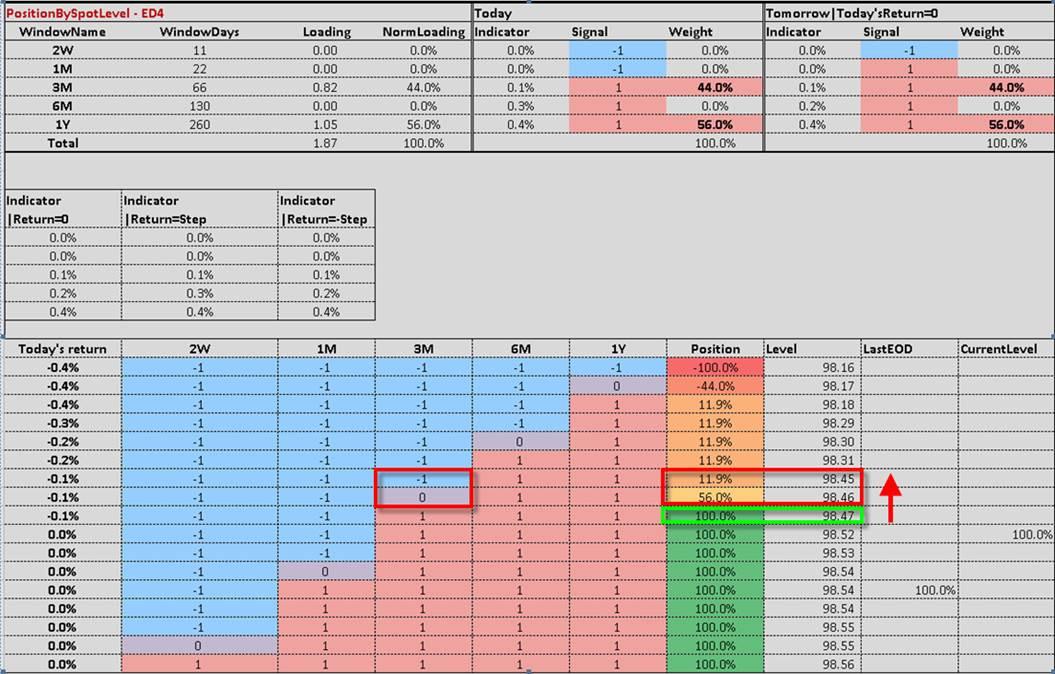
First is price-based, as it relates to the Nomura QIS CTA model and the level at which we would see Systematic Trend begin to deleveraging from the legacy “+100% Long” position in ED$ (ED4 is what we track), as it is the best proxy for the Leveraged Fund universe and their “grab” into the YTD Rates trade; currently we would expect reduction / selling-down of that position on a break and close in ED4 below 98.46/45, where the signal would move from “+100% Long” to just “+12% Long” as the 3m model window would “flip” to SELL (see bottom chart / table of email)
Second is the waaay out of consensus ECB scenario I put in yesterday’s first note, as outlined by our EGB Rates Strat Marco Brancolini, who made a call into the ECB that we see a “dovish surprise” from the ECB…but that perversely, it could come via a surprise twist which would actually see the long-end HIT LOWER, which in-turn would extend the recent “steepening” in Rates curves and risk accelerating the current “unwind” dynamic further.
Most importantly below, Nomura's McElligott attempts to answer the question that every investor has been asking over the past 24 hours:
“What does this type of “Momentum Shock” mean for forward themes and returns for both S&P and “Momentum” themes going-forward?”
(e.g. implications for the reversal of various long-standing dynamics seen with “Growth over Value,” “Defensives over Cyclicals,” “Large Cap over Small Cap,” “Min Vol over High Beta / High Vol” etc)

WWD : Slowly and Steadily Building a Bigger Coach

Slowly and Steadily Building a Bigger Coach
The brand's president Joshua Schulman and creative director Stuart Vevers talk about retail moves, digital strategy — and collections.

Joshua Schulman and Stuart Vevers can each keep a poker face. Last Tuesday, the respective president and creative director of Coach sat for an interview at the brand’s Hudson Yards store. In a wide-ranging conversation, they discussed a deep lineup of initiatives, including retail moves, collaborations, digital strategy and the spring 2020 collection that Vevers will show today. Neither belied any indication of the next day’s blockbuster news: the ouster of Coach parent Tapestry Inc.’s chief executive officer — and the man who hired them both — Victor Luis in the face of disappointing execution of the group’s strategy, and his replacement by board chair Jide Zeitlin. The Kate Spade and Stuart Weitzman brands are the others under the Tapestry umbrella.

During the interview, Schulman noted that Tapestry was formed around Coach. “The structure, the rationale for the group, is to leverage some of the strengths that Coach had built up over many years in terms of supply chain, distribution, real estate and so forth, but to allow Coach and the other brands to have their own customer-facing organizations, creative organizations and unique expressions to the consumer,” he said. He added that, at the same time, being part of a group has allowed Coach to be “more disciplined in our growth and not force unrealistic growth expectations around the brand. We can be focused on the appropriate type of growth for Coach.”

In the recently completed fiscal year, 2019, that growth was driven by international and digital channels, with North America outperforming the direct competition, according to Schulman. Growth has gone hand-in-hand with the deliberate, strategic elevation of the Coach image and product range from its longtime functional, mid-level positioning to the ever-growing affordable luxury arena, a nascent concept when Vevers arrived with the mandate to deliver an aesthetic and product that would facilitate the change. (This interview fell on his sixth anniversary with the brand.) Since Schulman’s arrival two and a half years ago from Bergdorf Goodman, that evolution has been deliberate and swift.

“When we launched the modern luxury transformation five years ago, it was about how to elevate Coach into having a fashion message and to be relevant in the luxury universe,” Schulman said.

While that elevation naturally centers on the brand’s core accessories, now 70 percent of the overall business — and Schulman stressed that core innovation is essential — the creation of a ready-to-wear identity was key to the strategy, and a primary reason for Vevers’ hire. “One of the things I’m definitely the most proud of is introducing ready-to-wear and fashion to Coach,” he says.

Rather than jump in with a frenetic everything-at-once arrival, Vevers opted for a measured approach, operating from a baseline belief that each category he would introduce must serve dual purposes: it must come from a place of fashion, and it must be fully serviceable. “We introduced categories gradually,” Vevers says. “The first season was focused on outerwear. We didn’t introduce dresses until the fourth season.” He wanted to ensure “that the clothes felt real, contemporary and that they were pieces I was going to see people wearing on the street.”

Despite the controlled approach, Vevers has, in a short time, created a clear fashion identity for Coach, rooted in an underlying urban sensibility infused with bohemian flair. “I had imagined the Coach muse on a road trip, picking up souvenirs along the way,” he says. “But I always imagined them putting their look together in New York City, starting and finishing their journey in New York City. Right now, and you’ll see in the upcoming show, I am really obsessed with the urgency of New York City itself.”

With the ready-to-wear component well underway, focus expanded to reimagining the brand’s network of stores, 980 deep, with a lighter hand. “In some ways this [Hudson Yards] store is a metaphor for a lot of the changes in the brand, and the new energy in the brand,” Schulman said. “It takes the original architecture that Stuart worked on with Bill Sofield to re-launch the modern luxury iteration of Coach and does it in a lighter, brighter, more transparent, more digital, more interactive way.” One of-the-moment change: a more gender-fluid arrangement of merchandise. At Hudson Yards, women’s and men’s ready-to-wear and sneakers are merchandised within the same areas.

Along with this focus on permanent stores, the brand is having a grand time with pop-ups. In the past year, it has done more than 130 iterations globally. Among the more off-beat, recent installations in Tokyo and New York’s SoHo involved different takes on the words “life Coach.” Visitors could enjoy immersive experiences and tarot readings. But they couldn’t buy anything — these were merch-less pop-ups, “probably one of the most eccentric versions,” Schulman said. In May, various pop-ups, mostly in China, featuring the work of Guang Yu, Yeti Out and other Chinese artists reinterpreting Coach’s dinosaur mascot, Rexy.

For Fashion Week, the brand installed “Coach Originals” inside its Madison Avenue store. LINK Heritage is extremely important within the Coach universe. The brand recently acquired all of the intellectual property of Bonnie Cashin, from the Bonnie Cashin Foundation. Cashin, who was hired by Coach’s founders to create bags, may have been fashion’s first creative director.

Much of Vevers’ work can claim Cashin-designed antecedents; when he arrived at the house, he threw himself into the archive, and had some help from the outside. On his first day at work, his now-husband gave him a vintage Coach bag with a photograph of Cashin inside. “She’s like a guardian angel of Coach,” Vevers says. “She introduced a lot of the elements that we recognize as signatures of the brand today.”

The pop-up also offers a take on the zeitgeist-y notion of fashion rental, allowing clients to borrow archival bags using a “library card.” While the returns on the long-term impact of rentals on fashion brands aren’t in, Vevers and Schulman both feel that the pop-up library concept will only add to the Coach ethos. Schulman notes that it will help “emphasize the longevity of the product…these bags can be loved by many people over time.”

Yet these days, heritage is best served with a dollop of currency, and if it’s major celebrity currency, all the better. Coach has forged relationships with a number of brand ambassadors, each serving a different purpose. To that end the range is vast, from Disney, Michael B. Jordan and Selena Gomez to fashion-insider pairing with Kate and Laura Mulleavy of Rodarte and, new this season, with Tabitha Simmons.

The collaborations are an exercise in driving excitement, which “can mean many different things and different scales. Our expectation for Rodarte is different than our expectation for Disney or for Selena or Michael B. Jordan. For us on a business standpoint, there are some that are big, traffic-driving exercises,” Schulman notes. “So whether it’s Selena Gomez or Disney, those we go out in a really big way. And then there are others that may be more at the top of the pyramid or with a particular appeal, like Rodarte or Tabitha Simmons, which brings in a level of fashion authority and fashion establishment.”

Similarly, linear thinking has no place in digital strategy. While the company doesn’t break out the percentage of business generated from e-commerce and remains very supportive of physical retail as a key part of its strategy, Schulman said that for the 2019 fiscal year, Coach “drove strong digital growth through the e-commerce channel.” It’s clear that, for Coach, digital means more than just sales through a dot-com. Schulman enthuses over a recent trip to the Oak Brook Mall where one of the company’s sales associates had recently been given the blessing to drive sales through his personal Instagram. Schulman now follows the associate and is inspired by watching how the social media platform aids him in working with new customers in his market. “The Oak Brook Mall is my Disneyland,” he makes the analogy to one of Vevers’ favorite epicenters of inspiration. “His obsession is Disney and mine is going to department stores and shopping malls around the world.”

​Schulman stressed that in-market adaptability and online nimbleness are crucial to the brand’s success. “It’s not one-size-fit-all in terms of either the technologies or platforms within one geography are not necessarily the same in another geography,” he says. “So we may excel at WeChat and Weibo in China, but it’s important to be present online in Japan. We just amplified our presence on Kakao in Korea. Of course, Instagram is in the forefront in North America.”

In terms of international markets, despite recent volatility and ongoing tariff fears, China remains Coach’s fastest-growing market. Schulman considers its customer being the most elevated in the world, and the one who most fully embraces Coach’s full product range. “Of course leather goods are our core, but the perception of the Chinese customer is that we are a full lifestyle brand. So much higher penetration of ready-to-wear in that market, our highest in the world,” Schulman, said, noting that the trajectory is expected to continue. “The opportunity there really is boundless as we think about the urbanization of the middle class, the number of cities with over a million people.”

Europe, too, remains an area of opportunity, the business there spiked by the relaunch of Coach Signature about 18 months ago at retail.

Yet for all its global reach, Coach is a New York-based brand, a point it is highlighting in the Coach Foundation’s current “Dream It Real” project, an initiative launched last year that supports young people in achieving their dreams. Despite its timely ring, Schulman swears the title is not inspired by the current immigration situation. When he arrived at Coach, Vevers sent him a package of various of his inspirations, and referred to those he worked with at Coach as “the dreamers.” The handle resonated with Schulman, who describes the brand’s founders Miles and Lillian Cahn as “second-generation immigrants but first-generation American dreamers who turned a small leather goods private label factory right here in Chelsea into a global brand.”

“I think that dream has changed and evolved,” Schulman said. “But the idea, to leave the world a better place and make an impact on your community, has stayed and really been amplified in these last years.” As such, it made perfect sense for Coach’s youth-oriented campaign.

“We see our community as a community of dreamers, of New York City dreamers who see their version of the New York dream, the American Dream as not about gratuitous wealth necessarily, but it’s about leaving the world a better place.”

And, he adds of the campaign’s international casting, “Stuart and the team have done a great job of finding people around the world, not just here in America, but who share those values. It’s a story that’s as relevant in St. Louis as it is in Shanghai.”
WSJ : Mario Draghi’s Plan for Final Jolt of Stimulus Runs Into Opposition

Mario Draghi’s Plan for Final Jolt of Stimulus Runs Into Opposition
Departing ECB president faces the possibility of a rare defeat amid questioning of need for more rate cuts or a new bond-buying program

FRANKFURT—European Central Bank President Mario Draghi hopes to end his eight-year term with a bang. Some fear it could conclude with a fizzle.

In the run-up to his departure on Oct. 31, the central banker has signaled plans for a large, final burst of monetary stimulus to prop up a eurozone economy that is tottering under the pressure of trade tensions.

But critical voices are multiplying, including a growing number from the ECB’s own 25-member rate-setting committee.

Mr. Draghi’s critics say the eurozone economy isn’t weak enough to warrant aggressive new measures just a year after the ECB began phasing out its €2.6-trillion ($2.686 trillion) bond-buying program. Borrowing costs for households, businesses and governments are so low, they argue, that easier money will have little effect. The bank’s key interest rate is already minus 0.4%.

They also say the measures Mr. Draghi has flagged—further interest-rates cuts and a new bond-buying program, known as quantitative easing, or QE—risk leaving the bank with virtually no ammunition if the economy sinks further, while also exacerbating the risk of asset bubbles and damage to the region’s banks. Several eurozone governments moved in recent months to rein in excess lending, including France.

“The ECB’s monetary policy is doing its duty, but it can’t do everything, and it certainly can’t perform miracles,” Bank of France Gov. François Villeroy de Galhau said in a recent interview with Swiss media.


The French banker has joined traditional hawks in Germany and other northern European countries in questioning Mr. Draghi’s bold stimulus plans, especially QE.

“With a second asset-purchase program, the ECB will continue disturbing markets, and prices do not reflect the risk anymore,” said Jürgen Stark, the ECB’s former chief economist. “All this is not thought through, just to be activist and show we are not at the end of our toolbox.”

Those objections raise the prospect of a rare defeat at Thursday’s ECB meeting for Mr. Draghi, whose bold new policies held together the fractious currency union during the sovereign-debt crisis. Still, the Italian, who has just two policy meetings left, can usually count on support from a majority of dovish council members, and some skeptics don’t have a vote at this week’s meeting, including Mr. Villeroy de Galhau.

Investors are pricing in a roughly 50% chance of a 0.2 percentage-point rate cut, as well as a program to buy about €30 billion to €40 billion of sovereign debt a month. As a compromise, Mr. Draghi could restart the bond-buying program, but at a slower pace, leaving its current restrictions in place.

He could also leave the decision to restart bond buying to International Monetary Fund Managing Director Christine Lagarde, who is set to take the ECB presidency on Nov. 1. Ms. Lagarde said last week that she would reassess the costs and benefits of the ECB’s controversial policy tools.

Mr. Draghi’s defenders say that it is easier to combat a downturn before it has taken root than to reverse it afterward. New factory orders in Germany fell sharply in July, while Italy’s economy has flatlined.

“If you don’t do anything then you don’t have any side effects, but you don’t have any impact on the economy, either,” Olli Rehn, head of Finland’s central bank and a member of the ECB’s rate-setting committee, said in a recent interview. He called on the ECB to launch a broad package of stimulus measures, including substantial new bond purchases.

The fresh uncertainty over ECB policy underscores the political and economic challenges facing central bankers in responding to the global slowdown that has followed the China-U.S. trade war.

The Federal Reserve is cutting rates. Unlike the ECB, however, the Fed raised interest rates during the expansion, giving it more ammunition to fight a downturn.

The eurozone is especially reliant on loose monetary policy, as it is highly dependent on trade for growth. Germany accounts for the same share of world exports as the U.S. with just a quarter of the population. The weakening of the euro in response to easy money has given exporters a much-needed boost.

At the same time, eurozone governments have been unwilling or unable to loosen purse strings to stave off a slowdown.

The recovery that Mr. Draghi’s bold policies helped engineer is now at risk, with the region’s economy growing at an annualized pace of just 0.8% in the second quarter and its manufacturing sector in recession.

However, the services sector, which accounts for two-thirds of eurozone output, is resilient, and unemployment is at an 11-year low.

“I find myself surprisingly skeptical, probably for the first time,” Stefan Gerlach, a former deputy governor of Ireland’s central bank, said in an interview. “Draghi does not seem to hesitate to bind the hands of his successor. I’m not sure the economy needs it. I’m not sure it achieves much. Some of the arguments the hawks are making sound sensible.”

As part of a new bond-buying program, Mr. Draghi has suggested that the ECB could loosen self-imposed rules aimed at ensuring it doesn’t dominate debt markets.

That would trigger opposition in Germany. German Finance Minister Olaf Scholz said last month that he would look into outlawing negative interest rates for retail depositors.

The ECB might also introduce measures to protect eurozone banks against even more negative interest rates. Banks bear the brunt of the policies since they need to keep money on deposit with the central bank, in essence paying the ECB to store their money. Meanwhile, banks have been unable to pass those costs fully on to depositors, who often still receive 0% on savings accounts. The ECB might provide banks some relief by exempting some bank deposits with the ECB from negative rates.

“We are at the end of the efficiency of monetary policy,” France’s finance minister, Bruno Le Maire, said in an interview. “The risks that we are now facing are not related to financial stability [but] how to fuel growth. The response is not only in the hands of the ECB.”

With political pressure rising on central bankers around the world, Mr. Draghi may want to leave Ms. Lagarde with room to maneuver.

“The next ECB president will really need to come up with a game plan to deal with the next downturn,” said Elga Bartsch, head of macro research at BlackRock. “Just turning around and saying, ‘Sorry, we are out of policy options,’ is not going to serve the independence of central banks well.”