WSJ : Israel Tiptoes Toward Conflict With Lebanon’s Hezbollah From drone strikes

Israel Tiptoes Toward Conflict With Lebanon’s Hezbollah
From drone strikes to psyops, Israel’s widening campaign to weaken Iranian ally escalates tensions

AVIVIM, Israel—A widening campaign by Israel to blunt the threat posed by Iran’s ally Hezbollah, and the pushback from beyond Israel’s borders, are raising the risk that the two sides will stumble into another war.

In what is known in Israel as the war between the wars, Israel has been hitting targets in Syria for years to try to prevent Tehran from moving military supplies to its Lebanese ally. More recently, raising the risk of conflict, it expanded that effort to Lebanon and Iraq.

Hezbollah responded last week, firing antitank missiles into this small farming community on the Lebanese border.

Israeli military officials said Hezbollah had crossed a line by firing into a civilian area rather than a closed military site. “These are places Hezbollah shouldn’t take the war between wars because it will end in a war,” an Israeli military official said.

Israel has widened the campaign as Prime Minister Benjamin Netanyahu fights to hold on to his post, facing a re-election bid on Tuesday.

Mr. Netanyahu speaks regularly about Israel’s need to combat Iranian aggression, but Israel has acknowledged only some details of the military campaign.

Israel has relied on high-tech surveillance to track what its officials say are Hezbollah’s efforts to manufacture precision-guided missiles and build tunnels into northern Israel.

The campaign also includes psychological operations. Last week, Israel staged the evacuation of an apparently wounded soldier to trick Hezbollah into claiming Israeli casualties after its strike on Avivim. The attack left two circular craters and a large patch of charred grass.

At the nearby Shebaa Farms, a small strip of disputed land controlled by Israel that borders Lebanon and the Israeli-controlled Golan Heights, the combatants have grown accustomed to exchanging fire. The approximately 10- square-mile area is surrounded by missile nets and jamming equipment, among other defenses intended to intercept incoming fire from Hezbollah.

Elsewhere along the Lebanon-Israel border, Israel uses drones and other means of surveillance and intelligence collection to monitor Hezbollah’s activities. Mannequins have been positioned in jeeps to dupe Hezbollah on where Israeli forces are stationed.

Even before last week’s flare-up, hostilities were high. Lebanese President Michel Aoun called a late-August drone attack in a Beirut suburb the equivalent of a declaration of war that “allows us to resort to our right to defend our sovereignty.” He appealed to the U.S. and France to intervene to calm the situation.

Hezbollah leader Hassan Nasrallah vowed Tuesday to strike Israeli military vehicles in its next attack.

Current and former Israeli officials acknowledge that Israel’s campaign is adding to tensions. But they say the alternative scenario is unacceptable: allowing a foe to obtain missile technology that could overwhelm Israel’s defenses and enable sneak attacks.

“If someone is not ready to risk anything, he will not gain anything,” said Yaakov Amidror, who was Israeli national security adviser from 2011 to 2013 and is now at the Jerusalem Institute for Strategy and Security. “Here we might lose the ability to defend ourselves if they succeed to build on top of what they already have.”

Sparring continued this week when the Lebanese group said Monday it had downed an Israeli drone, and Syrian-based militias fired rockets at Israel following a report that an airstrike had killed Tehran-supported militants near the Iraq-Syria border. Israeli officials said the drone fell because of a technical problem.

Hezbollah and Israel have fought two full wars, most recently in 2006. Israeli forces experienced 18 years of bloody guerrilla warfare while holding a security zone in southern Lebanon, before withdrawing in 2000.

In 2006, after Hezbollah captured two Israeli soldiers in a cross-border raid, Israel launched a massive assault on Lebanon, during which Hezbollah fired thousands of rockets at northern Israel. The 34-day war resulted in the deaths of 165 Israeli soldiers and civilians and at least 1,100 Hezbollah fighters and Lebanese civilians.

Israeli officials believe Hezbollah has since expanded its arsenal and capabilities. They say the paramilitary group is trying to manufacture new precision-guided missiles and convert some of its 130,000 unsophisticated rockets into these more precise weapons to target Israeli military and civilian sites. Hezbollah denies the charge.

Hezbollah has a few dozen precision-guided missiles, mostly smuggled in from Syria, according to Israeli officials. Hezbollah isn’t able to produce them in significant numbers yet, they say.

Israel’s efforts to reverse Hezbollah’s progress toward more advanced missiles have ended a fragile lull in the conflict.

Analysts say a conflict could break out at any time.

“Don’t pay too much attention when they say they want to avoid war,” said Jacob Nagel, head of Israel’s National Security Council from 2016 to 2017 and a fellow at the Foundation for Defense of Democracies. “If something will happen, the reaction isn’t if the sides want war or not, the reaction is keeping with their best interests.”

The margin for miscalculation is already narrow. On Sept. 1, one of several antitank missiles fired from Lebanon narrowly missed striking an Israeli military vehicle with five people inside, a second Israeli military official said.

“Both sides are acting, hoping that it will be limited to below the escalation line,” said Amos Yadlin, a former head of Israel’s military intelligence who is now executive director of the Institute for National Security Studies at Tel Aviv University. “But they can miscalculate.”

—Dov Lieber in Tel Aviv and Nazih Osseiran in Beirut contributed to this article.
FT : Broadcom says chip demand has ‘bottomed out’

Broadcom says chip demand has ‘bottomed out’

Broadcom said demand in its semiconductor business has “bottomed out”, taking some of the sting out of quarterly revenue that fell just shy of expectations as the chipmaker continues to deal with the fallout from the US-China trade spat.

In June, the trade dispute and Washington’s export restrictions targeting Huawei prompted Broadcom to cut its revenue outlook by $2bn to $22.5bn for fiscal 2019, with the company warning that geopolitical uncertainties had driven a slowdown in the chip sector.

Broadcom reiterated that revenue guidance Thursday, while also posting fiscal third-quarter earnings that outpaced Wall Street’s forecast.

“Looking at the semiconductor solutions segment, we believe demand has bottomed out but will continue to remain at these levels due to the current uncertain environment,” said Broadcom chief executive Hock Tan, who noted a “challenging market backdrop” during the quarter.

Broadcom booked overall net revenue of $5.52bn in its quarter that ended August 4, up from $5.06bn in the year-ago period but slightly below the $5.54bn expected by analysts polled by Refinitiv.

Net revenue in Broadcom’s semiconductor solutions unit fell about 5 per cent year-over-year to $4.35bn, but was up 6 per cent compared with the previous quarter.

Net income dropped to $715m from $1.2bn. On an adjusted basis, Broadcom earned $5.16 per share to beat the consensus view of $5.13.

Broadcom’s shares pared some of their initial losses in after-hours trading, sliding 1.4 per cent. The stock has gained more than 18 per cent on the year.

Broadcom, led by its dealmaking chief executive, announced last month it had come to terms on a $10.7bn deal to acquire antivirus software maker Symantec’s enterprise business, which offers services including cloud security and data loss prevention. The companies have said the deal is expected to close by the end of the calendar year.

However, private equity firms Permira and Advent International have approached Symantec about buying the entire company for more than $16bn. Beyond its enterprise business, Symantec owns the Norton and LifeLock brands.

FT : WeWork looks at curbs on co-founder’s voting power in attempt to save IPO

WeWork looks at curbs on co-founder’s voting power in attempt to save IPO
Corporate governance and falling valuation startle sceptical investors

WeWork’s executives, investors and advisers are discussing curbing the voting power of co-founder Adam Neumann and removing his wife Rebekah from a role in succession planning, in an attempt to save the company’s initial public offering.

People familiar with the talks said changing the terms of Mr Neumann’s supervoting rights, which give him 20 times the voting power of ordinary shareholders, was among the measures under consideration in an effort to win over sceptical investors.

Another possible change is taking Mrs Neumann out of an unusual role in helping select a future chief executive should Mr Neumann die.

Mr Neumann, 40, is now desperately at work to keep the IPO on track, even as the company’s advisers question whether investors will bite at an already cut-price deal that would value the lossmaking property giant as low as $15bn. He would have to agree to any of the proposed changes.

The new valuation is less than half the $47bn that WeWork was calculated at this year when SoftBank invested $2bn in the group, and less than a quarter of the $65bn that bankers at Goldman Sachs had at one point pitched as a possibility for the company.

Inside the office space company, concern about the fate of the IPO has been heightened by the management cancelling an all-hands town hall that had been planned for Thursday and the departure of chief communications officer Jennifer Skyler who announced this week she was leaving for a role at American Express.

To allay corporate governance concerns, WeWork has already promised to add a new director to its board, while Mr Neumann returned a nearly $6m payment from the company that had drawn criticism.

However, his advisers worry that the changes will not have a great effect on the listing, with investor concerns about corporate governance even more outweighed by fears about the valuation and business model.

Mr Neumann has been in regular touch with Masayoshi Son, the chief executive of SoftBank, to find out a solution. Ultimately, the Japanese group could agree to inject further capital to delay WeWork’s IPO to a later date, said people briefed about the matter.

Executives at WeWork’s parent, the We Company, have held one-on-one meetings with institutional investors, and the group is still planning on launching a roadshow for the offering on Monday.

These people added that no final decision had yet been taken and that it would ultimately rest with Mr Neumann.

WeWork and SoftBank declined to comment.

FT : To QE infinity and beyond

To QE infinity and beyond
Mike Mackenzie’s daily analysis of what’s moving global markets

All eyes were on Frankfurt on Thursday where the European Central Bank delivered an open-ended policy easing that was designed to buy time, via entrenched negative interest rates and a weaker currency, until the eventual arrival of fiscal stimulus. At least that's the idea.

The most telling initial market reaction in the wake of the ECB policy statement (followed by Mario Draghi's press conference) was a sharp rally in bond prices, led by Italy, Greece, Spain and Portugal. Italy's 10-year yield plumbed a record low of 0.75 per cent, before paring a chunk of that drop as the chart below highlights. In contrast, core 10-year yields, led by the German Bunds, reversed earlier declines to rise a touch.


As plenty observed, the ECB has opened the door for “QE to infinity and beyond”, which tilts buyers towards positive-yielding areas of the eurozone bond market. Until inflation returns towards the ECB's target of 2 per cent, QE will roll at a €20bn-per-month pace (from November) rather than end at a stated date.

Andrew Mulliner, portfolio manager at Janus Henderson Investors, noted:

“Given the sclerotic condition of the eurozone economy, this promise to maintain QE until rates go up, is as good as a QE forever. The parallels to Japan are clear.”

Indeed, the ECB lowered its growth forecasts for both 2019 and 2020 (to 1.1 per cent and 1.2 per cent, respectively). The outlook for inflation in 2019 was trimmed to 1.2 per cent, and shaved by 40 basis points to 1.0 per cent in 2020.

The base case for Thursday's meeting was that the ECB would cut rates further into record negative territory, by 10bp to minus 0.50 per cent, introduce a system of tiered charges for bank deposits, so as to alleviate the pain for lenders, outline an extended period of easy monetary policy (dubbed, forward guidance) and resume quantitative easing.

On that score the ECB delivered, but market sentiment always “wants more” as a certain Oliver Twist once pleaded. Some were calling for a 20bp cut and larger monthly purchases of bonds, although the open-ended QE appeared to offset calls for a larger monthly amount.

The market fallout from Thursday's meeting was the usual post-central bank cocktail of choppy trading for bonds and the euro exchange rate, alongside a notable swing in the share prices of financials via the Stoxx Banks index. At the close of play, the leading eurozone share markets were modestly higher, with the Stoxx Europe 600 Utilities sector topping Thursday's leaderboard with a gain of 1.4 per cent. A dividend yield of 4.89 per cent for the sector tells us why.

Andrew Wilson at Goldman Sachs Asset Management summed up the easing package:

“A smaller-than-expected rate cut and a lower-than-anticipated magnitude of monthly asset purchases was somewhat counterbalanced by strengthened forward guidance and the open-ended nature of resumed quantitative easing.”

Short-dated eurozone yields rose sharply, with the two-year bonds for Germany, France, Italy and the Netherlands all up more than 10bp. This reflects the market anticipating that ECB tiering for bank deposits means these institutions buying less short-dated government paper.

That prompted UniCredit to say:

“It remains to be seen whether this is just a knee-jerk reaction, reduced expectations for further rate cuts, or a more fundamental flaw in the tiering framework. The jury is out.”

Longer term, a flatter yield curve does little for bolstering bank profitability. Indeed, the real problem for the ECB remains a failure to clean up the banking sector. The contrast with the US and its banks since 2009 is profound.

The jump in two-year yields also appeared to have stemmed the earlier selling in the euro towards $1.09. By the close of regular European trading, the single currency was pushing beyond $1.1050.

Attention now turns to the policy response from the US Federal Reserve when it meets next week. An expected 25bp cut will barely slice into the hefty interest rate divergence with the eurozone, a disparity that will maintain pressure on the single currency.

One person clearly not happy with the ECB's actions on Thursday was President Donald Trump, who complained via his bully pulpit of Twitter:


Mr Draghi reiterated his previous remarks on policy and the currency:

“We have a mandate. We pursue price stability. And we don’t target exchange rates. Period.”

That said, the risk of US trade action against the eurozone looks high and applying tariffs is one form of currency intervention.

George Saravelos at Deutsche Bank reckons Mr “Draghi's last hurrah” means “we have seen the low in the euro”. He adds:

“The US presidential election, a turn to a more aggressive dollar policy and more Fed easing all make dollar dynamics more negative for next year. But it is too early for that view today, and we believe EUR/USD will remain stuck around 1.10.”

A key to choppy trading market action was Mr Draghi's repeating a plea that fiscal measures are required:

“Now it’s time for fiscal policy to take charge.”

That clearly underlines the limits of monetary policy and highlights the challenge facing Christine Lagarde once she assumes the presidency of the ECB in November.

But as Marc Ostwald at ADM observes, the omens are not good for fiscal stimulus:

“As has already been witnessed at this week's German 2020 budget debate, this call will fall on deaf and intransigent ears, as has been the case since Duisenberg first called for them 20 years ago.”

Still, the calls for big fiscal action won't fade and a deeper contraction (see the latest warning from Germany's Ifo Institute in Quick Hits below) only supports the urgency of deploying fiscal measures, or answering a key question posed by Andrew Mulliner:

“With Christine Lagarde on her way in and Mario Draghi on his way out and a new commission president soon to be in place, the chess pieces are being positioned for such a shift to fiscal. The question we ask is, will they be willing to do whatever it takes?”

That appears to have registered at the margin with some in the eurozone bond market, judging by the back-up in yields from their earlier lows on Thursday.

Quick Hits — What’s on the markets radar
Trade headlines left a mark on Wall Street as Mr Trump indicated he would push back the starting date for higher tariffs on $250bn of Chinese goods to October 15 from the start of that month. Reports the Trump administration had discussed plans for an interim trade deal with Beijing were subsequently hosed down by a senior White House official, but stocks recovered. Among equity factors, there were signs of recovery from the recent “quant quake” as momentum outperformed that of value. All up, it leaves the S&P 500 index nearing its record closing high of 3,025 from July.

The US consumer price index picked up in August with the year-over-year core CPI running at 2.4 per cent, its largest 12-month rise since July of 2018. That helped maintain selling pressure on Treasuries, with the yield on the 10-year note near 1.80 per cent, extending its climb from 1.43 per cent at the start of the month.

Turkey’s central bank delivered a big rate cut and signalled a more cautious approach towards easing, which bolstered the currency. The central bank sliced its main borrowing rate to 16.5 per cent from 19.75 per cent, exceeding market expectations of a 250bp cut. Among major currencies, the lira was Thursday's best performer versus the US dollar, with a further retreat in Turkey's inflation rate the key trend.

Ahead of the ECB meeting, the Ifo Institute cut its German growth forecast for 2019 and 2020, while flagging concern that a contraction in manufacturing threatens the service sector. Ifo forecasts a drop in gross domestic product growth for 2019 from 0.6 per cent to 0.5 per cent and also reduced its estimate for 2020 from 1.7 to 1.2 per cent.

Timo Wollmershäuser, head of forecasts at the Ifo, did not pull any punches:

“The German economy is at risk of falling into recession” and “like an oil slick, the weakness in industry is gradually spreading to other sectors of the economy, such as logistics, one of the service providers.”

Bleak tidings continued as industrial production for the eurozone contracted more than expected in July, spearheaded by Germany, as shown below:

FT : SmileDirectClub shares tumble 28% in public debut

SmileDirectClub shares tumble 28% in public debut
Dental company priced IPO above the range, yet stock slumped below

SmileDirectClub made a frown-inducing debut as a public company on Thursday, having priced shares for its initial public offering above the range of expectations only to see them slide 28 per cent.

The dentistry company priced its shares at $23 each, implying a market capitalisation of $8.9bn, but they closed at $16.67, valuing the company at less than $6.5bn.

That is still twice the $3.2bn SmileDirectClub achieved in private markets, but it raised new questions over public investors’ appetite for lossmaking start-ups.

The Nashville-based company, which sells clear teeth aligners directly to consumers for less than traditional orthodontists, reported a loss of $75m last year, even as revenues almost tripled to $423m. Its business has faced pushback from the American Association of Orthodontists, which has claimed in complaints with state attorneys-general and dental boards that the service is “illegal and creates medical risks”. The company denies those suggestions.

The percentage slide in its shares was the third-worst among all IPOs of more than $100m since 1990, according to Jay Ritter, a business professor at the University of Florida. The one-day dollar loss of $370.5m was the second worst, exceeded only by the $617m loss for Uber Technologies on its debut earlier this year.

SmileDirectClub listed 58.5m shares worth $1.3bn in an offering on the Nasdaq stock exchange. The company had previously targeted a range of $19 to $22 a share, before upping the price late on Wednesday.

Kyle Wailes, chief financial officer, said he was not concerned with the company’s early trading. “For our investors, it’s really the long-term growth we’re focused on,” he said.

SmileDirectClub is the latest lossmaking start-up to test public markets this year and one of the largest since governance and business model concerns threw WeWork’s $4bn listing into doubt.

The IPO was due to mint three new billionaires on paper: co-founders Jordan Katzman and Alex Fenkell and Mr Katzman’s father David, who serves as the company’s chief executive and runs its private equity backer Camelot Venture Group.

One person familiar with SmileDirectClub’s roadshow said the company faced questions about David Katzman’s dual role and his day-to-day involvement at Camelot. Mr Wailes said Mr Katzman was “100 per cent focused” on SmileDirectClub and was not actively managing any other Camelot-backed companies.

“He owns a very large percentage of the company overall, and he’s very committed to the long-term success of the company,” Mr Wailes said.

The company is using a so-called up-C structure, providing tax advantages to company insiders that critics contend are not fully shared with other investors. David Katzman will retain control of the company through supervoting shares that carry 10 times the weight of class A common stock sold in the offering.

JPMorgan and Citigroup are serving as the lead underwriters for SmileDirectClub’s listing.

(ZH) US Budget Deficit Hits $1 Trillion With One More Month Left In The Fiscal Y

US Budget Deficit Hits $1 Trillion With One More Month Left In The Fiscal Year

The fiscal year that started on Oct 1, 2018, is now in its final month, and yet according to the US Treasury, in the first 11 months of the fiscal year, the US Treasury has already accumulated a more than $1 trillion budget deficit.
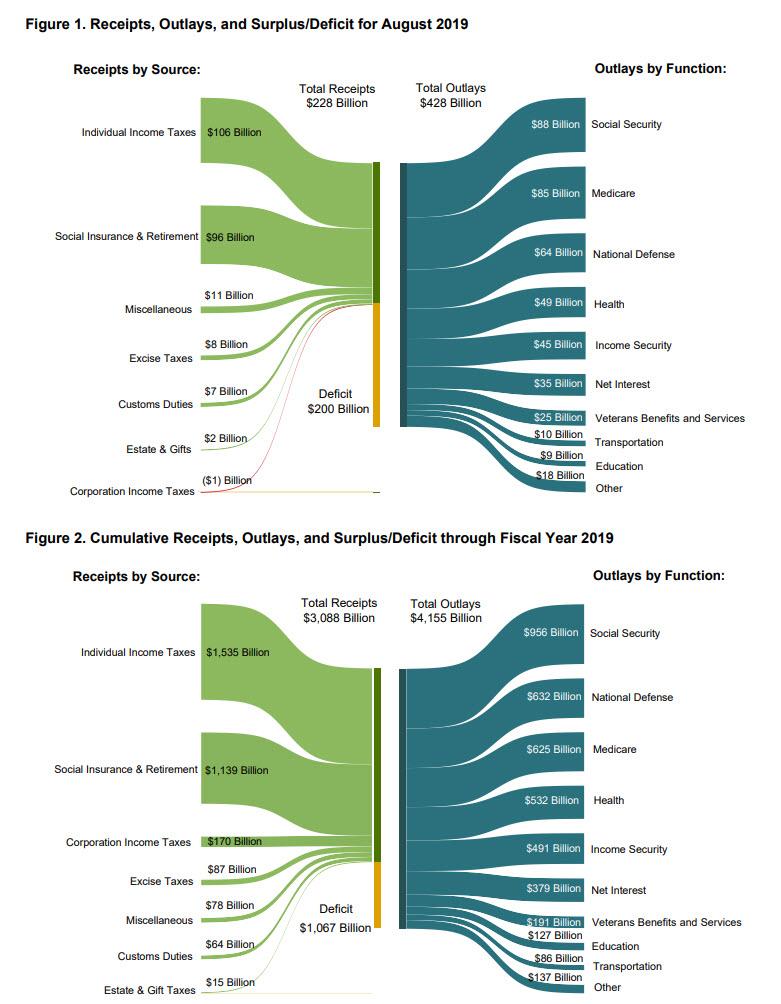
According to the latest budget data, In August, receipts rose 4% y/y to $228.0b in Aug, which however were dwarfed by $428.3 billion in outlays (a 1.1% drop Y/Y). The result was that the August monthly deficit was $200.3 billion, in line with expectations, if fractionally smaller than the $214.1 billion deficit posted in August 2018.
The biggest source of income, at $106 billion was income tax, with social insurance second at $96 billion. On the outlays side, the government spent the most money on entitlements such as Social Security ($88BN) and Medicare ($85BN). It may come as a surprise to some that National Defense was only third at $64BN.
However, more concerning is that on a YTD basis, i.e., the first 11 months of the year, the deficit surged 19% to at $1067.2BN, up 19% compared to $898.1BN last year, with YTD receipts in 2019 up 3.5%, while outlays rose double that, or 7.0%. The August deficit surged despite the gentle nudge from customs duties, which jumped to $64 billion in the fiscal year-to-date from $36.7 billion a year earlier, reflecting the Trump administration’s tariffs on Chinese imports, steel and other goods. Even still, income from duties represents a small share of overall federal revenue.

This means that for the first time since 2011, the US budget deficit will surpass $1 trillion at some point during the fiscal year.
It's not the end of the world yet though, as it’s likely the year-end deficit could narrow from a tax revenue bump. As the chart above shows, September, the last month of the fiscal year, typically produces a surplus because quarterly tax payments are due.

(ZH) The Top Lesson From The Quant Carnage: Too Many Investors Are Poorly Expose

The Top Lesson From The Quant Carnage: Too Many Investors Are Poorly Exposed To Positive News

Over the weekend, Morgan Stanley - once again ahead of its peers - pointed out what it saw as a major, if not the biggest, challenge facing today's market: what if things got better. Separately, three weeks ago - long before Bloomberg published "Carnage in Crowded Hedge Fund Stocks May Mean Some Don't Survive" - we wrote "Crowding Is Now One Of The Biggest Market Risks", in which we explained that virtually all funds are on the same side in both the most loved momentum stocks and most hated value stocks.
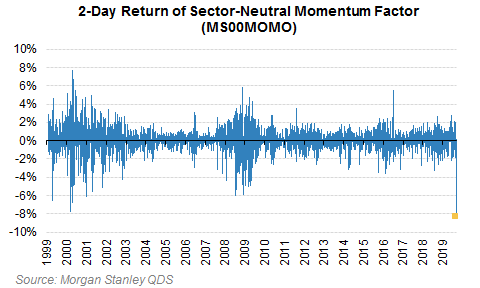
Well, fast forward to this week when the combination of "good news" suddenly dominating the newsflow, together with a massive unwind of the most crowded stocks, led to the historic, worst ever 2-day return in the sector-neutral momentum factor.
As such, looking at the events of this week and asking rhetorically, what are the lessons to be learned, together with what comes next, SocGen's Andrew Lapthorne concludes that the recent events showed that "too many investors are poorly exposed to positive news" and that "value stocks, a portfolio of doom-laden stories as we have seen in recent days, provide such a hedge."

First, a quick step back: for those who may have missed the fireworks of the past few days, that week we saw some of the most extreme factor moves ever, with Value stocks bouncing back strongly and Quality stocks suffering. As SocGen's Andrew Lapthorne writes, "both on Monday and Tuesday, we experienced factor performances unseen in more than ten years, across all major regions."
What is astonishing, however, is that at the same time global equity markets barely moved. "So, this was not the typical Value rally of a bull market, but a strong reversal of the Quality vs Value trade", according to Lapthorne.
To be sure, none of this is a surprise to the SocGen analyst who has been arguing, for some time now, "that Value stocks are extremely cheap and Quality stocks or bond proxies were expensive."
We had a polarised equity market created by collapsing bond yields, which has been a feature of the market since QE came along but went to extreme levels over the summer.
What added to this problem was fear of an impending slowdown and a search for perceived safety; as such "any asset with volatility and drawdown was to be avoided", while value being both volatile and cyclical and having underperformed for almost three years was shunned. Finally, with bond yields plummeting further this summer, Value stocks underperformed further and, more importantly, to a rally in all things “bond-like”.
As such, as both we and Morgan Stanley warned ahead of time, "a strong reversal was always a risk", especially if it was in the form of good news.
What was the trigger for the biggest quant crash in history?
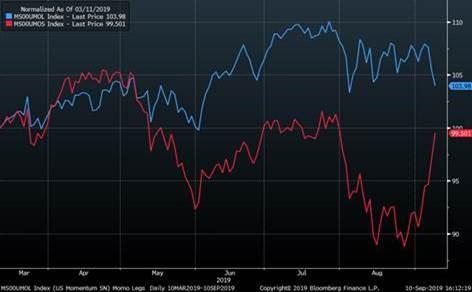
While there are various theories here, the simplest one is perhaps also the right one - a violent trend rejection. Over the past week, as a result of over $100 billion in investment grade bond issuance in September which led to an in kind shorting of matched maturity Treasuries, bond yields broke their downtrend and bounced back strongly. It was the force of the move, however, that highlighted how polarised the markets are as Morgan Stanley pointed out yesterday.
Essentially, as Lapthorne summarizes, the Quality versus Value trade gave back months of gains in two days. As a result, many investors freaked out out as most of the things they own lost money quite quickly. Conversely the one thing they don’t own, Value stocks and cyclical risk more generally, which many were short rallied violently.
And while it remains to be seen if this historic rotation is over, what are the lessons one can draw so far?

According to Lapthorne, the main lesson is that bond risk in equity markets should not be overlooked. SocGen's primary argument for Value was not dependent on accelerating GDP growth or an economic regime change, but largely about the need to diversify interest rate risk, a point it first made a year ago when rates were rising. The same applies today.
As a result, there is (or rather, was) too much bond price momentum priced into asset prices and to hedge this risk investors need to buy cyclical upside, "that might be bank stocks, autos, the Nikkei 225 or Value, which by definition is a portfolio of the world’s problems."
So what happens next?
While value stocks are still attractively valued despite the recent surge, they will likely require positive economic newsflow to extend their rally, because despite some relief from macro fears and trade talks, the economic environment has not changed. This means that rates and credit spread moves following the upcoming central bank meetings will be key to watch. Meanwhile, as we noted earlier today, "value" has already given back some of its gains in Europe following the ECB meeting today.
Irrespective, the biggest lesson to Lapthorne is that "investors need to diversify their bond and bond proxy risk. Too many investors are poorly exposed to positive news" and that "value stocks, a portfolio of doom-laden stories as we have seen in recent days, provide such a hedge."

(ZH) FBI Finally Agrees To Name Saudi Official Who Helped 9/11 Attackers Profile

FBI Finally Agrees To Name Saudi Official Who Helped 9/11 Attackers

Just 18 years after the terrible events of September 11, 2001, The FBI has agreed to provide a key piece of new information about alleged official Saudi involvement following intense efforts by the victims families.
While the alleged mastermind of the Sept. 11 attacks, Khalid Sheikh Mohammed, remains at Guantamo Bay (trial date set for January 2021!), he opened the door in July to helping victims of the attacks in their lawsuit against Saudi Arabia if the U.S. government spares him the death penalty.

And, as The Wall Street Journal reports, victims’ families have urged the government to make more information public, telling President Trump in a letter recently that it would help them “finally learn the full truth and obtain justice from Saudi Arabia.”
The families had sought an unredacted copy of a four-page 2012 summary of an FBI inquiry into three peoplewho may have assisted two of the hijackers in California in finding housing, obtaining driver’s licenses and other matters.
Two of the people, Fahad al-Thumairy and Omar al-Bayoumi, were linked to the Saudi government, according to FBI and congressional documents. The third person, whose name is redacted, is described in the summary as having tasked the other two with assisting the hijackers.
As a reminder, most of the attackers were from Saudi Arabia; Riyadh has denied complicity in the attacks.
In an odd admission, that appears to suggest they are withholding even more evidence, The FBI, citing the “exceptional nature of the case” said it would provide the name of one Saudi official the families’ had most wanted, but wouldn’t release any other information they sought.
Of course, this decision puts President Trump back in an awkward position of maintaining ties with his petrodollar partners who are buying all those arms while being forced to face realities about the Saudis' behaviors.

>>> US Close Dow +0.17% S&P +0.29% Nasdaq +0.30% Russell -0.04%

Closing Stock Market Summary

The S&P 500 advanced 0.3% on Thursday, as positive-sounding trade developments and stimulus measures from the ECB helped extend the market's September rally. The Dow Jones Industrial Average increased 0.2%, and the Nasdaq Composite increased 0.3%. The Russell 2000 (-0.04%), however, finished just below its flat line.

In terms of trade news, President Trump said he will delay the tariff rate increase on $250 billion of Chinese imports to Oct. 15 from Oct. 1. Those goods remain taxed at 25%, but the new 30% rate will be delayed at China's request, as Oct. 1 marks the 70th anniversary of the People's Republic of China. The president also remarked that China is expected to buy large amounts of U.S. agricultural goods. 

Mr. Trump's "gesture of good will" was followed up by a report from Bloomberg News that the president's advisers were considering an interim trade deal with China. This report was later refuted by sources from CNBC, which helped spoil an early rally effort in the stock market. An appreciation that the two sides appear willing to de-escalate tensions ahead of trade talks helped the market rebound.

This sentiment was made evident in the relative strength displayed in the trade-sensitive S&P 500 materials (+0.7%), information technology (+0.5%), and consumer discretionary (+0.5%) sectors. Accommodative measures from the ECB, which cut its deposit rate to -0.5% from -0.4% and announced it will resume quantitative easing on Nov. 1, were other supportive factors for equities. 

The market did lose some steam into the close, though, with the S&P 500 energy (-0.6%) and health care (-0.1%) sectors posting losses. Many energy stocks were pressured by another decline in the price of oil ($55.13, -0.61, -1.1%) amid lingering concerns about oil demand. Downward eurozone growth revisions for 2019 and 2020 from the ECB also weighed on the commodity.

The U.S. Treasury market experienced some noticeable price swings on Thursday. Yields fell in unison with the 10-yr German bund yield following the ECB policy decision. Some factors that helped lift yields back up included a turnaround in the German bund yield, weekly jobless claims that remained at historically low levels, and a stronger-than-expected 0.3% increase in core CPI for August.

The 2-yr yield increased five basis points to 1.72%, and the 10-yr yield increased six basis points to 1.79%. The U.S. Dollar Index lost 0.3% to 98.37, pressured by a rebound in the euro. 

Separately, some story stocks from Thursday included Oracle (ORCL 53.89, -2.40, -4.3%) and SmileDirectClub (SDC 16.67, -6.33, -27.5%). Oracle guided Q2 EPS slightly below expectations and announced its co-CEO Mark Hurd will take a leave of absence for health reasons. SmileDirectClub opened at $20.55 after pricing its IPO at $23 in a disappointing market debut. 

Reviewing Thursday's economic data, which included the Consumer Price Index for August and the weekly Initial and Continuing Claims report:

  • Total CPI for August increased 0.1% m/m, as expected, while core CPI, which excludes food and energy, rose a stronger-than-expected 0.3% (Briefing.com consensus +0.2%). The monthly changes left total CPI up 1.7% yr/yr, versus 1.8% in July, and core CPI up 2.4% (largest 12-month increase since July 2018), versus 2.2% in July.
    • The key takeaway from the report is that it shows budding inflation pressure in core CPI that is apt to keep policy hawks at the Fed squawking about not needing to be overly aggressive with rate cuts at this time.
  • Initial claims for the week ending Sept. 7 decreased by 15,000 to 204,000 (Briefing.com consensus 218,000). Continuing claims for the week ending Aug. 31 decreased by 4,000 to 1.670 million.
    • The key takeaway from the report is the very low level of initial claims, which is indicative of a tight labor market.

Looking ahead, investors will receive the following reports on Friday: Retail Sales for August, the preliminary September reading for the University of Michigan Index of Consumer Sentiment, Import and Export Prices for August, and Business Inventories for July.

  • Nasdaq Composite +23.5% YTD
  • S&P 500 +20.1% YTD
  • Dow Jones Industrial Average +16.5% YTD
  • Russell 2000 +16.8% YTD