FT : Brazilian exports could sustain $10bn hit from US-China trade truce

Brazilian exports could sustain $10bn hit from US-China trade truce
Latin American country had been a big beneficiary of Sino-American economic conflict

Minutes after the US and China revealed their 86-page trade truce this week, Brazilian diplomats on three continents scrambled to parse the agreement and answer a pressing question: were the good times over?

Since the beginning of the US-Sino trade hostilities, the Latin American nation has surfed a surge of demand from Beijing for agricultural produce, particularly soyabeans, which are used to fatten Chinese livestock.

Now, however, the pledge by China, the dominant importer of the oilseed, to buy $200bn in US goods and services over the next two years — one of several concessions to Washington in their “phase one” trade deal — has stoked concerns that demand for Brazilian produce could collapse, with some analysts forecasting a $10bn hit to exports and a fourfold increase in excess stocks.

“If — again, if — the volumes agreed to in the deal do indeed come to fruition, yes, it will have an effect on Brazil’s exports. The second half of 2020 could be a major problem for Brazil,” said Pedro Dejneka, partner at MD Commodities.

“If the US and China live up to the deal and China likely buys heavy volumes of US beans, it could be Brazil that is left standing in this game of musical chairs, with potentially more than 10m metric tonnes of beans left over by year end.” 

The sentiment was echoed by Marcos Casarin, chief Latam economist at Oxford Economics, who said a $10bn surge in Brazilian exports to China last year could be in jeopardy.

“I think it’s safe we assume that these are agriculture imports. Assuming China reduces imports from Brazil by the entire $10bn — which may be a worst-case scenario — then we could see a negative shock of 4 per cent to Brazil’s [total] exports.”

With a combined population of more than 1.6bn, the trade relationship between Brazil and China is among the world’s most important. China is Brazil’s largest trading partner, with Beijing reliant on the Latin American country for the agricultural goods, iron ore and crude oil to fuel its economy.

Despite analysts’ fears, Brazilian officials have adopted a more sanguine attitude to the deal brokered in Washington, acknowledging that while it was likely to face stiffer competition, the US-China trade war had not been expected to last for ever.

“We still have to keep in mind the impact on the main products exported by Brazil depends not only on the volume of Chinese imports, but also on the ability of the US to effectively supply them,” said Flávio Bettarello, deputy secretary of commerce and international relations at the Ministry of Agriculture.

“Eventually, Brazil may occupy third markets that will no longer be served by US products redirected to China,” he added.

Welber Barral, a former foreign trade secretary, agreed, saying Brazil will now “sell to other destinations at a little lower price”, without the high demand from China to help support prices.

“It will not change production at all. Last year Brazil exported at a premium and the US exported to other destinations with more logistical difficulties and at a lower price,” he said.

According to MD Commodities, soyabean exports to China accounted for 83 per cent of Brazil’s total soyabean exports in 2018, up from 74 per cent in 2016. By contrast, Spain and Thailand, respectively the second- and third-largest buyers of Brazilian soyabeans, accounted for less than 3 per cent each.

Brazil is expected in the coming months to overtake the US as the world’s largest soyabean producer thanks to the impact that extreme weather and the trade war have had on American agriculture. Brazil’s soya crop is expected to reach 120m tonnes, up from less than 100m tonnes in 2015.

The agricultural lobby, particularly Brazil’s soyabean farmers, also remains a powerful political force and a crucial part of President Jair Bolsonaro’s electoral base.

More broadly, Brazilian officials hope the US-China deal can aid the nation by soothing the nerves of international investors and traders, who had shied away from emerging markets like Brazil because of global trade tensions. 

“The agreement provides greater stability, which, even indirectly, favours Brazil. We expect a reduction in volatility and an improvement in the business environment in the coming months,” said Mr Bettarello.

“From a systemic point of view, we see the deal with good eyes, as a hostile climate between two of the world's leading players undermines the predictability of international trade and is undesirable for the sustainable growth of the world economy.”

Barron's : It May Be Time to Shop for Shares of U.K. Property Firms

It May Be Time to Shop for Shares of U.K. Property Firms

Property firms with a big exposure to shopping malls and retail centers have been hit hard by shifting consumers habits as more shoppers buy clothes, groceries, and other goods online.

Shopping center values in the United Kingdom fell by 27% on average last year, and rents were down by 26%. But values may have declined too much, and there could be retail property bargains as consumers seek new and different shopping experiences, such as cooking demonstrations and beauty makeovers.

Britain’s largest property firms, including British Land (ticker: BLND.UK), Land Securities Group (LAND.UK), Hammerson (HMSO.UK), and Intu Properties (INTU.UK), all own prime retail sites and have seen their values depressed. Over the past three years, shares of Intu, which is almost exclusively focused on retail property, crashed 88.8%, Hammerson slumped 47.3%, British Land fell 2.8%, and Land Securities lost 6.1%.

Slower growth in consumer spending since 2015 has not helped, but the crisis in retailing in general has been caused by high costs, low profitability, and sales migrating online.

Last year, many retailers in the U.K. went out of business, with 43 major chains failing—2,051 stores were affected along with 46,506 employees, according to the Centre for Retail Research.

But Mat Oakley, head of commercial research at real estate firm Savills, says that more than 80% of purchases anywhere in the U.K. touches a retail store in some way. “Retail is undoubtedly a cold, hard place to be in at the moment, but 2020 will be the year when we start to see some investors capitalize on the falls in prime yields,” he says. “With capital values on prime retail schemes having fallen by 20% or more in the past two years, the point at which a major investor calls the bottom of the cycle may not be far away.” Savills expects that a “major opportunistic investor” will take a big position in U.K. retail this year.

Hammerson, Intu, Land Securities, and British Land are good bets for investors looking for a rebound in retail, but it would be wise to be selective.

Hammerson owns London’s Brent Cross shopping center and Birmingham’s Bullring. It has a market value of 2.3 billion pounds sterling ($3 billion) and a share price of £2.86. It is well run and focused on investing in its flagship malls for shoppers looking for a “day out.” Deutsche Bank has a Buy rating with a target price of £4.40—a hefty 53% premium to the current share price.

Land Securities, a real estate investment trust that owns shopping centers and retail warehouse properties, has a market value of £7.3 billion and shares that trade at £9.79. Broker Panumure Gordon has a target price of £10.28, a more modest 5% premium to the share price.

British Land, which has a share price of £6.19 and market value of £5.7 billion, could be a better bet than Land Securities because of its strong development pipeline. Deutsche Bank has a target price of £6.30.

But Intu, which has a market value of £426 million and a share price of 31 pence, is least attractive. In a November note, Tom Musson, an analyst at broker Liberum, warned that it has “legacy cash-flow liabilities, a portfolio in need of increasingly high maintenance to stay competitive, and structural above-average and inflexible financial gearing.”

He set a target price of 28 pence, saying that “the current share price implies a further 25% decline in property valuations.”

(WRB) China’s Growing Economic Miracle…(Collapse). Or… Everyone Pays the Piper!


China’s Growing Economic Miracle…(Collapse). Or… Everyone Pays the Piper!
By: Brett Redmayne-Titley

In emulating the American economic raison d’etre, China has attempted to develop its unique capitalist model while ignoring that it too will soon suffer the same fate for the same reason: Unsustainable debt. When examining the recent realities of Chinese banking and finance over the past year it seems the steam that president Xi Jinping touts as powering the engine of his purported economic miracle of a master-planned economy is only a mirage, now almost completely evaporated before his eyes.
Like the many other similarly foolish western nations, China seeks only one path out of this fiscal death spiral, one that will likely spell doom and/or revolution in many countries soon: More debt.
China is becoming increasingly unable to continue to pay into the base of the world’s largest pyramid scheme of an economy and the cracks in the bubble are showing. This past year, saw three of the 4,279 Chinese lenders almost fail, if not for the massive intervention by the People’s Bank of China (PBoC) of immediate liquidity via more debt. The Chinese economic miracle is built on unsustainable debt-based infrastructure projects over the past two decades that have provided China with a face of prosperity to show the world, but this is only a mask to hide the limited countrywide success of the Chinese miracle into the rural areas. The injection of $Trillions in capital has seen China distribute these sums across the base of its economy creating a GDP that hit a high of 14.2 % in 2007 then averaged nearly 9% for the next decade before dropping yearly to 6.1% in 2018. All this growth had produced a personal affluence to a sub-set of Chinese society that has stoked this appearance of a flourishing economy.
This Chinese economic Keynesian trick of interjection of liquidity into national infrastructure is somewhat similar to the TVA and national works projects funded under Roosevelt’s depression-era New Deal. In this approach employment and therefore a growing tax base accelerated year after year as workers and corporations received the short-lived benefits of this massive windfall of available liquidity.
China’s method of stimulus is of course distinguished from today’s American model that merely shovels the injection of its own manufactured $Trillions by using multiple fiscal tricks to by-pass the citizenry and instead shovel the cash straight into the wallets of the already super-wealthy. Meanwhile, the US peasant once again pines in the “Hope” of yet another election.

The Metrics of a Failing Economy.

Many analysts have for nearly a decade opined that China’s belief in national fixed-asset investment, the biggest engine of China’s economy, has long been the fundamental contributor to Chinese GDP growth, which was directly proportional to an ongoing increase in public and private debt. “China has relied on export and debt-financed fixed asset investment for growth for over two decades,” said Ho-Fung Hung, Professor in political economy at the Johns Hopkins University.

But as the world economy slows while the metrics show a recession looming China’s economy is already cooling rapidly. “And as the central government and banking system keeps producing new loans to absorb the debt, it leads to the continuous debt buildup,” Maximilian Kärnfelt, an analyst with the Berlin-based Mercator Institute for China Studies, told news service DW, adding that infrastructure investment still largely drives China’s economic growth since fixed investment contributed to 45 per cent of China’s GDP in 2016.

In a sign of the disaster to come, the first Bank to almost fail was Baoshang Bank Co. in May 2019. In this instance, for the first time in twenty years, the government took over control and seized the bank. This progression next took form when Chinese regulators took a different approach by ordering three state-owned financial institutions to buy significant stakes in Bank of Jinzhou Co. When, Shandong-based Heng Feng Bank, which had failed to disclose its financial statements for two straight years, required a bail-out, the bank sold new shares for about $14 billion to a group of investors including a unit of China’s public sovereign wealth fund and a local government-backed asset management firm.

Although these were some of the smaller rural banks, as shown this past month in Chinese reports, their economy is following the world in a quantified slowdown that has seen GDP slip yearly since 2012. Making the matter worse a similar world slow-down in purchasing is already affecting China’s manufacturing-based economy. The three bank failures were only the tip of a huge iceberg.

China’s $40 Trillion banking system dwarfs the American system at double the size, with over 4,000 small, medium and massive, state-owned banks. The world’s four largest banks, including behemoth ICBC ($4TN), are all Chinese.
The failure of just three banks was important enough that Chinese regulators submitted Chinese banks to a stress test and the results were shocking. China’s central bank admitted that China’s banking sector is “showing signs of strain.” The stress tests had revealed that over 13% of China’s 4,379 lenders were designated “high risk” by the central bank’s report. With this amounting to over 570 banks, and thus multiplied by the three existing examples of bank bail-out funding, with the Chinese economy following the world into recession, the financial numbers and likelihood of any future series of bail-outs are truly biblical. If not, fiscally impossible.
Separately, the PBOC also stress-tested 30 medium- and large-sized banks in the first half of 2019. In the base-case scenario, assuming GDP growth dropped to 5.3% – or well above where China’s real GDP is now nine out of 30 major banks failed and saw their capital adequacy ratio drop to 13.47% from 14.43%. In the worst-case scenario, assuming GDP growth of 4.15%, or just 2% below the latest official Chinese GDP report, seventeen out of the thirty of these major banks failed the test. Separately, a liquidity stress test at 1,171 banks, representing nearly three-quarters of China’s banking sector by total assets, showed that ninety failed in the base-case and 159 in the worst-case scenario. The metrics of any collective bail-out indicates that China has upwards of an insurmountable $20 trillion problem rapidly approaching.

In reaction to these first three bank failures, the stress tests and poorer economic news China did what centrally planned economies do: Chinese policymakers focused on strengthening oversight and regulation by the PBoC and gave it authority to write new rules for much of the financial sector. The China Banking Regulatory Commission and the China Insurance Regulatory Commission will now be merged as part of an overhaul aimed at resolving existing problems such as unclear responsibilities and cross-regulation as well as closing regulatory loopholes and curbing risk in the $40-43 trillion (€34.78 trillion) banking and insurance industries.

With the metrics of China’s banking system already pause for considerable concern to the tune of $20 Trillion, this huge obligation is as much a mirage as the economy since it fails to add to the account the very large and un-tabulated Shadow Banking loans which would add $Trillions in debt to China’s already highly leveraged systemic banking risk. The International Monetary Fund (IMF), which provides- despite its predatory legacy- some excellent yearly analysis of worldwide economic developments has warned China’s problems could lead to “financial distress” in the world’s second-biggest economy. China is seen as one of the economies most vulnerable to a banking crisis, although Beijing has repeatedly assured that the risks are under control. In response to the PBoC reports, Chinese Finance Minister Xiao Jie echoed that the situation “was under control.”
China’s Economic Tricks of Sustainability.
As the world economic body politic runs out of any remaining gas to keep a pilot light under the rapidly cooling metrics that show their long forestalled recession is near and certain, China is also contracting.
The national debt of China, which is the total amount of money owed by the Chinese government and all organizations and branches stands at nearly CNY 38 Trillion ( $5.4 TN) and 54.44% of GDP.
Chinese debt has been accumulating ever more rapidly. The Institute for International Finance (IIF) reported that year-on-year, in Q1 of 2019 China’s corporate, household and government debt increased 6% more from 297% of GDP to an incredible 303%. However, this is also more than a 100% increase since 2008 and amounts to 15% of all global debt.
These figures do not include the off-the-books “Shadow Banking loans that some estimates predict would triple that debt percentage to much closer to $16 Trillion. The problems are most serious in China’s rural banking sector where an ever nervous public has reacted with two late-2019 bank runs at China’s Henan Yichuan Rural Commercial Bank and then at Yingkou Coastal Bank.

At the end of 2018, the budget deficit of the Chinese government was close to five per cent. However, if the off-balance-sheet (“shadow”) financing of local governments is taken into consideration, the budget deficit rises to over 11 per cent. However, at the end of 2014, the official government deficit stood at less than one per cent, but an accounting which includes local “shadow” funding was around five per cent.

China’s shadow banking system is so-called since this myriad of endemic lending trickery is believed to be massive in total and kept off the books. These risky, undisclosed loans entered China’s financial system in 2009 throwing open the doors to debt for a Chinese population hungry for investment in order to pay for all those Chinese and internationally made western goods.

The main kind of shadow deposit is generally offered as a wealth management product (WMPs). Chinese banks offer these via aggressive marketing of high-interest-rate accounts as their alternative to savings accounts which are regulated to a maximum return of 3 %. Since these sanctioned shadow loans advertise a return of as much as 8% or more, normal banking customers have been throwing their miraculously large paychecks into these funds by the billions.

One reason WMPs offer higher rates is that they are based on much riskier bank loans, much like the precursor to the late ’80s, early ’90’s American savings and loan meltdown. Incredibly, banks don’t hold these loans on their balance sheets or set aside capital against their potential defaults. Instead, they typically extend this debt via intermediaries called trust companies—firms that are not allowed to accept deposits or formally loan out money but are allowed to manage it. The trust companies create investment products like WMPs, which banks market for them in return for a commission.

With some smaller Chinese banks having already found themselves either getting bailed out or the subject of a bank run, one reason is that, like America, China’s interbank/repo rates have surged amid growing counterparty concerns of the many banks seeking depleting available liquidity. This has forced many banks to rely almost entirely on new deposits to fund themselves, forcing them to hike their deposit rates to keep their funding levels stable. Like any Ponzi trick in banking, new cash is required to sustain these thousands of lending pyramids. With the economy in decline, this need has lead to some desperate regional banks offering incentives for depositor’s cash that would make the long-ago American “free toaster” seem ordinary.
China has a massive pork famine that has seen disease wipe out 40% per cent of its pig population in 2019. With China being the world leader in pork consumption these bank’s desperations have created some interesting incentives to attract depositors. The SCMP reports that new clients who deposited 10,000 yuan (US$1,430) or more in a three-month time deposit at the Linhai Rural Commercial Bank in Duqiao in Zhejiang province were then eligible to enter a lottery to win a portion of pork ranging from 500 grams (18 ounces) to several kilograms. Other rural commercial banks in northern China’s Hebei province and western China’s Guizhou province have also launched similar pork rewards programs. Dushan Rural Commercial Bank, located in the remote mountainous county in Guizhou, offered a coupon for 10 yuan (US$1.4) worth of pork for every 10,000 yuan of new deposits.
This solution has been touted as uniquely beneficial to these banks since, instead of offering higher rates which only accelerate the bank’s insolvency due to requiring higher payouts on deposits, the bank is instead making a one-time payment, and the unusual incentive is enough to garner substantial new deposits.

PBoC cuts in its key lending rates in August ’19 designed to stimulate a slowing economy have only exacerbated net interest margin pressures on these banks. With less income from returns
on their loans and without the many funding options available to China’s much larger banks, these increasingly high-interest rates that China’s smaller banks have to offer in order to attract new cash deposits could further lead to their insolvency.

It’s been over four years since the last official Chinese benchmark rate cut. With America leading the way across the globe with rate cuts aplenty and China still having a base rate of far higher than the US rate of < 1.5%, it was only a matter of time for China to also drop rates.

With the new authority given to the PBoC, this key Loan Prime Rate (LPR) has become the new Benchmark Reference Rate to be used by banks for lending. This, like most recent decisions are designed to interject further liquidity in the form of debt once again into a still failing economy by lowering borrowing costs for small businesses. This rate will be now set monthly (20th of every month) and will be linked to the Medium-term Lending Facility rate. The current 1 year LPR stands at 4.15% after its latest cut on Nov 30 versus the Benchmark Rate of 4.35%. This number is sure to continue to shrink and can be considered a key indicator of Chinese frustration at retaining needed annual GDP growth since the result of this one move lowered the costs of the roughly 152 trillion yuan ($21.7 trillion) in yuan-denominated outstanding loans held by financial institutions (that are actually on the books) in a further hopeful attempt to again boost economic growth.
Just mere days after the 20 bps cut the PBoC further highlighted its desperate need for capital, announcing that it will be lowering the required reserve ratio (RRR) – or the amount of money banks are required to have on hand – by 50bps for commercial lenders.Currently, the required reserve ratio is 13% for large banks and 11% for small banks. The cut, which is the first since September, will bring the blended reserve ratio for Chinese banks to the lowest level since October 2007. In doing so PBoC effectively released about 800 billion yuan ($115 billion) in instant liquidity from out of the already cash-strapped financial system.

All these adjustments by China and the PBoC do little to control or pay-off increasing debt and are designed to maintain the Chinese miracle of TVA style infrastructural improvements that has been the employment engine of its economic growth. China’s new development of the Belt and Road Initiative (BRI), although a masterstroke in Eurasian commerce, also serves to continue the illusion.

As traditional monetary policy becomes ineffective to boost the economy, Chinese President Xi has installed twelve former executives at the state-run financial institutions across the country who will support the communist government’s ability to combat banking and debt difficulties, reported Taipei Times.

These appointments are in response to growth collapsing to a three-decade low in 2019. New manufacturing orders did increase but this was in large- and medium-sized enterprises. Small enterprises continued deeper into contraction and new non-manufacturing orders slowed, pushing employment further into quantified contraction.

An easier to understand recessionary metric, passenger car vehicle sales, fell yet again in December, plunging 3.6% to 2.17 million units, according to the China Passenger Car Association. This marks the 18th drop in the past 19 months for the country. Sales fell 7.5% in 2019 and 6% in 2018. GM said that its sales were down 15% in China and said that pressure into 2020 would likely continue.
Meanwhile, local Chinese manufacturers’ numbers are also down. BYD Co. posted an 11% drop in 2019 sales and SAIC Motor reported a “similar decline”.
Worse, exports to the United States were down 23% from the prior year.


Running from the Piper’s Call.

But, it seems that China has no choice but to carry on with the façade of financed infrastructure projects as the only path to survival. Said Victor Shih, an associate professor of political economy at the University of California in San Diego;

“Because it [infrastructure investment] already is a large contributor to growth, the slowing investment will substantially reduce growth rates. This is not what the leadership wants.”

Shih’s assertion seemed confirmed when last year, President Xi said Chinese banks would lend 380 billion yuan ($55.09 billion) to support Belt and Road cooperation, and Beijing would also inject 100 billion yuan into a Silk Road Fund. Some observers view the project as an instrument designed to help the Chinese economy, with state-owned companies in specific sectors expected to profit massively from its implementation.

But they still need funding and Chinese banks on their own volition may be reluctant to get involved when already having troubles of their own. Andrew Collier, managing director at Orient Capital Research, says

“The banks [may] remain leery of these projects because they doubt they will be profitable and they will be stuck with bad loan. In the end, we are going to see increasing defaults among smaller institutions, the collapse of private loans via wealth management products, and growing layoffs in areas of the country with less political power.”

Making matter worse, a study conducted by the Center for Global Development estimates that the initiative could increase debt sustainability-related banking problems in eight countries also involved in the BRI.

“I still think that if growth falls below a certain level, the top leadership will order a stimulus, which involves acceleration in debt growth,” said Victor Shih. “That is the only viable tool in China’s arsenal if the economy slows too much.”

As noted in a recent article by University of Helsinki economics professor Tuomas Malinen, China has stimulated its economy aggressively in Q1 and Q3 2019 but interestingly has not continued its past emphasis on infrastructure investments as in 2015/2016. Q3 of 2019 saw record-breaking stimulus programs, however, China concentrated instead on providing loose credit to enterprises through both conventional and “shadow” banks.

As Malinen forewarns:

“What is notable is that even with this record stimulus, China has kept its economy growing barely above the ‘official rate’. This tells us that the Chinese economy has reached or is very close to reaching the point of debt saturation, where households and corporations simply cannot absorb any more debt, and any new debt-issuance fails to stimulate the economy.”

Though a massive infrastructure-spending program could revive growth, the ability of China to issue fiscal stimulus is starting to be seriously limited. This effectively means that China is fiscally unable to underwrite massive infrastructure projects and so any new world-economy-saving stimulus from China, as in 2015/2016, will be practically impossible. New infrastructure initiatives- if recessionary metrics continue to deteriorate- could only be realized if those costs are directly monetized by the PBoC. This would be the weapon of last resort for China but , when considering a declining economy, may soon be inevitable.

As Goes China…?

China is just one more working example of the failure of the many globalist economies worldwide that are already similarly suffering in the grip of massive unsustainable- if not orchestrated- debt. Which country becomes the first to trigger the almost certainly pending domino effect of global economic collapse, is merely a rhetorical question at this point. As goes China…?
This week in an interview, former Reagan OMB director David Stockman highlighted the global economic link to China, saying,
“The world economy would be not nearly as good as it looks had the Chinese not been borrowing like there’s no tomorrow and building regardless of whether its efficient or profitable.”
Stockman added, in summation,
“The whole global economy is really dependent on China piling even more debt onto the $40 trillion pile they already have.”
China economically continues to play the financial role of Kenneth Lay to its American mentor’s Bernie Madoff. But in the last few months China has shown, like so many other so-called first world economies, that it too is now all-in at the casino and using only borrowed money in a desperate effort to stay at the table…or starve.
Worldwide, many countries already burn in political turmoil of their own debt-ridden making as their own primal forces of nature squeeze their populations with the resultant new mantra of ever increasing austerity while the IMF and World Bank waits in the wings, salivating to gobble-up the carcass.
Alas, when it comes to unsustainable national endemic debt one primal truth is now being heard clearly in China, as in other Central bank boardrooms across the globe, and the empty dinner plates of their public…
When the time comes to pay the piper, that debt will be paid, no matter…but the Piper will take, in lieu of payment, pork, flesh, blood, or… dreams!

(ZH) Retail Carnage Continues: Bose Lays Off 100s, Shutters All Retail Stores

Retail Carnage Continues: Bose Lays Off 100s, Shutters All Retail Stores

Taking the award for Most Continents Covered While Shrinking Retail Footprint this week is Bose, which will be laying off hundreds of employees to close retail stores across the world.
The company plans on closing its entire retail footprint in North America, Europe, Japan, and Australia, according to The Verge. It adds up to a total of 119 stores, according to a spokesperson. The closures are slated to happen "over the next few months".
And the company was direct in why it was making the move: it stated this week that its products “are increasingly purchased through e-commerce”.
The company has had a brick and mortar presence since 1993 and has locations across many shopping centers and malls scattered around the U.S. The stores help showcase the company's headphones, speakers and other hardware. But there are usually similar demo areas in stores like Best Buy, which still sells Bose products.


The company hasn't said exactly how many people would be laid off, stating:
“Originally, our retail stores gave people a way to experience, test, and talk to us about multi-component, CD and DVD-based home entertainment systems. At the time, it was a radical idea, but we focused on what our customers needed, and where they needed it — and we’re doing the same thing now.”
Colette Burke, vice president of Global Sales, continued:
"It’s still difficult, because the decision impacts some of our amazing store teams who make us proud every day. They take care of every person who walks through our doors – whether that’s helping with a problem, giving expert advice, or just letting someone take a break and listen to great music. Over the years, they’ve set the standard for customer service. And everyone at Bose is grateful.”
The company says it will keep stores open elsewhere:
“In other parts of the world, Bose stores will remain open, including approximately 130 stores located in Greater China and the United Arab Emirates; and additional stores in India, Southeast Asia, and South Korea.”
The company also says it is offering outplacement assistance and severance to employees.
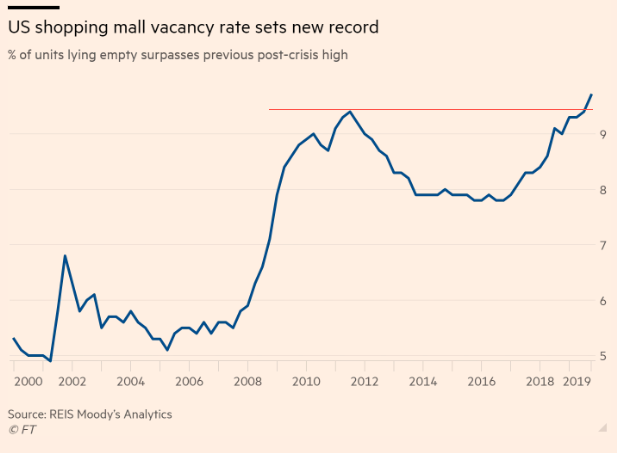
Meanwhile, the move may not surprise Zero Hedge readers, as we noted just two days ago that mall vacancies are hitting two-decade highs.
US retailers announced 9,300 store closings in 2019, according to Coresight, indicating that the retail apocalypse and a massacre of malls are far from over. Mall operators saw a surge of store closures in 2H19 and ahead of Christmas despite a relatively stable consumer that has been leveraging up via the use of credit cards.
Barbara Denham, a senior economist at Reis, said one notable trend during the 2019 holiday season was the shift in spending habits from brick and mortar stores to online. Denham said recent vacancy statistics paint a disastrous picture for shopping malls as vacancy rates have surged to a record high of 9.7%.

(ZH) All The World's Wealth In One Visualization

All The World's Wealth In One Visualization

The financial concept of wealth is broad, and it can take many forms.
While your wealth is most likely driven by the dollars in your bank account and the value of your stock portfolio and house, Visual Capitalist's Jeff Desjardins notes that wealth also includes a number of smaller things as well, such as the old furniture in your garage or a painting on the wall.
From the macro perspective of a country, wealth is even more all-encompassing — it’s not just about the assets held by private households or businesses, but also those owned by the public. What is the value of a new toll bridge, or an aging nuclear power plant?
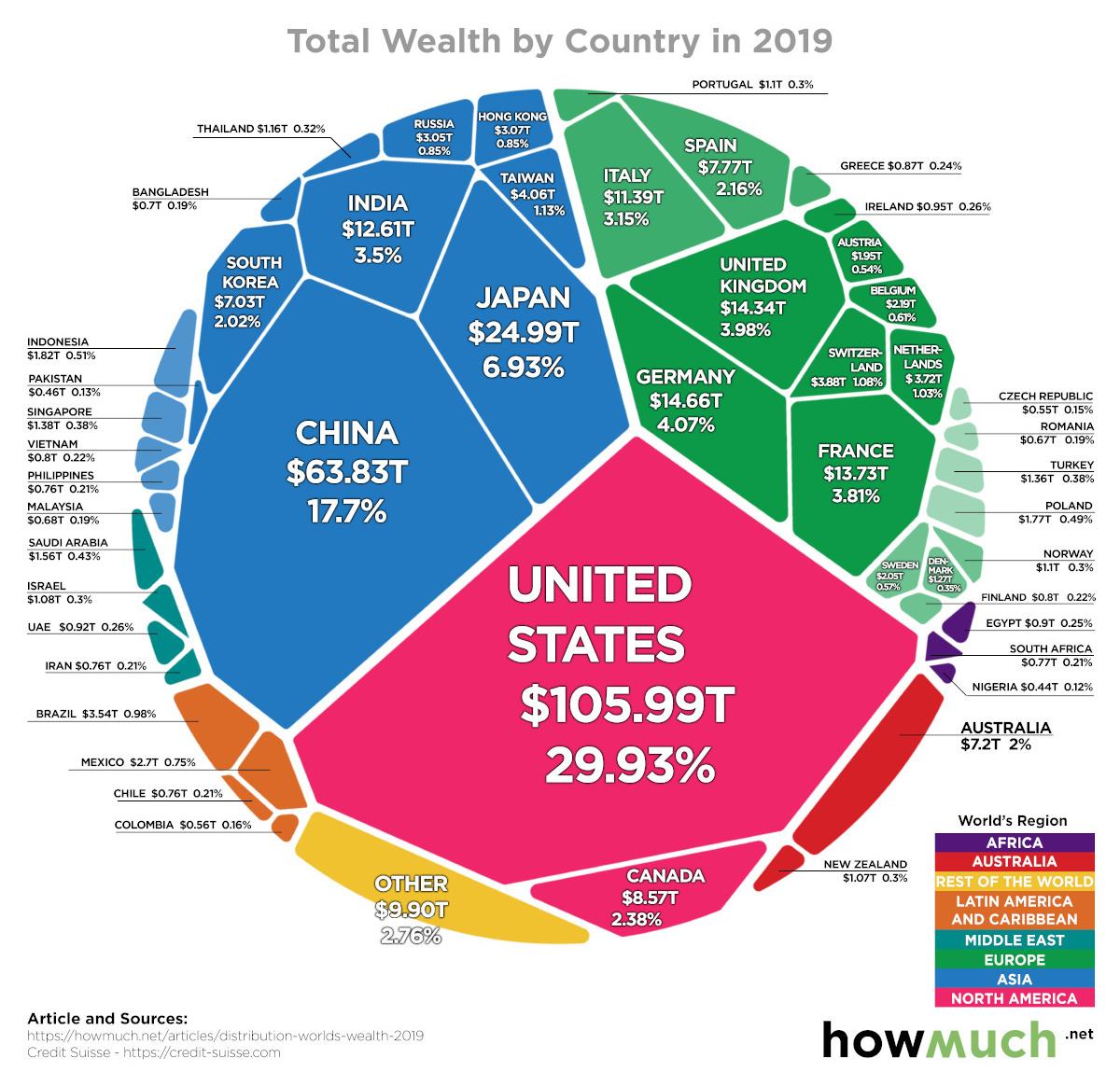
Today’s visualization comes to us from HowMuch.net, and it shows all of the world’s wealth in one place, sorted by country.


Total Wealth by Region
In 2019, total world wealth grew by $9.1 trillion to $360.6 trillion, which amounts to a 2.6% increase over the previous year.
Here’s how that divvies up between major global regions:
Last year, growth in global wealth exceeded that of the population, incrementally increasing wealth per adult to $70,850, a 1.2% bump and an all-time high.
That said, it’s worth mentioning that Credit Suisse, the authors of the Global Wealth Report 2019 and the source of all this data, notes that the 1.2% increase has not been adjusted for inflation.
Ranking Countries by Total Wealth
Which countries are the richest?
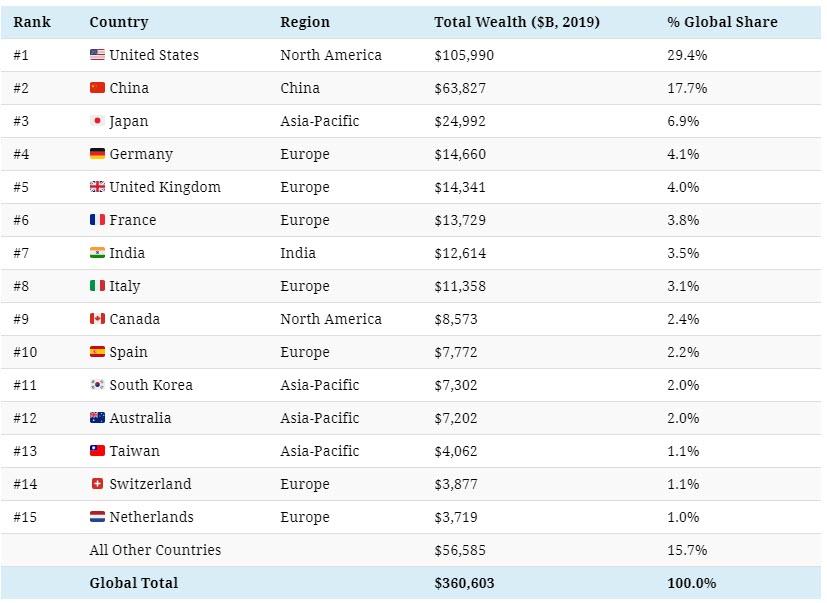
Let’s take a look at the 15 countries that hold the most wealth, according to Credit Suisse:
The 15 wealthiest nations combine for 84.3% of global wealth.
Leading the pack is the United States, which holds $106.0 trillion of the world’s wealth — equal to a 29.4% share of the global total. Interestingly, the United States economy makes up 23.9% of the size of the world economy in comparison.
Behind the U.S. is China, the only other country with a double-digit share of global wealth, equal to 17.7% of wealth or $63.8 trillion. As the country continues to build out its middle class, one estimate sees Chinese private wealth increasing by 119.5% over the next decade.
Impressively, the combined wealth of the U.S. and China is more than the next 13 countries in aggregate — and almost equal to half of the global wealth total.

FT : New glitch found in 737 Max software

New glitch found in 737 Max software
Technical review finds flaw when grounded Boeing jet powers up

Boeing has found a new glitch in the software of the 737 Max jet during a technical review, according to a person familiar with the matter.

The company said in a statement that it was “making necessary updates and working with the [Federal Aviation Administration] on submission of this change, and keeping our customers and suppliers informed”.

The software was part of a system that starts when the aircraft powers up and checks that the jet’s other systems are operating correctly, according to the person. During the technical review, Boeing found that one of the checks to monitor other systems did not start correctly.

The technical review was required to help identify and fix problems such as this one, the person said.

The 737 Max has been grounded since March following two crashes in a five-month span that killed 346 people. A flight control system known as the Manoeuvring Characteristics Augmentation System, or MCAS, could push down the nose of a plane based on input from a single sensor. The software was meant to help pilots avoid a stall, but it has been implicated in the crashes.

It is not unusual for problems to surface when a plane is scrutinised during development and testing, said Kevin Michaels, managing director of Aerodynamic Advisory.

The bigger question is how the problem will affect the date the Max returns to service. The FAA must sign off on the jet before it returns to the skies. Even if the US regulatory agency authorises the jet to return to the skies this spring, Mr Michaels said: “You’ve got these wickets to go through at the airlines to get these things back in service.”

Boeing reversed direction last week and recommended simulator training for Max pilots, which means airlines will need to secure two to four hours of simulator time for each one of their thousands of pilots.

American Airlines, Southwest Airlines and United Airlines have removed the plane from their flight schedules until June.

Also on Friday, Fitch Ratings downgraded Boeing’s long-term rating to A- from A, citing “continued regulatory risk regarding the timing and global sequencing of the 737 Max’s return-to-commercial service” as well as the challenge of catching up on deliveries and potential damage to the supply chain while production is halted.

Boeing shares closed 2.4 per cent lower at $324.15 on Friday.

FT : CDC recommends avoiding e-cigarettes that contain THC

CDC recommends avoiding e-cigarettes that contain THC
US health officials retreat from broad recommendation against vaping products

US health officials retreated from a previous warning about e-cigarette use, instead recommending that people not use THC-containing e-cigarette or vaping products.

The Centers for Disease Control and Prevention recommended that people not use e-cigarette, or vaping, products that contain tetrahydrocannabinol, the psychoactive component in cannabis, “particularly from informal sources like friends, family, or in-person or online dealers”.

The CDC found that “82% of hospitalised patients with data on substance use reported using THC-containing products; 33% reported exclusive use of THC-containing products”. It also said vitamin E acetate, an oil chemical used to dilute THC, “is strongly linked” to the lung disease (EVALI) associated with vaping.

In September, the CDC had cautioned against using e-cigarette products as it investigated vaping-related lung disease, saying people “should consider” avoiding vaping altogether.

The federal agency on Friday said emergency visits related to vaping have continued to fall after surging in August last year and peaking the following month.

The weekly emergency department visit rate peaked at 116 per million in September 2019 and fell to about 35 per million earlier this month. The agency attributed the decline to increased public awareness, removal of vitamin E acetate from certain products and law enforcement actions related to certain products.

The CDC also maintained that “adults who do not currently use tobacco products should not start using e-cigarette, or vaping, products”.

The growing e-cigarette market has come under scrutiny as regulators probe various illnesses and use of the devices among young people.

The CDC said 60 deaths have been confirmed in 27 states and the District of Columbia.

Barron's : The Method Behind the Melt-up: Why the Dow Won’t Stop at 30,000

The Method Behind the Melt-up: Why the Dow Won’t Stop at 30,000

The Dow Jones Industrial Average is going to hit 30,000—and don’t expect it to stop there.

Granted, to call Dow 30,000 at this point doesn’t take a lot of guts. It rose 524.33 points, or 1.8%, to 29,348.10 this past week, an all-time high. It was also the Dow’s first weekly close above 29,000, and with just 651.90 points to go—2.2%—30,000 appears almost inevitable. In fact, Barron’s predicted in 2017 that the index would hit the big round number, though we were too conservative in the timing: We targeted the year 2025. The Dow might well hit that target five years ahead of schedule.

The market’s rapid rise has been astonishing—the Dow has gained 2.8% so far in 2020, which translates into a 85% rise over the course of a full year—and has left observers searching for explanations. Some point to the phase-one trade agreement signed by the U.S. and China this past week, which will supposedly get the global economy zooming again. Others credit the Federal Reserve’s balance sheet, which has been growing, some say, because of its operations to support the repurchase-agreement market. Whatever the reasons, though, something seems off. “It feels like there is something unnatural happening now,” says Chris Harvey, head of equity and quant strategy at Wells Fargo Securities.

Maybe. But there might be a simple reason for the market’s rally. Investors are responding to a set of conditions—low interest rates, muted inflation, and massive cash returns from U.S. companies—that make putting cash into stocks the most rational thing they can do.

It wasn’t that long ago that the stock market was stuck in a no-man’s-land, caught between worries of a recession and hope that the Fed could help avoid one. The central bank lowered interest rates three times in 2019, which certainly helped matters, but it went even further in October, when Fed Chairman Jerome Powell said that it would not raise rates until inflation started heating up.

Nothing since then suggests that it has—wages grew by less than 3% in December, for instance—and the 10-year Treasury yield, which would rise if investors were worried about rising prices, still sits at 1.83%, just slightly above where it was three months ago. That does create a predicament for investors, particularly those seeking yield—and the solution has been in the stock market. “As long as inflation is down, reach for yield drives the market,” says Edward Yardeni, president of Yardeni Research.

Under those circumstances, the S&P 500 index is a perfectly rational place to park your money. Some 80% of the companies in the index boast cash-return yields higher than Treasuries. And while stocks look expensive on just about every metric one can find—the S&P 500’s price/earnings ratio of 18.9 is the highest since the aftermath of the dot-com bubble. Yet there is one metric by which stocks still look cheap: price-to-cash returns.

That’s the preferred metric, says Dennis DeBusschere, strategist at Evercore ISI. “I wouldn’t use a traditional metric,” he says. Based on price to cash spent on dividends and stock buybacks, he notes that the S&P 500’s valuation is in the bottom quartile of its history. “If nothing changes—low inflation, stable rates, growing cash returns—the market will be biased higher,” he says.

A lot can change, of course. Economic growth could reaccelerate and drive inflation higher, forcing the Fed to raise rates sooner than the market expects. Fears of a recession might have petered out, but the growth slowdown we’ve been worried about is still possible. Whatever the reason, markets need to take a break at least once in a while.

“This rally now has a life of its own,” writes Tom Essaye of the Sevens Report newsletter. “I do want to caution that any pullback that occurs (and there will be one) likely will be a bit more painful than before and on the order of 5% to 10%, given how stretched the market has become.”


How stretched? It depends where you look. The S&P 500 gained 15% from Oct 2, its weakest point of the fall, through Jan. 16. That might seem impressive, but as 74-day gains go, it isn’t all that spectacular. The S&P 500 gained 35% during the 74 days ended on June 19, 2009, as the market bounced off its financial-crisis lows, for example, and gained 29% for the 74 days ended on Jan. 25, 1999, following a near-bear market in 1998.

The recent 15% rally was more akin to those staged in 1997 and 1968, rallies that occurred near the end—but not at the end—of long bull markets.

Other metrics, though, demonstrate that the market really is in the process of melting up. John Kolovos, chief technical market strategist at Macro Risk Advisors, notes that the S&P 500’s 10-day moving average—a measure of the index’s short-term trend—is more than 9.25% above its 200-day moving average, a long-term measure.

The gap between the two moving averages has been that wide near all-time highs just 16 times since 1995, and while the market often sold off quickly—sometimes very quickly—more often than not, the rally resumed. The S&P 500 was up an average of 2.9% 65 days, or roughly three months, later.

Other indicators suggest a similar level of strength and reach a similar conclusion. The S&P 500’s 20-day moving average has risen for 61 consecutive days, according to Sundial Capital Research’s Troy Bombardia, while the 50-day moving average has gone up for 67 days, the 100-day has gone up 97 days, and the 200-day moving average has gone up 148 days in a row.

All four moving averages have been on winning streaks of 61 days or more at once just 11 other times since 1928, and history says the odds of the market trading higher are pretty good. The S&P 500 has gained a median 11.6% one year after such occurrences, with only one negative episode—in April 1987, six months before Black Monday.

Kolovos doesn’t see another Black Monday brewing. Such an event, he said, would be preceded by signs of a potential pullback, such as a decline in market breadth—too many stocks are currently doing too well—or an ominous chart pattern. Until he sees those, he isn’t going to worry about the inevitable drop.

“You will want to buy the pullback,” he says.

As for the Dow, it stands to benefit as long as investors are looking at cash returns. Its concentrated portfolio of blue chips, ranging from tech giants like Apple (ticker: AAPL) and Microsoft (MSFT) to financials like JPMorgan Chase (JPM) and Goldman Sachs Group (GS), are paying dividends and buying back shares at a rapid clip. Dow 30,000 may be just around the corner. How soon to 40,000?

FT : Ski slopes/climate change: losing the drift

Ski slopes/climate change: losing the drift
Resorts are grimly contemplating potential losses, but changes will be uneven

Each snow flake is unique. A lack of them creates an identical problem for many ski resorts. They rely increasingly on snow-making machines. The crystals made from water and compressed air cover the rocky, brown patches that would otherwise close the slopes.

Snow cover has been declining at an average rate of five days per decade in the northern hemisphere. Climate models suggest worse is to come, as the chart shows. A lot of the damage is caused by rain at lower altitudes. Higher up, the problem is increased melt. 

Of the 21 resorts used for the Olympic Winter Games, only 13 would have enough snow to host the event in 2050, researchers say. That assumes warming could be kept below 2˚C by 2100, under the most restrained emissions scenario. Another study looked at 310 vulnerable resorts in the eastern Alps, such as Italy’s South Tyrol. It found 2°C warming would reduce the number of ski areas capable of operating a 100-day season by nearly a third.


Resorts are grimly contemplating their potential losses. Even with just a 2°C rise, European hoteliers are estimated to lose more than €500m by the century end. In the US revenue losses from tickets and day fees alone could be as high as $2bn in 2090 under the “worst case” projection that sees temperatures potentially rising above 4°C.

But the challenges are not just from climate change. Skier numbers worldwide are only growing thanks to the Chinese enthusiasm for the sport. In Switzerland, where foreign tourists struggle with a strong franc, the number of ski days dropped by nearly a quarter in the nine years to 2017-18.

Changes will be uneven. The reduction of snow cover will be greatest in the spring. While average snowfall will decrease, extreme conditions might intensify. That might mean more heavy blizzards of the sort that hit Alpine ski resorts in 2018. Some, like Verbier, opened a month ahead of schedule.