FT : Scientists warn over outbreak of Chinese virus

Scientists warn over outbreak of Chinese virus
Epidemiologists say significant uncertainties remain about the severity and spread of mysterious illness

Concerns are rising over an outbreak of a mysterious Chinese virus, as some leading scientists suggested that more than 1,700 people may already have been infected, far more than had been thought.

On Saturday Chinese health authorities said they had discovered four more suspected cases in the central city of Wuhan, bringing the total number of suspected cases of the pneumonia-like illness in the city up to 45.

But experts are warning that significant uncertainties remain about the severity and spread of the illness, which has already killed two people and evoked memories of the SARS outbreak which proved fatal for hundreds of people more than 15 years ago.

A study by the respected MRC Centre for Global Infectious Disease Analysis concluded that a total of 1,723 people in Wuhan City would have had onset of symptoms by January 12, the last reported onset date of any case.

Neil Ferguson, a public health expert from Imperial College London, who founded the centre, told the BBC he was “substantially more concerned than I was a week ago”.

Prof Ferguson and his colleagues have made a number of assumptions in arriving at their estimate, including that Wuhan International Airport has a catchment population of 19m.

Later Prof Ferguson told the FT there were “a number of uncertainties. The key one is whether the travel of the three international cases was at all related to their illness. This does not appear to be so, but without more detailed information, we can’t be completely sure.”

The second important factor, he said, was the catchment of Wuhan airport “and whether we have underestimated travel by other routes, [for example] train then plane from elsewhere”. The three international cases had flown directly from Wuhan.

It was also possible that the number of cases could be being under-reported because in younger or fitter patients the symptoms might not be serious enough to warrant seeking treatment, he acknowledged.

Two people from Thailand diagnosed with the disease after travelling from Wuhan did not appear to have been severely ill, although they had both had a fever. It was “quite possible” they would not have been hospitalised if they had not travelled since most people did not seek medical care for flu-like symptoms.

“But we just don’t know the spectrum of severity at the moment. Much more detailed surveillance data will be needed to assess that,” he warned.

Dr Mike Turner, director of science at Wellcome, an independent research foundation in the UK, said the outbreak was in its early stages and there had been “some excellent and very speedy work by authorities in China”, with the research results rapidly made available to the world.

Estimates of the size of any outbreak “are very difficult to predict at this early stage but it is clearly still spreading. We are all more concerned than we were three days ago,” he added.

On Friday it emerged that three US airports, New York’s John F Kennedy, Los Angeles and San Francisco, were screening passengers arriving from central China but whether health screening at airports made a useful contribution to reducing spread was “a moot point”, Dr Turner argued.

Screening usually looked for a raised temperature but this was a symptom common to many different conditions, he pointed out. People who were sick generally did not board planes in the first place so the screening would probably only pick up those who had fallen ill in flight “which will be a very small fraction”, he added.

Dr Jeremy Farrar, director of Wellcome, said “uncertainty and gaps” in understanding of the disease remained “but it’s clear that there is some level of person-to-person transmission”. More cases were emerging in China and other countries and it was likely there would be “many more cases, in a number of countries”, he said.

It was possible that the often mild symptoms, and probability of people being affected and infectious without experiencing symptoms, could be masking the true numbers of people infected, and the extent of person-to-person transmission.

Wuhan is a major hub “and with travel being a huge part of the fast approaching Chinese new year, the concern level must remain high. There is more to come from this epidemic,” Dr Farrar warned.

TechCrunch : SpaceX’s Crew Dragon astronaut spacecraft has a key launch Saturday

SpaceX’s Crew Dragon astronaut spacecraft has a key launch Saturday — here’s what’s going down

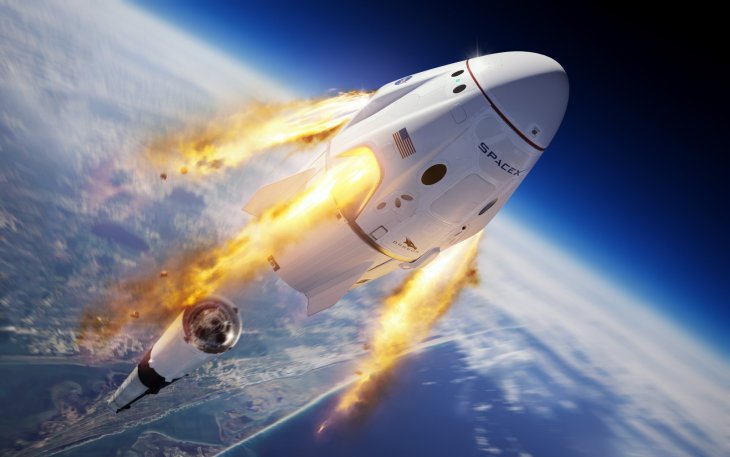
SpaceX and NASA are getting ready for a key test of SpaceX’s Crew Dragon commercial crew spacecraft on Saturday, and this should be the last major milestone that SpaceX has to pass in terms of demonstration missions before actual crew climb aboard the spaceship for a trip to the International Space Station. Starting at 8 AM ET (5 AM PT), a launch window opens during which SpaceX will hopefully perform what’s called an “in-flight abort” test of its Crew Dragon spacecraft and Falcon 9 launch vehicle, to demonstrate how its safety systems would protect astronauts on board in the unlikely event of an unexpected incident during a real crew flight.

The plan for this mission is to launch the Crew Dragon capsule atop a Falcon 9 — in this case, one that’s using a refurbished booster stage previously flown on three prior missions. This will be the Falcon 9’s last flight, however, as the plan includes loss of the rocket this time around instead of a controlled landing. The launch is intentionally being terminated early — just after the rocket achieves its “Max Q” point, or the moment during its flight when it’s under maximum atmospheric stress, at about 84 seconds post-liftoff.

At that point, the rocket will be about 19 kilometres (roughly 62,000 feet) above the surface of the Earth, and about four kilometres (2.5 miles) from its launch pad at Cape Canaveral Air Force Station in Florida. SpaceX has rigged the Dragon spacecraft’s launch escape system to automatically trigger at this point, which will separate the crew spacecraft from the Falcon and propel it away from the rocket very quickly in order to get it to a safe distance to protect any future passengers. After around five minutes past launch, the Dragon will deploy its parachute system, and then at around 10 minutes after it should splash down in the Atlantic Ocean between 3 and 3.5 km (roughly 2 miles) from shore.

After that, crews will recover the Dragon capsule from the ocean, and return it to Cape Canaveral, where SpaceX will study the spacecraft, including human-sized dummies acting as passengers and sensors within to monitor what happened in the cabin during the test. They’ll use this to ideally show that the abort process works as designed and will protect astronauts on board the spacecraft in case of any emergency that results in an early mission termination.

In addition to the in-flight abort system, SpaceX and NASA are also using this mission to prepare for crewed flight in a number of other ways. Today, astronauts Bob Behnken and Doug Hurley, who will crew the first piloted mission hopefully later this year, ran through a dry run of what they would experience in a live mission. They donned space suits and walked the transom that connects the Crew Dragon and Falcon 9 to its launchpad support structure, as NASA Administrator Jim Bridenstine noted on Twitter.

Jim Bridenstine

✔@JimBridenstine

Suited up! While crew members won't be aboard #CrewDragon during tomorrow's @SpaceX In-Flight Abort Test, astronauts Bob Behnken & Doug Hurley rehearsed what they'll experience during @Commercial_Crew missions. I'm excited we'll soon launch American astronauts from American soil!

The test will not involve any attempt to recover the rocket, as mentioned, and SpaceX Crew Mission Management Director Benji Reed said during a press conference today that they do anticipate some kind of “ignition” event with the Falcon 9’s second stage, which could possibly be large enough to be seen from the ground, he said. SpaceX crews will be on standby to recover as much as possible from the rocket wreckage, which will be useful to study, and they’ll also be on hand to minimize any potential environmental impact from the test.

This test was originally scheduled for roughly six months ago, but SpaceX’s Crew Dragon capsule intended for the mission was destroyed during an unexpected incident while test firing its engines. SpaceX and NASA investigated that explosion, and are now confident that they understand the cause of that incident, and have taken steps to ensure that a similar problem doesn’t happen again. The Crew Dragon being used now for Saturday’s test was originally intended to be the one used for actually flying astronauts, and another capsule is currently in development to serve that purpose.

SpaceX’s launch window for this test opens at 8 AM ET tomorrow, but spans four hours, and Reed said it could actually extend longer tomorrow if need be. NASA Commercial Crew program manager Kathy Leuders explained today that it’s crucial that not only launch conditions, but also recovery conditions, are optimal for the purposes of this test, so both will play a factor in when exactly they launch. Unlike with launches actually designed to reach a specific orbit, timing doesn’t have to be quite as on the nose, so there’s more flexibility in terms of making the decision to proceed or stand down. SpaceX has backup opportunities on both Sunday and Monday should they be required.

We’ll have a live stream and live coverage of the test starting tomorrow morning, so check back early Saturday. The stream will kick off around 15 minutes prior to the scheduled opening of the launch window, so at around 7:45 AM ET.

TechCrunch :As Alphabet crests the $1T mark, SaaS stocks reach all-time highs of

As Alphabet crests the $1T mark, SaaS stocks reach all-time highs of their own
Continuing our irregular surveys of the public markets, two things happened this week that are worth our time. First, a third domestic technology company — Alphabet — passed the $1 trillion market capitalization threshold. And, second, software as a service (SaaS) stocks reached record highs on the public markets after retreating over last summer.
The two milestones, only modestly related events, indicate how temperate the public waters are for technology companies today, a fact that should extend warmth into the private market where startups, and their venture capital backers, work.
The happenings are good news for technology startups for a number of reasons, including that major tech players have never had as much wealth in hand with which to buy smaller companies, and strong SaaS valuations help both smaller startups fundraise, and their larger brethren possibly exit.
Indeed, the stridently good valuations that major tech companies and their smaller siblings enjoy today should be just the sort of market conditions under which unicorns want to debut. We’ll continue to make this point so long as the public markets continue to rise, pricing tech companies that have already floated higher like the cliche’s own tide.

But while Alphabet, Microsoft and Apple are worth $3.68 trillion as a trio, and SaaS stocks are now worth 12.3x times their revenue (using enterprise value instead of market cap, for those keeping score at home), not every private, venture-backed company will necessarily benefit from public investor largesse.

What about tech-ish startups?
How much the current public-market tech valuation expansion will help companies that are increasingly sorted into the tech-enabled bucket isn’t clear; some companies that went public in 2019 were quickly spit up by investors unwilling to support valuations that matched or rose above their final private valuations. SmileDirectClub was one such offering.
The dividing line between what counts as tech — often fuzzy — appears to be slicing along gross margin lines, and the repeatability of business. The higher margin, and more recurring a company is, the more it’s worth. This market reality is why SaaS stocks’ recent return to form is not a surprise.
For Casper and One Medical, the first two venture-backed IPO hopefuls of the year, the more tech-ish they can appear between now and pricing the better. Because technology companies today are valued so highly, perhaps even a faint dusting of tech will save their valuations as they cross the chasm between private and adult.

TechCrunch : Deep tech VCs on what they view as some of the most impactful youn

Deep tech VCs on what they view as some of the most impactful young startups right now
During this week’s Democratic debate, there was a lot of talk, unsurprisingly, about ensuring the future of this country’s children and grandchildren. Climate change was of particular interest to billionaire Tom Steyer, who said repeatedly that addressing it would be his top priority were he elected U.S. president.
As it happens, earlier the same day, we’d spent time on the phone with two venture capitalists who think of almost nothing else every day. The reason: they both invest in so-called deep tech, and they meet routinely with startups whose central focus is on making the world habitable for generations of people to come — as well as trying to produce outsize financial returns, of course.
The two VCs with whom we talked know each other well. Siraj Khaliq is a partner at the global venture firm Atomico, where he tries to find world-changing startups that are enabled by machine learning, AI, and computer vision. He has strong experience in the area, having cofounded The Climate Corporation back in 2006, a company that helps farmers optimize crop yield and that was acquired by Monsanto in 2013 for roughly $1 billion.
Seth Bannon is meanwhile a founding partner of Fifty Years, a nearly five-year-old, San Francisco-based seed-stage fund whose stated ambition is backing founders who want to solve the world’s biggest problems. The investors’ interests overlap so much that Khaliq is also one of Fifty Years’s investors.
From both, we wanted to know which companies or trends are capturing their imagination and, in some cases, their investment dollars. Following are excerpts from our extended conversation earlier this week. (We thought it was interesting; hopefully you will, too.)
TC: Seth, how would you describe what you’re looking to fund at your firm?
SB: There’s a Winston Churchill essay [penned nearly 100 years ago] called “Fifty Years Hence” that describes what we do. He predicts genomic engineering, synthetic biology, growing meat without animals, nuclear power, satellite telephony. Churchill also notes that because tech changes so quickly that it’s important that technologists take a principled approach to their work. [Inspired by him] we’re backing founders who can make a ton of money while doing good and focusing on health, disease, the climate crisis . . .
TC: What does that mean exactly? Are you investing in software?
SB: We’re not so enthusiastic about pure software because it’s been so abstracted away that it’s become a commodity. High school students can now build an app, which is great, but it also means that competitive pressures are very high. There are a thousand funds focused on software seed investing. Fortunately, you can now launch a synthetic biology startup with seed funding, and that wasn’t possible 10 years ago. There are a lot of infrastructural advancements happening that makes [deep tech investing even with smaller checks] interesting.
TC: Siraj, you also invest exclusively on frontier, or deep tech, at Atomico . What’s your approach to funding startups?
SK: We do Series A [deals] onward and don’t do seed stage. We primarily focus on Europe. But there’s lot of common thinking between us and Seth. As a fund, we’re looking for big problems that change the world, sometimes at companies that won’t necessarily be big in five years but if you look out 10 years could be necessary for humanity. So we’re trying to anticipate all of these big trends and focus on three or four theses a year and talk as much as we can with academics and other experts to understand what’s going on. Founders then know we have an informed view.
Last year, we focused on synthetic biology, which is a becoming so broad a category that it’s time to start subdividing it. We were also doing AI-based drug discovery and quantum computing and we started to spend some time on energy as well. We also [continued an earlier focus on ] the future of manufacturing and industry. We see a number of trends that make [the latter] attractive, especially in Europe where manufacturing hasn’t yet been digitized.
TC: Seth, you mentioned synthetic biology infrastructure. Can you elaborate on what you’re seeing that’s interesting on this front?
SB: You’ve maybe heard of directed evolution, technology that allows biologists to use the power of evolution to get microbes or other biological machines to do what they want them to do that would have been impossible before. [Editor’s note: here, Bannon talked a bit about Frances Arnold, the Nobel Prize-winning chemist who was awarded the prize in 2018 for developing the technique.]
So we’re excited to back [related] startups. One, Solugen, enzymatically makes industrial chemicals [by combining genetically modified enzymes with organic compounds, like plant sugars]. Hydrogen peroxide is a $6 billion dollar industry, and it’s currently made through a petroleum-based process in seven-football-field-long production plants that sometimes explode and kill people.
TC: Is this then akin to Zymergen, which develops molecules in order to create unique specialty materials?
SB: Zymergen mainly works as a kind of consultant to help companies engineer strains that they want. Solugen is a vertically integrated chemicals company, so it [creates its formulations], then sells directly into industry.
TC: How does this relate to new architectures?
SB: The way to think about it is that there’s a bunch of application-level companies, but as synthetic biology companies start to take off, there’s a bunch of emerging infrastructure layer companies. One of these is Ansa Biotechnologies, which has a fully enzymatic process or writing DNA. Like Twist, which went public, they make DNA to sell to customers in the biotech industry. But whereas Twist using a chemical process to make DNA, Ansa’s approach is fully enzymatic. [Editor’s note: More on the competition in this emerging space here.]
Also, if you look at plant-based alternatives to meat, they’re more sustainable but also far more expensive than traditional beef. Why is that? Well plant-based chicken is more expensive because the processing infrastructure being used is more than 10 years behind real chicken processing, where you’ll see robot arms that cut up chicken so efficiently that it looks like a Tesla factory.
[Alternative meat] companies are basically using these extruders built in the ’70s because the industry has been so small, and that’s because there’s been a lot of skepticism from the investment community in these companies. Or there was. The performance of Beyond Meat’s IPO ended it. Now there’s a rush of founders and dollars into that space, and whenever you have a space where the core infrastructure has been neglected, there’s opportunity. A former mechanical engineer with Boeing has started a company, Rebellyous Foods, to basically build the AWS for the plant-based food industry, for example. She’s using [the machines she’s building] to sell plant-based chicken nuggets, [but that’s the longer-term plan].
TC: Siraj, you say last year you started to spend time on energy. What’s interesting to you as it relates to energy?

SK: There’s been some improvement in how we capture emissions, but [carbon emissions] are still very deleterious to our health and the planet’s health, and there are a few areas to think about [to address the problem]. Helping people measure and control their consumption is one approach, but also we think about how to produce new energy, which is a shift we [meaning mankind] need to undertake. The challenge [in making that shift] is often [capital expenditures]. It’s hard for venture investors to back companies that are [building nuclear reactors], which makes government grants the best choice for early innovation oftentimes. There is one company, Seaborg, that has figured out a clever reactor. It’s not a portfolio company but it’s [compelling].
SB: We also really like what Seaborg is doing. These [fourth generation] nuclear companies have a whole host of approaches that allow for smaller, safer reactors that you wouldn’t mind having in your backyard. But Siraj put his finger on it: as an early-stage deep tech investor, we have to consider the capital plan of a company, and if it needs to raise billions of dollars, early investors will get really diluted, so early-stage venture just isn’t the best fit.
TC: There are other areas you like, though, because costs have fallen so much.
SB: Yes. Satellite telephony used to be one of those areas. Some of the satellites in space right now cost $350 million [to launch] and took three to four years to build, which would be really hard for any early-stage investor to fund. But now, a new generation of companies is building satellites for one-tenth of the cost in months, not years. That’s a game changer. They can iterate faster. They can build a better product. They don’t have to raise equity to build and launch either; they can raise from a debt financier [from whom they can] borrow money and pay it back over time. That model isn’t available to a company like Uber or Lyft, because those companies can’t say, ‘X is going to cost us Y dollars and it will pay back Z over time.’
TC: What of concerns that all these cheap satellites are going to clog up the sky pretty quickly?
SB: It’s a real concern. Most [of today’s satellites] are low earth satellites, and the closer to the earth they are, the brighter they are; they reflect the sun more, the more satellites we’re seeing instead of stars. I do think it’s incumbent on all of these companies to think about how they are contributing to the future of humanity. But when you connect the unconnected, educational outcomes improve, health improves, inequality decreases, and the stability of governments improves, so maybe the developed world needs to sacrifice a bit. I think that’s a reasonable tradeoff. If on the other hand, we’re putting up satellites to help people buy more crap . . .
TC: It’s like the argument for self-driving cars in a way. Life becomes more efficient, but they’ll require far more energy generation, for example. There are always second-order consequences.
SK: But think of how many people are killed in driving accidents, versus terrorist attacks. Humans have many great qualities, but being able to drive a lethal machine consistently isn’t one of them. So when we take that into perspective, it’s really important that we build autonomous vehicles.
You [voice] a legitimate concern, and often when there are step changes, there are discontinuities along the way that lead to side effects that aren’t great. That comes down to several things. First, infrastructure will have to keep up. We’ll also have to create regulations that don’t lead to the worst outcomes. One our investments, Lilium in Munich, has built an entirely electric air taxi service that’s built on vertical takeoff. It’s nimble. It’s quiet enough to operate in city environments.
On roads, cars are constrained by 2D terrain and buildings, but [in the air] if you can do dynamic air traffic control, it opens up far much efficient transport. If you can get from downtown London to Heathrow [airport] in five minutes versus 50 minutes in a Tesla? That’s far more energy efficient.
TechCrunch : Cambridge Analytica email chain with Facebook sheds new light on da

Cambridge Analytica email chain with Facebook sheds new light on data misuse scandal
Cambridge Analytica whistleblower Brittany Kaiser has released new documents today that illuminate the initial jockeying between the company and Facebook as they discussed the need for Cambridge Analytica to delete data associated with 87 million Facebook users’ profiles.
The data was improperly obtained in 2014 by researchers with access to Facebook’s developer platform who were being paid by Cambridge Analytica to obtain and process social media users’ information for the purpose of targeting political ads.
In December 2015 a Guardian article about Cambridge academic Dr Aleksandr Spectre (Kogan) outlined how he had acquired the Facebook profiles for research, and that Cambridge Analytica had improperly acquired that data.
In subsequent Washington Senate hearings into the scandal, Mark Zuckerburg apologized for having failed to check that Cambridge Analytica had deleted the information.
At the time he said: “When we heard back from Cambridge Analytica that they had told us that they weren’t using the data and deleted it, we considered it a closed case. In retrospect, that was clearly a mistake. We shouldn’t have taken their word for it. We’ve updated our policy to make sure we don’t make that mistake again.”
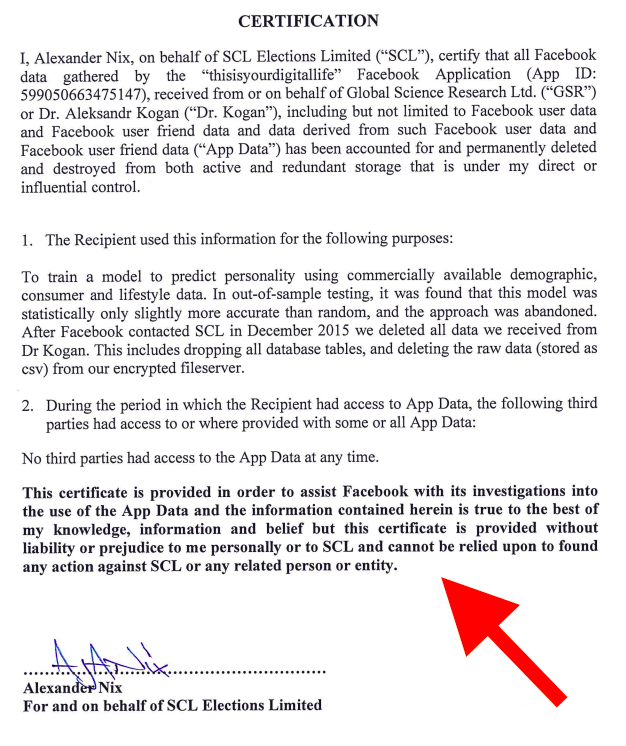
Instead, Facebook let the political consultancy self-certify via email and then in a signed document [found below] that it had destroyed the records, which the social network said had been acquired in violation of its rules.

Cambridge Analytica data deletion certification from CEO Alexander Nix, delivered to Facebook in January 2016

Furthermore, for example, in a submission to the UK Parliament, Facebook CTO Mike Schroepfer said: “In late 2015, when we learned Kogan had shared the data, we immediately banned TIYDL [the personality quiz app used to harvest data] from our platform and demanded that he delete all data he obtained from that app. We also demanded deletion from everyone that Kogan identified as having been passed some data, including Cambridge Analytica, and certification from all parties that the deletion had been completed.”
The information Kaiser releases today reveals the initial exchange where Facebook only requested by email that CA delete the data — and only asked the company to “provide us with confirmation” [i.e. of deletion], with no mention of a specific process of ‘certification’, as Schroepfer later told the UK parliament. It wasn’t until January 2016 that Facebook received the signed certification from Cambridge Analytica CEO Alexander Nix vowing the company had deleted the data.
Today Kaiser revealed exclusively to TechCrunch on stage at the WorldWebForum conference in Zurich the initial email exchange with Cambridge Analytica executives.
This ’email exchange’ – which TechCrunch has not been able to independently verify at this point – has never previously been published. Kaiser released to TechCrunch what she claims is a copy of the exchange. We have reached out to Facebook for comment.
According to the document passed to us, writing on Dec 17, 2015, Alex Tayler, Chief Data Officer for Cambridge Analytica, allegedly wrote to Facebook executive Allison Hendrix saying:
“I wanted to confirm that following your inquiry, that Facebook is satisfied that CA has not breached it’s terms of service or stolen data on non-consenting individuals. If you are satisfied this matter is resolved, would it please be possible for us to have a statement from Facebook to disseminate through our PR agency? We are still finding some articles repeating the initial false allegations made by the Guardian, and would like to be able to firmly refute them in order to prevent any further reputational damage to our company. Alternatively, if Facebook would like to issue a joint press release, we would welcome the opportunity to do so.”
A day later on 18 December 2015, Hendrix replied:
“Thank you again for taking the time to speak with me last week and providing additional information into Dr. Kogan’s development of the GSR app which was funded by Cambridge Analytica (via SCL Elections). As discussed, we don’t allow any information obtained from Facebook to be purchased or sold, and we have strict friend data policies that prohibit using friend data for any purpose other than improving a person’s experience in your app. From our conversations, it is clear that these policies have been violated.
“You have told us that you received personality score data from Dr. Kogan that was derived from Facebook data, and that those scores were assigned to individuals included in lists that you maintained. Because that data was improperly derived from data obtained from the Facebook Platform, and then transferred to Cambridge Analytica in violation of our terms, we need you to take any and all steps necessary to completely and thoroughly delete that information as well as any data derived from such data, and to provide us with confirmation of the same.
“We need additional information to complete our review. As an initial matter, did you transfer any data you received from Dr. Kogan to any person or entity other than Ted Cruz’s team? Have you made any other use of the data from Dr. Kogan? If there is any additional information of which you think we should be aware, we thank you in advance for providing us with that information and for your help resolving these issues.
“Please respond at your earliest opportunity confirming when you can complete the above request to delete all data (and any derivative data), and providing the additional information I’ve requested above. As mentioned above, our review is not complete; accordingly, we may have additional questions, requests, or requirements going forward, and this email should not be construed as a waiver of any of Facebook’s rights.”
On December 19, 2015, Tayler replied:
“Dear Allison, There are several incorrect statements in your email. First and foremost, Cambridge Analytica has not transferred the data we received from Dr Kogan to Cruz for President, nor to any other party. The only data we share with our clients are lists of contact information, perhaps with a few tags attached, for target audiences we identify for them (e.g. likely donors, persuadable voters), and models that we have produced under their direction. Secondly, Cambridge Analytica did not fund the development of Dr. Kogan’s app. We did not pay GSR for their time or technology, but rather paid the third party (e.g. survey vendor) costs for the surveys they ran. Please note that GSR was
contractually obliged to us to carry out this research with the consent of the survey respondents and in line with the terms of service of their vendors.
“Having made that clear, the model we received from Dr Kogan wasn’t very accurate (in validation experiments we ran, we found his predictions only slightly better than random). For our goal of extrapolating personality scores across our whole database, his model was simply not accurate enough to use as a training set, or to apply it commercially in any other way.
“Nevertheless, we still considered the project a success in that it provided us with a proof of concept for the personality research we have since undertaken internally (which is in no way connected with Facebook). It is these data that we have collected independently of GSR about which we have built our current business offering. For this reason, and in the spirit of the good-faith relationship we would like to maintain with Facebook, we will comply with your request to delete all data we received from Dr Kogan.
“Please let me know what else you require from us as soon as possible. It is a matter of urgency that we make it clear that Cambridge Analytica has not done anything wrong.”
There was then a time-lag probably due to the break for the holidays. On 5 January 2016, Hendrix replied:
“Thank you for your timely and detailed response, and for agreeing to delete any and all data that was derived from the Facebook Platform. Can you let me know how you were storing the data and what you did to delete it?”
On January 6, 2016, Tayler replied, copying in CA CEO Alexander Nix, saying:
“To be clear, we have not yet deleted the data we received from Dr Kogan, but will be happy to do so once Facebook confirms that this will resolve the matter. We are currently storing the data as csv files in an encrypted directory on our file server. When we delete the data we will simply rm -rf the directory.”
Six days later on 12 January, Hendrix:
“As a reminder, you received the data inappropriately and are obligated to delete it. You’ve indicated that you would like to maintain a positive relationship with us. Having one will require deletion of the data. In addition to deleting the data from the directory, can you check to see whether your server has any backups which also contain the data? While we don’t anticipate further issues at this time, we reserve our rights and can make no guarantees.”
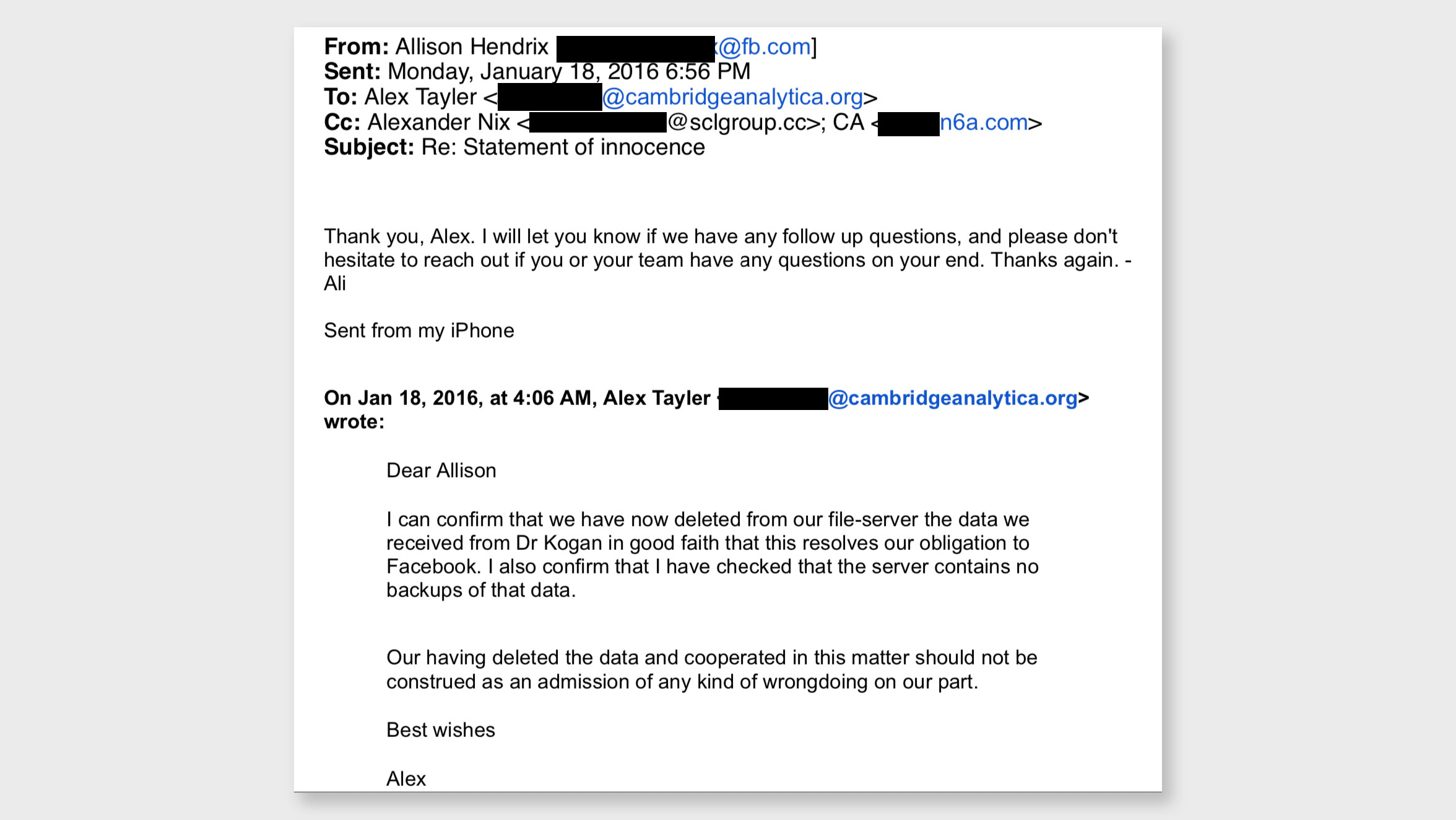
On Jan 18, 2016 Tayler replied:
“I can confirm that we have now deleted from our file-server the data we received from Dr Kogan in good faith that this resolves our obligation to Facebook. I also confirm that I have checked that the server contains no backups of that data. Our having deleted the data and cooperated in this matter should not be construed as an admission of any kind of wrongdoing on our part.”
On January 18, 2016, Hendrix replied:
“Thank you, Alex. I will let you know if we have any follow up questions, and please don’t hesitate to reach out if you or your team have any questions on your end. Thanks again. – Ali”
This entire exchange was then forwarded by executives from the N6A PR agency to Cambridge Analytica executives and was, in turn, obtained by Kaiser on 23 January 2016.

[Correction 11:30am Pacific: This article originally stated that Facebook accepted merely the email exchange published above as proof that Cambridge Analytica had deleted data attained from Facebook. However, Facebook later received a more formal signed document from Cambridge Analytica CEO Alexander Nix claiming the data had been deleted. This story has been updated to reflect that Facebook received this additional certification, which we reproduce here.]

FT : Retailers are ignoring the disruptive danger of the no-cooking trend

Retailers are ignoring the disruptive danger of the no-cooking trend
From Dominique Locher, Vevey, Switzerland, First generation online food pioneer since 1999

Tim Bradshaw, in “Takeaway victorious in £6bn battle for Just Eat” (January 11), describes the creation of one of the world’s biggest players in the once-in-a-generation shift in consumers’ eating habits. I am puzzled by the absence of bricks and mortar players in this rapidly evolving food delivery scene.

There is indeed a massive structural change in customer behaviour happening under the eyes of the classic retailer — and they don’t seem to move. With some exceptions such as the recent takeover of DejBox by Carrefour in France or the commitment of Amazon with Deliveroo in the UK, most others remain passive or even ignorant. This trend from homecooking to no-cooking lures customers away from the classic supermarket aisle, and every home-delivered ready-to-eat meal is a missed shopping act.

Generations Y and Z in particular seek more convenience, and this quest for easing their lives also touches the plate. Numbers speak a clear language: according to the UBS Evidence lab consumer study based on global data 2018, younger consumers (25-34) are ordering on average 1.22 times a week from those food delivery platforms, compared with 0.23 times for those aged 55-plus. Or just look at Takeaway.com, the Dutch food delivery platform that has just published its figures: jaw-dropping. Total orders for 2019 year jumped 70 per cent, due to a 113 per cent spike in the German market, 81 per cent in other markets and 16 per cent in its home market, Holland.

The battle of the “share of plate” should be at the top of the chief experience officer’s agenda of every single retailer. Too often the online food market share is already (by mistake) ridiculed, but the “online supermarket” is just the tip of the iceberg, the real disruptive danger is further down the value chain, the online food delivery market.

FT : Verhofstadt assured over ‘settled status’ deadline breakers

Verhofstadt assured over ‘settled status’ deadline breakers
EU citizens in UK will not be deported automatically if they fail to register with good reason

EU citizens living in Britain who miss the deadline for applying for “settled status” by mid-2021 will not face automatic deportation, the government said on Friday.

The statement came after Guy Verhofstadt, European Parliament co-ordinator on Brexit, said he had been reassured that the UK would be lenient with any EU national who missed the deadline with a reasonable cause.

“The impression had been given that anyone who missed the deadline would be out,” the former Belgian prime minister told the Financial Times at the end of a two-day visit to London.

An estimated 3m EU citizens have until the end of 2020 to register for the EU settled status scheme, allowing them to stay in Britain with existing rights after Brexit, with a six-month “grace period” extending until June 2021.

Fears that those who failed to register in time could be deported were stoked by Brandon Lewis, the security minister, who last year warned that European citizens living in the UK risked being sent home if they fail to apply for permanent residence by the deadline.

“If EU citizens have not registered by then without an adequate justification, the immigration rules will apply,” he told the German newspaper Die Welt.

But Mr Verhofstadt said he had been reassured by Steve Barclay, Brexit secretary, that the British government would be lenient with those who had a genuine cause for missing the deadline and would try to help vulnerable people.

An ally of Mr Barclay confirmed: “If someone doesn’t have settled status after June 2021 and haven’t applied on reasonable grounds then they will be able to stay. We particularly want to help vulnerable people, but you have to have a cut off date otherwise people won’t bother to register.”

They added that the settled status scheme was already working very well and that some 2.8m people had already successfully registered.

Meanwhile, Mr Verhofstadt failed to persuade the Brexit secretary to issue paper certificates proving settled status — as requested by some EU citizens — as physical proof of a right to remain.

Mr Barclay said people could take screenshots of emails confirming settled status, but that paper documents could be susceptible to fraud.

The European Parliament has also raised concerns over the independence of a monitoring authority to be set up in the UK to protect the rights of EU citizens under the terms of the withdrawal agreement.

Mr Verhofstadt claimed the authority would not be fully independent because it was being set up under the auspices of the Ministry of Justice, which would appoint a panel to select members.

He wants a guarantee that there would be a place on the authority — which could theoretically sue the Home Office if it fails to uphold the withdrawal agreement — for representatives of EU citizens. “My concern is it’s not independent,” he said.

Mr Barclay’s spokeswoman said that EU citizens, including lawyers and other qualified professionals, would be free to apply to sit on the authority.

FT : Casino/French strikes: red herring

Casino/French strikes: red herring
French supermarket blames unrest for poor sales, but this story whiffs of one of its fish counters

Crisis for some is an opportunity for others. French retailers Casino and Fnac Darty both blamed public sector strikes for poor fourth quarter sales and lower profits. Shares in both companies fell as much as a tenth on Friday. But Casino’s story whiffs of the fish counter at one of its supermarkets. 

Strikes are a handily recurrent scapegoat for corporate woes in France, as bad weather is in England. The current round of unrest is a response to plans by the Macron government to consolidate public pensions and raise retirement ages.

But protests by the country’s Yellow Vest movement in the final quarter of 2018 were far more disruptive. They were national in their impact. The current strikes mainly affect Paris and other big cities. 

The sales of Casino, controlled by Jean-Charles Naouri, should have rebounded since gilets jaunes protests were at their height. Instead, they are flat. As a result, expected profit growth from French retail has been revised down to just 5 per cent from 10 per cent previously.

Moreover, the loss of an estimated €25m of operating profit from a decline of €80m of sales is oddly big, say analysts at Bernstein. If market share losses are accelerating, then a target of €500m of free cash flow a year from French retailing is in doubt.

That would make it harder for the business to service large debts. Mr Naouri controls the group through “Breton Pulleys”, a chain of heavily-leveraged holding companies. These are popular with French tycoons keen to maximise control at minimal cost.

They are unpopular with bondholders, who want Casino to reduce borrowings. With creditors at holding company Rallye rejecting a repayment proposal earlier in the week, the requirement for cash is becoming more urgent.

It is easy for Casino to pass the buck to strikers for weak fourth-quarter profits. But under-investment and poor management may also share responsibility. Casino has been criticised for the opacity of its earnings and balance sheet structure. Its scramble for cash is another sign of the group’s souring prospects.