Bus. Of Fashion : Victoria's Secret: Bargain of the Century?

Victoria's Secret: Bargain of the Century?
Scandals aside, Victoria’s Secret has the market know-how and the retail network to remain on top — with the right guidance. Can new owner Sycamore Partners pull it off?

Beleaguered mass lingerie maker Victoria’s Secret’s bid to go private was realised on Thursday, in a deal that gave private equity firm Sycamore Partners 55 percent of the business for $525 million, valuing the whole company at just $955 million. L Brands, the public group that owned Victoria’s Secret, will retain the other 45 percent stake, including its Pink sub-brand, which continues to perform well in comparison.

Given that Victoria’s Secret as a whole — including VS lingerie, Pink and VS beauty — still generates roughly $7 billion in annual revenue (and about $4 billion from the marquee brand alone) — that’s a measly sum. And yet, it was the best deal L Brands was able to find, as no interested parties were willing to acquire the business in its entirety, according to a source familiar with the details. It also leaves L Brands saddled with more than $4 billion in debt and reliant on the growth of Bath and Body Works, which will likely retain Wexner's longstanding executives as Sycamore brings in new leadership for Victoria's Secret.

While Victoria’s Secret has been losing ground to more culturally sensitive competitors, in particular, the American Eagle-owned label Aerie, it’s still the dominant player in the global lingerie industry. It was the interpersonal scandals — the connection to Jefferey Epstein, the reports of misogyny and inappropriate behaviour — that got activist investors riled up enough to take action against L Brands Chairman and Chief Executive, Les Wexner, who has stepped down from his role in the face of the deal.

There is a chance that, like a restaurant chain mired in a food-poisoning scandal, Victoria’s Secret’s reputation has been ruined forever, and its sales will continue to decline. But Victoria’s Secret has something most restaurant chains don’t: dominance in a difficult market to crack. (Bras are difficult to get right when it comes to their industrial design and manufacturing, and they’re one of the few remaining items consumers still like to try on.) Victoria’s Secret has the know-how, and the retail network, to remain on top — with the right guidance.

“This transformation will not happen overnight; it is not as simple as simply flicking a switch to turn off a proposition that has been misaligned for years,” wrote Neil Saunders, an analyst at global data retail, in a recent note. “The board will need to be careful in charting a new course that resonates with consumers and addresses new competitive challenges such as the rise of rival brands like Aerie.”

That’s where Sycamore comes in. The private equity firm is known for its shrewd business tactics and impressive track record: many of the struggling brands it has acquired, including Talbots and Hot Topic, are now stable, if not growing explosively. Sometimes, rescuing companies from the brink has required drastic changes to how they operate, including splitting up brands.

This week, senior correspondent Chantal Fernandez took a deeper look at Sycamore’s strategy, breaking it down acquisition by acquisition. Read her analysis here, and have a great weekend.

Bus. Of Fashion : L'Oréal's Online Makeup Sales Rose in China in February

L'Oréal's Online Makeup Sales Rose in China in February
The cosmetics company is still bracing for a hit on demand due to the coronavirus health crisis.

PARIS, France — Online sales of L'Oréal makeup and skincare products had picked up in China in February and were even stronger than a year earlier, Chief Executive Jean-Paul Agon said on Friday.

China is the Maybelline and Lancôme maker's single-biggest market, and like rivals in the luxury goods industry, L'Oréal is bracing for a hit on demand due to the coronavirus health crisis as shops shut down and Chinese customers face travel bans.

L'Oréal has so far offset some lost business through e-commerce sales, Agon said, adding that platforms like Alibaba and JD.com appeared to be "finding solutions" to counter delivery problems in some parts of China.

"Even in February (online) sales were really good," Agon said at the CAGNY consumer analyst conference in Florida. "Sales of beauty products on e-commerce sites are stronger than last year."

(ZH) "Jeffrey And I Had Everyone On Videotape" Ghislaine Maxwell Reportedly Told

"Jeffrey And I Had Everyone On Videotape" Ghislaine Maxwell Reportedly Told Friend

Jeffrey Epstein's alleged 'madam' told a former acquaintance that she and the now-dead pedophile had "everything on videotape," according to The Telegraph.
The acquaintance, socialite and distant relative to the royals Christina Oxenberg, said that Maxwell also told her that Epstein bought a private helicopter because commercial pilots were "eyes and ears" he did not need.
She revealed she had spoken to the FBI about what she had been told.
Ms Oxenberg, 57, first met Maxwell in the early 1990s and said she would never forget a conversation the pair once had in Maxwell’s home.
“We were alone,” she said. “She said many things. All creepy. Unorthodox. Strange. I could not believe whatever she was saying was real. Stuff like: 'Jeffrey and I have everyone on videotape.’”...


Maxwell has been accused by several alleged Epstein victims of both facilitating and participating in sexual crimes. She has vehemently denied the claims and has not been charged with any crimes in connection to Epstein's activities.
If true, we wonder who exactly was taped?
And of course:

(ZH) China's Debts Are Coming Due At The Worst Possible Time

China's Debts Are Coming Due At The Worst Possible Time


The economic consequences of coronavirus are quickly piling up like garbage along the streets of Los Angeles. Breaking supply chains, closed Chinese factories, iPhone disruptions, and massive shortages of Chinese made products. These developments will most definitely get worse before they get better.
The economic impacts will be devastating. As China flatlines, and first quarter GDP growth approaches zero, the global economy, including the U.S., will also be greatly disrupted. Perhaps many low-cost, Made in China products will go on indefinite hiatus. What then?


Quite frankly, the global economy’s overdue for a synchronized downturn. Coronavirus may mark the turning point. But it would have arrived sooner or later, with or without the threat of a burgeoning pandemic.
Still, the prospect of a great plague makes people all the more excitable. A run-of-the-mill recession and bear market is one thing. But add the rapid spread of a hyper contagious virus to the mix, and the human animal is inclined to go mad in unison.
In the meantime, and despite yesterday’s moderate selloff, the major U.S. stock market indexes are near record highs. The expectation of ever more Fed intervention has pacified investors. But that’s not all…
The yield on the 10-Year Treasury note has slid down to 1.50 percent; near the lower limit of the federal funds rate, which is currently between 1.5 and 1.75 percent. In other words, the Fed’s next policy move has already been decided by Treasury investors. Similarly, gold investors, which have pushed the price of gold above $1,620 per ounce, have also preempted the Fed.
But what’s really going on? Moreover, should you panic, yet?
Should You Panic, Yet?
The answer, no doubt, depends on whether you’re a borrower or a lender. By this, some context is in order…
Assuming a financial agreement is made in good faith, both parties stand to benefit. The lender, having loaned money to a creditworthy borrower, can count on steady coupon payments. At the same time, the borrower can put the money to a resourceful undertaking; ideally, something that produces a return that’s greater than the loan.
However, when the borrower doesn’t live up to their terms of the agreement things quickly get ugly. The borrower may seek relief through bankruptcy court. The lender may take possession of collateral. Each case is different.
Still, when an economy is growing and loans are generally performing, the occasional bad loan can easily be absorbed. But the longer an economy’s growth run extends, the more complacent lenders become. Debts pile up higher and higher. At the same time, the perception of risk diminishes.
By the top end of the credit cycle, capacity has far outpaced demand. Businesses and individuals have overextended themselves with the expectation that continued growth will mask their mistakes. The boom then always ends at the worst possible time.
At the peak, the financial system has become highly unstable. Any triggering event will serve to topple it.
“Neither a borrower nor a lender be,” counseled Polonius in Shakespeare’s Hamlet. If we had to choose, most of the time it’s preferable to be a lender. But not always. For example, after a massive and broad reaching credit binge, borrowers and lenders are both equally screwed…
China’s Debts are Coming Due at the Worst Possible Time
Booms and busts fueled by cheap credit are incredibly destructive. What’s more, they’re exacerbated by central bank efforts to smooth out the business cycle. Rather than rounding the peaks and tapering the bottoms, stimulative fiscal and monetary policy has the unfavorable effect of magnifying them.
Coincidence. Fate. Serendipity. Providence. Destiny. Karma. Fortuity. Kismet. Or just plain chance. There is something both eerie and poetic about the genesis of the coronavirus outbreak being China…and at this precise moment in time.
One of the more reckless examples of destructive stimulus over the last decade is China’s mass concrete binge. Pumping credit to stimulate construction in China has had the ill-effect of compelling the country to do something extraordinarily incredible. In short, they’ve mixed up massive amounts of concrete and splattered it across the landscape.
Specifically, China’s economy used 6.6 gigatons of cement between 2011 and 2014. What a gigaton is we don’t really know. But we assume it is something unfathomable heavy. To put this in perspective, the U.S. used 4.5 gigatons of cement over the last 100 years.
What in the world compelled an entire nation to behave like utter blockheads? Unsurprisingly, misguided stimulus policies pushed everyone beyond the absurd. This mass malinvestment and overbuilt capacity may never realign with the real economy.
Over the last decade, China has borrowed massive amounts of money to finance one of the biggest infrastructure binges in history. Roads, bridges, airports, and entire ghost cities were constructed. The boom was spectacular. It was also an epic disaster in the making. Because the debt’s coming due at the worst possible time:
“More than 2 trillion yuan ($283 billion) of local-government notes will mature in 2020, according to Bloomberg-compiled data — a record and 58 percent more than [2019] level.”
How will local governments pay their debts when their economy’s on coronavirus lockdown? Alas, for borrowers and lenders alike, they won’t.

(ZH) S.Korea Coronavirus Cases Go Exponential As New Infections Soar By 70%; 10

S.Korea Coronavirus Cases Go Exponential As New Infections Soar By 70%; 10 Towns In Northern Italy Put On Lockdown

Summary:
  • South Korea reported 142 new cases, up 70% in one day, to 346; The country also reported its second death.
  • China reported 397 new cases, bringing the total cases to 76,288, and an additional 109 new deaths or 2,345 in total.
  • Italy reports 1st virus death, 15 additional cases, 10 cities on lockdown
  • 34 cases in USA.
  • China pledges to build 19 new hospitals in Wuhan
  • Hawaii hasn't tested any suspected cases in the state
  • 253 more passengers depart the diamond princess as 11 of 13 American evacuees in Nebraska test positive
  • Local authorities in China warn people will be punished for not returning to work if ordered
  • WHO's Tedros: Window for confronting virus rapidly closing
  • CDC says virus tremendous health threat, warns more human to human transmission of the virus in the US likely
  • First case declared in Lebanon
  • Iran confirms 9 more cases as virus reaches Tehran
  • South Korea reported massive jump in cases on Friday as total climbed to 204
  • Global Times insinuates that US might be covering up coronavirus cases
  • Health officials in Hubei 'apologize' for changing case confirmation 'criteria'
* * *
Update (2020ET): Earlier today, when describing the ludicrous lengths to which China has gone to mask the severity of the Coronavirus pandemic, after five definition changes of what a Coronavirus infection means, and which saw another major jump in the last two days' cases after Hubei admitted it hadn't tracked the recently unveiled prison cases, we said that there was a certain irony to China's data massaging, namely that the more China manipulates the data, the less anyone will believe a positive outcome for the epidemic as a result of lower cases and will instead claim that this is just the result of Chinese propaganda: "It points to a rather concerning confusion over how best to officially report the number of cases, leading to a loss of confidence in the true numbers,” Oanda analyst Jeffrey Halley told Bloomberg. "That could mean that internationally, the rest of the world keeps China in lockdown for longer, which will not be good for the ‘V-shaped recovery’ projections."


曾錚 Jennifer Zeng@jenniferatntd

Tu Yuanchao, deputy director of #Hubei’s Health Commission promises "transparency" after they added back the "deducted" #COVID19 cases. So far #China's criteria for #coronavirus diagnosis have changed 5 times according to how they need the numbers to be.
#CoronavirusOutbreak


149 people are talking about this


We then said that as China scrambles to goal seek its propaganda number, the world's attention has shifted to what has emerged as the second coronavirus hotspot, South Korea, where the number of cases is certainly not doctored, pardon the bad pun, and where there is a truly exponential increase in new cases, which are now doubling with every passing day in a terrible, if accurate, representation of what indeed happens when there is a viral epidemic.
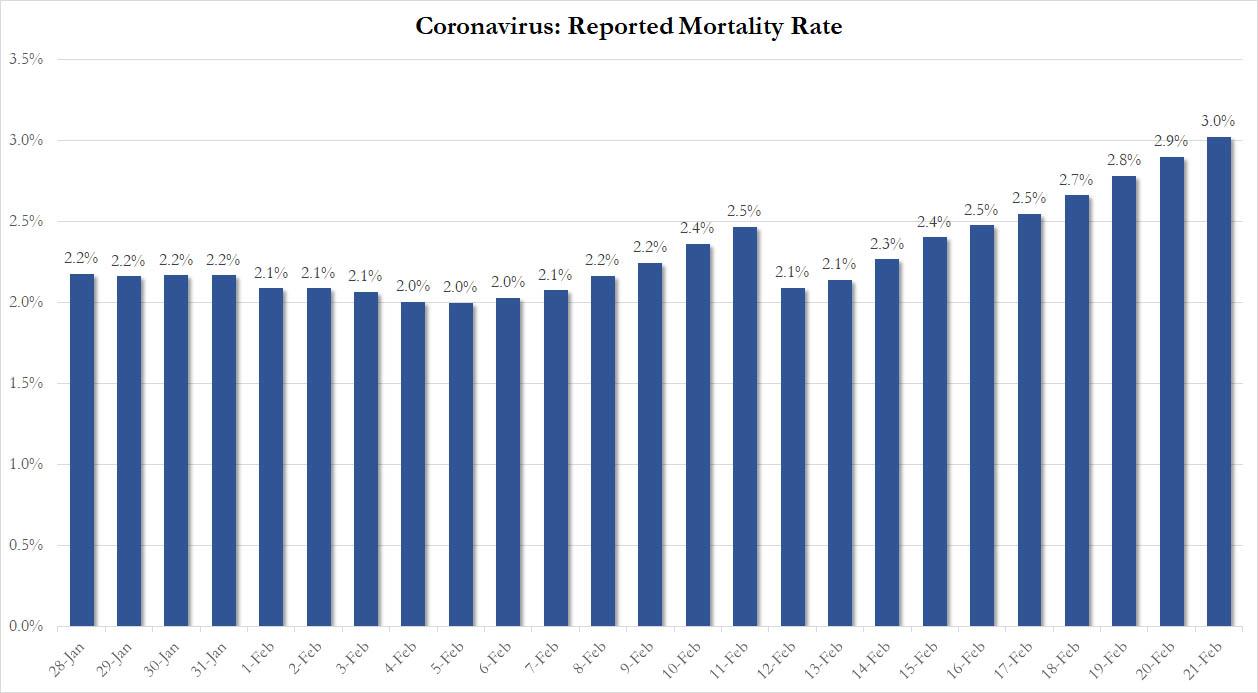
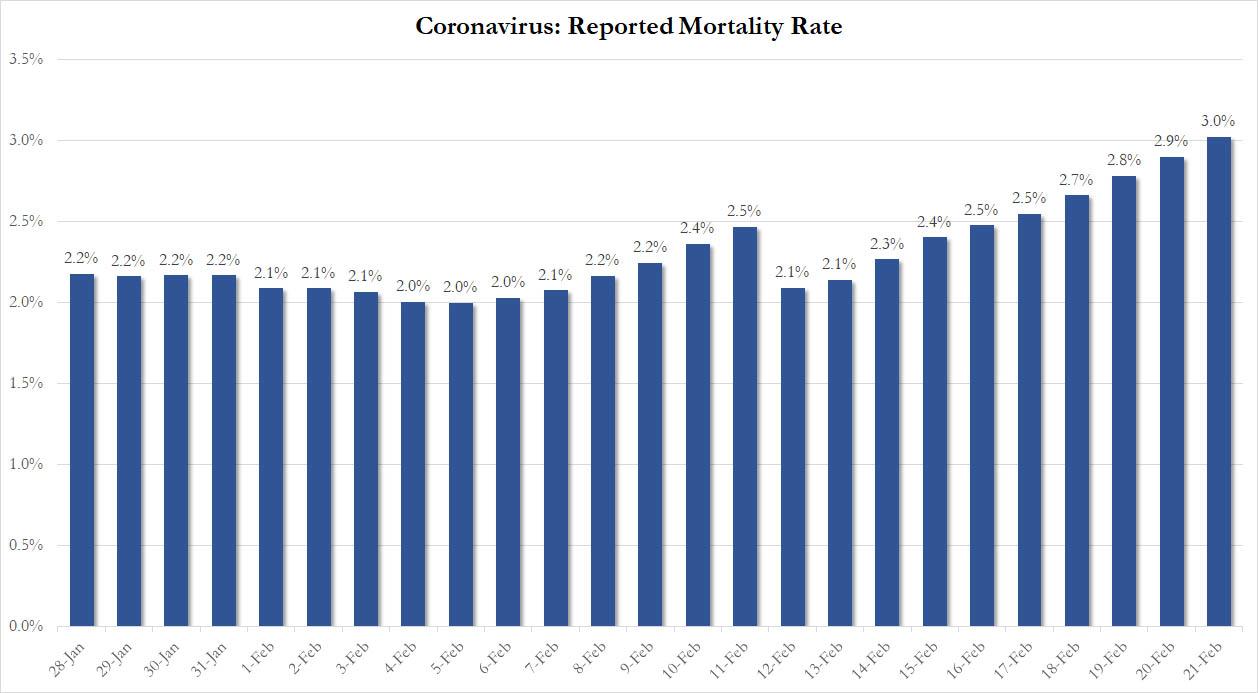
Late on Friday we got painfully clear example of just this when China reported that on Feb 21, there were just 397 new Coronavirus cases bringing the total to 76,288, a plunge of more than 50% from the previous day's adjusted increase of 889 and a number which is now completely meaningless in light of what has become a daily adjustment by China. Meanwhile, the number of deaths, which China has so far failed to revise (but will surely try before this is all over), rose by 109 to 2345, and with the number of cases barely rising, it also means that the mortality rate his now hit a new lifetime high of 3.0%. Which also means that China has to pick: keep fabricating the number of cases while the real deaths keep rising and the mortality rate creep ever higher, or change the definition of death.
So if Chinese data is now meaningless (and the only thing that matters is if and when its economy will come back on line), there is South Korea, and it is here that things have turned south quick. Or rather north if one follows the latest number of cases, because one day after total South Korean cases doubled (having doubled the day before that, and again the day prior), on Saturday South Korea reported that there was another stunning increase in the total number of cases which rose by 142 in one day, a 70% increase from the prior day, to a new high of 346; Putting this stunning increase in context, China, which officially has over 76,000 cases, had just 397 cases, while South Korea with just 204 cases, had an increase of 142, or about a third of all of China's new cases!
South Korea also reported its second coronavirus linked death.
With the number of people in South Korea being tested for coronavirus surging to 5,481, up from 3,180 last night, it is virtually certain that this exponential increase in new confirmed cases will last for quite a while, perhaps even longer than China's, unless of course, South Korea learns from Beijing just how to change the "definition" of cases and fast.
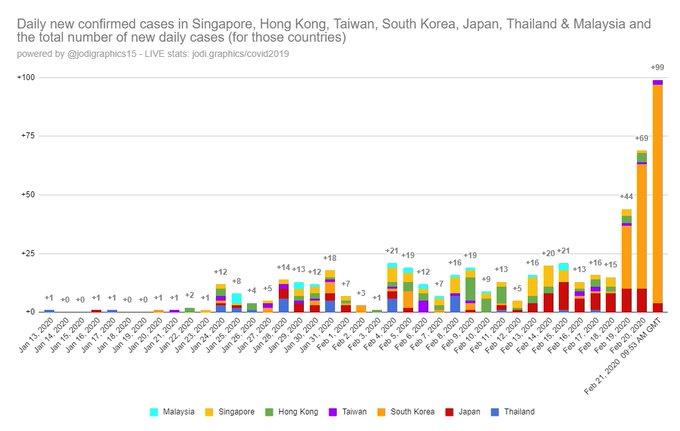
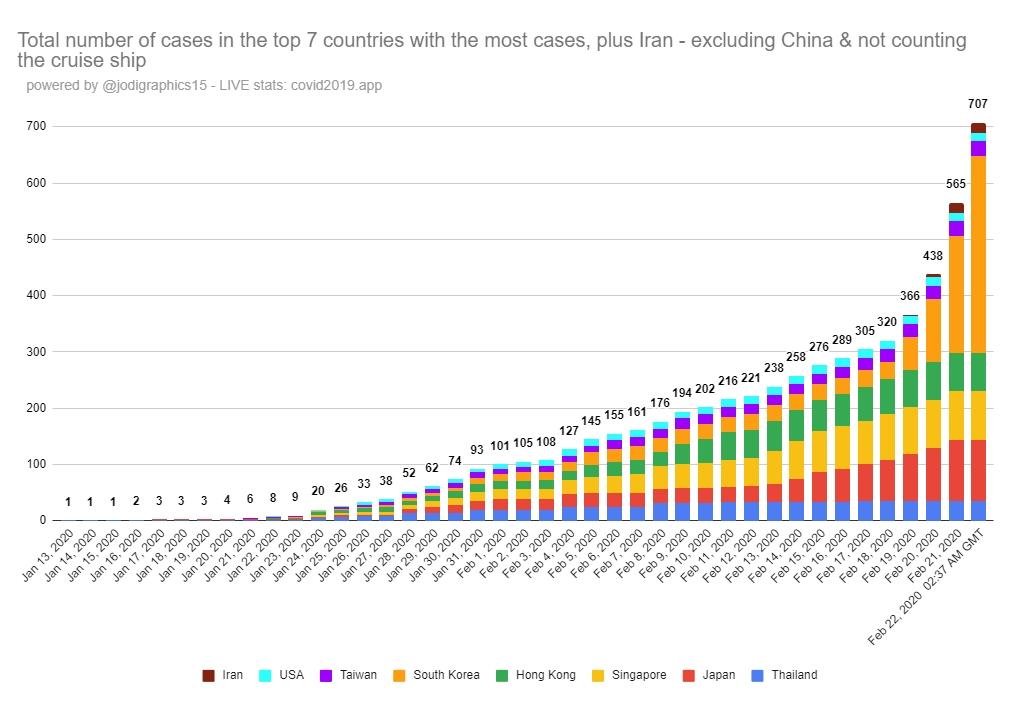
Thanks to South Korea, the number of cases in the top 7 countries outside China with the most cases, including Iran, and excluding the Diamond Princess Cruise Ship, is close to turning exponential as well.
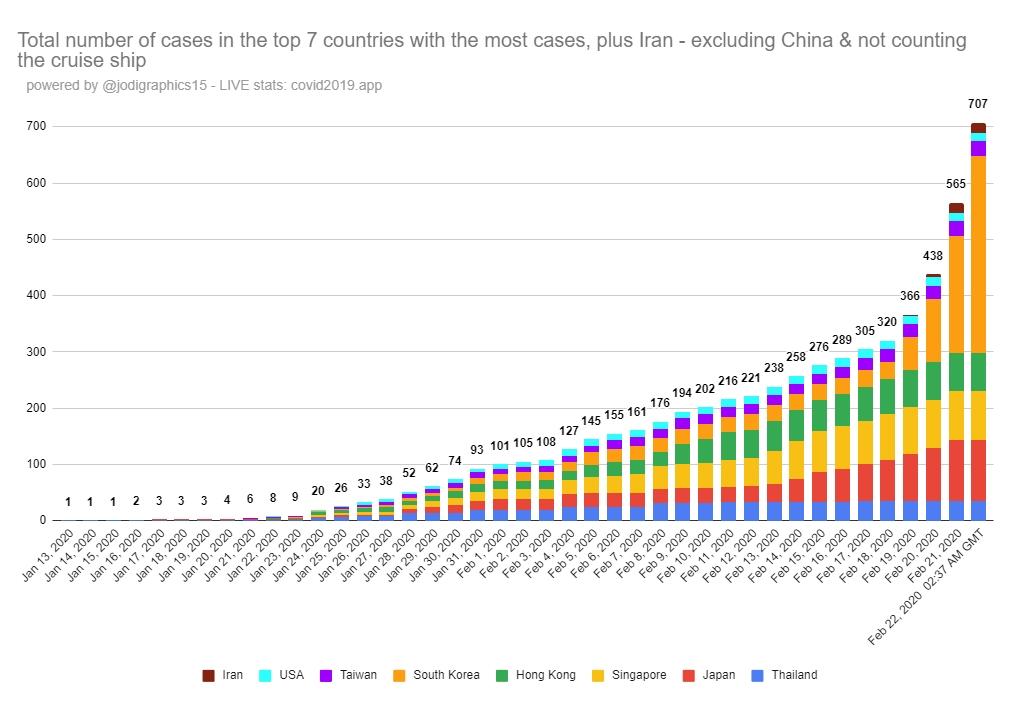
h/t @jodigraphics15
And so, as at least one cluster of new coronavirus cases has emerged in South Korea, and many are waiting for a similar emergence in Japan where the fallout from the early breach of the Diamond Princess quarantine will hit the hardest in the coming days, more and more are finally asking: "can it still be contained?"
If the answer is no, Rabobank's "unthinkable" coronavirus scenario comes into play, which for those who may have missed it, is the following:
This scenario is very short. The virus spreads globally and also mutates, with its transmissibility increasing and its lethality increasing too. The numbers infected would skyrocket, as would casualties. We could be looking at a global pandemic, and at scenarios more akin to dystopian Hollywood films than the realms of economic analysis. Let’s all pray it does not come to pass and just remains a very fat tail risk.
* * *
Update (1735ET): Italy's Corriere has just reported the first death from Covid-19 - a 77 year old man in Padua, Veneto region.
Authorities in northern Italy on Friday ordered the closure of schools, bars and other public spaces in 10 towns following a flurry of new coronavirus cases.
After 5 doctors and 10 other people tested positive for the virus in Lombardy, IBTimes reports that over 50,000 people have been asked to stay at home while all public activities such as carnival celebrations, church masses and sporting events have been banned for up to a week.
In a desperate attempt to reassure a public beginning to panic, Italian Prime Minister Giuseppe Conte said "everything is under control", and stressed the government was maintaining "an extremely high level of precaution".
In Casalpusterlengo, a large electronic message board outside the town hall read:
"Coronavirus: the population is invited to remain indoors as a precaution".
More polite than the full martial law forced upon the people of Wuhan for sure.
* * *
Update (1645ET): Earlier this week, we reported that a Japanese man who had recently visited the US state of Hawaii, a popular destination among Chinese and Japanese tourists.
Since then, things have been oddly quiet. For those who have been hoping that this is because authorities found no evidence that the patient was infected in Hawaii or spread the virus to anyone else he came into contact with, well, we're sorry to disappoint you.
Because journalists with the Star Advertiser discovered that the reason that officials haven't had any news is because nobody has been tested.
And nobody has been tested, because the state doesn't have any kits.
This report hit before today's CDC press conference, where the agency once again noted the shortage of tests, and the lack of preparedness among most US states (only three: Cali, Texas and Illinois are sufficiently prepared they said). Until this changes, the CDC said it will centralize 'surge' testing at the CDC.
More likely than not, this means there's probably a huuuuuge backlog of cases from around the country waiting to be tested.
The surge in cases reported earlier today was due to new cases from the Diamond Princess. Perhaps the next round of infections might involve human-to-human transmission in the US.
* * *
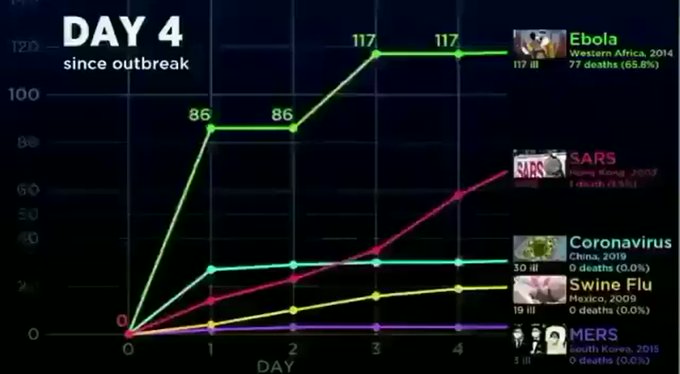
Update (1615ET): As the week draws to a close, we'd like to share a video with readers that we found particularly helpful while trying to put the outbreak in context:
Coronavirus breaking NEWS كورونا فايروس عاجل@novel_covid_19

Stunning and disturbing. #coronavirus compared to other

virus outbreaks.


1,957 people are talking about this


Additionally, we'd like to add a little levity for readers who have grown weary of all the videos depicting terrifying scenes on mainland China, we saw this report in the People's Daily.
Apparently, the only thing a cruise ship is good for right now is transporting doctors to coronavirus hot spots.
Russian Market

✔@russian_market

Is it a joke? China sends docs on a cruise ship? https://twitter.com/pdchina/status/1230947800533405699 …
People's Daily, China

✔@PDChina

The 1st #cruise ship sent to aid the fight against novel #coronavirus in #Wuhan arrives at Wangjiagang ferry terminal on Fri. The ship is set to provide waterborne accommodation for medical workers working on the frontline against #COVID19

51 people are talking about this


* * *
Update (1455ET): The New York Times is reporting that at least 34 people in the United States are infected with the new coronavirus spreading from China, federal health officials said on Friday.
These include 21 cases among repatriated individuals, as well as 13 US cases.
This is a dramatic increase from the last reported case count of 16, and Dr. Nancy Messonnier, director of the National Center for Immunization and Respiratory Diseases, said at a news briefing, more infections are expected.
“This new virus represents a tremendous public health threat,” Dr. Messonnier said.
* * *
Update (1315ET): The scapegoating continues.
The Epoch Times reports that 8 CCP leaders were removed from their positions following the discovery of 207 cases of the virus inside Rencheng Prison in Shandong, one of three provinces where prison cases have been detected.
曾錚 Jennifer Zeng@jenniferatntd

After 207 people at Rencheng Prison in #Shandong infected with #COVID19, 8 #CCP leaders removed from their positions, Yu Chenghe, spokesman of Shandong Provincial Gov. announces. #Coronavirus #CoronavirusOutbreak #coronaviruschina 山东省任城监狱207人感染 #新冠肺炎 8名官员被免职


125 people are talking about this


Just the latest reminder that officials can only hide things for so long with the coronavirus. Any lies or dissembling will be exposed by the onslaught of COVID-19.
* * *
Update (1240ET): As we mentioned below, the CDC had some pretty chilling words for the American public during a press conference on Friday. During the 12:15pm ET update, the organization warned that it had centralized 'surge' virus response due to a lack of testing kits and the fact that every state but three is unprepared for the epidemic.
During the press conference, the CDC described the virus as a "tremendous public healht threat" and warned that human to human transmission in the US is "very possible, even likely."
The announcement comes after the Washington Post reported last night that the CDC opposed the State Department's decision to bring the 14 Americans confirmed to have been infected with the virus aboard the 'Diamond Princess' back to the US with the other ~300 evacuees - thereby breaking the quarantine and risking a broader outbreak, and exposing many of the passengers on the flight who hadn't been infected to the virus.
The CDC was so mad, it reportedly asked for its name to be removed from a press release about the evacuation.
We also noted at the time that the decision to break the quarantine and bring the 14 infected persons back seemed idiotic.
So far, it's looking like that's exactly what's happening: As we noted earlier, 11 of 13 people quarantined in Nebraska have now tested positive.
Just imagine what happens if it hits Omaha, or Chicago. Or New York (which has already had a few scares):
AGTrader@ag_trader

If this hits NY or Chicago.... schools close overnight and everything shuts down.

Fed will be powerless.. just like 08... didnt matter if they were cutting rates... nobodoy was going to buy an overpriced house.

71 people are talking about this


Earlier, WHO Director General Dr. Tedros warned that the "window is narrowing" to suppress the virus before it's too late. That's in contrast to the language he used during the press conference late last month where the organization finally declared the virus a global pandemic. At the time, he assured the public that the number of cases was still small. "Even now there's a window of opportunity," he said."
Soon, it'll be a missed opportunity.
Update (1230ET): Remember those two hospitals that China slapped together in Wuhan that some have compared to prisons, and which have reportedly been rife with problems?
Well, now China is planning to build another 19 makeshift hospitals to quarantine more infected patients in Wuhan.
So far, the city of 11 million has converted 13 existing venues into hospitals, with a total of 13,348 beds. The 19 new hospitals would create 30,000 beds, according to China's Global Times.
In other news, minutes ago, two more coronavirus cases were confirmed in northern Italian region of Lombardy, bringing the country's total announced on Friday to 16. Italy now has some 19 cases.
It's unclear whether the patients were infected in Italy, or abroad. Some 250 others are in isolation awaiting testing results. Most of the cases have been found in northern Italy.
In the US, the CDC has warned that only three states, California, Nevada and Illinois, have the testing capacity needed to confront a coronavirus outbreak. Until more become available, the CDC will be handling any necessary 'surge testing'. They added that future human to human transmission in the US is possible, even 'likely' (which is why the US probably should have left those 'DP' passengers in Japan).
Meanwhile, here's what we're looking at so far for cases ex-China in Asia.
* * *
Update (1215ET): It looks like Beijing is adopting a new media strategy: Imply that the US is concealing a massive outbreak.
Hu Xijin 胡锡进

✔@HuXijin_GT

Coronavirus epidemic is getting severe in Japan and South Korea. Problems with coronavirus test in the US may impede full disclosure of outbreak there. Current flu season in the US is serious. Whether it is related to the coronavirus is worth vigilance.

329 people are talking about this


The US is actually using some pretty scary surveillance tech to screen flu patients who seek treatment in American hospitals to root out any possible coronavirus cases that might have slipped through.
* * *
Update (1140ET): Japanese health officials and Carnival Japan announced that 253 more individuals - a mix of passengers and crew, presumably - who tested negative for the virus have disembarked from the 'Diamond Princess' on Friday.
It looks like the company has extended the de-boarding process by a day, as there are still some passengers on the ship who won't leave until tomorrow.
Health experts and local officials (probably all the way up to PM Shinzo Abe) have been fretting about the possibility of an outbreak in Japan, especially with the Tokyo Olympics this summer.
You can't just cancel the Olympics like you can cancel the Tokyo Marathon.
This comes after US media reported earlier on Friday that 11 of the 13 'Diamond Princess' evacuees taken to the University of Nebraska Medical Center ended up testing positive for the virus, which means more individuals must've caught it either just before departing, or in transit, as 14 individuals who tested positive at the last minute were allowed aboard the flight that some say broke the quarantine.
University of Nebraska Medical Center representative Taylor Wilson said 10 of them are currently in isolation in the facility's National Quarantine Unit, while three others are in the biocontainment unit, according to USA Today.
Earlier this week, before they tested positive, Dr. Mike Wadman, the co-medical director of the National Quarantine Unit, said that all 13 would spend at least 2 weeks quarantined in Omaha.
By that time, one male patient had already been transferred to the hospital’s biocontainment unit because of severe symptoms including cough, fever and shortness of breath. At the time, officials said some of the evacuees were exhibiting 'minor symptoms'.
As of last night, there were 634 confirmed cases of the virus stemming from the 'DP', while 2 Japanese passengers passed away in Japan.
* * *
Update (1130ET): Epidemiologist had already warned that patients could be reinfected with the virus. But the Epoch Times' Jennifer Zeng is sharing a report about a patient in Sichuan (notably one of the provinces visited by WHO experts) who was reinfected with the virus after recovering.
曾錚 Jennifer Zeng@jenniferatntd

Not good news. Cured patient of #COVID19 in #Sichuan province infected again.
四川出現新冠肺炎「二次感染」患者 https://www.epochtimes.com/gb/20/2/21/n11884983.htm … via @dajiyuan
四川出现新冠肺炎“二次感染”患者 - 大纪元
新型冠状病毒肺炎(俗称“武汉肺炎”)被指有隐蔽性,除了此前发现有较长的潜伏期,近期还出现另一种现象,即治愈出院的患者被发现再次感染。截至目前,湖南常德、四川成都均出现这种病例。
epochtimes.com

520 people are talking about this


UPI reported earlier that everal patients in China who were discharged from hospitals after making a full recovery have been reinfected, citing reports in the People's Daily on Friday.
One patient in Chengdu was discharged from a local hospital and was quarantined for 14 days at home, but somehow became reinfected. And doctors quoted in the story said her case isn't unique.
It's also possible to catch the flu twice in one season, but that is rare.
* * *
Update (1100ET): Epoch Times' Jennifer Zeng is reporting that in parts of China, the government has signaled to workers that they will be "punished" if they don't report back to work.
And for everyone who gets infected, don't expect your employer to deal with it, Zeng adds. "if you get infected, it is not a work-related injury. You are on your own."
曾錚 Jennifer Zeng@jenniferatntd

#COVID2019 inspection officially ends. Employees who refuse to go back to work will be punished. In the meantime, gov. says if you get infected, it is not a work-related injury. You are on your own. #GDP is more important than human life in #China. #Coronavirus


1,581 people are talking about this


That's pretty chilling stuff, but as we pointed out yesterday, there's an ongoing debate in parts of the country where case numbers aren't as high (not that anybody trusts the government's figures) about whether keeping the economy on lockdown might be doing more harm then good. And in order to prevent a repeat of what happened last time (when millions just simply didn't show up), it's upping the ante for citizens who don't abide by the state's command.
The New York Times is reporting that, for the first time since the outbreak began, Chinese health officials acknowledged on Friday that their constant changes to the 'criteria' for what constitutes a 'confirmed case' have sown confusion and mistrust.
As we have assiduously reported, officials in Hubei have revised their case tallies three times now because of these shifting definitions.
in the province hardest hit by the coronavirus acknowledged for the first time on Friday that their methods of confirming and reporting infection numbers had sown confusion and mistrust. They added that they would no longer subtract cases from the total. The message comes just hours after state media reported new breakouts in a handful of Chinese prisons.
Moving over to the WHO's daily press conference from Switzerland, Director-General Dr. Tedros commented on the new cases and deaths reported in Iran, as well as Lebanon, which reported its first case this morning though hasn't yet recorded a death.
Asked whether the situation is at a "tipping point," Dr. Tedros replied that the "window of opportunity" for humanity to prevent an even more massive outbreak is rapidly closing.
"The window of opportunity is narrowing," Dr. Tedros said, and humanity is running out of time to stop this virus before things get much, much worse.
You know, just some reassuring words to kick off the weekend with a little levity.
We're starting to suspect that Dr. Tedros may have recently purchased some out-of-the-money S&P puts.
Seemingly responding to the growing number of 'armchair cranks' and 'conspiracy theorists' questioning why a WHO team of experts - a team that includes two Americans - hasn't yet traveled to Wuhan, Dr. Tedros added that the team is planning to travel to the epicenter of the outbreak on Saturday.
Eunice Yoon

✔@onlyyoontv

Senior @WHO team to travel to epicenter Wuhan on Saturday. https://twitter.com/onlyyoontv/status/1230061540084043776 …
Eunice Yoon

✔@onlyyoontv
Replying to @onlyyoontv
The more senior @WHO team has so far only seen situation in Beijing and heads to Sichuan and Guangdong Provinces (not #coronavirus hot zones) this week. @WHO told me #HubeiProvince visit not yet been ruled out. Latest on the WHO team whereabouts in #China below:

88 people are talking about this


So far, the team has traveled to Beijing, Sichuan and Guangdong provinces.
* * *
Update (1000ET): Check this out.
The NYT has published an interesting interactive illustrating the huge drop in flights departing from China to the US and other major economies.
The disappearance of tens of thousands of flights leaving China shows "how the coronavirus has hobbled a nation," the NYT said.
Jan. 23:
Feb. 13:
Put another way:
As the NYT reports, Oxford Economics said in a recent report that the outbreak could wipe $1.1 trillion from global output, which kind of undercuts Larry Kudlow's stammering on CNBC about this not being a 'US story': It's difficult to imagine a scenario where the US economy would walk away unaffected by this.
See it here.
In other news, Beijing continues to push the 'everything's fine; we're winning' narrative.
曾錚 Jennifer Zeng@jenniferatntd

After 500 prisoners in #China infected with #COVID19, Xu Xiaobo, Deputy Director of #Zhejiang Provincial Justice Department is still saying "the #epidemic is stable and under control". 监狱感染数百人,司法部厅长大人依然说「#疫情 平稳可控」#Coronavirus #武汉肺炎 #新冠肺炎 #


250 people are talking about this


* * *
Update (0725ET): Lebanon has confirmed its first case of COVID-9.
BNO Newsroom

✔@BNODesk

BREAKING: Lebanon reports 1st case of coronavirus https://bnonews.com/index.php/2020/02/the-latest-coronavirus-cases/ …
Tracking coronavirus: Map, data and timeline - BNO News
The tables below show confirmed cases of coronavirus (2019-nCoV, officially known as SARS-CoV-2 or COVID-19) in China and other countries. To see a distribution map and a timeline, scroll down. There...
bnonews.com

339 people are talking about this


The tiny Levantine state, which has swollen with refugees from nearby Syria in recent years, is in the middle of an economic crisis, and its government is presently weighing whether to default on an upcoming loan payment, which could lead to deeply unpopular austerity measures, as Al Jazeera reports.
Earlier, Israel’s Health Ministry confirmed that an Israeli citizen contracted the virus while aboard the Diamond Princess cruise ship (1 of 11 Israeli passengers). She is currently under supervision and isolation in Israel. All 11 were flown out of Japan and sent directly Friday into isolation at Sheba Tel Hashomer Hospital, where they will remain during a 2-week quarantine period. Earlier this week, Israel’s government announced a temporary travel ban on all foreign nationals who had traveled to Thailand, Singapore, Hong Kong and Macao during the past 2 weeks.
Following reports yesterday that two Beijing hospitals had been put under quarantine amid fears of a wider outbreak, WaPo reported that one district in Beijing has been found to have an "infection density" second only to Wuhan on mainland China. This has served to further intensify concerns about what might happen when millions of Chinese return to work next week.
* * *
When historians look back at the COVID-19 outbreak, they'll remember this week as an important turning point in the crisis, when international public-health experts and investors started to focus their attention on South Korea, Japan and other countries in the region that have seen the number of new cases accelerate markedly in recent days.
Put another way, evidence that the virus is spreading more rapidly within other Asian countries outside mainland China has become impossible to ignore, which is probably why US futures are pointing to a lower open for a second straight day.
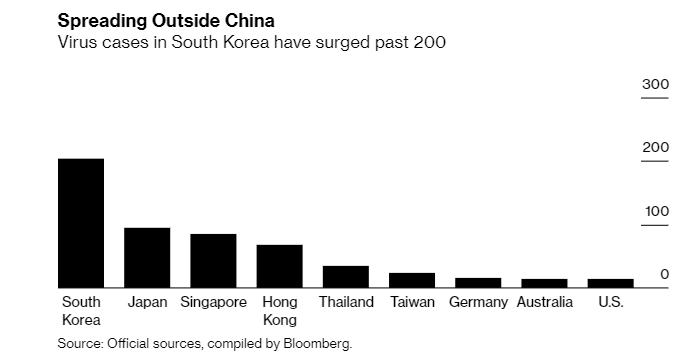
As Bloomberg reminds us, South Korea has seen its total cases soar past 200 as the number of infections doubled in 24 hours.
Meanwhile, cases in Singapore and Japan have topped 85, and let's not forget the 600+ from the 'Diamond Princess' who have been excluded from the 'Japan' total.
At least as far as deaths are concerned, the numbers outside of China remain small: out of 2,247 deaths, only 13 have occurred in other regions (this includes 2 more deaths in Iran announced just minutes ago).
But there's no getting around it: the spread of the virus will undoubtedly worsen the economic blowback, as one economist explained to BBG.
"The sudden jump in infections in other parts of Asia, notably in Japan and South Korea, has sparked renewed concerns," said Khoon Goh, Singapore-based head of Asia research at Australia & New Zealand Banking Group Ltd. "This points to a new phase in the outbreak, and one which will see continued disruption and more economic impact than previously thought."
Last night, we reported on the latest case numbers out of South Korea, and more have already been recorded. The current total is 204. Earlier this month, the WHO said China's approach to tackling the virus should be a "model" for other governments facing similar outbreaks. At the time, experts criticized the organization for appearing to parrot Chinese propaganda. But it looks like they might have been on to something. Because as we reported late last night, the Blue House has ordered a 'special management zones' in the cities of Daegu and Cheongdo, or what appears to be a kind of 'soft' quarantine. The government said that since they've failed to prevent an outbreak, they're pivoting decidedly to a strategy of containment.
Just a few hours ago, Chinese state media reported that 500 cases - roughly half of the new cases reported in China on Friday - involved prisoners at a handful of jails across the country, according to the Washington Post.
Infections have been confirmed at five prisons in Shandong, Hubei and Zhejiang, according to China's Ministry of Justice. A prison in eastern Shandong province showed 207 out of 2,077 inmates and staff were infected, and the provincial justice department’s Communist Party secretary was dismissed as a result, the province announced. Another jail in Zhejiang province found 34 cases. Hubei province, at the center of the outbreak, said Friday it found 220 new cases inside penitentiaries.
According to the Washington Post, the prison outbreaks underscore the virus's easy transmissibility in confined spaces.
Even the Global Times acknowledged that the prison outbreaks have "weakened" Beijing's claims that the virus is receding...
Hu Xijin 胡锡进

✔@HuXijin_GT

Coronavirus infection cluster emerged in several prisons in China with two prisons reporting over 200 infections each. It has left the impression that epidemic is rebounding, which has weakened public confidence to some extent.

225 people are talking about this


...Even as local officials adopt ever-more bizarre and draconian restrictions on individual movement.
Eunice Yoon

✔@onlyyoontv
Zhongnanhai, the central HQ of #China Communist Party and State Council, is in Xicheng district. It houses the offices of President Xi Jinping and Premier Li Keqiang. #coronavirus
Eunice Yoon

✔@onlyyoontv

My apartment complex told me I now need to apply for a pass that will allow me to enter/exit. Pass is linked to an individual ID- in my case my passport. Need to bring housing lease, too, as proof of residence. Each family gets 3 passes only. Those without cannot leave compound.

185 people are talking about this


Tests at a prison in eastern Shandong province showed 207 out of 2,077 inmates and staff were infected, and the provincial justice department’s Communist Party secretary was dismissed as a result, the province announced. Another jail in Zhejiang province found 34 cases. Hubei province, at the center of the outbreak, said Friday it found 220 new cases inside penitentiaries.
The prison outbreaks underscored the SARS-CoV-2 virus’s high transmissibility in confined spaces after the disease ravaged the Diamond Princess cruise ship docked in Japan.
While overall numbers remain low, thousands who fear they may have come into contact with a 'super-spreader' in Daegu, a city of 2.5 million about 2 hours south of Seoul. The woman, who believed she was suffering from a simple cold because she had not traveled abroad, reportedly attended four church services at a "cult-like" church with 1,100 members in the city, as well as branches in other cities, including Seoul, where the mayor has ordered the local church closed until further notice.
Communist Party leaders made yet another public misstep overnight when health officials said they would once again change their 'criteria' for what constitutes a 'confirmed' case of COVID-19 back to the more inclusive and accurate definition. Officials said they decided on the switch because they couldn't subtract already confirmed cases from the total, which sounds...almost plausible.
On CNBC Friday morning, Eunice Yoon, the network's reporter on the ground in Beijing, interviewed the owner of a Beijing restaurant discussing his fears about going out of business. But as China slouches back to work, millions are worried that Beijing might sacrifice the public welfare to get a few factories up and running.
Looks like the cat's out of the bag: North Korea has cancelled the Pyongyang Marathon, the country's largest tourism money-maker, because of COVID-19, according to the operators of several tour companies who spoke with AFP.
Beijing-based Koryo Tours, the official partner of the marathon, said on its website it had "received official confirmation today that the Pyongyang Marathon 2020 is cancelled".
"This is due to the ongoing closure of the North Korean border and COVID-19 virus situation in China and the greater region," it added.
North Korean officials have vehemently denied reports that the virus had crossed the Yalu River, evening becoming enraged at the US in response to an offer of assistance from the State Department. Recently, a WHO official said there are "no indications" that the virus has arrived in North Korea, but considering that we're talking about North Korea, that's hardly surprising.
As the lockdowns in Beijing, Tianjin and other cities intensified over the last week, more Chinese were subjected to displays like this:
Russian Market

✔@russian_market

Meanwhile in Tianjin

- It‘s just a flu. Everybody shut the door now.


198 people are talking about this


On Friday, Japanese health officials and Carnival Japan will release the last batch of passengers and crew from their 14-day quarantine aboard the 'Diamond Princess' despite criticisms from the CDC that Japanese officials had failed to maintain the quarantine. Right now, infectious disease experts see Japan as one of the riskiest places outside China, according to BBG. Health Minister Katsunobu Kato said on Sunday that Japan had lost track of the route of some of the infection cases, which have tripled in the past week to more than 90.
Iran just confirmed 13 more cases and 2 new deaths, mostly in Qoms, the same city where some earlier cases had been detected, while also reporting that the virus has reached Tehran, according to Reuters. So far, seven Iranians have been diagnosed in Qom, four in Tehran and two in Gilan, according to a tweet from the Iranian health ministry. Iranian officials have acknowledged the possibility that the virus might have arrived in every major Iranian city.
Even in Korea, health officials say they their investigators can't figure out how some of the outbreaks started. That's not exactly reassuring.
Right now, the focus is on South Korea. Last week, it briefly shifted to the UK before moving on to Japan. Italy just reported another three cases, doubling its count from 3 to six. Will they be next? Maybe Africa?


BArrons : How AT&T Is Transforming Itself for a Future of 5G and Streaming

How AT&T Is Transforming Itself for a Future of 5G and Streaming

AT&T’s John Stankey is sitting on the couch in his stunning corner office on the 46th floor of a new tower in Manhattan’s trendy Hudson Yards complex, high above the far West Side. The space has a spectacular view of the Hudson River and the New Jersey river towns beyond. The odor of fresh carpeting hangs in the air. Stankey, arms stretched over the back of the couch, appears remarkably, almost unreasonably, composed.

An AT&T (ticker: T) lifer who joined the company in 1985, Stankey has two huge and relatively new jobs. In June 2018, with the completion of the $108 billion Time Warner acquisition, Stankey became CEO of WarnerMedia, the restructured and renamed entertainment conglomerate. With a portfolio that includes HBO, CNN, TBS, TNT, Warner Bros., and Cartoon Network, Stankey instantly became one of the world’s most powerful media executives. Last fall, he also was named AT&T’s president and chief operating officer, adding responsibility for the company’s communications and advertising businesses, and making him the clear heir apparent to CEO Randall Stephenson.

Lately, Stankey is gearing up for the May 2020 launch of HBO Max, the company’s new entry into the intensely competitive market for subscription-based streaming services—and the core of AT&T’s revamped content strategy. In his free moments, Stankey is steering Ma Bell’s fifth-generation, or 5G, wireless rollout, streamlining AT&T’s balance sheet, and prepping for his eventual promotion to the top job.

We sat down with Stankey this week for an extended discussion on 5G, HBO Max, the fate of DirecTV, and a host of other topics. The excerpts below have been edited for space and clarity.

On why 5G is going to be more important initially for businesses than for consumers:

John Stankey: With 5G, we’re going to revert to what used to be the norm in technology, when business applications came first and then flowed to consumers. In the early 2000s, that shifted, and consumer applications drove mass deployment, and then benefits would flow to enterprises. With 5G, the dynamic is going to flip back, with the first meaningful applications enterprise-led, like distributed manufacturing floors that become automated through pervasive sensors and control mechanisms driven by 5G networks.

On why he’s not that worried about the impact of the coronavirus on the 5G rollout:

I’ve seen theories where the virus doesn’t peak until April, and I’ve heard others who say the outbreak is peaking now. But the devices that will drive 5G mobile-phone adoption aren’t even in factories yet, and won’t be manufactured until weeks before they’re brought to market. Assuming this thing passes by summer, I don’t think there’s going to be much impact.

On whether AT&T—widely seen as the best-positioned U.S. carrier in terms of 5G spectrum—still needs more bandwidth:

We will continue to be spectrum acquirers. Bandwidth consumption continues to increase. Things that consumers used to do at home—because that’s where they got acceptable performance and throughput—they’re now doing on the go. All of the carriers will continue to build additional capacity, and we’ll continue to find places to add to our spectrum portfolio.

On why AT&T wants to talk about content, not the various flavors of 5G:

If you’re talking to customers about the difference between “millimeter wave” versus “sub six” 5G networks, you’ve already lost. The speed and coverage you get doesn’t matter once you’ve passed a certain threshold. I’d rather talk to consumers about something they have an emotional attachment to, rather than, I can give you 110 megabytes and they can give you 105. And that’s why having content to marry to connectivity is important, because you’re not going to be able forever to sell connectivity based on speed.

On how buying Time Warner boosts AT&T’s connectivity business:

Customers will stop distinguishing between fixed and wireless connectivity. And then they’re going to say, why else should I do business with you? I believe it will be through aggregation of entertainment-based services. We’re talking about video today, but maybe tomorrow we add music, maybe a gaming subscription service, or some combination where I can get connectivity and I get something else with it. After we acquired Time Warner, we started offering HBO on top of our wireless services. Others are giving Netflix away for free. That trend continues. We’re going to see these services reaggregate over time under a different distribution model.

On why HBO Max will be a content platform, not just a subscription streaming service:

It’s about the strength of the platform to reach most U.S. households. To the extent that the platform is flexible enough to offer both subscription-based and advertising-based content, it’s a natural place for additional services to show up. That’s why HBO Max is such an important driver for our business—it is a high-value, low-priced service that we believe most U.S. households will want. It starts with a subscription video service. But we can add ad-supported services, as well.

On the role of streamed advertising:

First of all, we absolutely agree there needs to be a premium subscription-supported product that has no advertising. That will be the foundation of our platform. But our belief is that, over time, consumers will value depth and choice. And so we’ve said next year we’ll introduce an AVOD [ad supported video on demand] component to the product. And that AVOD component will broaden the kind of content that’s available, with a different monetization scheme. AVOD is not generating huge dollars. But look at Hulu. On a per-subscriber basis, there’s quite good economics. They’re using advertising in a different way, and that’s not even the most sophisticated approach that can be achieved now with current technology and what we know about customers. So I do believe there is a place for ad-supported content moving forward.

On offering a “channel store” on HBO Max, in competition with Roku, Amazon.com, and others:

With HBO Max, we’re going to establish a platform in most U.S. households that becomes a natural aggregation point. The difference is, we want to offer attractive economics for those services to come on the platform, so they can monetize their customers, as opposed to some of these egregious models of the dominant wireless OS providers [a reference to the Apple and Google app stores] that skim off the top and make it virtually impossible for anybody to make a buck. Or Roku’s demands to take portions of ad inventory in exchange for the right to be on the platform—I don’t think that’s long term the attractive way.

On the strategy around DirecTV, which is losing large numbers of subscribers:

We didn’t buy DirecTV because we loved satellite delivery. We liked the customer base. The play was to move most satellite customers to software-driven services. But we were later than we wanted to be on that product, AT&T TV, which launches in March. It is the satellite replacement product, the software-based service that allows us to modernize and bring a feature-rich customer pay-TV experience to the base, that is no longer dependent on satellite delivery. But If I had my wish, we would have been where we are right now over 18 months ago.

On the future of basic cable networks:

We’re going to see cable networks thin out. What’s going to be left will be those that have news, sports, and unscripted content. That’s what stays in that pay-TV bundle and has longevity over time. Do I think those things will become add-on packages as part of a subscription platform? I do.

On AT&T’s own basic cable networks:

Look, we’re not Viacom with 18 channels. We’re not Disney. We’re successful in that business, but we’re targeted. The bulk of our profitability there comes from CNN, which is news, and TNT and TBS, which have sports content along with general entertainment content. Then there’s truTV, which is not a huge economic contributor. And Cartoon Network, which will end up part of HBO Max.


On the National Football League, the Sunday Ticket offering, and the future of football broadcasting:

As for what happens to NFL rights, you would have to ask the NFL. Originally, the NFL viewed Sunday Ticket as a premium offer, and chose not to make it widely available. Does the calculus change going forward? We’re in a rapidly changing environment, and quite possibly it does. My sense is that all sports leagues realize that if they’re not being more deliberate about how they distribute rights, they’re going to miss some audience. Consider the National Basketball Association, which is quite popular with people in their 20s and 30s, who overindex on not being part of the traditional TV ecosystem. The NBA has to be thinking, do I want to only have my content available over cable, or should I be allowing my partners to make it available on other platforms? Will that undermine licensing revenues? Probably not. But I do believe we’ll see alternatives as you get into renewal cycles.

On the impact on AT&T from the Sprint/T-Mobile US deal:

It really doesn’t impact us. We’re running the same plays today as we did a week ago. We’re seeing momentum return in our subscriber growth. We’re going to finish the work on 5G deployment. I understand why Sprint and T-Mobile got together. T-Mobile was looking at this transition to 5G, and they had basically no spectrum.

Now, they have to bring the two businesses together and meld their portfolios. They’re going to be in a better position once they get through it, but they’ve got work to do. We bought Time Warner because we wanted to offer consumers not just great connectivity, but also something else. That’s our play. They’re not doing that. They’re going to figure out how to integrate cell sites and close down billing systems and do whatever they need to get economic efficiency. Our play is a great network, adding value with entertainment.

On future competition from Dish:

We’ll see. I love [Dish CEO] Charlie Ergen dearly, but he’s a very mercurial individual. Sometimes, the cards that he has on the table aren’t always the cards that he ultimately ends up playing. I’m sure there’ll be some surprises and twists and turns in whatever he does.

On the company’s three-year plan in response to recent pressure from activist investor Elliott Management, which includes selling assets and reducing debt, among other things:

It’s a nonissue at this point. We said we’d be at 2½ times debt to Ebitda [earnings before interest, taxes, depreciation, and amortization] by the end of 2019, and we delivered. AT&T often had three-year road maps but just didn’t communicate them, to give us flexibility when unexpected things popped up. Elliott asked us to tell people what our plans were, and in some cases, they’ve asked us to think a bit more critically on how we’re running the business. We’re casting a careful eye over every part of our operation, assessing how we’re positioned, thinking about whether we’re going to offer competitive pricing, with new entrants in the market like Charlie, and continued incursions from Google and Amazon. That’s a healthy process. I look at our operations and ask, are we as lean, as efficient, and as focused as we need to be? Three years from now, we will be a more-focused, more-tailored business than we are today because of portfolio rationalization, operational improvement, and product rationalization. That’s a healthy process for a business with a long, storied history.

On his future role at AT&T:

I don’t expect to occupy the WarnerMedia CEO role forever. This organization has gone through a lot of transitions over the past year. It wasn’t an easy year, but the business is so much better positioned. As great as the Warner asset was, it wasn’t configured the right way for this changing environment. Now, the business is positioned to respond to these trends. It’s hard to get an organization of this size with this much past success to do things differently. But that’s what we’ve done. Once that takes hold, it will be time for me to spend more time getting all of AT&T’s parts to work better together. The communications company, the media company, the advertising company. That moment will come, I expect sometime in 2020.

Many thanks, John.

Barrons : British Pub Owner Serves Up Rising Share Price

Mitchells & Butlers, one of Britain’s biggest owners of pubs, has faced difficult times, which has been reflected in its stock price. But the company has paid off more of its debt and has benefited as rivals were snapped up for premium prices. Investors may soon be toasting the steady rise in its stock.

Shares in the owner of O’Neill’s, All Bar One, and Harvester peaked on the FTSE 250 at 872.50 pence in 2007 but slipped to 139 pence a year later after a disagreement over strategy and a gamble on interest-rate movements that cost the group 393 million pounds sterling ($507 million).

Shares (ticker: MAB.UK) languished until last year at about 270 pence, but have jumped 45% in the past 12 months to 415.20 pence. Analysts are forecasting that the shares have further to rise.

The stock fetches a low, 10.5 times this year’s expected earnings and is valued at 50% below its peers. Anna Barnfather, an analyst at broker Liberum, estimates that the shares could rise another 44% to her target price of 600 pence. “The shares are unjustifiably undervalued,” she wrote in a January note.

The group last paid a dividend in 2017, and that’s unlikely to be fully restored until its pension fund is back to health. The company has a pension deficit of more than £300 million and has pledged to make annual payments of £49 million by 2023. After that date, Mitchells & Butlers should have more cash available, which it could put toward a dividend.

Broker Canaccord, which forecasts a target price of 530 pence, wrote in a January note, “We continue to view M&B as a long-term game. M&B should delever over the next decade (it should pay off £1.5 billion of the £2 billion debt).”

Mitchells & Butlers, which owns 1,671 restaurants and pubs, is considered one of the most attractive among the pubs groups in terms of the value of its properties.

The firm, which has a market value of £1.7 billion and employs 46,000 workers, has managed 18 months of positive underlying sales growth as it tapped into the growing trend for craft beer and premium food.

In November, it posted adjusted pretax profit of £197 million for the 12 months to September 2019. Canaccord forecasts a rise to £228.3 million by 2022. Revenues for 2019 were £2.2 billion, up from £2.1 billion.

The Mitchells & Butlers name is from two independent brewing and pubs businesses that merged in 1898. It became part of brewing giant Bass in the 1960s, which later renamed itself Six Continents. In 2003, Six Continents revived the Mitchells & Butlers name.

The management became distracted from the day-to-day business after one investor pressured them to split the operations side of the group into a separate business from the property.

Two other investors built major stakes, which sparked a boardroom battle over strategy and a succession of CEOs, which destabilized the business.

The business has been on more steady footing recently, with about 90% of its pubs refurbished in the past five to seven years. Chief Executive Officer Phil Urban told Barron’s that drinkers are flocking to the company’s more upscale pubs, which has helped boost the stock’s performance. Shares also got a boost from an initiative that has invested in other parts of the business such as software.

“We had another strong Christmas performance, with record sales levels across the five key festive days,” Urban says.

Another catalyst to push the stock higher is the potential for further consolidation in the sector. Two rivals, EI Group and Greene King, have already been snapped up. Any bidder for Mitchells & Butlers would need to navigate its complex securitization structure and win over a small number of key investors.

BArrons : Stocks Drop on the Week but Still Look Bubbly. Time to Prepare for a C

A stock-market meltup is happening right under our noses. And though we don’t quite have a definite sign that a bubble in equities is forming, several market statistics are concerning.

They suggest it might be best to prepare for a post-bubble correction of 10% or more.

On the surface, things look calm. The Dow Jones Industrial Average dropped 1.4% this past week, snapping two weeks of solid gains. The benchmark is up 1.9% for the year. The S&P 500 index dropped 1.2% for the week and is up 3.6% for the year. The Nasdaq Composite dropped 1.6% on the week and is up 6.9% year to date. None of those numbers point to a bubble.

It is what’s going on under the surface that looks worrisome. Growth stocks are dominating value stocks, blowing past dot-com-era outperformance levels. “The last time we got to these levels, the bubble burst and a 50%-plus global bear market began,” Citigroup strategist Robert Buckland pointed out in a Friday research report.

Consider the trading action in the market’s most popular stocks. The FAANGs— Facebook (ticker: FB), Apple (AAPL), Amazon.com (AMZN), Netflix (NFLX), and Google parent Alphabet (GOOGL)—are up 10% year to date, adding more than $330 billion in market value to the S&P 500. What’s more, the average price/earnings ratio for FAANG stocks has jumped to 35 times estimated earnings from 21 times last year.

Microsoft (MSFT)—an honorary FAANG member, with its $1.4 trillion market capitalization—is also something to behold. Shares are up 14% in 2020 and 65% over the past year, and now trade for 31 times estimated earnings. The last time the stock reached today’s valuation levels was in 2002, soon after the dot-com bubble burst.

It isn’t just rising valuations that should concern investors. There’s the options market, too. Microsoft’s bullish call-option volume, for instance, is blowing away bearish put-option volume, with the ratio up about 60% year over year. That’s significant because, as one colorful trader told Barron’s, “screen monkeys lifting quotes” helps fuel market froth.

Total trading in all options for the FAANG-plus-Microsoft group is also up about 60% year over year—and traders are buying more calls than usual. The action is undeniably bullish. It is possibly euphoric. The options-trading action is the closest thing to a smoking gun out there.

What to do? Sell stocks as they rise—or learn to trade the momentum?
At some point, value stocks will outperform growth stocks. The problem is investors who followed that path have underperformed for years. There are, after all, a lot of energy stocks—which have been slammed by low oil prices—in the value indexes. What about home-builder stocks? The group still trades at a modest price/earnings ratio, and recent U.S. housing data have been solid. The sector is up year to date, but the options market isn’t pointing to a bubble in housing stocks.

Besides sector rotation, one could sell down portfolio exposure—taking some money off the table. That can be painful, but prudent.
We aren’t calling the end of the bull market in U.S. stocks. Yet. But the market is overbought, in Wall Street parlance. That means bullish sentiment is high and a correction is due. A 10% drop to 3000 in the S&P 500—near the index’s 200-day moving average—wouldn’t surprise seasoned traders. In fact, the market is as far away from its 200-day moving average as it has been since late 2017. (That was followed by—wait for it—a correction.)

Bull markets don’t die of old age, as they say on the Street. Something has to happen to derail global growth. It could be the coronavirus outbreak in China. It could be slowing commercial construction activity in the U. S.—something Deere (DE) hinted at during its conference call on Friday.

Investors ignored Deere’s warning and sent its shares up 7% in trading on Friday. Deere left its full-year earnings guidance unchanged.

That’s another sign of a stock market bubble: ignoring bad news.

Barrons : A Contrarian Economist Is Warning of Recession and Deflation. He’s Bee

A Contrarian Economist Is Warning of Recession and Deflation. He’s Been Right Before.

Economist David Rosenberg has been warning for years that the U.S. economy isn’t as healthy as it might seem. He has a history of bucking conventional wisdom. The longtime bond bull spent seven years as Merrill Lynch’s chief North American economist, where he picked up on signs of a deteriorating economy before many others did. In 2005, he warned about the U.S. housing bubble, a year before it began to burst, and he called the last recession well before his contemporaries did. In 2009, he moved to Toronto-based wealth manager Gluskin Sheff & Associates, serving as chief economist and maintaining his bearish outlook for much of one of the longest bull market in history.

Now, a decade after his move, the 59-year-old self-described contrarian is as bearish as ever. Barron’s caught up with Rosenberg, who recently set off on his own as chief economist and strategist at Rosenberg Research & Associates. He remains a bond fan, predicting that another recession and stretch of disinflation—if not deflation—are around the corner. His against-the-grain recommendations go beyond bonds to gold to drug retailers to oil and gas. An edited version of our conversation follows.

Barron’s: What is your outlook for 2020 and beyond?

David Rosenberg: The consumer has no doubt surprised me in terms of its resilience. But as the legendary economist Herb Stein famously said, anything that can’t last forever won’t, and the consumer-resilience narrative is looking pretty stale to me right now. I expect that the consumer will lose its resilience this year. The pace of job creation is likely to slow, and, along with that, personal income growth will moderate. There is no recession without the consumer playing a part, and there are some early detection signs that the consumer this year will not be what the consumer was last year.

Will that cause deflation?

In the next 12 to 24 months, we’re going to be talking more about deflation than we have any other time this cycle. That’s something, by the way, that the Treasury market has already started to sniff out. You see that with the long bond yield having just broken back below 2%. I see the 10-year yield breaking below 1% and the long bond below 1.5% in the next one to two years.

You’ve been bullish on bonds for a long time. What is the Treasury market saying?

The Treasury market is saying that the shift I’m talking about, in terms of falling consumer demand, is already taking place. The Treasury market is actually a better leading indicator than the equity market.

Why are Treasuries a better economic indicator than stocks?

I find it amazing that so many analysts and strategists look at year-over-year inflation. You really have to focus on inflation expectations, which look forward and help capture how perception affects reality. The small-business survey conducted by the National Federation of Independent Business shows that a record-low number of small businesses say inflation is their top concern. And when you go to the University of Michigan’s consumer sentiment survey, you see the median inflation expectations are at their lowest level in recorded history.

So here you have the people who set the prices—businesses—and the people who pay the prices—households—saying something very consistent. Inflation expectations are at historically low levels, which is rather incredible when you think about it in the context of the tightest labor market in 50 years and an equity market that is at all-time highs, heading into the 11th year of an economic expansion. Treasury yields are reflecting this dynamic in a way that the stock market is not.

Do you think this threat of disinflation or deflation over the course of the next couple of years is something the stock market is missing?

Well, what has made this cycle unique is that the correlation between gross-domestic-product growth and the direction of the S&P 500 index has only been 7%. Historically, it has been 30% to 70%. The stock market is telling you nothing about the economy anymore. Economic fundamentals have never mattered as little for the stock market as has been the case during this 11-year bull market. The stock market is behaving more like a commodity than anything else, in that it’s trading on simple supply and demand.

Why has that relationship broken down?

It’s perfect symmetry. We have had $4 trillion of quantitative easing matched perfectly by $4 trillion of corporate share buybacks, to the point where the share count of the S&P 500 is down to its lowest point in two decades. You would normally believe that a powerful bull market in equities would have been reliant on a strong economic backdrop. But that’s far from the case. We have never before seen such a stock-market performance in the face of what has been in the last 11 years the weakest economic expansion of all time. We haven’t even had one year of 3% or better real GDP growth in the U.S. since 2005.

How has this long bull market for stocks happened amid lackluster economic growth?

Share buybacks are the way you square that circle. That has been a major source of demand, which has nothing to do with the economy and is giving an illusion of prosperity. In a very counterintuitive sense, the reason the correlation between the economy and the stock market has broken down during this cycle is because the stock market has actually needed to have the economy weak. What has happened in this cycle is that companies that issued massive amounts of debt did not use the proceeds to finance capital expenditures and instead repurchased shares, inflating earnings per share. That’s how we managed to take sour cream and make it into ice cream.

At what point does the breakdown you describe in the stock market versus the real economy catch up with investors?

Arithmetically it has made perfect sense to borrow money and buy back your stock, when you look at the relative yields in the corporate bond market and the yields in the stock market. But that relationship may soon come to an end. We’re starting to see some pivot here in the yield relationship that could start to affect the buyback cycle.

Going back to the idea that this may be the year where the U.S. consumer loses its resilience, the most dangerous thing anybody could do is extrapolate the strength in the job market over recent years into 2020 and beyond. Corporate profits have shrunk for three straight quarters and look to be about flat for the end of 2019, and that will feed through to the household sector. From October to January, there was practically no growth in inflation-adjusted retail sales. Where U.S. consumer demand goes, the rest of the world is going to follow.

What are the signs that the U.S. consumer is weakening?

We’re already starting to see signs of wage growth subsiding, in the context of a labor market that still appears to be quite tight. But the truth is always in the price. If this was truly a vibrant labor market, wage growth would be accelerating at this point—not showing signs of deceleration. On top of that, a broader unemployment rate—which includes discouraged job seekers and part-timers seeking full-time work—has bottomed and is starting to hook up. A lot of people are making a big deal out of the rise we’re seeing in the labor-force participation rate, but this is not the same sort of increase you see early in an expansion, when we’re drawing in recently unemployed skilled workers. The principal source of this participation increase is really coming from unskilled workers going into low-valued-added, low-productivity sectors of the economy, like retail and customer service.

How do you see the 2020 election playing out?

There’s a general belief that Donald Trump is going to win, and he probably will. But there is a nontrivial chance that Bernie Sanders does emerge as the Democratic candidate, and there is a nontrivial chance—about 40%—that he could be the next president.

Will the Federal Reserve cut interest rates this year? Will we ever return to more “normal” rates?

We already have that answer. During his confirmation hearing, Federal Reserve Chairman Jerome Powell said it was time to start normalizing interest rates. One of the first things he did was raise the estimate of the so-called neutral federal-funds rate to 3% from 2.5% while suggesting we’d likely have to get above that. Who would know that they’d never get to neutral? You have to go back to the 1930s to find the last time the Fed got stopped out at such a low fed-funds rate.

Why did the Fed reverse course on normalizing interest rates?

To think that all it took was a 2.5% fed-funds rate to cause the corporate bond and stock markets to choke in December 2018 is a real testament to how acute the problem is. We are simply choking on too much debt. The economy cannot handle a nominal funds rate above 2.5%, and it can’t handle real [inflation-adjusted] rates much above zero because of the gigantic debt morass. The poster child is the corporate sector, though other measures of debt are high. It’s not just the U.S.—it’s global. Interest rates have no staying power on the upside, and they will come down. The question is the speed and the level at which we bottom out.
Could stocks fall even if the Fed cuts rates?

With the correlation between the economy and the stock market so low, you’re probably better off talking about the stock market with your electrician, your plumber, or a taxi driver. An economist is not going to help you, because the stock market has not been operating on fundamentals. What I do know is that at some point the party ends. Economic forces are still very important to the Treasury market, even if they’re not important to the equity market.

If I’m correct, the yield curve will melt like a snowball in July. Your best strategy is to buy 30-year zero-coupon bonds, which will generate equity-like returns without taking on equity risk. That is my No. 1 recommendation for the next 12 to 24 months. If the long bond can make you 20% total return in 2019, when the S&P 500 made 30%, imagine what the long bond does if we enter into a bear market in equities.

How can we ever get back to “normal” rates?

There are two ways. The first is we have a multidecade period of austerity, or a prolonged debt diet. The second is a large-scale “debt jubilee,” or debt monetization program, by which the U.S. Treasury would put a large sum on the Fed’s balance sheet and the Fed would then print the money. This would be different than QE, where the Fed created excess reserves in order to boost liquidity at banks. It would be a benevolent debt default through hyperinflation.

Are either of these paths—austerity or debt monetization—likely?

Austerity is going to be a bitter pill. I could see debt monetization happening in the next recession, which I see in the next year or two. Things will get so bad that current critics of debt monetization will line up for it, much as was the case with QE. There are no more fiscal hawks—they’ve gone the way of the dodo bird.

Aside from buying long bonds, how else should investors position?

Within the U.S. stock market, the aerospace and defense sector is in a secular bull market, as military budgets are going up everywhere. The global semiconductor industry has almost become a staple within the business spending arena.

I also like gold, because it’s inversely correlated with interest rates and also because I’m noticing central bank after central bank diversify into bullion. Gold is just like bonds, a hedge against this elongated period of trade policy and domestic election uncertainty.

Drug retailing tends to be a reliable place in a recession, where you can still participate in the stock market without getting crushed. My last recommendation is oil and gas, and this is because I’m a contrarian by nature. The oil and gas industry is priced for the whole world turning into the Jetsons, driving electric vehicles in the next five years. I don’t think that’s going to happen. You want to buy sectors that are priced to extinction, and energy can scarcely be cheaper than it is right now.

Where should investors be looking on a geographic basis?

Japan is my favorite turnaround story and has been for a while. Prime Minister Shinzo Abe is the most transformational leader in the world, and his policies have helped revive the growth potential of the Japanese economy. That’s not to mention other changes taking place there from a corporate governance standpoint that is elevating shareholder returns. They are meanwhile permitting work visas for the first time, and more importantly the female labor-force participation rate in Japan is in a bull market. The rate of return on assets has a significant correlation to the female participation rate.

Japan has yet to fully embark on an equity-ownership culture, like the U.S. did in the 1980s. The country is under-owned relative to its own history and to developed markets. Supply-side changes under way, such as easing guidelines around immigrant work visas, in addition to ongoing efforts to increase transparency will help change that. It’s a long-term buy and hold.

Barrons : There’s a 5G Showdown Brewing. Intelsat Stock Could Be a Casualty.

Intelsat’s stock could again become a casualty in a 5G showdown among hedge-fund managers, satellite operators, and the federal government.

This conflict is happening 20,000 miles above Earth, where the Luxembourg-based company’s satellites transmit television signals over the so-called C-band. That band of spectrum is considered to be prime for fifth-generation, or 5G, service, so regulators want to clear out 60% of it for use by wireless companies. At first, it looked as if that transition would create a windfall for a consortium of satellite operators called the C-Band Alliance. The group volunteered to sell the spectrum privately in a plan that could have brought Intelsat as much as $24 billion.

Intelsat (ticker: I) could use a big payout, as it has been losing money for three years and carries nearly $15 billion of debt. The problem is that a private sale would require the Federal Communications Commission to give satellite operators the ability to sell rights they don’t currently have, in the regulator’s view. Intelsat disagrees. In a letter published late Friday, it challenged the FCC’s authority to clear the C-band with the draft rule the regulator published on Feb. 7.

The hope for a big payout has cratered since November, when FCC Chairman Ajit Pai decided on a public auction. Under his current plan, satellite providers will be reimbursed up to $5.2 billion for transition costs, along with up to $9.7 billion in the form of incentive payments parceled out over time.

It looks as if the company could get just $4.9 billion of those incentive payments. But the final details of the rule haven’t been nailed down. And one investor, David Tepper, from Appaloosa Management, has bet that Intelsat has enough leverage—financial and political—to win out over competitors and regulators alike.

In a letter on Tuesday to Intelsat’s management and board, he said the company should challenge the FCC’s plan, and if that fails, he urged that the company file for bankruptcy as a negotiating tool against the federal government. Appaloosa, with a 7.4% stake in Intelsat, isn’t the only hedge-fund manager making bets on the stock: Discovery Capital Management and PointState Capital reportedly have 6.1% and 2.4% positions, respectively.

Tepper started building his stake about a month after Pai’s public auction announcement, according to Securities and Exchange Commission filings. By that point, shares were trading below $10—he bought 2.89 million shares at an average price of $7.

Intelsat’s shares jumped 45% this week, in part because of Tepper’s letter and a quarterly report showing losses that weren’t as steep as forecast. The stock also gained because Intelsat said it wanted to dissolve the C-Band Alliance, and asked for a greater share of C-band auction proceeds that would otherwise have gone to its competitors—a 60% to 67% share, or up to $6.5 billion.

Its peer SES said in a letter on Thursday to the FCC that it “rejects the assertion by Intelsat that ‘there will be no C-Band Alliance going forward.’ ”

Tepper declined to comment. Intelsat said it doesn’t comment on bankruptcy rumors. The FCC and SES didn’t respond to requests for comment.

The details of the C-band auction will probably be determined at the next FCC meeting, on Feb. 28. The draft rule, published on Feb. 7, directs up to $5 billion of the proceeds from the auction to cover satellite companies’ relocation costs. On top of that, it provides a total of $9.7 billion in incentive payments for five satellite operators if they clear the C-band by September 2023.

It isn’t every day that an activist equity investor like Tepper supports a bankruptcy filing—restructuring often cuts into the value of a company’s stock, and sometimes destroys it altogether. But if Tepper’s letter is any indication, Intelsat’s hefty debt gives it leverage to negotiate with the government. The question is how much of that leverage it will exert to get a better deal.

Intelsat has already expressed an apparent willingness to challenge the regulator’s authority in court. It could also use a bankruptcy filing as a nuclear option in negotiations with the FCC. Corporate bankruptcy courts automatically halt payments to creditors, and those payments can be held in limbo for a long time. Either choice would conflict with the government’s goal of quickly transitioning to 5G wireless service.

Intelsat listed a few key requests in a Feb. 19 letter to the FCC. First, it wants to speed up the schedule for incentive payments. Second, it wants more flexibility around the deadlines for clearing spectrum. Third, it wants a larger share of the FCC’s total $9.7 billion pot for incentive payments.

For now, analysts say the $4.9 billion of incentive payments that Intelsat stands to receive won’t necessarily brighten the longer-term outlook for the business. The company’s net income has been declining for three years, as an excess of network capacity and a shift to fiber networks put pricing pressure on satellite operators more broadly.

Because the relocation costs won’t be compensated until mid-2021 under the current plan, Intelsat could be left with a short-term cash crunch, analysts say. It has a $421 million bond coming due in June 2021, though executives said in Thursday’s earnings call that they feel comfortable that the company has “ample liquidity” to manage the maturity.

Nevertheless, the FCC may well respond to the satellite companies’ concerns, possibly by speeding up its timeline for reimbursing satellite companies’ relocation costs and reducing their financial burden.

Whether or not Intelsat is in line for a bigger government payout, investors should expect the unexpected from this situation—and steer clear of it.