FT : Private jet demand surges in wake of coronavirus outbreak

Private jet demand surges in wake of coronavirus outbreak
Rise comes as airlines slash flights and warnings increase over spread of disease

Demand for private jets has surged since the outbreak of the deadly coronavirus as companies and individual seek alternative ways to fly out of Hong Kong.

The number of business jet flights between Hong Kong to Australia and North America leapt 214 per cent in January compared with a year ago, according to data from WingX, a business aviation monitoring company.

Flights from Hong Kong to global locations jumped 34.2 per cent in January compared with a year ago.

The rise comes as fears grow over coronavirus spreading more widely to Asia-Pacific markets. Airlines have slashed the number of flights to and from China. At the same time, commercial passenger planes in China have been grounded.

“We’ve seen a crazy amount of requests,” said Alain Leboursier, sales director at Luna Jets, a private jet broker.

Some of the requests have come from companies and governments wanting to move their staff from Hong Kong and China to the US, EU and Middle East.

Jeffrey Lowe, managing director of Asian Sky, an Asia-Pacific business aviation company, added demand has also been spurred because of fears that strict travel restrictions in countries such as Hong Kong could be introduced.

“Everyone quickly refers back to Sars. A lot of people are taking a knee-jerk reaction and moving themselves out of harms way,” he said.

The rise in demand for private jets comes as the International Air Transport Association on Thursday estimated the deadly coronavirus outbreak will cost global carriers almost $30bn in lost revenues in 2020.

Asia-Pacific airlines will be hit by the vast majority of the $29.3bn revenue fall. Iata forecasts a 13 per cent decline in passenger demand for the region’s airlines over the full year — the first fall in demand since the financial crisis more than a decade ago.

While Hong Kong has not experienced mass groundings of planes similar to China, it has suffered a cut of about 55 per cent of flights over the past month, according to data from OAG, the aviation consultancy.

Some business jet experts think the concerns over coronavirus is also leading some wealthy individuals to avoid flying on commercial planes in an attempt to avoid crowds.

Adam Twidell, chief executive of PrivateFly, a UK-based private jet brokerage, said there were a significant number of requests from people wanting to fly on business jets in recent days.

“One is for transport of a decontamination team within Asia, another is a Hong Kong-based family, travelling to Bali. They normally fly by commercial airline but on this occasion, are concerned about exposure on the flight,” he said.

However, Mr Twidell said private jet companies were also experiencing clients changing or cancelling their travel plans.

Data from WingX show hardly any growth in the number of private jet flights from China.

Aviation experts said this is largely because there is only a small number of private jet operators willing to fly to and from China because of the quarantine requirements and travel bans.

FT : Luxembourg regulator accused of failing to protect investors

Luxembourg regulator accused of failing to protect investors
Complaint to Europe’s top finance watchdog is blow to continent’s biggest fund hub

Investors who claim they were defrauded out of millions of euros from a Luxembourg-based fund range have accused the grand duchy’s financial regulator of prioritising promoting the country as a financial hub over protecting consumers.

The directors of three collapsed Luxembourg funds, who are seeking to recoup almost €100m, claim Luxembourg’s financial regulator, the Commission de Surveillance du Secteur Financier, has obstructed their efforts to investigate wrongdoing and recover losses.

The directors of the group of funds, known as LFP I, have submitted a complaint against the CSSF to the European Securities and Markets Authority (Esma), the body responsible for setting standards for financial regulators across the EU, accusing Luxembourg’s finance regulator of failing to comply with its obligations under European law.

The criticism of the CSSF raises questions about the robustness of investor protection in Luxembourg, which is Europe’s largest fund centre with €4.7tn of assets and is gaining further prominence as UK managers shift business there in response to Brexit.

In a letter to Esma seen by FTfm, LFP I director David Mapley said the CSSF’s “marketing mission to promote Luxembourg as a financial centre” had undermined its responsibility to protect investors.

He accused the regulators of trying to quash the directors’ investigations into mismanagement and fraud by the funds’ previous managers and service providers in order to “force the LFP I [funds] to ‘go away’ and prevent any reputational risk”.

The CSSF declined to comment on the case but said it acted with the aim of protecting investors.

Mr Mapley — who heads Intel-Suisse, a financial investigations and asset recovery specialist — started pursuing compensation for LFP I investors in 2017 and was appointed as a director in 2018.

His work — notably his multimillion-dollar lawsuit against Goldman Sachs on behalf of a hedge fund in 2010 — has earned him a reputation for ruffling feathers. He recently filed a police complaint against a website that contains allegations about fraud on his part, which he claims is part of a smear campaign instigated by the perpetrators of LFP I’s collapse.

Mr Mapley has filed several criminal and civil complaints in connection with LFP I against companies including Luxembourg-based management company Alter Domus, custodian Société Générale and auditor PwC. He pointed to the way the regulator had ignored the directors’ requests for historical fund information and withheld funding for the management of two of the funds that now fall under its responsibility.

The CSSF’s actions went against investors’ interests and “are completely in contrast to that of a normal regulator upholding financial markets standards and integrity”, he said.

Francis Hoogewerf, an investor in the Columna Commodities fund, one of the two LFP I funds that were suspended in 2016, told FTfm the CSSF had rebuffed him when he complained about his financial losses. In a letter to the investor, seen by FTfm, the regulator said it was not obliged to help him on the grounds that he was considered to be a “well-informed” investor.

It is not the first time the CSSF’s conduct has come under the spotlight. Last year, an investor group representing unit holders in a Luxembourg-listed fund that invested in Bernard Madoff’s $50bn Ponzi scheme accused it of “selectively” applying its rules in an attempt to stay competitive.

A former senior global regulator who declined to be named said fierce competition between small jurisdictions such as Luxembourg, Malta, Cyprus and Gibraltar risked compromising investor protection.

The scramble for UK fund companies to set up in the EU following Brexit led to scrutiny on Luxembourg and its biggest fund rival Ireland amid fears they were undercutting one another on regulatory standards to attract business. This led to a move to grant tougher powers to Esma, although the effort was later watered down.

The former global regulator said that until Esma had stronger intervention powers, it risked allowing “unfair competition between national regulators and a lowering of investor protection standards”.

FT : Raf Simons to join Prada as co-creative director

Raf Simons to join Prada as co-creative director
Luxury group Prada hopes to attract high-end shoppers with appointment of renowned creative designer

Raf Simons is to join Miuccia Prada as co-creative director of the Prada label, in a move that the luxury group hopes will reinvigorate interest in the company, which has lagged rivals in attracting new generations of high-end shoppers.

Mr Simons is widely considered one of the most creative designers in the industry, though his tenures at both Dior and Calvin Klein were tumultuous, with him reportedly exiting the Calvin Klein business nine months before his contract ended.

The Belgian designer, 52, will continue to operate his eponymous men’s label in Antwerp when he joins Prada on April 2.

Prada generated sales of €1.5bn in the first half of 2019, up 2 per cent from the previous year but trailing competitors such as LVMH and Kering.

At a press conference at the company’s headquarters in Milan, Mr Simons said he had been approached by Patrizio Bertelli, Prada chairman and chief executive, to join the company “right after” his exit from Calvin Klein in 2018.

His appointment will mark a reunion of sorts: Mr Bertelli and Ms Prada hired Mr Simons to design the Jil Sander label in 2005, which he led for seven years before joining Dior as artistic director. Ms Prada said in a 2016 interview with System magazine that she would “love” to work with Mr Simons again.

Ms Prada said Mr Simons’ contract was “for ever” and that she has no plans to retire soon. “I like working, I’m here to work even more.”

FT : Italy quarantines a dozen towns in coronavirus outbreak

Italy quarantines a dozen towns in coronavirus outbreak
Number of cases tops 100 as Milan closes schools in Europe’s biggest incident

The Italian government has placed a dozen towns in the north of the country under emergency quarantine after the number of reported coronavirus infections topped 100 on Sunday, in the largest outbreak of the virus so far in Europe.

Italian prime minister Giuseppe Conte announced on Saturday that people should not leave affected towns in the northern regions of Lombardy and Veneto unless they had special permission; public gatherings and events were suspended and some schools and universities will close.

Among the towns in Lombardy affected are Codogno, Castiglione d’Adda and Casalpusterlengo. Residents in all three towns, which lie to the south-east of Milan, were told to stay indoors on Friday after six coronavirus cases were diagnosed.

On Sunday the Italian authorities announced that the total infection count had reached 132; 89 of the cases are located in Lombardy where two elderly people have died in the outbreak.

Other cases include 24 in Veneto, two in Emilia-Romagna and one reported case each in Lazio and Piedmont. Ansa, the Italian newswire, reported on Sunday that there were suspected but unconfirmed cases in Milan and the region of Umbria.

The special measures have been enforced across an area with a population of about 50,000 people. Residents have been instructed by the Italian government to stay in their homes and the country’s civil protection agency has passed an emergency decree. Those who break the instruction risk fines or imprisonment.

Milan mayor Giuseppe Sala said on Sunday that he had requested all schools in the city to shut for a week, and several large Italian companies, including the bank UniCredit, have instructed employees in the affected towns to not come into work.

Several Serie A football fixtures, including Inter Milan’s match against Sampdoria, have been suspended.

Fashion designer Armani said it would hold an empty show in Milan on Sunday, the final day of the city’s fashion week; the event will instead be livestreamed online. MIDO, the world’s largest eyewear trade fair, which is due to take place in Milan at the end of February, said it was suspending the event until June as a result of the outbreak.

Authorities in Veneto were reported to be considering suspending the Venice Carnival, which is currently taking place.

Mr Conte said Italy had adopted “rigorous and meticulous controls” after two Italian citizens in their late seventies died from the infection.

Luca Zaia, regional governor of Veneto, said the rapid spread of the virus showed that local-to-local transmission had occurred and it would no longer be sufficient to try to isolate travellers from China to stem the outbreak.

Giulio Gallera, a Lombardy councillor for welfare, tried to calm worried locals.

“The message we want to give is that in the area of the outbreak, the measures taken are efficient and positive,” he told reporters. “The aim is to contain the situation as much as possible.”

(ZH) Berkshire Letter Highlights: Buybacks, Cash Hit All Time High; Earnings Soa

Full Letter attached

Berkshire Letter Highlights: Buybacks, Cash Hit All Time High; Earnings Soar As Market Rebounds

In its latest (surprisingly short at just 12 pages, perhaps the shortest yet) annual letter released at 8am on Saturday, Warren Buffett’s Berkshire Hathaway surprised investors when it announced that Q4 net earnings rebounded to a $29.2 billion profit, or $17,909 per share, from a shocking $25.4 billion loss (or $15,467 per share) a year prior, when last year's unexpected write-down at Kraft Heinz and unrealized investment losses reversed following the best quarter for stocks in years, and while revenues also rose to $65.4 billion from $63.7 billion for the fourth quarter, the all important operating earnings - which strip away capital gains and focus on Berkshire's core business - declined 23% to $4.42 billion from $5.7 billion a year earlier, due to underwriting losses at the Berkshire reinsurance group which was hurt by typhoons in Japan, wildfires in California and Australia, and widening losses at its business writing retroactive reinsurance contracts.
Operating earnings exclude most investment results and Buffett has said they are more reflective of Berkshire’s performance than net earnings, which tend to fluctuate widely due to unrealized investment gains or losses.
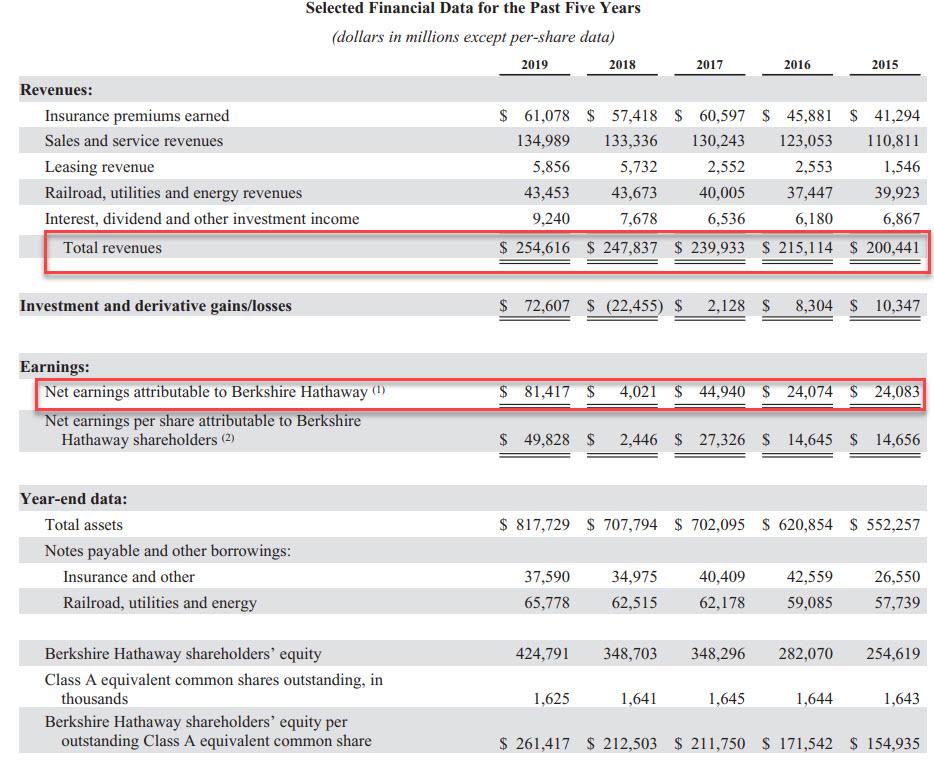
For the full year, Berkshire reversed the disappointing performance in 2018 (when it earned just $4.0 billion in GAAP profits, down 90% from the previous year, prompting the WSJ to describe this as "one of Buffett's worst years ever"), and recorded a whopping $81.4 billion in net earnings, driven mostly by unrealized investment gains with full-year revenues rising modestly from $247.8 billion to $254.6 billion. At the same time total asset across the conglomerate-cum-hedge fund (which at last check managed at least $242.1BN in US stocks ) rose by $110 billion to $817BN as of Dec 31, compared to the year prior.


Commenting on the company's $81.4 billion in 2019 GAAP net earnings, Buffett said that "the components of that figure are $24 billion of operating earnings, $3.7 billion of realized capital gains and a $53.7 billion gain from an increase in the amount of net unrealized capital gains that exist in the stocks we hold."
Buffett then focused on the $53.7 billion capita gain, saying that "It resulted from a new GAAP rule, imposed in 2018, that requires a company holding equity securities to include in earnings the net change in the unrealized gains and losses of those securities. As we stated in last year’s letter, neither Charlie Munger, my partner in managing Berkshire, nor I agree with that rule.
The adoption of the rule by the accounting profession, in fact, was a monumental shift in its own thinking. Before 2018, GAAP insisted – with an exception for companies whose business was to trade securities – that unrealized gains within a portfolio of stocks were never to be included in earnings and unrealized losses were to be included only if they were deemed “other than temporary.” Now, Berkshire must enshrine in each quarter’s bottom line – a key item of news for many investors, analysts and commentators – every up and down movement of the stocks it owns, however capricious those fluctuations may be.
Berkshire’s 2018 and 2019 years glaringly illustrate the argument we have with the new rule. In 2018, a down year for the stock market, our net unrealized gains decreased by $20.6 billion, and we therefore reported GAAP earnings of only $4 billion. In 2019, rising stock prices increased net unrealized gains by the aforementioned $53.7 billion, pushing GAAP earnings to the $81.4 billion reported at the beginning of this letter. Those market gyrations led to a crazy 1,900% increase in GAAP earnings!
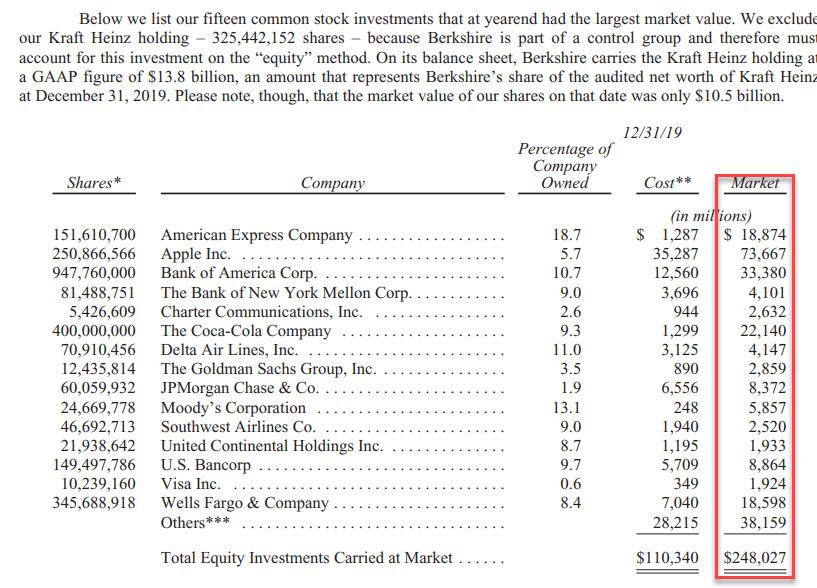
And speaking of market gyrations, here is the breakdown of Buffett's top 15 investments (excluding the Kraft Heinz embarrassment), which naturally soared in the quarter in which the Fed launched QE4. As a reminder, one year ago, the market value of these top investments was just $172.8BN, so a nearly $80 billion increase in market cap.
Some other observations on Berkshire's latest quarterly and annual results:
  • After imploding in late 2018, Kraft Heinz, which counts Berkshire as its largest shareholder, had a tumultuous 2019, with writedowns, management shakeups and downgrades to junk. As Bloomberg notes, Buffett’s company carries its Kraft Heinz investment on its balance sheet at $13.8 billion, a figure unchanged since 2018’s fourth quarter, even as the market price of the stake dropped to $10.5 billion at the end of last year.
  • Berkshire’s BNSF railroad posted a 5% gain in profit in the fourth quarter, just shy of record earnings in the previous three months, as a 3.8% drop in expenses helped counter falling revenue across shipments of products such as coal, consumer items and agricultural goods. BNSF had posted its full-year filing Friday night, on the eve of the release of Buffett’s annual letter, giving investors a sneak peek of results.
Of note: unable to find outside deep-value investments in a market that is overvalued and overflowing with liquidity, Berkshire bought back $5 billion of its own shares in 2019, with the buyback in Q4 rising to $2.2 billion, the most ever. The company changed its buyback policy last year, and some shareholders have been frustrated the company hasn’t spent significantly more cash repurchasing its stock. Ironically, it is none other than Buffett who has repeatedly urged his investments to engage in aggressive buybacks even as Berkshire has sternly resisted in putting Buffett's money where his mouth has been for years.
As he has in prior years, Buffett dedicated a modest portion of the last page of his letter to the topic of buybacks, making it very clear to even the most hardened skeptics, that buybacks to indeed support stocks, when Buffett said that "we will likely become more aggressive in purchasing shares. We will not, however, prop the stock at any level." Almost as if buying back stock tends to, gasp, prop it up. But... but... that nice fellow who runs that giant (money losing) quant shop said... yes, we know. He is wrong. Moving on: Buffett also had a tongue-in-cheek challenge to anyone who thinks the company hasn't bought back enough stocks, saying that "shareholders having at least $20 million in value of A or B shares and an inclination to sell shares to Berkshire may wish to have their broker contact Berkshire’s Mark Millard at 402-346-1400.... call only if you are ready to sell." The full excerpt below:
In past reports, we’ve discussed both the sense and nonsense of stock repurchases. Our thinking, boiled down: Berkshire will buy back its stock only if a) Charlie and I believe that it is selling for less than it is worth and b) the company, upon completing the repurchase, is left with ample cash.
Calculations of intrinsic value are far from precise. Consequently, neither of us feels any urgency to buy an estimated $1 of value for a very real 95 cents. In 2019, the Berkshire price/value equation was modestly favorable at times, and we spent $5 billion in repurchasing about 1% of the company.
Over time, we want Berkshire’s share count to go down. If the price-to-value discount (as we estimate it) widens, we will likely become more aggressive in purchasing shares. We will not, however, prop the stock at any level.
Shareholders having at least $20 million in value of A or B shares and an inclination to sell shares to Berkshire may wish to have their broker contact Berkshire’s Mark Millard at 402-346-1400. We request that you phone Mark between 8:00-8:30 a.m. or 3:00-3:30 p.m. Central Time, calling only if you are ready to sell.
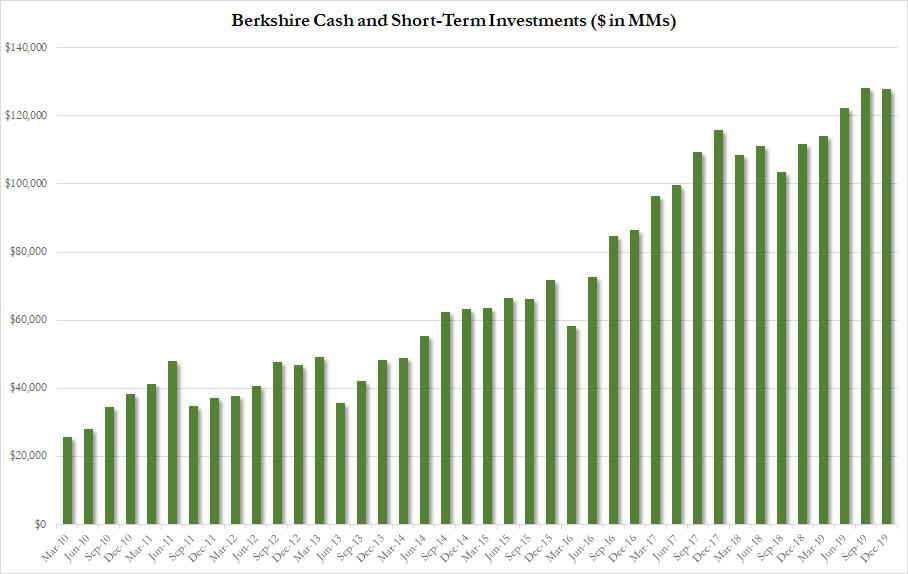
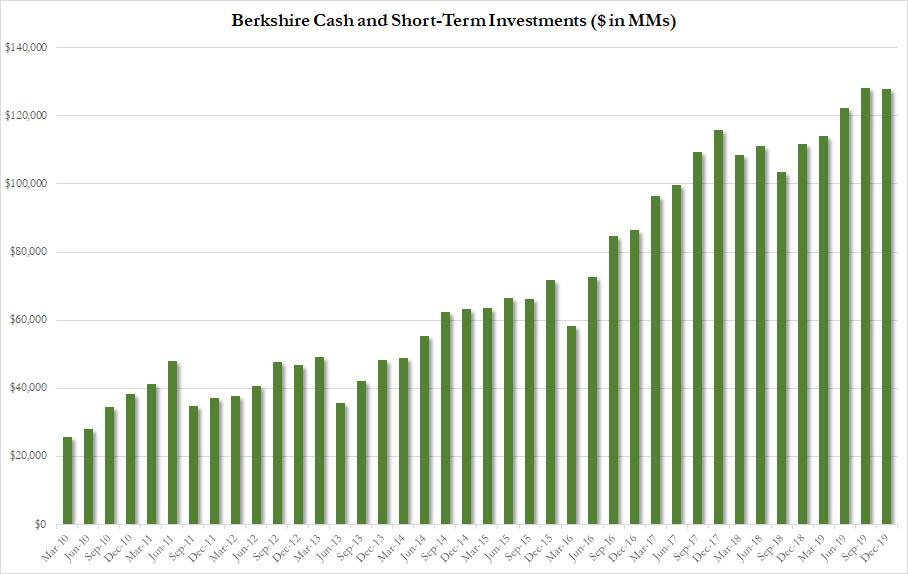
Yet even with the $2.2BN in Q4 buybacks, Berkshire's cash pile continued to rise, and it ended 2019 at a full-year record, or $128 billion, just shy of the all time high of $128.2 billion in Q3. Buffett has sought to redeploy those funds into higher-returning deals or stock purchases, but has been held back by what he’s said are "sky-high" prices for good businesses.
As one can expect, the theme of scarce investments continued in Q4, with Buffett writing that "we constantly seek to buy new businesses that meet three criteria. First, they must earn good returns on the net tangible capital required in their operation. Second, they must be run by able and honest managers. Finally, they must be available at a sensible price. When we spot such businesses, our preference would be to buy 100% of them. But the opportunities to make major acquisitions possessing our required attributes are rare. Far more often, a fickle stock market serves up opportunities for us to buy large, but non-controlling, positions in publicly-traded companies that meet our standards."
And yet despite the massive cash hoard and record buyback, perhaps in response to the company's shrinking set of investment opportunities (despite Berkshire surprising the market by buying a small new stake in Kroger, Biogen, SPY and VOO in Q4) and the decline in the company's operating earnings, the company has underperformed the S&P 500’s total return in recent years. In 2019, the company’s stock rose just 11% compared with a 31.5% total return in the S&P — Berkshire’s biggest underperformance since 2009.
Besides investment opportunities, in his annual letter, Buffett discussed corporate boards of directors, which he said are often ill-equipped to oversee companies and incentivized not to challenge executives.
He also said that at Berkshire’s annual meeting in May, shareholders will be able to ask questions of Berkshire executives Ajit Jain and Greg Abel, the two leading candidates to succeed Mr. Buffett as CEO, in addition to questioning Messrs. Buffett and Munger.
Buffett harped on the benefits of diversification, invoking not only a recent Lubrizol incident but also the New Testament:
... one final item that underscores the wide scope of Berkshire’s operations. Since 2011, we have owned Lubrizol, an Ohio-based company that produces and markets oil additives throughout the world. On September 26, 2019, a fire originating at a small next-door operation spread to a large French plant owned by Lubrizol. The result was significant property damage and a major disruption in Lubrizol’s business. Even so, both the company’s property loss and business-interruption loss will be mitigated by substantial insurance recoveries that Lubrizol will receive.
But, as the late Paul Harvey was given to saying in his famed radio broadcasts, “Here’s the rest of the story.” One of the largest insurers of Lubrizol was a company owned by . . . uh, Berkshire. In Matthew 6:3, the Bible instructs us to “Let not the left hand know what the right hand doeth.” Your chairman has clearly behaved as ordered
That said, Buffett did not leave out the Old Testament either:
Our P/C companies have meanwhile had an excellent underwriting record. Berkshire has now operated at an underwriting profit for 16 of the last 17 years, the exception being 2017, when our pre-tax loss was a whopping $3.2 billion. For the entire 17-year span, our pre-tax gain totaled $27.5 billion, of which $400 million was recorded in 2019. That record is no accident: Disciplined risk evaluation is the daily focus of our insurance managers, who know that the rewards of float can be drowned by poor underwriting results. All insurers give that message lip service. At Berkshire it is a religion, Old Testament style.
We can only guess who the Old Testament god at Berkshire is.
Curiously, unlike in prior years, Buffett decided to stay out of the political fray this year, and as Bloomberg notes, the billionaire Democrat and Hillary Clinton supporter didn’t mention the words “election,” “Trump,” or any Democrat running for president in the letter.
To be fair, Buffett did try to tone it down last year too, when in lieu of bashing Trump, he focused on overall prosperity in the U.S., saying that America’s success over the decades has been achieved in a bipartisan manner. And while in the past Buffett had openly campaigned for presidential candidates such as Hillary, he said more recently that he prefers not to use his position at Berkshire to promote his political views or, conversely, to impose his political opinions on Berkshire’s business activities.
Some other political flashbacks: Buffett wrote in 2013 that although he voted for Barack Obama the previous November, 10 of the 12 daily newspapers that Berkshire owned at the time endorsed the Republican candidate, Mitt Romney.
In the 2015 letter, written during the 2016 election campaign, Buffett said candidates “can’t stop speaking about our country’s problems” but that their downbeat views on the U.S. were “dead wrong.”
The son of a four-term Republican U.S. Representative has voted for more Democrats than Republicans over the the past 30 years, he said last year. He attended fundraisers for both Clinton and Obama ahead of the 2008 Democratic primaries. While he’s yet to publicly endorse for November’s election, Buffett said in early 2019, ahead of any campaign announcement, that he would support Michael Bloomberg if he ran for president.
Buffett concludes the letter by noting that his companies collectively paid 1.5% of the total corporate federal tax paid in America in 2019:
In 2019, Berkshire sent $3.6 billion to the U.S. Treasury to pay its current income tax. The U.S. government collected $243 billion from corporate income tax payments during the same period. From these statistics, you can take pride that your company delivered 11⁄2% of the federal income taxes paid by all of corporate America.
Fifty-five years ago, when Berkshire entered its current incarnation, the company paid nothing in federal income tax. (For good reason, too: Over the previous decade, the struggling business had recorded a net loss.) Since then, as Berkshire retained nearly all of its earnings, the beneficiaries of that policy became not only the company’s shareholders but also the federal government. In most future years, we both hope and expect to send far larger sums to the Treasury
One thing is certain: if Buffett endorses "bigger government" for the 2020 election, he will end up paying far more in taxes in the coming years. Assuming he is around, of course.

>>> eBay - Confirms it is exploring strategic alternatives for eBay Classifieds

eBay - Confirms it is exploring strategic alternatives for eBay Classifieds Group

eBay has been exploring potential value-creating alternatives for Classifieds and continues to be in active discussions with multiple parties regarding a potential transaction. As previously noted, eBay expects to provide an update regarding this process by the middle of the year. eBay remains committed to maximizing the value of Classifieds for eBay shareholders.

The strategic review of Classifieds is part of eBay's broader portfolio review, which resulted in the successful sale of StubHub for $4.05 billion in cash.
"eBay's Board and management are committed to driving significant returns to shareholders by maximizing the value of Classifieds and positioning our Marketplace business for long-term success," said Scott Schenkel, interim CEO of eBay Inc. "The Classifieds review process, together with the StubHub sale and our initiatives to increase volume, revenues, margins, and cash flow while continuing to invest in long-term profitable growth, demonstrate this commitment. We are acting with urgency while focusing on the ultimate objective of maximizing the value of Classifieds."

In addition to eBay's portfolio review, the Company's management team has executed numerous value creating actions since the beginning of 2019 that are transforming eBay's business and strengthening its foundation for growth. Among others, these actions include:
- Scaled Managed Payments in the US and Germany; by 2022, Payments is expected to generate $2 billion of revenue and $0.5 billion of operating income
- Delivered a point of margin improvement and committed to at least 2 additional points of margin expansion by 2022 while investing in revenue growth initiatives;
- Executed $5.0 billion in share buybacks and recently announced expansion of 2020 share buyback plan from $1.5 billion to $4.5 billion;
- Implemented eBay's first ever dividend and committed to a 14% increase in 2020;
- Increased focus on Marketplace volume growth with a reorganization of the executive leadership team and a re-prioritized customer-focused plan that includes improved vertical buyer experiences, more data & tools for sellers, and increased platform conversion leveraging an expanded structured data foundation.

eBay's Board and management team are confident that the above actions will help achieve the previously stated priorities for 2020 and position eBay for sustainable, profitable long-term growth.

Goldman Sachs & Co. LLC and LionTree Advisors LLC are acting as financial advisors to eBay on the strategic review of Classifieds, and Wachtell, Lipton, Rosen & Katz is acting as legal counsel.