Exclusive: G7 draft statement on coronavirus response does not detail fiscal, monetary steps - source
The Group of Seven industrial powers are crafting a statement for their finance leaders to issue on countering the impact of the coronavirus, but for now it does not specifically call for new government spending or coordinated interest rate cuts by central banks, a G7 official with direct knowledge of the deliberations told Reuters on Tuesday.
Global financial markets rallied sharply on Monday as central banks from Japan, Britain and France followed the U.S. Federal Reserve in saying said they stood ready to support the global economy and the French finance minister promised “concerted action.”
In the statement, expected on Tuesday or Wednesday, the G7 countries will pledge to work together to mitigate the damage to their economies from the fast-spreading epidemic, the source said on condition of anonymity due to the sensitivity of the matter.
The language of the statement is subject to change as it is still under discussion, the source said.
The United States - this year’s G7 chair - said the group’s finance ministers and central bank governors will hold a conference call on Tuesday morning to discuss measures to deal with the epidemic and its economic impact.
Why a Korean cult is at the centre of a huge coronavirus scare
The secretive sect insists it should not be blamed for the worst outbreak outside China
A quasi-Christian doomsday sect with hundreds of thousands of followers has been transformed from a theological curiosity to a global pariah.
South Korean officials blame the Shincheonji Church of Jesus for the world’s worst outbreak of the coronavirus outside of China. A plan to charge the sect’s leaders with homicide was announced in Seoul on Sunday.
“If they had taken active measures, we could have prevented many people from dying,” said Park Won-soon, Seoul’s mayor.
On Monday, Lee Man-hee, the 88-year-old founder and leader of the secretive church, bowed before national television in a gesture of remorse. However, he remained defiant even though the virus has killed two Shincheonji followers and thousands have more have fallen ill in the country. The church claims it has become a scapegoat for Seoul’s botched early handling of the crisis.
“People need someone to blame . . . our activities have been distorted by media so much and politicians are taking advantage of it,” said a member who asked to remain anonymous.
What is Shincheonji?
Last week at a church in Guri, a city east of Seoul, 30 former members of Shincheonji listened carefully to a re-education sermon that struck at the heart of the sect’s beliefs.
“It’s like detoxifying an addict. We replace their distorted views with conventional Christian teachings,” said Pastor Shin Hyun-wook, who has helped thousands escape the sect’s grasp over more than a decade.
Shincheonji was founded in 1984 by Mr Lee, who had previously been a member of other fringe churches. While it is not the only doomsday church in South Korea — about a third of the population of 51m identifies as Christian — Shincheonji is one of the biggest and most radical.
Its global expansion has been fuelled by cash from followers and relentless recruitment, experts said, often targeting vulnerable people questioning their faith. Experts added that friendly Bible study or choir practice sessions swiftly progressed to indoctrination.
Followers believe in a core tenet and preach it with gusto: that the spirit of Jesus Christ descended into Mr Lee and people should strive to be one of the select souls who can join him in heaven when the world ends.
Members infiltrate other churches, keeping their Shincheonji ties in the shadows, said Peter Lineham, an Auckland-based expert in religions.
“Nothing can be taken at face value with Shincheonji,” Mr Lineham said.
Members’ time is split between ensnaring new recruits and mass prayer and worship sessions inside packed halls and auditoriums. Foreign converts are whisked to South Korea to attend one of the scores of local centres.
“I felt like I had to save people out there from hell because I was already in heaven,” said Kang Ye-rim, 26, a member for three years before leaving the group two months ago.
Is the sect responsible for Korea’s coronavirus outbreak?
In mid-February, South Korean president Moon Jae-in, told the public that the worst would soon be over, when fewer than 30 cases had been reported. Case numbers have since risen to more than 4,200 and 26 have died.
Officials identified a 61-year-old Shincheonji member as a “super-spreader”, responsible for the big outbreak in the city of Daegu, the source of three-quarters of South Korea’s cases. Investigators are still probing exactly when the infamous “patient 31” contracted the disease. Officials said she came into contact with hundreds of fellow devotees.
Testing has revealed startlingly high infection rates among church members, who make up 60 per cent of South Korea’s cases.
Public anger has risen after revelations that senior officials, tasked with fighting the virus in Daegu, were Shincheonji followers who had tested positive for the coronavirus.
Has the group been unfairly targeted?
A petition to outlaw Shincheonji, citing its “immoral religious dogma and unco-operative attitude”, has drawn more than 1m signatures.
Part of the distrust had arisen from media reports that members refused to be tested and had gone into hiding, creating a public health hazard. Officials plan to test all Shincheonji’s Korean members as part of emergency efforts to stem the outbreak.
“We have told our followers to co-operate with health authorities,” a Shincheonji spokesperson said.
Shincheonji members conceded that they kept their faith secret from family and friends but said they did so out of fear of persecution.
“People look at me as if I am a monster,” a member said, adding: “I came to my church to search for deeper truth. Korean society criticises my religion but my belief has not been shaken by this at all.”
While Mr Lee, the self-professed second coming of Christ, remains public enemy number one, critics said the government was also at fault.
Baek Seung-joo, a senior opposition lawmaker, said the “biggest failing” was a decision to continue to allow travellers from China to enter Korea.
“The government should change its position and immediately ban arrivals from China for the health of South Koreans, Chinese and all humanity.”
Traffic and cinemas give measure of China’s downturn
Nation’s citizens are locked into longer-term worries about spread of virus outbreak
Beijing believes China’s economy will recover quickly from the coronavirus outbreak that is threatening global growth. However, two separate indicators show the nation’s downturn is unlikely to end anytime soon.
The first is average traffic congestion across 100 Chinese cities, based on daily figures provided by Wind, a data provider. This is measured by a ratio of peak to non-peak travel times: the higher readings climb above 1, the longer travelling the same distance within these cities takes during rush hour.
In 2019 the ratio dipped to 1.2 during the Lunar New Year holiday but quickly sprang back to about 1.5 after it ended. This year the ratio dropped to a record low of less than 1.2 and has since only inched back above that level.
The second indicator is box-office takings, which usually soar during the Lunar New Year period as people squeeze into theatres. But revenue in the first eight weeks of 2020 totalled just Rmb2.6bn ($372m), down more than 80 per cent from a year ago, according to Wind.
Julian Evans-Pritchard, senior China economist at Capital Economics, said the drop in cinema revenues, in particular, showed that even as some cities ease their containment measures, consumers are not yet willing to behave as they did before the outbreak began because of longer-term fears about a global threat.
“There’s going to be ongoing concerns about importing the infection back into China [from abroad], so it’s going to keep consumers on edge even if they’ve succeeded in containing it within China,” he said.
Don’t believe the hype about AI and fund management
Machine learning can generate marginal improvements but nothing truly transformational
Hardly a day goes by without investors being told that artificial intelligence will revolutionise investment management. After all, AI is being hailed as a way to enhance image recognition, healthcare, movie recommendations, fake news and even the humble toothbrush. Surely it is only a matter of time before AI allows investors to sit at home getting rich, while watching movies with sparkling teeth?
Despite that persistent hype, reality is different. And the best way to distinguish the two is to consider what AI actually is. I find it useful to take any statement using the phrase, and then substitute the word “statistics”. “The UK government vows to revolutionise the NHS with artificial intelligence,” sounds somewhat less transformative when one says: “The UK government vows to revolutionise the NHS with statistics.” Buying a “statistics-enabled” toothbrush also sounds more prosaic.
So how can we expect AI to help the investment process? The caricature is that one takes a bunch of data (preferably newfangled “alternative” data), throws it at some sort of “neural net”, and out pops a vaguely defined financial goldmine. This misconception drives serious statisticians crazy.
First of all, machine learning requires a clear goal. That was what Google’s legendary AlphaGo programme had when in 2016 it finally beat a human champion at the board game Go. But what is the goal of finance and investment? Higher returns over time? A two-times levered position in the equities markets will give you two-times the return. Is it higher risk-adjusted returns? Adding some diversifying assets like bonds to your portfolio will give you that.
My personal story that illustrates the pitfalls of AI came in 2010 when I became interested in genetic algorithms, which use the power of selection and breeding to “evolve”. I wrote a library of functions to evolve trading systems and allowed hundreds of thousands of artificial traders to breed. Eventually I had a huge population of artificial traders who were doing what many quantitative funds have been doing for decades — which was precisely not what I wanted.
Consequently, we have to tell the AI system something like: “Do not find me the returns that everybody knows about; just the subtle unknown ones.” But this is hard to specify. Even if one can accurately specify the desired returns, it leads to a second problem: If the effect is subtle, it is likely to be small or short-lived, and thus hard to exploit at scale. Across the vast global investment industry, only a tiny proportion of funds will therefore ever likely benefit.
A third problem is that an AI system learns from the past. In this respect it is no different from any other systematic or discretionary investment process. But the fundamental problem of finance is that the past is not a good guide to the future. To use a statistical term, finance is not “stationary”. In most AI domains like movie recommendation and toothbrushing, the “target” is stationary and the environment does not change much (unless you have had major dental work).
This is fundamentally not true in finance. There is a trade-off between reacting quickly to shifts in market dynamics, and believing that old patterns will reassert themselves. While one may wish an AI system to respond rapidly to events, this effectively means that it has to build a model on a very short history, which reduces the amount of data that the system can learn from. Tough choices have to be made.
And finally, financial data is very messy. Although it is not entirely random, the signal-to-noise ratio is certainly low. In fields where AI has been successful, this is typically not the case. AlphaGo, for example, knew exactly where the pieces on the board were. Nobody chooses 19 random movies for every one they like, and then expects Netflix to come up with good suggestions. It is possible to use sophisticated techniques to reduce the effect of randomness in finance, but it makes it challenging to apply machine learning.
It is not all doom and gloom. While it is unlikely that AI will create new scalable sources of returns, it is proving useful in more mundane tasks. AI is very good at cleaning data and great at detecting interesting features in gigantic datasets, for example. One technique that has gained traction is to use the same AI algorithms used in computer games to create realistic Non-Player Characters, like the monsters that try to kill you. These algorithms can approximate how a human trader would act in particular circumstances (without killing you, of course).
Once we are through the trough of disillusionment, investment managers will find many places where AI can generate marginal improvements. But they will probably still be cleaning their teeth with an old-fashioned brush.
Africa’s cloud computing boom creates data centre gold rush
Continent’s capacity has doubled in the past three years as global investment surges
International investors are rushing to fund a boom in the African cloud computing market, as the proliferation of smartphones and mass adoption of business software on the continent leads to soaring demand for data centres to power the technology.
Africa currently accounts for less than 1 per cent of total available global data centre capacity, according to data from Xalam Analytics, despite being home to about 17 per cent of the world’s population. However, its capacity has doubled in the past three years.
Among those to invest is London-based private equity firm Actis, which is injecting $250m into African data centres over the next three years — beginning with taking a controlling stake in Rack Centre, a leading Nigerian company that serves the west African market.
The investment will fund a doubling of Rack Centre’s 750kW capacity and its expansion across west Africa, creating one of the largest data centres on the continent.
“If you look at the trends around data, data consumption, cloud migration globally — those trends have played out in many markets and have led to significant growth of the data centre sector,” said Kabir Chal, director at Actis. “Africa is no different: you see digitisation, the inexorable migration to cloud, and really the advent of big data but, as a consequence, the supply of data hasn’t kept up.”
The supply of data
Where governments and companies have historically used their own in-house data servers for storage and computing, rising demand — driven by an increasingly online population and cloud-based business world — is leading them to outsource these capabilities to external data centres. These large facilities, which were once the province of telecoms operators, are now more frequently run by independent companies.
A driver for the localisation of data storage is that it improves connection speeds, since users no longer have to fetch data from the other side of the world, while it is also being mandated by governments that stipulate that local data must be hosted domestically.
Meanwhile for companies operating in Africa — particularly those in banking and oil and gas — the high cost of managing their own data via expensive internal server rooms and data centres, while keeping up with the growing technical demands of the field, can be prohibitive, said Uzoma Dozie, former chief executive of Nigeria’s Diamond Bank.
“Cyber security is not an expert capability of banks, and continuous upgrading and development [of data centres] is expensive,” said Mr Dozie. “So there’s a big opportunity there, as more people begin to use cloud services instead of having their own data servers . . . These are going to become more valuable.”
Powering the cloud
For data-storage companies operating in Africa, a big hurdle is the continent’s lack of infrastructure, which complicates an already capital-intensive, power-hungry business.
Companies must often rely on large-scale generators running on costly diesel and petrol to provide electricity, while slow internet speeds, high data costs and a lack of fibre networks — plus the increased cost of capital in countries perceived as risky by investors — all further constrain their operations.
“We have to fundamentally build our own power-generating capability to get a level of reliability and consistency, so that is a capital cost in itself,” said Tunde Coker, managing director of Rack Centre, which connects to over three dozen telecoms operators across west Africa, including Orange, MTN and Airtel.
Nevertheless, the Actis investment is part of a broader trend of international players looking to become involved in the data centre sector in sub-Saharan Africa — where the total data centre capacity equals about a quarter of London’s or half of Frankfurt’s, according to Xalam Analytics.
Last year, Boston-based private equity firm Berkshire Partners acquired a stake in Teraco Data Environments, which owns Africa’s largest data centre and powers much of the cloud computing in South Africa, saying it would use it to double capacity from 30MW to 60MW in the next few years.
Microsoft also launched its first African cloud data centres last year in the country, which is a key growth market alongside Nigeria, Kenya and Ghana and already accounts for roughly half of Africa’s data centre capacity. Meanwhile Amazon Web Services plans to open a cluster of centres in Cape Town in the coming months — the company’s first foray on the continent.
Both will rely on independent companies such as Rack Centre and Africa Data Centers, the South Africa-based subsidiary of Liquid Telecom that plans to double its 25MW capacity in the coming year.
‘A diversity of connectivity’
For consumers, the proliferation of African data centres will help to ramp up internet speeds that are currently among the lowest and costliest on earth — allowing users of streaming services such as Netflix, for instance, to access their favourite shows faster, and online gamers to play unhindered by connection lags.
One chief benefit is that independent companies, as opposed to centres owned by telecoms companies such as Orange or MTN, are able to provide clients with dozens of connectivity options.
“The big success everywhere in the world is where you have a neutral data centre where there are a lot of various providers of connectivity,” said Stephane Duproz, chief executive of Africa Data Centers. “Those cloud providers need a diversity of connectivity where they establish themselves. You will never see a big deployment of cloud in a telco data centre.”
There have been concerns in many parts of the world over Chinese ownership of data. But Mr Duproz, whose company has China Telecom is one of dozens of connectivity providers at its sites, said the Chinese had not yet made big investments in data centres in Africa. However, he added that “it’s definitely a conversation they are having”.
Closing Market Summary: Skid HaltedThe major averages surged on Monday with the S&P 500 (+4.6%) recording its first gain since February 19 while the Dow Jones Industrial Average (+5.1%) outperformed.
Equities started the new week on a firmly higher note even though the number of new coronavirus cases in the United States continued increasing while China reported its worst Manufacturing (35.7) and Non-Manufacturing PMI (29.6) readings in history.
China's PMI readings were much weaker than what was reported at the depth of the financial crisis, which promptly led to more calls for stimulus from the People's Bank of China. The Bank of Japan, meanwhile, offered to purchase JPY500 bln worth of JGBs. On the home front, the fed funds futures market continued pointing to expectations for a 50-basis point cut at the March 18 meeting or before.
Growing stimulus hopes contributed to another day of gains in the Treasury market, pressuring the 10-yr yield to a fresh record low (1.059%) in morning trade. Treasuries finished the day near their starting levels with the 10-yr yield down four basis points to 1.09%.
All eleven sectors finished the day in positive territory with nine groups climbing at least 3.0%. Countercyclical sectors like utilities (+5.9%), consumer staples (+5.5%), and real estate (+5.1%) outperformed throughout the day while the top-weighted technology sector (+5.7%) also made a significant contribution to the Monday advance.
The utilities sector returned into positive territory for Q1 (+0.9%) while consumer staples rallied behind Costco (COST 309.14, +28.00, +10.0%). The wholesale retailer spiked off a six-month low after Cleveland Research upgraded the stock to Buy after reports of very strong store traffic over the weekend. Costco will report its Q2 results on Thursday. Clorox (CLX 172.01, +12.59, +7.9%) made for another notable outperformer in the staples sector, rebounding from Friday's sharp loss.
On the cyclical side, technology (+5.7%) had a very good showing even though chipmakers lagged. The PHLX Semiconductor Index still jumped 3.5%, but most components finished behind the broader market. However, that underperformance was overshadowed by a formidable showing from large sector components. Apple (AAPL 298.81, +25.45, +9.3%) surged nearly 10.0% to levels from Tuesday. The stock was upgraded to Outperform at Oppenheimer.
Today's rally overshadowed continued weakness among transport stocks. The Dow Jones Transportation Average (+0.9%) was down for the bulk of the session, but a late rally helped the group turn positive. However, airlines like JetBlue Airways (JBLU 15.57, -0.21, -1.3%), American Airlines (AAL 18.86, -0.19, -1.0%), and United Airlines (UAL 61.26, -0.33, -0.5%) remained weak on expectations for more coronavirus-related disruptions to travel.
Similarly, cruise operators like Carnival (CCL 33.06, -0.40, -1.2%) and Norwegian Cruise Line Holdings (NCLH 35.59, -1.67, -4.5%) saw continued pressure after Japanese cruise operator Luminous Cruise filed for bankruptcy due to a collapse in demand. Royal Caribbean (RCL 80.56, +0.15, +0.2%) spent the bulk of the session in the red but turned positive in the late afternoon.
Reviewing today's economic data:
- The ISM Manufacturing Index for February managed to eke out an expansion reading at 50.1 (Briefing.com consensus 50.5), but that was weaker than expected and down from 50.9 in January. The dividing line between growth and contraction is 50.0.
- The key takeaway from the report is that there were noted concerns in respondents' commentary about the negative impact of the coronavirus, which is telling because the virus has continued to spread globally since the report was compiled, implying there is an increased risk of the index falling below 50.0 in March.
- Total construction spending increased 1.8% m/m in January (Briefing.com consensus +0.7%) on the heels of an upwardly revised 0.2% increase (from -0.2%) in December. Residential spending was up 2.0% m/m and nonresidential spending was up 1.6% m/m.
- The key takeaway from the report is that January marked the largest m/m increase in construction spending since February 2018, bolstered by continued strength in residential spending.
February auto and truck sales will be reported throughout Tuesday.
- Nasdaq Composite -0.2% YTD
- S&P 500 -4.4% YTD
- Dow Jones Industrial Average -6.4% YTD
- Russell 2000 -9.0% YTD

After Hours Summary: WIFI +13.4% up on earnings, but TLRY -11.4% and ZGNX -4% showing weakness; V and MCHP tick lower on weak guidance due to coronavirusAfter Hours Gainers:
Companies trading higher in after hours in reaction to earnings/guidance: WIFI +13.4%, ATSG +10.5% (light volume), LVGO +4%, EVRI +2.2%, FATE +1.6%
Companies trading higher in after hours in reaction to news: GNW +15% (announces agreement in principle with NYDFS regarding proposed Oceanwide acquisition of GNW's NY-domiciled insurance co), OMER +14.8% (reports updated clinical data from narsoplimab HSCT-TMA clinical trial; results surpass the FDA-agreed efficacy threshold), GNMK +14% (announces global shipments of ePlex Research Use Only test kits designed to detect SARS-CoV-2 virus), SIGA +2.9% (announces collaboration with Turnstone Biologics to supply TPOXX), TERP +2.7% (to delay 10-K)
After Hours Losers:
Companies trading lower in after hours in reaction to earnings/guidance: TLRY -11.4%, PGEN -7.9%, MAXR -5.8%, PI -4.7%, ZGNX -4%, APPF -3.7%, BGNE -2.5%, AMBC -2%, V -1.6% (lowers guidance due to coronavirus), MCHP -1.3% (guides lower due to coronavirus, also withdraws prior EPS guidance), STNE -0.3%, KWR -0.2%, SQM -0.1%, TDW -0.1%
Companies trading lower in after hours in reaction to news: UNIT -6.9% (to delay 10-K, lowers dividend), KPTI -6.2% (stock offering), TLND -4.8% (to delay 10-K)

Friday's Dip Buying By Hedge Funds Was The Most Extreme In The Past Decade: Why This Is Worrying Morgan Stanley
Amid the broader market carnage which culminated with the fastest 10% S&P correction from an all time high, last week also we observed the biggest one-day point drop in the Dow Jones ever (this in turn was followed by the biggest one-day Dow point surge ever on Monday). But more notably, following several days of freefall, on Friday equity long/short hedge funds finally stepped up, and whether it ends up being the “best trade”, the “worst trade”, or something in between, Morgan Stanley's prime brokerage writes that "the buying of US equities among Equity L/S funds on Friday was the biggest we’ve seen in the past decade." And while Monday's ramp certainly eased some concerns about another year of woeful hedge fund performance, Morgan Stanley cautions that depending on what happens to stocks from here, it "raises the risks that we could see a rotation and alpha drawdown, should these flows look to reverse in the future."
As we first observed two weeks ago, the record high leverage, crowding, and factor risks among the hedge fund community have raised the risk for future violent hedge fund rotations.

And while we have not yet seen these risks realized in the sharp sell-off over the past weeks, the recent behavior and mixed performance among HFs has made Morgan Stanley more concerned that we could be getting closer to a sharp rotation. In particular, three of the things the bank is watching have changed recently and are driving its greater concern:
- HFs have been actively adding to gross leverage, particularly by adding longs in the largest amounts of the past decade last Thurs and Fri. This is concerning because in 3 of the 4 similar past episodes since 2014, large long selling has followed afterwards and has coincided with negative HF alpha (see Figure 1 below)
- L/S funds bought large amounts of Momentum last week (and sold Value), once again crushing Marko Kolanovic's argument that a rotation out of momentum/low-vol and into value stocks is imminent.
- Performance (while good relative to the markets) has declined in absolute terms into negative territory and crowded stock performance has been mixed
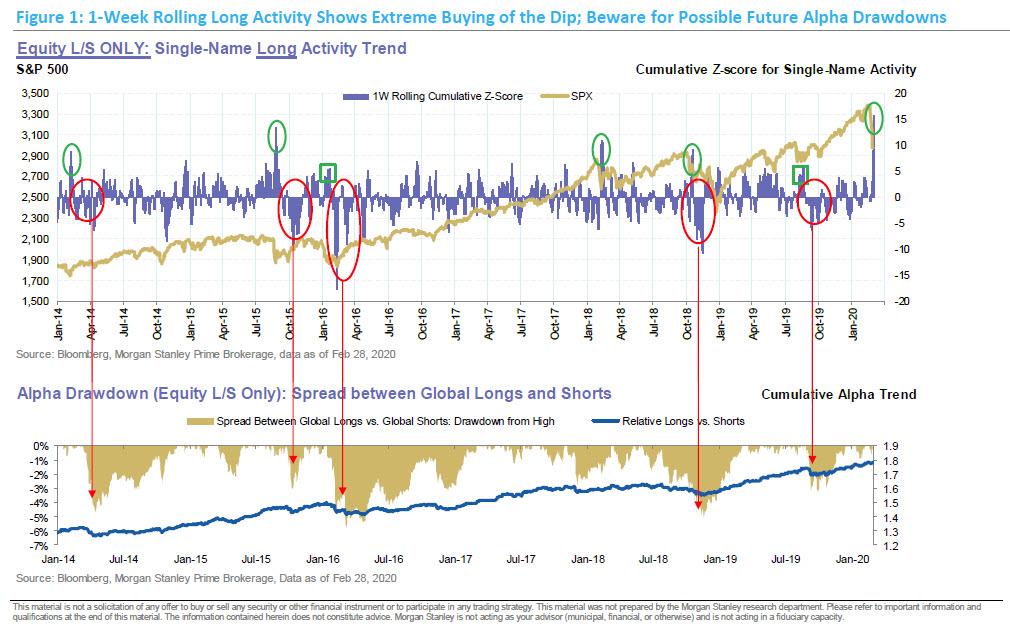
So was Friday's record dip buying a sign that hedge funds have finally gotten their mojo back and are again able to time market inflection points? According to Morgan Stanley that is hardly the case, and instead last week's flush into risk assets merely underscores the top three rotation risks, which are as follows:
Rotation Risk Consideration #1: Largest Long Buying of Past Decade
Throughout the sharp sell-off last week, HF activity showed almost no signs of active de-grossing. In fact, the opposite was largely the case as L/S funds bought longs throughout last week and Quant funds generally added to both sides of their books to keep their leverage from falling as fast as it would simply due to the falling markets. Put simply, there were no real signs of capitulation among Hedge funds.
While this behavior of buying dips and adding to gross exposure is fairly common during market pullbacks, the magnitude of the long buying among L/S funds spiked to unprecedented levels on Friday. For context, the long buying on Thursday was in line with the prior high from 2010-2019 and Friday’s buying was ~75% higher than that. Similarly, large long buying has often come near short term market troughs, aside from what happened in late 2018 (i.e. HFs generally exhibited good timing from a broad market perspective). Looking at the peak long buying within the green ovals in Figure 1, they peaked on the following dates:
- Feb 6, 2014
- Aug 27, 2015
- Feb 9, 2018
- Oct 17, 2018
However, this behavior raises the rotation risk that Morgan Stanley's Prime Brokerage has been getting more concerned about for a while. Essentially, the concern is that HFs have tended to sell longs afterwards (often as markets rebounded) and this selling coincided with negative alpha from L/S funds.
Notably, the one time there wasn’t a subsequent alpha drawdown in the next few months was early 2018. But as one can see from the next chart below, the long buying then was a reversal from long selling into the Jan ’18 peak, rather than an acceleration of long buying as we’ve seen recently. The chart below tracks the trend in the cumulative long activity over time to help show when longs have been built up or reduced. To be clear, HFs were covering shorts aggressively from 4Q17 to early ’18 so nets were going higher, but L/S funds weren’t arguably pressing their longs into the market high.
In addition, this chart shows that, while the long buying in Jan 2016 and Aug 2019 were not quite as extreme over a short period of time (as highlighted in the green rectangles in Figure 1), the long risk had been building for months leading up to the drawdowns in 1Q16 and Sep-Oct 2019.

Rotation Risk Consideration #2: Increased Momentum Buying (and Value Selling)
It’s not just that L/S funds were adding risk by buying the dip last week, what’s also notable is what they were buying. From a sector/industry perspective, they were mostly buying areas they’re already quite long: Software, IT Services (payments), Aero & Defense, Semis, Internet Retail, Hotels Restaurants & Leisure, and Entertainment.
From a factor standpoint, this manifested itself in one of the largest weeks of buying of Momentum in many years. It was the largest since last Sep (during the brief rebound after the sharp drawdown) and last Aug. In addition, it was the largest selling of Value in years. From a net exposure standpoint, L/S fund Momentum exposure is around the 50th %-tile since 2010 (and similar to where it stood prior to the selloff last Sep) while Value is around the 10th %-tile since 2010.

Rotation Risk Consideration #3: Performance Declines
For many HFs that are net long the market, there were few places to hide last week. Thus, it’s not surprising that funds lost about 4-5% gross last week as markets were down about 10%. This shifts returns into negative territory on a YTD basis. Needless to say, dipping into negative territory on a YTD basis early in the year is very different from doing so late in the year and leads to different investing behavior. Thus, being down about 2% hasn’t apparently triggered large de-grossing, especially as equity markets are now down 8-9% on the year.

For those looking for a performance trigger, Morgan Stanley suggests that one reference point might be early 2016. As the S&P sold off 9% from Dec 31 to Jan 20, L/S funds were down about 4-5%. However, the tipping point was that as the S&P rallied towards the end of Jan to be down only 5%, L/S were still down about 3.5-4% (i.e. there was little upside capture on the rebound). When markets started to sell-off again in early Feb and funds went back to being down closer to 5% on the year, they aggressively switched to de-grossing.
So while performance has held up so far, the concern is that a breakdown in returns could cause risk appetite to decline and de-grossing to increase. Two things to note on this front are:
- The crowded longs in the US have held in relatively well lately, but the 2 best days last week were last Thurs & Fri, which coincided with outsized long buying among HFs
- The crowded shorts have not been working well, which may suggest less cushion if the longs start underperforming

In conclusion, Morgan Stanley reminds us that a few weeks ago that the Combined Risk Metric of leverage-crowding-factors was back at highs, BUT that we had not yet seen aggressive HF behavior at that point and the rotations usually came a couple months after the metric hit highs. As such, "with the changes in behavior last week and more time passing, the risks of a rotation appear to be greater now and if capitulation (i.e. de-grossing) does play out among HFs, this would likely be fairly painful."