DAX:
- Lufthansa (LHA TH) +5.2%
- Global Assets Want G-7 Full Shock and Awe Display: Markets Live
- Wirecard (WDI TH) +4.2%
- Deutsche Boerse (DB1 TH) +3.1%
- Deutsche Boerse Raised to Neutral at Oddo BHF; PT 144 euros
- Fresenius SE (FRE TH) +2.1%
- Allianz (ALV TH) +2.1%
- Linde (LIN TH) +1.2%
- Bayer (BAYN TH) +1.2%
- Siemens (SIE TH) +1.1%
- Siemens Preferred Over ABB as Jefferies Initiates on Electricals
- Vonovia (VNA TH) +0.7%
MDAX:
- TeamViewer (1UD TH) +6.5%
- BAWAG, Others to Join Stoxx Europe 600; Casino, K+S to Drop Out
- K+S (SDF TH) +4.6%
- Varta (VAR1 TH) +4.5%
- Bechtle (BC8 TH) +4.4%
- Duerr (DUE TH) +3.8%
- Dialog Semi (DLG TH) +2.2%
- RTL (RRTL TH) +2%
SDAX:
- Wacker Neuson (WAC TH) +7.9%
- Heidelberger Druck (HDD TH) +7.4%
- HelloFresh (HFG TH) +6.3%
- HelloFresh Sees 2020 Adjusted Ebitda Margin 4% To 5.5%
- Hamborner REIT (HAB TH) +5.7%
- DWS (DWS TH) +5.6%
- Deutz (DEZ TH) -4.8%
- Deutz Prelim Full Year Revenue 1.1% Above Estimates
Is China's Economy Finally Starting To Recover? Here Is What The Real Data Shows
Over the weekend, China-watchers - or at least the ones who don't really watch China all that closely and instead rely on others' "hot takes" - were shocked to learn that in February both the Chinese manufacturing and non-manufacturing PMIs had crashed far below consensus expectations, tumbling to record low levels, surpassing even the economic contraction observed at the peak of the global financial crisis.
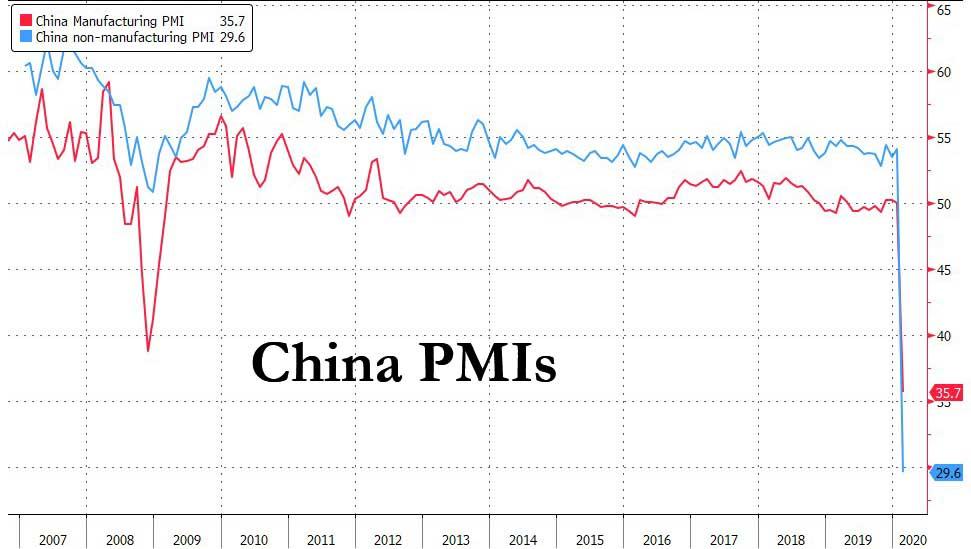
Meanwhile, anyone who was following out periodic updates of China's "alternative", high-frequency indicators demonstrating the real state of the economy was hardly surprised, because as we showed over the past few weeks, after China's catastrophic post-Lunar New Year collapse the economy has yet to stage a material rebound as profiled previously:
- China Has Ground To A Halt: "On The Ground" Indicators Confirm Worst-Case Scenario
- China Is Disintegrating: Steel Demand, Property Sales, Traffic All Approaching Zero
- Terrifying Charts Show China's Economy Remains Completely Paralyzed
And yet, judging by the market's torrid surge on Monday, it appears that - as so often happens - traders took China's latest numbers in stride, and specifically as an indication of Beijing "kitchen sinking" the collapse in February, with a V-shaped recovery sure to follow.
Or maybe not, because while not only has China's economy not picked up even modestly, but it is only a matter of time before Beijing, which has forced people to go to work against their will, succumbs to a second wave of coronavirus infections, one which will result in an even worse economic slump than the current one, which incidentally has yet to show any actual recovery!
So what do the latest high-frequency economic indicators show? It may come as a surprise to some that not only has China's economy barely posted any improvement since our last update on this topic a week ago, but it has in fact lost ground in some metrics. Courtesy of Goldman, here is the latest "alternative" data:
First, daily coal consumption has barely rebounded from the recent lows, and is in fact where it was when the Lunar Near Year started, and tracking almost 30% Y/Y:
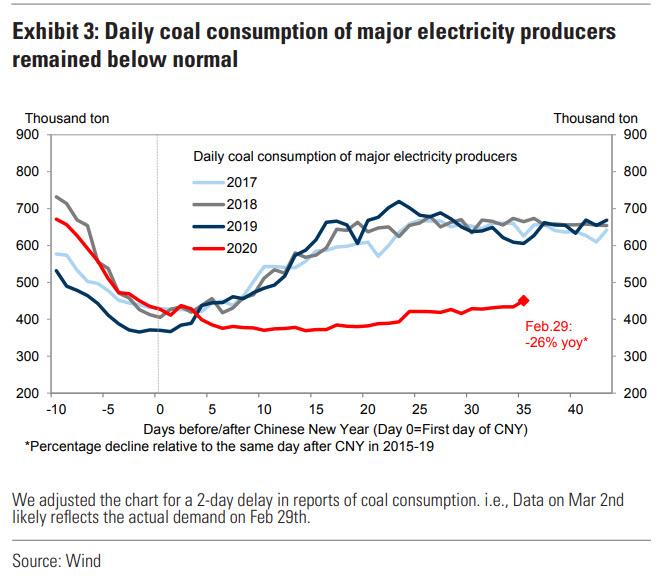
In line with the reduced daily coal consumption, railway-loaded coal volumes are also tracking substantially below the average level of the past three years, and what's worse, the 2020 series appears to have slowed down in recent days.

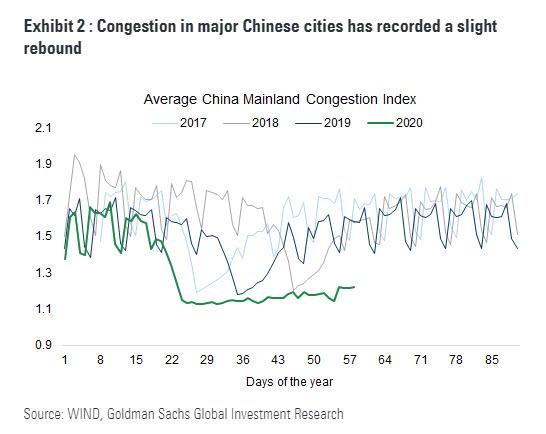
An even more ominous indicator is China's traffic congection index - a proxy of overall trade and commerce - which has barely budged since its new year lows and remains far below the same period in previous years.

With commerce frozen and amid fears that the government is lying about the true extent of the coronavirus spread, it will hardly come as a surprise that passenger traffic has failed to stage even a modest rebound from its new year lows, and is about a quarter of where it was one year.
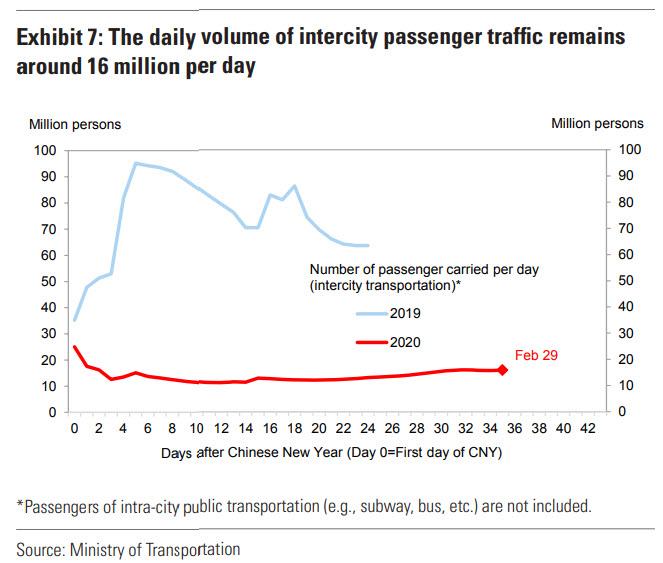
One of Wall Street's favorite real-time indicators, traffic congestion in major Chinese cities, has seen a modest rebound in recent days, however even it remains just barely above its level at the start of the lunar new year, and is below half where it has been in recent years.
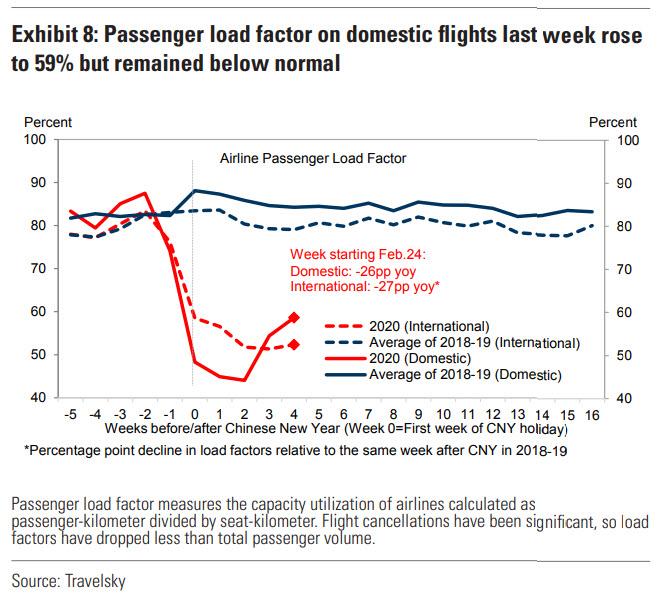
It's not just passenger traffic that is moribund: the load factor on domestic flights remains a fraction of where it has been in recent years.
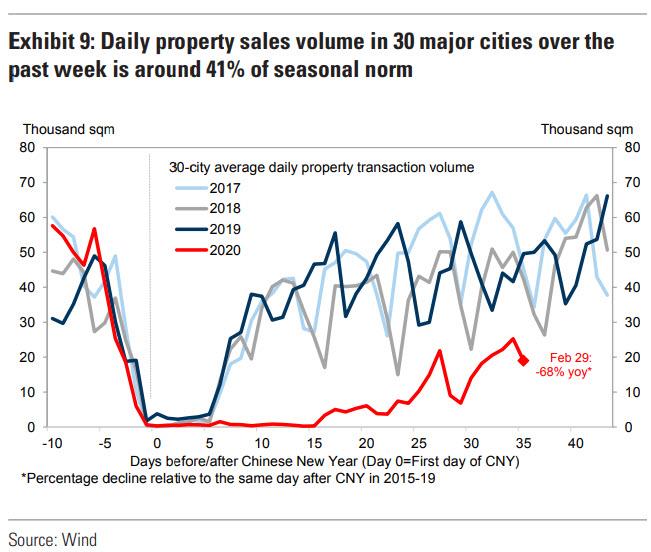
Even the one area where there was been a modest rebound in recent days, daily property sale, remains in dire territory, or about 68% down compare to last year.
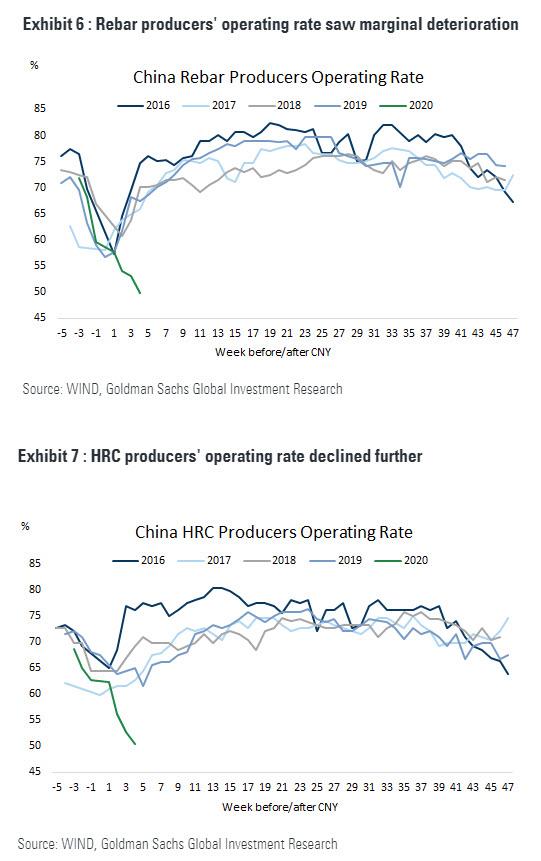
Looking at end markets for commodities used in construction, the operating rate of rebar slumped further on both weak demand and high inventories. Likewise, the operating rate of HRC and galvanized steel, mainly used in the manufacturing sector, is now at just 50% of capacity and shows no signs of recovery.
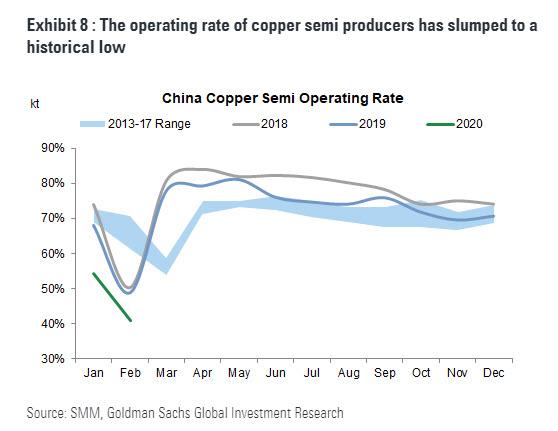
And, as Goldman points out, while the bank has found increased orders from cable and wires fabricators while, operating rate of copper rod producers remained as low as 50% for big companies and 30% for medium-sized producers. What’s more, some small producers have not restarted yet at all, according to a Goldman survey with onshore contacts.
There is a silver lining to China's ongoing economic paralysis: anyone who ventures into one of the country's thousands of cinemas will have the building all to themselves.
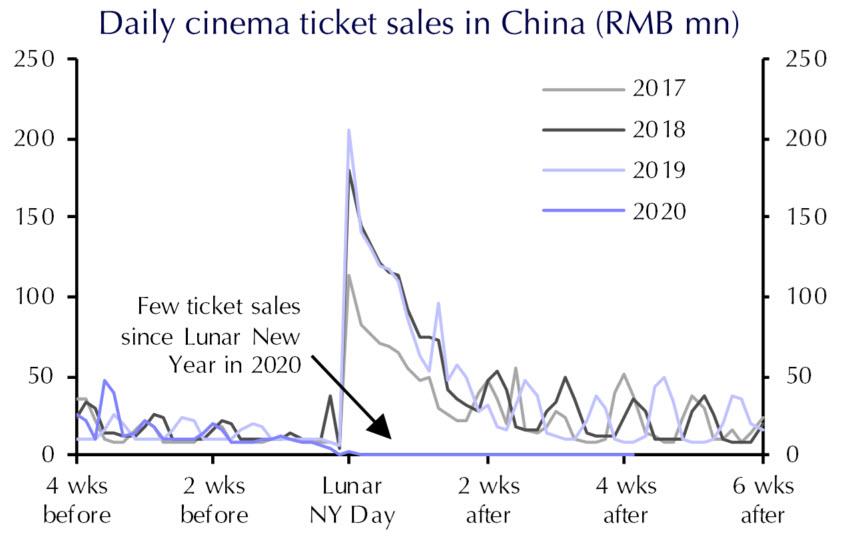
The failure of China's economy to reboot comes even as authorities have ordered owners of closed factories - whose employees are scared to return to work - to boost electricity usage to pretend that the economy is back to normal, and to fool those people who look at the charts above, into getting the impression that China's economy is humming again. We described this bizarre example of central planning on Saturday, and here is Rabobank's Michael Every commenting on this very phenomenon on Monday morning:
Saturday’s China PMI data were frankly shocking. Manufacturing was at 35.7 and services at 28.9: these are not recessionary levels, but outright depressionary. The private Caixin PMI was also awful at 40.3, again saying a deep downturn is biting. Of course, the real issue is if we get a V-shaped recovery in output - or in virus infections. Optimists, and Chinese stocks this morning, are cheering the former – and Chinese stocks are always freely traded and never, ever manipulated by the authorities, as well all know. Realists, and NASA satellite imagery of no pollution over China, lean towards the latter: as does one anecdotal, unsubstantiated report trending over the weekend that China has been ordering factories to leave the lights on to make them look busier from space and to boost electricity output in case pesky foreigners start trying to use that as a GDP proxy.
Finally, for all those expecting that Beijing will unleash another massive stimulus to kick-start the economy which remains paralyzed at a time when most analysts said activity would be back to normal by the first week of March, we give the last word to Nomura's China economist Ting Lu, who not only correctly predicted the plunge in PMIs, but also said that "the likelihood of another round of massive stimulus appears low as policy space remains limited.”"
“We believe markets might underestimate the scale of the current growth slump. Due to a slower-than-expected rate of business resumption, we have cut our year-on-year Q1 real GDP growth forecast to 3.0% and expect Beijing to ramp up policy easing measures in coming months. That said, the likelihood of another round of massive stimulus appears low as policy space remains limited.”
In short, for China - which was the world's growth dynamo during the global financial crisis and helped the world rebound from the 2009 global depression while raking up tens of trillions in debt - the end of the economic road may finally be here.
Japanese stocks surrendered gains and U.S. futures came off their highs Tuesday after a wave of initial enthusiasm about central banks kicking into gear to protect the global economy from the hit of the coronavirus.
Central bankers from the U.S., Japan and Europe pledged to act as appropriate to address mounting risks from the coronavirus and Group of Seven finance chiefs confer by phone Tuesday. The Aussie gained after the Reserve Bank of Australia cut rates by a quarter point and said it is ready to ease further. A report from South Korea showing another jump in coronvirus cases there, while on par with Monday, underscored that the disease continues to spread. U.S. 10-year yields slid, the yuan dipped and S&P 500 futures gave up about half their gains.
US AFter Hours WIFI +13.4% up on earnings, but TLRY -11.4% and ZGNX -4% showing weakness; V and MCHP tick lower on weak guidance due to coronavirus
Nikkei -1.22% Hang Seng +0.88% CSI +1.275 Shanghai +0.62% Shenzen +0.94%
Eur$ 1.1145 CNH 6.9803 CNY 6.9806 JPY 108.76 GBP 1.2790 CHF 0.9581 RUB 66.5190 TRY 6.1991 WTI$ 47.38 +1.35%
S&P +0.15% EuroStoxx +0.92% FTSE +0.31% Dax +0.86% SMI
Macro :
- ECB Joins Central Banks Pledging Coronavirus Action If Needed
- G-7 Finance Chiefs, Central Bankers Plan Virus Call Tuesday
- China Stocks Will Continue to Beat U.S. Equities: Macro View
- Hedge Funds Kept Buying the Dip in Stocks Amid Last Week’s Rout
- Stoxx600 : Additions: BAWAG Group, Rational, Teamviewer, Acciona, La Francaise Des Jeux, Vistry Group, Genus, Games Workshop, Redrow, Trainline, Countryside Properties, BE Semiconductor, Entra, Samhallsbyggnadsbolaget i Norden, Wihlborgs Fastigheter Deletions: Telenet Group, OC Oerlikon Corporation, HELLA, K+S, Bankia, Air France-KLM, Altran Technologies, JCDecaux, Casino Guichard-Perrachon, Lagardere, Tullow Oil, Jupiter Fund Management, NMC Health, AIB Group, Pirelli & C.
Keep an eye on :
- AI FP : Air Liquide in Talks to Sell CRYOPDP to Hivest Capital Partners
- AAPL US : IPhone Maker Expects China Plants Back to Normal in Coming Weeks
- BEI GY : Beiersdorf Sees 2020 Organic Revenue +3% To +5%
- BIM FP : Hype Over Qiagen’s Virus Test Was Overdone, Kempen Analyst Says
- CO FP : BAWAG, Others to Join Stoxx Europe 600; Casino, K+S to Drop Out
- IAG LN : British Airways to Merge Some Flights, Waive Fees Due to Virus
- DIE BB : Belgian Feb. Car Registrations Drop 6.3%; D’Ieteren Has 20.9%
- HAL NA : HAL Raises Stake in SBM Offshore to 20.35% Per Feb. 28
- HFG GY : HelloFresh Sees 2020 Adjusted Ebitda Margin 4% To 5.5%
- IGX GY : Infineon, STMicro Readacross from U.S. Peers Reassuring: Citi
- IMPN SW : Implenia Says Swiss Life Intends Up to 15% Holding in Ina Invest
- IPR PL : Impresa Full Year Net Income EU7.8 Mln Vs. EU3.1 Mln Y/y
- ITP FP : Inter Parfums Fourth Quarter EPS Beats Estimates
- JUP LN : Jupiter Backs Barclays Shareholder Resolution on Climate Change
- KGX GY : Kion 2020 Adjusted Ebit Forecast Midpoint Meets Estimates
- LISN SW : Lindt & Spruengli Full Year Div/Shr CHF1,750 Vs. CHF1,000 Y/y
- LOGN SW : Logitech Cuts Full Year Adjusted Operating Income Forecast
- MED SW : Medartis Full Year Sales Meet Estimates
- MCRO LN : Micro Focus to Postpone Refinancing Due to Market Conditions
- NOVN SW : Novartis’ Sandoz Settles U.S. Generic Drug Price-Fixing Charges
- OERL SW : Oerlikon Sees 2020 Sales Between CHF2.5b-CHF2.6b, Est. CHF2.64b
- PIRC IM : Pirelli Full Year Dividend Per Share EU0.183 Vs. EU0.177 Y/y
- POLY LN : VTB May Partner With Polymetal on Veduga Project, IFX Says
- QIA GY : Hype Over Qiagen’s Virus Test Was Overdone, Kempen Analyst Says
- QIA GY : Thermo Fisher Is Said to Be in Advanced Talks for Qiagen official bid @ 39/share
- RIO LN : Rio Narrowing Focus in Battery Raw Materials Hunt, UBS Says
- ROG SW : Roche Gets FDA Breakthrough Therapy Designation for Esbriet
- ROU BB : Roularta, Bayard Swap Magazine Stakes in Belgium, Germany
- SAN FP : FDA Approves Sanofi’s Sarclisa in Multiple Myeloma Treatment
- SAN FP : *SANOFI EXEC. SAYS PRODUCING EXPERIMENTAL LOT OF VACCINE NOW
- SBMO NA : HAL Raises Stake in SBM Offshore to 20.35% Per Feb. 28
- SNR LN : Boeing Supplier Sees Max Trailing Production Goal for Four Years
- SLHN SW : Implenia Says Swiss Life Intends Up to 15% Holding in Ina Invest
- SAX GY : Stroeer Full Year Revenue 1.9% Below Estimates
- SREN SW : UBS’s Ermotti to Be Nominated as Swiss Re Chairman From 2021
- TEF SM : Telefonica’s O2 Pledges to Cut Its Supplier Emissions by 30%
- TEL NO : Telenor Targets Revenue Growth 0-2% a Year, Keeps Other Targets
- TUI LN : TUI AG Only Sees Marginal Effect on Ops Due to Coronavirus
- UBSG SW : UBS’s Ermotti to Be Nominated as Swiss Re Chairman From 2021
- VACN SW : VAT Full Year Net Sales Beat Highest Estimate
- VIFN SW : Fitch Assigns Vifor Pharma BBB- First-Time IDR
- VITR SS : Vitrolife Says Coronavirus to Cut Asia Sales by ~30% in 1Q
- ZAG AV : Zumtobel Nine Month Adjusted Ebit EU46.9 Mln
USA Today comments on some of the stockpiling moves by consumers amid the coronavirus concerns
- Notes on Monday, a Kroger app had an alert which limited the number of sterilization and cold/flu related products that a person could buy to 5 of each per order
- Consumer staples products including Clorox disinfecting wipes were out of stock on websites belonging to Costco and Target
- The article suggests some consumers have been stockpiling toilet paper.
>>> Up
* Covestro Raised to Hold at Berenberg
* Deutsche Boerse Raised to Overweight at JPMorgan
* Deutsche Boerse Raised to Neutral at Oddo BHF; PT 144 euros
* Kainos Raised to Hold at Panmure Gordon; PT 750 pence
* MTU Aero Raised to Buy at HSBC; PT 269 euros
* QSC Raised to Buy at Commerzbank; PT 2 euros
* Reach Raised to Add at Peel Hunt
* Salmar Raised to Buy at Pareto Securities; PT 500 kroner
* Tesla Raised to Market Outperform at JMP; PT $1,060
* Vinci Raised to Outperform at RBC; PT 107 euros
* Workday Raised to Hold at SocGen
>>> Down
* AB InBev Cut to Hold at Mirabaud Securities; PT 63 euros
* Barclays Cut to Hold at SocGen; PT 160 pence
* Deutsche Post Cut to Hold at Nord/LB; PT 28 euros
* Hargreaves Lansdown PT Cut to 1,255 pence at Jefferies
* Lufthansa Cut to Reduce at AlphaValue
* Renault Cut to Hold at HSBC; PT 27.30 euros
* SES GDRs Cut to Reduce at AlphaValue
* Sixt Cut to Hold at Bankhaus Metzler; PT 78 euros
>>> Initiation
* 4SC AG Rated New Buy at MainFirst; PT 4.90 euros
* ABB Rated New Underperform at Jefferies; PT 18.50 Swiss francs
* Alstom Rated New Hold at Jefferies; PT 45 euros
* Cake Box Rated New Buy at Liberum; PT 250 pence
* Instone Real Estate Rated New Buy at Jefferies; PT 32 euros
* Legrand Rated New Underperform at Jefferies; PT 63 euros
* Schneider Rated New Hold at Jefferies; PT 97 euros
* Siemens Rated New Buy at Jefferies; PT 126 euros
>>> Call
* Covestro Worst-Case is Priced In, Upgrade to Hold: Berenberg
* Kion FY and Guidance In Line, Virus Outlook Missing: MainFirst
* Nordea Fares Worst in Danish Bank Customer Survey, JP Says
* Siemens Preferred Over ABB as Jefferies Initiates on Electricals
* Video Games Should Be Part of ‘Stay At Home’ Trade: Berenberg
* Vinci the Best Concession Stock in a Sell-Off, RBC Upgrades
Market rebound falters on doubts over coronavirus stimulus
Traders had anticipated co-ordinated easing measures from global central bank
The nascent rebound in stock markets stumbled in Asia on Tuesday as doubts emerged that central banks would take action to soften the global economic blow from the coronavirus outbreak.
Equity markets across the region initially rallied in morning trade in line with Wall Street overnight as investors pinned hopes on a potential announcement of co-ordinated monetary and fiscal stimulus when finance ministers and central bankers of the G7 nations meet later in the day.
The S&P 500 benchmark had surged by 4.6 per cent on Monday in New York in its biggest one-day gain in 14 months.
But optimism over policy support dimmed following a report that a draft statement attributed to officials from G7 countries did not specifically call for new fiscal or monetary easing from member nations to counter the virus.
“The G7 is not showing their hand right now simply because it’s too early — they don’t have enough data [on the outbreak’s economic impact],” said Stephen Innes, chief market strategist at currency broker AxiCorp.
By mid afternoon trading Japan’s Topix closed down 1.4 per cent after earlier trading up 1.7 per cent. The Japanese yen — viewed by investors as a haven during times of uncertainty — strengthened 0.6 per cent to ¥107.73 per dollar.
The CSI 300 index of Shanghai- and Shenzhen-listed stocks was just 0.3 per cent higher after having traded up 1.3 per cent in the morning session.
S&P 500 futures fell 0.6 per cent after earlier trading as much as 1 per cent higher.
Investors had this week began betting on a wave of monetary and fiscal stimulus measures by countries that have been impacted by the spread of Covid-19.
The Reserve Bank of Australia on Tuesday cut its key policy rate by 0.25 percentage point to a new record low of 0.5 per cent in a measure that was partly in response to the outbreak. The S&P ASX/200 was up 0.7 per cent after earlier rising 1.2 per cent.
The Bank of Japan had injected liquidity into the country’s financial system for a second day, and has said it would directly purchases assets to maintain market stability. Investors are now pricing in at a cut of at least 0.25 percentage point when the Federal Reserve’s monetary policy committee meets later in March.
Oil prices continued to climb on Tuesday as Brent crude, the international benchmark, rose 1.7 per cent to $52.81 a barrel. West Texas Intermediate, the US marker, jumped 2 per cent to $47.66. The yield on 10-year US Treasuries dropped 5 basis points to 1.112 per cent.
Analysts had earlier warned that stimulus measures in China, where the outbreak and began and which is home to most Covid-19 infections, could prove anticlimactic.
“It is premature to expect an imminent fiscal stimulus from China,” said Zhou Hao, an economist at Commerzbank. “The enthusiasm in the financial markets due to China’s stimulus hope is probably overdone.”
Mr Zhou said it was unlikely Beijing would launch any large-scale stimulus until it was clearer how much damage had been done to the economy by the coronavirus. The annual meeting of China’s legislature has been delayed due to the epidemic, further clouding the outlook for such measures.
The prospect of co-ordinated easing efforts had prompted investors to jump back into riskier assets like equities, which sold off heavily last week due to the outbreak, said Christy Tan, head of Asia markets strategy and research at National Australia Bank.
But she earlier on Tuesday warned there was scope for disappointment in the extent of stimulus measures. “The last time there was any kind of concerted action by [the G7 central banks] was during the global financial crisis. We’re not in that situation,” she said.
‘Intense’ trading sends exchange volumes to record
Platforms report soaring activity after coronavirus outbreak spooks investors
Trading volumes on stock and futures exchanges surged in February after fears over the impact of the spreading coronavirus sent important asset classes reeling.
Data from bourses showed that trading flows jumped sharply last week, when the US benchmark S&P 500 stock index tumbled more than 10 per cent from a recent peak to record its fastest correction since the 1930s.
Intercontinental Exchange, which owns NYSE Euronext and other platforms, said it handled a daily average of 7.6m futures and options contracts in February — a new monthly record. Deutsche Börse, the German exchange group, said Friday had been the heaviest day for share trading since 2008. Its monthly trading volume rose 60 per cent compared over 2019, to €183bn.
CME Group, the world’s largest futures exchange, said it had its second busiest day on record. “We saw a flight to quality,” said Derek Sammann, global head of commodities and options products at the CME. “People were getting out of equities and into fixed income.”
During the shake-out in markets last week the S&P 500 index notched its biggest one-day fall since 2011. Government bonds rushed higher, driving the yield on the benchmark 10-year US Treasury to a record low below 1.3 per cent as investors sought safety in havens.
“It felt intense . . . our busiest week ever,” said one European trader who declined to be named. “It was record day after record day, and each one seemed to get bigger than the last.”
Friday was the second-busiest trading day on record in the US, according to data from CBOE Global Markets. Turnover hit 19.35bn contracts, just behind the 19.76bn level set in the depths of the financial crisis in October 2008. Nearly $1tn of shares changed hands.
Traders who had been betting on US stocks to keep rising “were caught up with very long US equity futures positions into the correction and were forced to unwind these positions abruptly,” said Nikolaos Panigirtzoglou, an analyst at JPMorgan, in a note to clients.
The rapid shifts resulted in record volumes in exchange-traded funds. State Street’s SPY, the world’s largest ETF that tracks the S&P 500, hit a record for the amount of value traded for the day, which reached $113bn.
Bond ETFs, which trade on stock markets but consist of fixed-income securities, also experienced a rush of activity. Vanguard’s BND bond ETF, the second-largest of its kind, hit a record for value traded on Friday while BlackRock’s iShares AGG, the world’s largest bond ETF, marked its second-biggest day.
Exchanges may benefit from further activity in March. Mr Panigirtzoglou noted that the sharp rise in bond prices and decline in stocks had changed the composition of portfolios of investors that trade across several asset classes, such as pension funds, sovereign wealth funds and balanced mutual funds.
”It’s likely these investors will buy equities and sell fixed-income to rebalance at some point over the coming weeks and months,” he said. However, he added that the timing of these rebalancing efforts was unclear, as many funds are barred by regulation from making quick reshuffles.