>>> US Gapping up

Gapping up
In reaction to strong earnings/guidance
:

  • GNMK +20%, PINS +13.5% (issues upside revenue guidance for Q1; withdraws FY20 guidance, announces departure of COO), SGH +5.4%, LEVI +3.5%, RPM +2.5%, PRGO +2%, RCII +1.8% (provides update - March revenues were off by about 5% versus last year)

Other news:

  • EFC +67.6% (provides business updates due to COVID-19; declares dividend)
  • NYMT +37.3% (provides business update - is current with its repurchase agreement payment obligations, including margin requirements)
  • APT +22.6% (provides business update in orders resulting from COVID-19 pandemic)
  • NLY +22.5% (issues business update in shareholder letter)
  • KNOP +16.9% (ticking higher after saying it has not experienced any material changes in its operations since the filing of its annual report on March 19)
  • IVR +15.6% (provides financing update)
  • NVAX +12.8% (identifies coronavirus vaccine candidate; accelerates initiation of first-in-human trial to mid-May)
  • FDX +4.7% (indicated higher with WSJ reporting that Amazon will suspend competing delivery services)
  • MRO +4.6% (announces $1.3 bln 2020 capital spending budget and has also provided a hedging update)
  • AVID +4.5% (expects to report record growth in new paid subscriptions in Q1; withdraws FY20 guidance)
  • UPS +3.5% (indicated higher with WSJ reporting that Amazon will suspend competing delivery services)
  • SGMS +3.1% (won the Iowa Lottery's 10-year contract for a new statewide gaming system to serve the lottery and the 2,400 retail locations where Iowa Lottery games are sold)

Analyst comments:

  • STC +5.8% (upgraded to Mkt Perform from Underperform at Keefe Bruyette)
  • ANGI +4.3% (upgraded to Buy from Neutral at Citigroup)
  • DRI +3.6% (upgraded to Outperform from Neutral at Wedbush)
  • TWTR +2.9% (upgraded to Mkt Perform from Underperform at Bernstein)
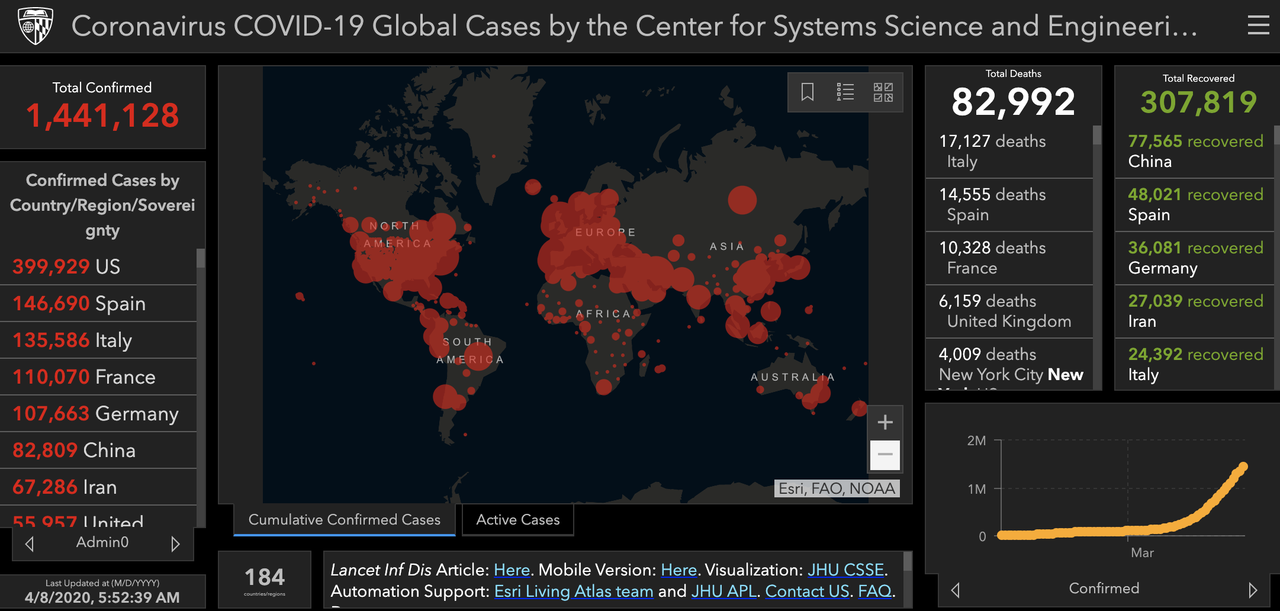
(ZH) Coronavirus Cases Pass 1.4 Million As Scientists Discover Reinfection Risk

Coronavirus Cases Pass 1.4 Million As Scientists Discover Reinfection Risk For Patients Much Higher Than Expected: Live Updates
Though the coronavirus outbreak figures reported out of Europe yesterday were probably more mixed than health officials would have liked, there was, apparently, enough to keep the resurgence of optimism that has fueled market gains in recent days alive. While China blithely prepares to unleash its second wave on itself and the world in what seems like an almost deliberate act, the Washington Post reported overnight that the main epidemiological model being followed by the federal government has just revised down the need for ventilators, beds and other equipment as the world seems to have convinced itself that a lull is underway.
Across the US, chatter on social media about the need to get at least some of the shut-down economy back online has intensified in recent days, as political commentary as inspired heated discussions as opponents accuse Republicans and many regular Americans of callously placing the economy and their own self-interest above protecting society's most vulnerable. Meanwhile, the global case total has surpassed 1.4 million, with 83k+ deaths.
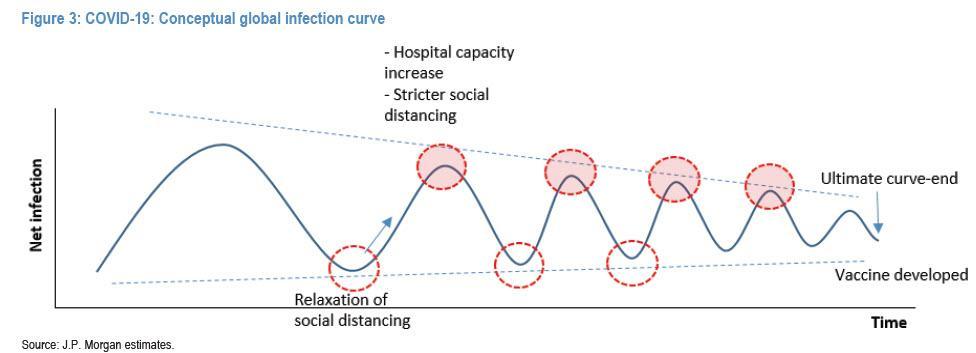
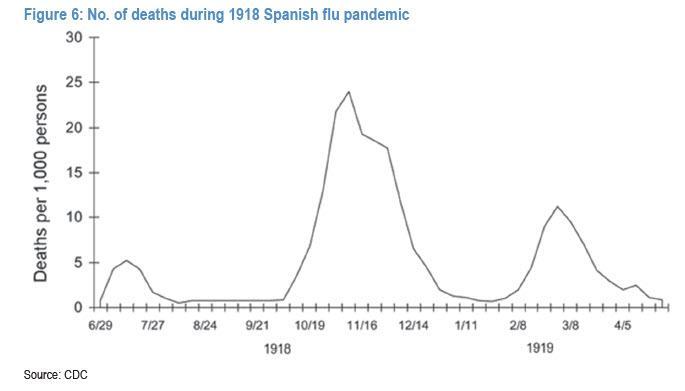
But as JPM projected, and as was the case during SARS and other prior pandemics, even if the novel coronavirus does begin to recede heading into the summer, remember: this is only part one.


At this point, it's not like anybody is going to snap their fingers and suddenly turn the clock back to Dec. 31, 2019. Many Americans - especially those at high risk - will likely cut down on leisure air travel, as pundits are already talking about the death of the "one-flight meeting".
But as we begin to weigh the pros and cons, and the Trump Administration reportedly weighs a plan to reactivate parts of the economy and allowing some people to get back to work if they can demonstrate that they're healthy, the SCMP late last night highlighted some new scientific evidence that is extremely disturbing.
As we explained above, by lifting restrictions on Wuhan, China is potentially unleashing hundreds, maybe even thousands, of asymptomatic carriers on the rest of the country. But scientists believe the 'herd immunity' that has supposedly been built up during the first wave should blunt the impact of ensuing waves somewhat. Well, unfortunately, it looks like that thesis needs to be reexamined.
Since the early days of the outbreak, we've seen reports about people being reinfected with the virus (though in some cases there were doubts about whether the virus ever really left). Well, now, a team of researchers at Fudan University in Shanghai has discovered that an alarmingly high number of recovered patients whom they've tested show low, or no, levels of the virus antibodies in their blood. That means a sizable chunk of those who are infected will be vulnerable to reinfection.
In other words, if these findings are confirmed, the hoped-for "herd immunity" that is supposed to help us get things back to normal in the time between now and however long it takes researchers to mass produce a vaccine simply isn't going to materialize: Instead of diluting the density and acting as blockers for spread, many will be reinfected, and go on to spread the virus to others, all over again. It's just the latest reason to worry that the second wave of the virus could be larger than the first.

Some countries are already seeing the first stirrings of a second wave: On Wednesday, Tokyo reported a record 144 new cases on Wednesday as PM Shinzo Abe's lockdown (which is legally toothless but has inspired most businesses to close nonetheless) took effect.
As the virus continues its woefully underreported spread across Africa - or so public health experts fear - Ethiopia announced on Wednesday that it's joining a growing list of African nations - already including Botswana, Congo, Ivory Coast, Senegal, South Africa and others - by declaring a state of emergency over the virus. The country's 110 million people have been relatively unscathed, reporting just 52 cases so far, though some fear that the country's close ties to Beijing and commerce between the two nations means many more cases have gone unreported.
Iraq also extended the closure of its main border crossing with Iran as the 'official' death toll in that country passes 10k. Much to Trump's delight, the decision will put added economic pressure on Tehran, as it will disrupt trade between the two nations, something upon which Iran's sanctions-starved government greatly relies.
Certain progressive media outlets in the US will likely never forget that certain conservative pundits and even - to a much lesser degree - President Trump, Mitch McConnell and other Republican leaders played down the coronavirus as the first cases were confirmed in the US. While President Trump likes to brag about his decision to shut down travel from China, in reality, that was a half-measure (he should have shut down travel from Europe, as certain senior advisors reportedly urged). And while they're not wrong, they're only telling part of the story. A lot of people in positions of power - including, as the Intercept notes, NYC's Democratic mayor - either underestimated the outbreak, or have changed views on subjects like drugs, whether shutting down schools makes sense, whether a partial shutdown that preserves more of the economy might be a more appropriate response - the list goes on and on.
Going through this list, it appears to us that nobody is more guilty than the WHO, which is partly why President Trump is insisting that the US reexamine the WHO's funding, and has mocked the WHO for 'totally blowing it'.
Of course, anybody who has only just started paying attention in the past few weeks (ie most of America) probably doesn't remember the WHO dragging its feet on the global threat and pandemic designations (those were two separate declarations), while also insisting that travel restrictions and border closures weren't appropriate at a time when those decisions could have gone a long way toward suppressing the spread.
Because as the White House reportedly prepares a plan to get some healthy people back to work in the not too distant future, the WHO is now urging that countries considering a lifting of their lockdowns should probably reconsider (even as China prepares to send legions of infected Wuhan residents across its own country, and the world).
The WHO said Wednesday that "we have a long way to go” to defeat the pandemic, said Dr Hans Kluge, the WHO regional director for Europe, adding that now is “not the time to relax [lockdown] measures,” and all countries must “double and triple our collective efforts”. “We still have a long way to go,” he said. “The progress we have made so far in fighting the virus is extremely fragile.” Any relaxation of social distancing measures requires “very careful consideration,” he added. “We need to remain committed.”
His remarks were clearly directed at the West (after all, he was speaking in English), but would the WHO, which has come under fire for refusing to criticize Beijing, say the same about Wuhan?
If you, dear reader, happen to be a billionaire like Microsoft founder Bill Gates, or at least wealthy enough to perhaps be insulated from the vicissitudes of the combined economic and public health crises which have caused the economy to literally grind to a halt, then perhaps you don't understand how bad things really are out there (after all, the stock market has really bounced back over these last few days). For those who still believe most Americans could survive a ten week total economic shutdown, the OECD would just like you to know: Most of the world is already officially in a deep recession. A leading indicator published by the Paris-based NGO showed its biggest drop on record.
Just in case you weren't aware, the global economy is a giant dumpster fire right now. And while people with comfortable white collar jobs are shouting at everybody to "stay indoors!!!!", there are millions of people are this country who are still waking up every day trying to figure out how they're going to eat, or take care of other essential needs, in the middle of a lockdown. That doesn't mean people should just flout the lockdown when they feel like it, it's just a reminder that everybody deserves the benefit of the doubt.

WWD : Vogue Italia Reacts to Coronavirus Crisis With Special Edition

Vogue Italia Reacts to Coronavirus Crisis With Special Edition
For the first time in the history of the glossy magazine, the April edition of Vogue Italia features a totally white cover.


MILAN — Vogue Italia is reacting to the coronavirus pandemic with a special issue, featuring, for the first time in the history of the magazine, a totally white cover.
“White is, first and foremost, respect. White is rebirth, light after the darkness, the sum of all the colors. White is the uniforms of those who have saved lives while risking their own. It’s time and space for thinking. And for staying silent too. White is for people who are filling this time and space with ideas, thoughts, stories, verses, music and kindness to others,” said Vogue Italia editor in chief Emanuele Farneti. “It’s a reminder that after the crisis in 1929, clothes turned white, a color chosen to express purity in the present and hope for the future. And above all, white is not surrender; it’s a blank page to be filled, the frontispiece of a new story about to begin.”


Donatella Versace’s sketch for Vogue Italia’s April issue. Courtesy of Vogue Italia
Inside, the April issue of the magazine — which hits newsstands today and is free for download at the title’s web site — shows a fashion feature realized in a week by 40 artists who usually collaborate with the glossy publication. Reflecting the emergency, which is shaking the industry, the feature includes contributions from high-profile fashion personalities such as Steven Klein, David Sims, Mert Alas and Marcus Piggott, Joe McKenna, Bella and Gigi Hadid, Collier Schorr, Glen Luchford, Paolo Roversi, Petra Collins, Willy Vanderperre, Olivier Rizzo and Lindsey Wixson to cite a few, who shot at-home pictures of themselves, their families and their friends connected online.

“Some people say that the raison d’être of Vogue is to entertain — to offer a few hours of divertissement to those who leaf through its pages. I don’t know about that. What I do know, as you’ll read in this issue, is that in its long history stretching back over 100 years, this magazine has come through wars, crises, acts of terrorism. I know that its noblest tradition is never to look the other way (perhaps the most shining example is Audrey Withers, who was editor in chief of the British edition during the Nazi air raids). Because, as Withers herself observed, to be passive is to consent to the status quo,” Farneti wrote in the editor’s letter. “Just under two weeks ago, we were about to print an issue that we had been planning for some time, and which also involved L’Uomo Vogue in a twin project. But to speak of anything else — while people are dying, doctors and nurses are risking their lives and the world is changing forever — is not the DNA of Vogue Italia. Accordingly, we shelved our project and started from scratch.”
Alessandro Michele’s sketch for Vogue Italia’s April issue Courtesy of Vogue Italia
Participating in the creation of the magazine during the global lockdown, a range of fashion designers — such as Dior creative director Maria Grazia Chiuri, Miuccia Prada, Valentino creative director Pierpaolo Piccioli, Gucci creative director Alessandro Michele, Donatella Versace, Michael Kors, Stella McCartney, No. 21 creative director Alessandro Dell’Acqua and Jeremy Scott — created dedicated sketches. In addition, Michele and Piccioli discussed with Vogue Italia how they are coping with the creative process while working from home.

FT : Supply chains need some love during the coronavirus pandemic

Supply chains need some love during the coronavirus pandemic
Companies should pull out the stops to support critical suppliers now and prepare to resume production

Continental, one of the world’s largest car-part makers, sits smack in the middle of many global supply chains. Geographically diversified and relatively well capitalised, the German-listed manufacturer is about as well positioned to survive the coronavirus pandemic as a company in its sector can be.

Yet its chief executive Elmar Degenhart warned last week that profit margins at its auto division will probably drop to zero and that smaller suppliers were in danger of going out of business.

History suggests he knows what he is talking about. A Case Western Reserve study of the US auto industry’s experience around the financial crisis found that the total number of suppliers fell from just under 15,000 in 2007 to around 12,000 in 2011. Individual businesses reported that their average number of direct competitors fell from eight to six in the same period.

So far, the sector’s big players have done very little to prevent a repeat, although no one wants to say so publicly. One carmaker told me that it was too soon for his company to step in, because most production lines have only been shut down for two weeks. Another executive said that his company was counting on state aid to keep its suppliers afloat because “we can’t let them continue producing for us if there is no demand from our customers”.

Although corporate leaders have been spouting platitudes about caring about their stakeholders, including suppliers, the story is similar in most other industries. UK retailer New Look has suspended payments for existing stock and cancelled orders. Swedish fast fashion group H&M has tried to do a bit more: while cutting back orders, it is taking delivery of already produced goods without seeking changes to payment terms. “The suppliers, and their employees, are extremely vulnerable in this situation,” H&M said. “We are in a close dialogue with several partners and industry stakeholders . . . with the aim of finding a joint industry solution.”

Supply chain experts warn that companies may find their level of detachment comes back to haunt them when they want to resume production. “It’s not a matter of just being able to say ‘we can start up again’, but rather finding out who can start shipping,” says Roger Dennis, author of a 2015 report on the impact of crises on supply chains.

He points to the experience of the 2011 floods in Thailand. Factories that had been built to withstand natural disasters, with their own power sources and storm surge protection, ended up becoming literal “islands of resilience because no one could get in or out”.

Companies should be talking to their suppliers to locate and alleviate potential pinch points ahead of a restart. They also need to rethink the way they view their suppliers, says Bindiya Vakil, chief executive of Resilinc, a supply chain data and management group. Rather than prioritising vendors with whom they spend the most money, they should concentrate on those that supply parts and raw materials that are critical to revenue generation.

Consider personal protective equipment. It is relatively cheap and abundant, so few hospital administrators previously worried about how and where their distributors obtained it. They now know, to their chagrin, that they cannot function safely without it.

For those critical suppliers, companies should pull out the stops — help them redesign their processes and give them a boost financially, Ms Vakil advises. “Pay early, improve your payment terms, loan money, buy the raw materials for them if they do not have the necessary credit,” she says.

Faced with an extraordinary surge in demand — an enviable problem to have when other sectors are mothballed — UK supermarket chains are already starting to do this. Morrisons has dramatically sped up payments to suppliers with turnover of less than £1m. They are receiving funds immediately, rather than having to wait up to 60 days.

For its part, Tesco is working with suppliers of key products — eggs, milk, sausages and toilet roll — to meet the increased demand from shoppers eating at home. The changes include increased production at farms and dairies all over the UK and simplified ranges.

Tesco has encouraged dairies to drop one-pint bottles of milk to boost production of more popular two and four pint bottles, and cut its toilet roll selection from 33 products to 10. The grocer is also ordering in quantities that fill entire pallets and trucks, to avoid wasting delivery capacity.

Meanwhile, it is also working with its main egg supplier, Noble, to take less popular white-shelled eggs that would ordinarily go to McDonald’s. “We are incredibly grateful for everything that our suppliers are doing to help our customers get the food and essentials they need,” says Andrew Yaxley, Tesco’s chief product officer.

It is obviously more financially rewarding to help suppliers boost output than to support them in crisis. But those smaller vendors will be vital if we are to have any hope of a rapid economic restart. They also can help solve our longer term sustainability problems. Companies must seize this chance to rewrite the rules of engagement. This is not a time for penny-pinching.

FT : New York luxury towers quake as coronavirus hits property market

New York luxury towers quake as coronavirus hits property market
Highly leveraged developers struggle to sell units that can be priced above $50m

Frances Katzen, one of New York’s top luxury property brokers, had made a brisk start to the year. Then, coronavirus struck.

Within weeks, Ms Katzen saw $80m in sales evaporate as the pandemic put the city on lockdown. She has since regained some of those, including a $20m deal for a downtown penthouse that closed last week. But most buyers have fled.

“The sky has fallen,” said Ms Katzen, a residential broker at real estate agent Douglas Elliman. “We’re there.” 

For New York developers, the dread is that a prolonged pandemic shutdown will not only scare away potential buyers but also prompt those who have already agreed deals — but not yet closed — to walk away. That, in turn, could cause lenders to seek recourse as developers fall behind sales milestones spelt out in their loan agreements.

“There’s going to be a world of pain,” one New York developer predicted. 

Others remain hopeful the pandemic will soon subside and the market will rebound with pent-up vigour later in the year. That may be a question of science more than real estate.

In the meantime, many typical buyers of luxury condominiums have themselves been hit by the market turmoil. One prospective buyer of a co-operative apartment on the Upper East Side had their offer rejected in recent days, according to several brokers, after their finances no longer satisfied the co-op board’s standards.

The virus hit just when New York’s luxury market appeared to be regaining its footing after a years-long slump brought on by a glut of supply, as well as the disappearance of Chinese and Russian buyers due to geopolitical tensions. 

Developers were also grappling with an increase last year in the city’s so-called mansion tax, as well as other tax changes. Several lowered prices in the fourth quarter by 10 per cent or more and activity shot up in the new year. 

The overall number of sales in Manhattan in February was 54 per cent higher than a year ago, making it the strongest February since 2010, according to Core, a New York realtor.

But with March came the lockdown to curb the spread of the virus, with New York halting all but essential construction projects. It also banned property viewings. That restriction was subsequently lifted — although few sales agents or appraisers have shown much inclination to risk their health in the midst of a pandemic. If they have the means, many have left the city for second homes elsewhere.

“You’re not allowed to build and you’re not allowed to sell . . . so things are going great!” one property executive quipped.

Garrett Derderian, the author of the Core report, said sentiment was likely to deteriorate as gross domestic product and jobless numbers are reported in April and May. Ultimately, he said, the duration of the crisis would determine the extent of the damage — both to the real economy and the city’s property market: “It’s the million-dollar question: How long will this last?”

A few opportunistic buyers have braved the market in hopes of nabbing a bargain, according to Ms Katzen. But many others stayed away, she acknowledged. “People follow people,” she said, “and it doesn’t feel good to be spending money right now.” 

For developers, who are typically highly leveraged, the inability to complete construction or close deals could spell doom: sales contracts typically contain clauses that allow buyers to walk away with their deposits if a building has not been finished by a certain deadline. That is known as the “outside date”, and enforced by the New York state attorney-general. 

Even before coronavirus, several New York luxury projects were years behind schedule. Shortages of labour and equipment created by the building boom slowed construction, as did the complexity of erecting the new generation of “super tall” towers that have reshaped the Manhattan skyline over the past decade.

One such project is 111 West 57th, where prices for the 46 units run from $17m to more than $50m. Barring an extension, its outside date is weeks away, according to people briefed on the matter.

“Just about any luxury condo in New York — whether it’s complete or almost complete or partly complete — it’s in the same boat right now: it’s frozen,” said Kevin Maloney, whose Property Markets Group is one of 111 West 57th’s developers.

Mr Maloney, a veteran developer, has navigated the savings and loan crisis of the late 1980s and early 1990s, the September 11 terror attacks and the 2008 financial crisis, among other market shocks. He believes that buyers, developers and lenders will eventually have to find common ground — but only after the full extent of the crisis has become clearer.

Even so, Mr Maloney predicted there would be lasting damage: “There’s going to be a bunch of failed projects throughout New York.”

Just down the street from 111 West 57th is another super tall known as Central Park Tower that represents one of the city’s biggest luxury property bets. The tower boasts 179 units, which its developer, Extell Development, was struggling to sell even before the crisis, according to brokers.

Extell declined to comment on the pace of sales. Last week, it made a subtle but possibly telling move when it published some listings for the building on its website. Typically, such high-priced sales are handled privately.

“They’re getting desperate,” a broker said. 

>>> US Early premarket gappers

Early premarket gappers

  • Gapping up:
    • EFC +43.7%, KNOP +39%, NYMT +32.8%, NLY +27%, GNMK +24.9%, IVR +11.5%, PINS +10.8%, NVAX +8.2%, SGH +5.4%, AVID +4.5%, UPS +3.3%, PRGO +3%, FDX +2.8%, SGMS +2.2%, RCII +1.8%, TWTR +1.5%
  • Gapping down:
    • TAL -9.5%, GSX -6%, VIPS -4.2%, MRSN -4%, EDU -3.7%, IQ -3.6%, BIDU -2.5%, NTES -2%, ALGT -2%, WB -1.8%, HUYA -1.2%, ZUO -1.2%, BABA -1%, SAGE -1%, DIS -0.6%

SCMP : The impact of the coronavirus outbreak has been catastrophic for the luxu

Luxury fashion brands like Chanel and Dior need to evolve. Here’s how it could start
* Luxury brands dealing with the fallout from the coronavirus need to find alternatives to unsustainable business models
* One way is looking to the less trend-driven segment of hard luxury, namely jewellery and watches


The impact of the coronavirus outbreak has been catastrophic for the luxury industry.
Months of store closures, disruptions to supply chains, a dramatic plunge in traveller numbers and a series of lay-offs have ended a decade of growth and optimism for luxury groups such as LVMH, Kering and Richemont.
While recovery is on the horizon – industry watchers point to the last quarter of 2020 as the beginning of a turnaround – things will never be the same. That’s why this is a good time to take stock and look at a new way forward for a fashion industry that even before this recent development was in need of a big readjustment.
Thanks to growing middle classes in countries such as China, where millennials have made conspicuous consumption their favourite pastime, the fashion industry has experienced a decade of excess. More collections, more events, more brands, more far-flung cruise shows, more “drops” and more “activations” have been needed to feed this seemingly insatiable beast, regardless of issues such as overproduction and a relentless pace that has taken its toll on industry professionals.

As high-end labels start to plan ahead for a post-coronavirus reality, they might do well to look to a sector close to home: the less trend-driven sector of hard luxury, namely jewellery and watches.
While jewellery labels such as Cartier, Bulgari and Van Cleef & Arpels are as marketing-focused and business-minded as their fashion counterparts, they work at a slower – and more humane – pace. They release high jewellery collections once or twice a year (usually during the biannual haute couture shows in Paris) and more affordable, entry-level ranges when they see fit, operating without the constraints and unreasonable deadlines of a fashion calendar that forces de

Scarcity of materials, longer timelines for product development and a much higher price point are some of the reasons for the jewellery industry’s less frenetic rhythm, but they are all elements that fashion brands could incorporate into their business models, even at the expense of quick, but short-term, growth.
The purchase of a jewel, whether you’re buying a wedding ring or a gift for a loved one or yourself, is often associated with intimate moments. That’s how high-end fashion brands should start approaching their relationships with their clients, by making every purchase count and feel special.

Acquiring new customers is important, but so is cultivating existing ones and building loyal followings, instead of being all things to all people and looking for the low-hanging fruit.

Do luxury labels like Chanel, Dior or Valentino really need to produce a minimum of six womenswear collections a year? Why not make their clothes more special and forget about the bells and whistles, focusing on fewer, but better, pieces that people actually want to buy?
Those three brands all make haute couture, bespoke fashion that is considered the best the industry has to offer and can only be shown in Paris. One way to help them transition would be the Chambre Syndicale de la Haute Couture (the French entity behind Paris Fashion Week) making couture week a yearly event in July and dropping the January shows, which take place only a month before the ready-to-wear season begins. It’s a small change that would create some breathing room in the busy fashion calendar and elevate the couture shows in July to a more special moment that editors and clients can look forward to.

A reassessment of how things used to be done is long overdue and will not happen without some pain, but those who evolve will eventually reap the benefits and grow stronger.
Less volume, higher margins: this should be the mantra of fashion companies that want to call themselves luxury labels.
Looking at the way watch and jewellery houses operate could be a good start for those who are serious about changing their practices for a more sustainable and responsible decade

SCMP : China’s consumers are starting to binge on travel, cosmetics again in sig

China’s consumers are starting to binge on travel, cosmetics again in signs economy is reviving
* Bookings for domestic travel, hotels have risen on Trip.com, while online transactions on Pinduoduo surge
* Gains may not recover to last year’s levels just yet with the global economy facing the threat of recession, analysts say

Chinese consumers are shopping again, in a timely boost for the beleaguered economy, as they regain some semblance of normal life after unprecedented lockdowns aimed at containing the coronavirus pandemic.
Demand for travel, cosmetics, outdoor gear and food has surged in recent weeks as policy-driven stimulus kicked in, workers returned to offices and factories and the government started easing restrictions on people’s movement.
Transport bookings rose more than 50 per cent, while hotel reservations increased by 60 per cent during the three-day tomb-sweeping Ching Ming Festival through April 6, according to Trip.com Group. Online retail orders have likewise boomed, according to e-commerce site Pinduoduo.

“Consumption is expected to steadily warm up, as the latest data shows confirmed Covid-19 cases are not growing,” said Zhang Kailin, analyst at Dongxing Securities in Beijing. Government policies will also underpin the trend, she added.
The pickup in discretionary spending suggests the world’s second largest economy is on the mend. The state has handed out discount vouchers to rejuvenate retail sales. Manufacturing in large companies unexpectedly grew last month after a historic slump in February, while home sales revived.

The coronavirus has infected at least 82,000 people in mainland China and claimed more than 3,300 lives, while new cases and deaths continue to rise in Europe and the US. The numbers in China have tapered recently, underscoring optimism it can come out of the crisis soon and recharge the economy.

China may lead the post-coronavirus economic recovery as social distancing and working from home arrangements will accelerate the growth of e-commerce and related services, according to Wenli Zheng, a Hong Kong-based money manager at T. Rowe Price.
“We found most opportunities in areas where the virus brought short-term disruption, but without impacting medium-term underlying demand,” he said in a statement. “These include IT hardware, home improvement, automotive and sportswear. We think that pent-up demand could help drive acceleration for several quarters.”

Amid new-found ‘liberty’ and pent-up demand, purchases of tickets for domestic tourist spots more than doubled in the past week, which that coincided with the Ching Ming Festival, according to Trip.com, China’s largest online ticketing group. Several tourist attractions saw overflowing crowd troubles, local media reported.
Online sales of cosmetics are also increasing rapidly, boosted by aggressive discounting and live-streaming promotions. Shanghai-based skincare producer Lin Qingxuan posted a 147 per cent year-on-year sales gain on International Women’s Day in early March, a local news site reported.

Pinduoduo has recorded more than 50 million retail orders per day since mid-March, a 60 per cent increase from a year ago, “showing the recovery in the domestic retail market,” the e-commerce site told the Post. Colour cosmetics such as lipsticks, eye shadow, eyebrow pencils saw “decent growth,” it added.

Nationwide food consumption has expanded by a robust 24 per cent, according to Fanli.com, a Shanghai-based third-party shopping site that enables discounted purchases on various e-commerce platforms. Apart from daily necessities, apparel and outdoor gear are among the hottest items.
The big question, though, is if the buying will continue. The International Monetary Fund has warned of a recession as countries such as Japan and Singapore are only beginning to tighten measures to contain the pandemic. China’s economy may have shrunk 5.1 per cent last quarter, according to consensus estimates of analysts in a Bloomberg survey.
“It would still take time for consumer confidence in the medium to long term to return,” said Chen Ke, a Shanghai-based analyst at consultancy firm Roland Berger China. “The key reason is the uncertainty about the pandemic domestically and internationally,” he said.