Closing Market Summary: Daylong Fade Produces Modest LossesThe major averages ended Tuesday with modest losses after surrendering their opening gains. The S&P 500 (-0.2%) slipped four points after starting the day with a 93-point gain while the Nasdaq (-0.3%) underperformed slightly.
Equities jumped out of the gate after markets across Asia and Europe had another good outing overnight. The sharply higher start was attributed to optimism about a potential plateau in coronavirus cases, but the key indices hit their best levels within the first five minutes of action, followed by a daylong slide that sent the Nasdaq and S&P 500 into negative territory.
Six out of eleven sectors ended the day with gains ranging from 0.1% (real estate) to 2.4% (materials) while the top-weighted technology sector (-1.1%) underperformed from the start.
Apple (AAPL 259.43, -3.04, -1.2%) and many other large tech components struggled in the afternoon. Chipmakers finished a bit ahead of the sector, with the PHLX Semiconductor Index surrendering 0.5%.
On the flip side, materials (+2.4%) and energy (+2.0%) outperformed throughout the day. The energy sector was able to remain in the green, even though crude oil slumped into the pit close, ending lower by 9.3% at $23.78/bbl. Exxon Mobil (XOM 41.24, +0.77, +1.9%) announced a 30% reduction to its capital spending plans for FY20.
As for materials, the group's advance was paced by gains in names like Dow (DOW 32.33, +1.79, +5.9%), Freeport-McMoRan (FCX 7.59, +0.40, +5.6%), and Eastman Chemical (EMN 52.87, +2.69, +5.4%). Martin Marietta Materials (MLM 185.42, +8.46, +4.8%) and Vulcan Materials (VMC 107.92, +4.75, +4.6%) also had a good showing, likely due to expectations that the next fiscal stimulus will include an infrastructure component.
Regarding additional stimulus, House Speaker Nancy Pelosi told Democratic lawmakers that she wants the next spending package to be at least $1 trillion. Meanwhile, Senate Majority Leader, Mitch McConnell, said that he expects the increase to the small business loan program to be approved on Thursday.
Treasuries retreated during the first half of the session but narrowed their losses as the day went on. The 10-yr yield ended higher by six basis points at 0.74%.
The U.S. Dollar Index fell 0.8% to 99.88, returning to levels from Thursday.
Reviewing today's economic data:
- The NFIB Small Business Optimism Index fell to 96.4 in March from 104.5 in February
- Job openings decreased to 6.882 mln in February from a revised 7.012 mln (from 6.963 mln) in January
- Consumer credit expanded by $22.30 bln in February (consensus $14.00 bln) after increasing by a revised $12.10 bln (from $12.00 bln) in January.
Tomorrow's data will be limited to the 7:00 ET release of the weekly MBA Mortgage Index (prior 15.3%).
- Nasdaq Composite -12.1% YTD
- S&P 500 -17.7% YTD
- Dow Jones Industrial Average -20.6% YTD
- Russell 2000 -31.7% YTD
Stock buybacks expected to halve as companies bolster defences
S&P 500 groups will purchase $371bn of their own shares this year, Goldman estimates
Big US companies will spend half as much buying back their own stock this year compared with 2019, Goldman Sachs analysts predict, weakening a vital prop for the market as companies shore up their balance sheets.
Share repurchases for companies in the benchmark S&P 500 index will hit $371bn by the end of the year, 50 per cent lower than the $730bn spent last year, according to Goldman estimates circulated to clients on Friday and released on Monday.
David Kostin, the investment bank’s chief US equity strategist, said 51 companies had suspended their share repurchases since the beginning of March — equivalent to 27 per cent of aggregate buybacks last year.
“A spate of recent suspensions, escalating employee lay-offs and increasing political and social pressure will curtail buyback spending, which remains historically elevated following the passage of corporate tax reform,” Mr Kostin wrote in a research note.
This reduced demand “from the principal buyer of shares during the past decade”, he added, would lead to wider trading ranges, less support for the market during sell-offs and slower growth in earnings per share.
A drop in spending on buybacks will add further pressure on a market grappling with the fallout of coronavirus on the global economy.
Share buybacks have boomed since the financial crisis and reached a record $806bn in 2018, the first year of the corporate tax cuts ushered in by US president Donald Trump, helping to boost the stock market to record highs. Apple, the biggest spender in recent years, typically buys more than $10bn of its shares every quarter.
The repurchases have attracted the attention of politicians. Mr Trump expressed dismay that companies had used the tax cut to buy back stock. Joe Biden, the frontrunner for the Democratic nomination in this year’s presidential elections, last month called on US chief executives to “publicly commit now to not buying back their company’s stock” for a year. Bernie Sanders, his opponent, wrote an opinion article last year calling for curbs on buybacks.
The US government’s $2tn spending package to mitigate the economic damage of the pandemic bans companies that take a loan under the package from paying a dividend or conducting share buybacks for 12 months until after the debt is repaid. Aircraft maker Boeing and airline Delta are among big companies to have announced halts to their share repurchases and dividends.
A group of eight big US banks has also paused share buybacks. This group includes four of the biggest spenders on share buybacks in the S&P 500 — Bank of America, JPMorgan, Citi and Wells Fargo. Despite agreeing to cut buybacks, US banks have argued they wish to continue paying out dividends, which they perceive as a marker of financial stability.
Goldman analysts forecast that dividends for companies in the S&P 500 will fall 25 per cent this year. Investors in the futures market are betting that dividends for companies in the benchmark will remain below 2019 levels for the next nine years.
Donald Trump Has Stake In Hydroxychloroquine Drugmaker: Report
The president has repeatedly touted the anti-malaria drug as a coronavirus treatment despite a lack of medical evidence.
President Donald Trump reportedly owns a stake in a company that produces hydroxychloroquine, the anti-malaria drug he has repeatedly touted as a coronavirus treatment even though his experts say there’s no strong evidence it works.
Trump “has a small personal financial interest” in Sanofi, the French drugmaker that makes Plaquenil, the brand-name version of hydroxychloroquine, The New York Times reported Monday.
In addition, Sanofi’s largest shareholders include a mutual fund company run by major Republican donor Ken Fisher, the paper said. Trump’s three family trusts, as of last year, each had investments in a mutual fund whose largest holding was Sanofi, according to the Times. Commerce Secretary Wilbur Ross also had ties to the drugmaker, the Times reported.
Trump’s “assertiveness” in promoting the drug contrary to the recommendation of top health experts “has raised questions about his motives,” the Times noted.
A chorus of Trump supporters with no medical expertise have backed the president’s urging of doctors to treat COVID-19 patients with the drug, including his personal lawyer, Rudy Giuliani, and Fox News host Sean Hannity.
In the face of warnings from top infectious disease expert Dr. Anthony Fauci that the drug’s safety and effectiveness are uncertain in treating COVID-19, Trump has continued to laud its supposed benefits.
“What do you have to lose?” he asked at a press briefing this week urging those sick with the virus to take the drug.
Turns out plenty.
“There could be deaths,” American Medical Association President Dr. Patrice Harris said. “This is a new virus, and so we should not be promoting any medication or drug for any disease that has not been proven and approved by the FDA.”
Generic drugmakers also are gearing up to produce hydroxychloroquine pills. One of those companies was co-founded by Trump golfing buddy Chirag Patel, according to the Times.
Gapping down
In reaction to disappointing earnings/guidance:
- NTUS -2.2% (discloses preliminary Q1 revs; withdraws FY20 guidance)
- FLS -0.5% (withdraws FY20 guidance)
Other news:
- ALC -2.3% (provides update on COVID-19; withdraws guidance and dividend)
- VXX -1.9% (trading lower with futures extedning gains)
Analyst comments:
- N/A
Gapping up
In reaction to strong earnings/guidance:
- VMD +12.5% (raises revenue guidance for Q1), LMNX +10.5% (raises Q1 revenue guidance), ANGO +6.5%, KHC +4.3% (guides Q1 revs well above consensus as growth accelerated), HOLX +3.2%, HI +2.9% (suspends 2020 guidance), GBX +2.4%, TSCO +2.3%
Other news:
- GCI +61.2% (announces the appointment of Douglas Horne as our new Chief Financial Officer, effective April 7, 2020; adopts shareholder rights plan designed to protect its net operating loss carryforwards and other tax assets)
- TRTX +33.7% (provides update on CRE debt securities portfolio)
- TWO +23.4% (declares interim stock dividend)
- M +11.4% (CFO to leave the company as of May 31; external search is underway for Price's replacement)
- NIO +11.3% (March deliveries increased 116.8% yr/yr)
- GSKY +9.3% (provides COVID-19 business update)
- AZO +9.3% (provided update on COVID-19 action)
- BA +8.3% (rebounding despite plans to temporarily suspend 787 operations in South Carolina)
- APRN +7.5% (D. E. Shaw increases passive stake to 5.2% from less than 1%)
- HL +5.9% (production results)
- XOM +5.5% (reduces FY20 Capex by 30%; maintains long-term outlook)
- MMM +5% (3M and Trump Administration plan to import 166.5 million additional respirators into the US over the next three months)
- TCOM +4.5% (Booking Holdings (BKNG) sold 4,500,000 ADSs at an average price of $23.45 per ADS in the open market since March 23)
- T +3.6% (provides financial update regarding COVID-19)
- DHI +3.3% (sees Q2 home sales revenue +10% yr/yr to $4.4 bln; withdraws FY20 guidance due to COVID-19)
- WORK +1.6% (upsizes and prices offering of $750.0 mln of 0.50% convertible senior notes due 2025)
Analyst comments:
- LOW +4.5% (upgraded to Buy from Hold at Loop Capital)
- STZ +4% (upgraded to Buy from Neutral at UBS)
- EQNR +3% (upgraded to Outperform from Mkt Perform at Bernstein)
- BHP +2.8% (upgraded to Outperform from Neutral at Credit Suisse)
- AMT +1.9% (upgraded to Overweight from Equal Weight at Wells Fargo)
Early premarket gappers
- Gapping up:
- TRTX +29.1%, TWO +16.1%, VMD +12.5%, APRN +12.3%, LMNX +9.7%, NIO +8.1%, BA +6.9%, HL +5.3%, MMM +4.5%, KHC +2.5%, GSKY +2.1%, WORK +0.9%
- Gapping down:
- VRNS -6.1%, VXX -3.6%, NTUS -2.2%, ALC -1.2%, FLS -0.5%

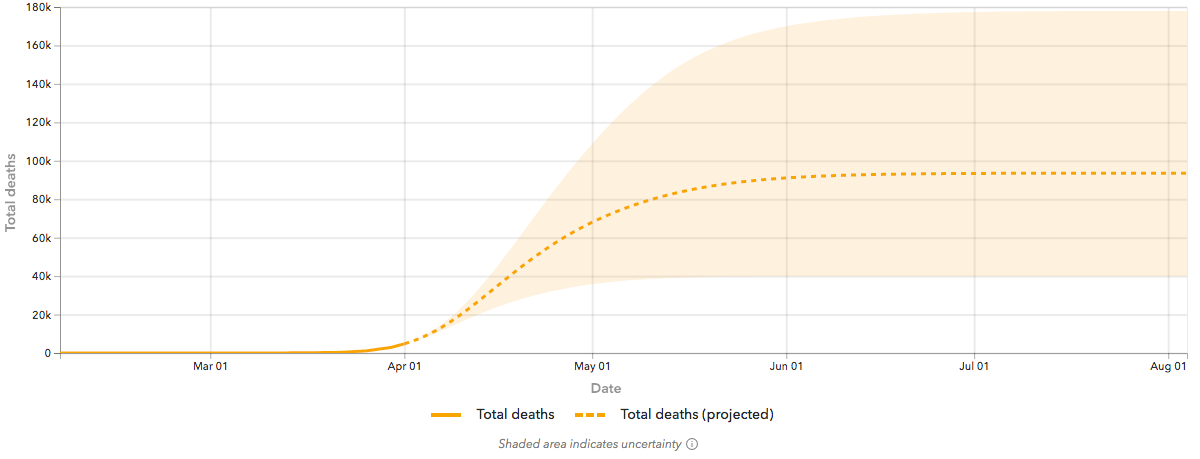
Total projected U.S. deaths from COVID-19 (dotted line) are projected to be 93,531 by Aug. 4, with the shaded area representing uncertainty, ranging from about 40,000 to 180,000. Graphic: Institute for Health Metrics and Evaluation
COVID-19 Pandemic Has Only Just Begun
Why every U.S. city and county should brace for severe outbreaks, a possible second wave, and even a resurgence of coronavirus later this year and next.
While the worst COVID-19 outbreaks in the United States so far have occurred in a relative handful of large cities and other locales, experts say the steep rise in cases — the curve — will come to communities large and small across the country in coming days and weeks. Already some rural counties are seeing outbreaks. For just about everyone else, it’s a matter of time.
And this may be just the first wave of a pandemic that could return in multiple seasons, all depending on whether it can be contained by physical distancing, a potential vaccine or other preventive measures.
“This is an extraordinarily transmissible virus, and I think it’s more transmissible than we recognize,” says Michael Mina, assistant professor of epidemiology at Harvard T.H. Chan School of Public Health.
Mina has “little faith” in the accuracy or extent of COVID-19 testing so far. Between people who are sick but have not been tested and the unknown number of people carrying the disease without any symptoms, and transmitting it, Mina and other epidemiologists says it’s completely unknown how many people are actually infected.
“We really don’t know if we’ve been 10 times off or a hundred times off in terms of the cases,” Mina says. “Personally, I lean more to 50 or a hundred times off.”
That means instead of more than a million cases in the world right now, there could be anywhere from 10 million to perhaps 100 million. That also means the extreme preventive measures like stay-at-home orders could last months, not weeks, Jeremy Konyndyk, a senior policy fellow at the Center for Global Development, tells the health news site STAT.
Few doubt the effects will be grave, no matter what the actual number of cases is right now.
Total projected U.S. deaths from COVID-19 are projected to climb steeply in coming weeks and reach 93,531 by Aug. 4, according to the Institute for Health Metrics and Evaluation (IHME), an independent global health research center at the University of Washington. The estimate, which includes a wide range of uncertainty, was cited today by Dr. Deborah Birx, the White House coronavirus response coordinator.
“There will be a lot of death,” President Trump declared today.
‘It’s all coming soon’
“The spread and scope of COVID-19 is just immense, and that’s because it’s been spreading unchecked, and still is,” says Mark Cameron, PhD, an immunologist and medical researcher in the School of Medicine at Case Western Reserve University in Ohio.
During the 2003 SARS epidemic, which was also caused by a coronavirus, Cameron worked at Toronto General Hospital, the only major city that experienced an outbreak outside of China. That disease and this one yielded similar data on many measures except one: the ratio of severe to mild cases. “People who got SARS in 2003 got very sick very fast, so it was easy to identify them, and isolate and treat them,” Cameron says. Conversely, a far lower percentage of people had mild or no symptoms with SARS, so it did not spread as rapidly as COVID-19.
Many of the same extreme preventive measures were taken in Toronto as are being done now in states across America, Cameron says, and the 2003 epidemic was contained, and the virus was apparently eliminated from the human population.
“This virus is very smart, and it spreads very easily,” Cameron says of COVID-19. “This is unprecedented. This is a 100-year pandemic.”
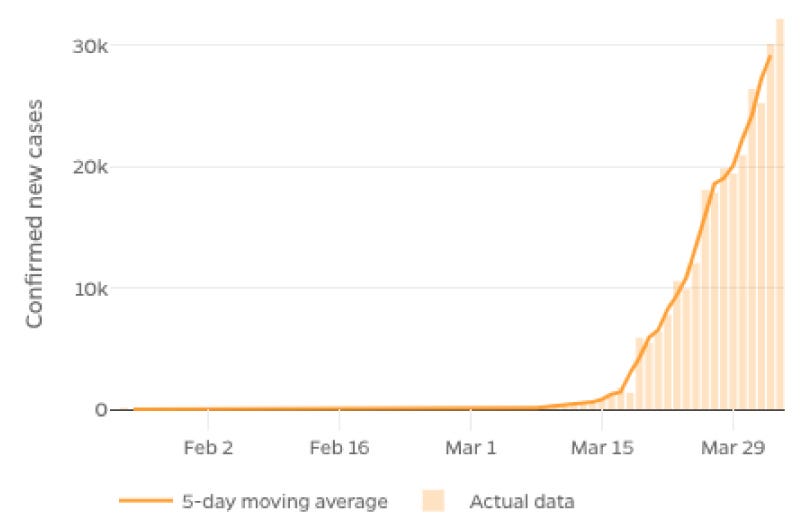
The first U.S. case of COVID-19 was reported Jan. 21, 2020. This chart shows the number of new cases each day since then, through April 3. Credit: Johns Hopkins University School of Medicine
New York’s unfolding nightmare illustrates how population density fosters more rapid spread of a disease, Cameron and other experts say. But every city and state that has yet to see severe outbreaks of COVID-19 will get its turn, Cameron tells me. The curves will be similar, even if the total numbers of cases and deaths are lower.
“Every state will experience their own curve and their own peak,” he says.
Mina agrees, adding another twist that has yet to play out: It’s known that people with underlying health conditions are at greater risk for severe symptoms and death from the coronavirus. So areas with a high proportion of people who have heart disease and diabetes may experience more severe death ratios than what’s been seen so far. Mina cited Memphis, New Orleans and Atlanta as three examples.
“These are places that I think have the potential to be hit very hard,” Mina says. “It’s all coming soon.”
Making matters potentially worse, unlike New York and other major cities that have large, highly capable hospitals, may rural communities have none. St. John the Baptist Parish in Louisiana, near Baton Rouge, has the highest per capita coronavirus mortality rate in the nation right now, and exactly zero hospitals, according to Politico.
How the curves ultimately play out depends largely on the extent to which preventive measures are put in place, kept in place, and followed by the public.
“Our estimated trajectory of COVID-19 deaths assumes continued and uninterrupted vigilance by the general public, hospital and health workers, and government agencies,” says Dr. Christopher Murray, director of the IHME, the organization publishing the death projections cited by the White House. “The trajectory of the pandemic will change — and dramatically for the worse — if people ease up on social distancing or relax with other precautions. We encourage everyone to adhere to those precautions to help save lives.”
Time to prepare
Meanwhile, cities, counties and states fortunate enough to have watched the havoc unfold elsewhere have had an opportunity to take strong spread-prevention actions while simultaneously making preparations akin to a war footing while case counts are relatively low.
One example of a state in waiting is Ohio, where Gov. Mike DeWine issued a strong stay-at-home order for March 23. “We haven’t faced an enemy like we are facing today in 102 years — we are at war. In the time of war,” DeWine said.
That strict order and other physical distancing measures help explain why Ohio has about one-fourth as many cases as neighboring Michigan, says Dr. Robert Salata, a professor of medicine in epidemiology and international health at Ohio’s Case Western Reserve University.
Salata leads the medical response in an 18-institution united command center, similar to what’s used by the military in a time of war. “And this is a time of war,” he says in a phone interview. Cases are starting to spike, and Ohio is in week 1 of a 4-week ramp-up to an expected peak, he says.
“It’s not totally chaotic or a real crisis at this point,” Salata says. “But it can become so, and we’re preparing for that inevitability.”
He and colleagues are taking a variety of measures:
- Eliminating elective surgeries and cutting back on even semi-urgent care to reduce occupancy in the system to just 60%, much lower than normal.
- Working with a local biodefense company to figure out how to re-sterilize and re-use protective gear.
- Figuring out when infected hospital workers can return to work, by testing 10 days after symptom onset, again 24 hours later, and letting them return if they test negative but still have a cough (but of course wear a mask).
- Using this low-volume “window of opportunity” to study the COVID-19 cases they do have, including through clinical drug trials.
“Ohio has had more time to watch what’s been happening in Seattle, and the Bay area and New York, to be proactive instead of reactive,” Cameron says. “But at the same time what I’m seeing in the case data, in general every city or county is experiencing the same type of curve. So Ohio might have been a little lucky so far, and population density and measures that were taken proactively will help us, but we can’t be complacent in terms of this spread, and the case rates of infection that have been seen everywhere else.”
72% of all counties probably already have an outbreak
Given the underreporting of total cases, disease modelers at the University of Texas at Austin used the data that is available and projected the likelihood that any given county in the United States already has an outbreak, meaning sustained human transmission, whether they realize it or not.
“If a county has detected only one case of COVID-19, there is a 51%
chance that there is already a growing outbreak underway,” the researchers state. “COVID-19 is likely spreading in 72% of all counties in the US, containing 94% of the national population.”
chance that there is already a growing outbreak underway,” the researchers state. “COVID-19 is likely spreading in 72% of all counties in the US, containing 94% of the national population.”
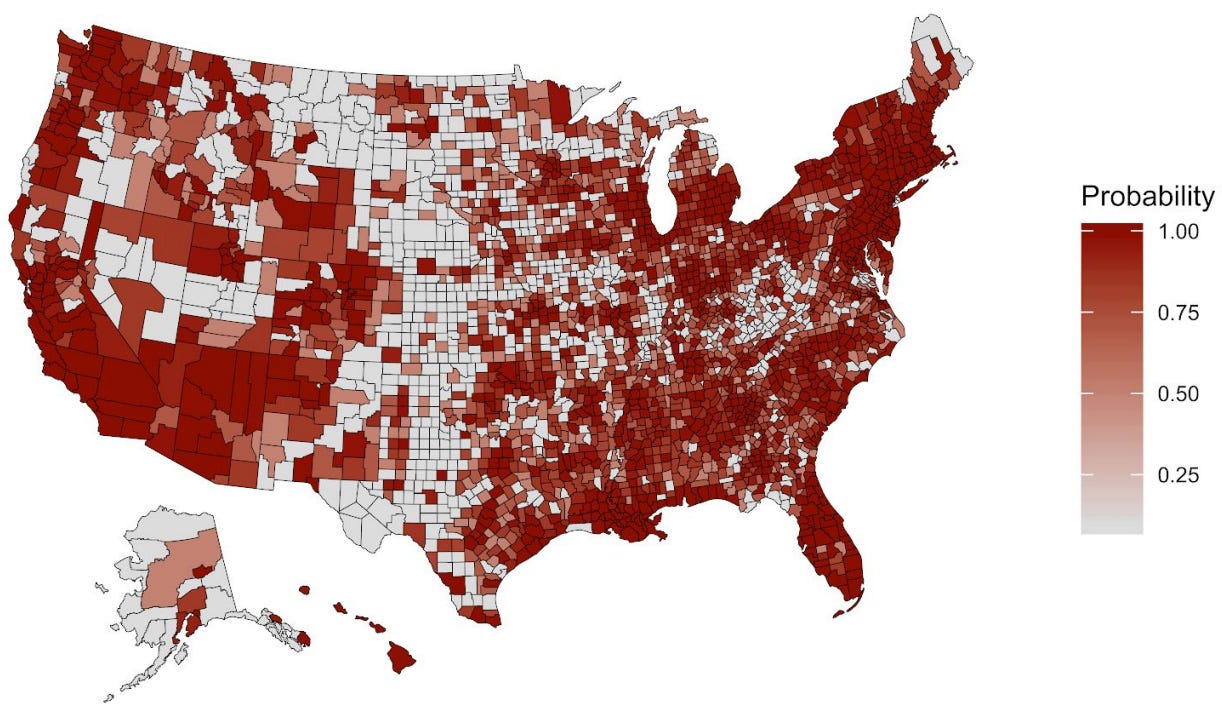
Probability of ongoing COVID-19 outbreaks for the 3142 counties in the United States. The chance of an unseen outbreak in a county without any reported cases is 9%. A single reported case suggests that community transmission is likely. Image: Emily Javan, Dr. Spencer J. Fox, Dr. Lauren Ancel Meyers
“Proactive social distancing, even before two cases are confirmed, is prudent,” conclude the researchers, Emily Javan, Dr. Spencer Fox, and Dr. Lauren Ancel Meyers. “Although not entirely surprising, these risk estimates provide evidence for policymakers who are still weighing if, when, and how aggressively to enact social distancing measures.”
The map—a snapshot of the moment as of April 3—is probably optimistic, the researchers figure. “It is likely that our entire map will be bright red within a week or two, given that COVID-19 spreads very quickly and often silently,” they write.
Second wave… and then more
Meanwhile, worst-case scenarios are not inevitable, says Dr. Harvey Fineberg, president of the Gordon and Betty Moore Foundation, a philanthropic organization, and former president of the U.S. National Academy of Medicine.
“That choice begins with a forceful, focused campaign to eradicate Covid-19 in the United States. The aim is not to flatten the curve; the goal is to crush the curve,” Fineberg writes in an April 1 editorial in the New England Journal of Medicine. “China did this in Wuhan. We can do it across this country in 10 weeks.” But that would require quickly taking far more aggressive than the current U.S. response, including six big steps, including:
- Establishing a unified command at the federal level and for each state
- Solving the shortage of protective gear for healthcare workers
- Making available millions of diagnostic tests
While what is done now is vital, decisions in coming weeks and months could prove similarly weighty.
“We know from the SARS 2003 outbreak in Toronto that there is a well-documented wave of second infections caused by letting some of the close-contact and personal protective equipment (PPE) precautions be relaxed, because they felt they were on the other side of the curve,.” Cameron says. “Turns out they weren’t, and a new curve, a new outbreak, a second wave, occurred in Toronto. We need to avoid that.”
Already some Asian countries that had flattened their curves are seeing resurgences in new cases, including Singapore and Taiwan, according to The New York Times.
Next season and beyond
Further ahead looms another great unknown: Whether COVID-19 will subside with warmer temperatures, as is typical of some coronaviruses and influenza.
Don’t bank on it.
“Unlike seasonal influenza or common colds where the transmission chains get easier to break in the warm, humid, summer months, especially amongst communities with herd immunity, we cannot count on COVID-19 relenting simply because of a change of season,” Cameron says. “COVID-19 has already bulldozed through multiple different climates in the northern and southern hemispheres quite easily.”
Among South American countries as of today, April 4, Brazil has 7,910 diagnosed cases and 299 deaths, Chile has 3,737 cases and 22 deaths, and Ecuador has 3,163 cases and 120 deaths.
Even if the pandemic does lessen or go away this summer in the United States, that won’t mean it’s gone.
“It is more likely that COVID-19 will spread relatively unchecked by seasons until the surges and curves have run their course… in populations world-wide, then return seasonally, hopefully put in some check by those amongst us with pre-existing immunity by having had it already,” Cameron says. A vaccine would help too, of course, but that’s thought to be months away.
Breaking the chain of transmission
Cameron cites the 2009 H1N1 “Swine Flu” pandemic as an example of how viruses can flaunt the seasonality rule. “It took firm hold in the spring and summer months of 2009 in Mexico and the U.S., spreading virtually worldwide from there until August 2010.”
The influenza pandemic of 1918–19 cycled through multiple seasons across two years, ultimately killing some 675,000 people in the United States and more than 50 million around the globe. (In Boston, a second wave hit during the first season when World War I ended, and large crowds gathered to celebrate.)
If there is a notable dip in COVID-19 cases this summer, all it takes to re-emerge in the fall is for infected people, whether from south of the equator or from a fresh pocket in the Northern Hemisphere, to travel.
“There has to be a chain of human transmission to support the seasonality of a particular illness,” Cameron explains. “So breaking that transmission is absolutely critical. If it finds enough of a foothold in enough places that we don’t detect, it will re-emerge in the fall.”