NEW YORK TIMES
Saturday
• New York became one of the first states to take meaningful action to restrict police forces when governor Andrew Cuomo signed bills that ban the use of chokeholds by law enforcement and that repeal a half-century-old law that has kept police disciplinary records secret in the state.
• Whether companies are liable if their workers and customers catch the coronavirus has become a key question as businesses reopen— companies say they face lawsuits, and many are pushing Congress for temporary legal protections.
• US government employees are among what officials say is a backlog of 1.7M Americans waiting for passports after the State Department shut down most of its consular services to protect its staff from contracting the coronavirus.
• Scientists have shown—at least in the tightly controlled environment of a laboratory cell culture—that coronaviruses carrying a particular mutation infect more cells and are more resilient than those without it, but geneticists caution against drawing strong conclusions from this.
• Two years after Trump declared on Twitter that “there is no longer a Nuclear Threat from North Korea,” classified assessments and experts outside government say the country’s arsenal is far larger than it was when Trump and Kim Jong-un held their historic meeting.
• The Trump administration finalized a regulation that will erase protections for transgender patients against discrimination by doctors, hospitals, and health insurance companies, part of a broad Trump administration effort across multiple areas of policy to narrow the legal definition of sex discrimination.
• The coronavirus pandemic has sent economies into recession and reduced government revenue, prompting countries such as Nigeria and Tunisia to remove restraints on electricity and petroleum prices, a politically perilous approach.
• +/- HMC: A recent cyberattack that disrupted the automaker’s operations may have been the first time criminals deployed sophisticated software previously known to be used by state agents against the control systems at industrial facilities such as factories.
Sunday
• Epidemiologists, small-town mayors and county health officials who predicted a surge in coronavirus cases once states begin to reopen are being proven correct, as thousands of Americans get sick from the virus in new and alarming outbreaks.
• Despite the pandemic and recession, tech’s largest companies—still wildly profitable and flush with billions of dollars from years of corporate dominance—are laying the groundwork for a future where they will be bigger and more powerful than they are now.
• “In just under three weeks since the killing of George Floyd set off widespread protests, what started as a renewed demand for police reform has now roiled seemingly every sphere of American life, prompting institutions and individuals around the country to confront enduring forms of racial discrimination.”
• Less than 24 hours after a white police officer shot and killed a black man outside a fast-food restaurant in Atlanta, mayor Keisha Lance Bottoms announced that the city’s police chief had resigned and the officer involved in the shooting had been fired.
• Brazilian president Jair Bolsonaro’s rejection of the emerging scientific consensus on how to fight the pandemic and his promotion of unproven drugs chloroquine and hydroxychloroquine are factors that helped tilt the country into its current health crisis.
WALL STREET JOURNAL
Weekend
• Many protesters say they will continue to target local governments across the nation that are entering budget-planning season to reallocate some funding for policing—often the largest chunk of a city’s operating budget—to social services.
• More than 1,300 Chinese medical-supply companies, many providing masks and respirators in the pandemic, listed on their FDA registrations a US agent without proper contact information, according to a WSJ analysis.
• Wild stock swings have lured large and small investors into the risky world of volatility trading, where they’re wagering hundreds of billions of dollars on a strategy that has grown so big that trading on expected market moves can itself move markets.
• As the coronavirus pandemic accelerates the shift to online shopping, customer-service operations at some big retailers are overwhelmed by shoppers frustrated by delayed shipments and sluggish refunds for returned goods.
• The Federal Reserve said severe disruptions in the US labor market related to the coronavirus pandemic were hitting workers with lower earnings, including minorities, especially hard.
• As confirmed coronavirus cases in the US surpassed two million, driven in part by surges in more than a dozen states, some places were citing the increases as reasons to pause on reopening plans; related stories report that the Centers for Disease Control and Prevention recommended that as states reopen and large gatherings take place—including protests—people wear masks; and that White House economic adviser Larry Kudlow told investors the Trump administration doesn’t expect a second wave of cases, contradicting public-health officials.
• Researchers piecing together how the body’s immune system responds to the coronavirus say some people who have never encountered the pathogen before appear to be able to mobilize parts of their immune system to ward it off.
• Trump has long viewed his stewardship of the world’s largest economy as his administration’s defining legacy, but with less than six months left to campaign, new polls, including a WSJ/NBC news poll, show he has few other advantages in his bid for re-election.
• Trump said he would like to see “a new and updated” Republican party platform, after the Republican National Committee opted to carry over the 2016 plan for this year despite calls for changes on key issues.
• A Chinese government-linked effort to spread pro-Beijing messages through Western social media is clumsy but persistent and is adapting and improving over time, according to a new analysis of Chinese-language activity on TWTR and FB.
• Technologies new and old will soon be appearing in offices, airports, schools, restaurants, retail spaces and sports arenas to counter the spread of Covid-19 and prevent future pandemics.
• The state of California said film and television production can resume Friday, roughly three months after being shut down because of the Covid-19 pandemic, but it may take a while before things are up to speed and back to normal.
• The Covid-19 pandemic has revived interest in hoarding aluminum to sell at a later date, a trade that became controversial after the 2008-2009 financial crisis.
• H.O.T.S.: After Warren Buffett’s Berkshire Hathaway sold out of airline stocks too early, retail investors started buying them indiscriminately—but both sides may be wrong; UBER might look to acquire a smaller rival such as Postmates as it prepares for a new competitive onslaught in food delivery from GRUB; As long as the economy remains in the grips of Covid-19 crisis, American optimism will face limits.
FINANCIAL TIMES
Weekend
• The European Union plans to spend billions of euros on advance purchase deals with pharmaceutical companies for potential coronavirus vaccines, a sign of growing efforts by wealthy nations to secure supplies of eventual treatments.
• Countries across Europe hope to salvage their summer holidays by easing some of the restrictions used to curb the pandemic, and next week nine countries will reopen their borders in a bid to lure visitors.
• The UK formally rejected an option to extend its post-Brexit transition period beyond the end of the year, leaving companies only a few months to prepare for more restrictive trading conditions with the European Union.
• With malls and jewelry stores closed for business during coronavirus lockdowns, the $80B global diamond industry has ground to a halt, and faces a number of hurdles to regain lost ground.
• Big Read story says that betting on the US managing a quick recovery from the pandemic, a subculture of individual retail investors are driving up some stocks, but many professional fund managers question the fundamentals of the broader rally.
• Lex Column: Pearson’s report card has read “needs improvement” for far too long, and there is plenty of scope for a new leader to make a mark; The amount of UK capital sullied by past ties to slavery can’t be quantified precisely, but “we can be sure it is large”; Buyout firms may be Nestlé’s best hope for a sale of its North American mass-market bottled water business.
• Comment: The dramatic and belated change in attitudes toward racial injustice we are now witnessing will halve an effect on who can be considered tolerable and who is intolerable to memorialize with statues, says the historian Simon Schama.
NEW YORK POST
Saturday
• HTZ stock has soared as mom-and-pop day traders snap it up after the company’s bankruptcy, to the dismay of large investors such as Carl Icahn, who sold sizable stakes after the company collapsed on May 22.
• +/- SBUX: The coffee chain reversed policy and said employees can wear Black Lives Matter-related clothing at work, reversing a dress code that banned political messages on garments.
Sunday
• New York City governor Andrew Cuomo on Sunday threatened to shut down Manhattan and the Hamptons again if residents don’t adhere to the state’s social distancing rules.
• The influential sister of North Korean leader Kim Jong Un is rattling nerves in South Korea by threatening military action and accusing activists of sending anti-Pyongyang pamphlets across the border.
• + NKE: In a letter to employees, the sportswear giant said it was adding June 19—known as Juneteenth, the oldest known US celebration of the end of slavery—to its list of annual official days off.
New York Hedge-Fund Traders Aim to Avoid City Tax by WFH
Firms say many fees were for services performed outside the city and therefore not subject to the city tax
Many employees at New York City hedge funds and other investment firms are now scattered around the region, working from home. Some view that as an opportunity to avoid a New York City tax, tax specialists say.
The city’s 4% unincorporated business tax raises about $2 billion a year for the city by taxing investment-fund managers, law firms and other individually owned businesses, based on the portion of sales or services performed within the city.
As employees sheltered at homes in the Hamptons or in the suburbs, a group of hedge funds and other investment-management firms have begun using apps to track where their New York-based employees are working day to day. Their goal is to show that a large portion of the fees paid to investment managers were for services performed outside the city and therefore not subject to the city tax.
The city is already forecasting a $359 million decline in collections of the unincorporated business tax compared with the $2.14 billion in last year’s budget, without taking into account actions of companies looking to shift accounting of sales outside the city.
“We are concerned about the potential impact of the shift of employees out of the city and will adjust upcoming forecasts if it becomes a trend that affects city revenue,” said Laura Feyer, a spokeswoman for the mayor. “Meanwhile, we will continue to make responsible budget choices and advocate for federal government support.”
In the past four weeks, a dozen investment-management companies, with a total of $1.2 trillion in assets under management, have signed up to electronically document employee locations based on cell-tower, global-positioning and wireless data, said Nishant Mittal, co-founder of Monaeo, an app used by companies and individuals to document residency for tax purposes. Monaeo was acquired in March by Topia, a company that helps companies manage global business travel and employee mobility.
He said about half were hedge-fund managers and the others were managers of other investment vehicles.
Driving the push, he said, was the expectation by the firms that many employees will continue to work from home even after offices are allowed to reopen in the next few weeks.
“We believe that in the new world people will be comfortable working from home,” even after New York City fully reopens, he said. “Even if that is only one to two days a week, that is going to make the tax savings worthwhile from an asset manager perspective.
Here is how it works for a hedge fund with $50 billion in assets. Typically, fund managers are paid 2% of assets each year plus 20% of investment gain. The 2% fee works out to an unincorporated business tax of $40 million on a gain of $1 billion at the city’s 4% rate.
If all employees could show they worked outside the city during just the past three months that would result in a $10 million savings for the investment managers—and a $10 million loss to the city.
“UBT uses the standard of where the services are performed,” said Timothy Noonan, a law partner at Hodgson Russ LLP who specializes in litigation on New York City and New York state residency rules. “If the services are performed by all the analysts in their vacation property in the Hamptons or New Jersey, those services would not be allocated to New York City.”
Many wealthy individuals are also looking for ways to take advantage of the pandemic by limiting the days they spend in New York and turning their vacation homes into their main residence. But under complex rules in place, the city and state routinely challenges and audits many such shifts.
A taxpayer who continues to work for a New York company but moves out of state has to show the change was made for the convenience of the employer, said Robert Willens, a tax and accounting consultant who publishes a tax newsletter.
The state hasn’t indicated whether it views people working at home because of the virus as working there for the convenience of the employer.
But the rules of the UBT are simpler and clearer. Beginning in 2009, the city began switching from a complicated formula based on three factors—payroll, property and receipts—to a simpler test based on sales alone.
A city study based on 2014 tax receipts found that finance and real estate accounted for 42% of tax liability under the tax, but only 19.5% of taxpayers. Legal services accounted for 28%, followed by professional services with 17%.
Mr. Mittal said that law firms, accounting firms and other partnerships could take advantage of the same provision as well.
“It applies to everybody,” he said. “The finance people are the first ones to figure it out. They are very savvy when taxes on a billion dollars in gross receipts is at stake.”
Barron’s Weekend Summary: Cover story looks at eight companies that should be able to maintain dividends during the pandemic; Tech sector valuations are getting frothy
* Cover story: Dividend stocks have long been a foundation for steady income and a reliable pathway to accumulating wealth for retirement, but the coronavirus pandemic forced many companies cut or suspended them to conserve cash; Barron’s looks at eight companies—HD, JNJ, LRCX, MCD, NEE, PG, TXN, Roche Holdings—that should have the financial strength to keep their dividends intact, or even raise them, during the crisis.
* Tech Trader: Though tech giants such as AAPL, AMZN, FB, GOOGL, and MSFT will likely come through the Covid-19 crisis stronger than ever, tech valuations nonetheless remain in frothy territory—much like the way investors bid up the stock of Sun Microsystems during the height of the Internet bubble.
* Trader: Positive on CPB, CAG, GIS: Companies remain some of the most appealing of the big packaged food players, and while the intensity and duration of a second wave of Covid-19 cases isn’t clear, they should continue to benefit as consumers eat more at home; The US is in a much better position to handle a second wave of coronavirus infections than it was in February and March, and the potential economic consequences are much less dire.
* Profile: Duane McAllister, senior portfolio manager for the $1.1B Baird Short-Term Municipal Bond fund, prefers revenue bonds—which are issued to fund specific projects—over general-obligation bonds to avoid pension risk and track revenue streams; his team invests in investment-grade munis in the one-to-five-year segment of the yield curve and can hold up to 10 percent in non-investment-grade securities.
* Interview: Jim Covello, global co-head of single-stock research at GS, says that 121 of the 700 or so dividend-paying companies in the Russell 1000 Index, or 17 percent, have suspended or cut payouts this year, particularly in sectors such as energy, consumer discretionary, and industrials.
* Features: 1) Positive on GS: Investors who have focused on what the bank lacks are overlooking its strengths in risk management, investment banking, and leadership—chief executive David Solomon is pushing to build an online banking franchise, broaden relationships with corporate clients, and expand the firm’s alternative asset-management business; 2) Some of today’s most distressed stocks have suddenly gotten a jolt of enthusiasm from young day traders, many of whom are new to stock investing and may not have the same reverence for the advice of elder statesmen as more experienced market participants do; 3) A rebound in the initial public offering market “has been so fast and furious that even the country’s top bankers have struggled to price IPOs”; last year’s wave of offerings was a great place for investors to hide during the crisis, and bankers and private companies see new opportunity in the sector; 4) Positive on PGR: Stay-at-home orders mean fewer cars on the roads, fewer accidents, and fewer claims to pay, so profits are soaring for auto insurers—but Progressive’s stock, which already reflects a lot of bad news, has barely risen, creating an opportunity for investors to buy a growth stock at a value price; 5) Positive on MELI, JD, BABA, HCL Technologies: Emerging markets are lagging behind again as Covid-19 cases surge in India and South America, but under the vast umbrella of stocks in the sector, some world-class companies have survived the decline and are poised to keep climbing—an indication that it’s more important to pick stocks than regions; 6) Positive on WFC, JPM, C: American banks have so far beaten back calls to suspend their dividends during the coronavirus crisis, and the payouts seem likely to continue despite the recession and what figures to be a long recovery; in addition, Wells Fargo, Chase, and Citi expect to increase reserves in the second quarter.
* European Trader: Positive on Basic-Fit, The Gym Group: As the world shakes off the coronavirus, the focus on staying healthy is likely to return, along with strong demand for workouts and classes, which should boost the value of two of Europe’s biggest publicly listed gym chains.
* Emerging Markets: A rally in Brazilian stocks may be coming to and end—low interest rates and strong prices for iron ore and oil have driven up shares, but stumbles from the Bolsonaro administration, particularly in its handling of the coronavirus pandemic, make further gains difficult.
* Commodities: “Natural-gas prices trade nearly 20 percent lower this year, and analysts say they haven’t hit bottom yet, despite the early start to the Atlantic hurricane season, expected high demand for the summer season, and signs that the US economy is recovering from the Covid-19 pandemic.”
* Streetwise: RDFN chief executive Glenn Kelman says traffic growth for online listings for houses in suburbs and small towns has outpaced that for in big cities by 164% over the past two months, supporting anecdotal evidence that buyers are moving from cities out to the country.
Private equity barons grow rich on $230bn of performance fees
New analysis estimates performance of PE funds, net of fees, matches public equity markets
A handful of super wealthy multibillionaires have accumulated vast riches from running private equity funds that have performed no better on average than basic US stock market tracker funds since 2006.
The number of private equity barons with personal fortunes of more than $2bn has risen from three in 2005 to 22, according to a new analysis which estimates investors paid $230bn in performance fees over a 10-year period for returns that could have been matched by an inexpensive tracker fund costing just a few basis points.
“This wealth transfer from several hundred million pension scheme members to a few thousand people working in private equity might be one of the largest in the history of modern finance,” said Ludovic Phalippou, professor of finance at Oxford Saïd Business School.
The biggest winners have been the founders of Blackstone, Apollo, KKR and Carlyle — the four largest private equity managers. Stephen Schwarzman’s personal fortune of $17.7bn ranks the Blackstone co-founder as the world’s 29th richest billionaire, according to the annual Forbes list. Leon Black’s $7.7bn fortune ranks the Apollo founder at 63rd, while George Roberts ($6.1bn) and Henry Kravis ($6bn) of KKR rank as the 108th and 112th richest billionaires. David Rubenstein, Carlyle co-founder, is at 275th place with an estimated wealth of $3.1bn.
Private equity contracts are complex and opaque with little public information disclosed about fund performance. But claims that illiquid private equity strategies deliver markedly superior performance to public markets have attracted huge inflows from institutional investors including pension schemes, insurers, sovereign wealth funds, endowments and family offices.
Mr Phalippou’s analysis indicates that large US public pension plans earned about $1.50 (net of fees) for every $1 invested in private equity funds between 2006 and 2015. This translates into annualised returns of about 11 per cent, little different from the US stock market over the same period.
“The performance of PE funds, net of fees, matched that of public equity markets since 2006,” said Mr Phalippou.
Blackstone said that Mr Phalippou’s analysis contained conceptual errors and was deliberately aimed at producing negative conclusions. “We have delivered exceptional outperformance to our investors, including 31m US pensioners,” Blackstone said.
An alternative methodology for evaluating private equity returns, known as public market equivalent, points to similar results.
More recent vintages of PE funds since 2015 have not fully matured and were excluded from the analysis.
Low interest rates and rising valuations in the long bull market for equities which followed the financial crisis provided an ultra-benign environment for private equity managers. Mr Phalippou warned that any lengthy period of weaker stock markets could expose flaws in the industry’s expensive business model where large fees are paid every year to investment banks, consultants, lawyers and accountants along with interest payments by portfolio companies on debt raised from institutional investors.
“The private equity industry may need to rethink its business model, lowering costs and reconsidering how performance fees are paid in order to remain sustainable. This, however, will probably generate fewer billionaires,” he said.
Other recent analysis has drawn similar conclusions.
A report published in February by Bain & Company found investors did better from tracking the S&P 500 over the past decade than investing in US buyout funds.
A recent analysis of 717 private equity groups by Victoria Ivashina and Josh Lerner, two Harvard Business School professors, said the division of profits among senior partners depended on whether they were founders of the partnership and not on their record as investors.
Carlyle said that it was “inappropriate” to include other asset classes and strategies, such as real estate, energy, and long-dated private equity, with buyout funds as each has a different risk/return profile and time horizon.
“Carlyle is proud of its track record of investment performance that has enabled it to keep the trust of its investors for decades,” said a company spokesperson.
KKR said: “We are proud of our long track record of outperformance for our investors and disagree with the representations in the [Phalippou] paper which are based on flawed assumptions and selective engagement with the facts.”
Timberland and Vans owner eyes acquisitions despite uncertainty
VF chief executive says it could be an opportune time for deals
The company behind Timberland, Vans and The North Face is on the lookout for further acquisitions despite coronavirus uncertainty, saying it could be a good time to expand its collection of clothing, footwear and accessories brands.
“In times like this, some of the greatest returns could be generated through acquiring,” Steve Rendle, chairman and chief executive of New York-listed VF Corp, said in an interview.
While he made clear that organic growth was VF’s biggest priority, Mr Rendle said he saw potential opportunities to buy smaller rivals in subsectors including athleisure, outdoor and activewear.
Analysts said Canada Goose, Gap’s Athleta and Columbia Sportswear could be among the types of targets for VF, which has a market capitalisation of $24bn. Mr Rendle did not comment on any particular company.
Coronavirus has caused a slump in global dealmaking, and the total mergers and acquisitions value of $955bn so far in 2020 is the lowest since 2013. There have been some transactions in sectors such as technology, but concern about the outlook for consumer spending has made buyers reluctant to swoop on retail and consumer companies. Total deal value in the sector of $96bn is the slowest since 2010, according to Refinitiv.
VF traces its roots back to 1899, when the company was established in Pennsylvania as a glove and mitten maker. It later expanded into lingerie and named itself Vanity Fair Silk Mills.
Over the decades the company has reshaped its portfolio, adopting the abbreviated name in the 1960s to reflect an increasingly diverse product line-up.
A series of acquisitions in the early 21st century created the modern day group, although VF has not made a sizeable purchase since it added Icebreaker, the merino clothier brand, and Altra, the running shoes brand, in 2018.
Most recently it has focused on disposals. VF spun off its Wrangler and Lee jeans businesses, among other assets, as Kontoor Brands last year, and in January it put its workwear division that sells to businesses up for sale.
Today the company is focused on 12 brands, mostly outdoor and activewear related, including the JanSport and Eastpak backpack divisions and Napapijri, an upmarket label known for its Skidoo jackets.
“We’ll be thoughtful, but there will be opportunities, we know that [for acquisitions],” said Mr Rendle, who has run the group since 2017.
Asked how much firepower VF had to do deals, he said the company had access to $5bn in cash following a recent bond offer and revolver. “We’ll use that as we see fit, with near-term liquidity being the most important thing today.” Acquisitions could include not just clothing brands, but companies that could help expand its capabilities in data and digital.
While coronavirus disruption and closures have hurt the company, whose revenues fell 11 per cent from a year ago to $2.1bn in the three months ended March, strength in ecommerce has helped it hold up better than peers. Digital initiatives include personalisation services that allow customers to design their own footwear, clothing and backpacks based on photos or artwork.
Mr Rendle said he expected interest in outdoor activity to increase as lockdown restrictions are eased. “We’re not going to take flights any time soon, but people do want to get out and recreate near home.”
The group was previously based in North Carolina, where Wrangler was founded, but after the Kontoor spin-off, VF relocated last year to Denver.
Mr Rendle added that he expected the crisis to accelerate VF’s shift away from department stores and other struggling retailers.
VF has about 1,500 stores globally under the Vans, Timberland, The North Face, and other brands, and direct to consumer channels at present account for about 40 per cent of revenues.
In contrast to retailers that have withheld rent in the crisis, the chief executive said that VF was meeting its obligations to landlords and suppliers.
“We know we will be one of the surviving companies,” he said. “Being a preferred partner that treats people the way we want to be treated, we think will put us in a very advantaged position.”
Telecoms groups consider reviving mergers after EU court ruling
A new round of consolidation in sector could threaten bloc’s competition policy
Bankers and lawyers acting for some of Europe’s largest telecoms companies are anticipating a bonanza of deals on the back of a court ruling last month that dealt a blow to the EU’s strict competition policy.
At the end of May, the General Court, the EU’s second-highest court, overturned the European Commission’s 2016 decision to block the £10.25bn takeover of O2 in the UK by its smaller rival Three, owned by Hong Kong conglomerate CK Hutchison.
The ruling has potentially paved the way for a new round of consolidation in the telecoms sector, antitrust experts said. Its impact could also stretch into other industries, including steel, where the merger of Tata Steel and Thyssenkrupp was thwarted by the commission last year, as companies look to strengthen their hand.
Markets where there are still four mobile telecoms operators, such as Denmark and Sweden, have been tipped as candidates for consolidation. Hutchison, which struck deals to buy mobile rivals in Italy, Ireland and Austria before it was thwarted in the UK, is a potential consolidator, according to one person with direct knowledge of the company’s strategy. Hutchison declined to comment.
Margrethe Vestager, the EU’s competition commissioner, was opposed to a telecoms merger in her native Denmark in 2015. This led to the abandonment of a deal between Telia and Telenor to merge in the country, say people with direct knowledge of the matter.
Spain, which has five telecoms participants, is also seen as a candidate for consolidation, particularly after MasMovil, the country’s fast growing challenger brand, agreed to be taken private by three large funds. That has led to speculation of a future tie-up with struggling Vodafone in the country or possibly Orange, the French-owned telecoms company, to reduce pricing pressure in the Iberian market.
“The ruling will have knocked the commission’s confidence and it has called into question how aggressive they can be when blocking mergers,” said Sara Ashall, counsel in the antitrust practice of Shearman & Sterling in Brussels.
“It has also given companies more confidence to try to merge. Even in cases where before they thought they didn’t have a chance, then may now give it a shot,” she said.
Brussels finds itself in a weakened position after the General Court ruled that the EU made “several errors of law” in assessing the potential harmful effects to consumers of the Three-O2 deal, and that it had not provided enough evidence that prices would rise or competition would suffer.
“Businesses with big deal plans will rejoice that the commission’s wings have been clipped, and mobile operators will be dusting off the consolidation plans they shelved four years ago,” Ms Ashall said.
The ruling comes at a difficult time for the EU and the commission. European companies find themselves exposed to state-backed foreign takeovers given the recent drop in valuations triggered by harsh coronavirus lockdowns.
Meanwhile, Paris and Berlin, among others, have urged Brussels to allow the creation of so-called European champions after the blocked merger of France’s Alstom and Germany’s Siemens last year.
“This makes life very difficult right now,” said a person with knowledge of the commission’s thinking. “The legal bar is so high now and what the court is asking is so complex that it makes it very hard to block mergers.”
But the commission, which has two months to challenge the decision, is set to fight back with an appeal. The EU cannot afford to lose this case because consumer welfare is at stake, said a person familiar with the arguments against the merger.
“There is a real risk that we will see bad deals that will lead to poor consumer services in the next few years,” the person said, pointing to growing evidence from leading free market economists such as Thomas Philippon, that more intervention leads to healthier competition.
Brussels is likely to argue in part that the judges misinterpreted their standard of proof on the case and that there is enough evidence to show the merger would have weakened rivals in the UK market, leading to higher prices for consumers, according to people familiar with the EU’s thinking.
EU officials are also hoping that the European Court of Justice will rule against the General Court, as it has done in other cases, the people said.
Officially, Ms Vestager has kept her options open. “We are urgently analysing the judgment,” she told journalists a day after the ruling. “There are a lot of new legal issues being raised in the judgment, and on the basis of that of course we will decide whether to appeal or not.”
Thomas Wilson, an antitrust partner at legal firm Kirkland & Ellis, warned that the General Court’s ruling might place an additional burden to both companies looking to merge, but also on the commission.
“Given the strict legal standards established by the court,” Mr Wilson said, “the judgment will likely herald even closer scrutiny and longer review times for mergers in markets where there are only a few competitors and high barriers to entry.”
“The judgment will also require the commission to think twice before blocking deals.”
The Great Divide Between Stocks & The Economy
“There is a ‘Great Divide’ happening between the near ‘depressionary’ economy versus a surging bull market in stocks. Given the relationship between the two, they both can’t be right.” – May 12th.
The optimistic view currently is that stocks have it right. Such was a point made in a recent CNBC interview with Ed Yardeni:
“The market has been a ray of sunshine. Basically investors are convinced that we’ll get out of this, and the economy will recover along with earnings. So far, that forecast seems to be working out pretty well. The economy may very well be catching up with the stock market rather than the stock market going off on its own.”
I want to come back to this point in a moment, but we need some historical context.
Relationship Between Stocks & Economy
While the media is a bit ecstatic with the markets rise, I disagree with Yardeni a bit. Historically when stocks have deviated from the underlying economy, the resolution has always been lower stock prices.
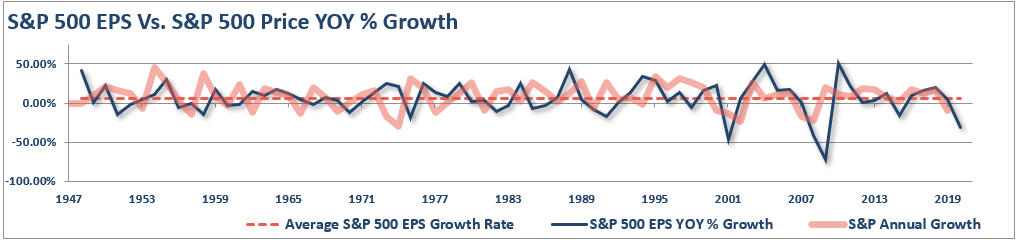
There is a close relationship between the economy, earnings, and asset prices over time. The chart below compares the three going back to 1947 with an estimate for 2020 using the latest data points.
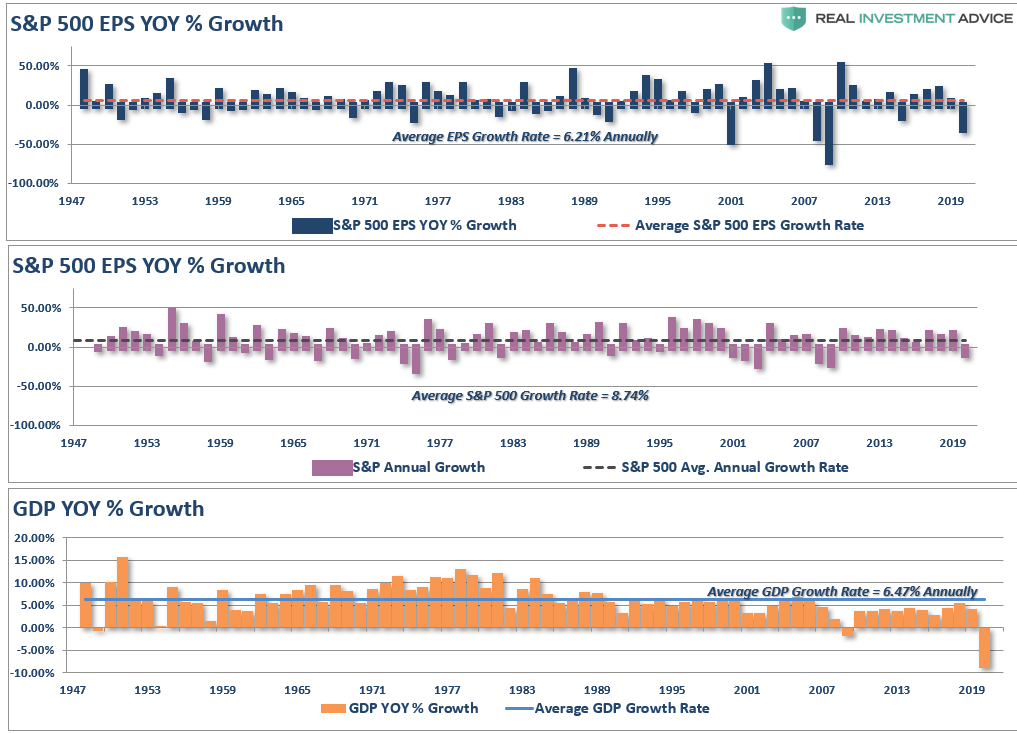
Since 1947, earnings per share have grown at 6.21%, while the economy has expanded by 6.47% annually. That close relationship in growth rates should be logical, particularly given the significant role that consumer spending has in the GDP equation.
Stocks Vs. The Economy, Which Is Right?
While over short periods, the stock market often detaches from underlying economic activity, this is due to psychology as investors latch onto the belief “this time is different.”
Unfortunately, it never is.
While not as precise, a correlation between economic activity and the rise and fall of equity prices does remain. In 2000, and again in 2008, as economic growth declined, corporate earnings contracted by 54% and 88%, respectively. Such was despite calls of never-ending earnings growth before both previous contractions.
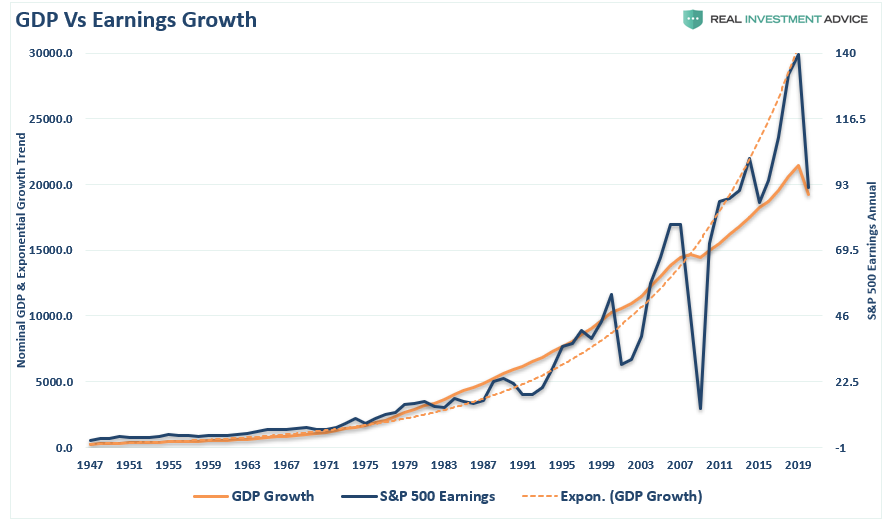
As earnings disappointed, stock prices adjusted by nearly 50% to realign valuations with both weaker than expected current earnings and slower future earnings growth. While the stock market is once again detached from reality, looking at past earnings contractions, suggests it won’t be the case for long.
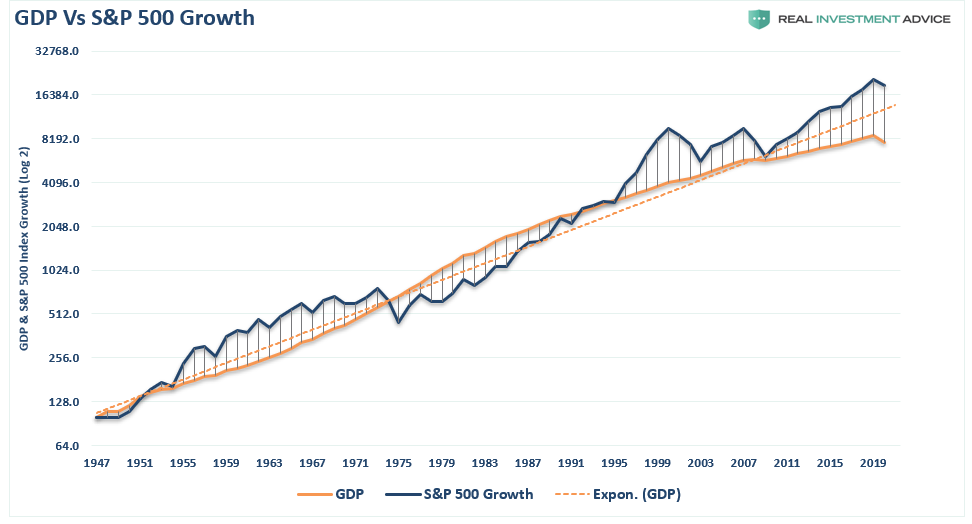
The relationship becomes more evident when looking at the annual change in stock prices relative to the yearly GDP change.
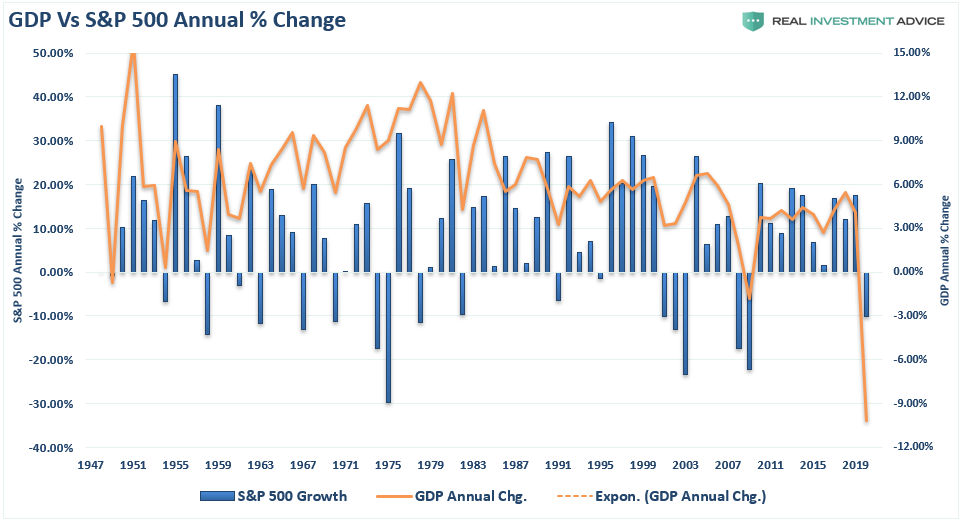
Again, since stock prices are driven in part by the “psychology” of market participants, there can be periods where markets become detached from fundamentals. However, where history disagrees with Yardeni, fundamentals never play “catch up” with stock prices.
Stocks Running Of Bad Economic Data
As Mr. Yardeni noted, the market is hopeful that the economy will quickly recover, bringing earnings growth back. Bolstering that view was last Friday’s employment report which CNBC continues to tout:
“The Bureau of Labor Statistics’ latest release trounced expectations, revealing the unemployment rate dipped to 13.3% from 14.7% while economists anticipated a jump to roughly 20%. Payrolls increased by more than 2.5 million, beating estimates for a 7.5 million decline.”
It was certainly good news at the headline. Unfortunately, the report was rife with errors that suggest the “real” unemployment rate is markedly higher.
There was a significant decrease in the sample rate of households, which sharply increases the margin of error in the report.
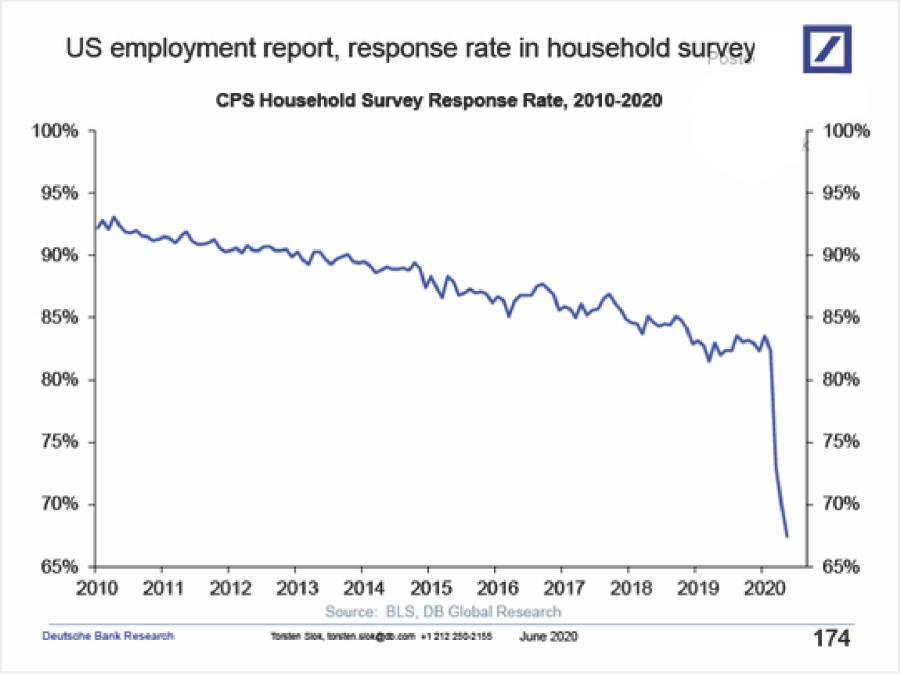
BLS In Error
More importantly, there was a miscalculation of the data in the report:
The drop in the unemployment rate is due precisely to the substantial decrease in the labor force. Since February, according to the BLS, 6.3 million people have decided they no longer wanted to work. Such is substantially more than would be expected even based on the massive increase in unemployment.Therefore, if we adjust for the labor force, and count the extra 4.9 million people who were “not at work for other reasons,” the “realistic unemployment rate” was 17.1 percent in May.While that number is down from April, it is still higher than any other unemployment rate in over 70 years. (But the 13.3% number was as well.)
“There were also a large number of workers classified as employed but absent from work. As was the case in March and April, household survey interviewers are instructed to classify employed persons absent from work due to coronavirus-related business closures as unemployed on temporary layoff.However, not all such workers were so classified.If the workers were classified as unemployed on temporary layoff, the overall unemployment rate would be about 3 percentage points higher than reported (on a not seasonally adjusted basis).
If we make the proper adjustments to the unemployment rate for both April and May, it reveals the ugly truth.

In other words, the unemployment rate was 16.3% using their data, which suggests the number of unemployed is closer to 26 million.
If my numbers are close to correct, there will be implications to earnings and profits.
One Time Bump May Fade Quickly
Furthermore, there is a difference between a one-time bump and an economic recovery based on growing economic activity.
“The labor market data suggested an economic recovery is arriving sooner than expected and revived hopes for a V-shaped trendline for gross domestic product.” – Yardeni
While “hope” is high, the virus is behind us, there will be no “second-wave,” a vaccine will be available by year-end, and more stimulus is on the way; there are many issues which can go wrong. Like this:

I am certain the economy will not be “locked down” a second time regardless of the severity of the outbreak. Politicians have learned their lesson. As Steve Mnuchin said on Thursday:
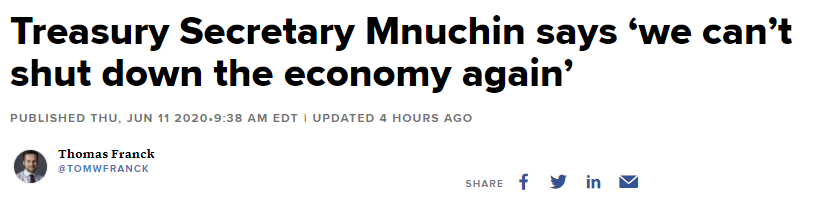
However, the risk is a secondary infection will deter consumers from returning to the economy.
The partial reopening of the economy did lead to some hiring last month, but going from zero staff to a skeleton crew with a limited opening is one thing. Getting back to full-employment, which will require substantially increased demand, is quite another.
Importantly, the government’s Paycheck Protection Program (PPP) certainly boosted employment in May. However, while the program “encouraged businesses to keep people on payroll,” if demand doesn’t return before the money runs out, layoffs will rise.
JOLTS May Have It
Looking at the latest Job Opening and Labor Turnover Survey (JOLTS), openings continue to decline suggesting the initial rehiring may be a one-time bump.
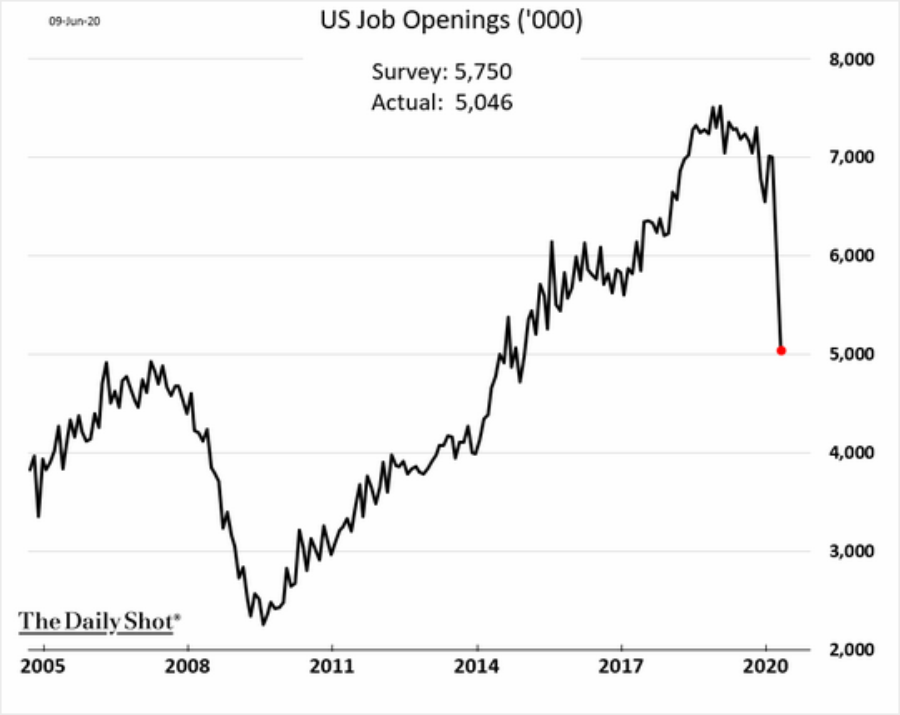
The same was the case in the areas that saw the biggest jumps in employment last month. In other words, businesses have rehired the workers they need, but may not be hiring any more for a while.
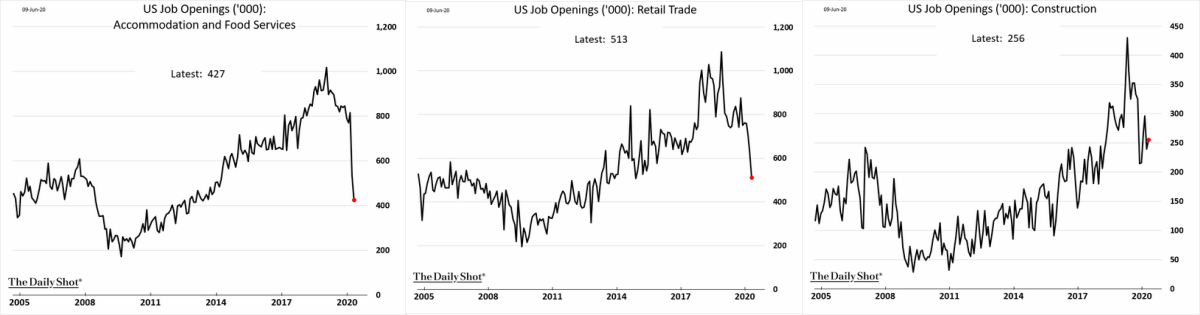
Such was further confirmed by another 1.5 million individuals filing for initial unemployment claims last week. While initial claims from unemployment are falling, such is expected as employers reach the limits of staffing needed to remain in business. However, these numbers could rise as the wave of forthcoming bankruptcies ensue and PPP ends.

Economy May Disappoint
“We’ve been talking about the ‘V’ — this is better than a ‘V’. This is a rocket ship.” – President Trump“Real GDP could be down 40% to 50% in the second quarter. But the worse it is in the second quarter, the greater the likelihood we’ll see something like a 20% increase in the third quarter.” – Yardeni.
The COVID-19 pandemic has triggered one of the most severe global recessions in nearly a century and will leave the world scarred for years. Such was the warning from the Organization for Economic Cooperation and Development (OECD) on Wednesday.
Their warning, based upon the expectations of a “second-wave” of the virus, would derail the initial economic bounce. The OECD offered two forecasts for global growth:
- The assumption a second wave of the coronavirus arrives in the back half of 2020; and,
- A strict social distancing measures is enough to avoid the emergence of new virus cases and deaths.
The OECD forecasts global growth will plunge by 7.6% in 2020, and “remain well short” of its growth activity levels from 2019, suggesting no V-shaped recovery. If a second wave can is avoided, the world economy will contract by 6% in 2020, and again fail to recover to pre-corona levels by the end of 2021.

The OECD makes the case for either a “Nike Swoosh” or a “W-shaped” recovery. Both are well short of current expectations, but align with our analysis from last week:
Recovery To Nowhere
“However, the “return to economic normality” faces immense challenges. High rates of unemployment, suppressed wages, and elevated debt levels, makes a “V-shaped” recovery unlikely.Such is where the “math” becomes problematic. A 50% drawdown in Q2, requires a 100% recovery to return to even. In the more optimistic recovery scenario detailed above, two-quarters of record recovery rates still leave the economy running in a deep recession.”
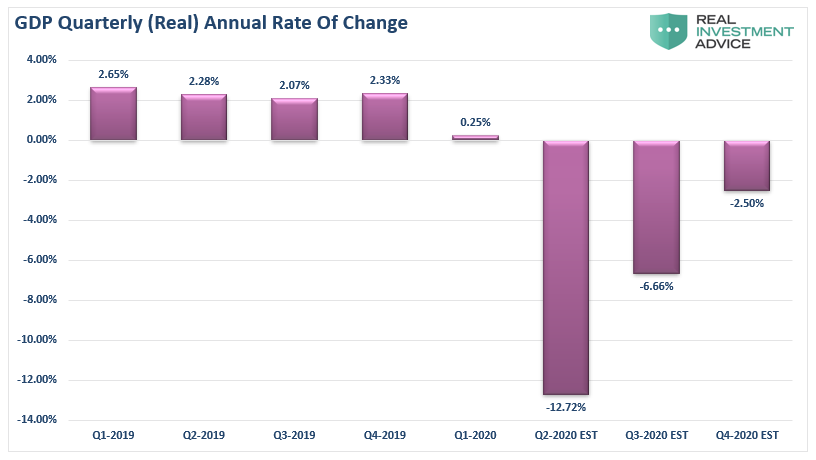
“Even if the economy achieves high recovery rates, it won’t change the recession. The resulting 2.5% economic deficit will remain one of the deepest in history.”
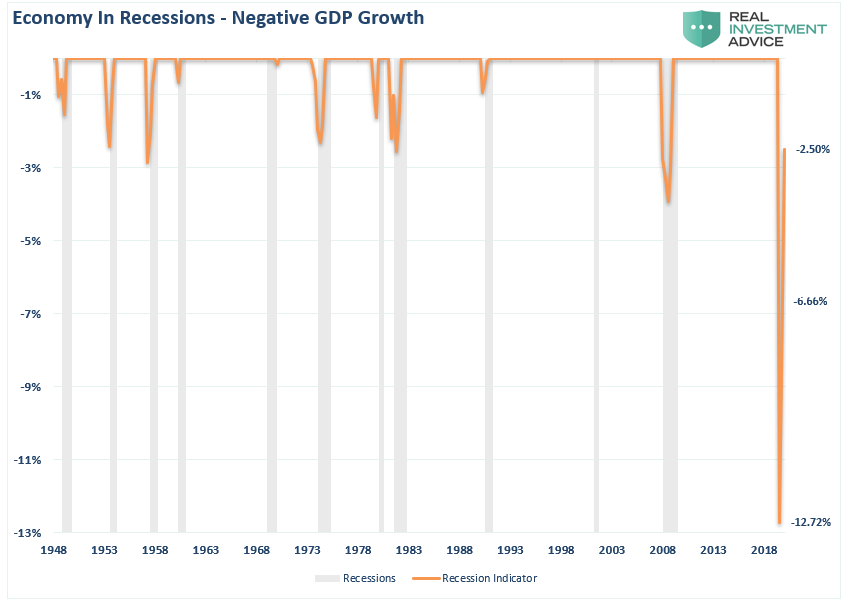
While such a recovery would be welcomed, it is not enough to support stronger employment, wage growth, or corporate earnings.
Here is the issue missed by the majority of mainstream economists.
“Before the “Financial Crisis,” the economy had a linear growth trend of real GDP of 3.2%. Following the 2008 recession, the growth rate dropped to the exponential growth trend of roughly 2.2%. Instead of reducing the debt problems, unproductive debt, and leverage increased.”
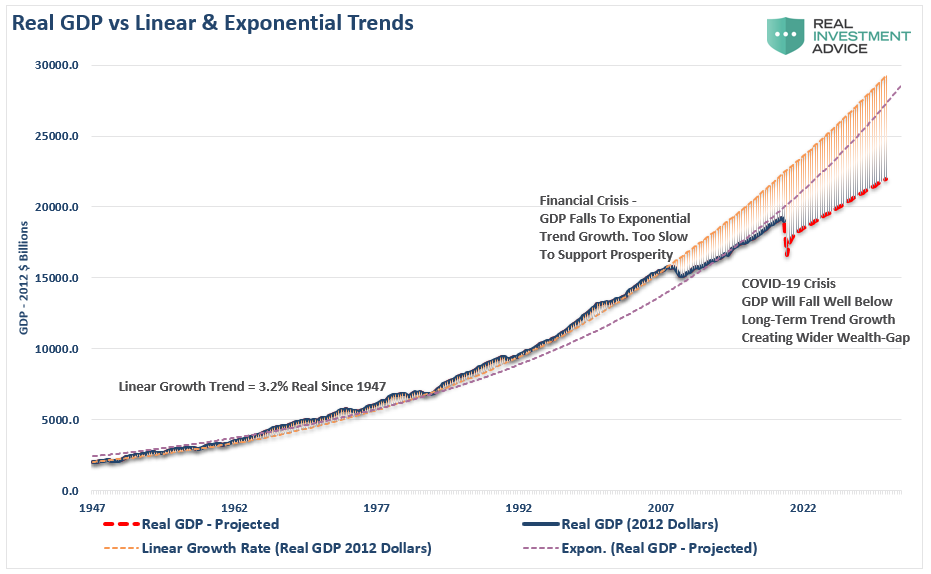
If our analysis is correct, which agrees with the OECD and the World Bank, such would suggest President Trump’s pumping of a V-shaped recovery is overly optimistic. Importantly, the markets may suffer disappointment as expectations fall short.
The Stock Market Isn’t The Economy
The economic destruction playing out in real-time will eventually weigh on markets. There is a negative feedback loop between employment and consumption. As unemployment rises, consumption falls due to a lack of income. Since businesses operate based on demand for goods and services, the correlation between PCE, fixed investment, and employment are high.
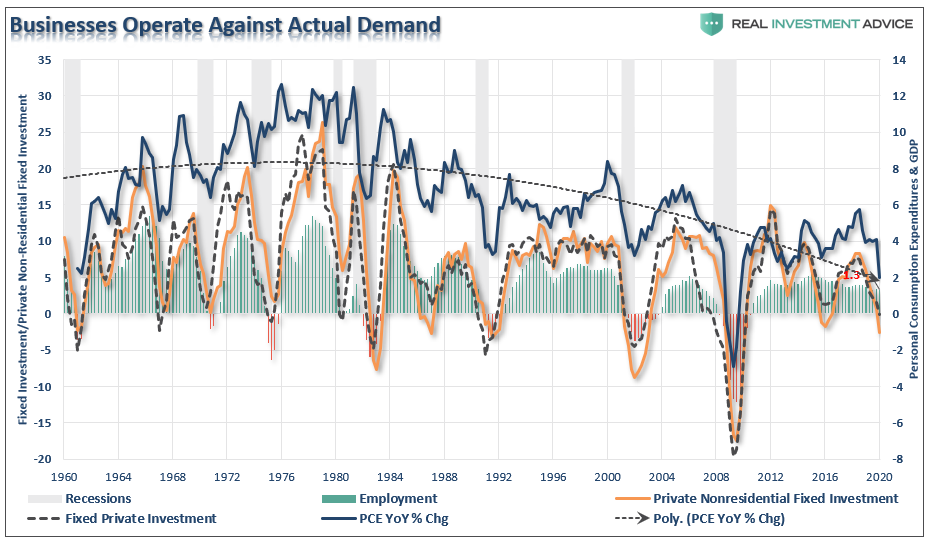
As noted, even with the reopening of the economy, businesses will not immediately return to full operational activity, until consumption returns to normalized levels. Such will frustrate policy-makers and the Fed.
Profits To GDP
It isn’t just the economic data that will be horrid over the next few months, but earnings will likely be just as bad. Earnings can not live in isolation from the economy. As shown below, corporate profits ebb and flow with economic activity.
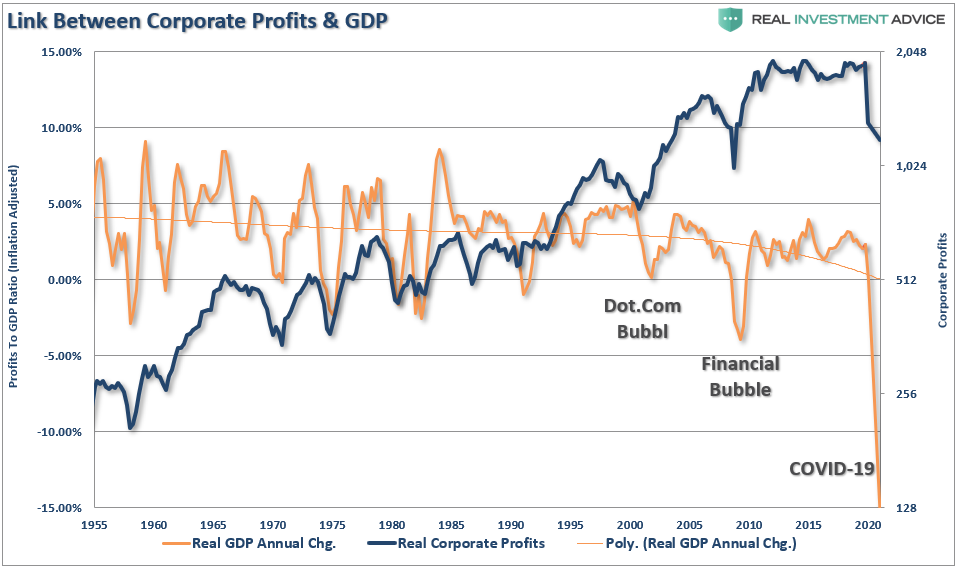
You shouldn’t dismiss the fact markets are deviated from long-term earnings. Historically, such deviations don’t work out well for overly “bullish” investors. The correlation is more evident when looking at the market versus the ratio of corporate profits to GDP.
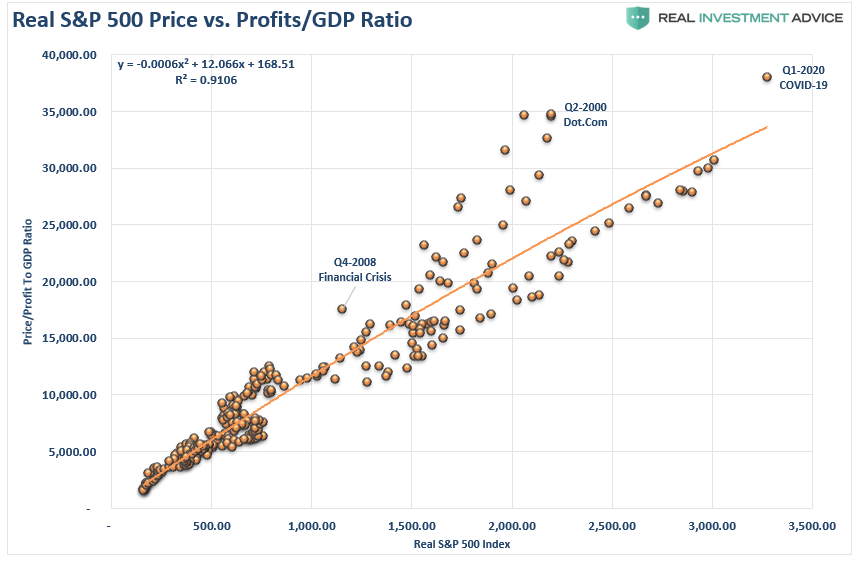
Again, since corporate profits are ultimately a function of economic growth, the correlation is not unexpected. Hence, neither should the impending reversion in both series.
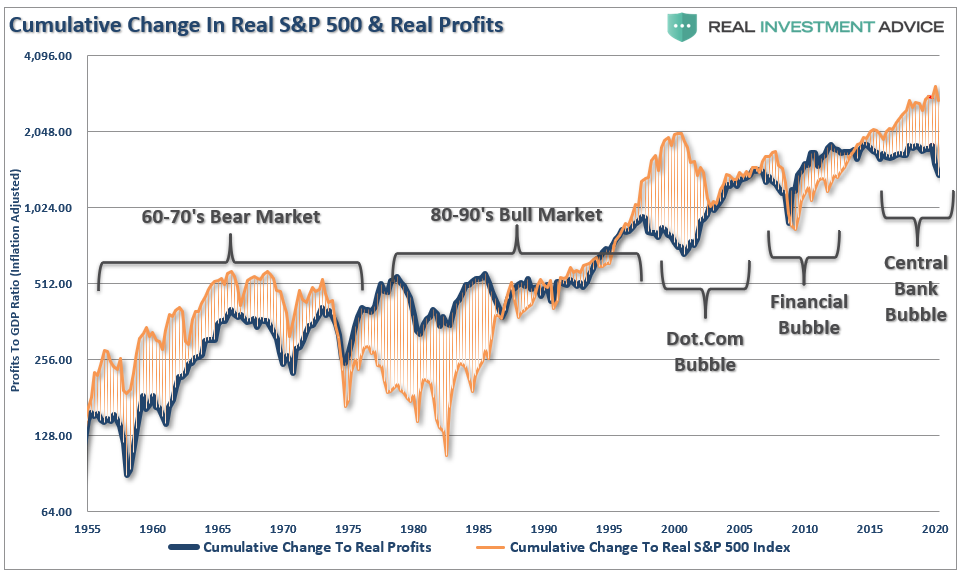
The detachment of the stock market from underlying profitability guarantees poor future outcomes for investors. But, as has always been the case, the markets can certainly seem to “remain irrational longer than logic would predict.”
However, such detachments never last indefinitely.
“Profit margins are probably the most mean-reverting series in finance, and if profit margins do not mean-revert, then something has gone badly wrong with capitalism. If high profits do not attract competition, there is something wrong with the system, and it is not functioning properly.” – Jeremy Grantham
Reversions Happen Fast
There are a tremendous number of things that can go wrong in the months ahead. Such is particularly the case of surging stocks against a depressionary economy.
While investors cling to the “hope” that the Fed has everything under control, there is more than a reasonable chance they don’t.
Regardless, there is one truth about stocks and the economy.
Florida Reports Another Record Jump In New Cases As Global COVID-19 Count Nears 8 Million: Live Updates
Summary:
- Nevada reports 3rd-highest jump; NY reports latest numbers
- LatAm accounted for 40% of cases reported Friday
- Florida reports record jump for third day in a row
- 23 states across US seeing case numbers rise
- Latin America and US vie for global coronavirus leader
- Beijing reimposes lockdowns in some areas after cluster discovered
- Russia reported another 8k+ jump in cases
- EU signs vaccine deal with AstraZeneca
- Gilead strikes deal to distribute remdesivir in Europe
* * *
Update (1400ET): Once again, Beijing's favorite English language mouthpiece (at least on Twitter) is chiming in to play down China's latest outbreak, while castigating the US.

Meanwhile, according to the WHO, infections in Latin America now exceed 1.4 million, more than a quarter of the global total, while LatAm accounts for 40% of all new cases.
Mexico reported 5,222 cases on Friday, Chile announced 6,754 and Argentina had 1,391, all new highs. Chile registered its highest daily death toll to date, with 222. Brazil, the largest country in Latin America, has almost four times as many cases as any other country in the region.
Italy registered 346 new cases Saturday, compared with a daily average of 274 this month through Friday. The country had a one-day peak of 6,557 on March 21.
New York reported 32 deaths, “the lowest so far,” Governor Andrew Cuomo said, as new cases inched higher by 0.2%, in line with the seven-day average.
Nevada health officials meanwhile reported 270 new cases, bringing the statewide total to 10,946 positive cases; 463 people have died from the virus statewide.
NEW: Nevada reports third-highest jump in COVID-19 cases with 270 in 24-hour period, more than 6K tests conducted Friday https://www.news98.info/new-nevada-experiences-third-highest-bounce-in-covid-19-instances-with-270-in-24-hour-interval-greater-than-6k-checks-carried-out-friday/ …


See news98's other Tweets
Health officials said they've conducted at least 235,500 tests statewide.
* * *
Update (1130ET): Minutes after publishing this post, we're already adding the day's first withering stat: Florida has reported yet another record jump in newly confirmed cases, reporting a 3.6% jump statewide, compared with the 7-day average of 2.1%.
For those who haven't been closely following the situation, this is the third day in a row that Florida has reported a record jump in cases, and Saturday's number (remember, they're reported with a 24 hour delay, so these are cases confirmed on Friday), at 2,581, blows away the last daily record (which, again, was reported yesterday).
Saturday marks the 10th day out of the past 11 that Florida has confirmed more than 1,000 new cases, a phenomenon blamed on the loosening social distancing restrictions across the state. Most of the cases are coming from the southern part of the state, with Miami-Dade County being one of the standouts.
Florida now has 73,552 confirmed cases and 2,925 deaths linked to COVID-19, according to the latest numbers released by the health department on Saturday. In addition, the state confirmed 38 coronavirus-related deaths over the past day, including 13 in Miami-Dade County, seven in Broward and nine in Palm Beach County, Local10 reports.

Source: NYTimes
Gov Ron DeSantis said that even though there are more cases, fewer people are going to the hospital, including in Miami-Dade. Asked Thursday if the state’s reopening plans could be rolled back because of the numbers, the governor pointed to the increase of testing and blamed it for the majority of the jump.
"As you’re testing more you’re going to find more cases and most of the cases are subclinical cases," DeSantis said. "And we expected that from the beginning. We’re doing 30,000-plus tests a day in terms of results on average...As people have been getting back to work, I think employers have told folks you should get tested, so we’re starting to see at our test sites a much younger demographic. So you do see 98% test negative but you do see some cases...usually no clinical consequence."
Statewide, Florida reports having completed over 1.3 million tests for COVID-19, with 5.4% coming back positive.
* * *
No matter how many times Larry Kudlow insists the US won't resort to another round of lockdowns under any circumstances, Investors will inevitably pay close attention to the infection and hospitalization numbers out of the country's second class of 'hot spots': California, Florida, Texas, Arkansas and the roughly 20 other states where infection rates are climbing.
Granted, some of these states are arguing that the increase in testing rates is the primary driver of the higher confirmed infection numbers In Portland, where Gov. Kate Brown - who once threatened to take away a small business owner's children if they dared defy the lockdown - has announced a one-week "pause" in the state's reopening plans...even as she insists the increase in testing is mostly responsible for the spike.
At this point, the inconsistent messaging coming from Democratic governors supports critics allegations that decisions to reimpose lockdowns, or delay the process of reopening, appear to be politically motivated. Though in Houston, it appears officials' concerns about the city being "on the precipice" of another serious outbreak are (somewhat) justified.
As "CBS This Morning" reported Saturday, "there are disturbing signs that the grip of the deadly coronavirus pandemic is tightening in some parts of the US as at least a dozen states see an uptick in COVID-19 cases. New virus hotspots are emerging in the South and Southwest, and some states like Texas, Arkansas, Arizona and California are in some areas seeing their largest daily infection numbers yet. Florida and Arkansas have been criticized for reopening some beaches and parks, and failing to enforce social distancing.
Some experts argue that this is the consequence of reopening too early; others dismiss the numbers as merely a short-term rebound that we had already anticipated; and finally, others argue that it's more complicated than all that, given that Georgia, one of the first states to start aggressively reopening, hasn't reported the increase seen among several of its neighboring states.
Yesterday, the CDC raised the prospect of another round of lockdowns, even as the White House has categorically dismissed the possibility; meanwhile, a new forecast is projecting 140,000 deaths in the US from COVID-19 by July 4. That’s compared with roughly 112,000 as of Saturday.

The warning isn't exactly a surprise. During the past week, South Carolina and Florida showed their highest daily number of coronavirus cases yet. Arizona's average daily cases nearly tripled over the past two weeks. And Texas saw four of its worst days so far in terms of hospitalizations.
In Houston, there is a warning: "People should not take things lightly. Or assume that the virus is under control," said Houston Mayor Sylvester Turner.
Texas businesses and restaurants – among the first to reopen – could become the first to shut down again.
"I want the reopening to be successful. I want the economy to be resilient," said Harris County Judge Lina Hidalgo. "But I'm growing increasingly concerned that we may be approaching the precipice - the precipice of a disaster."
Arizona is reporting more than 1,000 new cases per day, up from fewer than 400 a day in mid-May when stay-at-home orders started to ease.
"I think the question of did we open too soon is a valid one," said Frank Lovecchio, an emergency medicine doctor in the Phoenix area. He reports seeing a surge of severe cases requiring intubation.
On Friday, North Carolina Gov Roy Cooper implored his citizens to try and help stop the spread after the state reported a record number of new cases in a single day...
"The numbers show that the disease is spreading and that more people need hospital care. This has to be taken seriously," he said. Utah and Oregon have delayed their reopenings by a week..."As I've said a zillion times: the virus makes the timelines. We don't make the timelines," Gov Brown said.
...while in New Jersey, Governors Murphy and Cuomo are celebrating the fact that their states have the lowest rate of spread in the country.
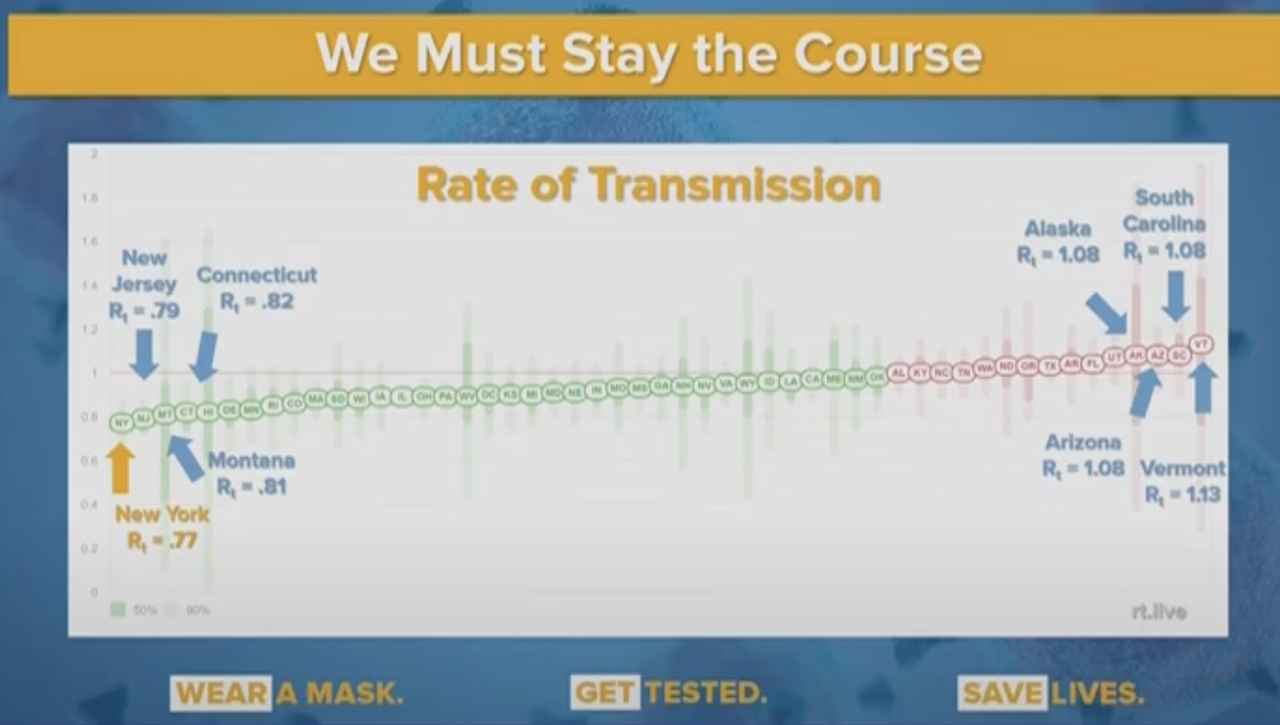
According to the NYT, 23 states are still seeing daily case reports climb.

Worldwide, the number of coronavirus cases reported daily has once again started to climb as Russia and Latin American have emerged as the newest hotspots as the outbreaks in the Europe and at least part of the US have subsided. At last count, the world had nearly 7.7 million confirmed cases, and 426,000 confirmed kills.
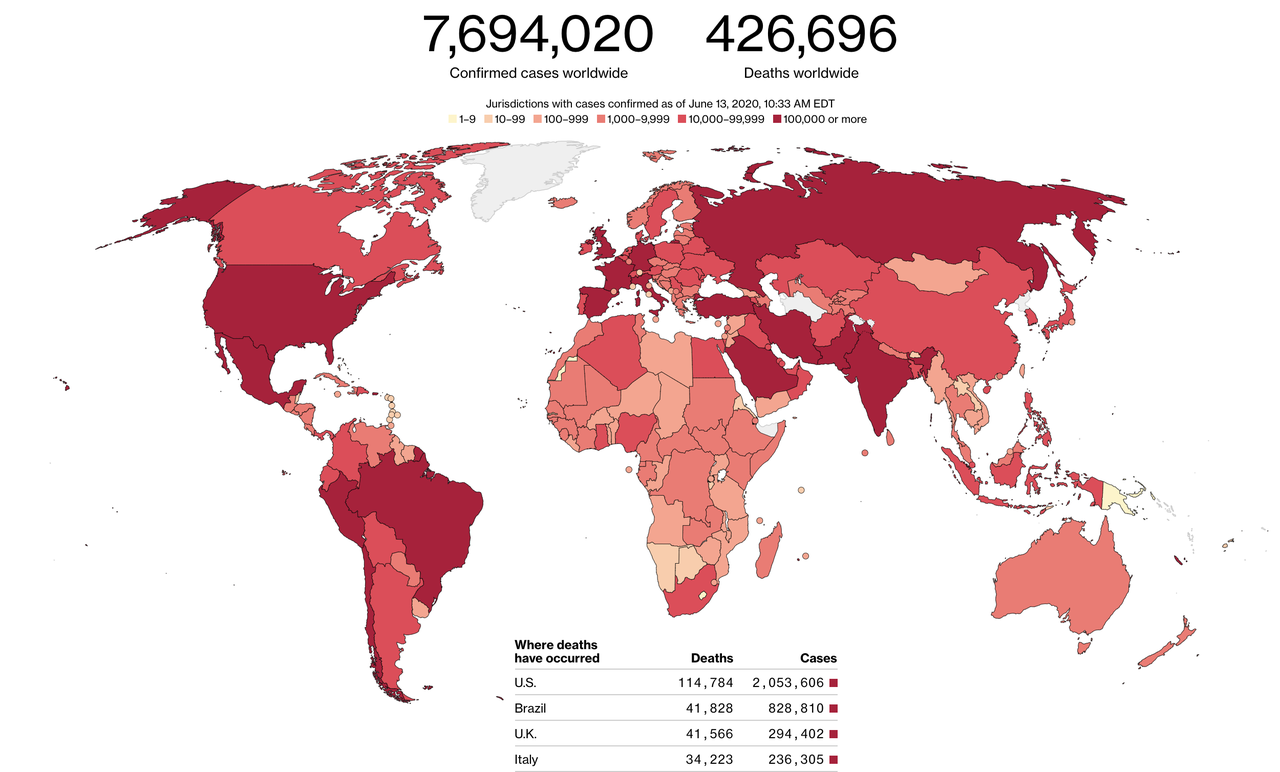
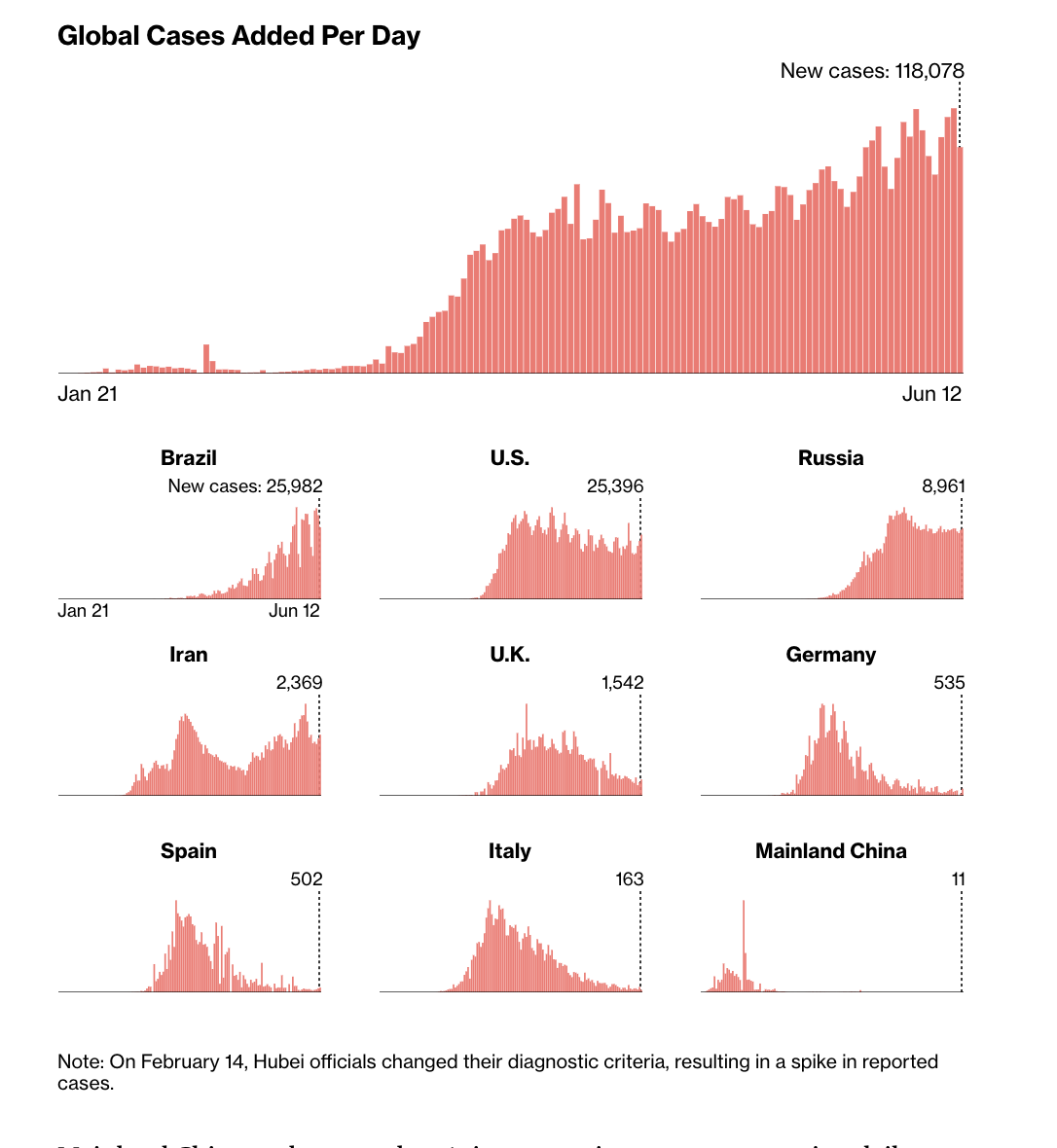
Source: BBG
In Europe, EU bureaucrats are already taking steps to secure supplies of still-untested vaccine prototypes as the global scramble to find a vaccine takes on an added urgency as thousands of politicians - including President Trump - find themselves making lofty promises about vaccine supplies that they might not be able to keep.
Bloomberg reports that the EU has signed a deal with AstraZeneca for the pharma giant to supply Europe with as many as 400 million doses of Oxford University’s experimental vaccine candidate - the subject of one of the most closely watched trials in the world - at no profit.
How generous!
In other vaccine news, Dr. Reddy’s Laboratories entered into a non-exclusive licensing agreement with Gilead to manufacture and sell its star experimental COVID-19 treatment remdesivir in 127 countries, including India, even though the verdict on its effectiveness remains elusive.
News of the deal comes as Germany reports 572 new coronavirus cases Saturday morning, its highest daily tally in weeks, bringing the German total to 187,263. That compares with 169 the previous day and almost 7,000 at the peak of the pandemic in late March.
Meanwhile, Russia reported 8,706 new confirmed infections, +1.7%, according to data from the government’s virus response center. Deaths rose by 114 to 6,829. Moscow accounted for 17% of new cases, and 34% of all new cases were asymptomatic. The country has more than 520k confirmed cases.
As we reported earlier, Beijing is locking down a large swath of the southwestern part of the capital city after an outbreak reportedly stemming from a major seafood market and wholesaler.
From: elaumann@oscargruss.com At: 06/13/20 18:58:52
To: lanreder@oscargruss.com, elaumann@oscargruss.comSubject: CGX CN – CINE LN – OG Risk Arb comments on CINE LN and CGX CN PRs regarding termination, litigation and seeking damages 6-13-20
DISCLAIMER This information represents neither an offer to buy or sell any security nor, because it does not take into account the differing needs of individual clients, investment advice. Those seeking investment advice specific to their financial profiles and goals should contact their Oscar Gruss & Son Incorporated sales representative. Oscar Gruss & Son Incorporated believes this information to be reliable, but no representation is made as to accuracy or completeness. This information does not analyze every material fact concerning a company, industry, or security. Oscar Gruss & Son Incorporated assumes that this information will be read in conjunction with other publicly available data. Matters discussed here are subject to change without notice. There can be no assurance that reliance on the information contained here will produce profitable results. A security denominated in a foreign currency is subject to fluctuations in currency exchange rates, which may have an adverse effect on the value of the security upon the conversion into local currency of dividends, interest, or sales proceeds. The value of securities and depositary receipts of foreign issuers that are denominated in United States dollars are also influenced by fluctuations in currency exchange rates. © 2020 Oscar Gruss & Son Incorporated. All rights reserved.
Eric K. Laumann
Head of North American Risk Arbitrage Research
Oscar Gruss & Son Incorporated
22 W. Washington Street, Suite 1500
Chicago, IL 60602
Ph: 212-419-4018