(ZH) "A Staggering Number": Over $18 Trillion In Global Stimulus In 2020, 21% Of

"A Staggering Number": Over $18 Trillion In Global Stimulus In 2020, 21% Of World GDP


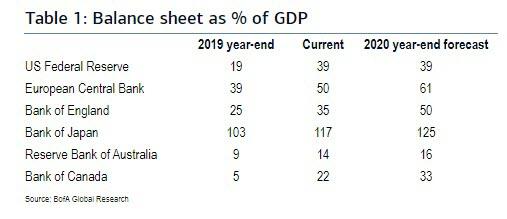
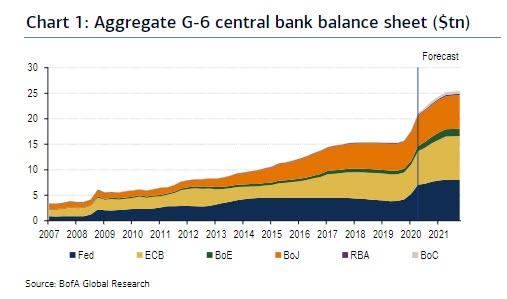
On Friday, we relayed the latest observations from BofA chief investment officer, Michael Hartnett who concluded that there is just one bull market to short - namely credit - "and the Fed won't let you" by which he means all central banks. As the following table shows, the balance sheet of the G-6 central banks has exploded, with the Fed's total asset expected to double in 2020 amid an avalanche of money printing.
And visually:

Of course, it's not just central banks: as Hartnett also explained there is also the 2020 fiscal bazooka which has a way to go, with the massive fiscal stimulus unleashed post-covid taking 3 forms in 2020: spending, credit guarantees, loans & equity.
Hartnett also noted that according to BIS data, US & Australia lead spending (>10% GDP), Europe is using aggressive credit guarantees (e.g. Italy 32% GDP), while Japan/Korea are stimulating via government loans/equity injections.
But the most staggering fact was when one puts it all together.
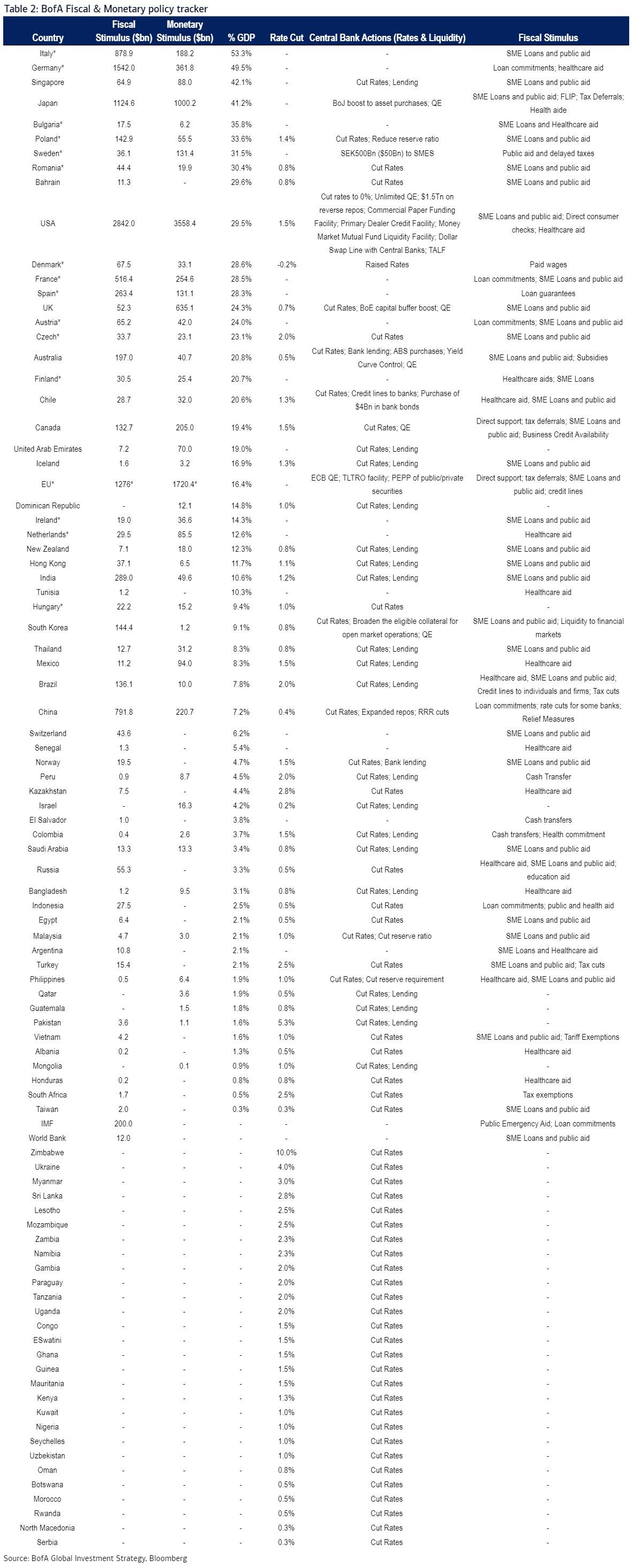
According to BofA calculations, in addition to the record 134 rate cuts YTD, the amount of total global stimulus, both fiscal and monetary, is now a "staggering" $18.4 trillion in 2020 consisting of $10.4 trillion in fiscal stimulus and $7.9tn in monetary stimulus - for a grand total of 20.8% of global GDP, injected mostly in just the past 3 months!
And to think none of this would have been possible if officials had not collectively decided to shutdown the global economy in response to the coronavirus pandemic.

For the interested, here is a full breakdown of all the fiscal and monetary stimulus as compiled by BofA:

FT : Millions of European jobs at risk when furlough support ends

Millions of European jobs at risk when furlough support ends
Governments face difficult choices over winding down their coronavirus employment protection schemes

Millions of workers on European employment protection schemes are at high risk of losing their jobs when support is withdrawn, highlighting the dilemma for governments as they extend or amend their public subsidies.

Employment subsidy programmes cover 45m jobs, or a third of the workforce, in Germany, France, Britain and Italy and Spain. They are credited with preventing Europe from suffering the type of catastrophic job losses that have hit the US since the coronavirus pandemic struck. 

Governments have mostly extended their schemes into the autumn, fearing that premature withdrawal of support could trigger mass job losses.

But as demand and output pick up, policymakers and analysts are weighing not only the vast public costs but also the risk that blanket subsidies could trap people in unviable “zombie” jobs and deter them from moving into sectors with better long-term prospects.

“Extending job protection will just postpone the problem,” said Katharina Utermöhl, senior economist at Allianz. A recent study by the insurer concluded that 9m jobs — or one-fifth of those enrolled in job protection schemes — were vulnerable because they were in sectors that would continue to struggle. These include tourism, travel, hospitality, retail and entertainment.

“It is really important to have other initiatives, such as active labour market policies,” Ms Utermöhl added.

While the OECD expects the eurozone unemployment rate to climb to 10 per cent by the end of June, this is still much lower than the US, where the jobless rate is forecast to reach 17.5 per cent by that time.

Job losses are far higher in the US, with more than 45m new claims for unemployment insurance filed since mid-March. Although hiring picked up in May, Heidi Shierholz, ex-chief economist at the US Department of Labor, calculated that more than one in five US workers are still either on unemployment benefits or waiting to receive them.

But the majority of newly jobless are temporary lay-offs and could be swiftly rehired, so the unemployment picture could look quite similar on both sides of the Atlantic by the end of the year, according to OECD forecasts.

US policymakers have chosen mostly to support workers with more generous unemployment insurance benefits — with a federal supplement of $600 to state benefit levels — which means about two-thirds of workers are better off on benefits.

They now face the same challenge as EU counterparts: how to phase out support without huge hardship and a surge in long-term unemployment. “We can’t turn off federal relief too early,” said Ms Shierholz. Support should be tapered only when unemployment fell or employment rose to an appropriate level, she added.

In Europe, meanwhile, trade unions and employers are demanding that governments extend job protection schemes. Many have done so for the next few months, in some cases with employers sharing more of the cost.

But no big European economy has said how it plans to target job subsidies in specific sectors, create new hiring incentives or set up mass reskilling programmes. Such measures will be needed — shifting support from keeping workers in existing jobs to helping them find new ones — to avoid either mass job-losses or zombie jobs, economists say.

The Spanish government is under particular pressure because its ERTE scheme runs out at the end of June. Talks of a three-month extension will resume this week with business and union organisations demanding a more generous approach from the government. Mindful of a rising public debt burden, ministers want employers to carry more of the cost.

Spanish officials say ERTE has worked, with 1m people returning to their jobs and bringing the total of employees covered down from 3.4m at the scheme’s peak to 2.4m. But, of the big European economies, Spain is likely to be hardest-hit by the jobs shakeout, with unemployment reaching 22 per cent by the end of September, according to OECD forecasts.

“It is very hard to know when to stop ERTEs,” said Toni Roldán, director of the Esade EcPol think-tank in Madrid. “It probably should be sector by sector. The most important thing there is flexibility, since companies know best the situation they are in.”

The UK has gone the furthest in tapering its job protection scheme. Although it will last until October, it is closed to new applicants and employers will progressively start sharing the costs from August, though employees will still receive 80 per cent of regular pay. Hard-hit sectors such as hospitality and tourism are to be treated the same as others.

The Allianz study found that the UK had the highest level of “zombie” employment at 7.6 per cent, or 2.5m jobs, suggesting mass job-losses to come. But the debate is now turning to how the government can support workers to find new roles — through retraining schemes, job guarantees for young people or direct job creation in state-funded infrastructure projects.

France has one of the most generous and extensive job support schemes, which the government says will cost €31bn over six months. Almost 9m people were covered in April but that fell to below 8m in May, according to labour ministry estimates. The scheme will run until September.

Germany’s Kurzarbeit, or short-time work scheme — described by the IMF as the “gold standard” of protection programmes — will last in its enhanced emergency format until the end of the year but a standard scheme could run for up to 24 months.

With Germany’s economy up and running, and with the government injecting a further €130bn stimulus into the economy, there are some concerns that Berlin may be doing too much.

“Now we are in a situation where most activity can resume, you don’t want to pay people for not working,” said Moritz Kuhn, professor of economics at the University of Bonn. “It just distorts labour demand for employers.”
>>> Barron’s Weekend Summary

Barron’s Weekend Summary: The widening wealth gap in the US threatens the sustainability of the stock market recovery; AAPL faces growing scrutiny of its App Store commissions

* Cover story: “The one-two punch of the worst health crisis and economic downturn in decades has brought to the fore an issue that has been simmering for decades: an increasing income and wealth disparity among Americans. This widening gap has long-term economic implications and threatens the sustainability of the stock market’s recovery”; Economic disparity creates deep divides, which increases political risk for investors and opens the door to potential tax and regulatory changes that can weigh on corporate earnings.

* Tech Trader: +/- AAPL: As the company prepares to hold the first-ever virtual version of its Worldwide Developers Conference, kicking off with a keynote speech on Monday by chief Tim Cook, there’s growing scrutiny of the 30 percent commission Apple charges for App Store sales, which have boomed during the coronavirus lockdown.

* Trader: There’s no doubt that the economy is getting better—retail sales rose by 17.7 percent in May from April, and the Conference Board Leading Economic Index gained 2.8 percent in May—but for a truly sustainable rally, improvements must keep coming; XBI, the SPRD S&P Biotech exchange traded fund, may be the best way to play the biotech trend—unlike IBB, the iShares Biotech ETF, it is equally weighted, so that smaller players are given greater heft than in the market-weighted iShares fund.

* Profile: Brian Campbell, co-manager of the Touchstone Mid Cap fund, and his peers at the fund’s subadvisor, the London Company, take significant long-term positions in midsize companies with high and growing returns on capital, pricing power that is improving over time, and strong balance sheets with flexibility to take on additional debt if needed (top 10 holdings: CTXS, ENTG, ODFL, SWKS, CPRT, CTAS, BKI, APH, KMX, AWI).

* Interview: Eddie Yoon, manager of the Fidelity Select Health Care Portfolio fund, discusses the outlook for the coronavirus pandemic and how investors should navigate investing in healthcare, one of America’s biggest sectors; he says that because many vaccine programs are being developed on industrial-scale vaccine platforms, he’s hopeful one will be available by this time next year.

* Features: 1) Most economic data are averages, which means that greater inequality—more wealth in the hands of the few—mathematically masks the real economic data that reveal the fragility of our system; wealth gaps make Federal Reserve policy less effective, and low-income borrowers can’t typically access ultralow rates, exacerbating inequality; 2) Fred Hickey, editor of the High Tech Strategist, says this is the second most expensive tech market, after the first Internet bubble, and he is skeptical of tech valuations—though as Barron’s notes, the issue for investors is that fundamentals don’t often apply to tech stocks; 3) Positive on BC: Boating stocks have lagged behind their recreational vehicle peers even though shares of outdoor-oriented companies are hot as consumers look for ways to vacation in the great outdoors, making this a good time to consider Brunswick, which is no longer a hodgepodge of leisure brands and is focused only on boats; 4) Positive on ROLL, WAB, EMR, AME: Barron’s found four industrial companies—two midsize and two large-cap—whose stocks look compelling because they are high-quality operations that should benefit from a cyclical recovery in the US and global economies, and can expect secular tailwinds for their businesses; 5) Positive on JPM, BAC, WFC, T, COF, PSA, PFF, FPF, JPI: Preferred shares, a sector dominated by large banks, have made a comeback since the stock market’s turmoil in March, and now offer attractive yields of about 5% from a range of issuers, making them a “compelling opportunity,” according to Douglas Baker of Nuveen.

* Follow-Up: NKLA, DKNG, and SPCE, which went public by merging with special-purpose acquisition companies instead of traditional initial public offerings, have cult followings and have seen their shares multiply several times over, a sign the model has won acceptance from investors, even if not every SPAC can achieve the same success.

* European Trader: Positive on Kinepolis Group: The cinema chain, one of Europe’s biggest and most profitable, is in a better position that most of its peers—it owns 53 of its sites and doesn’t have onerous rent bills, and has wider seating than rivals, giving it a better chance of rebounding when the pandemic subsides.

* Emerging Markets: Argentina looks on the verge of restructuring its ninth bond default in the two centuries since its independence—and investors should get ready for the tenth as the new left-leaning government and the Wall Street firms that lent its predecessor some $65B battle over a plan amid the coronavirus pandemic.

* Commodities: “Demand and prices for transportation fuels took a hit when it became apparent that Covid-19 would slow down travel, but gasoline, diesel, and jet fuel are set to establish their own paths toward recovery.”

* Streetwise: There are gathering signs of hope for coronavirus drugs—Geoffrey Porges of SVB Leerink, a doctor and analyst, is bullish REGN and GILD, but sees more upside for Gilead, which traded up on remdesivir hopes but has now settled back to 12 times earnings, a deep discount to the market.

>>> US Close Dow -0.80% S&P -0.56% Nasdaq +0.03% Russell -0.59%

Closing Stock Market Summary

The S&P 500 declined 0.6% on this quadruple-witching expiration Friday, as renewed concerns about a recovery and the coronavirus tempered the market's early enthusiasm. The Dow Jones Industrial Average lost 0.8%, and the Russell 2000 lost 0.6%. The Nasdaq Composite (+0.03%), however, eked out an incremental gain.  

Today's price action was relatively volatile. The S&P 500 gained as much as 1.3% shortly after the open but then declined as much as 1.0% into negative territory by the afternoon. The following coronavirus-related developments were attributed to the intraday decline:

Apple (AAPL 349.72, -2.01, -0.6%) will reportedly re-close some stores in four states due to COVID risks. Arizona, Florida, and California reported noticeable increases in daily coronavirus cases. Boston Fed President Rosengren said a second-half economic rebound will likely be slower than initially hoped due to the continued spread of the coronavirus.

The market closed off its lows, but most sectors still finished lower, including the S&P 500 utilities (-3.1%) and industrials (-1.7%) sectors at the bottom of the standings. The health care sector (+0.9%) was the lone sector in the green amid gains in its biotech components. The iShares NASDAQ Biotechnology ETF (IBB 137.85, +4.36) rose 3.3%.

CarMax (KMX 91.78, -6.13, -6.3%) was among the weakest performers in the S&P 500 after the company provided mixed earnings results. Shares initially traded higher after the company said sales have progressively improved since hitting a trough in early April.

U.S. Treasuries ended the session near their flat lines after trading lower in early action. The 2-yr yield and the 10-yield remained unchanged at 0.19% and 0.70%, respectively. The U.S. Dollar Index increased 0.3% to 97.67. WTI crude rose 2.5% (+$0.95) to $39.74/bbl. 

Friday's economic data was limited to the Current Account Balance for the first quarter, which narrowed to $104.2 billion (consensus -$99.8 billion) from $109.8 billion in the fourth quarter of 2019. Looking ahead, investors will receive the Existing Home Sales report for May on Monday.

  • Nasdaq Composite +10.9% YTD
  • S&P 500 -4.1% YTD
  • Dow Jones Industrial Average -9.4% YTD
  • Russell 2000 -15.0% YTD

Barrons : Nikola Stock Is Paying Off for ValueAct and Jeff Ubben

Nikola Stock Is Paying Off for ValueAct and Jeff Ubben

Sustainable investing requires patience and a fair bit of imagination.

Look at Jeff Ubben’s investment in upstart startup Nikola (ticker: NKLA), the fuel-cell and battery-powered truck maker that went public via a backdoor listing this month.

Ubben, chairman and founder of ValueAct, invested in the company when it was private through the ValueAct Spring Fund, a sustainability-focused fund launched in early 2018. The hedgie sits on Nikola’s board and owns an aggregate 5.6% stake through ValueAct.

So far, the investment appears to have paid off. Three months ago, he told CNBC that Nikola would be a $100 billion company. It’s already a quarter of the way there, thanks to a surge in the past two weeks.

Ubben and ValueAct did not respond to requests for comment.

Exuberance for Nikola isn’t complete. It’s the sixth-largest short among auto makers. Shorting is the act of borrowing a stock in a company and selling those shares, with the hope that the price will drop. Then it will be cheaper to buy the stock to return to the lender.

Nikola recently commanded a 243.6% borrow fee, as there aren’t enough shares to lend out to meet demand, according to data provider S3 Partners. And there’s reason to be skeptical: Nikola expects no sales this year, but hopes to top $1 billion in sales in 2023.

Belief is a powerful force. Just three years ago, Ubben told this reporter: “It’s going to take an activist” to make sustainable investing grow.

Ubben appears to be on the mark for now, but will Nikola hold up for the long haul?

Barrons : It’s Showtime for This European Cinema Chain’s Stock

It’s Showtime for This European Cinema Chain’s Stock

When the coronavirus pandemic subsides, some cinema chains will struggle to bounce back as they are faced with the economics of reduced capacity in a new socially distanced world.

Kinepolis Group (ticker: KIN.Belgium) is one of Europe’s biggest and most profitable chains, with 1,079 screens in Europe, Canada, and the U.S. across 111 sites.

It’s in a better position than most of its peers—it owns 53 of its sites, so it doesn’t have onerous rent bills, and 80% of its costs are variable. Kinepolis had good timing when investing, prior to the pandemic, in what it calls “cozy” seats that are wider and set apart from one another.

The Belgium-based company’s shares hit a peak of €59.70 euros last December, and over the past six months crashed 31%, to €39.35 ($44.74), as they ceased trading during the lockdown. But this could be an attractive entry point for a company considered the sector superstar. Analysts think the shares will recover fast.

Guy Sips, an analyst at Belgium broker KBC Securities, predicts that the shares could rise 44%, to €57.

Beatrice Allen at Berenberg has marked it a Buy with a €45 price target. She wrote in a June note that it’s a “unique entry point into a high-quality name,” and added in a March note that “Kinepolis has best-in-class profitability and cash flow generation compared with peers, thanks to its ownership of real estate.” Allen also hints at potential merger-and-acquisition opportunities.

Kinepolis was formed in 1997 as a result of the merger of two family-run cinema groups and was first listed on the Belgium stock exchange in 1998.

It is less dependent than most on what it takes in at the door (55.2% of sales) and from popcorn consumption (28.3%) because it has diversified into renting rooms to companies (11%), property management (2.5%), advertising (2.3%), and film distribution (0.6%).

It fetches 31.9 times this year’s expected earnings and is valued at a 60% discount to its peers. The firm has a market value of €1.1 billion and employs 4,600.

In February, the company posted a 14.7% increase in net profit to €54.4 million for 2019 on sales of €551.5 million.

CEO Eddy Duquenne tells Barron’s, “Our strategy has always been focused on combining a lower-than-average risk with a higher-than-average return.

“Our facts-and-figures-driven management style and cautious financial policy, combined with a solid real estate position, make us stand out from others while dealing with this crisis.”

In Europe, it has 55 complexes throughout Belgium, the Netherlands, France, Spain, Luxembourg, Switzerland, and Poland.

Following the acquisition of Landmark Cinemas, a Canadian cinema group and MJR, an American cinema chain, Kinepolis now also operates 46 cinemas in Canada and 10 in the U.S.

Cinemas are a risky short-term bet as consumers adjust to a new socially distanced world. The chains rely on a decent pipeline of Hollywood blockbusters to draw in fans, but the studios have postponed big-budget movies.

Some exhibitors have ignored the agreed 12-week window for cinema exclusivity to cash in on whatever deals are possible with streaming services.

“The fact that all blockbusters are being postponed proves the value of the theatrical window,” says Duquenne, adding that people will want to go to the cinema together, especially postpandemic. “Cinema will always be a social event. It’s a night out,” he says.

With new James Bond and Spiderman movies coming, investors may want to take a seat at Kinepolis because it could be lights, camera, action for the stock.