>>> Week End Press Summary

NEW YORK TIMES
Saturday
• The world has entered a “new and dangerous phase” of the coronavirus pandemic, according to the World Health Organization, as cases in the US cases spike sharply across the American South and West, particularly in states that loosened restrictions on businesses several weeks ago.
• The Department of Homeland Security deployed helicopters, airplanes, and drones over 15 cities where demonstrators gathered to protest the death of George Floyd, logging at least 270 hours of surveillance, far more than previously revealed.
• Geoffrey Berman, US attorney for the Southern District of New York, whose office has been at the forefront of corruption inquiries into Trump’s inner circle, refused to resign after attorney general William Barr tried to fire him, setting up a standoff over the independence of law enforcement and Trump’s purge of officials.
• Trump is expected to issue an executive order within days to temporarily suspend various work visas that businesses rely on to hire foreigners, sparking concern among universities and sectors spanning manufacturing, technology, and consulting about the potential fallout.
• In their effort to stamp out the latest coronavirus outbreak, leaders in Beijing are avoiding the heavy-handed restrictions they deployed in other regions earlier during the pandemic, opting instead for a more targeted approach to avoid taking the economy.
• International nuclear inspectors and the US accused Iran of hiding suspected nuclear activity, the first time in more than eight years that Tehran has been accused of obstructing inspections, paving the way for a new confrontation with Western powers.
• Trump said he will again attempt to end a program designed to protect young immigrants from deportation, one day after the Supreme Court ruled that his earlier efforts to do so were arbitrary and improper.
• Rising seas and climate change are transforming the classic 30-year mortgage—home buyers are increasingly using mortgages that allow them to stop making monthly payments and walk away from the loan if the home floods or becomes unsellable or unlivable.
• The Trump administration finalized a decision to not have the EPA impose any limits on perchlorate, a toxic chemical compound found in rocket fuel that contaminates water and has been linked to fetal and infant brain damage.
• Economists at research group Opportunity Insights estimate that the highest-earning quarter of Americans has been responsible for about half of the decline in consumption during this recession, affecting many lower-wage service workers on the other end of many of their transactions.
• Litigation finance, an esoteric, high-risk investment strategy, is attracting wealthy investors looking for outsize returns from coronavirus-related suits, like business interruption claims and lawsuits against landlords who do not fulfill their obligations to safeguard their buildings.
Sunday
• Trump on Saturday fired Geoffrey Berman, the federal prosecutor whose office put his former personal lawyer in prison and is investigating his current one, heightening criticism Trump is purging officials whose independence could be a threat to his re-election campaign.
• Trump’s attempt to revive his re-election campaign at a rally in Tulsa Saturday faltered—he found a far smaller crowd than his aides had promised and delivered a disjointed speech that didn’t address the multiple crises facing the nation or scandals battering him in Washington.
• Even as coronavirus deaths and infections soar in Latin America, efforts there to contain the crisis have been undermined by a litany of corruption scandals, including criminals selling flawed or useless masks, sanitizer, and ventilators and a collapsing hospital system.
• Nursing homes nationwide are kicking out old and disabled residents—among the people most susceptible to the coronavirus—and leaving them at homeless shelters, rundown motels, and other unsafe facilities to make room for more-profitable patients.
• In stark contrast to the US, a mix of social, demographic and epidemiological factors has kept unemployment down in Japan even as the coronavirus has damaged the country’s already weakened economy.
• A group of leading scientists is calling on a journal—Proceedings of the National Academy of Scientists—to retract a paper on the effectiveness of masks, saying the study has “egregious errors” and contains numerous “verifiably false” statements.
• China released a sweeping blueprint on Saturday to tighten its control over Hong Kong, revealing plans to establish a security agency in the territory to help Beijing extinguish challenges to its power after months of unrest.
• Joe Biden, whose campaign has long struggled to raise money, bypassed Trump in May for the first time, raising $80.8M together with the Democratic National Committee, about 10 percent more than the $74M Trump raised with the Republican Party.

WALL STREET JOURNAL
Weekend
• Front page story reports “US companies brought home $124B in foreign profits in the first quarter of 2020, the highest level since an immediate rush after the 2017 tax law, according to data released by the Commerce Department.”
• In the post-pandemic world, “more economic activity will be designated vital to national security, accelerating pressures on globalization that existed before Covid-19 arrived”—and governments that wall off segments of their economies could see higher costs and lower growth.
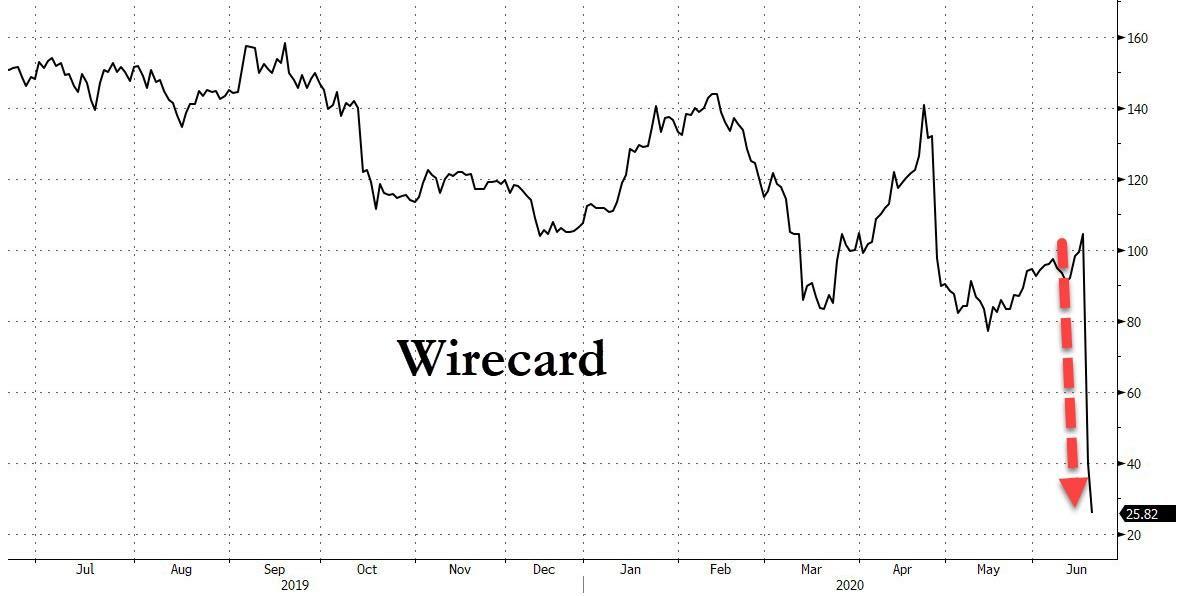
• Story reports on the events that led to the resignation of Markus Braun, the “self-styled visionary” behind Germany’s Wirecard—one of Europe’s highest-profile fintechs—who stepped down after auditors couldn’t locate €1.9B, raising serious questions about his legacy.
• The Internal Revenue Service has attempted to identify and track potential criminal suspects by purchasing access to a commercial database that records the locations of millions of American cellphones.
• Bowing to bipartisan pressure in Congress, the Trump administration said it would release the names of borrowers who received Paycheck Protection Program loans of $150,000 or more.
• As the coronavirus pandemic spreads from Europe and the US to the developing world, the age profile of its victims has changed—instead of the majority of casualties being older people, middle-aged people are increasingly dying in poorer countries.
• A deadly border skirmish between China and India this week illustrates how the increasingly forceful approach Chinese leader Xi Jinping has adopted in asserting territorial claims along its periphery can threaten the region’s stability.
• Airlines and airports that are getting ready for an increase in travel as lockdowns ease are partly blaming a standstill in international travel on governments for not lifting travel bans, quarantines, and other restrictions more quickly.
• +/- AAPL: With the number of people buying their first iPhone declining, the tech giant’s annual Worldwide Developers Conference, to be held remotely this week, will showcase how the company is diversifying so that it no longer has to rely so heavily on its signature product.
• + Samsung: The world’s largest smartphone maker is trying to jump-start lackluster sales of 5G handsets in the US, addressing the sticker shock that might have kept customers at bay by offering cheaper models that still have many in-demand features.
• A key Chinese index, the CSI 300, turned positive for the year according to FactSet, making it one of the few international stock benchmarks to show a gain for 2020, underlining the relative resilience of mainland shares.’
• H.O.T.S.: For some knowledge workers fleeing the big city amid the pandemic, the perks of relocating to distant cities offering cheaper housing and lower taxes will soon grow stale; KMX, which just had its worst quarter, faces a growing number of e-commerce upstarts seeking to take market share; So-called technical analysis, which seeks to predict the direction of stock prices based on charts, may be closer to the market than many people think.

FINANCIAL TIMES
• Officials in Australia say China is behind a sophisticated, state-sponsored cyber attack, launched over the course of many months and targeting government, business, education, and political organizations.
• The International Atomic Energy Agency has called on Iran to open two of its former nuclear sites to inspectors, a vote supported by France, Germany, and the UK but which Russian and China opposed.
• European Commission president Ursula van der Leyen faces pressure to overhaul the way Brussels wants to divide up the proceeds of the bloc’s multibillion-euro recovery fund after several countries’ leaders voiced complaints during a video summit.
• President Uhuru Kenyatta of Kenya said his country and others in Africa are in danger of being caught in the crossfire of the US-China rivalry, and called for international cooperation in the face of the coronavirus crisis.
• Big Read piece on retail says “The long queues at reopened shops suggest pent-up demand, but the impact of Covid-19 has been severe on an industry dependent on global supply chains, high levels of discretionary spending, and tourism.”
• Lex Column: Even before the pandemic, life expectancy had stalled in many rich countries, but some experts think longevity is now set to rise; Reputational and financial hits from scandals and profit warnings leave European asset manager GAM with an uphill struggle; ULTA is better equipped than many of its peers in the beauty sector to deal with the coming challenges.
• Comment: China’s recent border clash with India should be seen as a clarion call, says Michele Flournoy—“This is a moment that demands US leadership to convene and mobilize the region’s democracies.”

NEW YORK POST
Saturday
• After months of debate over costs, more than 130 New York City hotels have struck a deal with unions to impose strict sanitary standards to keep workers and guests safe from the coronavirus.
• - FB: Athletic clothing brand North Face became the first high-profile advertiser to announce a boycott of Facebook’s ad platform because of the site’s refusal to not flag Trump’s recent posts about the George Floyd protests.
Sunday
• New York state’s coronavirus metrics are “on the right path” as it prepares to reopen more businesses Monday— fewer than one percent of the tests administered came back positive for Covid-19 Saturday, part of a trend showing infection numbers shrinking over the past several days.
• Dr. Matteo Bassetti, head of the infectious diseases clinic at the San Martino hospital in Italy, believes the coronavirus has become less dangerous and could disappear on its own without a vaccine.
Reuters - Germany struggles to impose local lockdowns as coronavirus infections

Germany struggles to impose local lockdowns as coronavirus infections spike

FRANKFURT (Reuters) - Authorities in Germany’s Goettingen and North Rhine Westphalia regions have called on police to enforce quarantine measures following a rise in local coronavirus infections, which caused the country’s virus reproduction rate to spike.

Germany’s reproduction rate of novel coronavirus infections jumped to 1.79, the Robert Koch Institute (RKI) for public health said on Saturday, far above the level needed to contain it over the longer term.

The number of confirmed coronavirus cases in Germany increased by 687 to 189,822, data from the RKI showed on Sunday.

A riot broke out at a block of flats in Goettingen on Saturday where around 700 people had been placed into quarantine.

“Around 200 people tried to get out, but 500 people complied with quarantine rules,” Uwe Luehrig, head of police in Goettingen, said at a press conference on Sunday.

In the ensuing fracas, eight police officers were injured after residents started to attack law enforcement officials with bottles, fireworks and metal bars, Luehrig said.

Officials in North Rhine Westphalia forced 6,500 employees and their families to go into quarantine after more than 1,000 staff at German meat processing firm Toennies tested positive for coronavirus.

Armin Laschet, the premier of the state of North Rhine Westphalia called in consular officials from Poland, Bulgaria and Romania to mobilise translators to persuade workers at a local meat processing plant to observe a new lockdown.

“There are 1,300 properties where staff and their families live, and where we need to observe the quarantine rules,” Laschet said at a press conference on Sunday, explaining that local police and public order officials were helping out.

“We need to explain to people that if they are infected they should not seek to return to their home countries. Their best chance is to stay in Germany where they will get the best healthcare,” Laschet said.

(ZH) Meet The 29-Year Old Short Seller Who Made Millions On Wirecard's Downfall

Meet The 29-Year Old Short Seller Who Made Millions On Wirecard's Downfall

As the FT reporters who kept the pressure on Wirecard in the face of legal threats, covert hacks, aggressive surveillance and other intimidation tactics (Germany's financial regulator BaFin even launched an investigation into FT reporter Dan McCrum over allegations that he was "collaborating" with short sellers) pop the bubbly in celebration, a handful of prescient short-sellers who remained steadfast in the face of the company's aggressive defense are reaping tremendous profits.
The investing community is still trying to parse how the blatant fraud at Wirecard managed to escape their notice even in the face of intense scrutiny, both WSJ and the FT have published stories about the winners and losers on the buyside.
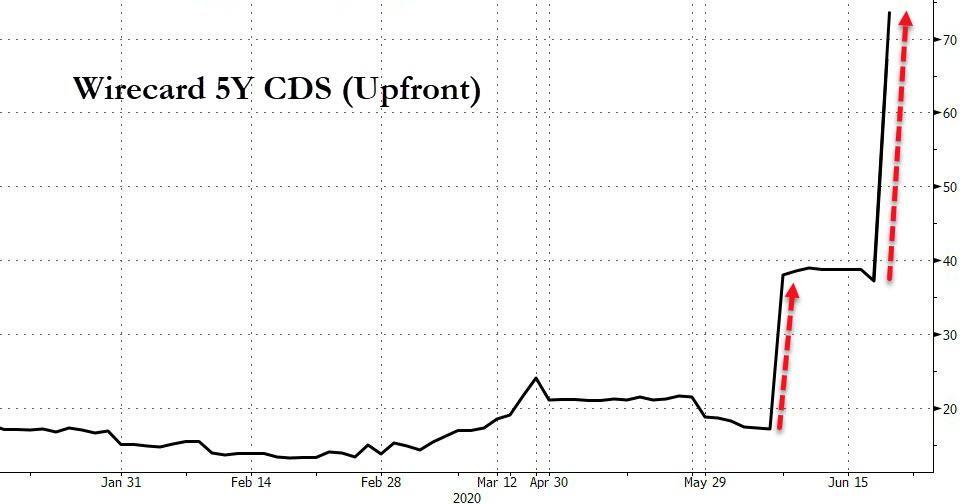
As we noted earlier today, the investors who made the 'real killing' on Wirecard's collapse are those who bought the insurance against its bonds. Shortsellers who bet directly against the stock, or loaded up on put options, still saw their gains capped (for shortsellers who are borrowing and selling the shares, their max return without leverage is 100% - borrowing costs). Holders of Wirecard CDS saw the spread blow out from just over 500bps (or 18 points up) two weeks ago to 8600bps, or roughly 73 points upfront, at the end of the week.

While we imagine at least some savvy retail traders also made a decent profit off any bets against Wirecard, the success of the CDS trade means mostly institutions probably benefited, and it even begs the question of whether more funds might start focusing on CDS spreads instead of trading equities during the coming months.
Still, WSJ calculated that the biggest hedge funds betting against Wirecard's stock (via shorts and via options) probably made a total of $1 billion between just a handful of firms.
One of those firms is Safkhet Capital Management, a boutique hedge fund based in New York that's run by Fahmi Quadir, a 29-year-old PM and one of the most promising female up-and-coming managers in the small but widely respected community of shortsellers.
Some funds that started betting against Wirecard more than a decade ago never made it to the payout (they were likely forced to fold when the German government explicitly backed Wirecard in its battle against the short sellers, a decision that looks extremely questionable in retrospect). Fortunately for Quadir, who had 25% of her fund's capital dedicated to a bet against Wirecard, she managed to get the timing just right.
The hedge fund PM, whose net worth is reportedly close to $100 million, reportedly made her bones in the industry with big bets against Valeant and Tesla that paid off when both those stocks crashed (though Tesla has since regained its footing in a big way).

Fahmi Quadir
Quadir launched her boutique fund in January 2018 to much fanfare after her research was publicly praised by storied short seller Marc Cohodes, according to Bloomberg.
Prior to this, she had been an analyst at Copper River Management, and an equity analyst for Krensavage Asset Management, a New York-based firm that makes long and short wagers on stocks, with a focus on health care.
According to public securities filings like its form ADV, Safkhet has somewhere between $25 million and $100 million in capital, qualifying it as a boutique. But with the Wirecard profits, her capital may well grow along with her reputation as wealthy investors look for more discerning managers who can generate better value now that gangs of Robinhood day traders are outperforming GSAM.

SCMP : Shock in Germany as hundreds run riot in Stuttgart

Shock in Germany as hundreds run riot in Stuttgart
  • Hundreds of partygoers ran riot, attacking police and plundering stores after a 17-year-old suspected of using drugs was apprehended soon after midnight
  • The scale of the violence overwhelmed the officers, forcing them to call in reinforcements from other parts of the state

German authorities expressed shock on Sunday over a rampage of an “unprecedented scale” overnight in the city centre of Stuttgart, where hundreds of partygoers ran riot, attacking police and plundering stores after smashing shop windows.
Two dozen people, half of them German nationals, were arrested provisionally, as police reported 19 colleagues hurt.
“They were unbelievable scenes that have left me speechless. In my 46 years of police service, I have never experienced this,” said Stuttgart police chief Frank Lutz.
Tensions built up soon after midnight when officers carried out checks on a 17-year-old German man suspected of using drugs, said Stuttgart deputy police chief Thomas Berger.

Crowds who were milling around at the city’s biggest square, the Schlossplatz, immediately rallied around the young man and began flinging stones and bottles at police.
The groups of mostly men also used sticks or poles to smash windows of police vehicles parked in the area.
“I sharply condemn this brutal outbreak of violence, these acts against people and things are criminal action that must be forcefully prosecuted and condemned,” Baden-Wuerttemberg state premier Winfried Kretschmann said in a statement.

At the height of the clashes, some 400 to 500 people joined in the battle against police officers and rescue workers.

As officers pushed back against the crowd, they broke up into small groups, carrying on their rampage around the city centre, smashing shop windows and looting stores along nearby Koenigstrasse, a major shopping street.
Videos posted on Twitter showed people breaking shop windows, leaving goods strewn on the streets.
A jewellery store was completely emptied and a mobile phone shop wrecked, according to regional broadcaster SWR.
In all, nine shops were looted while 14 others suffered damage such as broken windows.

As smaller scale clashes had already broken out downtown last week between police and groups of young people, officers had already bulked up their deployment overnight with an extra 100-strong team.
But the scale of the violence overwhelmed the officers, forcing them to call in reinforcements from other parts of the state.
Only four and a half hours later were they able to quell the violence that has been described as “civil war-like scenes” by Social Democrat regional MP Sascha Binder.
Police on Sunday ruled out any political motives for the rampage, describing the perpetrators as people from the “party scene or events scene”.

An unusually large number of people were in the city centre to enjoy the summer’s night because discos and clubs are still shut over he coronavirus pandemic, said Stuttgart mayor Fritz Kuhn.
Some of the rioters were charged up by alcohol, he said, adding that others may have been driven by “the addiction of putting a little film on social media.”
Asked about the nationalities of the 12 non-Germans who were detailed, Berger said they stemmed from a range of countries from Croatia and Portugal to Afghanistan and Somalia.
Calling the riots of “an unprecedented nature,” interior minister for the region Thomas Strobl vowed to “use all available means available under the rule of law to go after the rioters.”

SCMP : Coronavirus: recovered Chinese patients may be defenceless against foreig

Coronavirus: recovered Chinese patients may be defenceless against foreign mutation, study says
  • Antibodies found in blood of people who have fought disease failed to stop D614G, Chinese scientists say
  • Mutant form identified in genetic data of samples collected at Xinfadi food market in Beijing where latest outbreak began

Recovered Covid-19 patients in China may still be vulnerable to a mutant form of the pathogen spreading overseas, a new study says.
According to Professor Huang Ailong from Chongqing Medical University, there is an urgent need to determine what threat the mutation, known as D614G, poses to people who have recovered from a different form of the virus.
D614G began spreading in Europe in early February and by May was the dominant strain around the world, presenting in 70 per cent of sequenced samples in Europe and North America.
Antibodies found in patients who had been infected with earlier forms of the pathogen failed to neutralise the mutant strain, the scientists said in paper published on Biorxiv.org, a preprint website, which means it has not been peer-reviewed.
Since the latest coronavirus outbreak was reported at the Xinfadi wholesale food market in Beijing, 227 new infections have been confirmed and more than 2.3 million residents have been tested for Covid-19 in a bid to contain the spread.
Health authorities identified the infection in a number of locations at the market, including inside the mouths of imported salmon. The whole genome sequencing data of samples from the first three patients have been released and they all contained the D614G mutation.

Huang and his team selected a strain of the virus that had previously circulated in China and then manipulated it to create a man-made version containing the mutation.

They then extracted antibodies from 41 blood samples collected from recovered patients and pitched them against the mutant.
According to a report published last week by Scripps Research, a medical research facility in San Diego, the D614G mutation has the potential to increase the number of spike proteins on the coronavirus and boost its ability to infect human cells by a factor of 10.
However, that estimate was mostly based on computer modelling so questions remained over the possible increase in binding efficiency.
In the Chongqing study, the antibodies generated by three patients failed to suppress the mutated strain, with one sample showing almost zero effect.
The researchers then tried to infect host cells with the mutant and normal strains. The mutant’s entry efficiency was 2.4 times higher.
“This seemingly small increase in entry activity could cause a large difference in viral infectivity in the human body,” they said.

One of the concerns now is that the prevalence of D614G will have a detrimental impact on vaccine development.
Several Chinese vaccine candidates have entered the final phase of clinical trials, but they are based – like those under development in the United States and Europe – on the earliest strains of the coronavirus detected and sequenced in Wuhan.
A study by IBM’s AI medical team in April warned that the D614G mutation could reduce the effectiveness of vaccine programmes that target the virus’ spike protein. A separate study by a team of researchers in Serbia last month came to a similar conclusion.
“Given the evolving nature of the SARS-CoV-2 RNA genome, antibody treatment and vaccine design might require further consideration to accommodate the D614G and other mutations that may affect the immunogenicity of the virus,” Huang said.
About 10 per cent of the people infected by the new outbreak in Beijing are in a critical condition, according to the city’s health authorities, and medical teams from across the country have been flown into to help with the aid effort.
The Chinese government and the World Health Organisation have both said the genetic information of the virus points to a source outside China, but whether it arrived via a refrigerated food chain or a human visitor has yet to be determined.

WSJ : Huawei’s 5G Dominance Threatened by U.S. Policy on Chips

Huawei’s 5G Dominance Threatened by U.S. Policy on Chips
Commerce Department ban prevents Chinese tech giant from using many of its own designed components needed for 5G rollout

HONG KONG—When Huawei Technologies Co. was banned last year from buying American parts, the Chinese tech giant had a workaround: make greater use of its own chips.

That strategy is in jeopardy after the Commerce Department last month restricted chip makers globally who use U.S. technology from supplying semiconductors to Huawei, a rule that covers virtually all builders of high-end chips.

Huawei faces the prospect of losing dozens of critical components that go into 5G base stations, according to a teardown of a Huawei-made base station by California-based research firm EJL Wireless Research. Base stations are a set of boxes that are typically mounted on towers or buildings and connect cellphones to a wireless network.

The latest rule, many analysts say, throws a wrench in Huawei’s ability to lead the global race for dominance in 5G, the next generation of superfast wireless networks. The Chinese company has said the new restrictions will disrupt the rollout, maintenance and operations of telecom networks world-wide, though it remains unclear whether the U.S. policy will change or if Huawei will be able to find new workarounds.


Components at risk, EJL’s analysis shows, include parts like radio-interface chips. These link different parts of the base station and were likely developed by Huawei to substitute for a similar line made by U.S. vendors Xilinx Inc. and Intel Corp. Another example: Huawei-designed chips that transform analog signals into digital signals and back, which replaced chips from American companies such Texas Instruments Inc. and Analog Devices Inc., according to EJL.

The U.S. rule hurts Huawei because while the Chinese company can design world-class chips, it doesn’t have the capability to build them. The latest measure takes a “surgical approach,” Undersecretary of State Keith Krach said in an interview earlier this month.

“We’ve utilized the strengths of semiconductor-equipment companies and electronic-design software companies to eliminate Huawei’s access to the necessary, sophisticated chips to build 5G systems and their most sophisticated smartphones,” Mr. Krach said.

U.S. officials have called Huawei equipment a security threat, telling allies that the company could enable the Chinese government to spy through its networks. Huawei denies such claims.

Huawei, the world’s largest maker of telecom equipment, relies on a handful of specialized chip manufacturers who make extensive use of U.S. technology in the process—most notably Taiwan Semiconductor Manufacturing Co., widely seen as the world’s leader in chip manufacturing.

Without access to the Taiwanese firm, it’s not clear how Huawei can procure such chips from other manufacturers, also called “foundries.”

“Those things, I don’t think, could be made in a foundry in China right now,” said Earl Lum, president of EJL and a longtime wireless-industry analyst. “Which means, you don’t have a 5G base station.”

A spokeswoman for Taiwan Semiconductor Manufacturing said the company is working with outside counsel to analyze the new rule. During the company’s annual general meeting earlier this month, Chairman Mark Liu said the rule might affect its business, but “I believe that we will still have a high market share in this field.”

A Huawei spokesman said last week that the company was reviewing the potential impact of the new restrictions and declined to comment further. The company has previously said the rule will affect the expansion and maintenance of networks globally.

Huawei hasn’t disclosed the quantity of chips it has in inventory. Pierre Ferragu, an analyst at New Street Research, estimates the Chinese company has less than 12 months in stockpile of its most advanced telecom-equipment chips covered by the new rule.

To be sure, legal experts say the Commerce Department’s move could allow for affected chip manufacturers to continue building chips for Huawei—for example, by sending the chips to third parties, instead of to Huawei, for assembly and distribution.

U.S. officials could grant licenses to chip builders using American technology to supply Huawei, and companies have a 120-day grace period to deliver chips ordered before May 15.

In its teardown, EJL disassembled a 5G base station manufactured by Huawei in June 2019. The teardown consisted of the base station’s “active antenna unit,” a 90-pound white box that is typically mounted atop a cellular tower and communicates with a user’s smartphone.

The device made heavy use of U.S. components. Although the base station was made after Huawei’s May 2019 blacklisting, the company had an extensive stockpile of American parts, which likely went into the device, Mr. Lum said.

To determine which U.S. components Huawei replaced with self-developed parts, EJL’s research relied on industry contacts and an analysis of the telecom-supply chain, and it is possible that the actual contents of Huawei’s recently built base stations are different.

Huawei has made enormous leaps in the design of its chips in recent years. Yet building advanced chips requires highly specialized tools, with the most advanced capable of slicing transistors just five nanometers in size. Taiwan Semiconductor Manufacturing is one of just a few chip makers capable of such a feat, analysts said, though U.S. companies are the dominant makers of chip-manufacturing tools themselves.

One alternative manufacturer for some Huawei-designed chips is Shanghai-based Semiconductor Manufacturing International Corp., a chip maker that received another $2.2 billion dollars in state investment after the new Commerce Department rule.

However, analysts say the company is years behind its Taiwanese rival in terms of manufacturing prowess and still reliant on U.S. technology: Goldman Sachs predicts the Shanghai-based company’s revenue from Huawei to fall to zero by the fourth quarter from 19% currently.

The company didn’t respond to requests for comment.

FT : China to set up powerful security agency in Hong Kong

China to set up powerful security agency in Hong Kong
Beijing’s determination to press ahead puts it on a collision course with US and UK

Beijing will establish a powerful national security agency in Hong Kong as China’s parliament rushes to pass a controversial new law by the end of this month.

The official Xinhua news agency reported on Sunday that the Standing Committee of the National People’s Congress will convene a special session on June 28, at which it is expected to impose a new national security law on Hong Kong.

On Saturday, Xinhua reported that the law will authorise the new agency to carry out national security work in Hong Kong. It will also have jurisdiction over “a very small number of crimes that endanger national security under certain circumstances”, Xinhua added, without providing further details.

China’s parliament, which is finalising a draft of the new legislation, had previously said it would enable state security organs to operate in Hong Kong. But confirmation that a powerful new agency would be established will exacerbate concerns about the law.

“Beijing’s hand is grabbing the administrative and judicial reins of Hong Kong,” said pro-democracy lawmaker Alvin Yeung. The continuing lack of details when it came to specific criminal actions was “extremely worrying”, he said.

Chinese and Hong Kong officials have argued that such concerns are unwarranted as the vast majority of cases under the new law would be adjudicated by local courts in accordance with common law principles.

According to Xinhua, giving the agency jurisdiction over certain crimes was necessary to prevent a situation where China might be forced to declare a state of emergency in Hong Kong, as it can do under Article 18 of the Basic Law, the territory’s mini-constitution. The new national security law, Xinhua added, will trump any existing local laws that are “inconsistent” with its provisions.

Beijing will also appoint a representative to a national security committee headed by Hong Kong’s chief executive.

Chinese officials argue that the eruption of large pro-democracy protests last year, which often led to violent clashes with police and widespread disruption, have brought Hong Kong to the brink of such an emergency.

Beijing’s determination to press ahead with the law puts it on a collision course with the US and UK, and could spark an upsurge of protests in the largely autonomous Chinese territory.

According to Xinhua, Hong Kong’s chief executive will also determine which judges in the territory will be allowed to preside over national security cases - a departure from current practice of letting the judiciary determine trial assignments.

The new details were released just one month after the National People’s Congress shocked Hong Kong’s 7.4m residents and the international community with the news it intended to draft the legislation.

Last month Donald Trump, US president, threatened to rescind economic and trade privileges Hong Kong enjoys with the US if the national security law was passed, on the grounds that it would fatally undermine the “one country, two systems” arrangement that is supposed to guarantee the former British colony’s wide-ranging autonomy until 2047.

Boris Johnson, UK prime minister, has also threatened repercussions, saying he is prepared to offer a pathway to citizenship for as many as 3m Hong Kong residents who either hold or are eligible to apply for British National (Overseas) passports.

President Xi Jinping’s administration, which blames US and British “interference” for the pro-democracy protest movement in Hong Kong, has said it will take unspecified countermeasures against both countries if they follow through on their threats.

“China’s determination to push for a national security law in Hong Kong is unshakeable,” Yang Jiechi, Mr Xi’s top foreign affairs official, told Mike Pompeo, US secretary of state, at a meeting on Wednesday in Hawaii. “China resolutely opposes US interference in Hong Kong affairs.”

The NPC’s announcement is likely to spur protests in the territory, despite concerns over Covid-19. Large demonstrations are planned for July 1, the 23rd anniversary of China’s resumption of sovereignty over Hong Kong. The territory’s pro-democracy camp has held a large protest march on the anniversary every year since 2003, when an estimated 500,000 people gathered to oppose national security legislation that was later abandoned.

Hong Kong’s government has not tried to pass a national security law since, which Beijing said left it no choice but to act unilaterally. 

In June last year, mass rallies against a controversial extradition bill that would have allowed Hong Kong residents to be sent to China for trial on certain charges attracted crowds of as many as 2m people.

(Oilprice.com) Is US Oil Dominance Coming To An End?

Is US Oil Dominance Coming To An End?

  • U.S.’ energy dominance agenda is dead as the country’s shale industry is looking at a steep production decline.
  • The U.S. tight oil or shale rig count has fallen 69% this year from 539 in mid-March to 165 last week.
  • U.S. oil import dependence is set to grow in the next couple of years.
U.S. energy dominance is over. Output is probably going to drop by 50% over the next year and nothing can be done about it. It has nothing to do with the lack of shale profitability or other silly memes cited by people who don’t understand energy.

It’s because of low rig count.
The U.S. tight oil or shale rig count has fallen 69% this year from 539 in mid-March to 165 last week. Tight oil production will decline 50% by this time next year. As a result, U.S. oil production will fall from to less than 8 mmb/d by mid-2021.
What if rig count increases between now and then? It won’t make any difference because of the lag between contracting a drilling rig and first production.
The party is over for shale and U.S. energy dominance.
Energy Dominance is Over
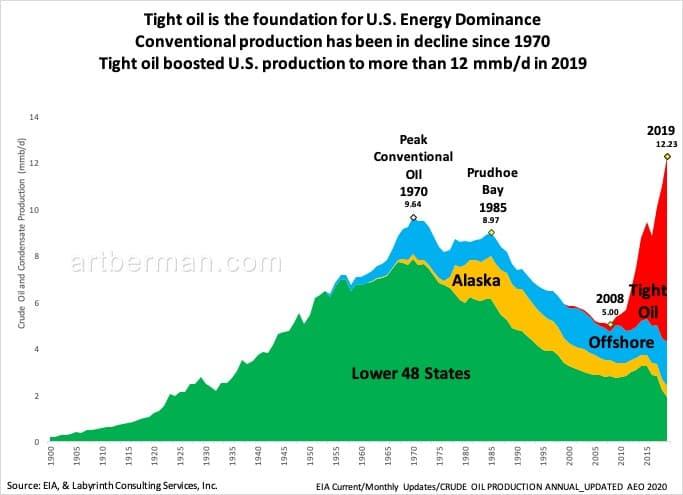
Tight oil is the foundation of U.S. energy dominance. The U.S. has always been a major oil producer but it moved into the top tier of oil super powers as tight oil boosted output from about 5 to more than 12 mmb/d between 2008 and 2019 (Figure 1).

Conventional production has been declining since 1970. It fell from almost 10 mmb/d in 1970 to 5 mmb/d in 2008.
Figure 1. Tight oil is the foundation for U.S. Energy Dominance.
Conventional production has been in decline since 1970. Tight oil boosted U.S. production to more than 12 mmb/d in 2019.
Source: EIA and Labyrinth Consulting Services, Inc.
Tight Oil Rig Count and Oil Production
Rig count is a good way to predict future oil production as long as the proper leads and lags are incorporated.
It takes several months between an upward price signal and a signed contract for a drilling rig. It takes another 9-12 months from starting a well to first production for tight oil wells. With pad drilling, usually all wells on the pad must be drilled before bringing in a crew to frack the wells.
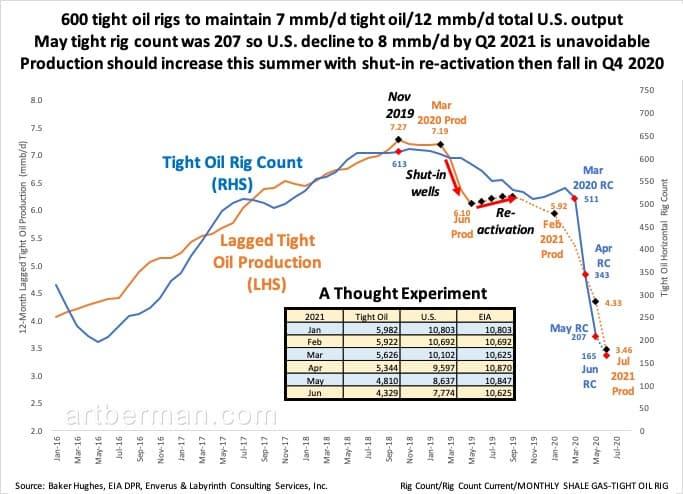
Tight oil horizontal production reached 7.28 mmb/d in November 2019 when the lagged rig count was 613 (Figure 2). That corresponded to 12.9 mmb/d of U.S. oil production—tight oil is about 55% of total output. Approximately 600 rigs are needed to maintain 7 mmb/d of tight oil and 12.5 mmb/d of U.S. production.
The horizontal rig count is now 165 so it is unavoidable that production will fall. The considerable lags and leads mean that production decline cannot be expected to reverse until well into 2021 assuming that it starts to increase immediately. That won’t happen because of constrained budgets and low oil prices.
Figure 2. 600 tight oil rigs to maintain 7 mmb/d tight oil/12 mmb/d total U.S. output.
May tight rig count was 207 so U.S. decline to 8 mmb/d by Q2 2021 is unavoidable. Production should increase this summer with shut-in re-activation then fall in Q4 2020.
Source: Baker Hughes, IEA DPR, Enverus and Labyrinth Consulting Services, Inc.
U.S. producers shut in most of their wells in May because oil prices had collapsed and storage had reached its limits. Tight oil production has fallen more than 1 mmb/d to 6.2 mmb/d and total U.S. output is around 10.5 mmb/d.
With the storage crisis now apparently averted and with somewhat higher oil prices, most tight oil wells are being re-activated. Production should increase until all shut-in wells are back on line and then, it will resume its decline.
Based on rig count analysis, U.S. oil production will probably be about 8 mmb/d by mid-2021 or more than 4 mmb/d less than peak November 2019 levels.
Killer Decline Rates Require Lots of Rigs
Lower U.S. crude and condensate production is unavoidable with rig counts where they are today. That is because tight oil decline rates are really high.
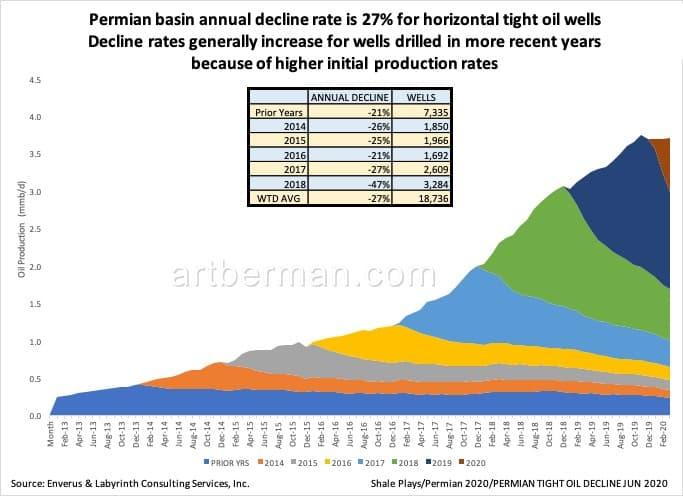
Figure 3 shows Permian basin shale play decline rates by year of first production. The average of all years is 27% per year. More recently drilled wells decline at higher rates because of better drilling and completion technology. The problem is that the wells don’t have greater reserves—they just produce the reserves faster. That means higher decline rates.
Figure 3. Permian basin annual decline rate is 27% for horizontal tight oil wells
Decline rates generally increase for wells drilled in more recent years because of higher initial production rates.
Source: Enverus and Labyrinth Consulting Services, Inc.
This is not a criticism of the plays or the companies. It’s just a fact.
And that’s why it’s critical to keep 500 or 600 rigs drilling all the time—to replace the 30% of output lost every year to depletion.
Production can be turned off and on as it was in May and June. Production cannot be increased without adding rigs and drilling new wells. Assuming there was infinite capital available to add rigs and drill wells, it would take several years to increase rig count to levels needed to maintain 2019 output levels.
Drilled, uncompleted wells (DUC) may be brought on to slow the rate of production decline somewhat. It is important to note, however, that completion accounts for at least 50% of total well cost. Capital constraints and low oil prices will affect the ability and enthusiasm of companies to complete DUCs.
After the last oil-price collapse, it took 2.5 years for tight oil rig count to increase from 193 in May 2016 to 618 in November 2018 (Figure 3). There were thousands of DUCs during the last oil-price collapse in 2014-2017 but they didn’t have much effect on production decline.
The current June rig count of 165 will continue to fall for several months because of low oil price & capital budgets.
Figure 4. It took 2.5 years for tight oil rig count to increase from 193 in May 2016 to 618 in November 2018.
June rig count of 165 will fall for several months based on oil price & capital budgets.
Source: Baker Hughes, IEA DPR, Enverus and Labyrinth Consulting Services, Inc.
Rigs Don’t Produce Oil, Wells Do
I’ve shown how rig count, lagged production and decline rates are used to estimate future levels of production. That approach is useful but the truth is that rigs don’t produce oil—wells do.
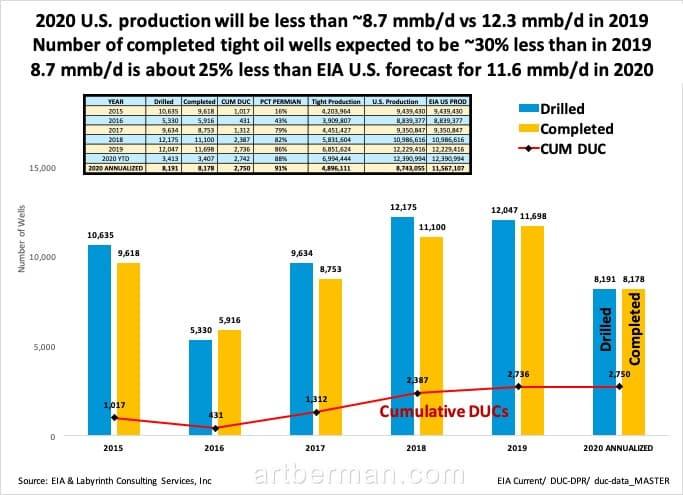
Another approach, therefore, is to compare the number of tight oil wells that were drilled and completed during each of the last 5 years to the corresponding average production rates for each of those years. Then, using year-to-date drilling and completion data, we can annualize and project what 2020 production is likely to be.
This approach suggests that 2020 tight oil production will be about 30% less than in 2019 (Figure 4). Since tight oil represented 56% of total U.S. output in 2019, we may then estimate that U.S. production will average about 8.7 mmb/d in 2020.
Figure 5. 2020 U.S. production will be less than ~8.7 mmb/d vs 12.3 mmb/d in 2019.
Number of completed tight oil wells expected to be ~30% less than in 2019. 8.7 mmb/d is about 25% less than EIA U.S. forecast for 11.6 mmb/d in 2020.
Source: EIA and Labyrinth Consulting Services, Inc.
That is similar to the estimate obtained from the rig count approach. It is, however, about 25% less than EIA’s 2020 forecast for U.S. crude & condensate production.
Energy Dominance and Green Paint
Much lower U.S. oil production is bad for Trump’s Energy Dominance anthem and its corollary that the U.S. is energy independent. It’s even worse for oil prices and the U.S. balance of payments once demand recovers. We will have to import even more oil than we do today and it will cost more.
The idea of U.S. energy independence is ignorant at best and fraudulent at worst. The U.S. imported nearly 7 mmb/d of crude oil and condensate in 2019 and more than 9 mmb/d of crude oil and refined products. That’s almost as much as China—the world’s second largest economy—consumes.
The U.S. is a net exporter in the same way that shale companies are making huge profits—by accounting sleight-of-hand.
The U.S. imports other people’s crude oil, refines it and then, exports it. If a country imports unpainted cars, paints them green and then exports them, is it a net exporter of cars? No. It’s an exporter of green paint.
The U.S. is screwed when it comes to near- to medium-term oil production. It’s not because of Covid-19. U.S. rig count began to decline 15 months before anyone had heard of Covid-19. Even if the road to economic and oil-demand recovery is faster than I believe it will be, it will take a long time to get back to 12 or 13 million barrels per day of production.
There are good reasons to expect that much lower U.S. oil production will eventually lead to higher oil prices. That may result in renewed drilling and another cycle of over-supply and lower oil prices. That is how things have developed in the past.
But a new phase of economic reality and oil pricing is unfolding and no one knows where it will lead. Lower demand may mean that reduced U.S. oil output is appropriate. The only thing that seems certain is that the U.S. will not be the oil super power it was before 2020.