After Hours Summary: APYX +44% gains on approval to market Helium Plasma Technology products in new countries; CSTL -5% declines on stock offeringAfter Hours Gainers:
Companies trading higher in after hours in reaction to earnings/guidance: N/A
Companies trading higher in after hours in reaction to news: APYX +43.7% (received clearance to sell Helium Plasma Technology products in five new countries), GO +7.5% ( to join S&P MidCap 400), SCVL +6.7% (provided store re-opening update; Q2 comp sales are up +28.1% yr/yr second quarter-to-date), NRZ +5.5% (raised quarterly common stock dividend), MYOV +4.5% (to host call to discuss Phase 3 SPIRIT 1 results), ALLO +3.8% (lightly traded; presented preclinical findings supporting DLL3-target AlloCAR T therapy in SCLC), EAT +2.3% (to join S&P SmallCap 600)
After Hours Losers:
Companies trading lower in after hours in reaction to earnings/guidance: N/A
Companies trading lower in after hours in reaction to news: CSTL -4.5% (commenced public offering of 1.5 mln common shares), LIQT -4.5% (lightly traded; filed for 1.6 mln share common stock offering by holders), SPR -4.4% (Boeing [BA] directed co to reduce 2020 B737 shipset production plan), BRP -3.6% (announced follow-on offering of 11.5 mln shares of Class A common stock), ONEM -3.2% (announced secondary offering of 7.0 mln common shares by selling shareholders), TMUS -1.6% (commenced public securities offerings in connection with Softbank's [SFTBY] stake monetization), CAKE -1.1% (filed for secondary stock offering)
Closing Stock Market SummaryThe S&P 500 gained 0.7% on Monday, but it was the Nasdaq Composite (+1.1%) that continued to steal the spotlight. The tech-sensitive index closed at another record high and rose for the seventh straight day amid strength in the mega-cap technology stocks. The Dow Jones Average increased 0.6%, and the Russell 2000 increased 1.1%.
Notably, Apple (AAPL 358.87, +9.15, +2.6%) and Microsoft (MSFT 200.57, +5.42, +2.8%) gained more than 2.5%, hit fresh all-time highs, and boosted the top-weighted S&P 500 information technology sector (+1.9%) to the top spot today. The utilities sector (+1.3%) followed suit, while the health care (-0.4%) and financials (-0.5%) sectors lagged.
Apple received a lot of attention today due to its annual Worldwide Developers Conference, although most of the stock's gains came prior to the widely-watched event. On a related note, Cowen raised its price target on AAPL to $400 from $335 before the open. Microsoft and other tech giants rose on no specific news catalysts.
As for the coronavirus situation, the U.S. exceeded 30,000 new cases on Saturday for its highest daily level since May, but some of the hotspots in the country did report a lower count on Sunday. Vice President Pence also called attention to the increasing rate of infections among younger people, according to ABC News.
In other developments, Nike (NKE 99.51, +3.73, +3.9%) received a price target increase to $112 from $96 at Piper Sandler, American Airlines (AAL 14.92, -1.08, -6.8%) announced plans to raise $3.5 billion in capital through stock and bond sales, and Virgin Galactic (SPCE 17.39, +2.39, +15.9%) partnered with NASA for a private orbital astronaut readiness program.
U.S. Treasuries finished little changed after starting the session with small gains. The 2-yr yield was unchanged at 0.19%, and the 10-yr yield increased one basis point to 0.71%. The U.S. Dollar Index declined 0.6% to 97.09. WTI crude futures rose 2.2%, or $0.86, to $40.60/bbl.
Monday's economic data was limited to the Existing Home Sales report for May:
- Existing home sales declined 9.7% m/m in May to a seasonally adjusted annual rate of 3.91 million (consensus 3.98 million). May marked the third straight month of a decline in sales.
- The key takeaway from the report is that closed sales in May reflect most contract signings completed in March and April, which is when the brunt of the COVID-19 shutdown effects were felt. Accordingly, the disappointment over weak sales in May should be mitigated by a belief that coming months will feature stronger sales activity.
Looking ahead, investors will receive the New Home Sales report for May on Tuesday.
- Nasdaq Composite +1.1% YTD
- S&P 500 -3.5% YTD
- Dow Jones Industrial Average -8.8% YTD
- Russell 2000 -14.1% YTD
Announces proposed public securities offerings in connection with SoftBank’s Monetization of a Portion of Its Shareholding in T-Mobile
Announced the commencement of the public securities transactions described below, subject to market and other factors, in connection with SoftBank’s monetization of a portion of its shareholding in T-Mobile. For every share of common stock sold by T-Mobile in the public securities transactions, T-Mobile has agreed to repurchase one share of common stock from a subsidiary of SoftBank at a price per share equivalent to that received by T-Mobile in its sales. Consequently, the public securities transactions will not involve gain or loss to T-Mobile and will not affect the number of outstanding shares of T-Mobile common stock or T-Mobile’s capitalization.
- T-Mobile announced the commencement of a registered public offering of 133,548,303 shares of its common stock (the “Public Equity Offering”). T-Mobile intends to grant the underwriters of the Public Equity Offering the option to purchase up to an additional 10,016,123 shares of its common stock.
- T-Mobile announced the expected distribution, on June 26, 2020, on a pro rata basis to the record holders of T-Mobile’s common stock as of 5:00 p.m., Eastern Time, on June 25, 2020 (the “Record Date”), of registered, transferable subscription rights (“Rights”) to purchase 0.05 shares of our common stock for up to 19,750,000 shares of T-Mobile’s common stock (the “Rights Offering” and, together with the Public Equity Offering, the “Public Offerings”). These rights would entitle the holders thereof, other than Deutsche Telekom, SoftBank and Marcelo Claure and their affiliates (who have agreed to waive their ability to exercise or transfer Rights), to subscribe for our common stock at the per-share price to the public in the Public Equity Offering. As the Record Date is expected to be prior to the closing date of the Public Equity Offering, none of the investors who purchase shares in the Public Equity Offering will receive Rights. The rights are expected to be listed, and trading is expected to commence, on the NASDAQ Global Select Market effective June 24, 2020.
In addition, today T-Mobile concurrently announced its intention to sell up to 30,000,000 shares of its common stock to a Delaware statutory trust (the “Trust”) and the intention of the Trust to offer its cash mandatory exchangeable trust securities (the “Trust Securities”) in a private offering exempt from registration under the Securities Act (the “Private Offering” and, together with the Public Offerings, the “Offerings”). This press release is not an offer to sell or purchase, or a solicitation of an offer to sell or purchase, the Trust Securities. Related
Swile, le challenger du titre restaurant lève 70 millions d'euros
La start-up tricolore (ex-Lunchr) active depuis janvier 2018 traite déjà un volume de 400 millions d'euros, soit 7 % du marché du titre restaurant. Elle élargit son offre aux titres cadeaux et ambitionne de devenir l'appli de référence pour la vie des employés en entreprise.
L'ascension est fulgurante. Moins de trois ans après son lancement , la start-up Swile (ex-Lunchr) a déjà conquis 8.000 entreprises, gère au quotidien les titres de restauration de 210.000 employés, et traite un volume d'émission de 400 millions d'euros. Des résultats qui lui permettent de prendre quasiment 7 % d'un marché jusque-là verrouillé, notamment par les quatre grands acteurs du secteur (Endered, Sodexo, Up et Natixis), condamnés en décembre dernier à verser une amende de 415 millions d'euros pour entente (appel non suspensif en cours). Mais aussi de continuer à convaincre les investisseurs qui viennent de lui confier 70 millions d'euros, dont une petite partie sous forme de dette.
Index, bpifrance et Idinvest se sont associés sur ce nouveau tour de financement qui révèle surtout les nouvelles ambitions de Swile. Au-delà du titre restaurant, la jeune pousse veut élargir son champ d'action et s'installer sur le marché en plein boom du « bien vivre ensemble » au sein de l'entreprise. « Cette application sera centrée autour de l'expérience employé et lui donnera notamment la possibilité de gérer tous ses avantages et sa vie quotidienne au travail », explique Loïc Soubeyrand, PDG et fondateur de Swile.
Cadeaux, mobilité, les nouveaux horizons
Dès cette semaine, les titres cadeaux devraient être disponibles pour les salariés dont les entreprises participent au programme. Ils pourront ainsi dépenser ces avantages via la même carte de paiement qu'ils utilisent pour manger, ou via l'application. D'ici à la fin de l'année, les titres mobilité devraient suivre. Dans le cadre de la loi LOM , les sociétés peuvent en effet donner jusqu'à 400 euros à leurs employés pour qu'ils financent des modes de transport alternatifs.
« Nous poussons Swile sur tous leurs nouveaux services », assure Franck Ferron, responsable juridique et social chez Sodiaal. Avec ses 3.200 salariés équipés de la carte de titre restaurant, la première coopérative laitière de France est l'un des plus gros clients de la jeune pousse, qui sait désormais convaincre les grands groupes de basculer vers ses services. « Swile, c'est le Free du titre restaurant, clame Franck Ferron. Ses services sont moins chers, il apporte de l'innovation et a su rapidement résoudre les problèmes que l'on a rencontrés. »
Ouverture du marché brésilien
Pour couvrir la palette des avantages aux employés, Swile aimerait également proposer le traitement des titres vacances. Mais le timing n'est pas encore le bon, puisque le gouvernement vient de confirmer le monopole accordé à l'ANCV . « S'il venait à s'ouvrir un jour, nous nous inscririons naturellement dans cette logique », glisse simplement l'entrepreneur. Déjà habitué à évoluer sur un secteur dans lequel il est délicat de naviguer et où les lobbys sont puissants, Loïc Soubeyrand préfère pour le moment se focaliser sur la deuxième phase de son entreprise permettant aux employés de mieux vivre ensemble (cagnottage, création d'événements, rappels d'anniversaire…) qui lui ouvre un marché bien plus large. Seuls 33 pays gèrent le titre restaurant sur un modèle analogue à la France, alors qu'avec cette appli, il n'est plus limité, explique-t-il : « La tech s'est surtout concentrée autour de la productivité à travers la création de logiciels collaboratifs comme Slack ou Zoom. Nous pensons qu'il existe un autre marché au sein des entreprises, qui simplifie la vie quotidienne des salariés, et permet aussi indirectement d'améliorer leurs performances. »
En parallèle, Swile ouvre une activité au Brésil, qui est le premier marché mondial sur son coeur d'activité du titre restaurant. La start-up prévoit aussi de recruter une cinquantaine de personnes d'ici à la fin de l'année et ambitionne de quadrupler ses parts de marché en France. Autant de chantiers qu'elle devra mener de front pour continuer sa folle trajectoire.
Gold Nears Breakout As Goldman Upgrades Precious Metal On "Debasement Fears"
Spot gold prices are rallying this morning, as the dollar dives, pushing to within a tick or two of May's highs...
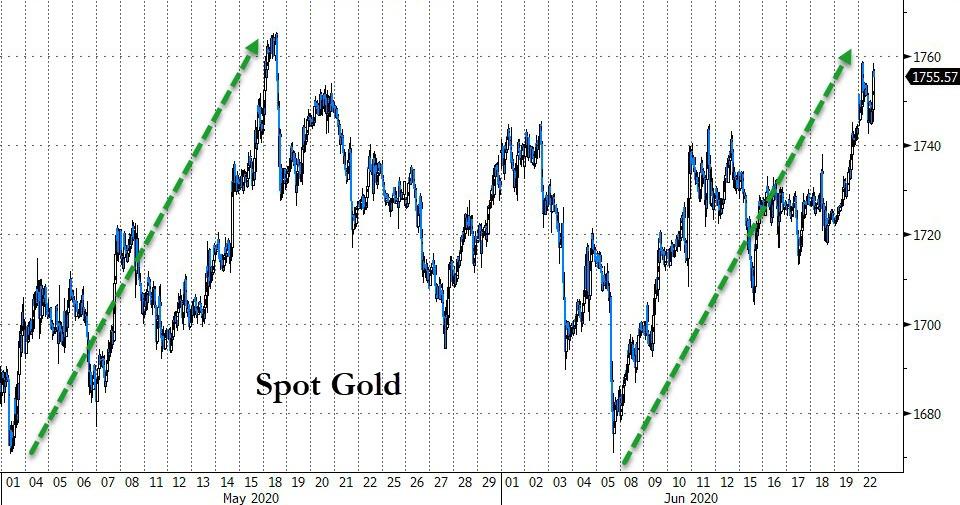
A breakout from here would take the price of the barbarous relic to 2012 levels and quickly beyond...
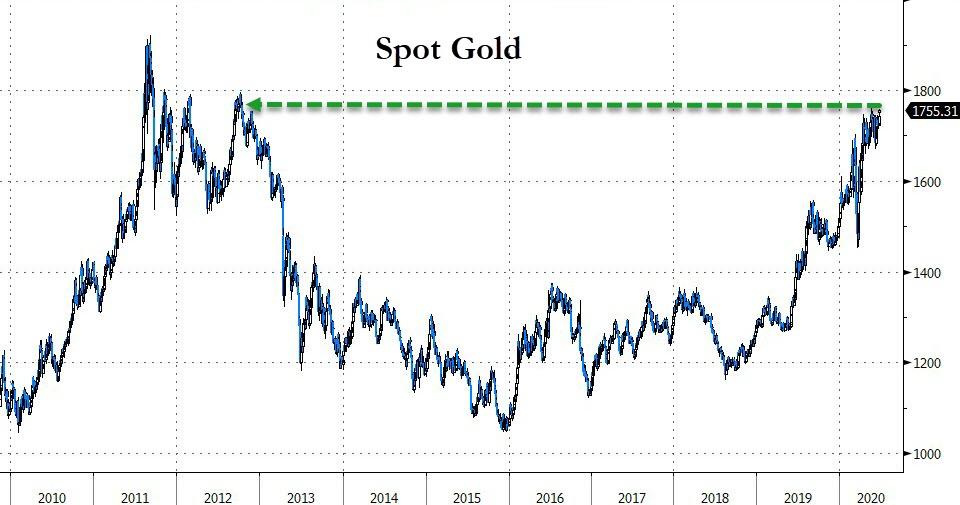
Until the last few days, gold has struggled to find a direction since rebounding in late March on the back of the Fed's "QE" announcement as it remains torn between a large negative "Wealth" shock to EM consumers and CB demand and a surge in "Fear"-driven DM investment demand.

However, as Goldman argues in their latest Commodities Research note, gold investment demand tends to grow into the early stage of the economic recovery, driven by continued debasement concerns and lower real rates. Simultaneously they see a material comeback from EM consumer demand boosted by easing of lockdowns and a weaker dollar.
As Goldman writes:
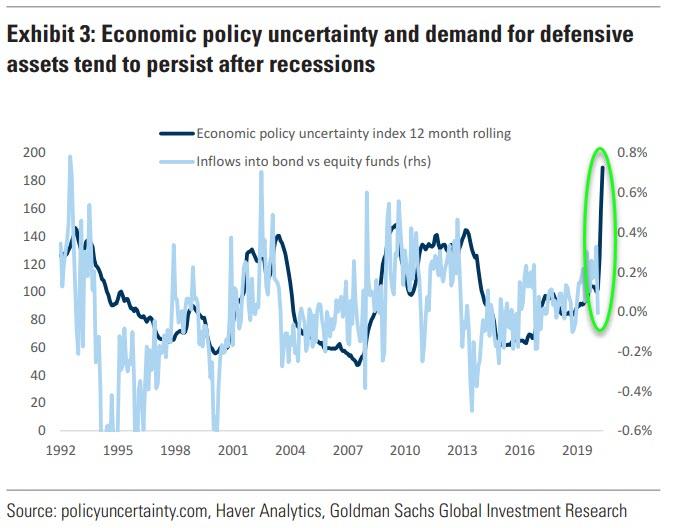
Looking at previous recessions, we note that economic policy uncertainty tends to jump after recessions and remains high for several years (see Exhibit 3). In 2020, the virus has led to unprecedented fiscal and monetary stimulus. It remains unclear how much more stimulus will be deployed by DM governments, how the resulting deficits will translate into higher taxes down the road, and how long monetary policy will remain ultra-loose. Finally, it is unclear whether the crisis leads to second round shocks, such as social unrest, political volatility, or rising international tensions. In such an environment, demand for defensive assets (gold in particular) will continue to expand, in our view.Policy uncertainty aside, we believe that debasement fears remain the key driver of gold prices in a post-crisis environment such as this. Faced with both an unprecedented shock and an unprecedented policy response, it remains unclear how inflationary the economic recovery will be.Furthermore, current social unrest increases the uncertainty over how much inflation policymakers will tolerate, and for how long. Although high inflation didn’t follow the 2008 crisis, there are a number of notable differences in today’s economy that may make this time different. Specifically, a much larger fiscal and monetary stimulus, better household balance sheets going into the crisis, no tightening in bank regulation/credit standards and less political will for austerity policies all point to greater inflationary pressure than in 2008.
Specifically, Goldman see gold prices as following a similar path today as they did in 2008-2013:
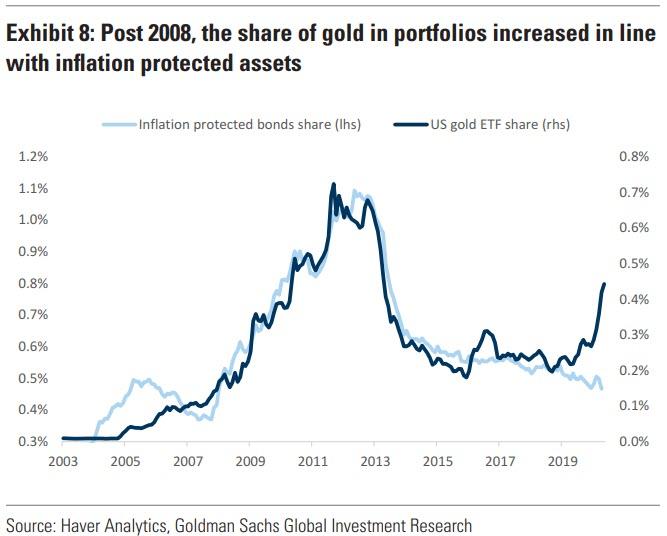
During the GFC crisis gold had an initial jump as nominal rates fell and QE started in November 2008. It then remained stuck in a range through the first half of 2009 as the policy effect took hold. During these periods there were brief corrections sparked by risk-on mini-rotations out of defensive assets but overall gold price remained directionless for about 6 months. The market finally broke out higher in October 2009 in line with a decline in real rates as inflation rose while policy remained loose.Allocation to gold continued to increase in line with the share of inflation protected assets in investor portfolio’s for 3 years (see Exhibit 8).This is consistent with the observation that a high level of economic uncertainty persists for several years following a recession and that investment demand for gold will likely continue to expand into the recovery stage the business cycle. After policy (and economic) uncertainty receded, gold fell.
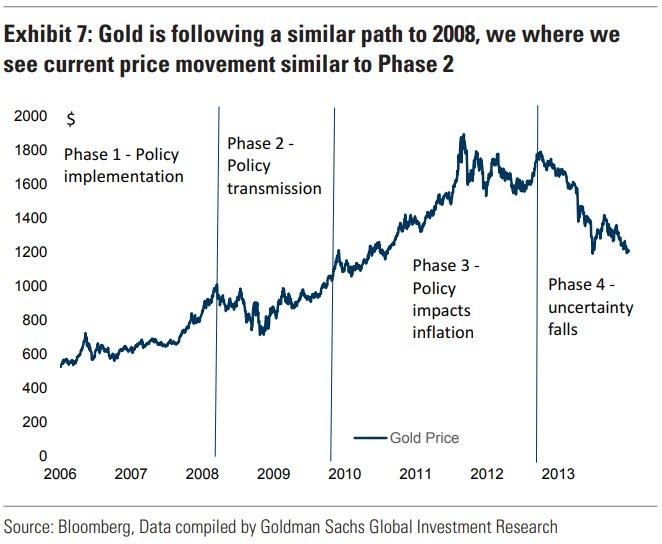
Goldman believes that a similar case is likely to play out today, with real rates dragged lower by a gradual normalization of inflation expectations while nominal rates remain depressed due to loose central bank policy. This leaves two main drivers sending gold prices higher: lower real rates and higher EM demand.
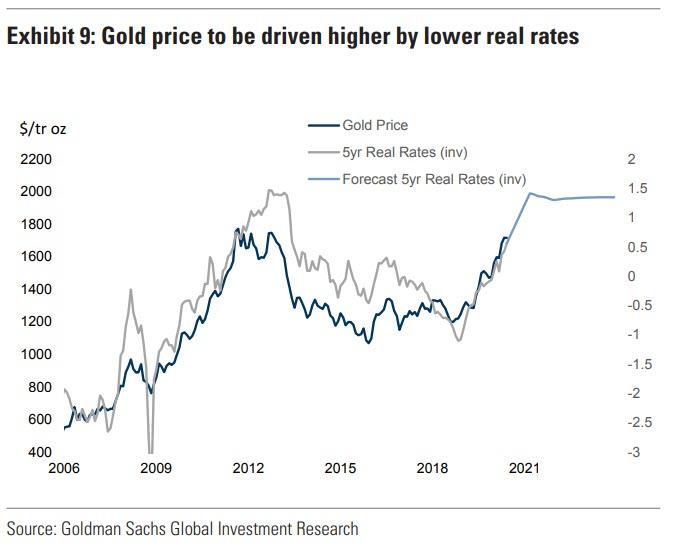
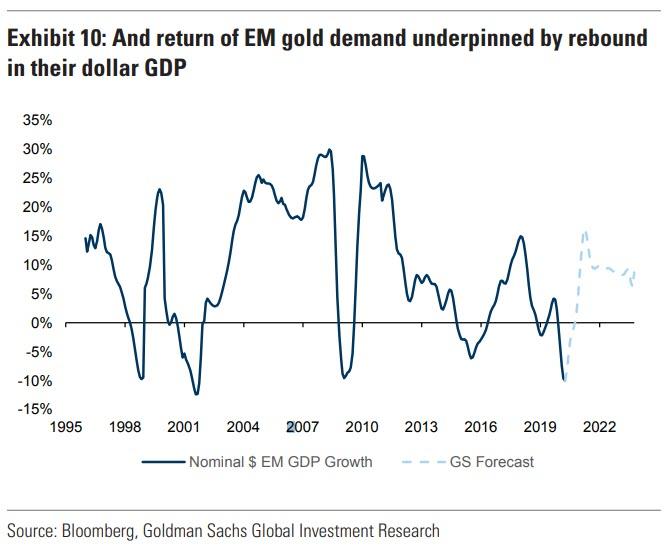
Our rates strategists expect 5 year rates to end the year at 0.35 and be only 0.45 by end of 2021 - almost the same level they are today. Simultaneously, they see scope for a higher 5 year inflation swap rate, as the market is underestimating inflation beyond 2020. Our economists expect inflation over the next 5 years to average 1.73% vs current market pricing of 1.02%. Therefore, real rates in the US are expected to continue to fall, increasing debasement concerns and putting upward pressure on gold (see Exhibit 9).At the same time, our FX team expects material dollar downside as US interest rates are back at zero, eroding the positive carry spread it had over other G-10 currencies. A weaker dollar will also help boost the purchasing power of major gold consumers in across Emerging Markets, supporting gold through the “Wealth” effect. Chinese gold demand appears to be rebounding after lockdown in line with the improved Shanghai discount. This suggests EM gold demand will shift from being a drag on gold prices to a tailwind as we move into 2H20 (see Exhibit 10).
On the back of this they have raised their 3/6/12 month gold price forecasts to $1800/1900/2000/toz.
Goldman also revised up their silver forecast from $13.5/14/15 toz to $19/21/22 toz.
The upward revision is driven by two primary factors.
First, coordinated global stimulus will help generate growth in industrial production and global economic activity. Relative to gold, silver demand is more closely tied to industrial production, accounting for 50% of its demand (see Exhibit 16). Therefore, as the economy recovers and “Fear” based demand for gold moderates, we expect silver industrial demand to increase, driving up prices. Silver also stands to benefit from growing investment in solar power.Secondly, we have argued in the past that silver is the precious metal of second choice after gold. This means that when interest in precious metals is moderate investors may still add to gold but silver often gets overlooked. However, when interest in precious metals is surging (as it is now) a lot of investors historically diversify part of their gold purchases with silver.

In this environment silver can outperform gold because it is a smaller market and moderate relocation into it can lead to a material price spike.