(ZH) The "Greatest Bear Market Rallies Of All Time", And Why This One Is Ending

The "Greatest Bear Market Rallies Of All Time", And Why This One Is Ending


After two consecutive weeks of declines in the Fed's balance sheet, the stock market has started to look especially wobbly, and after several days of steep declines, all June gains have vaporized.
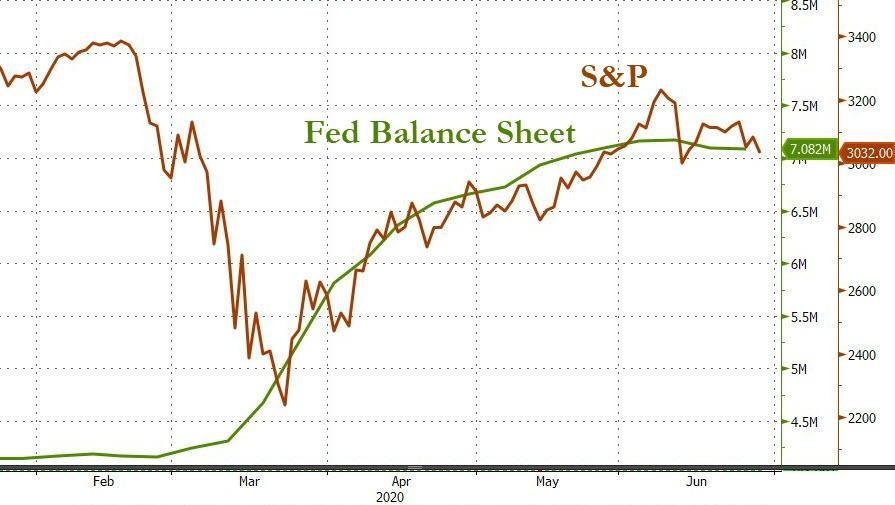
Of course correlation isn't causation, and the prevailing narrative is that the market weakness has been due to a spike in coronavirus cases across sunbelt states and fears that the V-shaped recovery is not coming, although as we have repeatedly said, the Fed will urgently need to expand its QE which is now running at "only" $80BN per month for TSYs, an amount that will be insufficient to monetize the flood of new debt in the coming years. To do that, however, the Fed needs a "shock" pretext to resume aggressive balance sheet expansion and a "second wave" is just that.
So while we wait for the media narrative to "confirm" that the next escalation in the pandemic has arrived and is forcing states to resume shutdowns, it is hardly a surprise that on Wall Street strategists are taking a step back and after bearish projections virtually disappeared in the past month, discussions of a bear market rally are once again front and center with BofA's Michael Hartnett taking the lead. According to the BofA CIO, while Q2 is on pace to be the best quarter for the S&P500 and oil in 50 years...
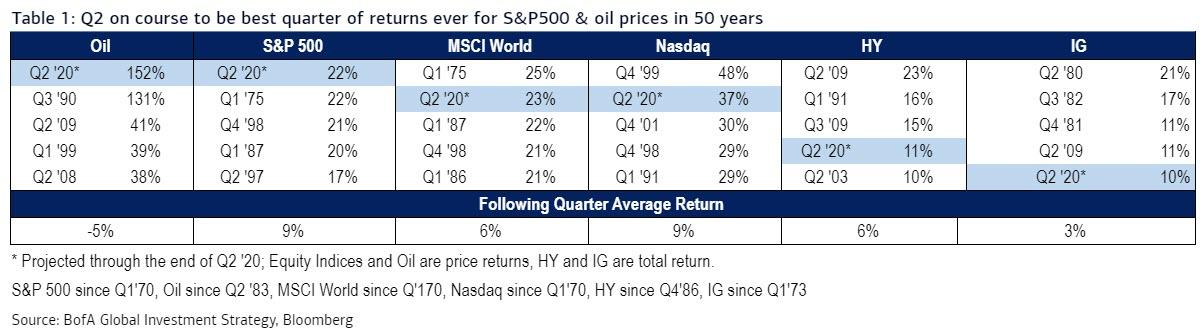
... a rebound largely driven by reopening optimism ("Mar 20th NY lockdown - SPX 2304; Jun 8th NY reopening - SPX 3232"), it's time to admit that the furious 50-day, ~40% rally may have been nothing more than a bear market rally.
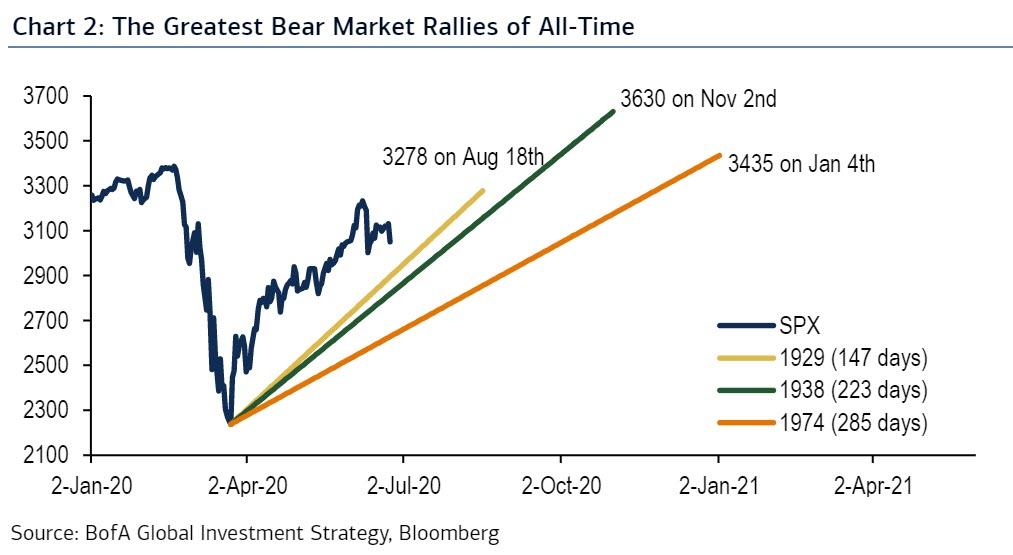
To put it in context, Hartnett shows that the current rebound has largely been following the trajectory of the three "greatest bear market rallies of all-time" (1929, 1938, 1974), which would put the S&P at 3300-3600 sometime between Aug & Jan'21, but what follows would be a far more painful move lower, as was the case after all these bear market rallies fizzled resulting in lower lows.
Hartnett is not the only one trying to predict how the bear market rally dies. Leuthold Group's CIO, Doug Ramsey, who in March told his clients to sit out what's coming and thus missed the $10 trillion surge in market cap, has a message: it ain’t over yet.
"The bulls could be proved right in that the March 23rd low holds, but you could lose a lot of money in a drawdown here," said the Leuthold chief investment officer. "You could still very easily have a drop of 20% from the peak we made on June 8th. Very easily."

As Bloomberg notes, "the warning reflects a wider schism on Wall Street these days. Many of the bears whose jaws dropped over the resiliency of stocks remain steadfastly skeptical, awaiting the moment of vindication. Meanwhile, early believers are running victory laps, doubling down on the rally on the theory skeptics will have to capitulate and stimulus will continue to flow."
But what may be the single most beneficial aspect of the recent Fed-fueled ramp which saw the central bank inject or backstop nearly $8 trillion (and counting), is that technical analysis has finally been thrown out of the window, and "by now, everyone’s aware there’s no moment of the past that can be used as a template to tell which way stocks will lurch next."
Just days before the March 23 bottom, Ramsey cautioned clients that it was “too early” to expect a major bear market trough, as a phase would come when stocks and economic data fell in tandem. A study by the firm showed that on average, over 11 past recessions, stocks didn’t start to recover until 1 1/2 years after the economy started contracting. Little did he know that on March 23 the Fed would toss all the playbooks, and go so far as to break the law by creating a SPV in collaboration with the Treasury that would allow it to buy corporate bonds... a similar approach that will soon give it the ability to buy stocks after the next crash.
It wasn't just Leuthold: Barclays strategists mapped out a scenario where an extended recession could lead to a 50% peak-to-trough selloff. The farthest the S&P 500 ever fell was 34%. Goldman was expecting a second wave of selling to push the S&P below 2,000. Northern Trust Wealth Management pointed out that it typically takes about 1 1/2 years to recover from a 20% drop. Instead, the S&P 500 rose 40% in 50 days, the fastest rebound in nine decades. Anyone who tried to use 2008 as a road-map was badly burned.
In other words, we are - and have been - in truly uncharted territory, where the only thing that matters is what the Fed does next. Of course, we can make some educated guesses as to what comes next, and as we have been claiming for months, the Fed needs another crash to unleash even more helicopter money and further take over capital markets. After all, it already controls most of the bond market where Treasurys no longer have any signaling power whatsoever; as such the Fed will soon need a stock market crash to fully take over equities next by following the BOJ and SNB in purchasing ETFs, and eventually single stocks. That's why when looking, ahead one has to think not like a financial strategist but a central bank criminal whose only purpose is accelerating the wealth transfer from the middle class to the 0.01% while avoiding the inevitable coming systemic reset.
For now, however, Ramsey isn’t alone in claiming “it’s too early to say” calls for further downside were wrong. As Bloomberg notes, economists at TS Lombard remain bears, expecting a drop of at least 20%. Still, they’ve dropped their March call that the S&P 500 would fall below 2,000 over the summer. Incidentally so did Goldman which now is expecting the S&P to trade around 3,000 by year end, and while JPMorgan expects a correction due to quarter end rebalancing, the bank last twekk finally upgraded stocks to Overweight, telling its clients to buy... just as the record bear market rally was about to end.
Because while the market may have changed - or rather died thanks to the Fed - one thing that will never change is that for Wall Street to prosper it needs fools who are willing to play its game.

WSJ : Wirecard Scandal Puts Spotlight on Auditor Ernst & Young

Wirecard Scandal Puts Spotlight on Auditor Ernst & Young
Emails show auditor had questions related to unorthodox financial arrangements in 2016

Ernst & Young GmbH, auditor to insolvent German fintech company Wirecard AG WDI -63.74% , had questions related to unorthodox arrangements under which the company’s cash was held in bank accounts it didn’t control as far back as 2016, according to emails seen by The Wall Street Journal.

The auditor subsequently signed off on three years of Wirecard’s financial results with those arrangements in place.

Now $2 billion that was held in those accounts has disappeared. Wirecard says the money probably doesn’t exist. On Friday, a German shareholder association filed a criminal complaint to the prosecutors’ office in Munich, where Wirecard is based, accusing EY auditors of missing the alleged fraud.

“We feel Ernst & Young’s auditing work was a disaster,” said Marc Liebscher, whose Berlin-based law firm is representing the private Wirecard investors who filed the complaint. “Our clients are convinced, Ernst & Young should stand trial.”

EY said it had been duped along with everyone else. “There are clear indications that this was an elaborate and sophisticated fraud, involving multiple parties around the world in different institutions, with a deliberate aim of deception,” it said.

Wirecard’s fall from being regarded as a shining star of the European tech scene has been spectacularly quick. On Thursday, it filed for insolvency in a Munich court. The company’s value has all but evaporated. Markus Braun, a large shareholder and chief executive officer until last week, has been accused by prosecutors of inflating Wirecard’s sales volume with fake income. He was arrested and then released on bail Tuesday. Mr. Braun consistently denied wrongdoing at the company.

On Saturday, Wirecard said it and its units plan to continue operations. It said it is taking measures to resume business in the U.K., after financial regulators froze its operations there Friday. The company issued prepaid card and electronic wallets for consumers, among other things.

At the center of its downfall is the disappearance of $2 billion in cash Wirecard said it had but kept in trustee-controlled accounts because of an oddity in how Wirecard supposedly conducted a large part of its business.

Wirecard used third-party partners to process payments for it in markets where it didn’t have licenses. Wirecard’s revenue from those businesses was deposited in the trust accounts rather than paid straight to Wirecard.

The money held back in these accounts is equivalent to more than one quarter of total group revenue for Wirecard in the years 2016 through 2019.

Emails seen by The Wall Street Journal show the auditor had questions about aspects of the unorthodox arrangement as early as in 2016.

Wirecard’s explanation for the arrangement was that much of the money was kept in the trustee accounts as a form of risk management. The cash was available to provide refunds and chargebacks to customers for things like canceled airline tickets or disputed charges.

In October 2016, a senior manager at EY agreed to visit one of the third-party partners the following February, according to the emails seen by the Journal. He was to attend with one of EY’s audit partners, who had responsibility for signing Wirecard’s accounts.

The manager included a note to a Wirecard executive who looked after another third-party partner. The note said EY was preparing a presentation that would ask questions about a trustee account, similar to questions it had raised about the trustee account of another of Wirecard’s third-party partners.

EY declined to comment on the specifics of these emails. Last week, EY said it refused to sign off the company’s accounts for 2019 after being given fake balance confirmations for the trustee accounts at two banks meant to be holding Wirecard’s money.

Wirecard has said recently it could no longer be sure that its trustee relationships had ever been reliable. It warned that accounts from previous years could also be affected.

Investors who bet Wirecard’s share price would fall have been sending detailed complaints to EY for years, flagging their concerns and media reports that raised questions about the company’s accounting and business practices, based on letters reviewed by the Journal.

“They’ve basically turned a blind eye toward the critics that raised very serious allegations,” said Fraser Perring, who with his former partner, Matthew Earl, published an early report critical of Wirecard in 2016.

Ernst & Young GmbH is the German affiliate of Ernst & Young Global Limited, the global umbrella organization for EY firms. Like other big accounting firms, country-based affiliates that provide audit services to companies, such as Ernst & Young LLP in the U.S., are legally separate and independent from other entities in the global network.

EY’s relationship with Wirecard began in 2008, when it was hired by the company to conduct a special audit amid allegations from the German shareholder association that Wirecard had deficiencies in its financial statements. It cleared the company. From 2009, EY became Wirecard’s group auditor.

Last year, Wirecard hired another audit firm, KPMG LLP, to look into allegations raised by the Financial Times that a large share of Wirecard’s reported revenue and the bulk of its profits between 2016 and 2018 actually came from a trio of third-party partners. In April, KPMG released a 74-page report saying it couldn’t verify the arrangements with the third parties due to lack of cooperation.

After that, EY informed Wirecard’s board that it was unable to obtain sufficient evidence to confirm cash balances on trust accounts.

Ernst & Young GmbH’s repeated signoff of Wirecard’s financials adds to a number of instances in recent years where EY affiliates have seemed to miss signs of fraud.

In China, Ernst & Young Hua Ming LLP has audited Luckin Coffee Inc. since the coffee group’s founding in 2017. In April this year, several months after a short seller circulated an anonymous report alleging much of Luckin’s revenue was fabricated, Luckin disclosed as much as 2.2 billion yuan of its 2019 revenue had indeed been fabricated. Its shares have since collapsed.

In Denmark, the business watchdog brought two EY auditors before the Danish Disciplinary Board of Auditors earlier this year over what it said was a faulty auditing of Danske Bank’s 2014 accounting statements related to a $200 billion money-laundering scandal.

The Public Company Accounting Oversight Board, a U.S. watchdog that polices audits of public companies, in a May 2019 report said its 2018 reviews of “portions of two issuer audits” by Ernst & Young GmbH didn’t identify any audit-performance issues. The regulator said it didn’t have inspection oversight over Wirecard audits.

Ernst & Young GmbH disclosed to the PCAOB in March this year that it or a member of the firm was either a defendant in or subject to a criminal or regulatory action in three instances. One instance had been settled with BaFin and the others were for proceedings before the German audit authority.

WSJ : U.S. Coronavirus Infections Hit Another Daily Record

U.S. Coronavirus Infections Hit Another Daily Record
Acceleration in cases prompts authorities in states including Texas and Florida to impose new restrictions

Coronavirus cases continued to surge in the U.S., as Florida reported another record-breaking number of new confirmed infections on Saturday, the second day in a row that it broke such a record.

Florida, Texas, California and Arizona have accounted for much of the recent rise in cases, prompting authorities to impose new restrictions in those states and reverse their reopenings.

The U.S. recorded more than 45,000 cases Friday, according to data compiled by Johns Hopkins University. The tally was significantly higher than the 39,972 cases reported Thursday, a record at the time. The previous high of 36,291 daily cases was recorded in late April.

According to the Florida Department of Health, the state reported 9,636 cases on Saturday, up from 8,831 cases on Friday and a much lower 4,966 cases on Wednesday. The rate of positive cases has also jumped. On June 13, the rate of positive tests was at 5.36% and has steadily climbed over the last two weeks, registering a positivity rate of above 14% in the last two days.

Florida, like other hot spots in Texas and Arizona, faces the challenge of trying to convince people to stay home, which is harder to do on a summer weekend with a forecast for nice weather.

Florida’s Gov. Ron DeSantis said Friday that the record-breaking number of cases this week was primarily a result of “a big test dump,” but he said the rate of positive tests had gone up considerably since May.

Texas and Florida, which had been among the last states to shut down and among the earliest to reopen, took steps to keep people at home. On Friday, Florida imposed new restrictions on bars, and Texas Gov. Greg Abbott closed down bars across the state as Houston issued a stay-at-home order.

The U.S. accounts for more than 25% of the more than 9.8 million cases world-wide, according to data from Johns Hopkins, which many experts say likely understates the true toll of the pandemic.

More than 495,000 people have died globally from Covid-19, about 125,000 of them in the U.S.

The World Health Organization says it expects total global cases to pass 10 million next week. On Friday, the WHO and two global health nonprofits announced plans to procure two billion doses of an eventual coronavirus vaccine to distribute to developing nations.

Mr. Abbott’s move to close bars marks a turnaround for the governor, who earlier this week said he didn’t want to backtrack on reopening. Mr. Abbott has explicitly banned local jurisdictions from forcing people to cover their faces and in late April, while announcing reopening measures, said his earlier lockdown executive order had “done its job.”

But as the number of infections in Texas climbed, particularly among young people, Mr. Abbott moved to enact restrictions.

“At this time, it is clear that the rise in cases is largely driven by certain types of activities, including Texans congregating in bars,” Mr. Abbott said in a statement.

Democratic members of Congress from Florida have been pressing Mr. DeSantis, a Republican, to implement a statewide mask mandate as infections rise throughout the state. But he has resisted such calls, leaving it instead to local authorities.

Mayor Carlos Gimenez in Florida’s Miami-Dade County said Friday that beaches in the county would close for the coming Fourth of July weekend.

After reporting 103 new cases on Friday, the city of San Francisco, among the first in the nation to issue a stay-at-home order, paused the Monday reopening of business including hair salons, barbershops and outdoor bars.

“At our current rate, the number could double rapidly,” Mayor London Breed wrote on Twitter. “If that continues and we don’t intervene, we’ll be at such a high number that our only option would be to shut down.”

At the first coronavirus task force briefing in nearly two months, Vice President Mike Pence heralded the reopening of the economy and said the U.S. is making progress on coronavirus, despite mounting cases in more than 20 states.

“There may be a tendency among the American people to think we are back to the place we were two months ago, that we are in a time of great losses and great hardship of the American people,” Mr. Pence said Friday at the briefing. “The reality is we are in a much better place.”

Still, Anthony Fauci, director of the National Institute of Allergy and Infectious Diseases, warned that areas that have seen cases come down or haven’t been hard-hit by coronavirus are at risk when the virus surges in other parts of the country.

Deborah Birx, the task force’s coordinator, said that the antiviral drug remdesivir, which is used in treating coronavirus, has been reallocated to states that are being hit hard. Federal officials have said supplies are dwindling and will run out this month.

The U.S.’s inability to get a handle on the virus also spurred European Union member states to propose keeping a restriction on American travelers when the bloc reopens next week, even as citizens from 15 other countries, including Canada, Japan and possibly China, may be allowed to travel again to the EU.

Covid-19 deaths haven’t yet seen the same increases as cases and hospitalizations, in part because the expansion of testing in the U.S. is identifying more mild and moderate cases. But infectious-disease epidemiologists caution that deaths typically lag behind other indicators in the data, as the disease often progresses over the course of several weeks in the most severe cases.

Outside the U.S., Tokyo reported 57 new cases on Saturday, the most since a state of emergency was lifted a month ago. The capital’s infections, which have made up more than half the national total recently, are largely among young people, so the number of people in serious condition continues to shrink.

Australia reported 47 new cases of infection on Saturday, the highest daily count since April 17. And New South Wales, the nation’s most populous state, implemented mandatory coronavirus testing for all returning travelers.

New South Wales reported six new cases Saturday, while the remaining 41 cases were in Victoria State. Authorities there sent text messages to residents in affected areas telling them to get tested and to expect health officers conducting door-to-door visits.

FT : Philippines investigates Wirecard’s local partners

Philippines investigates Wirecard’s local partners
Central bank governor vows to ‘clean up mess’ as south-east Asian country dragged into scandal

Philippine regulators say they are investigating the local partner businesses of Wirecard in a probe that may finally map out the full extent of the south-east Asian country’s exposure to one of Europe’s worst accounting scandals.

The investigation by the country’s National Bureau of Investigation and Anti-Money Laundering Council comes after the dramatic collapse of Wirecard, a German payments company long regarded as a European tech champion, dragged the Philippines into the scandal.

The newly-launched probe will examine partners of the stricken payments group, including Centurion Online Payment International, PayEasy Solutions and ConePay International, Mel Georgie Racela, the AMLC’s executive director, said in an interview.

The entities were among those identified in an Financial Times investigation last year that appeared, on paper at least, to do substantial business with the German payments processor. The company filed for insolvency on Thursday after revealing a multiyear accounting fraud.

“We have included [about five] business partners of Wirecard as persons and entities of interest,” said Mr Racela. “We also need to dig further in on the directors and officers of these business partners.”

The questions facing local authorities have multiplied following a chaotic week in which Wirecard admitted that €1.9bn supposedly held in two Philippine banks probably never existed, and amid reports that its former chief operating officer, Jan Marsalek, had travelled to the country from Germany.

Menardo Guevarra, secretary of justice, told the FT that while immigration data showed Mr Marsalek arriving in Manila on June 23 and leaving for China from the central city of Cebu the following day, “CCTV footage does not show him arriving here and there is no record of any flight to China scheduled in the morning of June 24 from Cebu”.

He said personnel who entered information on Mr Marsalek’s alleged arrival and departure in the immigration database were being questioned.

The mystery of Mr Marsalek’s whereabouts is one of several facing regulators who will have to unpick a web of bizarre companies that seemingly generated millions of euros in income for Wirecard, but which appeared very different on the ground.

Attempting to visit some of these partners last year, the FT found a retired seaman and his extended family, who were dumbfounded at the idea that payments company Conepay had cited their home address in a town three hours north of Manila as its own business address on its website and company documents.

Christopher Bauer, a German former Wirecard Asia-Pacific executive, and his wife Belinda Bauer are among those under investigation by the AMLC, Mr Racela said. The couple — who had been identified in the FT investigation — owned PayEasy as of 2017, according to public filings, and have represented Centurion in interactions with Wirecard.

The Bauers and ConePay did not respond to requests for comment.

“We are willing to talk to all parties involved to clean up this mess,” Benjamin Diokno, the governor of the Bangko Sentral ng Pilipinas, the country’s central bank, said in an interview.

Under instruction from Mr Guevarra, the anti-fraud division of the country’s National Bureau of Investigation is examining how BDO Unibank and the Bank of the Philippine Islands, the two lenders that purportedly held the missing money, became ensnared in the scandal.

The two banks last week said paperwork presented to EY, Wirecard’s longtime auditor, showing they had the money, was bogus. The two lenders suspended employees they believe helped forge the documents. 

Having said that the money never entered the country, Mr Diokno told the FT that the €1.9bn was equivalent to 5 per cent of the Philippines’ foreign currency deposits and it would have been unable to come onshore without triggering action by the AMLC, which receives alerts for all transactions exceeding $10,000. 

“The Philippines is a dollar-centric economy, so euros are unusual coming in at that level,” Mr Diokno said.

Mr Guevarra added the probe by the anti-fraud division would “invite the Filipino trustee of Wirecard to shed light on his involvement, if any” in Wirecard’s business. 

Account balances for the €1.9bn supposedly held at the two Philippine lenders show the law firm of Mark Kristopher Tolentino, a Philippine lawyer and former government official, holding the money on Wirecard’s behalf, according to documents seen by the FT.

A supporter of Philippine president Rodrigo Duterte who has appeared in photographs alongside the populist leader making the latter’s trademark clenched-fist salute, Mr Tolentino’s corporate website describes him as a “young, dynamic and aggressive” litigator and a “media personality”.

He denied wrongdoing and said he had been framed. “I am not the trustee of Wirecard,” Mr Tolentino told the FT. “I never signed any document with Wirecard. They committed identity theft.” 

Barron's : How Dell Stock Can Take Off. A VMware Spinoff Is Just Part of the Ans

Dell Technologies shares have looked tempting ever since they came public in 2018.

The reason is Dell’s 81% stake in the cloud-software company VMware (ticker: VMW), which is worth more than Dell itself. Yet Dell stock has appreciated little since it went public because of concerns about the future of the company’s hardware business and uncertainty about whether investors would get their hands on those shares of VMware, which Dell has called its “crown jewel.”

The chances of a VMware distribution to holders of Dell (DELL) have now apparently increased. The company is considering a spinoff of its VMware stake, The Wall Street Journal reported. Dell shares rose 8%, to $52.25 this past week, and there could be more upside if a spinoff goes forward. Dell’s stake in VMware is worth $50 billion, or about $67 for every Dell share. Dell’s market value is around $38 billion.

“Dell is trading at a very high conglomerate discount,” says Amit Daryanani, an analyst at Evercore ISI. “The stock in a steady state should be worth in the $60s, and with a spin, in the mid-$70s.”

Barron’s has written favorably about Dell, including making it a favorite stock for 2020. Dell makes servers, personal computers, and other hardware. Companies like Dell, with multiple businesses and assets, often trade at a discount to their sum-of-the-parts value. The stock trades for just under eight times projected earnings in its current fiscal year ending in January 2021.

Why so cheap? Dell has a lot of debt—roughly $40 billion, excluding its finance unit—largely stemming from its 2016 purchase of EMC.

Dell likely can’t do a spinoff of its VMware stake until September 2021, the fifth anniversary of the EMC deal, which included the VMware stake, because of tax reasons. So investors may have to wait. But tax expert Robert Willens tells Barron’s that investors who have contacted him would like Dell to commit to a spinoff in 2021.

The decision rests with CEO Michael Dell, who controls about half of Dell’s stock. Dell declined to comment on the Journal report, which said the company might also seek to buy out the public holders in VMware. Or Dell could do nothing. Indeed, divesting its stake in VMware could leave it as “an undifferentiated hardware company,” Daryanani says.

But if Dell wants to escape its valuation purgatory, it needs to spin off VMware and maintain a close relationship with the company through a partnership agreement.

VMware would likely relish its independence and could garner a higher valuation as a result. VMware shares, which fell 2.5% this past week, to $146.50, trade for about 25 times current-year earnings projections.

Here’s a bullish scenario for Dell: The company spins off its VMware stake, converts its supervoting stock in VMware into the stock that now trades publicly, and VMware agrees to take on $10 billion in debt and pay a special cash dividend to its holders including Dell, which would allow Dell to cut its debt.

Another bonus would be if Michael Dell agrees to turn his supervoting stock in Dell into regular stock. That would allow Dell to potentially enter the S&P 500 index—S&P doesn’t admit companies with dual-class shares into the index—and Michael Dell would still call the shots, given his dominant economic stake. If he acts, Silver Lake, which also holds supervoting Dell stock, would likely follow.

Now, that could be heavenly for Dell shareholders.

>>> Barron’s Weekend Summary: The top 25 chief executives in the US have focused

Barron’s Weekend Summary: The top 25 chief executives in the US have focused on crisis management this year; A list of the 100 most sustainable companies

* Cover story: Barron’s list of the top 25 chief executives; This year, when the main job of CEOs went from capital allocation to crisis management because of the coronavirus, Barron’s considered corporate leaders’ preparedness as a key factor in creating the list.
• GE’s Larry Culp cut costs and repaid debt, helping the company deal with the global pandemic and economic crisis. • Despite a big stock run and stunning top-line growth, ZM chef Eric Yuan sees huge opportunities.
• GILD chairman and chief executive Daniel O’Day has moved aggressively to test and distribute Covid-19 treatment remdesivir.
• REGN co-founder and chief Leonard Schleifer is leading a major effort to get a drug for Covid-19 into clinical trials.
• BLK chief Laurence Fink is helping the Fed manage its bond buying, and hasn’t been afraid to take a social stand based on his belief that companies should have a purpose.
• CMG chief Brian Niccol has returned the once-troubled food chain to industry-leading performance by instilling focus and discipline on his team.
• TSLA chief Elon Musk is forging ahead with innovation in two industries, electric vehicles and batteries.
• MSFT chief Satya Nadella oversaw a major push into the cloud, and the pandemic has only increased demand for Microsoft’s services.
• NVDA’s Jensen Huang offered scientists free licenses to the company’s genomics-computing platform.
• BAC chief Brian Moynihan has kept workers on the job, and pledged big bucks to tackle inequality.
• AAPL’s Tim Cook has succeeded in diversifying the tech giant’s business, and warned early of the pandemic’s impact.
• WMT chief Doug McMillon has sought to remain competitive by investing in hiring, pay hikes, and omnichannel retailing.
• Jeff Bezos of AMZN responded to the pandemic by hiring 175,000 more people as he sought to navigate the online-shopping surge.
• GM chief Mary Barra retooled the auto giant and has kept it in the black through the current crisis.
• LOW chief Marvin Ellison has worked to close the technology, efficiency, and performance gap with his former employer, HD.
• After building a cancer-drug franchise, MRK chief Kenneth Frazier is now focusing the pharma giant’s efforts on Covid-19.
• Tricia Griffith of PGR, long viewed as the best-managed major auto insurer in the US, moved quickly to help employees and customers during the pandemic.
• NFLX chief Reed Hastings got a boost as people staying home with more time than usual for watching movies and shows found fresh content on the streaming service.
• SHOP’s Tobias Lütke is helping keep small businesses afloat with his e-commerce platform.
• NDAQ chief Adena Friedman led the exchange’s seamless transition to remove operation during the pandemic.
• The remaining five CEOs on the list are Douglas Baker of ECL, Jamie Dimon of JPM, Craig Jelinek of COST, Larry Merlo of CVS, and Mark Zuckerberg of FB.

* Tech Trader: The success of AAPL’s virtual worldwide developer conference—which columnist Eric Savitz says was better than previous live versions—foreshadows larger issues for the sprawling corporate event business, which has taken a hit from the Covid-19 pandemic; While remote events may grow in popularity, the stakes are too high to give up on live events altogether.

* Trader: “The selloff in banks isn’t good for the stock market. The tech sector now makes up about 27 percent of the S&P 500 and is approaching levels of concentration last seen during the dot-com bubble”—but those shares can’t keep going up forever.

* Features: 1) Barron’s list of the 100 Most Sustainable Companies is based on 28 ESG categories covering a blend of 230 indicators; Given all the challenges of 2020, Barron’s decided to create its regular list, then re-rank the companies based solely on “softer” social factors to create two model portfolios—one is an overall sustainability ranking, topped by A, the other is a social metrics ranking, topped by VFC; 2) Positive on BBY, NVDA, VZ: These three corporations place a high value on so-called human capital—including workforce composition, gender, ethnicity, etc.— a subset of the “S” in ESG investing that is rapidly emerging as a key factor in sustainable investing; 3) Despite a proliferation in ESG mutual and exchange-traded funds—from fewer than 200 in 2018 to over 550 today—social principles have gotten far less representation in portfolios than environmental and governance issues; Jeff Gitterman, a co-founding partner at Gitterman Wealth Management, shares insights into how to build a strong social-focused ESG portfolio; 4) Decades of research, not to mention investment performance, have slowly eroded the idea that it was impossible to reconcile personal values with a successful investment portfolio, but never before has there been such a uniform emphasis on companies doing right by all of their stakeholders; 5) As the Covid-19 pandemic continues to wreak havoc, stocks that were hot at the start of it, such as ZM, ETSY, and PTON, are rising while RCL, UAL, and other travel stocks fall, posing a challenge for investors who had started focusing on 2021 earnings expectations as the next performance-driver for stocks; 6) Positive on DELL: The company’s shares have looked temping since they went public in 2018, primarily because of its 81 percent stake in VMW, which is worth more than Dell itself; a spinoff should lead to more upside for Dell shares, but that can’t happen until next year because of tax reasons, so investors will have to be patient.

* Streetwise: NVDA chief Jensen Huang says the company’s deal with Mercedes Benz is transformative—Nvidia has gone from hardware for videogames, to hardware and software for AI, to hardware, software, and services for cars, which makes it a platform company, not just a chip maker.